
43 Decision - The I Ching
Rising at the King’s court to cry out the truth is dangerous. Tell it to your own city, but don’t raise the army. There is far to go.
Lines
1
Power in the toes. Going brings no victory.
2
Cry of fear. They may come in the night. Fear not.
3
Power in the face is unfortunate. The Sage decides decisively. Alone on his path it starts to rain, he gets wet, and feels hurt.
4
A flayed bottom, his path is slow. Led like a lamb, regret dies. Hearing words but not believing.
5
Weeds decide decisively. The middle path is without regret.
6
Without a cry, it will end badly.
Qabalah
Imperfectly Path of Beth: Binah to Kether. The Magician.
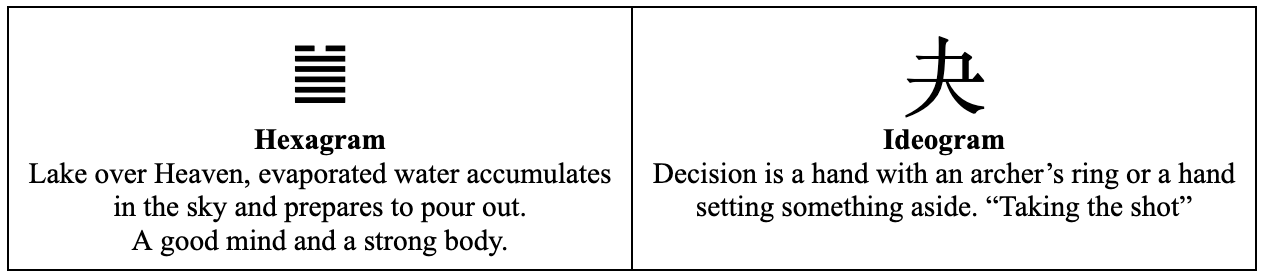
Where 42 accumulated water, here the dam breaks open and what was accumulated is released. In this hexagram we find the image of a clear mind making a serious decision. While the partnered hexagram, 10 “Walking”, showed caution for the path ahead, here the choice is made and consequences follow. The hexagram is described by the Great Treatise as the origin of writing. Visually, we can see it as a side view of an engraved line, or a black (yin) brushstroke on a white (yang) sheet.
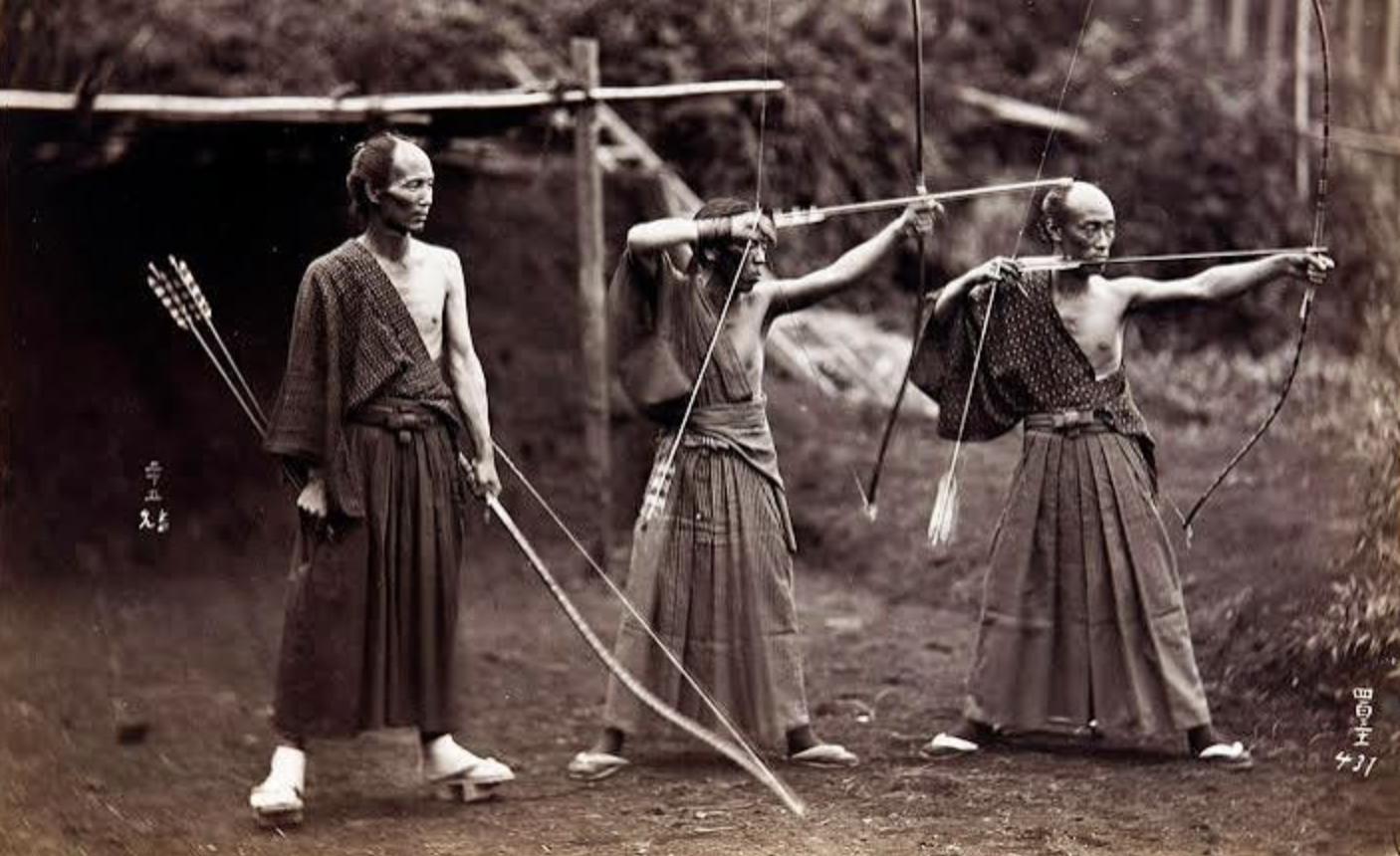
The ideogram shows the hand of an archer. Together this is a dam breaking, a crack which unleashes built up force, an arrow let fly. This is the “flow state” which occurs in sharp shooters, when they hit the mark effortlessly. When we act with a clear mind, we become decisive.
Judgment: This is the conscience, the desire to speak the truth though the situation is not right. We damn ourselves if we speak at the wrong time, it is better to inform those we trust and not be too quick to act. Aiming well, rather than “spraying and praying”.
1 This is the same image as the first line of hexagram 34: The energy here is in the toes, the lowest part of the body and thus the lowest form of energy. This is unconscious action, or acting blindly on impulse. Consider the situation that leads to stubbing your toe: movement without awareness.
2 Here, the alarm is sounded. When a threat is recognized early enough and proper measures are taken, there is no need to worry. The readiness is all.
3 To have only the appearance of power is bad. This line describes a “paper tiger”. While a wise one may appear weak, they are decisive and capable in their actions. One may often have to go against the grain or break away from people for the sake of what’s right. Wise people go their own way even if it’s difficult.
4 Here, we have a very religious image: one can imagine the sage who has gone their own way being flayed like Christ. So too the lamb, innocent and being led either to the slaughter or by the good shepherd. In both forms, it is likely they will not be believed; those who proselytize are seen as mad, and those who try to warn of impending doom are thought of as “crying wolf”.
5 Weeds are decisive much in the way a sage is. Both are persistent; no matter how one tries to thwart them, they continue on their path. When you make a decision, you must become like a weed.
6 If you don’t sound the alarm for fear of being a “boy who cried wolf” or one who thinks the sky is falling, the danger does come. We must not be shaken by fear of reception to the truth. We must speak decisively.
The two prominent images here are shooting and “speaking daggers”. Proper speech is much like archery, we have a target, and our words must hit the mark. In Twilight of the Idols, Nietzsche wrote of his aphorisms and maxims as arrows: words meant to pierce their targets.
Just as with shooting, there are environmental hazards one must take account of and countless distractions that appear. Hitting the bull’s eye is easy for a marksman, but difficult for an amateur.
We can think of the zen archers who, having rid themselves of conscious intention, become completely absorbed in the action of shooting, and easily hit the mark. It is almost always our thoughts that disrupts natural ability. When throwing darts, we often hit the mark the first time, but then get caught up in the myriad ideas and miss again and again until we reach the proper “zen” state where tension is released and energy is able to flow freely. This is the mental state of the magician, fearless and thoughtless but for the singular target.
Aleister Crowley described this process well in his Book of Lies:
The Mountaineer
Consciousness is a symptom of disease.
All that moves well moves without will.
All skillfulness, all strain, all intention is contrary to ease.
Practice a thousand times, and it becomes difficult;
a thousand thousand, and it becomes easy;
a thousand thousand times a thousand thousand, and
it is no longer Thou that doeth it, but It that doeth itself through thee.
This is the goal: to act effortlessly and hit the mark every time.