
52 Mountain - The I Ching
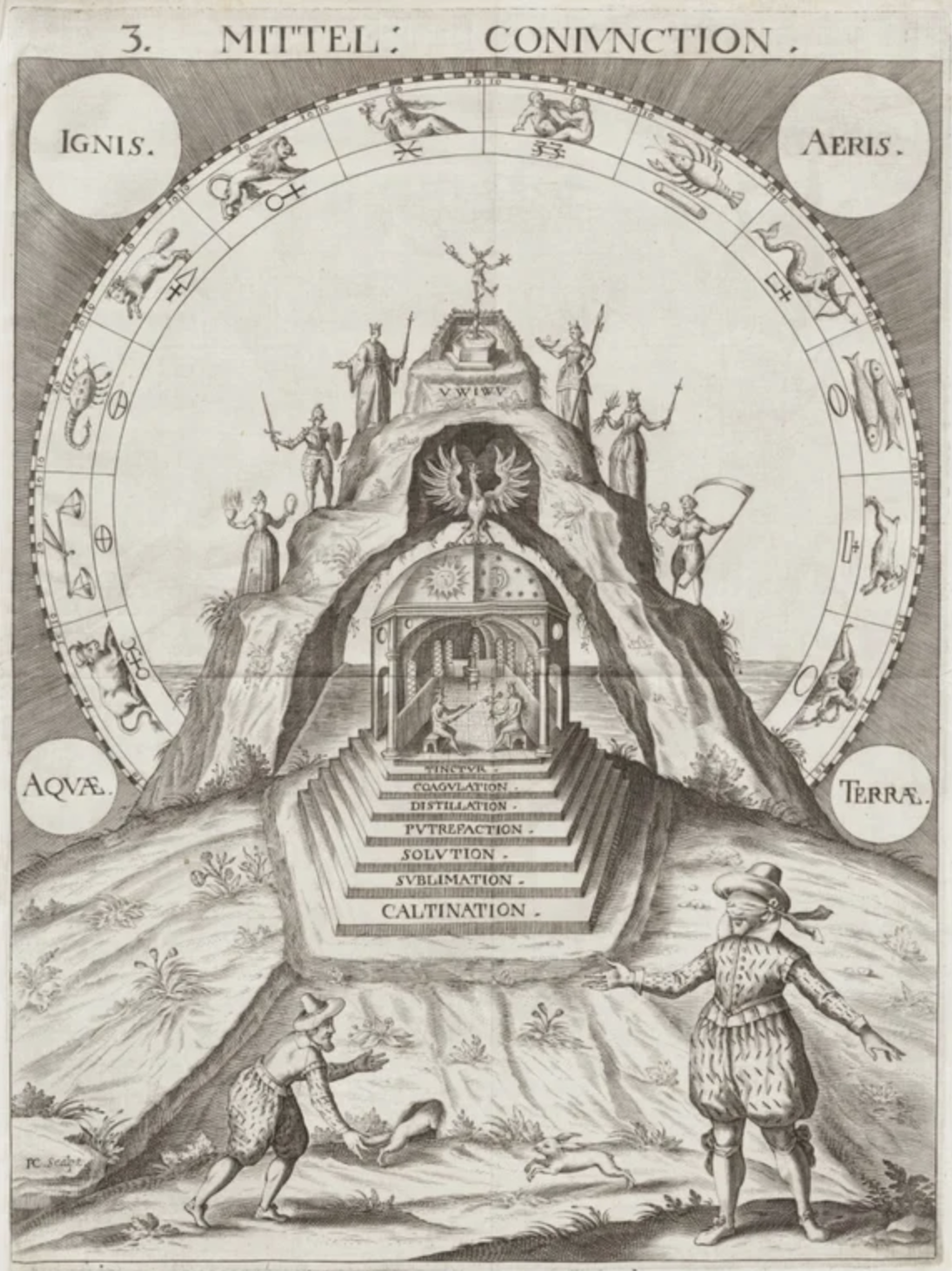

Focusing on his spine and losing himself. Walking in the courtyard, seeing no one.
Lines
1
Focusing on his toes.
2
Focusing on his legs. Keeping them still upsets his heart.
3
Focusing on It. Straightening himself in the dead of night. Dangerous, for his heart is aflame.
4
Focusing on his body.
5
Focusing on his mouth so his words are in order.
6
Focusing on high.
Qabalah
Netzach. The Seven of Disks and the Seven of Cups.
This hexagram shows the calm that is opposite to the violence of Thunder. The trigrams show the twin peaks, and the ideogram shows an eye with legs which has stopped to focus on something. This is an image of meditation and yoga, contemplation rather than action.
Judgment: Focusing on the spine is the very essence of esoteric tradition. The thirty three vertebrae that make up a human spine are the basis for traditions with graded systems like the Freemasons. It is the number of paths in Qabalah including the Ain Soph, the infinite. This is the path of the Chakras as well. Focusing on our spine is focusing on not only the philosophies of God and Man, but on our evolution, each vertebra a victory over chaos.
Yet, by focusing on these things we turn away from the world, we go inward, and thus see no one. As we move up the body, we ascend the Holy Mountain.
1 We start, naturally, at the base. Let us look at the dream of Nebuchadnezzar which was revealed to Daniel by God. Daniel 2:
32 This image's head was of fine gold, his breast and his arms of silver, his belly and his thighs of brass,
33 His legs of iron, his feet part of iron and part of clay.
34 Thou sawest till that a stone was cut out without hands, which smote the image upon his feet that were of iron and clay, and brake them to pieces.
35 Then was the iron, the clay, the brass, the silver, and the gold, broken to pieces together, and became like the chaff of the summer threshingfloors; and the wind carried them away, that no place was found for them: and the stone that smote the image became a great mountain, and filled the whole earth.
Here we see the importance of having a strong foundation, for though the statue has brilliant and sturdy metals above, a simple stone thrown at its weak feet brings it crashing down. This line mirrors the first lines in hexagrams 21, 22, 31, 34, 43, and 50. Each offering a different view of the feet.
In this case, we must cease moving and pay attention.
2 Now to the legs, which as we read before, are of iron. They want to move, and our passions want to move them. The heart is upset by the inability to move on a whim; consider children forced to sit still and the outrage that ensues.
3 This is the most passionate part of the body, that which sets hearts aflame. While it can be the greatest source of power, it is most often the downfall of even the strongest, most serious people. If one can master it, the rest will come quite easily.
4 Now, a focus on the body all together, the flesh and bones, the organs, and the energies flowing through it. Having overcome the base drives seated below the trunk, the body can be mastered. This is an acephalic view of the body, for the head has yet to come.
5 Along with It, the mouth is perhaps the most unruly part of the body. In the other hexagram, which this one shares with the sphere of Netzach, 27, I wrote of the danger of the tongue in regard to the warning given in the lines. Here, that warning is heeded, and the mouth is disciplined. Here we “watch our mouths”.
6 While the disciplining of the body parts we’ve covered up to this point may seem to be a great work in itself, it is nothing compared to mastering the mind. This is the magnum opus, for the mind is so unruly it believes itself to be separate from the body below it, superior and outside the law. It is not. The mind is simply another organ which must be put in its place.
In Crowley’s yoga chapter of Book 4 he shares the story of a student who comes to a guru seeking magical powers. The guru says that it is quite simple: pointing to a spot on the student’s body, he says that to gain these powers, he need only bathe in the river every day for a week, but when he does, he must not think of that spot.
This is, of course, an impossible task. The mind must undergo extraordinary training to gain the simple ability of not thinking. As soon as we start to attempt to move the mind, we find it enragingly difficult, for it wishes nothing more than absolute dominion over you. Should you put it in its place, it will be no different from your hand or foot. We live our lives according to the phantoms that haunt our minds, animalistic fears and desires dictate it, though it feels itself above such things. By stilling our bodies and practicing advanced magic, which is often just doing very simple things correctly, we can begin to learn to focus, and not focus.