
53 Gradually Going - The I Ching
The woman marries.
Lines
1
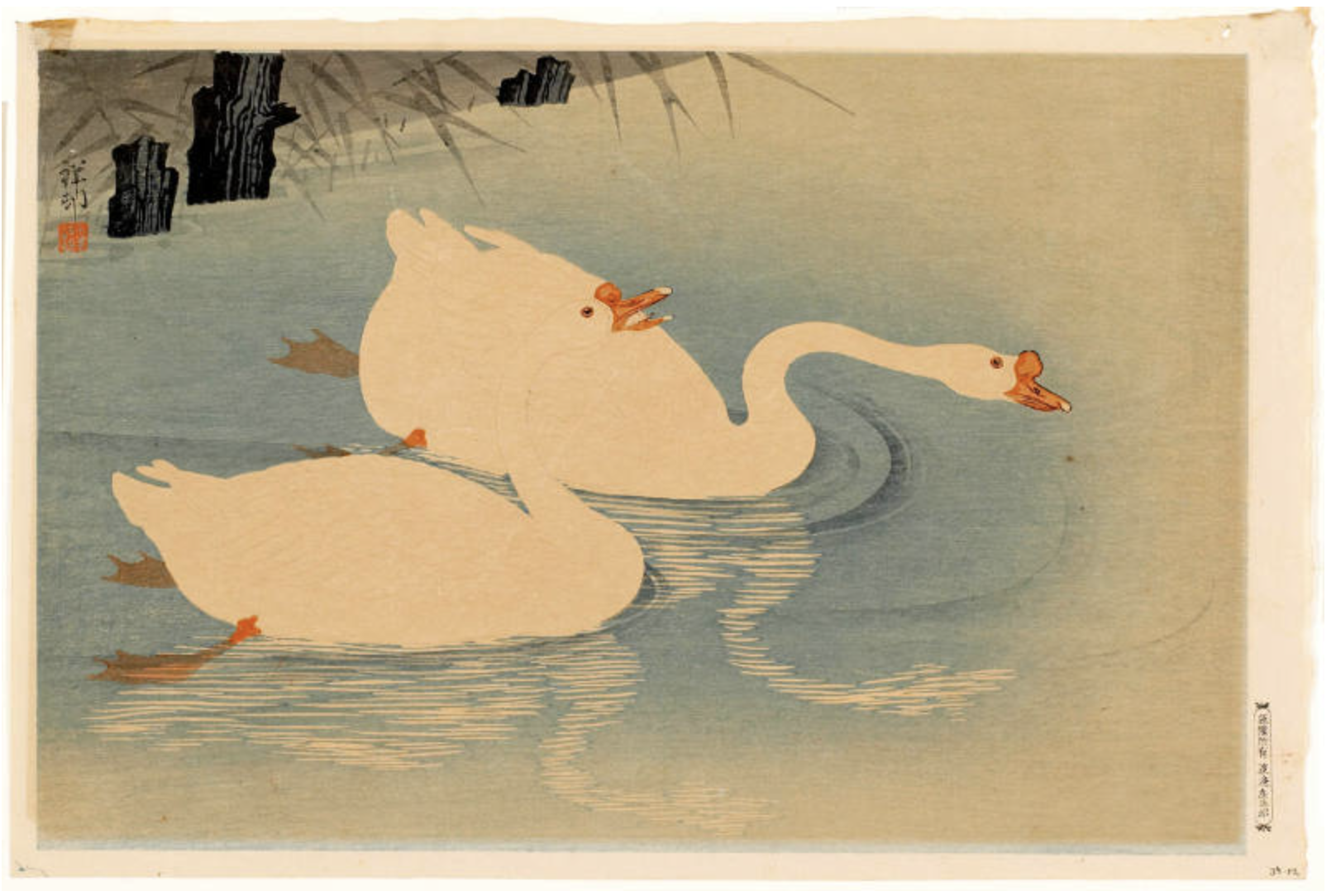
Geese gradually go to the shore. Dangerous for little children, even if they’re warned.
2
Geese gradually go to the rocks. They drink and eat, and are pleasantly pleased.
3
Geese gradually go to the land. A husband goes to war and does not return. His wife is pregnant, she will not raise the child.
4
Geese gradually go to the trees, they may find their perch.
5
Geese gradually go to the hill. A woman is not pregnant for three years. In the end she conceives.
6
Geese gradually go to the crossroads. Their feathers may be used in ritual.
Qabalah
Path of Pe: Hod to Netzach. The Tower.
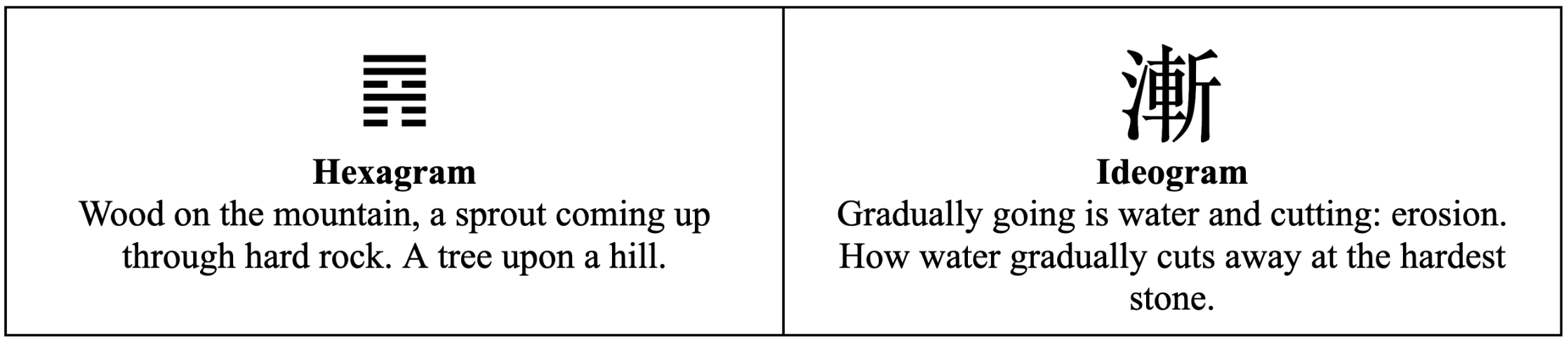
In this hexagram we are given the image of slow growth and slow destruction, the trigrams show a tree rising from a mountain, a slow path toward “coming out on top”. The ideogram gives us the long process of erosion. This hexagram is paired with hexagram 18 which shows destruction through internal decay, while this shows annihilation from external forces.
Judgment: In ancient China, wild geese were given as engagement gifts. The Ming dynasty novel “Water Margin” names the goose as the “Bird of Five Virtues”: good for they mourn their dead, right for they will not take another mate if their partner dies, proper for they do not break formation, wise for they anticipate the eagle, and faithful for they fly south in the autumn and return north every spring.
The goose is given as a wedding gift because it embodies the virtues sought for in a bride and proclaimed by a suitor.
1 The geese’s journey begins at the shores of a lake or river where they have bred. Here we are shown our first “gradual” danger, that of a child playing by the shore. When you stay in the sand, and only let the far reaches of the tide touch you, it can appear safe, but the further out you go, the more dangerous the tide becomes. This is dangerous even for adults, but for children it is extremely so. The precipice of all great heights and depths are like this.
2 Solid rock is reached and the geese can rest for a time and enjoy themselves. Our place in the world has improved, away from the dangerous and uncertain edges and toward stability.
3 As the journey continues inland, the stability of the previous line is lost. A simple life is undone by tragedy. A man dies in war and his pregnant wife is left alone in an impossible situation.
4 The geese reach trees, but with their webbed feet, they cannot easily perch on branches. They seek out a suitably flat surface, and in this ideogram, it is a rafter. This is finding a new home, a place where you fit in.
5 With stability having been returned, ascent and gradual improvement can start. Though it takes time, we can get to the top. Through trials and tribulations, the goal is obtained, a child is born. This is the biological clock of the geese’s migration, waiting until the time is right.
6 Once the peak has been reached, the time comes to change direction. The goose cannot stay in one place forever, so they take flight. This may be the journey North, the homesick geese yearn for their place. Hexagram 18 showed the sick home, while this is the homesick. What remains are feathers, a mark of success, a flag mounted on a peak.
In The Sun Also Rises Hemingway describes the subject of this hexagram perfectly:
“How did you go bankrupt?’ Bill asked.
“Two ways,” Mike said. “Gradually, and then suddenly.”
While catastrophic failure appears instantaneous, it is usually a very long process of erosion that brings a structure to that point. This hexagram corresponds to Mars, and the tarot card “The Tower”, which depicts God bringing down the tower of Babel. It does not show the lengthy process of unifying humanity and constructing the tower, nor the development of hubris which led to its downfall.
In Water Margin, the speech on the five virtues of the goose is a warning given to a soldier who has killed a dozen geese. The leader sees the panicked geese flying away and considers it an omen for the downfall of his men. This is mirrored in Wagner’s Parsifal, who shoots a sacred swan, leading to his fall from innocence. The simple action which causes a gradual chain reaction.
On the human register, we see the gradual ascent through social rank and position and, even more finely, the slow process of love and marriage.
In The Fault in Our Stars, John Green paraphrases Hemingway aptly: “I fell in love the way you fall asleep: slowly, and then all at once.”