
Accessing Our Right Brain Concept of Self
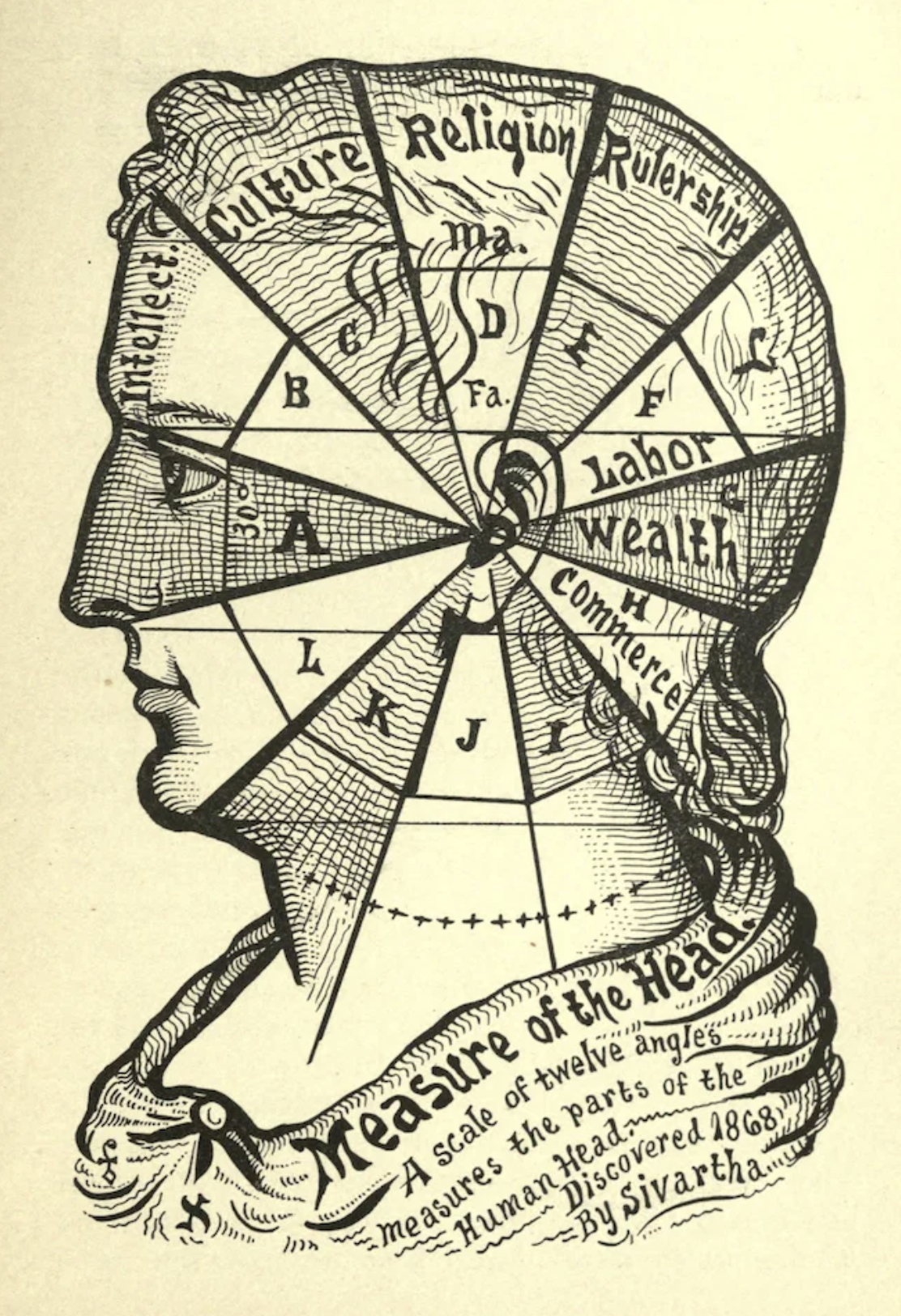
Dr Alesha Sivartha’s Book of Life, 1898.
The very first exercise in William Donius’ book Thought Revolution is as an invitation to access different forms of intelligence within our own mind. Readers are first asked to write down what animal they think they are most like and then asked to complete the same task with our non-dominant hand. By virtue of this mere switching of hands, we bypass the left brain processing center. This uninterrupted access to the right brain almost always yields a different answer, one symbolically much more akin to our true nature.
The left hemisphere serves as the brain’s primary operating system, organizing information into a linear fashion and processing the language needed to convey that information. Our right hemisphere, however, has an information processing capacity that Donius called “simultaneous.” When information is removed from the linear, language-generating filter of the left brain, it allows us to see more elements of a situation and understand greater meaning. The theory of Thought Revolution posits that accessing our right brain is a means of accessing our subconscious mind, which is controlling most of our thoughts and behaviors.
As Donius explains, “This book explores how we arrive at various limiting positions in life. I call these the lies we tell ourselves. I believe these lies are perpetuated in our left brain by the dominant linear style thinking of our left brain.” We become more risk and novelty-adverse as life progresses because our brains have evolved to protect us, and so we must learn to manually override some of those mechanisms. The animal exercise that opens the book is a way of looking at ourselves differently, starting the process of rewiring any limited thinking that may have accrued from our left brain’s effort to always keep us safe.
The method of using the non-dominant hand to access the right brain is known as intuitive writing, and Donius recommends it as a way of making informed decisions and reaching a deeper understanding of self. “By exploring my right brain through writing with my non-dominant left hand I learned to access the place where I had locked some memories tightly away. After a time I was able to unlock some of my own mysteries and break barriers that had stymied me for decades. The solution for me involved learning how to set loose material I had repressed, and when I did, I gained insights into who I really am and the things I truly desire.” He insists that personal change is a natural byproduct of intuitive writing. Accessing the right brain means accessing our subconscious mind, where we’re more effectively able to reprogram our thinking.
According to Donius, there’s a natural division of labor between our left and right hemispheres, with the left deriving a sense of purpose from meeting our needs and the right being allowed to draw on its vast database and non-linear processing abilities. When we’re experiencing internal conflict, it is generally our left brain that ends up driving our thoughts and behavior because it houses the brain’s primary operating system and therefore has a form of veto power. But if we use intuitive writing to gain clarity on what we’re conflicted about, our brain can become a much more creative tool for understanding and problem solving.
“The left brain craves the status quo. So it is unlikely to allow us to give serious consideration to a major life change,” he explained, referring back to the animal exercise. “One question that generates two answers happens because switching from dominant to non-dominant activates the passageway into the right brain and unleashes its more intuitive thinking. In the process, it reveals that two relatively independent consciousnesses exist in the brain.” The animal we write with our dominant hand tends to reflect our conscious intentions and aspirations, but the animal we write down with our non-dominant hand tends to elicit an animal more descriptive of how we operate in daily life.
When the right hemisphere is accessed, rather than immediately organizing an experience into a story about what we should want, what makes sense, or what feels safe, we briefly access the symbolic, associative intelligence operating underneath our projected narrative. The idea that just tapping into that data can cause such a profound expansion of self-awareness is radical, but the simplicity of the method and instant results speak for themselves. The left brain can still satisfy itself organizing, planning and executing, but it no longer has to dominate operations with incomplete information.
Most personal change begins with seeing something about ourselves that we couldn’t see before, so regular intuitive writing is the practice of consistently making the unknown essence of our authentic self known. As Jung famously warned us, “Until you make the unconscious conscious, it will direct your life and you will call it fate.” If he’s correct, then intuitive writing may offer a direct way to interrupt this illusion of fate before it hardens into an unconscious pattern.