
Avis Akvāsas Ka (Artefact VI)
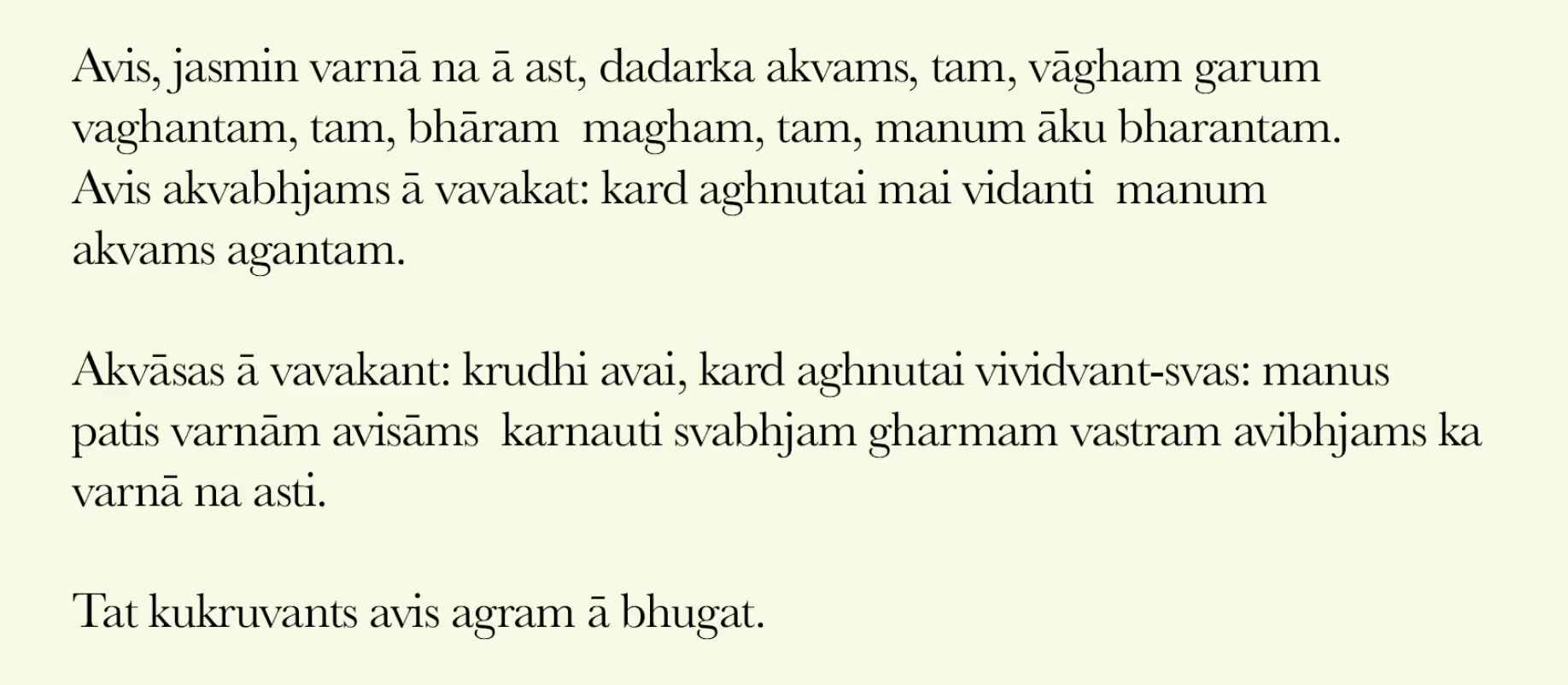
Artefact No: 6
Description: Schleicher’s Fable
Location: Origins within Pontic-Caspian Steppe
Age: 5th and 4th Millenia BC.
The above artifact never existed. It is a fable written in 1868 by Augustus Schleicher, composed in Proto-Indo-European (PIE), a long dead language that was reconstructed from the multitude of languages descended from it, spoken in a broad arc from modern English in the west to ancient Tocharian in the Tarim Basin in China. PIE is believed to have been first spoken between the 5th and 4th millennia BC.
Another term for a descendant language is a ‘daughter language’ because she is a child of the mother tongue. For example: English is a daughter language of Old English, which is a daughter language of Proto-Germanic, which is a daughter language of Proto-Indo European (PIE). German and Yiddish are our cousins by way of Old High German, also a daughter of Proto-Germanic. Italian, Spanish, French, Portuguese, and Romanian are all daughter languages of Proto-Italic, who’s mother language is Proto-Indo-European. Sanskrit, Persian, Hindi, and a host of other Eastern languages can all be traced back to Proto-Indo-European, too. Our linguistic family tree is surprisingly large, some branches are healthy, others have withered but at the trunk we find, again and again, PIE.
PIE was reconstructed using the comparative method: linguists studied existing languages for familial traits. Our most fundamental words—those concerning family, body parts, numbers, and animals—show the strongest connections across daughter languages. Once linguists identified enough examples across languages, they could reconstruct the original PIE word, marking it with an asterisk.
Take the word ‘daughter’ in English. This is daúhtar in Gothic, θugátēr in Ancient Greek, dúhitṛ in Sanskrit, dugәdar in Iranian, dŭšter in Slavic, dukter in Baltic, duxtir in Celtic, dustr in Armenian, ckācar in Tocharian, and datro in a form of Hittite. This renders daughter as *dʰugh₂tḗr in PIE.
Here are two more: Horse is Eoh in Old English, aíƕa in Gothic, Equus in Latin, áśva in Sanskrit, ech in one of the Celtic languages, ēš in Armenian. This renders *éḱwos in PIE, (although earlier scholars spelled it *akvās).
And sheep or ewe in English is awistr in Gothic, ovis in Latin, avi in Sanskrit, ovèn in one of the Slavic languages, ōi in Celtic, and eye in Tocharian. Which gives us *h₂ówis in PIE (although earlier scholars spelled it *Avis).
“The study of protolanguages parallels fundamental physics research—both reveal hidden connections that deepen our understanding of the world.”
I mention the spelling of earlier scholars to get us back to Schleicher, and his fable, which is titled Avis akvāsas ka, or The Sheep and the Horses. Here it is in English:

The study of PIE has attracted remarkable scholars, rivaling nuclear physics and astrophysics in intellectual rigor. These men and women often mastered numerous languages and conducted research in remote locations across the globe.
As early as the 16th century, visitors to India were aware of the similarities between Indo Iranian languages and European ones. In 1653, Marcus Zuerius van Boxhorn proposed a proto-language of Scythian as the mother language for Germanic, Italic, Slavic, Baltic, Celtic and Iranian. In 1767, Gaston-Laurent Coeurdoux, a French Jesuit living in India, wrote a paper proving the similarities between Sanskrit and European languages.
In 1818, Danish linguist Rasmus Christian Rask showed the links between Old Norse, Germanic and other Indo-European languages. A few years later Jacob Grimm - one half of the Brothers Grimm of fairytale fame - laid down Grimm’s law, which brought a rigorous and widely used methodology to historic linguistic research, layingthe ground for Schleicher’s great work and his fable.
Schleicher used the available PIE words that he had reverse-engineered. In those early days there was only a limited vocabulary that he felt confident enough to work with. And yet Schelicher wrought something very layered and profound: he created a nursery rhyme from the cradle of pre-civilisation to teach himself and his colleagues this ancient language. And it contained themes - as many nursery rhymes do - that go back to our earliest days: the beginnings of agriculture, the domestication of horses and sheep - the naming of our world. And yet this simple fable - a prehistoric Baa-Baa Black Sheep - was the linguistic equivalent of Jurassic Park; Schleicher breathed life into this ancient language.
If we were to trace these diverse and far-flung lineages back to some Oral Eve, we would most likely find her living on the Steppe north of the Black Sea. This is the Kurgan Hypothesis and was formulated by Marija Gimbutas in the 1950s. Gimbutas, a Lithuanian archaeologist, who survived the Nazi occupation of her homeland, was the first scholar to match PIE theories with archaeological evidence from her excavations into Bronze and Iron Age cultures from across the Steppe. The Kurgan Culture, so named after the burial mounds that it left, were early domesticators of the horse, and first to use the chariot, spreading their language and ideas with them.
I saw these Kurgan mounds last year in Ukraine. The battlefields by the Black Sea are in the deltas of the great rivers and terminally flat. These ancient burial mounds are one of the few pieces of high ground and both sides use them as fighting positions.
The study of protolanguages parallels fundamental physics research—both reveal hidden connections that deepen our understanding of the world. PIE studies sometimes feel otherworldly yet innately familiar, revealing ancient pathways of thought and meaning.
There are parts of PIE that feel hallucinatory, spiritual and yet innately familiar: linear clusters of nodal points like constellations of forgotten meanings; or ley-lines within the language that suggest a truer course we might take.

Take the word ‘Day’ which comes from the PIE word *dei ‘to shine, be bright’ and *dyēus ‘the daylight sky-god’. This PIE term gave Greek the name of Zeus, Latin the word Diem, and Sanskrit word Deva, ‘heavenly, divine, anything of excellence’. So to Carpe Diem is not merely a matter of seizing the passing moments but of grasping the divine within them.
Or take the other PIE word for ‘to shine’ which is *bhā, and also means ‘to speak’. This connection surfaces in Greek "phēmi" (to speak), Latin "fari" (to speak) and "fama" (speaking, reputation), and English "fame." Ancient speakers saw speech as a kind of illumination - words could light up understanding just as fire lit up the darkness. We still preserve this dual meaning when we talk about ideas being "brilliant" or someone giving an "enlightening" speech.
Lastly, one that I noticed last week while I was in Brazil: the Portuguese for ‘the way’ “Sentido” shares a cognate with our word ‘sentient’. This ancient connection between movement and perception appears in Latin "sentire" (to feel) and "sequi" (to follow), again in Portuguese as "caminho" (way, path), and English words like "sense," "sentiment," and "sentient." When the original PIE speakers talked about "finding their way," they were simultaneously describing physical navigation and emotional/intellectual understanding. A path was both a literal route and a way of feeling through the world. This deep link between movement and consciousness persists today when we speak of "following our feelings" or finding our "life path," echoing an ancient understanding that movement, feeling, and knowing are fundamentally connected. Most days I forget this, but it’s good to be reminded.
I’m going to leave you with a long list of reworked versions of ‘The Sheep and the Horses’. The Fable has become a palimpsest for PIE scholars down the generations. I don’t pretend to understand the later versions which abound with algebra-like symbols to denote glottal stops and plosives but I do like the idea that this artifact lives on.