
Becoming AI Philosophers: A Co-Evolution with Tobias Rees
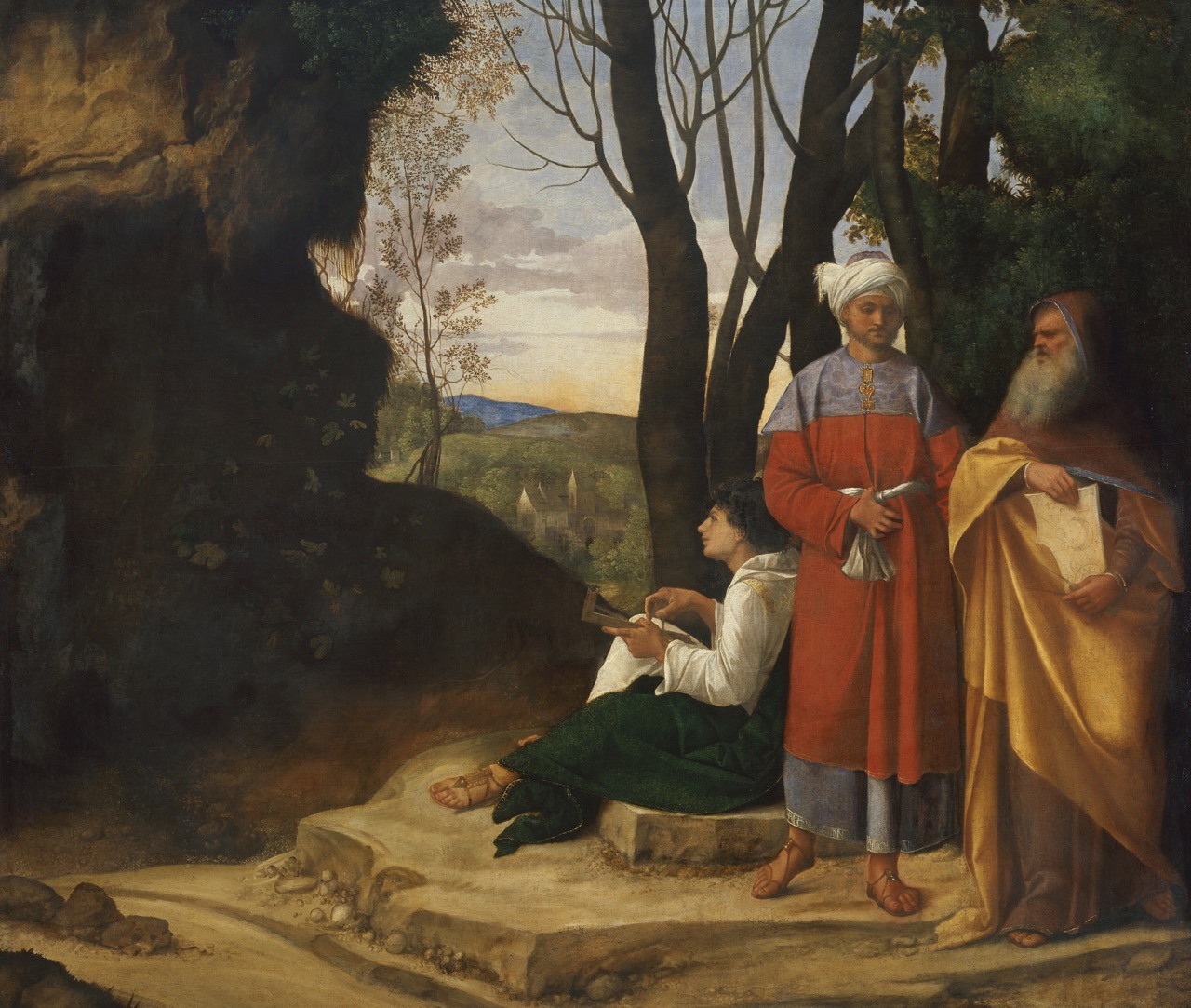
The Three Philosophers, Giorgione. Oil on Canvas. 1505.
The term philosophy was coined by Plato in order to make comprehensible to his fellow Athenians a new way of living a life. His teacher Socrates asked, how shall we live? Embedded in this line of inquiry is an invitation to think about how we think, which brings us into the realm of unexamined opinions. “Socrates’ invitation was to think about thinking — in order to discover the unexamined presuppositions on which how we think is dependent. An unexamined life, as he saw it, was not a life for humans,” philosopher and founder Tobias Rees explained. He believes philosophical R&D is essential to examine our own thinking about what AI is and could be. Rees believes unexamined opinions can come to dominate aspects of our lives and personalities without our consent and because AI is evolving so quickly and the narratives around it are so confusing, the time for philosophical R&D is now. We are all invited to be part of the Socratic exploration into the question - how shall we live with AI?
“When we think about thinking, we don’t do it to arrive somewhere. The goal is not to find an answer to the question how shall we live? The goal is to steadily keep the question open and get outside of how we’ve already thought, outside of what other people say,” he said. Rees’ efforts certainly match the ambition: after founding his own AI image generating company limn and serving as Director of Berggruen Institute’s Transformations of the Human Program, he’s establishing a headquarters for the AI philosophical R&D movement called Stella Matutina. Located in an old convent on Lake Lucerne in Switzerland, Stella will gather thought leaders from around the world, becoming for AI and the 21st century digital world what the Bauhaus school in Germany was for architecture and building in the 20th century physical world.
One of the nuns still living in the convent when Rees and his partners bought it pointed out a prophetic synchronicity when Sister Mary Ruth said, “I always wondered why the Bauhaus entered our lives. And I never had an answer to this, but now that you say you want to do a modern day Bauhaus I totally understand. It was providence.” Upon hearing this, Rees went from having goosebumps to having a panic attack.
“I could barely remain seated because she just declared in all sincerity that it was God’s plan that I came there and presented this.” he said. “So Stella Matutina is designed as a form of milieu that is composed of a school, a 12-month curriculum for post bachelor students where you can learn philosophical R&D.” Rees resonates with people who can’t be reduced to their official field and wants the scene he’s creating at Stella to be a fertile, multidisciplinary ground for what he calls “scene-iuses. “Brian Eno says we have this concept of the lone genius that invents something. In reality every so-called genius was part of a scene, and that scene is full of people who did things that inspired that genius.”
“In some sense I grew up in the 19th century, I grew up with my grandparents on a small farm. We only ate what we grew, we only heated the house with wood we cut ourselves. I’m an only-child and I’m an only grandchild. We lived fully with the seasons, and it sounds very romantic. It was not at all,” Rees mused, describing life as a Polish kid growing up in a remote village in southern, Cold War Germany during a time when there were almost no foreigners in the country.
Growing up with an overwhelming sense that he didn’t belong led to him isolating as a child and enclosing himself in his mind. Other than Christian songbooks, there were no books and certainly no music in the house. He said, “I read my first book when I was 16. I’d never done anything before, so then when I went to university I wanted to study philosophy, but I couldn’t handle it at all. There were all these kids from bourgeois society, they’d all studied Greek before and I had not. They all spoke standard German perfectly, and I had no clue how to sound like them. But there was anthropology, which really was classical, modern ethnography and it was about pre-modern people. And that’s how I grew up!”
After spending a few years studying anthropology, he returned to philosophy, but remained a self-identified outsider of modernity. “I’ve always been an in-between person. I don’t like being part of most milieus, I don’t like groups that form through social relations where social means status,” he described of feeling like an outsider in his own time. “I’m happy to be part of groups that form around creative processes or intellectual exchanges. I like to meet, say hey how are you, and go straight into it.” When he came to the U.S. to study at Berkeley, his reticence toward modernity was put to rest by his PhD. supervisor, who told him he simply had no right to despise the present because now is always the best time to be alive. In terms of answering the question of how shall we live, Rees is determined to get the best out of being alive by forming his own milieu curious to examine unexamined features of our AI co-evolution.
“I think AI’s real value could be that it can help us have processes that we humans cannot have on our own. It can help us think things we couldn’t think of alone as humans, it can supply possibilities to the human creative process that humans couldn’t generate alone,” he said of how to use AI to expand the possibilities of process. This, in his opinion, is the highest and best expression of philosophical R&D when it comes to our co-evolution with AI. He draws the comparison between math and music being creative human fields rather than output-based sciences, where process, conceptual insight and understanding are all essential to creating a finished product.
“Right now when someone does R&D to build technology, they build it from within the discipline and practice of engineering. Engineering is about the skills to design and build machines like they have been built since the 1860s or ‘70s,” he explained. “The basic principles have remained surprisingly stable, and I think that AI doesn’t fit into that old category of what a machine is.” Exploring this conceptual understanding of technology and the definition of a machine inspired Rees to advocate for philosophical R&D when it comes to AI. Since the 1860s, a machine was most readily understood as a tool built to make industrial processes more efficient or to automate things humans did. AI simply doesn’t fit into that model.
What a machine could do was predefined by the human who built it, but AI learns by itself and is exceeding what its human creators could have planned. The whole idea of pressing a button and the machine reliably executing what we want it to do is no longer applicable. “This makes AI relationally dependent, that’s very different from a machine. It has an agency of its own, and it’s relationally needy. So why did we build AI for output rather than for process?” he asks, pointing out that this is a philosophical rather than a technical question, but traditional philosophical approaches are insufficient. We must apply all possible answers to dedicated R&D approaches for how humans use AI, how we think about it, how it’s designed and how it’s evolving on its own in order to begin to understand how to best integrate with it.
In creating limn.ai, expanding creative thinking capacity through image generation was the goal. Rees believed a collaborative feel between the artist and agent could be generative of new possibilities. “And wouldn’t it be nice for human artists to discover these nonhuman spaces of possibility? So we just did experiments with artists.” Building this relationship is important to him because he’s attuned to the largely European sentiment that AI is seen as the catastrophic ending of artistic genius. The choice to bring Stella to the EU was very intentional. He said, “When art, philosophy and tech get together, that’s Europe at its best. That led to Florence, that led to Paris, that led to Weimar and the Bauhaus.”
And so, as prophesied, Stella Matutina will open in the new year as an antidote to the cultural pessimism toward modernity Rees knows all too well. As more and more new possibilities and problems emerge which change our self-understanding, taking a curious, philosophical view on our co-evolution with AI creates a space to intentionally become more conscious about what kind of relationship we want to have with technology. Rees wants the relationship to be poetic because that’s the most open mindset to be in when doing philosophical R&D. Operating from this state, his disidentification with modernity coupled with his determination to love it gives him a unique perspective on the existential, potentially civilization-defining questions being asked about AI.
“How do we make philosophical insights into positive fields of action? That’s why philosophical R&D is so important, that’s why we need to learn how to build from the perspective of these philosophical insights,” he shares of his mission with Stella. “The commitment is to the spiritual, poetic quality that makes us see the world differently.”