
Floating (Museum of Suspense III)
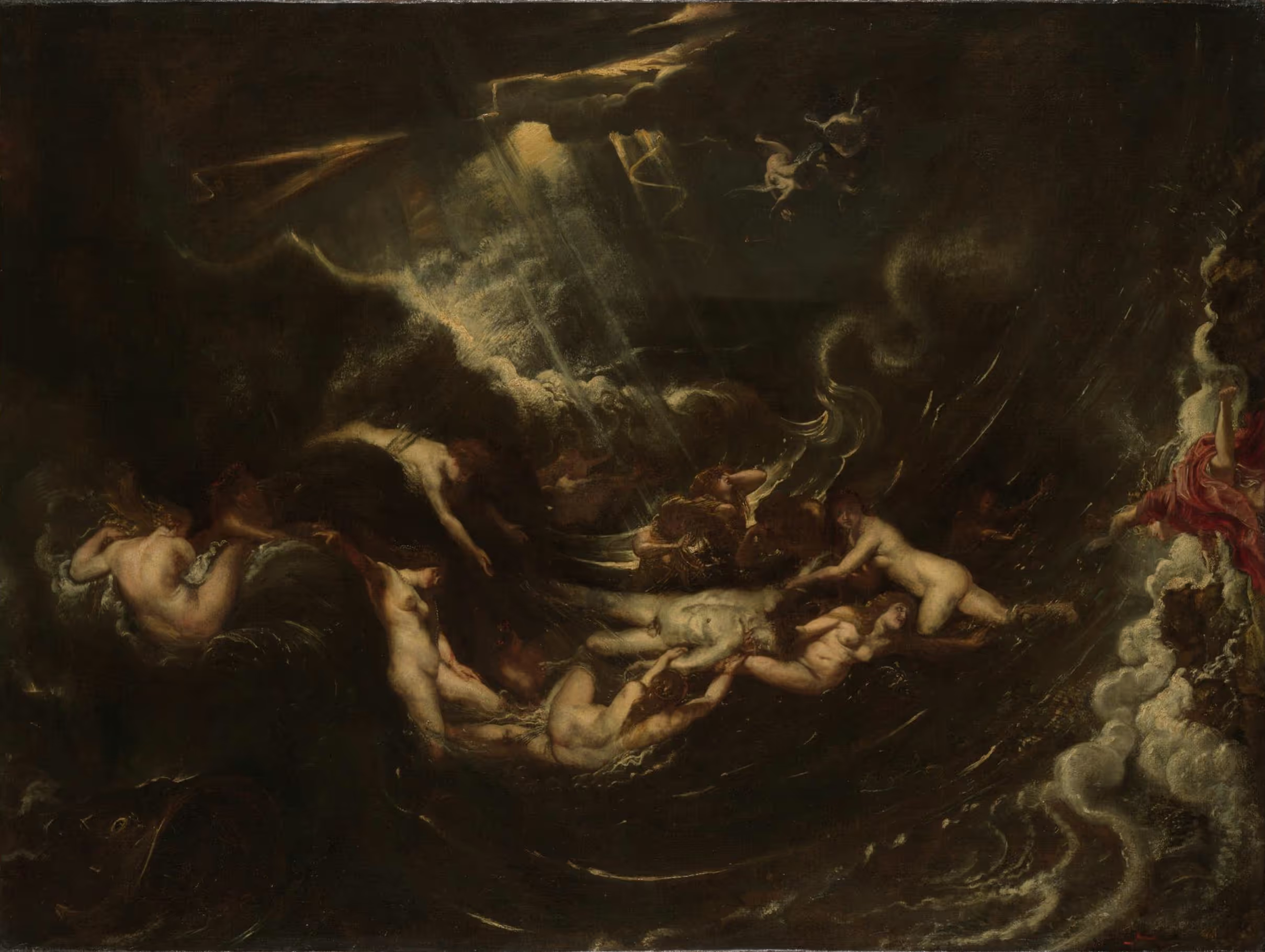
Peter Paul Rubens, Hero and Leander, c. 1604, oil on canvas, Yale University Art Gallery
Certain images bring you back to them. Peter Paul Rubens’s Hero and Leander (c. 1604, Yale University Art Gallery) is one such image. It is, after all, a painting about return. Or rather about return’s denial.
On the surface, it is a mythological image: a tragic scene of Ovidian lovers. A boy named Leander crosses a sea — the Grecian Hellespont — to reach his beloved Hero. He swims only at night, guided by the stars and Hero’s lamplight. But one night, a storm unfolds. Hero’s light is obscured and Leander loses his way. He drowns.
In Rubens’s picture, the protagonist continues to float, his body outstretched. He is carried by the waves and the nymphs who ripple within them — graceful bodies which murmur “ebb” and “flow” in a language theirs alone. Perhaps it is telling that when the Neapolitan poet Giambattista Marino saw Rubens’s canvas, he admonished the nymphs. “Where, where do you sea-nymphs carry [him]?” the poet cried.1 How often has nature (or the divine, of which Rubens’s nymphs are part) appeared to us unsympathetic?
Rubens, a masterful conjurer of figures and fables alike, condenses the Ovidian narrative into a single cinematic frame. In the fable, Leander’s lifeless body would be brought by waves to Hero’s shore; upon her discovery of him, Hero would throw herself from the tower which once lit her beloved’s way. In the painting, Leander remains within the picture’s center. He is an eye stilled within the storm. Whereas Hero, but a dash of red cloth at the picture’s margin, falls. To be more precise, she is still falling.
Everything remains in a state of suspense, including the composition of the painting itself. Glancing above Leander’s body, past the throws of nymph and storm, one finds the horizon line. There, in the distance, the storm has subsided. That horizon remains out of reach, and the aperture upon which it opens appears destined to close. The whole painting centers on this closure. To return to the painting is, analogically, to return to life as if from the brink of death.
Three centuries after Rubens, the poet Leigh Hunt gave voice to Leander’s floating thoughts, to those questions which emerge when life and death approach one another. In Hunt’s 1819 poem, time dilates as Leander turns between the eternal and the everyday:
When faced with a final glimpse, with the limited horizon, to whom do our own thoughts return?
I return to the painting in part because it stretches beyond myth and beyond the lives of the fabled lover and beloved. Set within the Museum of Suspense, its poignancy resides in the force of possibility as well as doubt. It presses beyond the individual life to ask us how we, in confronting our own mortality, might better turn to the lives of others.
1 “Dove dove portare / Ninfe del mar […] / Il feretro funesto / Del misero d’Abido.” Giambattista Marino, “Leandro morto trà le braccia delle Nereidi Di Pietro Paolo Rubens,” La Galeria (The Gallery), 1620. More precisely, the poet refers to a cask as opposed to the body inside.
2Leigh Hunt, “Hero and Leander,” in The Poetical Works of Leigh Hunt (London, 1849).