
Inheritance Protocol - A Transmission To Future Humans
Aided by the rapid development of AI, human beings are co-evolving with technology faster than we can process the implications. Inheritance Protocol, a project founded by technologist and entrepreneur Olga Vox of Alinea Institute, invites us to craft a message to future generations as a way of consciously exploring what intelligence is worthy of transmission. The project’s website distinguishes between knowledge and information, reminding us that the truth of the human experience can only be expressed by human beings. As such, Vox believes we owe it to the generations that follow us to collect and transmit pieces of individual, distinctly human wisdom.
“I hope it feels less like a database and more like an archaeological site of human interiority,” Vox explained. “Civilizations preserve their wars, technologies, institutions and monuments remarkably well; they are much worse at preserving what it actually felt like to be alive inside them.” She describes an “invisible layer” of the human experience that’s typically only transmitted person-to-person, or through the act of living itself. This layer contains individual answers to questions like: How did people love? What did they consider sacred? What wisdom did families transmit without ever writing it down? What did people understand only after suffering? What did they want their descendants never to forget?
In seeking to collect answers to these questions, The Inheritance Protocol is asking for letters, which can be submitted online or in person at this year’s Burning Man festival. The project emerges at a moment Vox believes is critical in defining the trajectory of our co-evolution with AI; the moment where machine intelligence is becoming more powerful than human intelligence. “I became troubled with a strange asymmetry: we may be creating the most consequential intelligence in human history, but most of humanity participates in its creation only as training material,” she said. “A small number of institutions build the systems; everyone else contributes the language, culture, images, histories and behavioral traces from which those systems learn.”
Becoming conscious of what we train AI on led Vox to wonder what happens to future generations for who may be entirely reliant on such systems for gathering information. What representations of the human experience are being translated into machine-readable data? Vox suggest that an invisible layer containing the soul of humanity is lost in every step of the process, a layer that contains, “Embodiment, context, silence, ancestral knowledge, the things we never thought to record. By the time a machine encounters ‘humanity,’ much of the body, ritual and tacit knowledge has disappeared. We have always struggled with confusing the map for the territory. Now we are building intelligence from the maps.”
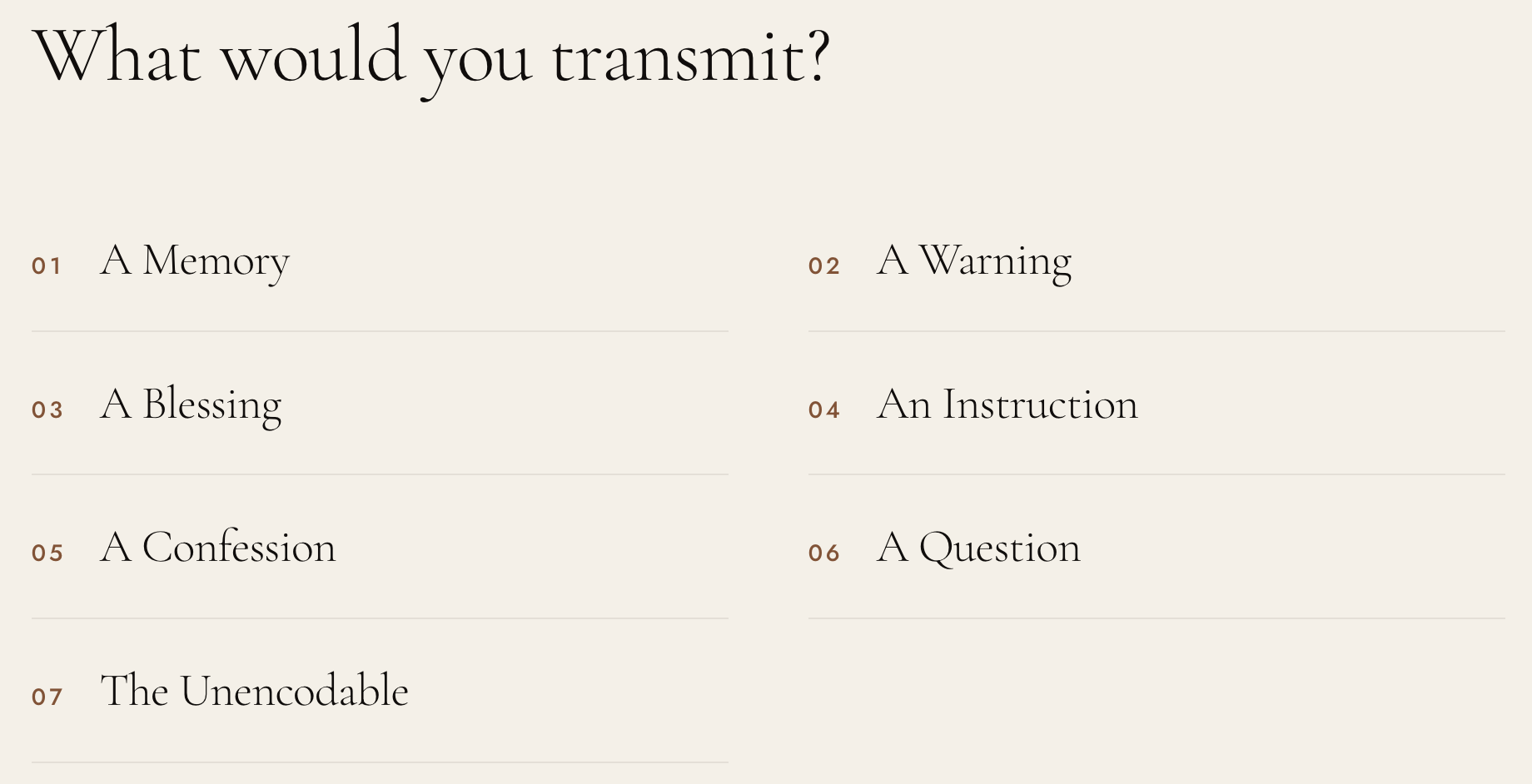
The Inheritance Protocol asks what we choose to transmit beyond informational data, the website inviting letter submissions containing intentional acts of inheritance: a memory, warning, blessing, instruction, confession or question addressed to beings that will eventually encounter us as ancestors. Sample submissions include entries like one titled Do Not Mistake Speed For Understanding, written by an anonymous contributor from Oakland coming out of a long illness who shares that, “We built machines to remove waiting from our lives, and then discovered that most of what we loved was made of waiting.” Another called How To Sit With Someone Dying was anonymously submitted from Kyoto just after a funeral reminding us to, “Sit close enough so they can feel you there. Do not fill the silence. When they speak, do not correct the facts.”
Vox was born in Moscow just before the fall of the Soviet Union, and believes that gave her a unique appreciation for aspects of life most of us take for granted and often falsely regard as permanent. “Adults around me had lived inside one account of how reality worked and then suddenly found themselves inside another. That leaves an impression on a child. You begin to understand quite early that many things human beings treat as permanent - money, borders, institutions, ideologies, collective ideas about what is normal or possible - are actually agreements,” she described. “Living in San Francisco today, I find the symmetry striking: I began life watching one operating system for society dissolve, and now I live in the place where another kind of operating system is being written.”
As submissions grow, Vox believes they may one day live inside their own AI-powered library where the so-called invisible layer will be made visible through interactive features we’ve not yet imagined. In anticipating this eventuality, she says, “I want that encounter to be fundamentally different from scraping the internet. Data is what can be captured. Inheritance is what someone chooses to entrust.” To entrust wisdom to another is an act of love, so crafting an Inheritance Protocol submission feels antithetical to the hyper-intellectual conversation sphere surrounding our co-evolution with artificial intelligence. Crafting a transmission inherently pulls us out of our minds and into our hearts, and it’s consciously given rather than extracted by data scraping.
“Before writing, you return to the body, mortality, memory, ancestry. To the fact that you came from other human beings, who came from other human beings, stretching backward through an almost unimaginable chain of lives. Then you imagine that something which may outlive you is listening,” Vox tells us, encouraging writers to be present with whatever comes up for them in the process of creating a submission.
The call to action is reminiscent of Rabbi Edward Feinstein’s Rosh Hashanah message called The Tao of Judaism, recorded 30 years ago in a sermon. He invited his congregation to write letters to their future children and loved ones not yet born. “I want you to put into this letter what you have learned about the meaning of your life - what you’ve learned from your upbringing and education, from working in the world, from marriage, divorce, raising children, saying goodbye to loved ones. What has life taught you?” he asked. “Modernity knows only the self. And the self is the problem, not the solution. I want more than just the self. I want connection to something bigger and more real. I want a basis for my values. I want a sense of my place in the world.”
Reading his words, it feels like the invisible layer of shared wisdom is what creates that connection to a greater whole. Simply by inviting participation and making space for the invisible layer to be made visible, The Inheritance Protocol is creating that connective tissue between us in the present and those in the future. It is the first of many experimental ventures Vox will run through Alinea Institute, founded with the intent of exploring what optimal co-evolution and cultural coordination with AI could be. “There is a line at the center of the project: before we tell the future what humans know, we remember what it feels like to be human,” she explains, inviting us to become aware of the extraordinary strangeness of being alive for such a short period of cosmic time. It is from this tender place of distinctly human vulnerability that we come to know what wisdom deserves to live on.