
Living in the Future
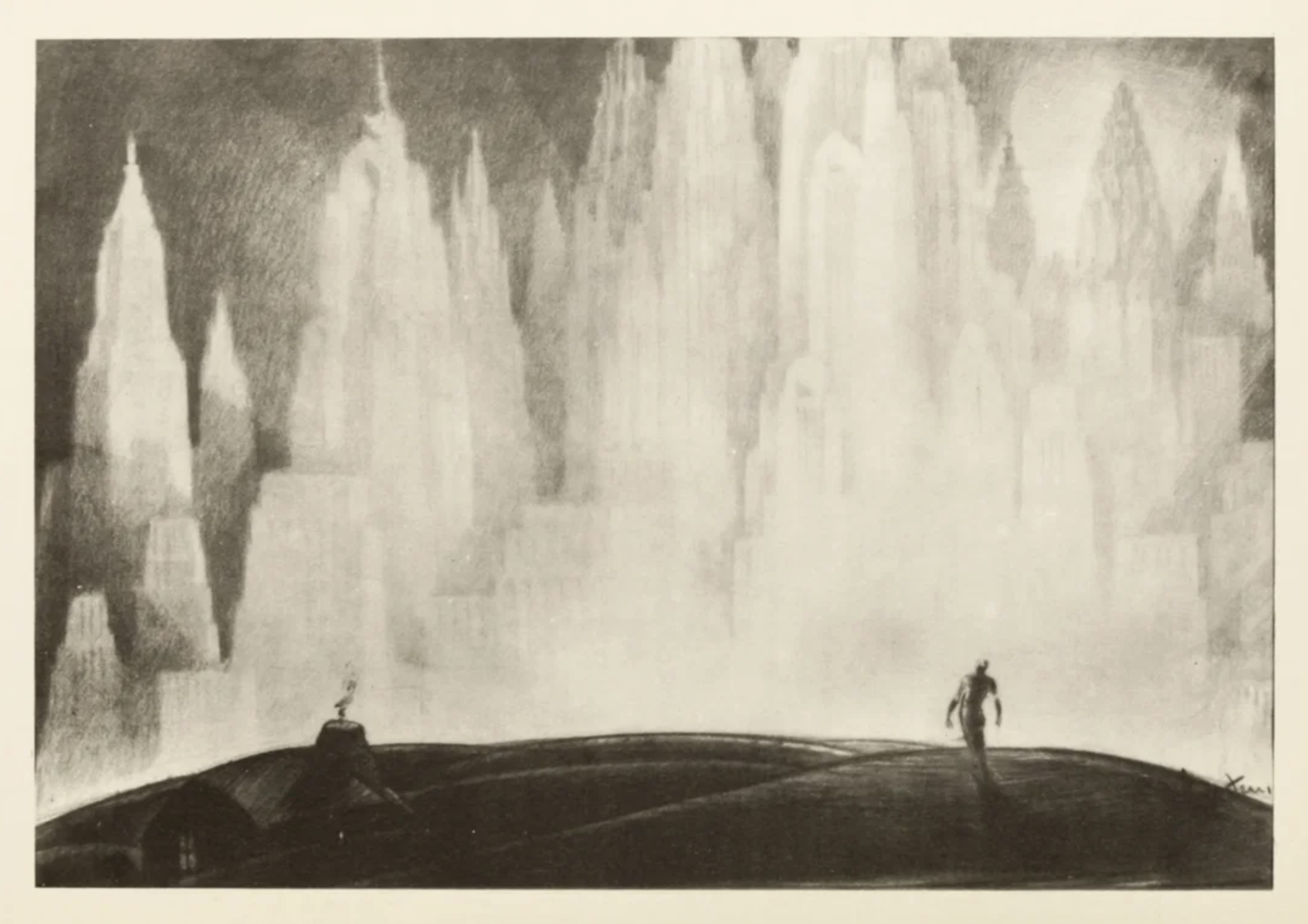
The Metropolis of Tomorrow, Hugh Ferriss. 1929.
“Live in the moment,” they tell you, but it’s not in the moment that we live.
We live in the future!
Anticipation grabs hold of our attention and whisks it off ahead of us, to the end of this sentence.
It’s the same in stories, as it is in life. It’s in the anticipation of what’s coming that, like a mote in a projector beam, a movie suspends you. Will our hero make it out of this one? Will the lovers reconcile?
When you’re watching a movie, you’re never watching just one scene, let alone one frame, you’re watching the entire movie - the scenes you’ve half forgotten and the ones that haven’t appeared yet. You wait, hand suspended in the popcorn bucket, for what’s coming next, anxious it will disappoint you, hopeful it will all turn out alright.
Movies take advantage of the way we are always getting ahead of ourselves. “The mind is like a flashlight, not a bucket” observed the philosopher Karl Popper, borrowing from phenomenologists like Edmund Husserl, who described the intentional character of consciousness. The mind, he says, isn’t merely waiting passively for shadows to pass in front of it; it ventures out like a search party looking for a lost hiker, in pursuit of what can fulfill it. Inchoate glimmers of unanswered questions guide our attention ahead of what we actually perceive, towards what we don’t yet know, but hope will satisfy our curiosity. It’s not just our actions that are led towards some purpose or other; even where we focus our gaze depends on what we’re looking for. That’s why, as magicians and pickpockets know, we easily miss what’s right in front of our eyes.
Husserl points to the surprise you experience when, for example, what you’d taken for a mannequin starts to move, or a ficus turns out to be fake, as proof that our experience of the world around us is made up of what we expect to see, not just what we actually see. If we didn’t implicitly expect the mannequin to just be a mannequin, or the ficus to be a real plant, how could we be surprised when they turned out to be something else?
Expectation is fueled by dopamine, a brain chemical that gets released in anticipation of a ‘reward’, which could be anything from the resolution of a melody to matching with someone on Hinge. Dopamine can explain why the anticipatory structure of consciousness is powerful, so powerful that casinos and social media companies dedicate a lot of research to understanding how to use it against us, but it doesn’t explain why we anticipate rewards in the first place – how our minds are able to cast themselves forward into what hasn’t happened yet… what, in other words, is not (yet) real. Dopamine can compel our interest because it reinforces (rather than creates) the fundamental forward-looking character of the mind.
I feel stifled when I try to stop the onward march of consciousness, to focus on a flower, or on my breath, and to keep my attention from wandering down the path to its proper home of non-being, the “not yet” of the future. “Being present” feels unnatural to me, which may be because I’m addicted to my smartphone, or it may be because it's not living in the moment that we need to do in order to take back our lives from distractions and grifters—we need to fight for the future!
In his book The Principle of Hope, Ernst Bloch wrote that “everybody’s life is pervaded by daydreams.” If consciousness casts its gaze forward, he meant, then being conscious is far from a simple connection to what exists. Consciousness, paradoxically, is concerned with what is not present, to what we have not yet brought into reality.
It’s not just idle daydreams that involve weaving reality together with what is not (yet) real but actions, being the effort to bring something into existence, are about irreality too. It’s with the desire to bring a delicious sandwich into being that I slather a slice of bread with aioli (and also because I'm fancy), and it’s because I want love in my life that I ask out the woman I’ve been chatting to at the party, behind the fake ficus.
"If we could just live in the present, then we could be practically immortal."
According to Bloch, hope is the basic temporal structure of living, but it is also “booty for swindlers.” Because our actions are always conjuring into being what is not yet real, they can never be built on a solid foundation of proof. Actions are speculative, they take leaps of faith. No action can ever be tried, tested, and true while it’s still needed. Instead of satisfying my hunger, that heavy sandwich might give me indigestion. I might be making the greatest mistake of my life by asking out the woman behind the fake ficus. We never have sufficient evidence that our enterprises will turn out as we hoped, which is why we need hope in order to act at all.
This leaves us vulnerable to swindlers, cheats, and scammers who take advantage of the necessity of hope. Grifters’ prospects get better in times like these, when uncertainty is all around us. Cheats love the desperate. That’s why it’s become a truism, over the past year, that “everything is scams now.”
It’s tempting, then, to stop looking to the future, when it has so often disappointed you, and to retreat back into the present. The present, at least, seems to offer something we can be certain of, something that can never be taken away from us. It’s tempting to take refuge in the present when the future seems hopeless.
The present promises to shelter us from the uncertainty of the future, and also from the dreadful certainty of death; if we could just live in the present, then we could be practically immortal. This is how Epicurus reassured himself: "Why should I fear death? If I am, death is not. If death is, I am not. Why should I fear that which can only exist when I do not?" If we could just limit being to the now, then death would be no threat to the living.
The now might be a good place to clear your head when your worries and hopes are all getting to be a bit much and you just need to stop and pretend for a moment that you could hold back the flow of time. Everything that happens, happens in the present, so it’s a good place to start. Still, Jacques Derrida, who criticizes what he calls the “metaphysics of presence” points out that everything that happens there happens by way of detours into what’s different and distant. The techniques you use for awareness and attunement come to you through 2500 years of Yogic and Buddhist traditions, and the self-discipline you use to shut out the past and shut out the future relies on the reel sent by your friend in Australia. In other words, even being present still involves what is absent, what is in fact very far removed—millenia of practice, and communication with distant continents.
The present is a good place to visit, but it doesn’t have everything we need to live. Though we might wish there was, there is nowhere for us to take refuge in a dead present.
What times of false hope demand is not retreating from hope, but the development of the keenest, most careful eye to the difference between false hope and real possibility. We need to learn how to distinguish between the rosy light of a brighter dawn and the flashing, buzzing blue light of trinkets that only promise salvation.
To live well in desperate times, we must daydream, but we must daydream wisely! We must fight for the future!