
Off-Grid Reinvention: An Interview With Adam Freeland
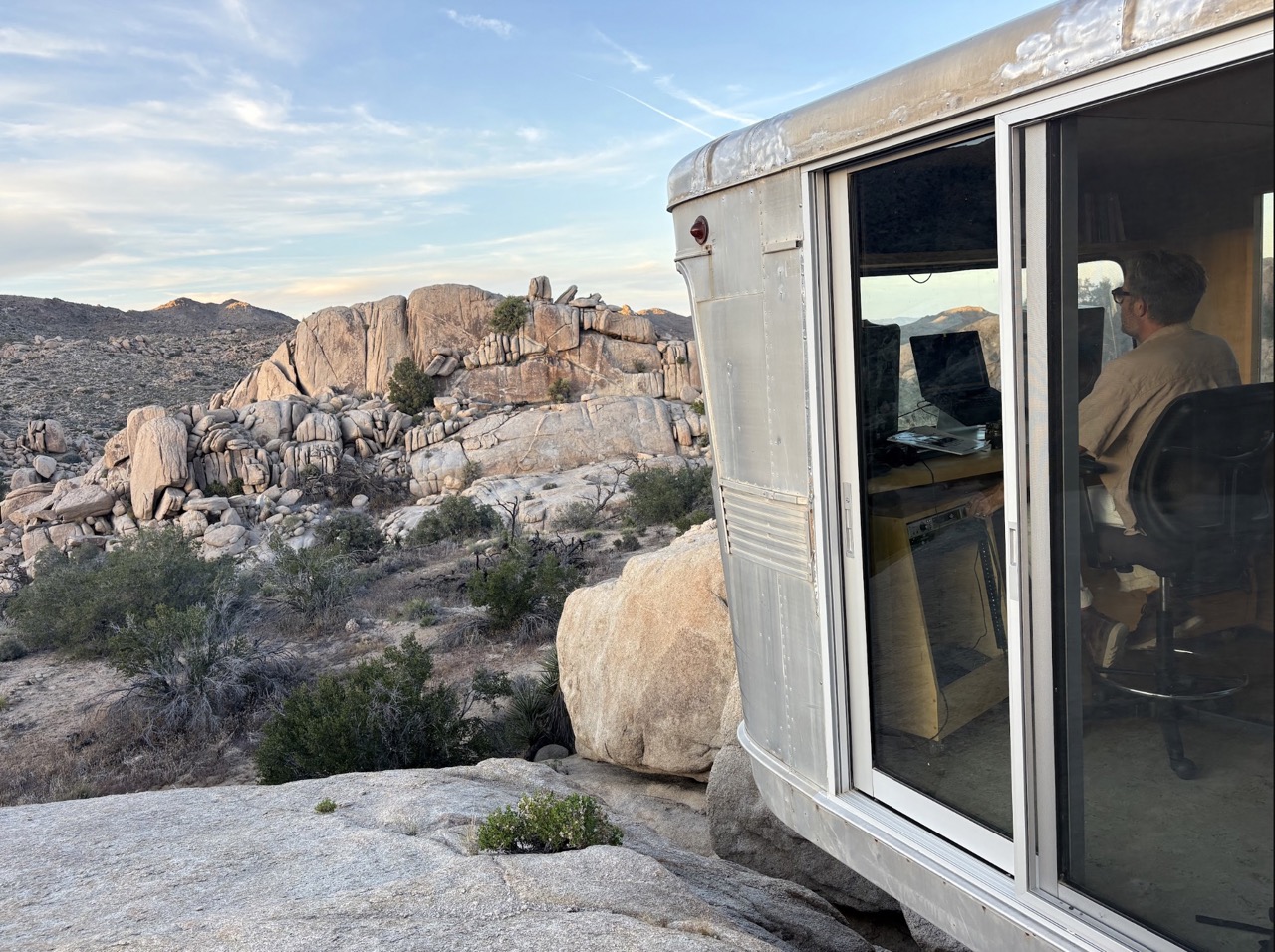
Adam Freeland in his Desert Studio
One of the last places on Earth a seasoned UK breakbeat fan would expect to find the legendary and illusive producer and DJ Adam Freeland would be deep in a massive boulder forest in California’s upper Mojave desert. Yet, the Brighton native has hiding out there for nearly 15 years, dialing in his outrageous off-grid set-up, including a customized, vintage aluminum alloy trailer he’s now using as a recording studio. Facing what he fondly refers to as ‘Reverb Canyon -’ a deep boulder canyon scattered with wildflowers - he can point speakers straight into it for playback, and run XLR cables all the way down to the bottom to record vocals and instruments.
The story behind the positioning of the trailer, balanced perfectly between two boulders, reveals much about how the desert culture he lives in operates. There seems to be a sacred, unspoken agreement to both leave your neighbor alone and to help them when they need it, no matter what. “I have a nuclear physicist neighbor down the road who helped me, his name is Solar Dan. He used to build and take apart nuclear power stations, and he told me he and I could get [the trailer] up here,” Adam explained. Given that he’d spent months trying to figure out how to do just that, including trying to convince crane operators to drive 5 miles down a harrowing dirt road to his place, and hanging around a nearby military base unsuccessfully soliciting Chinook helicopter pilots to help him haul it to that very spot, this was a radical idea.
“Dan said ‘we can do it with some chains, some pulleys, some rope.’ And we did it! We basically built a bridge then put a steel bar between these two rocks,” he said, pointing out that he didn’t want to put any bolts through the boulders or do anything to disrupt the natural landscape. “It was the hardest thing I’ve ever done and it took two of us like, a week. So we got it up here and built the concrete substructure under it. And the idea is that this is Boulder-verb,” he said, yelping into the canyon to illustrate his point. The echo of his voice came back with a soft, almost feathered texture to it. “I can be working on something super electronic, but then I can put it through the Boulder-verb and somehow, even if you can’t hear it or don’t know that’s where it’s from, I like the idea of taking the quantum particles of the desert into my music.”
At the height of his touring career, Adam disappeared from the global rave scene and from Marine Parade, the beloved record label he founded and ran. He was then briefly part of an indie band called The Acid, a project meant as a reprieve from his hectic DJ career, that accidentally blew up on SoundCloud, got signed, and soon had him touring again. It seems everything Adam touches creatively expands far beyond what can be imagined, and The Acid was no exception. The band scored an experimental film released in 2016 called The Bomb about what it feels like to experience a nuclear weapon, which screened at film festivals on eight 30-foot-high screens surrounding the audience. The following year, the band was invited to perform the score in front of Congress and at the Nobel Peace Prize award ceremony in Oslo.
Although he was growing as an artist in a whole new world of music and cultural influence, Adam found himself yet again living on airplanes and out of hotel rooms on the road. “It wasn’t a hard decision to step away from it,” he said, about leaving the band and going back to the desert. After that, other than working on occasional sets for Burning Man or one-off festival gigs, he hardly made any music at all. It took the better part of a decade to get his place built out, but when he finally sat down to write songs again in 2026, within a few weeks he’d finished what he considers to be the best music of his life. The first of these new songs, which have a darker, more organic sound than anything he’s previously released, are out now on the Transhuman EP via the newly revitalized Marine Parade. A second EP will soon follow.
For Adam, the decision to leave his old life behind was a deeply spiritual one, a calling to learn how to live in harmony with nature. He never related to the synthetic, hedonic, escapist vibe of the rave scene, nor did he enjoy the touring lifestyle. While playing Coachella for the first time in 2001, Adam fell in love with the desert and decided he wanted to end up there. He got serious about making it happen after spending New Year’s Eve 2015 with the poet and Grateful Dead lyricist John Perry Barlow, who inspired him to make a list of his dreams and peak life experiences. “My peak life moments had all occurred deep in nature either by myself or with one other person, not around thousands of people. And I really wanted to use my hands to do something manual. Making music is great but it’s ephemeral, it’s not a physical thing and I think there’s something very primal about creating physical things. My list of dreams was short - buy land, build house, take up archery.”
A little over a month later, he was shooting a bow and arrow on the property he now lives on, which he bought off Craigslist after responding to a cryptic email from the owner. She wanted to know what his intentions were with the land, so he explained that he was an artist with a dream of learning to live off-grid and build a house himself. The owner, who bought the plot from Mary Wilson of The Supremes, said she’d know when she met the right person, seeming to imply that it was not Adam. But he persisted. “I sent her this long email explaining that this was my destiny, that I’d seen it in my dreams and mind’s eye so whatever it was going to take, I’d make it happen. She didn’t respond,” he laughed.
Several pleading emails later, Adam was permitted to see the property, and finally invited to make an offer, at a specific date and time following the completion of Mercury’s retrograde cycle, which was eventually accepted. When asked what living and building his home there has done to his consciousness, his answer was immediate. “Doing something big in the physical world, like getting a 10-ton trailer up on boulders, lifts the ceiling of what’s possible. Most of our limits are self-imposed, and of course society is constantly telling us we can’t do stuff and we believe it. But this cycle of believing it, then something happening to remind us that it’s just a societal narrative we don’t have to believe, can be broken by the primal act of doing big things.”
"It’s not just how to use land, it’s about how to optimize your energy based on how you would flow through an environment."
Now that his house and studio are built, complete with solar powering the whole property and flowing water through pipes he put in himself after digging trenches with a pick axe, the next big thing is getting back to music. “For ten plus years, most of my creative juju has been focused on this property and music became an occasional hobby,” he said. “And I’m finally about to step back in the fast lane so to speak with the relaunch of my label Marine Parade - I’ve got a few EPs ready to roll. I haven’t released anything under my name in over 15 years. Just in the last couple weeks I made a track that was supposed to be a B-side for another release, but it’s a banger. You know when you make something, and it comes really quickly, then you’re like, oh shit - this is it! Doesn’t happen that often. But it’s happening again.”
He’s also working on an album, tentatively titled Eight Minutes and Twenty Seconds. “That’s how long it takes the photons of light to leave the surface of the sun, run through my solar panels and come through this circuit. What you’re hearing right now, that power, eight minutes and twenty seconds ago was on the sun,” Adam explained while playing one of the unreleased tracks. “Five years ago, I was never coming back - I’d gone feral. I’d come into LA to visit and people would look at me all wide-eyed. I was mainlining desert. But I’m in the world now, and I’m about to start releasing music again, which is a completely different ballpark from where I left off when you could actually sell records. And I don’t care, I just want to put cool tracks into the world and I’m not invested in it having to be a material success, so it feels good.”
His last US festival appearance before moving out to the desert was at Coachella in 2015, which was right as America’s commodification of the dance music genre known as ‘EDM’ became a dominant market force. In terms of knowing when to leave the party to preserve maximum enjoyment and dignity, Adam chose the perfect cultural moment to become a feral, off-grid recluse. “Sometimes I sit out here and look at these boulders and laugh at myself for thinking I manifested this. The boulders are like ‘how about we called in a guardian?’ This land has no protective zoning - I feel like I was called here to take care of it. One time a bobcat came, and at first I was scared, so I started telling it out loud how grateful I was to be here and how dedicated I am to taking care of the land. It just looked at me, then after awhile I realized I was probably ruining its day so I shut up and carried on doing some yoga.”
When asked if he had any regrets, besides bothering the bobcat, Adam did name one - not studying permaculture before starting to build. He finally took a course during the pandemic and got to bring the principles of how to imagine a thriving environment into designing his studio space. “It gives you a whole-systems approach of how to set up your land and live,” he said. “There are basic principles based on patterns in nature of how to harness energy, how to capture resources, how to use your own energy and make sure everything around you is ergonomic. It’s not just how to use land, it’s about how to optimize your energy based on how you would flow through an environment.” His teacher told him permaculture is about remembering that resource scarcity is almost never the problem while better design is almost always the answer.
“Your energy is a super precious resource when it comes to living off-grid. If the well is way over there and the solar panels are way over there, you get tired,” he mused, pointing out what he would have done differently. But Adam identifies as a hard-wired optimist, believing we all have the power to do the work that needs to be done to make sense of life in a pro-humanity, pro-Earth way. According to him, a less prominent but equally satisfying aspect of off-grid living, besides the adventure of it all, is how your relationship with life deepens when you start noticing new things from being alone in the natural world, and how you make sense of it.
“I have a theory, or a frame really, about the role of trees and plants. Everything that’s ever happened in the physical world is recorded in the wind,” he explained, pointing to a nearby tree, “and those pine needles are receiving that story and converting it into sound. Although I might not know exactly what it’s saying, I like this idea that at night the Pinyon Pine is singing to me the story of everything that ever was. And it’s a beautiful story.” Theoretically, everything we create contains the totality of our personal stories at the quantum level. And now, at long last, the world gets to experience Adam’s story through the music created in collaboration with the natural intelligence of the place he’s made his home.