
Seeing is Believing
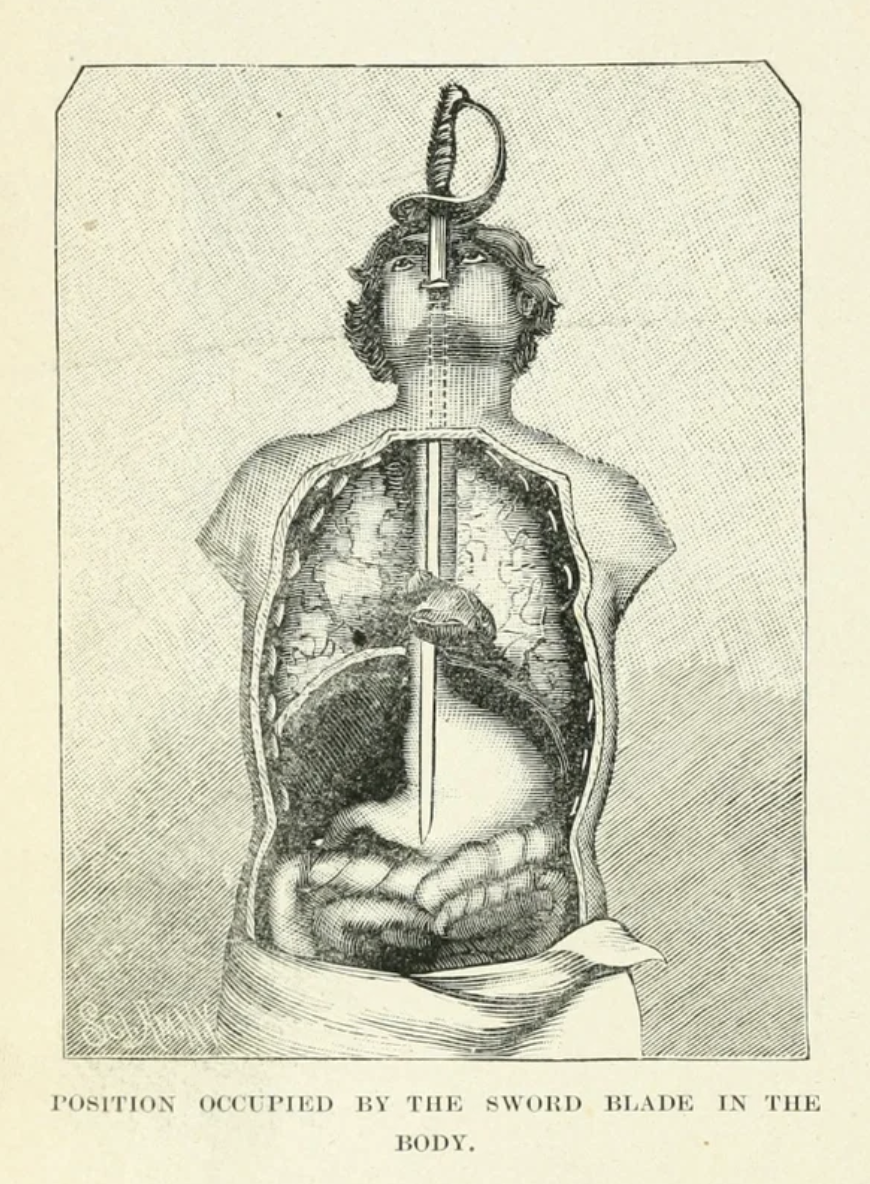
From ‘Magic: Stage Illusions and Scientific Diversions,’ 1897.
The Magic Castle may have the highest barrier to entry of any club in Los Angeles. It’s well known among Angelenos that just arriving in sneakers will have you bounced from the Castle’s grounds, alongside all those uninvited or lacking membership. Once you’re in, the rules get even more rigid, barring you from filming or performing magic yourself. It’s unsurprising, perhaps, that Nathan Fielder, a comedian constantly toying with the edges of social adherence, happens to be one of The Magic Castle’s long-time members, inviting friends and collaborators to join him on regular visits. Some years ago, Fielder and director Lance Oppenheim were at a magician’s table in one of the Castle’s close-up rooms. The magician asked someone to yell out the name of a famous person, any famous person. An unfamiliar voice rang out from the back of the room, “Elizabeth Holmes!” That’s when Oppenheim recalled that the independent entertainment company A24 had recently been approached by the former Theranos CEO to discuss documenting her life. Oppenheim asked Fielder later that night if he had heard about Holmes’ odd inquiry to A24, and the seed for their documentary You Can See Everything was planted.¹
At one point in the film co-directed by Fielder and Oppenheim, Fielder asks Holmes if she’s ever seen one of David Blaine’s signature performances where he punctures the back of his hand with an ice pick, pushing the tip all the way through to his palm. He then asks an audience member to pull the ice pick out after they’ve been squirming in their seat for a minute or so. When they finally do, no wound shows and no blood is left behind whatsoever. Fielder says he’s convinced that this “trick” is no trick at all, that Blaine is actually sticking an ice pick through his hand with immaculate precision. It would seem a naive assertion if Blaine hadn’t made a lifelong practice of blending magnificent feats of endurance with classic street magic. “I’m often asked why I don’t just stick to card tricks,” Blaine remarks, “especially since it can be so rewarding but without the risk of hospitalization […] I love the reactions and I love the way it moves people, so why take the risk? As a magician I try to give people an experience they’ll hopefully remember, something that even if they know the secret, it doesn’t diminish their sense of wonder.”²
In Professor Hoffmann’s Modern Magic, an encyclopedia of magic tricks and their secrets dating back to 1876, the first rule listed for any initiate magician is “Never tell your audience beforehand what you are going to do.”³ If an audience member is expecting you to pull a rabbit out of your hat, they’ll be studying the hat closely, looking for the trick’s inner workings before the performance has even begun. But what if you never said out loud to any audience that you were practicing magic, and instead led them to believe that you were a comedian? Then you would be taking the art of magic far beyond its current limitations. You could use humor to disarm the audience, capturing the attention of those put off by a magician’s anticipated approach, creating genuine moments of wonder when you subvert all expectations by attempting the impossible.
“They say one of the hardest parts of magic isn’t learning the sleight-of-hand itself,” Fielder claims, “it’s making the rest of your movements look natural while you’re performing the trick.”⁴ Fielder’s signature style exists in the inverse, in choosing not to look natural. Rather than forging a smooth and confident persona like Blaine’s, Fielder has found interesting ways to lean into his interpersonal discomforts. Like a stage magician who leads a participant through performing an incredible task, Fielder will lead his participant in a socially uncomfortable moment through to the other side. By asking questions in earnest response to his or his participants unease, Fielder will facilitate moments to explore this mysterious anxious space with his participant. He will reply to the kind of ambiguously unsettling comment that many of us silently push past, conspiring that “if we all pretend we didn’t just see that, then it didn’t happen.” But it did happen, and Fielder’s acknowledgement of the resulting awkwardness has some magical power, revealing many hidden truths about ourselves and each other.
In one episode of Nathan For You, Fielder’s original television show, he braved a highwire between two seven-story buildings six times in a row. Years later, he piloted a Boeing 737 full of consenting actors for his series The Rehearsal. With a philosophy that mirrors Blaine’s, Fielder often trains and commits to performing feats that threaten his life. And if the feat is not life-threatening, it is so ambitious as to be unbelievable - like when Fielder successfully reconnected a man with his teenage love using only her first name and an ambiguous sketch of her likeness. No idea is too big for Fielder, who knows that an audience member is more likely to believe what they see next if their sense of wonder is intact. “It makes the magic possible,”⁵ says Blaine. In other words, the audience member is then primed to witness an illusion.
One of the most popular proverbs in the English language is “seeing is believing,” though part of this adage has been concealed through time. The full proverb reads “Seeing is believing, but feeling is truth.” You Can See Everything dares us to look closely at all that we feel and all that we’re shown, whether it’s in the stories the subjects are telling, the overarching story that Fielder and Oppenheim are telling, or the stories we’re telling ourselves and each other about what we’re witnessing. “Strong magic is built around story,” Blaine suggests, “and when done well, that story lives on,”² a belief that fellow magician Nathan Fielder embodies as well.
- Film at Lincoln Center. "Nathan Fielder and Lance Oppenheim on You Can See Everything." YouTube, uploaded by Film at Lincoln Center, 19 October 2026, https://www.youtube.com/watch?v=6gn0QeqYMr4.
- “India” David Blaine: Do Not Attempt, season 1, episode 3, National Geographic, 2025. Apple TV, https://tv.apple.com/us/episode/india/umc.cmc.fzise7kz1udqe1z38b6vvdhs?showId=umc.cmc.7ie2bz8bn2skjjjobttwn46oh.
- Professor Hoffman. Modern Magic: A Practical Treatise on The Art of Conjuring. (David McKay, Publisher, 1904) p. 03.
- “My Controls” The Rehearsal, season 2, episode 6, Blow Out Productions / HBO, 2025. HBO Max, https://play.hbomax.com/show/609d8b4c-f0a6-4a5d-b9d3-bb0f2e207efb.
- “Magic” Shangri-La, season 1, episode 1, Tremolo Productions / Shagri-La / Showtime, 2019. Paramount Plus, https://www.paramountplus.com/shows/video/Ik_NQ67QeqfNkDu75lz6xgQlZrWJPb__/.