
The Ancient Sky - An Introduction
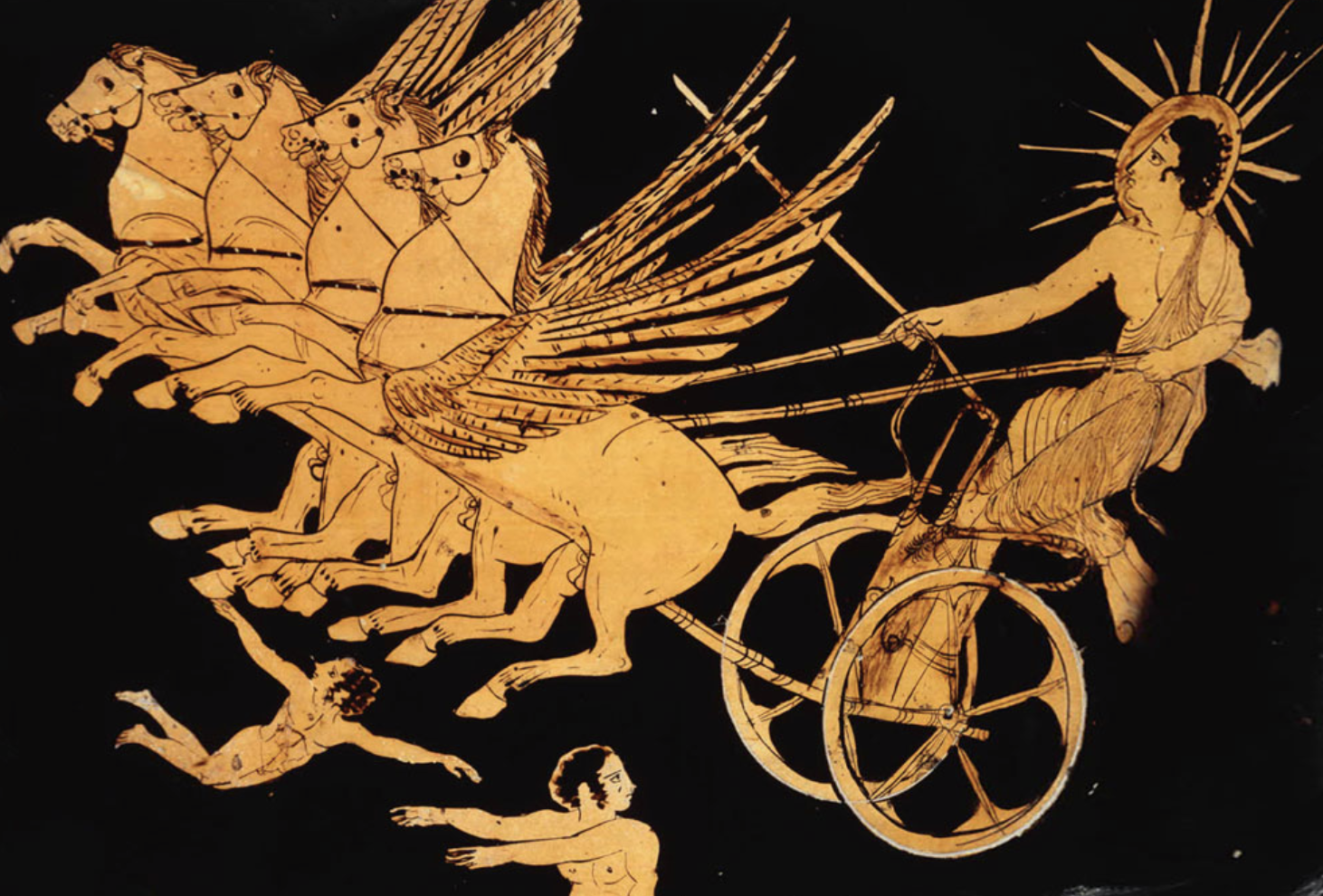
The sun-god Helio rising into the sky at dawn. 430 B.C.
The night sky is our oldest map, our first clock, and the foundational book of our mythologies. Before modern astronomy mapped the light-years between distant solar systems, ancient civilizations viewed the stars as dynamic, living entities interwoven with the earth and the passage of time. A geocentric model of the universe, where Earth sits at the centre, was the dominant, though not exclusive, understanding of the cosmos in the ancient world. Thinkers like Pythagoras, Epicurus, and Heraclides all posited something close to heliocentrism, but religion was not oppositional to science in the ancient world, and the truth of mathematics did not need to undermine the truth of mythology. To the ancient Greeks, the cosmos could be both an infinite, empty expanse and a massive, solid dome, forged of bronze, upon which the stars were fixed. It is from this latter understanding where most of the stories we still tell about the sky began.
Before we tell the stories of the individual constellations, understanding these foundational perspectives lays the groundwork for charting individual constellations. By grasping how ancient observers mapped the mechanics of the heavens, the rich stories woven into individual patterns of stars, from the great northern bears to the tragic figures of the zodiac, come into clearer view.
Based in the Northern Hemisphere, at the center of the Greek sky lies the polos, the heavenly axis or pole star, and most stars appear to rise in the east and set in the west as the celestial sphere turned. A select few constellations closest to the pole never slip beneath the horizon, amongst them Ursa Major, Ursa Minor, and Draco were seen traveling in an eternal, night-long circle around the axis. To explain why this heavy celestial dome rotated, the Greeks turned to mythology. The Titan Atlas, stationed either beneath the northern axis in the legendary land of the Hyperboreans or on the western rim of the world by the Atlas Mountains, held the sky upon his shoulders. His continuous posture and effort spun the dome, causing stars to cycle endlessly above mortal heads.
As Titan turned, so too did the tapestry of stories he held up. Constellations changed predictably with the seasons through a cycle known as heliacal rising and setting. A constellation's heliacal rising occurred when it became visible on the eastern horizon just prior to dawn, right before the glare of the morning sun washed it out. Each day, the constellation would rise earlier each night, climbing higher into the pre-dawn sky until, months later, it would reach the western horizon at dusk and disappear from view completely in its astronomical setting, beginning a period of celestial absence. Save for the evergreen constellations closest to the poles, all stars go through this process, but to the Greeks the most vital of these occurrences were the heliacal risings of the twelve constellations of the zodiac. They were said to rule the heavens during the period when their pre-dawn appearance on the eastern horizon was immediately replaced by the rising sun. For example, Gemini first appears above the eastern horizon in late May, its spot quickly taken by the morning sun. As weeks pass and Gemini rises earlier each night, its position on the solar horizon at dawn shifts to Cancer by mid-June. It is from this order that we assign the zodiacs their months still today. We can understand the night sky as a year long tale, each night a new part of the story emerges, each month one protagonist is slain and replaced by the next, only for the cosmic drama to begin again each year.
When stars vanished beneath the horizon, the Greeks believed they entered the lower half of the celestial dome extending deep underground. In this subterranean realm, the constellations were thought to dwell deep within the earth in the misty pit of Tartaros, the realm of the dead. Before rising back into the sky, the constellations were cleansed and purified in the earth-encircling river, Okeanos. Mythical figures mirrored this dual existence. The Dioskouroi, or Gemini twins, split their time equally between Heaven and Hades, while Homer described Orion both as a heroic constellation striding across the night sky and as a ghost hunting wild beasts in the Underworld.
While the Greeks viewed the sky through a lens of geometry, heroic myth, and a revolving dome, the Ancient Egyptians approached the heavens through agricultural necessity, timekeeping, and funerary theology. Rather than a bronze dome, Egyptians saw the sky as the arched body of the goddess Nut stretching over her brother Geb, the earth. Every evening Nut swallowed the sun god Ra, giving birth to him again at dawn.
To track time during the night, Egyptians developed a system of thirty-six star groups known as Decans that rose sequentially roughly every ten days. These decans functioned as celestial clocks, often painted inside coffin lids and tomb ceilings to help the deceased navigate the hours of the night.
Like the Greeks, the Egyptians paid close attention to circumpolar stars that never set, referring to them as the Ikhemu-sek, or those that know no destruction. They viewed these unmoving northern stars as the immortal destination for the Pharaoh's soul. However, the most crucial star in the Egyptian sky was Sopdet, associated with the goddess Isis and known today as Sirius. Its heliacal rising in mid-summer heralded the annual flooding of the Nile, marking the start of the Egyptian New Year. When stars set in the Egyptian sky, they were believed to spend seventy days in the Duat, the underworld, undergoing rituals of death and rebirth before emerging again in the east, providing a striking parallel to the Greek belief in stellar purification beneath the earth.
It is easy to hear this belief system and think of it as quaint and pre-scientific, but it is important to remember that the Ancient Greeks and Egyptians saw stories as companions to science, not replacements. The sky was a fable in motion, and the stories people put upon this dark page were a means to understand themselves just as much as to understand the page itself. As we start our journey of the stories of each constellation, we will see the reason for that cross-cultural idea of constellations existing in both the heavens and below the earth: they are just as much about the gods as they are about us humans.