
The Ancient Sky - Aries
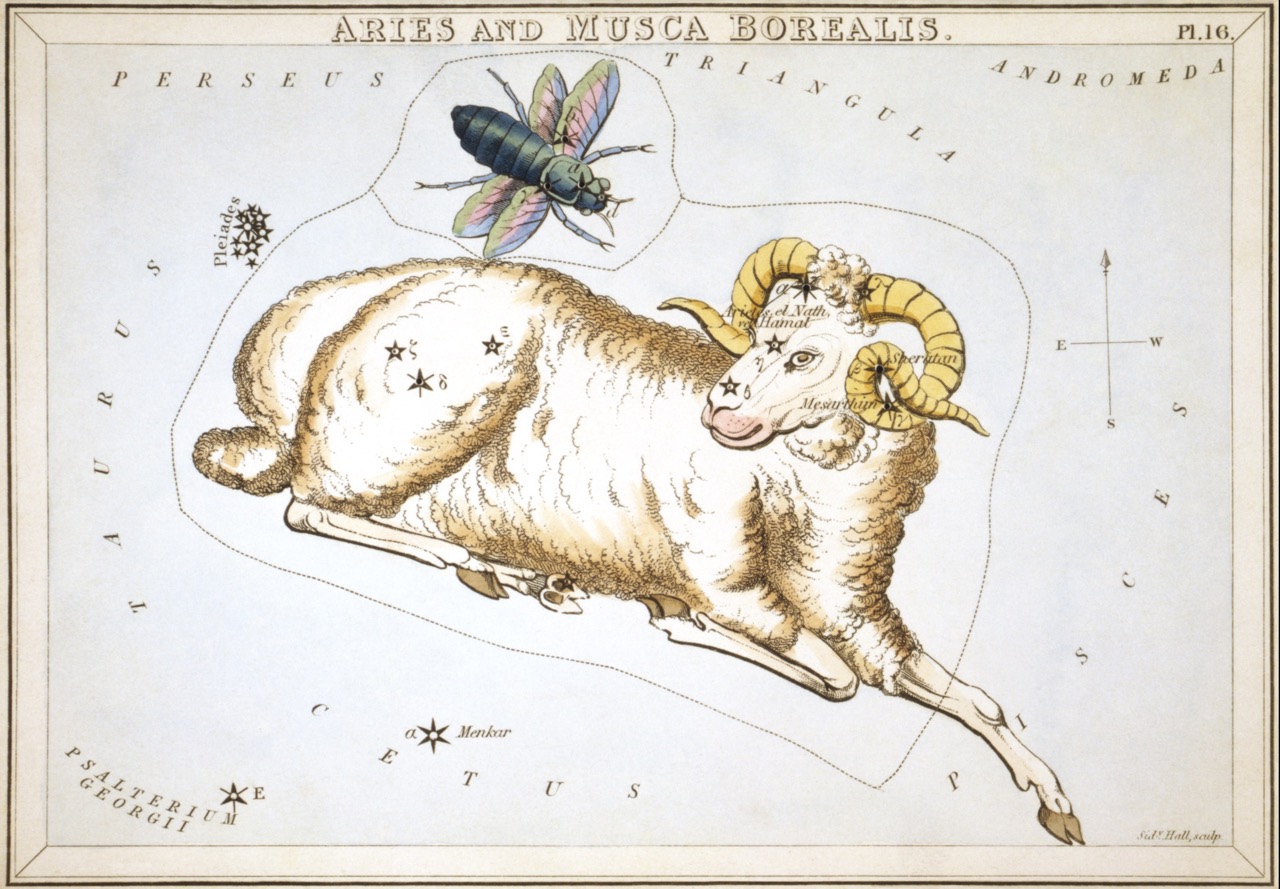
It was the Golden Ram that brought spring. While his fleece remained on Earth, targeted by Jason and the Argonauts quest and protected by Kings and Dragons, the spirit of the ram was sent to the sky to watch over us. When the sun crossed into the constellation of Aries, the year began; a time for rebirth, for planting, for shedding the scars of winter and beginning anew, free from the chains of the cold. It is the first Zodiac of the ancient world, and the one that most clearly shows how the practical science and the mythology of the Zodiac exist hand in hand, bridging the duality of ancient humanity.
For the ancient Greeks, the night sky was a moving tapestry, telling stories that unfolded over the course of months. Each constellations appearance brought with it new practical, agricultural and temporal requirements, but it also brought a new fable, reminders of how to live, and who to worship.
The myth of Aries begins in Boeotia, a region in central Greece centred by the city of Thebes. Ruled by King Athamas who, after ending his married to the cloud nymph Nephele, takes a new wife named Ino. Ino wanted her offspring to take the throne, not Nepheles children Phrixus and Hele. She caused a severe famine by roasting the kingdom's seed grain and then bribed messengers sent to the Oracle at Delphi to falsely report that the gods demanded Phrixus be sacrificed to end the starvation.
Athamas took the word of the Oracle as divine, and brought Phrixus to the altar to be sacrificed. Desperate to save her children, Nephele prayed for help. The messenger god Hermes provided her with Chrysomallos—a divine, winged ram with a fleece of pure gold. As the sword was about to be dropped, Chrysomallos swooped down to the altar and plucked Phrixus and Helle from danger and flew east across the sky.
The flight was long and dangerous, and Phrixus and Helle held onto the golden fleece as best they could but while crossing the narrow strait dividing Europe and Asia, Helle slipped from the ram's back, and drowned in the sea. The body of water was forever named the Hellespont ("Sea of Helle") in her honor.
Devastated, the ram carried Phrixus safely to Colchis on the Black Sea, where King Aeëtes offered the young prince asylum. Out of gratitude to Zeus, Phrixus sacrificed the ram, and its golden fleece was placed in a sacred grove guarded by a sleepless dragon. The very same fleece that would be immortalised all over again in the story of Jason and the Argonauts. Yet while the fleece of gold was bound to the earth, the spirit was deified in the skies. To honor Chrysomallos’ heroism, Zeus immortalized his spirit as the constellation Aries, and the Ram would fly across the sky, saving all who saw it from the trials and tribulations of the winter it banished.
For ancient astronomers, Aries became the vital anchor of time, marking the official arrival of spring, it signaled the time to sow crops, initiate civil calendars, and celebrate nature's renewal. The myth of Aries and the practical advice its presence offered show how closely knit the relationship between divine storytelling and science was in the ancient world, and still today, the ram in the sky gives us hope for a better year ahead.