
The Ancient Sky - Gemini
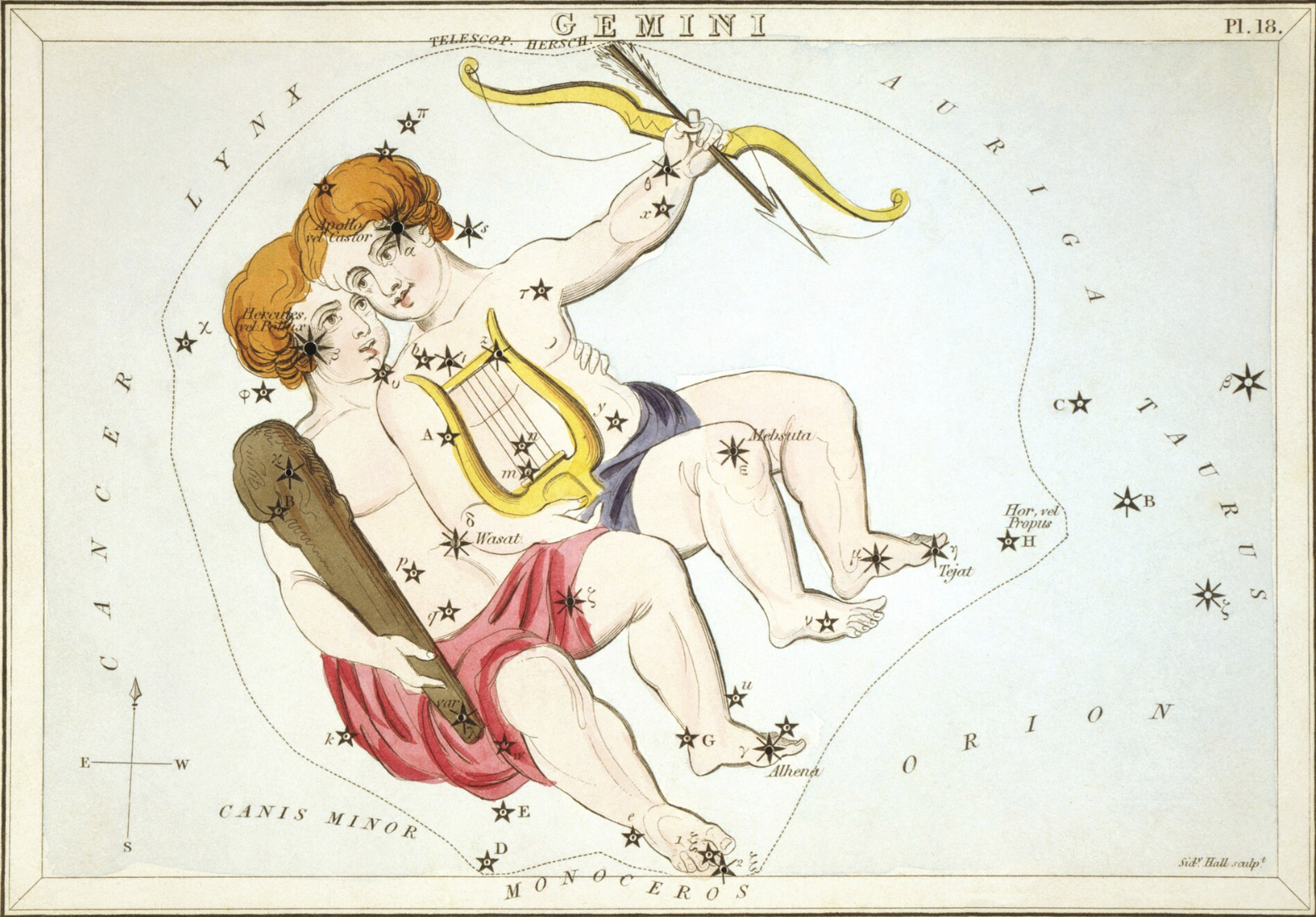
The Great Twins watch over the sky in love and duality, bringing with them the start of summer. They are the harbingers of change; two brothers who, in their contrast, bring the long, warm days of May and June, the opening of trade routes across the Mediterranean, the ripening of crops, and a period of increased socializing. Gemini is the third Zodiac of the ancient world, and like the Ram and the Bull before it, its presence in the night sky served as both a practical navigational guide and a profound philosophical reflection on the dual nature of human existence.
Important for mariners and travelers, when the constellation rose on the horizon, sailors knew the turbulent spring storms were giving way to the calm, navigable waters of summer. Easily recognized by Castor and Pollux, the two bright, neighboring stars that dominate the summer night, they have inspired stories of duality across cultures since at least 4,000 BC. We have records of the stars as divine twins across Proto-Indo-European myths, as twin horsemen in ancient Indian belief, and as Yin and Yang in Chinese tradition. Yet it is the Mesopotamians and the Greeks who most profoundly saw in these two identical lights stories of unbreakable brotherhood, mortality, and the delicate balance between the divine and the earthly.
For the Babylonians, Gemini was known as MAŠ.TAB.BA.GAL.GAL, or the "Great Twins." In Mesopotamian astrology, the constellation was identified with the twin gods Lugal-irra and Meslamta-ea, guards at the gates of the underworld. Holding axes and maces, these fierce deities protected humanity against pestilence and chaos during the intense, sweltering heat of the summer solstice. They represented the dual forces of protection and destruction, reminding ancient civilizations that life and death, light and shadow, walked perpetually side by side.
Crossing from Babylon into Greece, this Mesopotamian story of dual guardianship evolved into one of devotion, and the "Great Twins" Lugal-irra and Meslamta-ea became the "Dioscuri", Castor and Pollux. Born to Leda, Queen of Sparta, the twins shared a single womb but two different fathers. On the same night that Leda was to conceive Castor with her husband King Tyndareus, Zeus was so overwhelmed by her beauty that he took the form of a swan and raped her. Immortalized in art for millennia, this encounter resulted in Leda laying two eggs, each containing a pair of twins. From one egg came Helen of Troy and Clytemnestra (the eventual wife and murderer of Agamemnon), and from the other, Castor and Pollux, ,with Pollux the divine son of Zeus, and Castor the mortal son of Tyndareus. Despite the difference in their bloodlines, the brothers were inseparable, and became famed throughout Greece for their courage, athleticism, and loyalty: Castor a master horse-tamer, and Pollux an invincible boxer.
Together, the Dioscuri joined Jason on the Argo to retrieve the Golden Fleece, the very same fleece that precedes them in the Zodiac sky. On their adventures, they rescued the ship from violent storms and earned their reputation as the patron guardians of sailors. When a deadly clash with rival twins led to the mortal Castor’s death, the immortal Pollux begged Zeus to let him join his brother in the underworld, refusing to live forever without his other half. Moved by Pollux's devotion, Zeus offered a compromise: the brothers would share immortality, spending half the year in the dark underworld of Hades and the rest together in the golden halls of Mount Olympus. To honor their supreme love, Zeus placed their forms side by side in the heavens as Gemini.
For ancient stargazers, the myth of the Twins was a deeply personal lesson written across the night sky. As summer arrived, it was a reminder of the bonds of family, that the stormy seas of spring were survived through loyalty and love not to be forgotten in fair weather. Gemini reminded the ancient world that every human being is a mix of the mortal and the divine, bound to the earth yet capable of heroic devotion, and better together. As sailors navigated by the light of Castor and Pollux during the warm summer nights, the constellation served as an eternal symbol of brotherhood, balance, and the power of love to grant immortality.