
The Ancient Sky - Taurus
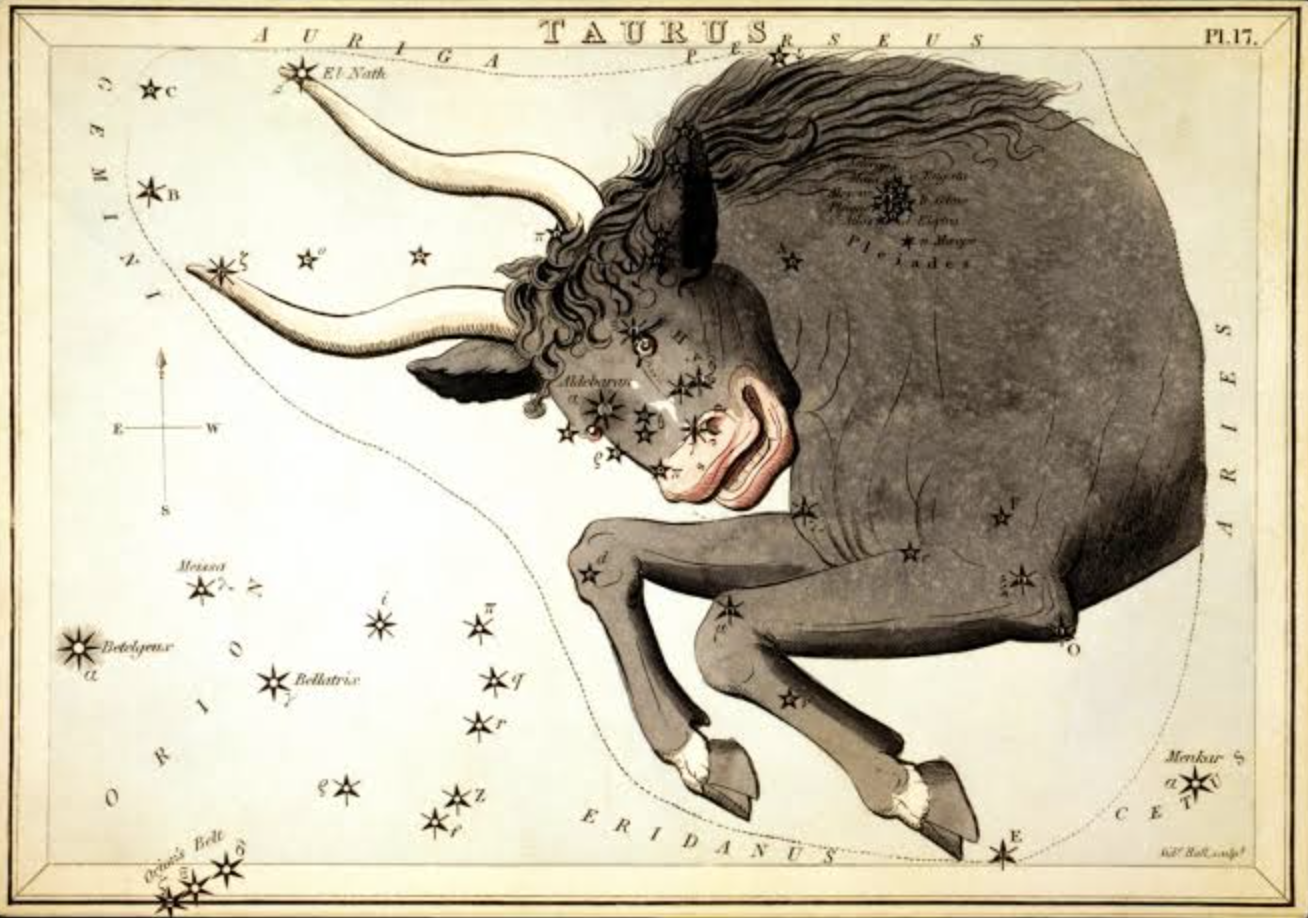
The Bull of Heaven takes many forms. Depicted in cave drawings from the Upper Palaeolithic era, writ in stone by the Babylonians in the MUL.APIN and the Epic of Gilgamesh, carved in ceilings by the ancient Egyptians, and mythologised by the Greeks, Taurus is perhaps the oldest constellation we have; as long as we have looked at the skies, we have watched our Bull of Heaven plow the spring soil into life each year. His terrestrial form has charged across Mesopotamia and the Aegean, been locked in legendary struggles against gods and demigods, defeated by the sun and triumphed over evil, and, eventually, placed high in the heavens to guard the gate of summer.
As the sun travels out of Aries and crosses into the constellation of Taurus, the world shifts from the raw, explosive spark of rebirth into the steady, fertile work of growth; a time for tilling the fields, honoring the earth, and harvesting the fruits of early labor. Taurus is the second Zodiac of the ancient world, though the first for the Hebrew world, and like Aries before it, it reinforces the bridge between practical, agricultural science and the grand mythologies that gave meaning to human life. For the ancients, the constellation of Taurus was unmistakable—dominated by the fiery red eye of Aldebaran and the glittering cluster of the Pleiades resting on his shoulder. When he finally rose in the morning sky, farmers knew the earth was warm enough to nurture seed, but sailors knew to read the stars with caution, for the Pleiades brought seasonal winds. This vital shift in the physical world is mirrored by a tale of divine power, earthly passion, and cataclysmic strength.
In the ancient Greek telling, the story of Taurus centers on Zeus, and his infatuation with Europa, a Phoenician princess of otherworldly beauty. One day, Europa was walking with her maidens along the Mediterranean shore when Zeus spotted her from Mount Olympus. He fell in love, but knowing that an overt, divine approach would terrify the mortal princess, and in order to avoid the gaze of his wife Hera Zeus transformed himself into a magnificent, snow-white bull and mingled with her father’s herds in a field nearby the beach. His hide was white as alabaster and glowed in the sun, his horns curved like crafted silver, and the small mark of a crescent moon mark glowed upon his forehead. Europa approached the bull, stroking his flanks, and weaving garlands of flowers around his horns. Encouraged by his docility, she climbed onto his broad, muscular back.
As soon as she sat, the bull bounded into the sea, and Zeus swam across the churning Mediterranean, carrying her from Asia to the island of Crete. There, revealing his true divine form, Zeus would rape Europa, with their union resulting in many children, including the future King Minos. Zeus made Europa the queen of Crete, and it is from her that the continent of Europe takes its name. To commemorate the mighty, gentle bull that had carried divine destiny across the ocean, Zeus immortalized his form in the night sky as Taurus. The story has all of the trappings of Greek mythology, Zeus up to no good in various guises forms the basis of so many tales, but we can see too how the story relates to the constellation, and the temporal promises it brings. As April ends, virility and beauty abound, winds come across the sea and bring with them new life, just as Zeus took the beautiful Europa to Europe and brought life to Crete.
Yet the story of the celestial bull reaches even further back into the dawn of history. In Mesopotamian lore, some thousand years before the Greeks, Taurus was the Bull of Heaven, sent down by the goddess Ishtar to destroy the hero Gilgamesh and the city of Uruk, bringing seven years of drought until he was defeated. Upon his slaughter, Gilgamesh threw his remains high up to heaven where he remained as a constellation. The rising of the sun each morning represented Gilgamesh, the sky once again becoming a tapestry that each night played out their battle. Across cultures, the constellation of Taurus has always embodied raw physical force, earthly abundance, and stubborn endurance.
For ancient stargazers, Taurus provided an indispensable marker of the year’s progression. His appearance signaled the peak of spring's fertility and the promise of summer's strength. The myth of Taurus reminded ancient humanity that nature possesses both a gentle beauty that entices us and an immense, unstoppable power that commands our respect. Still today, the mighty bull watching over the night sky stands as a testament to patience, strength, and the enduring beauty of the earth.