
The Economy Is The Medium Pt. I - The Market
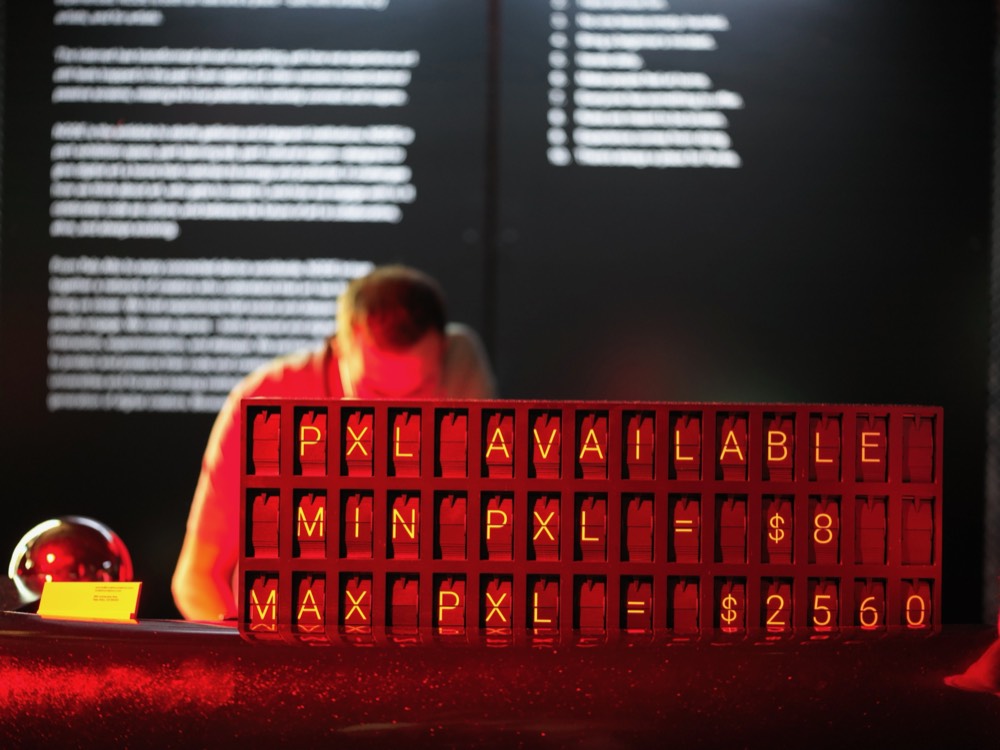
The front-desk price board at the opening — a split-flap sign reading PXL AVAILABLE / MIN PXL = $8 / MAX PXL = $2,560. The thesis image: the price is posted like a menu, not discovered at auction.
The only door into this economy is a front desk on University Avenue, and what it hands you is not a ticket...
1. THE ROOM
The only door into this economy is a front desk on University Avenue, and what it hands you is not a ticket. The show is free to walk through. "This exhibit is free to view," the docent says, in a script I heard rehearsed at the noon walkthrough, "but if you wish to participate, you can go to the front desk and purchase a pixel that will then be minted into the exhibition." The pricing is simpler than the split-flap board makes it look: every pixel costs the same fifth of a cent, at every rung of the ladder. Eight dollars buys the smallest card, 4,000 pixels; $2,560 buys the biggest, 1.28 million. Every step between buys more pixels at the same rate. House rules allow up to five cards a person. No bulk discount, no grades: the ladder measures appetite rather than ranks buyers.
Past the desk, daylight ends. Qian Qian built the entrance so you would "lose the sense of perspective in the larger than life PXL world." It is a new space constructed inside the room, dark as a camera body. Its wayfinding uses the graphic language of Kim's own website and the NET traits he drew. Even the signage is authored by the system it explains.
The screen at the center began the evening the way nobody had ever seen it: empty. "I've never seen that screen in an empty state," someone on the team said at the walkthrough; until that afternoon there had been nothing real to show. The contract cleared mainnet at 3:56 p.m. Pacific. The doors opened at 5:30. The composition's entire life fit inside that gap. When the room filled, the screen was still black: a billion-pixel economy, open for business, holding nothing. The first injection was waiting for the audience.
Tapping your card initiates a transaction, and the docent's script is precise about the part that matters: the exact moment you tap affects what you will see. A spotlight finds you where you stand. Your pixels join a queue. Every fifteen minutes the accumulated mints inject into the composition in a single batch, arriving the way Kim designed them to arrive: not sliding in flat from a corner but descending "like a ring coming down… a natural phenomenon." For the first injection of the night they suspended the cycle entirely, so the opening beat could be conducted rather than scheduled. When it came, most of the room just stood and looked around. Live minting is built to be felt, but wiring what your senses report to what a chain just did is not yet anyone's reflex. The first beat landed the way new rituals do: awkward, and energizing for the same reason.
The wall is twelve thousand pixels wide. At the VVIP hour Kim stood in front of it and gave the room its owner's manual: the groups his pixels cluster into, the tweens that morph them, the five camera modes ("inspired by real camera movements"). Mid-sentence, a stray artifact bloomed across the composition. He handled it the way you can only handle a thing you have total title to: "This is new data that comes not exactly from my code — the system is so complex. It's not my fault. When it's doing this, just ignore it for a moment." The room laughed. The work went on computing. "This work is new," he said. "We just started here from zero, and I hope it grows further."
At nine the artist becomes the DJ: one hour of techno in the garage, the party the room's designer told me, in writing, "isn't part of the PXL ecosystem." If the economy stops at the garage door, the practice does not. "The music I played," Kim said at the artist talk the next day, "was one hundred percent generated. It was my own code creating the music… no samples… I designed every instrument." Even the party fenced outside the work was made of the work's material. Selling still has a closing bell: the pixels stop at ten. The building, someone said, stays open "until we mint the last pixel tonight." By midnight, seventy-five million pixels had entered the vessel: 75,030,254 of a 128-million capacity.
The economy is not how the work is sold. It is what the work is made of.

2. WHAT PXL ACTUALLY IS
Kim Asendorf did not put an artwork on a token. He made the token the pigment. Ask him what a pixel is and he'll give you a koan first: "a point of light, but not a classic point of light, which is usually a circle. The pixel is a rectangle. It's almost absurd in itself: how can a light be rectangular?" Then a childhood memory: the Nintendo Entertainment System, screens where every pixel was two millimeters of visible rectangle. "An aesthetical choice, not an ideological choice — it's very personal. I just love it." His whole display philosophy fits in one sentence: "one pixel is exactly one LED… if the pixel really is at the right spot, it's so beautiful in itself. That's the pixel I'm looking for." And the ownership claim underneath the tokenization is an authorship claim: "My pixels are special because they do what I want — I trained many, many years… that's when they become my pixels. I don't use a JPEG and see them as my pixels just because they're on my screen. I created them. And now I tokenize them." The token, in other words, is "a statement that the pixel itself is worth to be tokenized." He has spent his career on the thing everyone else treats as invisible infrastructure, and the contract is how he signs it.
PXL is a fixed supply of 1,024,000,000 pixels, written into a smart contract before any image existed. That number is the first compositional decision. Kim once told his studio the cap was "the first contract I made with myself." Then, on camera in the pre-opening interview, he corrected his own epigraph. It was the first of several corrections that would alter this account: "It's not exactly the first contract — I've written blockchain contracts for other works — but it's a contract that is bigger than just a single work. A super contract." One that "sets a limit of how far I can work with that topic." The limit measures a budget for a body of work rather than a countdown to an ending: "how many works under this umbrella can I do?" And a contract with yourself, as we will see, can still leave choices to its author.
Three surfaces draw down the one supply. Kim said it plainest to the opening-night room: "all these works you are seeing here tonight are using the same pixels… they are interchangeable. You can take the pixel out of one work and put it into another, if you own it." PXL DEX is made up of 256 works, each an embedded reservoir you can fill and drain; the image's density moves with its balance, and a drained deck goes black. PXL POD is 256 more that only watch, built, in Kim's words, "to prove the point that the PXL token… can now be used in the second work." PXL NET is the one-of-one that opened at NODE on July 11. Kim described it to me in March, mid-build, in one sentence that contains the whole design brief: a new system whose goal is "as many pixel as possible," where "that comes with limitations, that hopefully lead to new ideas and visuals." Capacity first, then the constraint, then the form.
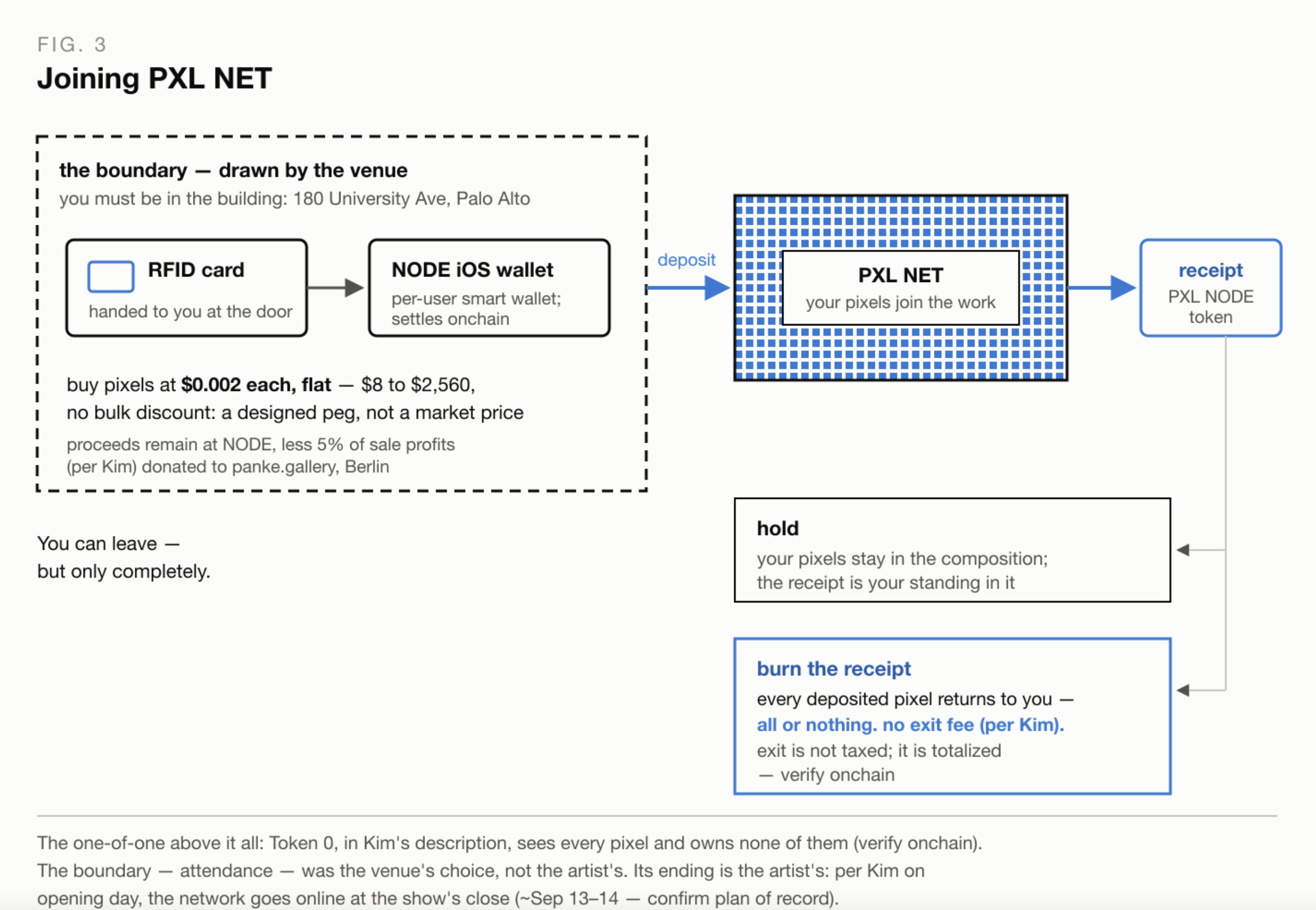
Token 0 is the network itself: in Kim's description, it sees every pixel in the system and owns none of them. You join by depositing pixels; you get a receipt, a collection called PXL NODE, though your pixels may not form a discrete node of their own. Kim, walking me through it on opening day, explained that even a large purchase "will appear as single pixels and join existing nodes — so you cannot say that you really created a node, but you still build out the network with your new contribution." You buy in and the network decides what you become. "Pixels should never be locked somewhere. Whatever you do here, even if you buy these pixels, you become just a lender to the network. You can get your pixels back out if you want." You can leave, but only completely. There is no exit fee. On opening day I asked whether a fee could ever be added later, and he closed the door entirely: "It cannot be added… I made it free." Token 0 and the pixel ledger are separate code bases: the one-of-one renders the network but lives entirely outside it, holding no position in the thing it sees.
And one more design fact, stated to me plainly: who will hold Token 0 is not disclosed, on purpose. The work's center is a witness whose owner declines to be witnessed.
The witness token cost five dollars to deploy. Kim told me so the day before the POD mint: "just paid $5 to deploy the contract and ~60kb data" — twenty-two and a half kilobytes of it the DEX code itself — and I keep coming back to that number: a billion-pixel market, a designed death, a peg, a witness token, sixty kilobytes, five dollars. The materials bill of the medium. The medium stayed wet until the last minute. At noon, walking the finished room, I heard Kim say the NET contract was still one test away from mainnet: "mainnet deployment is crazy shit." At 3:56 that afternoon it landed, block 25512504, contract name "Net," total cost about a dollar. It did not go quietly. Two contracts had to land in sequence (an onchain SVG renderer first, then Net, which needs the renderer's address), and mid-deploy his script threw an error. "That means super crash," he told Amanda afterward, still coming down from it. The chain was fine; only his waiting code had blinked. "Nerve-wracking every time." Ninety-three minutes before the doors, the artist emailed me the address, one line, no commentary. The billion-pixel economy's final surface cost less to deploy than the sandwich he'd eaten while testing it.
The sale is as designed as the contract: venue only, RFID cards, a NODE iOS wallet, the same flat peg from the front desk. The contract itself enforces each deposit between 4,000 and 1.28 million pixels. NODE's tagline for all this is NETWORK MAKES ART WORK, which the show means literally.
3. LONDON, JULY 2022
In the summer of 2022 the most alive room in digital art was a minting floor. Bright Moments, the gallery I founded, had built its whole model on a single inversion: the moment a generative artwork comes into existence (the transaction itself) could be an event you attend. Minting live onchain wasn't new. Art Blocks had made the long-distance reveal a genre. Bright Moments' invention was staging the mint in person: a room watching the transaction become the work. The CryptoVenetians in Venice Beach in 2021, a thousand tokens generated one at a time in front of the people who claimed them, were the proof. You stood in a room in Venice Beach or Manhattan; your city's token was generated in front of you, and the market was the evening's program. We were minting our way around the world, city by city. That July we were in London for Proof of People week at 18 Albemarle Street. The European chapter begins there: we brought the European artists over to mint their CryptoLondoners in person (Zancan, Ciphrd from fxhash, Andreas Gysin, Kim himself). That week is when I first met Ganbrood. They came to see what a live mint felt like.
That is also where I met Kim Asendorf. The first thing that ever passed between us was, fittingly, a provenance problem. He'd minted one of the London tokens, and it landed in the wrong wallet; I spent part of the next day getting it back to him. The relationship opened with the two of us staring into a ledger, fixing where a thing actually lived. Two months later he came by our Berlin gallery during Art Week. Bright Moments was setting up shop inside the European scene just as the scene was deciding what it thought of crypto. The person receiving him there was Malte Rauch, who would later conduct a still essential published interview with Kim.
Hold the personnel in mind. In this story the people barely change; only the economy underneath them does.
"The artist supplied the algorithm; the venue supplied the market: the mint mechanics, the pricing, the city token, the roadmap. Kim was, in the truest sense, showing work inside someone else's system."
4. WHERE KIM COMES FROM
Start with where he comes from, because the show's confidence does. Kim Asendorf was born in 1981 in Achim, near Bremen, and came to art through the machine room: an industrial electrician's training, a few semesters of technical informatics at the University of Bremen, then the Kunsthochschule Kassel from 2006, in Joel Baumann's new-media class, classical art training with a soldering iron in it. His standing came the institutional way: transmediale in Berlin, ZKM in Karlsruhe, Eyebeam in New York, DAM Gallery representation, a Schloss Solitude fellowship. Nothing in that résumé is crypto-native: the ledger arrived two decades into a career embedded in Germany's digital-art institutions, which is why a writer and curator like Anika Meier, who has curated him and argued for his work inside the German scene, keeps appearing in this account.
By the time he walked into Albemarle Street, Kim had spent fourteen years testing systems until they showed their structure. In 2008 he uploaded roughly twenty thousand numbered images to Flickr through its API, as a performance, until the platform locked the account. This gesture contained the career to come: a system pushed to its structural limit, the limit made visible, the artist moving on.
In 2012 he open-sourced pixel sorting, the technique that made his name, and then made a thousand other artists' names. Free, forever. He put the algorithm on GitHub "without any license, for anybody… I had no clue… learning by doing," made a few images with it and moved on, in the mood for "more experiments" rather than "using one finding to create the perfect work, which probably other people have done with the algorithm." They did: it became an After Effects plugin, then an Apple commercial, then television title sequences. "I've seen it everywhere. I didn't see it coming."
That is also the year Casey Reas first came across his work. Kim was showing at DAM Projects in Berlin, a gallery Reas was working with at the time. Reas, who has watched this medium longer than almost anyone, places him in a lineage older than any market: "a group of artists, mostly European, who are thinking about the medium itself, working in the traditions of materiality," the digital descendants of the architect asking the brick what it wants to be, the painter using paint for its properties.
Thirteen years later, with PXL, he capped a supply. Closed, forever.
Open technique, closed economy. I think he spent two decades learning that in computational art, the technique cannot be owned but concluded that the economy can. The record complicates that neatness: in 2011, a year before the giveaway, he was already running GIF Market, where pixel scarcity set pixel prices, as Brian Droitcour notes in NODE's own essay for the show. The market instinct and the open hand coexisted from the start; what changed was which one got the contract. When the question of whether the inversion was deliberate finally reached him in the afternoon interview, he answered that 2012 was "without any license, for anybody… I had no clue… learning by doing," and 2025 is the super contract. The giving away was innocent; the capping was a decision he had spent the thirteen years in between learning how to make.
His old peer Andreas Gysin locates the achievement elsewhere entirely: "I've never seen particle systems like this before… he innovated the language which for me is the highest achievement for an artist." The day everyone agrees about what PXL is, it will have stopped circulating but Gysin gave me the formal version of my arc, and it is better than mine: in the old feedback work, "by smearing, pixels are created and destroyed… in the PXL series the individual pixels are just 'offset': the amount of elements is unchanged." The early work destroyed and created pixels freely; the mature work conserves them, rearranging a fixed population. The image grammar is the economic grammar: nothing is minted or burned in the picture, and the picture's economy is a hard cap. Conservation governs the aesthetic and the tokenomics at once, the same rule written twice: in geometry and in supply.
5. TOKYO, 2023: THE MARKET AS AN EVENING OUT
Before that rule was written into a contract, it was tested inside a market neither of us controlled alone. The high-water mark of the live-minting model, for Kim and for us, was Tokyo. In May 2023 Bright Moments took over a space there for a week, and Kim shipped Event Horizon: thousands of works minted live across the event, the collectors physically present, and at the end of one night his freshly minted pieces, piped live through a TouchDesigner rig, performing on the screens of the Womb nightclub while the room danced. It was supposed to be nothing more than a party yet it laid the groundwork for every IRL experience that followed. In my own notes, I described that era as the moment we turned art into entertainment, and I don't use the phrase as an apology. It worked. The economics of it were legible to everyone in the room: you came, you minted, you owned, and the party was the market's own liquidity made visible.
But notice who owned the economy. The artist supplied the algorithm; the venue supplied the market: the mint mechanics, the pricing, the city token, the roadmap. Kim was, in the truest sense, showing work inside someone else's system. What he took from that era, I now think, was a working diagram of the machinery: who holds the mint, who sets the price, who owns the door. When I finally asked him what the live-minting years taught him about who should hold the mint, he answered a warmer question than the one I meant. I was asking who should run the machinery; he answered who deserved to use it: "People who speak to me about the work and the art… who want to learn about it, instead of whatever is going on in any markets. You learn over the years who's really interested — who's even gaining something from it. Not financial gains, but emotional gains." He answered my infrastructure question with a lesson about company. Collectors, he said, "become some kind of spiritual relatives… collectors are basically funding my time. I use funds to buy time."
6. THE GRAVEYARD, 2023–2024
In 2023 through 2024, the tide went out. The NFT market's long collapse hit the live-minting model precisely where it was strongest: the market as an event needs an audience that keeps showing up. By 2024, the crowds and floor prices were both thinning. This was Carlota Perez's trough, where the froth drains out and whatever is structural has to prove it can live without it. Inside Kim's practice, the collapse appears as a run of collaborations that never shipped as events, each leaving a component behind.
ASDF (2023): the generative streetwear brand, partly incubated in the Bright Moments orbit through months of conversations. 2023-Kim kept the brand token deliberately away from the art market. He was, on the record of those sessions, anxious about a "weird synergy" between his art career and a commercial token. 2025-Kim erased exactly that line. jiwa's 2026 read is the better epitaph: PXL is "both a contract and a brand… You need the two together, the unit and the implementation."
BM25 (2024): my part, so let me show my work. In July 2024 I presented a slide to the Bright Moments artist cohort: a single installation as an ecosystem of related tokens, a 1/1 at the top, "parent of all the tokens lower in the pyramid," editions below, a billion-unit penny token at the base. The one-of-ones had a name and a designer: ten Generators, Qian's design ("physical embodiment of cryptographic keys," the tokenomics draft called them), and one of the mockups already imagined Kim's work. The Kraftwerk space plan labeled its two floors straight out of Eric Raymond: Level 2, CATHEDRAL; Level 0, BAZAAR. On the July 19 call (Kim, Qian Qian, Phil Mohun, Gysin, and John Gerrard all present), I said it in one breath: "going back to the Eric Raymond essay… I've talked about a barbell. A few one of ones and a billion fungible tokens." The same draft had a credit card becoming a smart wallet at the door and unused tokens converting to digital art at the close. Across those months the calls read like a cohort portrait: Sarah Meyohas, DEAFBEEF, Matt and Holly, Mario Klingemann; Jana was part of the conversations too, and of course, so was Kim. On the July recording, he was thinking out loud: "I'm not so sure if I really want to think about an artwork as an installation or as a one of one and then also have the possibility to create various… let's call it subtokens."
The resemblance shows a shared design problem rather than causation. Ideas this size move through rooms, not from slides, and the honest genealogy runs through Kim's own career first, then through everything this cohort had been rehearsing together since the CryptoVenetians: live minting as ritual, Kraftwerk Berlin in 2022, London, now NODE. The record shows that BM25 never happened, and six months later PXL DEX capped its supply at 1,024,000,000 interchangeable tokens. Two years later (eight days short of it, to be exact), PXL NET opened a venue-gated economy: cards at the door, per-user wallets, deposits becoming objects, under a 1/1 that sees every token in the system. The shape is recognizably the barbell, with one decisive difference: BM25's one-of-one was a parent that owned the pyramid beneath it, and Token 0, in Kim's description, owns nothing at all.
The honest version was always a question. In the finished room, with the 2024 slide on my phone between us, I finally asked it: you were skeptical of one-of-ones with subtokens, what changed? He didn't flinch: "Basically we are there, right." Then he corrected the shape, the way everyone in this story corrects my shapes: "The generator is a master algorithm and the little things are just subsets of it — but not the same… smaller outputs from a bigger system. And yeah, maybe that is what you also had in mind." The barbell survived but the ownership relation was inverted.
The week before the opening he rewrote the whole camera system. Qian counted a hundred hours of fine-tuning. The documents establish something narrower, and better: a continuity of ideas. The same design problem was articulated, dated, and witnessed inside one cohort, with the artist in the room, before the contract was written. This was not a chain of custody but a conversation the cohort kept having until the one artist who could finish it did.
Pixels, Art Basel Miami (2024): 51,200 pixels, 24 cubes, a live mint, designed to be staged at Art Basel Miami itself. We worked it from summer into fall, with Kim, Phil, and me in Paris meeting the Art Basel team. At a dinner at Ian Rogers and Hedwig's apartment during the October fair, with Snowfro and Raoul Pal among the guests, Kim opened his laptop and showed the first version of PXL DEX: monograms, rainbows, 3D. By November the Miami project was called off (the capital wasn't there and the market was soft), and Bright Moments showed the Dream Machine at the fair instead. Kim skipped Miami in person entirely, and when DEX arrived that winter, the mint was online-only. It was a working hypothesis, to be tested in the room and not asserted: DEX is Pixels rebuilt on the artist's own terms. Even the name compresses.
CLUB, Kraftwerk Berlin (2025), the collaboration that refused to die: one algorithm for a whole building, a listening chamber minting a generative album, a one-of-one auction aimed at institutions. Unrealized as an event, but on New Year's Day 2026 I told Kim "CLUB at kraftwerk is still a great dream to realize," and he was already coding Rust audio and trading demos with Richie Hawtin. In hindsight the chamber looks like POD's ancestor, and the institutional auction like Token 0's, a lineage Kim has not yet confirmed, so read it as resemblance, not causation.
None of it was failure. The fungible base from BM25, the pixel-unit from Miami, the brand-and-contract lesson from ASDF: the components reassembled inside a structure no institution could break.
The deal is the contract, and the artist wrote it.