
The Quantum Dadaist
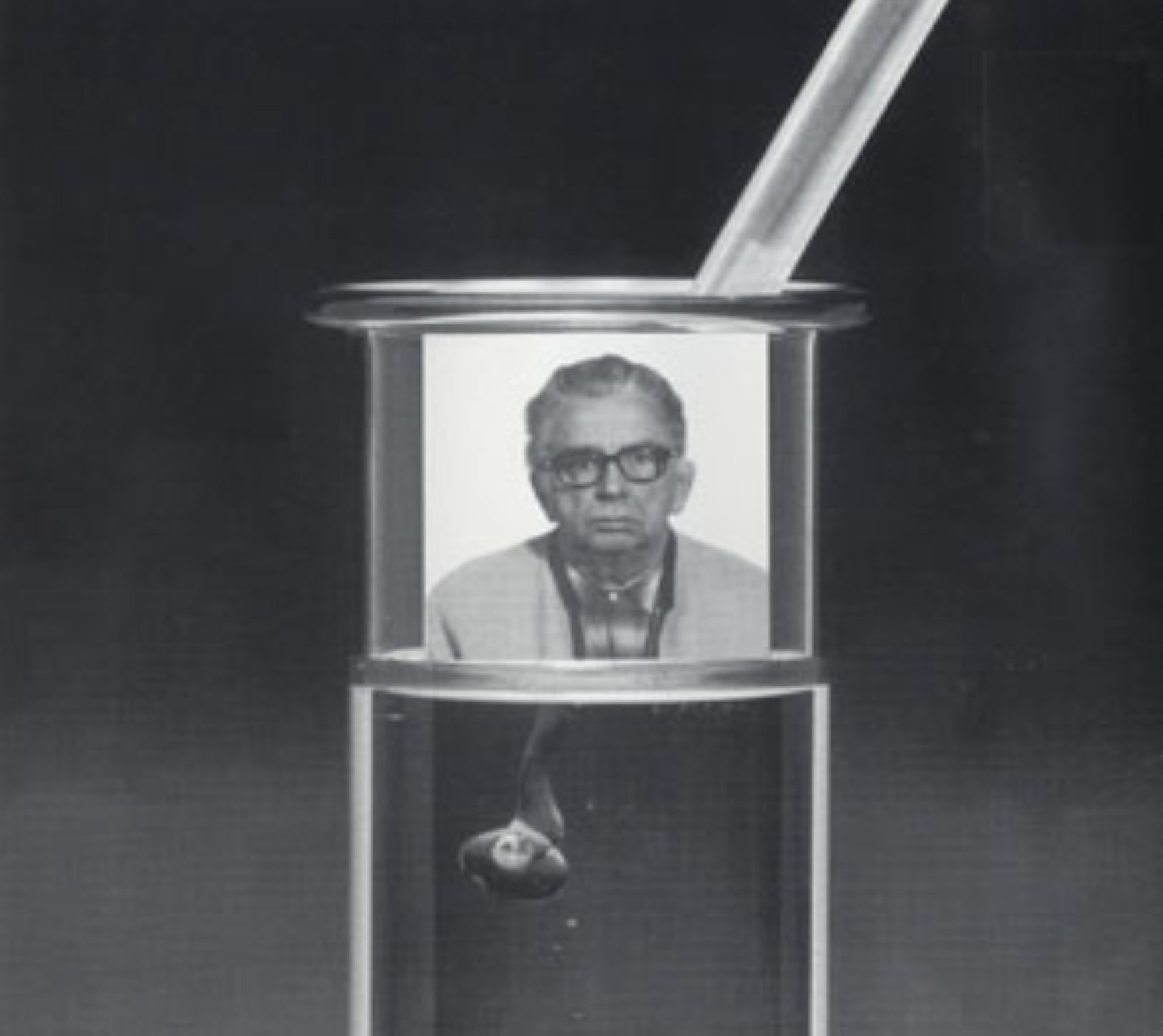
The history of the twentieth century contains few figures as unclassifiable as Bern Porter. To the academic establishment, he was a bizarre anomaly: a brilliant nuclear physicist who walked away from the Manhattan Project to publish Henry Miller, pioneer mail art, and transform commercial trash into radical visual poetry. To the artistic avant-garde, however, he was a visionary prophet, a quantum Dadaist who synthesized physics, technology, and aesthetic rebellion into a singular philosophy he dubbed Sciart. Art critic Peter Frank famously observed that "Porter is to the poem what Marcel Duchamp was to the art object, a debunker of handiwork fetishism." Yet despite quietly shaping mid-century counterculture, Porter spent much of his ninety-three years on the far margins of American life, an irascible iconoclast who insisted that art was something to be found, lived, and distributed without ever asking for permission.
Porter’s journey into experimental art began in physics laboratories. Born in Maine in 1911, he studied physics at Colby College and Brown University. While conducting graduate research at Brown and working on cathode-ray tube technology for the Acheson Colloids Corporation in New York during the 1930s, he frequented museums, absorbing the found-object aesthetics of Marcel Duchamp and Alexander Calder. A corporate trip to Paris in 1937 brought him through instinct to Gertrude Stein’s salon. Listening to what he described as the "carved, sculptural flow of her language," Porter found a structural template for his later performance poetry. By the late 1930s, he was moving seamlessly between elite scientific circles—working alongside Albert Einstein and J. Robert Oppenheimer on uranium isotope separation—and the bohemian arts community.
On August 6, 1945, the detonation of the atomic bomb over Hiroshima shattered Porter’s faith in pure science. He resigned from the nuclear weapons program almost immediately. Reflecting on his departure, Porter noted that his exit "wasn't wholly from guilt... my reaction from destruction was simply that I had to do something constructive with what limited talents and funds I had." Biographer James Schevill, in Where to Go, What to Do, When You Are Bern Porter, framed this departure as a pivotal moral pivot toward pure creative output. Diving headfirst into the Bay Area cultural scene, Porter became a vital catalyst for the San Francisco Renaissance. Operating Bern Porter Books and co-editing the vanguard literary journal Circle, he championed anti-war literature, bringing out Henry Miller’s Murder the Murderers (1944) as Miller’s first American book release, alongside early works by Kenneth Patchen, Kenneth Rexroth, and Robert Duncan.
In 1948, Porter established the Schillerhaus in Sausalito, California—a "house of creative thought" where he drafted early iterations of his Sciart Manifesto. Porter argued that technical fields like physics and electronics should not be separated from humanistic expression. He envisioned Sciart not as a mere blending of two distinct disciplines, but as an urgent, systemic fusion designed to heal the dangerous rift between scientific rationale and artistic ethics. In Porter’s view, Western civilization had allowed technology to advance without a moral or poetic compass, culminating in the horror of the atomic bomb. Sciart was his conceptual corrective. He proposed that artists adopt the rigorous experimental methodologies, structural mechanics, and materials of modern science, while scientists adopt the emotional depth, moral intuition, and creative freedom of the arts.
As he articulated in his seminal treatise I've Left: A Manifesto and a Testament of SCIence and ART, physics allows poetry to break free from standard linear typography, expanding into spatial, visual, and environmental mediums. Porter argued that just as the splitting of the atom redefined humanity's understanding of matter and space, artistic expression had to explode past the boundaries of the traditional printed page. Sciart demanded that the artist engage directly with the physical universe—utilizing light, radiation, cathode rays, architectural space, and mechanical diagrams as legitimate artistic media. Language, under the Sciart framework, ceased to be merely a vehicle for narrative; it became a physical material to be analyzed, manipulated, and reorganized like atomic particles.
This philosophy reached its practical peak in his mastery of the found poem. While earlier Dadaists used collage as an intuitive or accidental technique, Porter elevated the practice to a methodical, quasi-scientific experiment. He harvested advertisements, technical manuals, discarded blueprints, corporate slogans, and junk mail, reframing typography and graphic layouts as visual poetry. Through Sciart, these discarded artifacts of industrial capitalism were subjected to a process of aesthetic isotope separation. By stripping commercial text of its original functional context, Porter exposed the underlying absurdities, consumerist anxieties, and propaganda of Cold War technocracy.
In The Manhattan Telephone Book (1972), he applied this methodology on a grand scale, transforming pages of dense phone directory entries into a stark commentary on modern isolation, data saturation, and human anonymity. Similarly, his work Waste-Maker: 1926–1961 treated the printed byproduct of American consumer culture as geological strata waiting to be excavated. Simultaneously, Porter pioneered mail art as a decentralized, gallery-free delivery system for Sciart—using the international postal network as a massive, open-source laboratory for exchanging experimental prints, broadsides, and rubber-stamp art beyond the reach of institutional gatekeepers.
Despite his brilliance, Porter’s life was continually disrupted by personal trauma, political friction, and a famously difficult personality. Following a painful family crisis in 1950, he fled the country to spend five years in Guam and the South Pacific. Upon returning, his prickly nature and extensive FBI surveillance made technical employment unstable. He spent years oscillating between the two halves of his identity, taking short-lived technical positions, making brief moves to Tasmania, attempting to teach high school, and eventually taking a position at the Marshall Space Center in Huntsville, Alabama, working on NASA's Saturn V rocket.
In 1967, his tenure in the space program came to a chaotic end following an event the full truth of which remains elusive. Porter was out walking when a police cruiser pulled up alongside him; startled, he fell over, was taken in for drunkenness, and was arbitrarily committed for three weeks to an Alabama state mental institution. Diagnosed with a paranoid personality, he was promptly released, but the federal space program could not retain a security risk with a psychiatric record. Following a brief sojourn in Guatemala, Porter returned to Maine for good.
Settling in Belfast, Maine, Porter established his home as the Institute of Advanced Thinking, effectively turning his living space into the ultimate three-dimensional Sciart installation. The Institute functioned as an uncompromising, living found sculpture that challenged every norm of domestic life. Porter stored research papers, manuscripts, and small assemblages inside his unused stove and refrigerator, constructed an orgone accumulation platform in his backyard inspired by the fringe psychological theories of Wilhelm Reich, and invited visiting scholars into an environment entirely divorced from institutional control. He maintained strict, unorthodox entry rules: university affiliation automatically disqualified applicants, and visitors were forbidden from using his kitchen or bathroom.
In his final decades, Porter lived as a fierce local gadfly and town eccentric, authoring a controversial 700-page regional planning report attacking real estate speculation, running an unsuccessful primary campaign for governor, and subsisting largely on soup kitchens and food scavenged from local art openings. Summing up his interactive, sensory philosophy toward art, Porter insisted in 1982 that "things of mine are meant to be touched, sensed but not read or understood mindwise, though pronouncing out loud is useful."
When Porter died in 2004 at the age of ninety-three, his passing was marked only by a short obituary in a local Maine weekly newspaper. As his longtime collaborator and performance partner Mark Melnicove observed, "What he got interested in—found poetry, visual poetry—in the world of literature, it's the least celebrated form." Yet as James Schevill wrote, "In the end, Porter himself becomes a Found." By depositing his extensive archives across institutions like Colby College, Bowdoin College, UCLA, the Getty Research Institute, and the Maine State Library, Bern Porter ensured that his legacy as a quantum Dadaist—a man who refused to separate the splitting of the atom from the creation of a poem—would survive on his own uncompromising terms.