
Work Is Love Made Visible
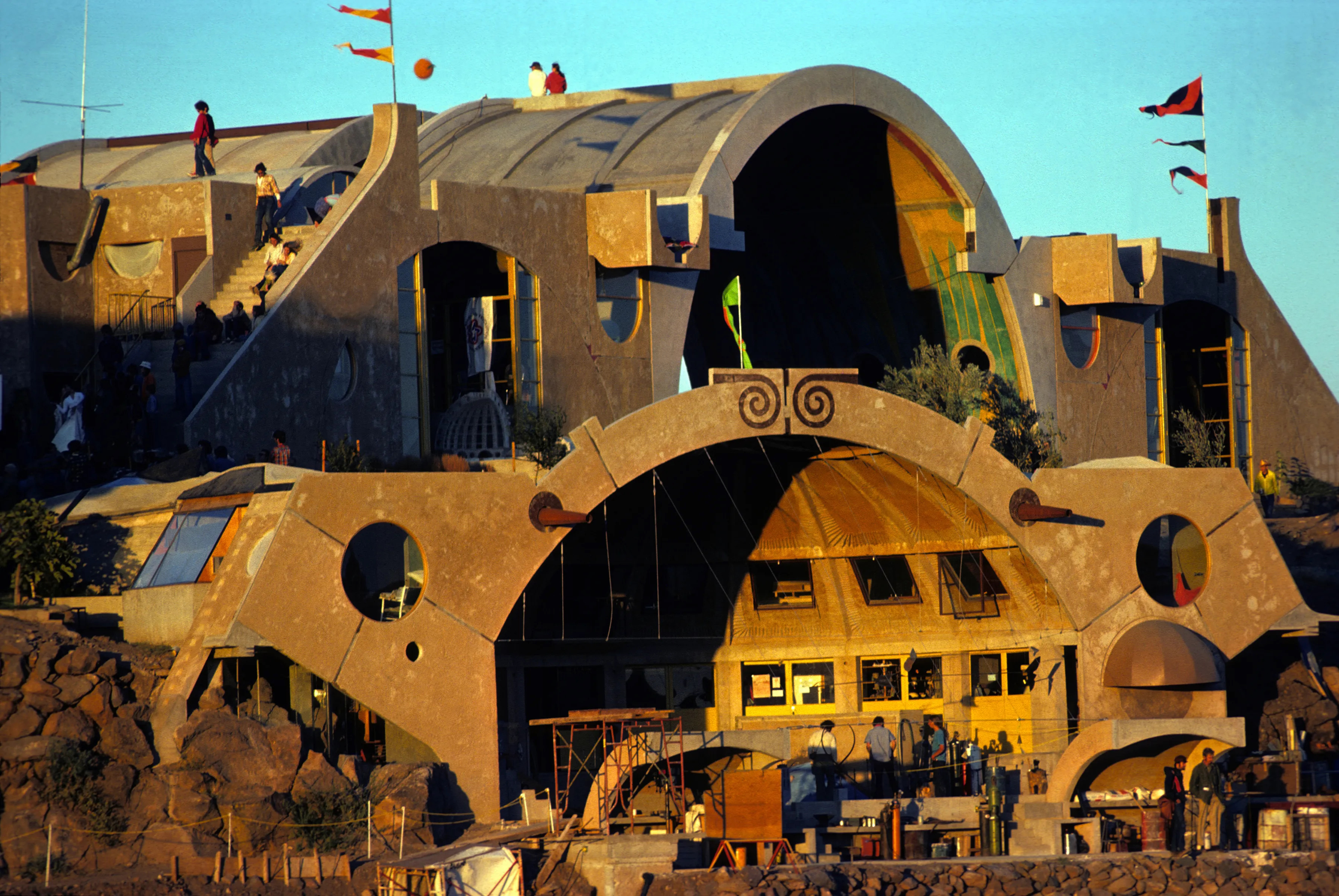
The Bauhaus architectural school was in its infancy when Khalil Gibran first published The Prophet and penned the words ‘work is love made visible’. It was 1923, and Gibran could not not have imagined the structures that would emerge from the new building materials coming out of the 20th century, like concrete, glass and steel. These words were shared recently, by the Arcosanti Board President and Chairman John Walsh during a speech at the 2017 FORM Festival, an experimental arts and music festival taking place at Arcosanti, the Brutalist architectural wonder between Phoenix and Sedona, Arizona. Both architecturally and ecologically, Arcosanti and the ongoing work to keep it thriving, succeed in making love visible in every detail.
Designed by the Italian architect Paolo Soleri, who had moved to the US to study under Frank Lloyd Wright, Arcosanti was imagined as a vertical city built to lessen the impact of human habitation on the ecosystem. Soleri coined the term ‘arcology’ to describe the concept, a portmanteau of architecture and ecology to demonstrate how the two could work together to strengthen each other. Examples of this abound around the property - flower beds built into sections of the amphitheater, multi-tiered gardens following concrete steps down the canyon Arcosanti is built into, a fully developed food forest spread across those garden beds, as well as orchards and greenhouses. Residential agriculture classes are offered onsite, where guests can spend up to four weeks learning how to work with the local ecosystem to grow food in the desert.
Soleri believed that the concept of a city needed reinventing in order to advance civilization, saying, “Unless we moderate, unless we reinvent the American dream, then it’s not going to be a dream. It’s going to be a doomsday.” Building with the intention of harmonizing man-made structures with nature may seem obvious, but it requires an epistemological shift in approach that runs counter to the American, capitalist culture of instant gratification. Soleri’s warning seems increasingly imminent, and as increasingly extreme and unpredictable weather continues, yielding to nature becomes the only choice, because being in harmony with it becomes logistically and financially impossible.
Perhaps this is a clue pointing towards what evolution is demanding of us at present, and it seems best understood through the lens of seeing work as an act of love. Gibran wrote, “You work that you may keep pace with the earth and the soul of the earth. For to be idle is to become a stranger unto the seasons, and to step out of life’s procession, that marches in majesty and proud submission towards the infinite. When you work you are a flute through whose heart the whispering of the hours turns to music. Which of you would be a reed, dumb and silent, when all else sings together in unison? Always you have been told that work is a curse and labour a misfortune. But I say to you that when you work you fulfill a part of earth’s furthest dream, assigned to you when the dream was born. And in keeping yourself with labour you are in truth loving life, and to love life through labour is to be intimate with life’s inmost secret.” Can we reinvent the American dream simply by adopting such an attitude?
If you need an attunement to that attitude, look no further than the Arcosanti residents and extended community members - Arconauts as they call themselves. Soleri believed that redefining what the American dream means is an essential first step to being able to design infrastructure and new ways of being to support it. The Arconauts are living it every day and sharing it in the mission statement of the Cosanti Foundation, founded by Soleri and his wife in 1965. The name blends two Italian words - ‘cosa’ and ‘anti,’ literally meaning ‘before things.’ Before there were material things, there were people and there was nature. Through its work, the Cosanti Foundation asks the question, what are the material things that best serve the people and the ecosystem they dwell in? Buildings and tools that facilitate harmony seem like the first answers.
In that spirit, Arcosanti has one famous export - bells. As a harmonizing tool, bells have taken their place in human history often as the centerpiece of urban communities in the form of a bell tower. The bells at Arcosanti’s have a sound and aesthetic distinctly unique to them. In a show specifically designed for this year’s FORM festival, Lorde incorporated a tower of Arcosanti bells, and wore what looked like a suit of armor made of bells across her chest. In his book A Glance At The Future, Gibran described bells as being, “...moulded in the metal of emotion and poised above the holy altar - the human heart.” This dedication to harmony, completely fearless of the work required to bring it into Earthly form, can start simply by believing it’s possible. Arcosanti itself, the bells, FORM Festival, and the Arconauts who make it all possible, are symbols of that attunement.
Gibran asks, “And what is it to work with love? It is to weave the cloth with threads drawn from your heart, even as if your beloved were to wear that cloth. It is to build a house with affection, even as if your beloved were to dwell in that house. It is to sow seeds with tenderness and reap the harvest with joy, even as if your beloved were to eat the fruit. It is to charge all things you fashion with a breath of your own spirit. And to know that all the blessed dead are standing about you and watching.” May we continue to honor each other, our planet, our ancestors and all of life by attuning ourselves to the attitude of making love visible and harmony possible through thoughtful, fearless, artful work.