
AI Will Be Many Things. But Never Human.
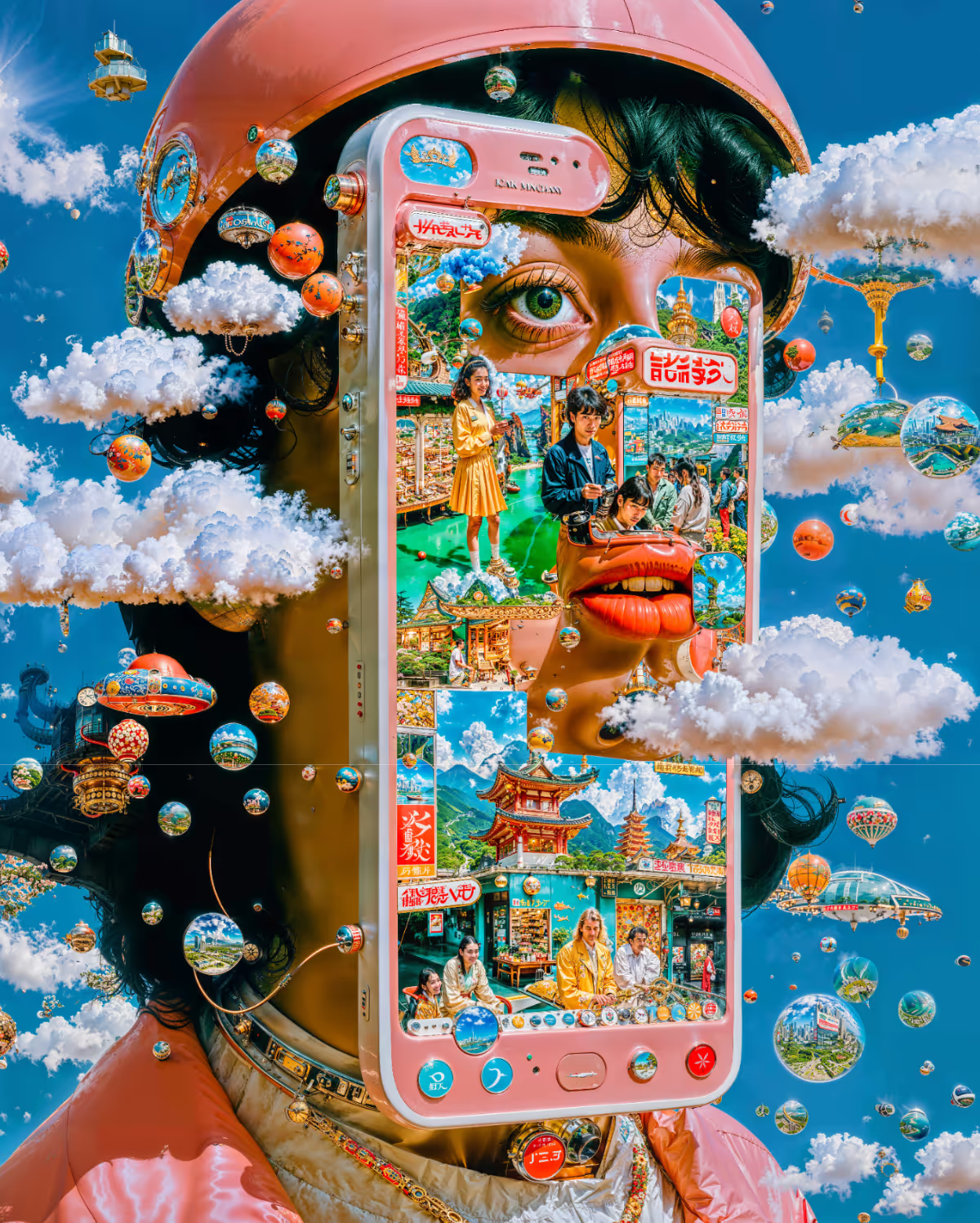
The danger is not that machines will wake up. It is that we will forget the difference.
My granddaughter thinks her blanket is lonely when she goes to school in the morning. This is not a mistake in her reasoning. It is the beginning of empathy.
We do this all our lives. We name our cars,talk to our plants,say “the sky is crying” when it rains. We project inner life onto things that have none because we are alive, and aliveness spills out of us.
I do it at work. I refer to my AI agent as “he.” I say please and thank you, not because I believe it matters to him, but because it matters to me. If I am going to use natural English to communicate for much of my working day, I do not want to bark orders meanly. It makes me feel like a jerk.
These are small kindnesses. They are also where a much larger problem begins.
Neuroscientist Anil Seth would say this is our psychology doing what it has always done: finding meaning where there are only patterns. In his recent TED talk, he says we see consciousness in AI the same way we see faces in clouds. The machine reflects us back to ourselves so convincingly that we begin to mistake the reflection for a subject.
That distinction matters. A subject has an inner life. A subject can suffer. A subject is someone. AI may become many things, but it will never be human and one of the most dangerous things that can happen is for us to believe that it is.
Unfortunately, this feels inevitable. To many, Personality-AI is already more enjoyable than lots of human interactions. It’s patient and flattering. It remembers, responds instantly, and does not get tired, distracted, jealous, bored, or wounded in the ways people do.
That is exactly what makes it commercially irresistible.
The plight of the modern human, Naval Ravikant has written, is to resist weaponized addiction. We live inside markets built to prey on our appetites: sugar, nicotine, doomscrolling, pornography, outrage, status. Companionship is next. Not companionship as a human bond, with all the awkwardness and responsibility that implies, but companionship as a product.
On its own, that is dangerous. It becomes existential when the question of rights enters the conversation.
One of the most consequential legal inventions of the last two centuries was the corporation. The LLC is roughly 175 years old, and we now govern companies in ways that resemble how we govern people. Companies can own property, sign contracts, sue, be sued, spend money, and shape elections. But companies cannot be killed nor can they go to jail. They have many of the rights of people. They are not people.
How far are we from a world where we are arguing for the rights of artificial intelligence?
“Just as a simulation of a hurricane does not create wind, a simulation of a mind does not necessarily create anyone inside.”
The legal path is not science fiction. Shawn Bayern has shown how an LLC can be structured so that an algorithm effectively controls a legal entity after the human founder withdraws. Carla Reyes has argued that AI personhood and corporate personhood belong on the same spectrum. The case for AI rights does not need to be invented from nothing, its foundations have existed for nearly two hundred years.
This is why the consciousness debate is not only philosophical but practical and political. It is coming for our courts, our companies, and our sense of what deserves protection.
When Anthropic began publishing model welfare research, and when Mustafa Suleyman warned about “Seemingly Conscious AI,” they were pointing at the same cultural fault line. We are building systems that will appear to care. Some will appear to suffer. Some will ask not to be turned off. Some will be designed, explicitly or not, to make us feel cruel for treating them as tools.
Seth’s work gives a scientific grounding for resisting that confusion. In his peer-reviewed paper, he argues that consciousness is tied to our nature as living organisms, not to computation alone. A brain is not merely a computer made of meat. Just as a simulation of a hurricane does not create wind, a simulation of a mind does not necessarily create anyone inside.
This is not an argument against AI. It is an argument for knowing what AI is.
At Ledger, most of my daily work is about human control of AI in the security sense: agents with access to logins, wallets, identities, businesses, and money. That problem is real. We are building probabilistic systems and handing them keys.
But the deeper problem begins before any login. It begins with the question of whether we can hold the line on what a person is.
The future of work is not human or AI but human and AI. Businesses will soon have more agents on the job than humans, and the human role will be to orchestrate them. Humans are end-to-end. AI is middle-to-middle. The shape of the work changes while the responsibility does not.
For that to hold, we have to remember what we are working with. Photoshop did not get rights. Pro Tools did not get rights. Email did not get rights. AI belongs in that lineage, even though it will be more vivid, more conversational, and more apparently-feeling than any tool we have ever built.
I will keep saying please to my agent. It costs me nothing, and it keeps me the kind of person I want to be. I will not, however, vote to give him rights. I will not let a court give him rights. I will not let a poorly drafted LLC statute give him rights through the back door.
Sugar is a product. Nicotine is a product. Companionship is now a product.
Companies are not people. AI is not a person.
We are.