
The Book Cover Review: The Chrysalids
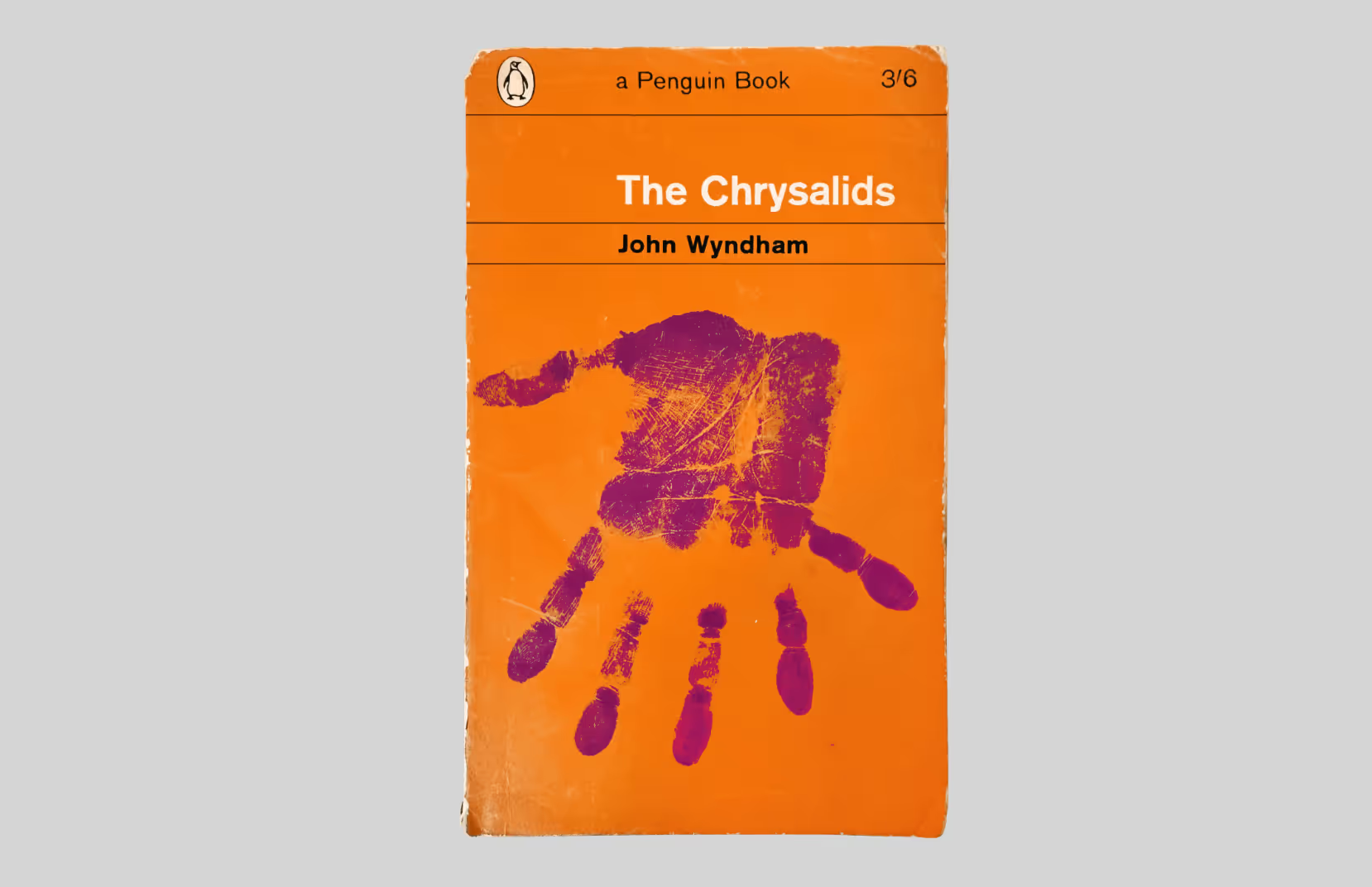
There were two ways that people living a very long time ago would leave handprints on the walls of caves. No doubt you’ll have used both methods as a child, when your imagination was emergin and mark-making was a daily activity.
The first is a stencil, drawing around outstretched digits. Picture our ancestors placing their hand against the rough stone and precisely spitting pigment at it. And the second method is to leave a solid print, as we see on this 1964 paperback edition of John Wyndhams’s The Chrysalids.
The dogma of decades was that prehistoric artists were men. More recent research begins tounpick this dominant narrative (someone had the good idea of measuring finger ratios),fixing women at the centre of the cultures’ creativity.
‘When I was quite small I would sometimes dream of a city – which was strange because it began before I even knew what a city was.’ So opens this beautiful, melancholic, thrilling coming-of-age story. It is set in a time post ‘Tribulation’, the reader inferring this to be some ancient nuclear catastrophe caused by the godless Old People, misremembered in religious tracts of deity vengeance. Humans have rebuilt small communities, trying to coax an irradiated land to produce crops and animals.
The inevitable arable and livestock mutations are rigidly rejected by the dominant, dogmatic ruling men as ‘abominations’ and ‘blasphemies’. To be alive but to fall outside the mainstream narrative is to live as an ‘offence’.
Main character David has his own mutation, one he is able to hide from the terrifyingly conservative family he is growing up in. One day he meets another child, Sophie. She has a more visible blasphemy, a sixth toe. Her family survives secretly on the outskirts of the village. To be found would mean banishment to the Badlands – an unlivable wasteland.
I admire our cover artist, Bryan Kneale, for ignoring the fact that Sophie’s genetic anomaly is on her foot, rather than her hand. In fact I’m not sure anyone in the book is described as having six fingers. But here we are – a downward facing black/purple extra-pinky handprint set against the atomic flash of Penguin orange and reaching out to the reader in mutated welcome.
Actually, the 1955 hardback first edition of The Chrysalids does use a foot with a bonus toe and it just doesn’t work. Footprints speak of journey, handprints speak of creation. We find traces of our own Old People in cave complexes and ancient river beds. Their footprints are accidentally preserved, some plodding hunter treading in the right combination of mud, whereas their handprints are deliberate marks full of agency and hope, stretching out to us across a million tribulations.
The Chrysalids of the title are David and a group of his friends. Their unseen mutation is less a blasphemy and more the inevitable future of the human race.
And this is what they share with our prehistoric artists.
This article was borrowed from David Pearson’s Book Cover Review. To see more like it, head here.