
The Soul of the Word (1963)
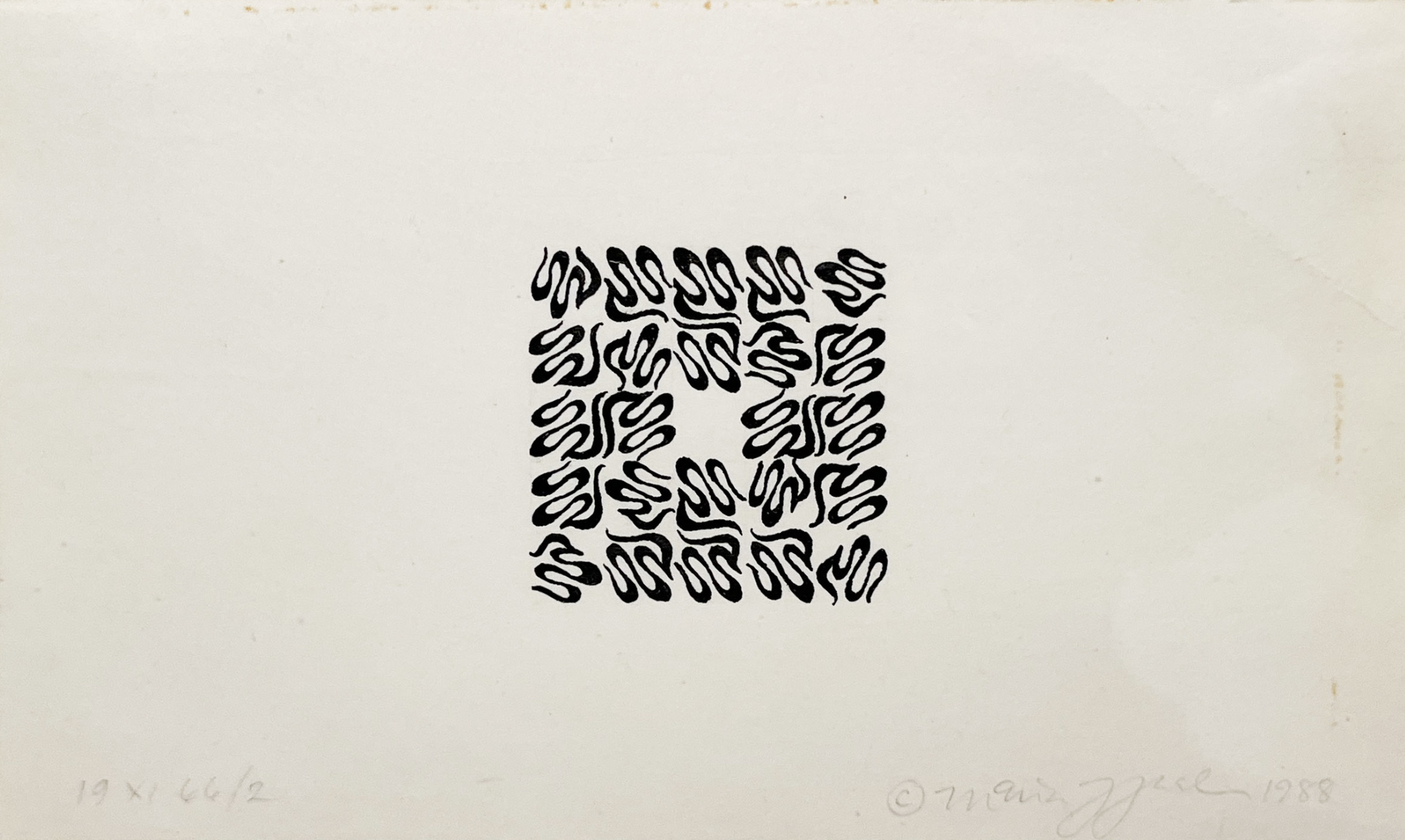
19 XI 66/2, Marian Zazeela.1966.
Marian Zazeela is most known, and her work most often experienced, through her collaborative works with her husband, the composer LaMonte Young. Her light sculptures, album art works, and graphic design work defined the visual and environmental language of 60s downtown New York, but her work as solo artist has long been overlooked, especially her calligraphic creations. In this short essay, first published in the legendary Aspen Magazine in 1971 but written nearly a decade prior, she described her process of making letters. For Zazeela, the letter is a living thing that she breathes life into through her nib. It contorts on the page, following some unknowable natural order for which she can only act as a vessel for facilitation.
Marian Zazeela January 22, 2026
If I choose to inscribe a word I begin in the center of the page. The word first written is awkward and leans a little to the left. I go over the letters adding characteristic curves, making the lines heavier. The letters grow larger, extend curled tentacles out toward each other, begin rubbing and burying their shoots in each other. I move the pen from left to right adding ornaments. The word begins to act as a single unit. Repeated strokes perform continual changes as the letters shift and grow.
The word is still discernible. A sweeping ornament is fastened to the first letter which is now perfect and needs no adjustment.
Now the end letter must have a flourish giving the extra length needed to be exactly centered. Some of the letters have sent wriggling lines beneath them and the balance again requires correction compensation. The word has now spread out of its letters. The letters are more and more obscured as the writing takes precedence. The word no longer matters; it can be spoken.
But the writhing rising out of the word is a dragon devouring itself. Like a cat cleaning her fur the tongue of the word licks its scales with flame and the body of the word ignites and takes the shape of its destruction, which must be perfect and lie perfectly still in the center of the page. if it happens, as it sometimes has, that the flames are not satisfied by the assumption of the word alone, and continue to writhe and curl then the soul of the word is imprisoned and must be set free. And the flames must be slowly brought to the edge of the page where the cool sea waters will soothe them and let them rest. When the fires die out and only the record of flame remains the soul of the word will be carried out to sea and be born again in a raindrop. While it falls to earth in this form it perceives everything through the distorted lens of water; then as it hits the ground all these preconceptions shatter.
But soon the soul of the word is dried and warmed by the sun and feeling drowsy, falls asleep. Upon waking it recalls two dreams: the first, a dream of its future life, tells of the great height it will reach as the soul of a word highly respected by the people, upon whose tongues it will be carried into the richest courts in the world and gently whispered to the ears of noble men and beautiful women; the second dream is the story of its past life but it does not recognize itself in its previous form. Several lives later the dream recurs. Several dreams later the life recurs.
Marian Zazeela (1940 – 2024) was an American light artist, designer, calligrapher, painter, and musician.