
“Black” is a Country (1962)
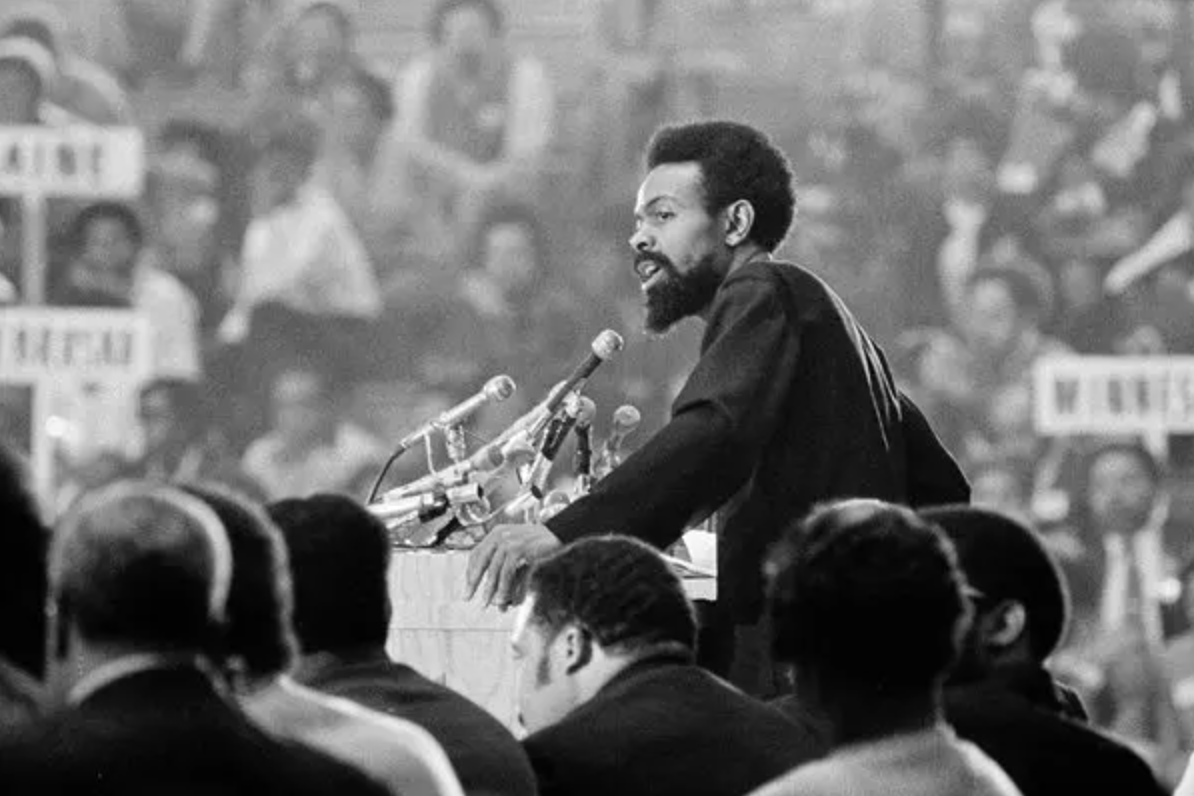
At the height of the civil rights struggle in 1962, Amiri Baraka (formerly LeRoi Jones) wrote this essay-cum-manifesto that became one of the most significant works of racial theory of the 20th century. A call for black self determination, it is no coincidence that it was in the same year of publication that Malcolm X entered the public sphere as an alternative leader to Dr. Martin Luther King of the Civil Rights Movement. Baraka, when talking about this now-famous work, and the controversy that surrounded it for years, said that the only thing he was abdicating for was that Black people in America have to act in ‘our best interests’. In his pleas for self determination, Baraka argues that Black people have a unique culture that constitutes a national identity seperate from that of White America. Baraka would go on to found the Black Arts Movement and spearhead the second Harlem Renaissance, but this essay marks his most profound shift, from a beat poet of Downtown New York to a thought leader in Harlem, fighting for a new world.
Amiri Baraka April 21, 2026
To a growing list of “dirty” words that make Americans squirm add the word Nationalism. I would say that the word has gained almost as much infamy in some quarters of this country as that all-time anathema and ugliness, Communism. In fact, some journalists, commentators, and similar types have begun to use the two words interchangeably. It goes without saying that said commentators, etc., and the great masses of Americans who shudder visibly at the mention of those words cannot know what they mean. And it is certainly not my function, here, to rectify that situation completely. But I do think that unless the great majority of people in this country begin to understand just exactly what Nationalism is (or at least that variety of Nationalism which is most in evidence among the smaller, so-called uncommitted countries of the world) they will pass from the scene like the boxer who “never knew what hit him.”
The concept of “acting in one’s own best interests” is certainly not unknown to America or to the rest of the so-called Free World (which I am told includes Portugal, South Africa, and parts of Mississippi). In fact, I would say it is just this concept which has allowed the Western peoples to remain for so long the richest and best-fed in the world. No matter what people or countries had ultimately to suffer while they were pursuing these “best interests,” the pragmatic efficiency of England, France, or the United States in accomplishing such ends is almost legendary. Weird historical “music,” in the so-called Opium Wars in China (Britain), the “defense” of the Suez Canal (Britain/France), the Spanish-American and Castro-American Wars (United States)—some examples, both recent and long past, of this “best interests” doctrine as applied by the West— leaps immediately to mind. And these kinds of activities can also be included within the definition of Nationalism. So it seems strange at first to see Westerners squirming at the mention of a concept and/or practice they themselves have been most responsible for perfecting. There is a comic analogy in the fact that in con man language “savage” means “sucker.”
The “rub,” of course, is that when another people or country, who have been used or exploited because it served the best interests of a Western power, suddenly become politically and/or physically powerful enough to begin talking about their own best interests, which of course are usually in direct opposition to the wishes of their exploiters, it is then that Nationalism becomes a dirty word—one to be stricken from as many minds as possible, by whatever methods. (To my mind, it is absurd to think for a moment that the people who killed Patrice Lumumba thought he was a Communist. They understood exactly what he was.) And it seems a simple enough conclusion to me that most of the so-called “hotspots” in the world are caused by this same conflict of “nationalisms,” even in our own South. (An historical aside: The Civil War in the United States was of course the victory of the industrial interests in the country over struggle must take. In America, black is a country. The Cubans are attacked by this country because they refuse to let themselves be used solely to further the Industrial interests of this country. Communism is not the issue. Lumumba was killed because he resisted the designs of the neo-colonialists to continue to make money from the labors of the African. Communism, again, was not the issue.
“The idea of “passive” resistance is not the answer. It is an Indian “rope trick” that cannot be applied in this scientific country. No one believes in magic anymore.”
The black man has been separated and made to live in his own country of color. If you are black the only roads into the mainland of American life are through subservience, cowardice, and loss of manhood. Those are the white man’s roads. It is time we built our own. America is as much a black country as a white one. The lives and destinies of the white American are bound up inextricably with those of the black American, even though the latter has been forced for hundreds of years to inhabit the lonely country of black. It is time we impressed the white man with the nature of his ills, as well as the nature of our own. The Negro’s struggle in America is only a microcosm of the struggle of the new countries all over the world.
The idea of “passive” resistance is not the answer. It is an Indian “rope trick” that cannot be applied in this scientific country. No one believes in magic anymore. The Christian church cannot help us. The new nationalists all over the world have learned to be suspicious of “Christianity.” Christ and the Dollar Sign have gotten mixed up in their minds, and they know that the latter is their enemy. It is time black Americans got those two confused as well. The idea of the “all black society” within the superstructure of an all white society is use less as well (even if it were possible). We are Americans, which is our strength as well as our desperation. The struggle is for independence, not separation—or assimilation for that matter. Do what you want to with your life . . . when you can. I want to be independent of black men just as much as I want independence from the white. It is just that achieving the latter involves all black men, or at least those who have not already taken those available roads into the mainstream I mentioned earlier— subservience, cowardice, and loss of manhood.
This struggle has first got to aim itself at those black men who have already taken those three roads to “success.” The “rubber stamps” of our exploitation. Usually, as we know, these rubber stamps are set up as our “leaders.” Official Negroes they are called. Good. Let them be official. It only means that they are as sick and useless as everything else in this country that has, of recent years, been unofficial. When we speak of the ugliness of American foreign policy, we cannot separate our disgust with that from the knowledge that these official Negroes, as such, must be the repositories of those same policies. The best interests of the black man in America cannot be furthered by these puppets and messengers. It is not in the best interests of the black man if another black man gets up in the United Nations and apologizes to that august body for the conduct of “his people.” It is not in the best interests of the black American if another black American suggests to the world that the only way in which his people are going to achieve their independence is to get walked on in public places or blown out of buses. And it is strictly up to those black people who realize these things to come out and say them. Not only say them, but act upon them. And we must act now, in what I see as an extreme “nationalism,” i.e., in the best interests of our country, the name of which the rest of America has pounded into our heads for four hundred years, Black.
Amiri Baraka (1934 – 2014) was an American writer, poet, historian, playwright, essayist, and critic who is one of the most significant, controversial, and respected writers of his generation. His work are considered defining texts of African American culture and Baraka is widely regarded as the founder of the Black Arts Movement that brought on the second Harlem Renaissance.