
The Architecture of Dreams
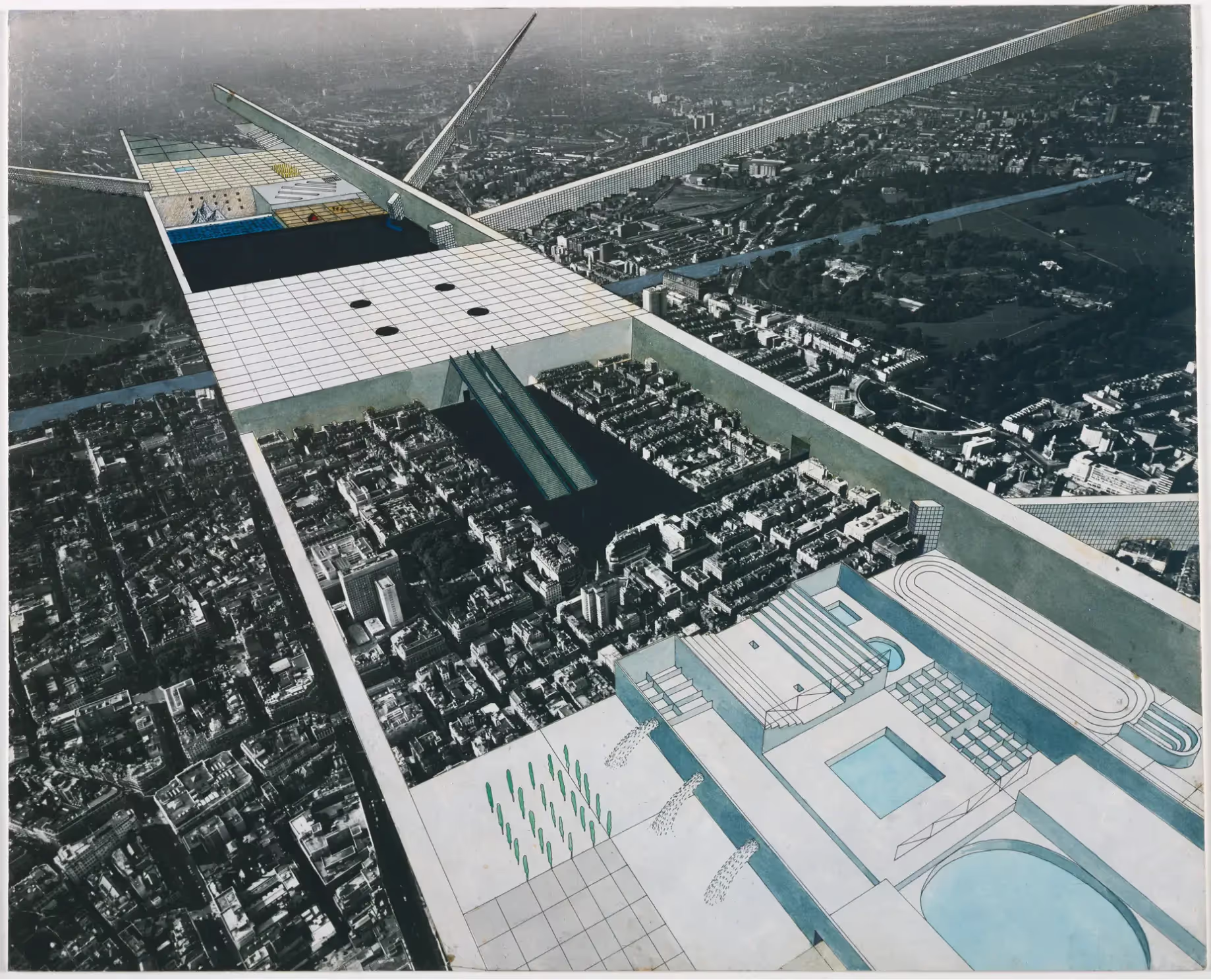
Exodus, or the Voluntary Prisoners of Architecture: The Strip (Aerial Perspective), Rem Koolhaas. 1972.
Carl Jung, one of the pioneers of psychoanalysis, tells the story of a patient who dreamt of a golden scarab; a luminous, rare beetle. As she recounted the dream to Jung, he heard a tapping at the window behind him. He opened it and in flew a scarab-like beetle, the closest analogue to the golden scarab found in their region. He caught it and placed it in her hands. Her dream breached reality and became a foundational example of what Jung described as synchronicity, an acausal connecting principle where the psyche and the material world fold briefly into one another in correlation. An inner image manifested into matter. Synchronicity proposes that meaning is constructed as it is encountered, appearing at the precise intersection of inner intuition and outer event. Jung believed dreams were an amplification of the self and advocated writing them down, building a bridge between the conscious and unconscious mind.
A bridge.
When I was 23, I moved from an old Victorian house along Burgess Park Camberwell, in South London, to Leonard and Power Street in Brooklyn, New York. In both cities I was one bridge away from the centre. In London, the Thames, in New York, the East River. From outer membrane to temporal nucleus.
My first evening in New York was April Fool’s Day and I walked home late from Manhattan, crossing the bridge back to Williamsburg. At the apex of the suspended passage, something blurred. I forgot my new life in New York. In my tired eyes I imagined crawling into my bed in Camberwell, sightlining through the window to the tennis courts of Burgess Park. I was listening to Surround by Hiroshi Yoshimura.
By the time I reached the end of the bridge, Manhattan folded into Brooklyn, and I felt I had crossed the street from Borough Market to Broadway. For the next four years I lived half the year between London and New York with recurring dreams that they were the same place. I never spent enough time in either city to feel fully at home. There formed a liminal metropolis in the unconscious, an archetypal interior where distance dissolved. My transient life was rearranging space in my dream field of the sister cities. I would leave a rave in South London and cross a bridge to arrive in Midtown. Friends from both cities occupied the same rooms, as though the psyche were composing their own compensatory geography. Streets overlaid one another as tracing paper over a plan. I began to rethink my relationship to architecture. What is architecture in psychological space?
After Brooklyn I moved to Harlem. Then back to Camberwell. In December 2019, I returned to New York and stayed in a mystical woman’s apartment in a building called the School House in Chinatown. She left dried leaves on the counter and insisted I drink them in hot water each day. Over lunch I told a friend in the building about how I would dream about living simultaneously in London and New York. I found myself scanning his shelves. My hands landed on a large chrome volume, 1,344 pages heavy, called S,M,L,XL by the architect Rem Koolhaas. He said he’d read it in Toronto, explaining how a running dictionary moved through the book, continuously cross-referencing itself. A few months later, I bought the same book at the Architectural Association Bookshop in London.
Over the Covid lockdowns, I returned to New York and took S,M,L,XL with me to Alphabet City’s towering complex blocks lining the FDR. I took up running, traversing from the east village to central park, where I would lay on the grass and stare at the clouds. I was sitting along the east river, when I read the prologue to S, M, L, XL, which begins with ‘Once, a city divided in two parts.’ Koolhaas proceeds to discuss the bridges over a river, which axis London, a surreal reorganisation of the centre. Synchronicity. A bridge as mediator. Time folding back on itself. Inner condition and external structure streaming parallel.
“How do we measure the timeline of synchronicity, that does not begin or end?”
Many metropolises are established along rivers, where waterways functioned as primary logistical corridors for trade and extraction. An infrastructural spine for commerce, circulation, and territorial growth. Architecture is a necessity.
Shelter. Infrastructure. Circulation. Dreams construct spaces not because we require them for survival, but perhaps because we long for them or symbolically relate to them through time looping. In my dreams, bridges unfolded beyond their structural connections, becoming temporal architectures attuned to my body’s rhythms, marking cycles of sleep and wake, shifts in alertness, and the flow of circadian time.
After Covid, I took a turn in my career path and I moved permanently back to London. I no longer dream of London and New York merging.
Perhaps the architecture of our dreams reveals our most honest urbanism, one governed not by capital or infrastructure, but by longing. When I stood on the bridge between Brooklyn and Manhattan, imagining Camberwell, was I recalling or forecasting. Was I building a future self who would one day return? Sigmund Freud suggested that dreams are a theatre of memory, where past experiences and desires fold into the present dreamscape. When we imagine constructing a theatre from an architectural perspective, how do we perceive the ways it differs from a brain. Both organise space, filter light,create thresholds, andmediate between inside and outside. In dreams, micro and macro collapse and the universe extends above and within. Do our dreams operate in four dimensional space? Albert Einstein proposed that time is a dimension like space. If so, the dream may be a spatial mirror, allowing past, present and future coexist in the same corridor.
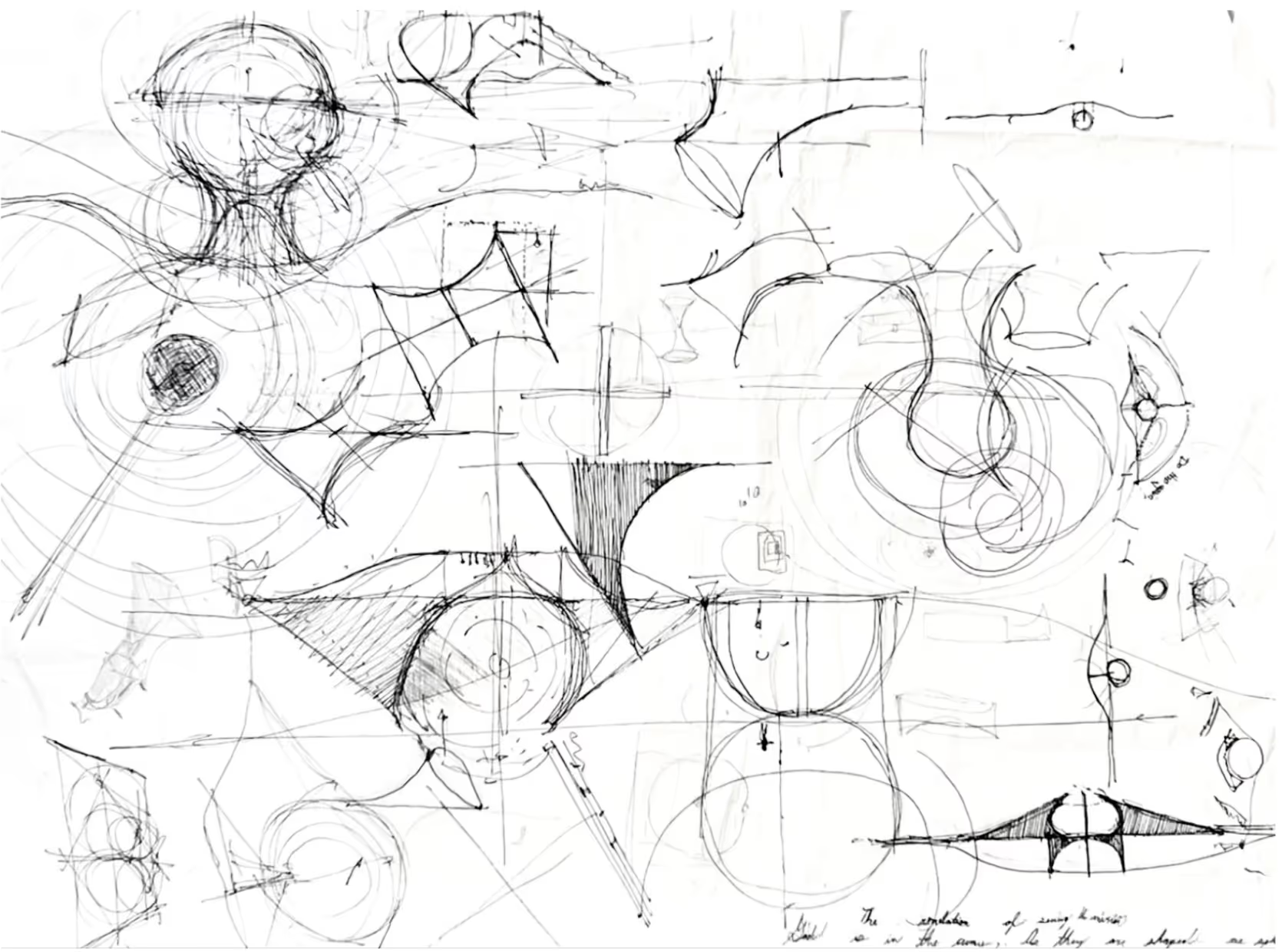
A painter renders an image from the inner eye. A dreamer constructs a place from memory and anticipation. Both contract imagery into form, both edit reality. A friend once described dreaming of a flea market that felt as if it were a neverending city, with shiny objects stretching infinitely. Another described dreaming, without color, of an infinite tower with a spiral staircase, standing on an endless road. These are architectural typologies, the market, the road, the tower. But in dreams they are unbound by gravity or planning permission, they are spatial metaphors. “Dreaming is the doorway,” writes Eric Wargo, who discusses time loops as retrocausation and precognition. Are we dreaming forward or remembering backward? Is there a possibility that we are beyond a myopic now? Is what we consider the ‘now’ just a glimpse of synchronicity over an expanded lifetime, and how do we measure the timeline of synchronicity, that does not begin or end?
If architecture is the organisation of space across time, perhaps dreams are a radical form of architecture: structures without matter, cities without borders, bridges that span oceans. We are living in a world of scarce resources. If architecture is shaped by need, and dreams are shaped by desire, we must ask ourselves what our intention is toward those desires. Can our dreams reveal what our environment is asking of us? Can they expose the excess, the longing, the imbalance between what we require and what we consume. What are we building, and why?
Perhaps synchronicity is not only a poetic coincidence, but an ethical signal. A moment where inner imagery meets outer condition and responsibility. If our dreams are architecture without material limits, they move freely and without consequence. Waking architecture, by contrast, always carries consequences. In a time of ecological strain and spatial inequality, desire cannot remain abstract. It must be examined. Redirected. Refined.