
Living with Water
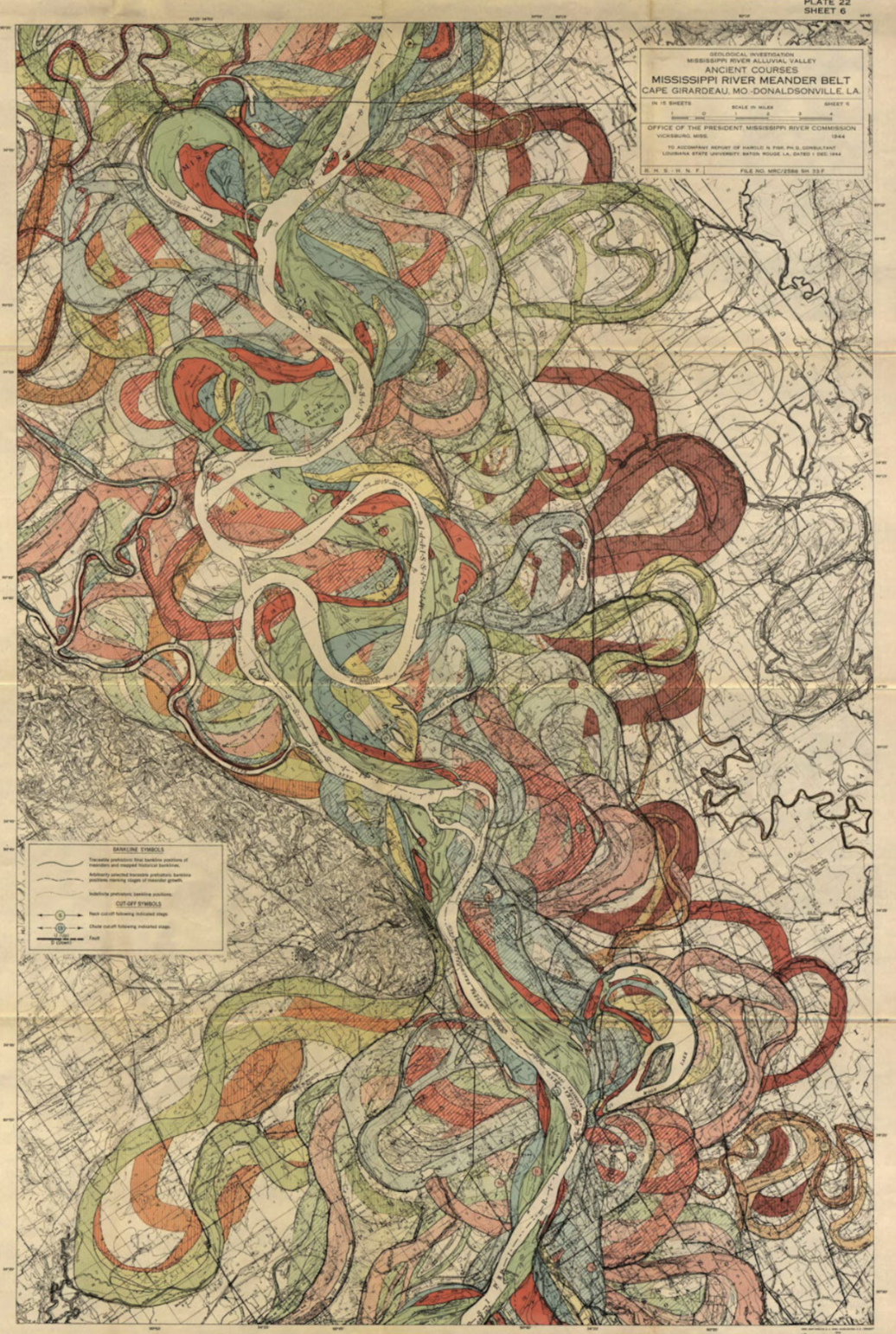
Mississippi River Meander Belt, Harold N. Fisk. 1944.
Robin Sparkes May 21, 2026
The ground beneath you may appear fixed, but the most constant quality of existence is change itself. What presents as solid earth are tectonic plates in slow drift, driven by convective force. The same energy that once held Pangea together as a single landmass, fractured it into the continents we inhabit now. The ground moves just as the tides do, shifts with the current, responds to weather and season, only it unfolds across timescales beyond what we can see.
It is bodies of water on our planet that make change visible with our perception of time, currents legible in immediate movement. Water is the elemental bond of hydrogen and oxygen, a convergence so precise it created the conditions in which life on Earth became possible.
Our own bodies are made of water. When we live in close company with external bodies of water, we relate to space differently than we do over solid ground and landlocked horizons. With water, we witness change as it is occurring, see time as it is made visible in the pull of a current, the rise of a tide, the return of rain to the same ground it once left. When we observe water, we reorient the body toward its own molecular biology. To live with water is to hold a different quality of attention, one drawn toward rhythm rather than permanence.
Historically, humans have been led by the behaviour of water. The Nile flooded annually, depositing the black silt that made Egypt's agriculture possible and its calendar sacred. Along the Indus, the ancient cities of Mohenjo-daro and Harappa developed sophisticated urban drainage and water management systems. In China, on the Huang He, the Wei River basin became the cradle of exchange; its floods bringers of both catastrophe and renewal, demanding hydraulic engineering that gave rise to coordinated governance. Daoist philosophy, rooted in the same riverine culture, understood water as the living expression of qi, the vital force that flows through everything. The river is the condition of possibility. Water is our origin.
Our systems of living emerged in response to nature. Mesopotamia, meaning "land between rivers," may represent one of the earliest known sites in which people collectively organised themselves into a city. Occupying the floodplain of the Tigris and Euphrates rivers in what is now modern Iraq, in around 4000BCE Uruk grew into a dense urban centre of temples, granaries, and administrative structures, a place where people learned to live together. A living network and infrastructure built in accord with the land's natural cycles, formed around the management of water and grain. Water was understood as the source of Me, the divine order from which all life flowed, underpinning agriculture, ritual and the city as a living apparatus. The flood came and receded, as a gift requiring reciprocity. The soil it left behind fed the city. The cycle repeated, and in repeating, became the basis of order. The word for the deep freshwater aquifer beneath the land, abzu, is best described as comic water, universal. To drink, to irrigate, to build, was to participate in something sacred, to move in accord with a force that transcended the human. Water, soil, seed, and season moved together in a regenerative cycle. Today, ecologists refer to this process as syntropy, the tendency of living systems, when well attuned, to build complexity and abundance over time. Where entropy pulls toward disorder and dispersal, syntropy has the capacity of life to organise, accumulate and renew. A symbiosis.
“When we live with the tide, the body recalibrates toward what is immediate and shared, attuning to a rhythm beyond the clock.”
Through this attunement, ideas emerged that would outlast the civilisation that created them. The need to measure the interval between flood and harvest, between sowing and reaping, between one cycle and the next, gave rise to the first systematic divisions of time. Arithmetic, geometry and early algebraic thinking developed as tools for irrigation, land division and grain distribution. The unit of the second, the division into minutes, is the residue of a people that measured their survival against the rhythm of two rivers. To cultivate space was to become entangled with time, the field, the flood, the canal, and the calendar, all forming a single system in which the organisation of one required the measurement of the other.
Today we still use the units of time calibrated to the behaviour of water in Mesopotamia, the Fertile Crescent. The river is an infrastructure, a calendar and clock, held together in a confluence of moving water. To live beside it was to see time passing, cycles completing. What the ancient world understood through necessity, we are beginning to relearn through urgency. The cycle returns.
Across cities worldwide, the cost of belonging to a place has become the defining crisis of urban life as land ownership concentrates and communities are displaced. Rem Koolhaus described the city as "an addictive machine from which there is no escape." Architect and artist Bo Shen proposes Sojourn as a modern infrastructure for living with water, beginning on London’s Grand Union Canal in North Kensington and extending outward to the tidal estuary of The Wash in East England. Where the first cities turned to water to build collective life, Shen turns to water as a way out, to rebuild community with intention, away from a metropolis where land is an asset before it is ground. Sojourn organises design around tidal logic, a route traversable by boat stretching over two hundred kilometres from city to rural. Referencing the longhouse, a communal dwelling of the Haudenosaunee of northeastern North America that was a spatial and spiritual structure in which extended family lived, governed and held ceremonies under a single roof, Sojourn reorders this logic as a collective anchor for the boating community. A tidal gauge marks the water levels, dictating when life moves outward and when it draws inward; the tide becomes the shared clock around which community forms. Although affordable, the narrowboat is a micro space, becoming the intimate space of sleep, rest and bodily care and forming, in numbers, a shared system of living as an intentional community with water. Infrastructure, relearned from the river.
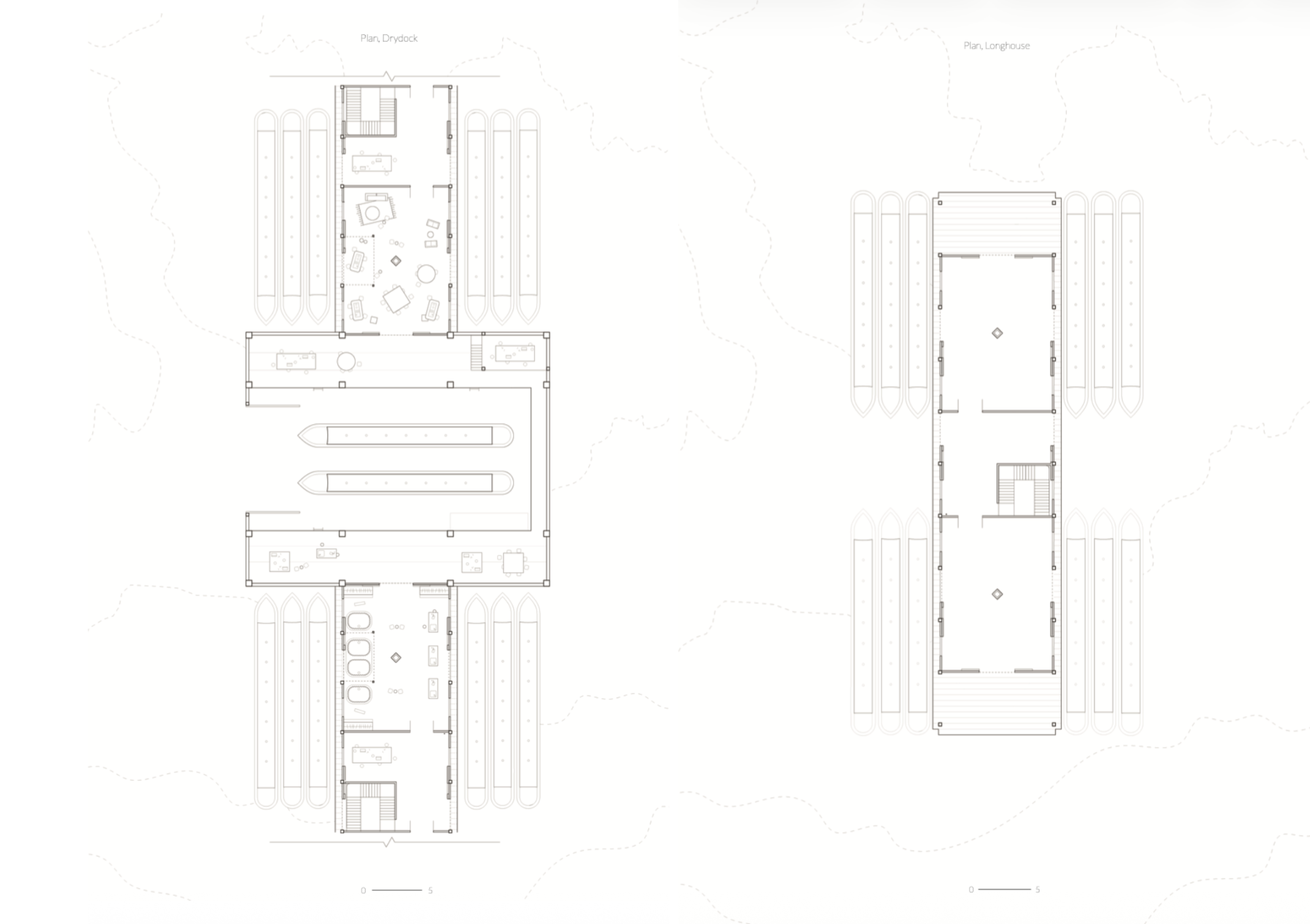
Time is relative. It moves differently depending on where you are and how you are moving. When we live with the tide, the body recalibrates toward what is immediate and shared, attuning to a rhythm beyond the clock. Where are we now? What does it mean to live over unstable ground? To be part of a collective is to live in dialogue with something that moves on its own terms and in doing so develop an acute awareness of resource and time. To live over unstable ground is to understand, slowly, that stability must be practiced. Now that we can count time, how will we choose to apply ourselves to it? The cycle returns.
Begin to cultivate what is closest to you. Whether a vast open garden, a balcony, or a single window sill, the invitation is the same. To tend to a living system is to listen to the earth's rhythms until they become legible in the everyday. The smallest plot of soil holds the same logic as the floodplain. The cycle returns.
Robin Sparkes, is a spatial designer, studying the kinesthetic experience of architecture. Her design, research, and writing practice traverses the relationship between the body, temporality, and the acoustics of space.