
Between Nihilism and Salvation
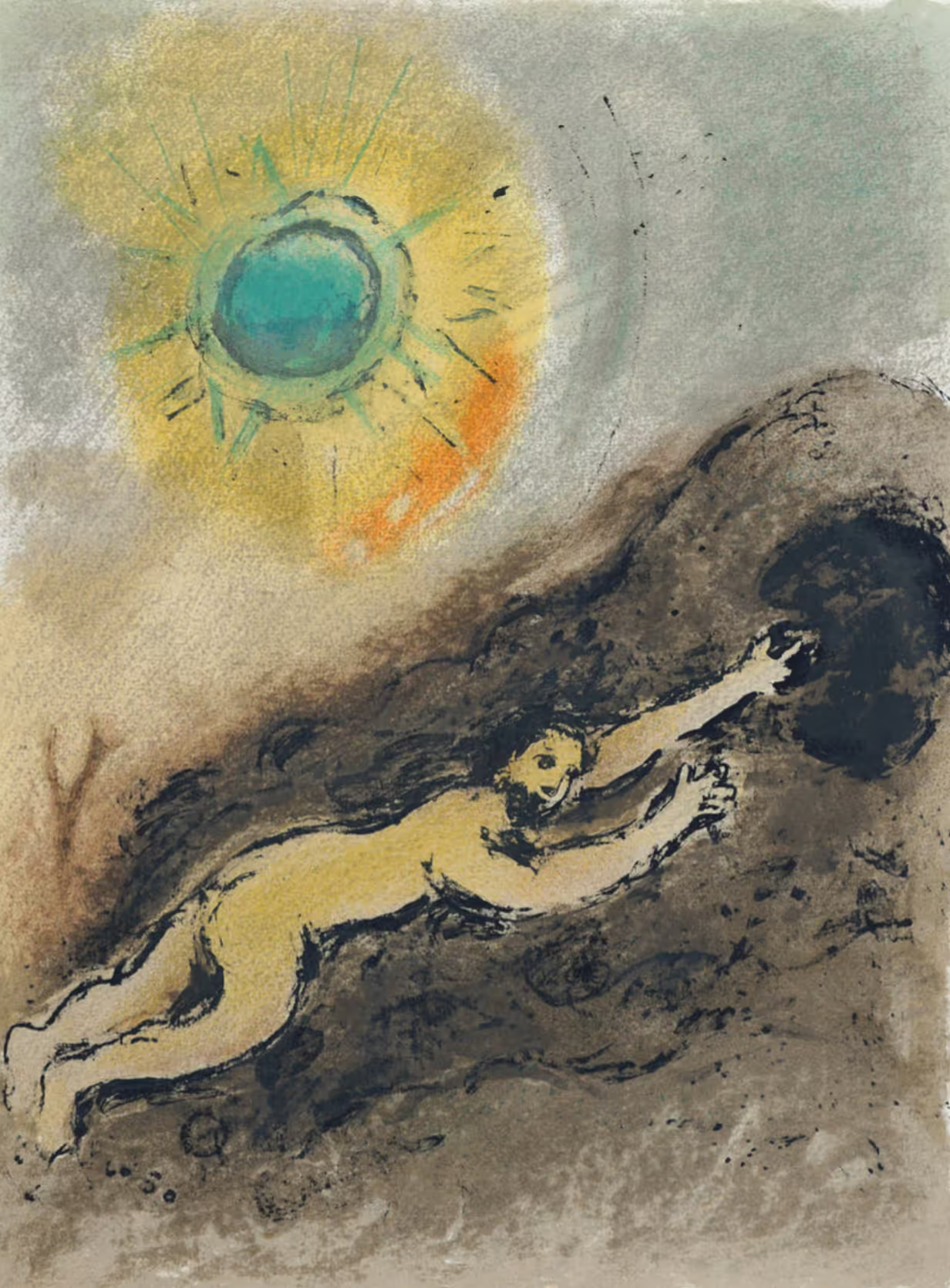
Marc Chagall, Sisyphus. 1975.
“The chef has requested you not to read that while you eat his food,” the waiter said, pointing to my copy of Kafka’s The Trial. I must have given him a confused look, because he smiled and said; “so that you don’t lose your appetite.”
It was embarrassing, but pretty much every social interaction embarrassed me at that age, and it thrilled me too. It was the first time any one out in the city had ever noticed, and seemed to approve of, what I read. I wanted desperately to break the silence in the empty diner, to talk with him further, but I was too shy. I ate my lasagna in silence, paid the bill, and left.
Kafka. Pessoa. Dostoyevsky. Beckett. I wallowed in the literature of despair, bleakness, and nihilism, clinging to the jejune certainty that life is pain like a squalid but tolerable shelter from the storm.
Pessimism saved me from the need to loathe myself, because if there was a fault with being itself, maybe I wasn’t to blame for my unhappiness, maybe it wasn’t that there was something wrong with me.
I took comfort in the belief that it’s okay to not be okay. I reassured myself with philosophical arguments that I was right to find existence a joyless wasteland; that I was right not to believe that things could get better. That pessimism protected me from the people who tried to convince me that their cult or fitness fads or baseline belief in the improvability of the human condition could help.
Growing up on the West Coast in the ‘90s, everybody had something to believe in—EST or Eckhart Tolle or Osho or the Paleo diet or the power of positive thinking. Shifting with the seasons, friends and family clung to one saviour after another, each time with renewed hope that they’d finally found a remedy for their ennui or their gastrointestinal disorder or their money problems.
These days, the circles I move in are more down-to-earth. The people around me aren’t seeking the meaning of life or immortality—they’re just concerned with finding a fulfilling job or making their relationships work. And yet, even these very practical and mundane problems easily acquire a significance that leaps out ahead of itself.
“The job will not save you,” Freamon says to McNulty in an episode of The Wire. Too often we forget this advice. We let the quest for meaningful work, work that contributes to society and brings us creative fulfilment, take on a significance that’s greater than it can bear. We allow ourselves to believe that not only will work bring some limited, contingent meaning into our lives, but that it will bring us an escape from the groundlessness of living.
This is what Simone de Beauvoir called “seriousness” - over-identification with our jobs, or our role as a parent, or our ceramic farmhouse kitchen sink, in which we allow ourselves to forget that, as important as children or jobs are to us, they have no meaning apart from what we invest in them. We can, and often would, be better off if we invested meaning in other things as well.
“The little things can be transformative. Even if they don’t alter the essential character of existence, they can change the way existence feels…”
That’s not to say that your work doesn’t matter, that your family doesn’t matter - they really do (your trendy kitchen sink, however, doesn’t matter). It’s just that we put too much weight on the things we’ve already committed to to save us from the need to constantly create and recreate meaning and purpose. You allow yourself to believe that it’s just an absolute fact that your children matter, not that you’ve chosen to shape your life around that particular source of meaning.
It’s easy for us to carry on trying to find fulfillment in work or relationships or interior decorating because fulfillment is elusive - it’s always a promotion or a new coat of paint away, and that lets us believe that we haven’t reached it yet because we’re falling short. But that’s not it. We haven’t reached it yet because it’s not there to be found. Meaning-making is an infinite task.
I used to be proud that my pessimism sheltered me from the hope so often preyed upon by religious-leaders, middle-managers and marketers; the hope that the solution to the problem of how to live well, an ultimate solution, is somewhere to be found. But this limited me: by being dead-set on avoiding this error, I rushed head-long into its opposite - the belief that just because there is no solution to having problems at all, there are no solutions to this problem or that problem, or that they’re not worth solving.
Despite what the romantics say, love cannot conquer death. But it’s still pretty great. And even though it brings pain, with each hurt we can learn to do it better and make it more enduring. Dancing cannot save us from the fundamental groundlessness of all meaning, but it can make it feel good to have a body and be alive. The little things can be transformative. Even if they don’t alter the essential character of existence, they can change the way existence feels; make it exciting and full of possibilities and significance.
The temptation to give up trying to make things better because ultimately we’re going to die, and ultimately all life will be extinguished at the heat death of the universe, and ultimately nothing really matters, is just as much an error as the temptation to believe we can find ultimate answers. You don’t need to solve these problems in order for that poem you’re writing, or that long lazy Saturday afternoon, or that campaign you’re working on, to be worthwhile.
In fact, to seek salvation and to give in to nihilism are both responses to the same error: the error of only being satisfied by final answers. In either case, it’s a refusal to be content with the kinds of meaning and joy that can be discovered and created in this life, a life that is not only impermanent, but lacks anything beyond itself to give it purpose.
It is exactly because everything that makes life worth living remains incomplete that we can let go of the need for seriousness. Because there’s no final answer, we can let ourselves play.
Albert Camus says, “we must imagine Sisyphus happy”, because being’s inescapable absurdity gives us the chance to fill it with experimentation and inventiveness and feeling; in short, to live!