
On the Mechanics of Creation
When scientist and author Itzhak Bentov passed away in 1979 he was in the midst of finishing up a self-illustrated comic strip, which he called the ‘Co[s]mic S[t]rip’. Eventually published by his widow Mirtala, the comic became a book called A Brief Tour of Higher Consciousness that describes in elegantly simple detail Bentov’s theory on the origin and mechanics of creation, received intuitively during meditation. The theory is best summed up by his predecessor of over 600 years, a 13th century German mystic named Meister Eckhart quoted in the prologue of the book: “The eye by which I see God is the same eye by which God sees me.”
Bentov rarely used the word God, preferring terms like ‘the Creator,’ ‘Universal Mind’ or ‘the Absolute.’ Residing in ‘the fertile void’, this Universal Mind exists in a field of pure potential - it is the original source of consciousness at rest until it decides it wants to create. Anything created from that source is thus inherently made of the same informational code as the Absolute itself. He wrote, “We have to keep in mind that Creation is a big hologram. In other words, every little unit cell in the big structure, whether it is a universe, a cosmos or a super-cosmos or a super-duper-cosmos, contains the information about the whole big structure. The smaller the unit cell, the fuzzier the information; nevertheless, it is there.”
While a grain of sand may have far less consciousness and capacity for creation than an enlightened master, both contain the same divine source code. The ‘fuzziness’found in that bit of sand is best understood as very simple code relative to the more sophisticated program running a human who’s achieved enlightenment. Bentov didn’t live long enough to be exposed to simulation theory, but much of what describes fits in with the idea of the universe as a computer program or video game, designed to generate new experiences. The Absolute is the master-programmer, akin to an acorn seed containing the genetic pattern of a whole oak tree, only instead of a single tree, it contains the blueprint for all there is.
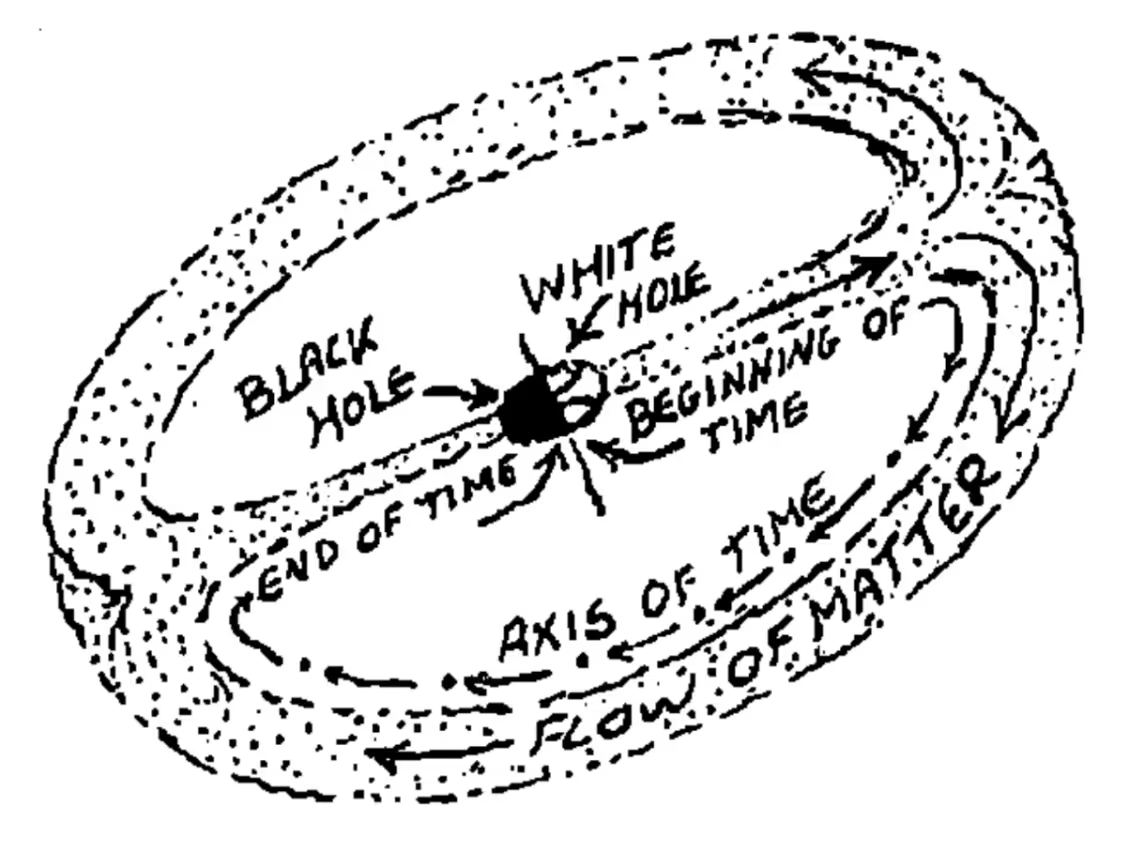
When the Creator becomes active and wants experience, creation begins. Rather than a singular big bang, Bentov subscribes to the idea of a ‘continuous bang’ universe, where the first of many white holes emit a jet of radiation to form a toroidal field around the Creator and matter then forms as it comes from the white hole, first as light. A Biblical interpretation names sound as the prime emanation, because the Creator had to first vibrate the sound of what was to be created before it would manifest. As the book of Genesis says, “Let there be light.” In a continuous bang universe, a white hole and black hole sit back to back in the center of the torus surrounding the Creator, eternally birthing and destroying all there is.
“What is vibrating from the void will manifest and what is not vibrating will not, but it shall still contain the seed for all that could be.”
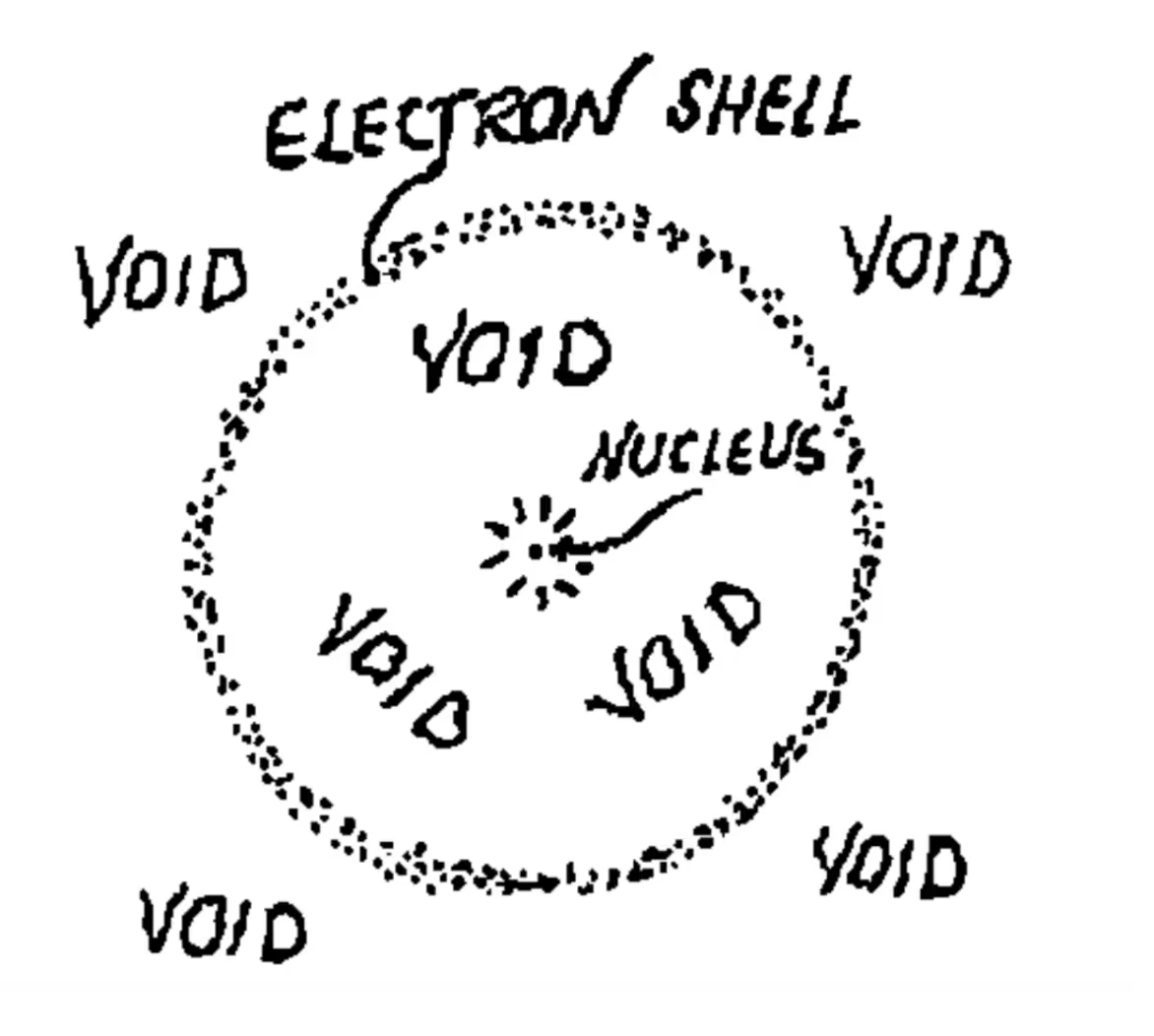
The idea of vibration as the prime emanation is referred to by Bentov as ‘wiggly consciousness,’ and he contends that everything in existence is made up of a combination of vibration and the fertile void, just like the Creator. When he wrote, “The table, the flowers, the scent of the flowers, and our bodies are all made of rapidly vibrating consciousness,” he’s articulating the same concept as Donald Hoffman’s case against local realism. Hoffman, an author and evolutionary biologist, believes that what we experience as local reality is just a sort of user interface generated by our brains in order to make sense of the sea of wiggly particles we’re immersed in. “Fortunately, our senses disregard all these facts and assemble lovely faces, houses and flowers from hunks of void for us to enjoy. But we know that our senses are deceiving us. The gruesome facts still remain. We are hunks of vibrating, wiggly void!”
What is vibrating from the void will manifest and what is not vibrating will not, but it shall still contain the seed for all that could be. Bentov also points out that the fertile void of pure consciousness is not a private void, but one that connects all there is. “Everybody and everything is made up of this vibrating void, whether you like it or not. Your thinking processes spread out and affect all Creation; there is no privacy, and at this point, it is too late to complain,” he wrote.
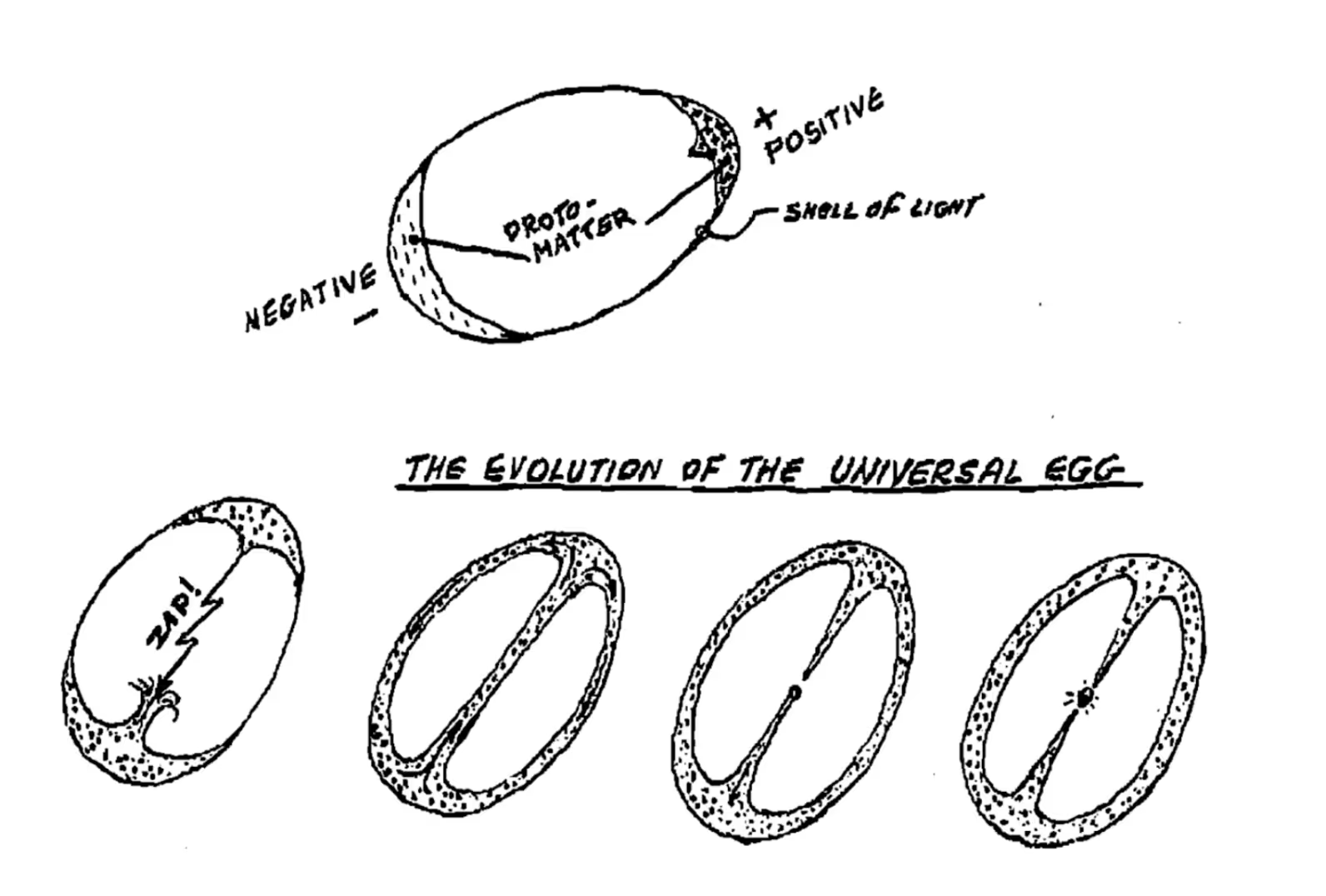
The phenomenon of quantum entanglement occurs when two or more particles, such as a pair of photons, become entangled, they remain connected and influence each others’ states even when separated by large distances. According to the book, this process is a mirror of how the Universal Mind creates its experience of ‘other’ by first polarizing into what we understand to be opposites. To activate the creation of all there is, these two poles move away from each other, to opposite ends of the toroidal field surrounding the Creator that looks like a cosmic egg. “Once separated, they want to come together again, because opposite polarities attract each other,” Bentov wrote. “Then the positive end extends with a thunderous sound, the first sound of Creation, it reaches the negative end, whose protospace then begins to flow along the sides of the ovoid, like a wave, outlining the area where space-time and matter will eventually be.”
Bentov also offers an answer for the inevitable question of the meaning of life itself: The point, he tells us, is that the Creator inevitably wants to go beyond the unmanifest rest of the void, craving experience and self-knowledge, but there’s no one and nothing to play with in the unmanifested void! And so vibration begins, followed by polarity, ultimately leading to the creation of all there is. According to this model, we are all fractals of the Universal Mind playing a game of hide-and-seek from our true God-selves. We are so deeply immersed in the world of form that we’ve forgotten our true selves, and what many people call mystical experiences are what Bentov describes as the Absolute saying, “Boo! I’m you!”
He goes even further than this, claiming that the Creator seeks to create more creators who are evolved enough to be responsible for creating their own universes. Achieving enlightenment puts a soul in the running to be promoted from a piece of Creation to Creator-status. Bentov ends the book with a quote from Shankara, an Indian sage who lived in around 800 A.D., to sum up his thesis: “On the vast canvas of the Self, the picture of the manifold worlds, is painted by the Self itself. And the Supreme Self, seeing but itself, enjoys great delight.”