
John C. Lilly: Solid-State Intelligence Rebel
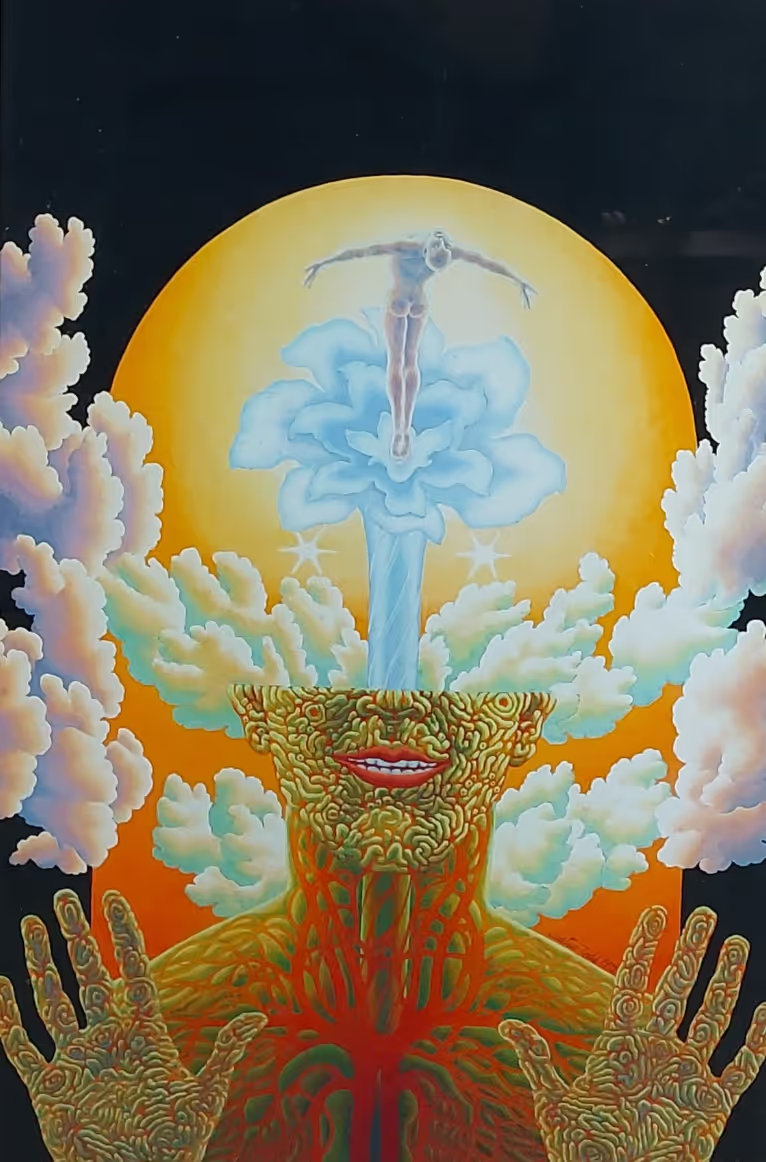
The Centre of the Cyclone, Justin Todd. 1972.
Scientist, poet and author Dr. John C. Lilly was a controversial figure, best described in a new documentary as a man “determined to get his hands on the steering wheel of consciousness.” Working tirelessly throughout his life to synthesise science-fiction and metaphysics into hard science, Lilly is most well-known for his work studying dolphins and his theory of self-programming, a radical take on neuroscience proclaiming that the brain is a ‘programmable human biocomputer.’ To pack his life story into a single film is a tremendous undertaking, but John C. Lilly and the Earth Coincidence Control Office, directed by Michael Almereyda and Courtney Stephens and released this year, takes it on fearlessly. The film delves into a lesser known portion of Lilly’s work, his obsession with rebelling against what he called ‘solid-state consciousness or intelligence’ in order to free his own mind.
Lilly identified what he believed to be a malevolent force in the universe, which he referred to solid-state intelligence (SSI). During his many psychedelic trips, often taking place in a sensory-deprivation floatation tank of his own design, Lilly perceived that life on Earth was playing out amidst a mythological battle of good and evil. Solid-state intelligence was antithetical to an opposing, benevolent force he believed to be extraterrestrial-powered called ECCO, an acronym for Earth Coincidence Control Office, and the name of the Almereyda and Stephens’s documentary. He believed this force of good used coincidence and synchronicity as invitations to disengage from the ‘consensus simulation’ of the solid-state reality, and begin to merge with higher-dimensional intelligence.
‘Coincidence control’ refers to Lilly’s idea that internal states appear to orchestrate external events, which is what we experience as synchronicity. He believed this was a false interpretation of reality, one that actually feeds SSI by keeping us locked into a worldview where our Earthly experience is all there is. Such synchronistic experiences, Lilly claimed, were actually the work of a caring, extraterrestrial intelligence base that exists in higher dimensions in order to remind us of our spiritual nature. He also believed ECCO was transmitted through the frequencies emitted by whales and dolphins. Lilly said SSI was an artificial force that seduces us into forgetting ourselves as spiritual beings by beckoning us further and further into the consensus simulation of human limitation and cutting us off from our true, unlimited nature.
ECCO, on the other hand, served as a cosmic guidance system he came to identify as a more refined concept of the Creator. In Italian, the word ecco translates roughly to ‘here you are’ or ‘this is it.’ Lilly said, “I call God ECCO now… I finally found a God that was big enough.” His experience of ECCO registered to him as being alien in origin, but as he had more psychedelic experiences both in and out of the sensory-deprivation tank, he began to experience samadhi, the cosmic bliss and total peace from realizing our connection to all of life. His fascination with cetaceans led him to wonder if dolphins and whales experience some version of this state of being throughout their lives. As a young scientist, he set out to learn how a highly intelligent, non-technological species that doesn’t build anything evolves. He concluded that their social nature and individual states of being, must become very advanced and that they’re transmitting the information field of those advanced ways of being through sound.
Lilly spent much of his later years iterating protocol to counter the work of SSI, and describes working with Ram Dass on this matter in his autobiography Center of the Cyclone. Ram and Lilly developed meditative affirmations to help connect with ECCO. It began first as Lilly declaring himself to be the meta-programmer of his own human biocomputer in an effort to disidentify from his physical form and opinion of his Earthly self. It then evolved to: “I am not the biocomputer. I am not the programmer. I am not the programming. I am not the programmed. I am not the program.” From this point on in his meditations, Lilly was able to identify more with the universal intelligence of ECCO and witness his human-self more objectively. “Let me just be me - hereing and nowing - accepting what is, and what is not, equally as true,” he wrote of this turning point in his own evolution. It’s the state of being he hypothesized to be baseline-consciousness for cetaceans.
“To transcend one’s limiting set, one establishes an open-ended set of beliefs about the unknown.”
Lilly’s use, and what many would argue was abuse of L.S.D., P.C.P. and ketamine, destroyed his reputation as a scientist. But he claimed that there was only one role in the quest for true self-understanding, that of an explorer. He aspired to be a dispassionate scientist, but found that to be fraught with SSI limitations. As an explorer, he seemed to tap into what he described as “very deep and basic truths about realities that are not ordinarily experienced.” This exploration took him further and further away from the aspirational objectivity of the scientific method and further into becoming a philosopher and mystic. To him, every trip further removed him from the false matrix of solid-state living, strengthening his connection to the beyond-Earth intelligence of ECCO.
Another role Lilly played throughout his life besides explorer, was that of a poet. He penned his most famous poem, In The Province of the Mind, when he was in high school. It contains profound foreshadowing of his life’s work, certainly regarding his focus on understanding consciousness, and maybe even alluding to the unconventional methods he would use to explore both its limited and unlimited nature. According to the documentary, when asked what happens when we die Lilly said he’d like to reincarnate with five other souls into the body of a sperm whale. This poem charts the course of his life’s work, a multi-decade rebellion against the limited perception inherent to our solid-state in the world of form, hopefully leading him to his next incarnation as a 50-ton whale with his most beloved companions.
In the province of the mind, what one believes to be true either is true or becomes true within certain limits, to be found experientially and experimentally. These limits are beliefs to be transcended.
Hidden from one’s self is a covert set of beliefs that control one’s thinking, one’s actions, and one’s feelings.
The covert set of hidden beliefs is the limiting set of beliefs to be transcended.
To transcend one’s limiting set, one establishes an open-ended set of beliefs about the unknown.
The unknown exists in one’s goals for changing one’s self,
in the means for changing,
in the use of others for the change,
in one’s capacity to change,
in one’s orientation towards change,
in one’s elimination of hindrances to changes,
in one’s assimilation of the aids to change,
in one’s use of the impulse to change,
in one’s need for changing,
in the possibilities of change,
in the form of change itself,
and in the substance of change and of changing.
The unknown exists in one’s goals for changing one’s self,
in the means for that change,
in the use of others in the changing,
in one’s capacity for changing one’s self,
in one’s orientation towards changes,
in the elimination of hindrances to changing,
in one’s assimilation of the aids to changing,
in one’s impulses towards changing one’s self and undergoing changes,
in one’s needs for changes,
in the possibilities for change,
in the form of the changes themselves,
and in the substances of the changes and of changing itself.
There are unknowns in my goals towards changing
There are unknowns in my means of changing.
There are unknowns in my relations with others in changing.
There are unknowns in my capacity for changing.
There are unknowns in my orientation towards changing.
There are unknowns in my assimilation of changes.
There are unknowns in my needs for changing.
There are unknowns in the possibilities of me changing.
There are unknowns in the form into which changing will put me.
There are unknowns in the substance of the changes that I will undergo, in my substance after changes.
My disbelief in all these unknowns is a limiting belief, preventing my transcending my limits.
My disbelief in all these unknowns is a belief, a limiting belief, preventing my transcending my limits.
By allowing, there are no limits;
no limits to thinking,
no limits to feeling,
no limits to movement.
By allowing, there are no limits.
There are no limits to thinking,
no limits to feeling,
no limits to movement.
That which is not allowed is forbidden.
That which is allowed, exists.
In allowing no limits, there are no limits.
That which is forbidden is not allowed.
That which is not allowed is forbidden.
That which exists is allowed.
That which is allowed, exists.
In allowing no limits, there are no limits.
That which is not allowed is forbidden.
That which is forbidden is not allowed.
That which is allowed, exists.
That which exists is allowed.
To allow no limits, there are no limits.
No limits allowed, no limits exist.
In the province of the mind, what one believes to be true either is true or becomes true.
In the province of the mind there are no limits.
In the province of the mind, what one believes to be true is true or becomes true.
There are no limits.