
Worthwhile Dilemmas
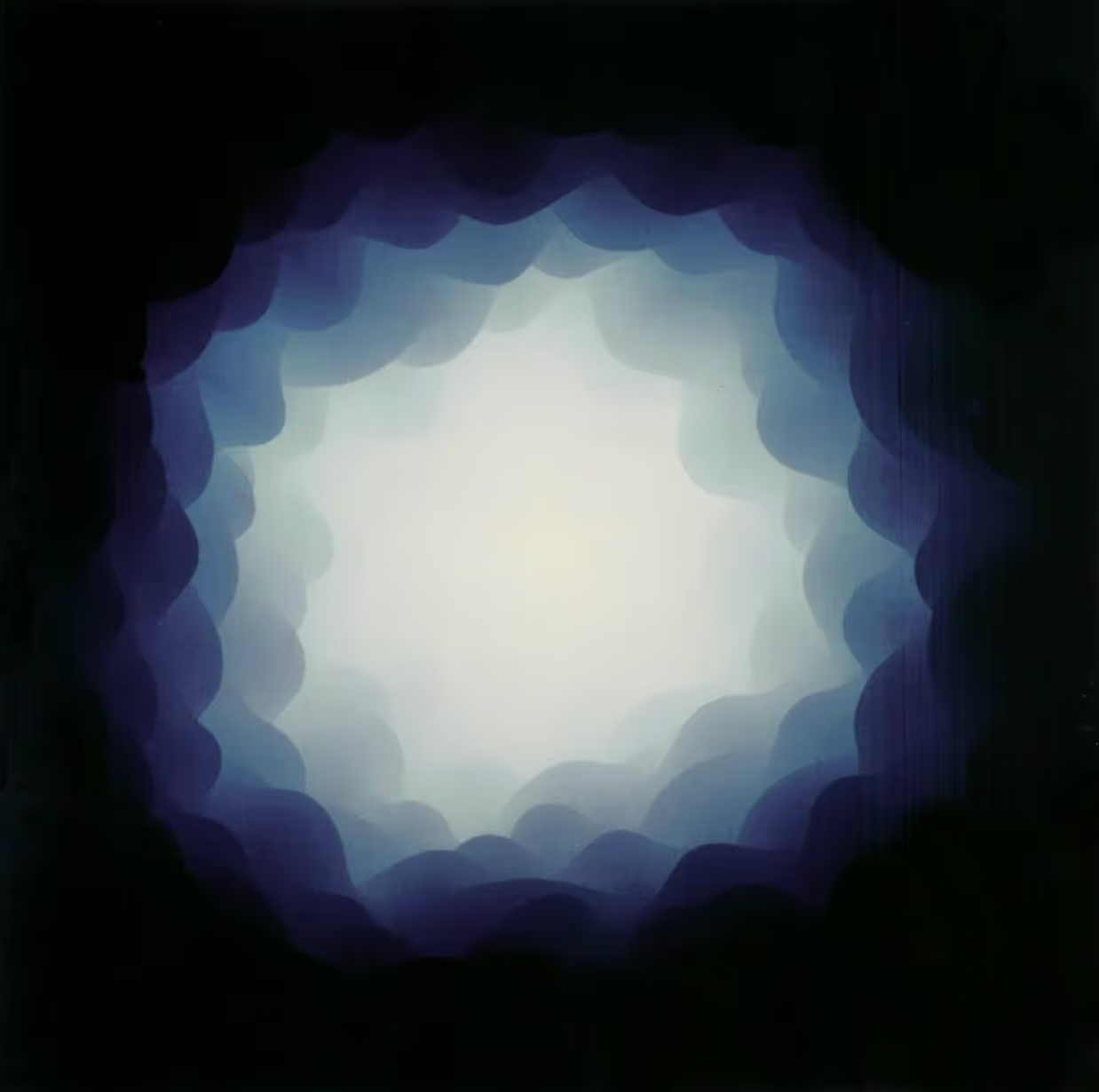
The Clear Light, Peter Schmidt. 1975.
Peter Schmidt and Brian Eno first met in a sort of mentor/mentee dynamic which, over the course of fourteen years, took the amorphous shape of an ongoing collaborative discourse. “He was someone who was using art as a system of knowledge,” said Eno, “not as a system of decoration or simply of earning a living. It was the crucial issue of his life as it is of mine, and it was the matrix around which he considered all of his other theories and personal discussions and problems…”
Over the course of their friendship, there were countless instances of synchronistic thinking where one would discover the other had been employing the same method of working without any prior discussion. At one point, Eno was writing open-ended phrases on index cards and picking one at random to help him open up during instances in which he felt blocked. He would then follow his immediate interpretation of the phrase as a kind of rule. If the phrase felt like it didn’t apply to the problem at hand, Eno would let the contemplation of it inform the work in subtler ways, effectively designing his way into a new opportunity for creative flow. “At the same time, Peter had been keeping a little book of similar messages to himself as regards painting” Eno reflects, “and he’d kept those in a notebook and we were both very surprised to find the other not only using a similar system, but also many of the messages being absolutely overlapping so there was a complete correspondence between the messages.” Upon this discovery, the two combined their respective messages, accumulating, and developing even more in the process. They soon released their collection to the public as a deck of cards known as Oblique Strategies, published in 1975, it prevails as Eno and Schmidt’s major collaborative effort.
Now in its fifth revised edition, the messages that comprise Oblique Strategies range in mystery; Disconnect from desire or Do nothing for as long as possible read like clear pieces of advice alongside the cryptic Towards the insignificant or Where’s the edge? Where does the frame start? Though Eno, a self-proclaimed ‘evangelical atheist’, has sparsely mentioned Oblique Strategies next to words like ‘oracle’ or ‘divination’, we get the sense that each directionless direction echoes some resonant wisdom rooted well within humankind’s longstanding relationship with divinity.
For some years prior to the development of Oblique Strategies, Eno had been studying the works of John Cage, a pioneer of avant-garde composition who was devoted to the study of Zen Buddhism. Many of Cage’s writings in Silence: Lectures and Essays—a book that Eno has repeatedly cited as a seminal influence— discuss and reflect the ambiguous nature of the kōans; specific sacred messages used in Zen Buddhist meditation. A classic kōan, for example, is one that Zen Master Hakuin Ekaku would often tell his disciples—Listen to the sound of one hand.
“Nothing changed and now everything is different.”
“Koan study is a unique method of religious practice which has as its aim the bringing of the student to direct, intuitive realization of Reality without recourse to the mediation of words or concepts…When the koan is resolved it is realized to be a simple and clear statement made from the state of consciousness which it has helped to awaken.”(Sasaki x, xi, xii)
The state of consciousness that a kōan helps to awaken is called satori—a sudden enlightenment described by many as a lightning flash of deep understanding. A more familiar, accessible sudden flash of deep understanding is what we might call inspiration, derived from the Latin inspiro, inspirare meaning ‘to breathe into’. When we are inspired we are “breathing in” new life, or spirit. We could say then, that inspiration is a mundane form of satori, or that satori is an experience of inspiration at some wider, deeper level.
When a disciple meditates on a kōan with intention and discipline for an extended period, an experience of satori is inevitable. Pulling an Oblique Strategies card has a similar effect on the artist concerning an experience of inspiration, only the whole process happens much quicker. One pulls the card with intention, flips it over, reads the sacred message—
Faced with a choice do both
—and the new perspective offered by this suggestion alters conscious reality. Seemingly disparate ideas begin to reveal themselves as inherently connected in unexpected ways. Recognizing these newly revealed connections, we light up with a charge of readily available energy. In a flash, the process is once again set in motion, imbued with new life. Nothing changed and now everything is different.
When we ask ourselves a sacred question or give ourselves a sacred prompt, we establish a magical relationship with language—the tool we use to understand the world around us. This new relationship acknowledges that there are other, more subtle tools for understanding within us which only get sharper when we let them be of use. The more we allow the use of these alternate tools to inform our creative process (as well as our meditation), the more enriched our work, our play, and our lives become.
We’ll end on an exercise, read the statement below.
The most important thing is the thing most easily forgotten
Now feel free to contemplate a bit.
When you’re ready, open yourself up to this next question:
Is the above statement a kōan or an oblique strategy?