
It’s Gonna Rain
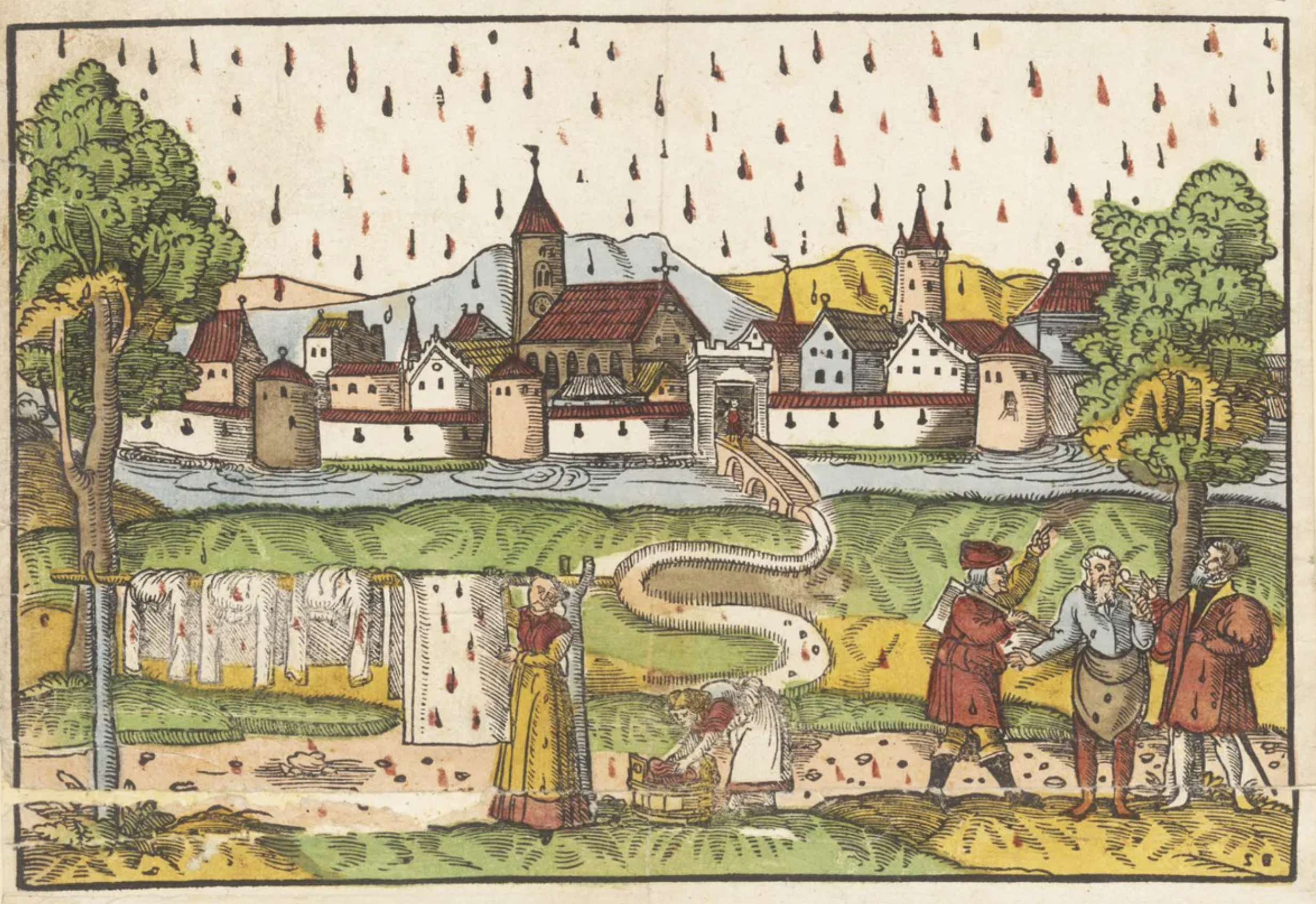
Hans Glaser. 1554.
Derek Simpson April 14, 2026
By the time Steve Reich released It’s Gonna Rain, splicing and looping strips of audio tape was a technique well known to the champions of the avant garde. A handful of composers had long been manipulating prerecorded sounds, challenging the idea that music is defined by rhythm, melody, and harmony. These composers had been laying the foundations of electronic music since the late 1940’s in a style known as musique concrète or ‘concrete music,’ creating works defined by their unidentifiable source material.
A single sound may originate as a 3-second recording of laughter, for example, but in the final composition, the laughter would be slowed and stretched to 20 seconds, emulating an engine being ignited in the distance. Another sound, a train passing by, may be sped up, layered on top of itself a few times, and looped, creating a 3-minute chorus of metallic frogs. The idea was to create a subjective musical experience, to compose works that were fully made up of these abstracted sound recordings. The work was a success if a listener could hear something totally fresh to their ears. Reich’s 1965 composition flips this idea on its head. Using the same basic tools as a piece of concrete music, the sample and the loop, Reich underlines and accentuates his piece’s source material: a single recording of a human voice—that of Pentecostal preacher Brother Walter.
“He began to warn the people! He said: ‘After a while, it's gonna rain after a while, for forty days and for forty nights!’ And the people didn't believe him…” Brother Walter’s sermon booms through San Francisco’s Union Square, “And they begin to laugh at him! And they begin to mock him and they begin to say: ‘It ain't gonna rain!’" He preaches about Noah, a righteous man called upon to preserve life on Earth after God decides to cleanse the Earth with a massive flood. God advises Noah to build an ark, one that can fit his family as well as pairs of each animal to repopulate after the flood. In the time it takes Noah to build the ark, he tries to warn others about the impending flood, but as Brother Walter reminds us, Noah was considered a fool for his concerns.
And then it rained.
About half of Steve Reich’s roughly 17-minute composition features loops of Brother Walter’s proclamation “It’s gonna rain! It’s gonna rain! It’s gonna rain!…” over and over and over again. The main loop is duplicated and played on two tape machines. One is panned to the right ear while its twin loop is panned to the left, each slightly out of sync with its counterpart, creating a swirling effect upon playback referred to today as ‘phasing’. The result is a masterwork in balance—the Organic (human voice) and the Machine (regenerative tape loops) provide perfect support for one another as the piece gradually phases into oblivion.
“The answers may not immediately be so obvious. They may even be hard to hear at first, whispers in a crowded room.”
Sixty years later, the Machine has completely flooded the music-making process and the industry that surrounds it. Samples are conserved and archived in their own libraries, looping has become a popular compositional tool embraced by all genres, and the laptop serves the independent artist as the sole affordable means to write, arrange, record, produce, mix, master, distribute, and promote their own work.
Musical ideas can now be expressed faster than ever before without the supposed hassle of learning to play an instrument. A talented prompter can prompt an AI model with their musical idea, and the model will translate their idea in under a minute. Being trained on all available recorded music to match any and every specific artist’s musical aesthetics, the model will present you with a song containing your own musical ideas, convincingly performed by an artist you love, or by a totally new ‘artist’ whose style is informed by those you love.
Artists themselves have become the raw source material they once used, getting their own likenesses sampled for songs they wrote that sampled songs that someone else wrote that sampled songs that were based on songs that some other people played. It’s gonna rain, it’s gonna rain, it’s gonna rain.
For the moment, the Organic has lost its footing in music-making. Whether Reich’s composition was a divinely channelled warning in and of itself is entirely up for debate, but the fact remains: if we’d like to consciously preserve any shred of the Organic while the Machine continues to flood the arts, we must create the balance ourselves.
If we focus on creating and maintaining this balance, we can remain mindful of our fascinations. When a shiny new toy presents itself, we can watch our interactions as we become more and more familiar with it, paying close attention to how we feel as we use it. If we haven’t applied that kind of attention to our interactions with an older piece of tech, we can certainly apply that same watchfulness each time we use it from here on out. It’s never too late to be mindful.
We can also maintain awareness of our relationship to convenience. If a new software is promising to provide an ‘easier way’, we can explore its exciting features all the while asking ourselves important questions like “Do I have as much fun creating when I use this?” or “Is this making the work better?”. The answers may not immediately be so obvious. They may even be hard to hear at first, whispers in a crowded room. Or they could be loud answers that surprise us. Listening as closely as possible to whatever comes up is key.
When we come to our creative process with the intentions outlined above, we are not interested in vilifying anything that could potentially be of use. We are not looking to label anything as ‘good’ or ‘bad’, ‘right’ or ‘wrong’. We are instead using the contemplative space we inhabit in that moment of exploring the Machine to bring us closer to our intuition. If we can hear our intuition loud and clear, then we can trust in the creative decisions we are making as a result. If we can trust in our creative decisions, then we are gifted with a deep, knowing sense that we are doing our best and most honest work in each moment, both as artists and as human beings. No matter what new technologies we embrace from this contemplative space, balance is maintained without extraneous effort. Any flood can continue on and we can respond accordingly, preserving the Organic in all its undeniable glory.
Steve Reich. "It’s Gonna Rain, Part I (1965)" Early Works, Nonesuch Records, 1987, https://music.apple.com/us/album/its-gonna-rain-part-i-1965/79577208?i=79577204.
Steve Reich. "It’s Gonna Rain, Part II (1965)" Early Works, Nonesuch Records, 1987, https://music.apple.com/us/album/its-gonna-rain-part-ii-1965/79577208?i=79577206.
Boosey & Hawkes. "Steve Reich on Composing "It's Gonna Rain"" YouTube, uploaded by Boosey & Hawkes, 17 August 2023, https://www.youtube.com/watch?v=PQFh85RY03c.