
Becoming Las Vegas
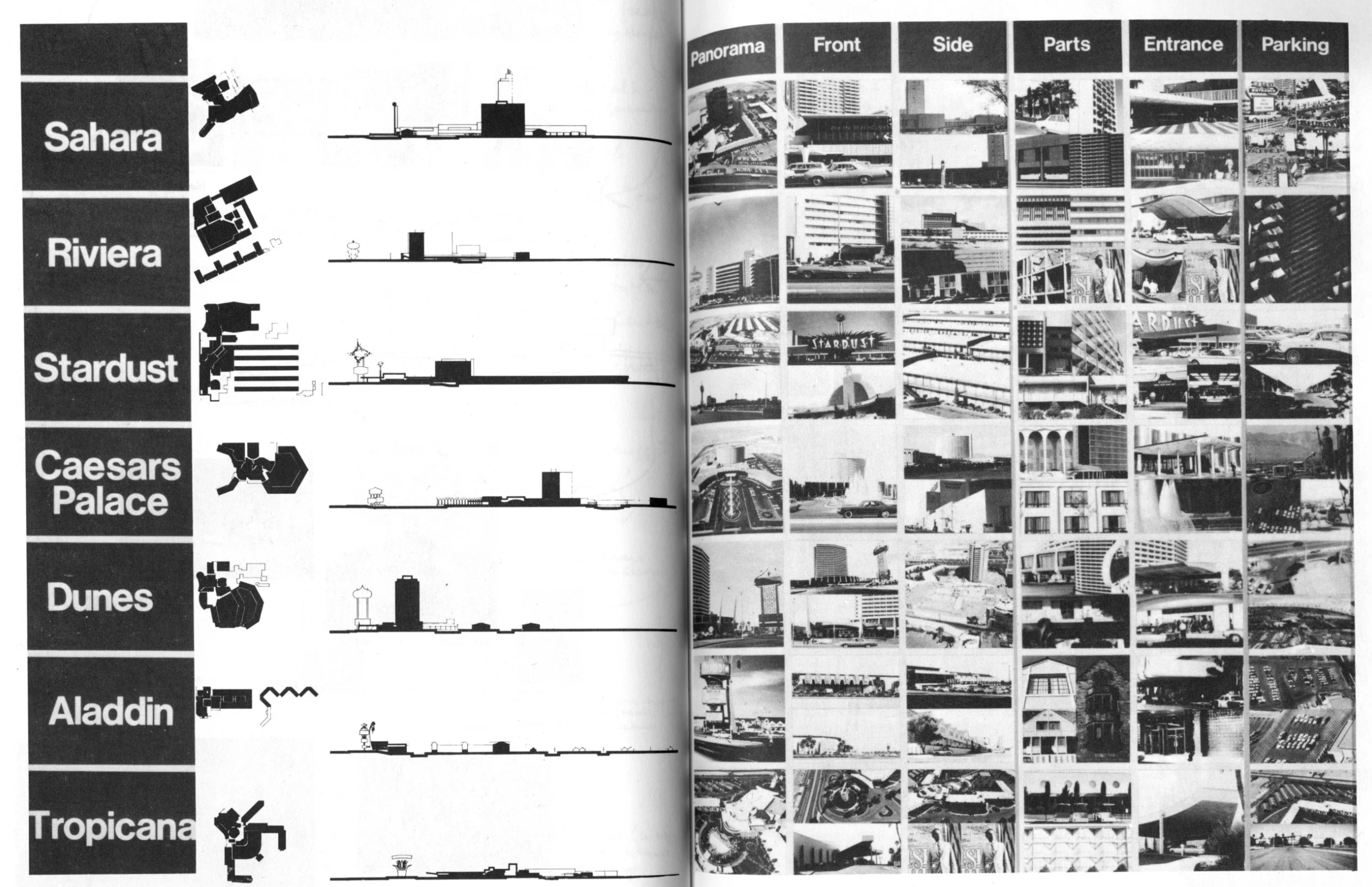
Learning From Las Vegas, Venturi, Brown, Izenous. 1977.
Jordan Poletti January 20, 2026
If you take the raised pedestrian bridge from the Statue of Liberty, over the 8 Lane Freeway, with the Arthurian Castle on your right, you will find yourself, after being handed a number of call cards for limo-drivers, sex workers and magicians, in the M&M World of Las Vegas Boulevard. Nestled neatly into the facade of the MGM Grand, right next to the world's second largest nightclub, owned and operated by a high-end Asian Fusion franchise, it is near identical to the many M&M worlds across the world. If you don't think about it for too long you can make yourself believe you are in Leicester Square, Times Square or Shanghai's People's Square. You wouldn't do this, however, because there is no place in the world you would rather be than right here, the centre of everything and nothingness and very little in between. As you walk through this temple of sugar coated chocolate, peanuts and wafer respectively, you will find yourself no longer in view of the entrance from which you arrived and as you stumble past a 10 foot tube of green candy, you will feel the soft patterned carpet of the MGM Grand Casino. Immediately your tiredness will lift as you breath in oxygenated air and are embraced by the warmth of cigarette smoke and blue-light, epileptic digital screens and the faint click-clack of a roulette ball. If you wanted to return to the M&M world you could not, because the exit has disappeared and it is a one-way porthole that serves a single destination. You will pay a 20 dollar ATM charge to take out not enough money and you will ask yourself the same question that Gorgias, Lao Zing, Descartes, Einstein, David Byrne and Little Simz have asked before you - how did I get here?
If you do not like to gamble, you may well go your whole life without ever visiting Las Vegas. If you do like to gamble, you should go your whole life without ever visiting Las Vegas. But if you have any interest in America, by which I mean modernity, then it is the most important place on Earth. Since its 20th century inception, it has been a city of popular and academic lore, used as muse and message for sin, singularity and separation. A false city who's skyline, Tom Wolfe once wrote, is made up not of buildings or mountains but signage. For the first 100 years of its existence, I suspect the mythification of Las Vegas came from its singularity and its otherness. A city built for a singular purpose of pleasure fulfilment, Versailles it's only equal, and the only legal destination of satiating an American desire for economic self-flagellation. When you arrived on the Strip for 100 years, you encountered novelty, a mirage of simulation and simulacra. Baudrillard's treatise needed no other examples that Las Vegas itself, though only in his later years did he begin to take the city as seriously as he should have. It was Chris Kraus, in her infinite prescience who organised the Chance Conference with Baudrillard in the Nevada desert, placing the father of hyper-modernity in the belly of his patricidal son. It was, he said, and architects, theorist and critics before him, a prototype of the world to come. It's designed disorientation of brash patterns and labyrinthine interiors a far cry from a world still holding onto an enlightenment structure of order and reality. As its neon farms and mob-owned tables were replaced by Eiffel Towers, Pyramids, Gondolas and conglomerates, Las Vegas continued to exist as separate from the rest of the world, updating and adapting to retain its otherness. Where Baudrillard called Disney Land 'miniaturised pleasure of real America', Las Vegas was the miniaturised pleasure of the imaged world. It existed beyond America, a universe unto itself, no longer representing a world but becoming one. It was the only true place in the world, because it cared not for truth, showed there was no truth in the first place, only belief. It offered something separate from daily existence, and this is what gave it its power.
Yet as you stand in the MGM Grand, a bag of M&Ms in your hand, there is little novelty. It feels strangely familiar. You did not get lost on your way here because somehow, the labyrinths of the city felt like you had walked them a hundred times, that the roadmap was embedded in you. This is because the world has caught up with Las Vegas, nearly 100 years later. When Nixon removed the dollar from the Gold Standard in 1971, he made money a simulacra, that which points only to itself, Las Vegas sighed, as it had been doing the same since 1931. Now, it is not just money which is the simulacra but the hyper-reality than Baudrillard talked about has taken is in full force, and Vegas was waiting. On a single junction, outside the M&M world, you can travel through space and time, every corner of the globe and time-period of history. The Statue of Liberty, the Pyramids of Giza, the Eiffel Tower, Caesar's Palace, Medieval Castles. It is no coincidence that the hotels of Vegas are always pointing to something else. They're taking us out of space and time, to a plane not inhabited by context, but a flat circle of shamelessness and instinct. Yet now, this Junction that was once the property of the Nevada desert, exists in the right hand pocket of near ever pair of trousers in the world. We scroll through our feeds and move through time and space. We see a model under the Eiffel Tower and right below it, an aunt by the Sphinx. Between the personal experience we are served ads for hard shell chocolates and pop- ups for daily spins that promise the potential of riches. Brown, Izenour and Venturi told us we must learn from Las Vegas, but instead we have become it. The city understood, long before the rest of the world, that space and time are redundant in the face of desire and satiation. It is the external facade of hyper-reality, of the dissolving of era, country, reality, into a single falsity all while you are crossing that pedestrian bridge above a six lane highway. This is where we are all right now, wavering on the precipice of the M&M World and the Casino beyond it. And we haven't even got inside to gamble yet.
Jordan Poletti is a writer and researcher, focusing on 20th century cultural theory and philosophy.