
Fragment from “America”
Jean Baudrillard December 12, 2024
Speed creates pure objects. It is itself a pure object, since it cancels out the ground and territorial reference-points, since it runs ahead of time to annul time itself, since it moves more quickly than its own cause and obliterates that cause by outstripping it. Speed is the triumph of effect over cause…

John Margolies, 1987. Road sign near Santa Rosa, New Mexico.
Jean Baudrillard was amongst the most consequential sociologists and philosophers of the modern age, formulating ideas of cultural consumption, hyperreality, and simulation that came to define our collective understanding of the technological age. In 1986, this titan of French academia published his American travel journals, written while driving across the United States. The work is insightful and biting, laden with humor, cynicism and awe for the country. Here is a fragment of these journals; concerning the joy of driving, the nature of artificiality, and the vast American desert to create a theory of America as land defined by, and powered by, speed.
Jean Baudrillard December 12, 2024
Speed creates pure objects. It is itself a pure object, since it cancels out the ground and territorial reference-points, since it runs ahead of time to annul time itself, since it moves more quickly than its own cause and obliterates that cause by outstripping it. Speed is the triumph of effect over cause, the triumph of instantaneity over time as depth, the triumph of the surface arid pure objectality over the profundity of desire. Speed creates a space of initiation, which may be lethal; its only rule is to leave no trace behind. Triumph of forgetting over memory, an uncultivated, amnesic intoxication. The superficiality and reversibility of a pure object in the pure geometry of the desert. Driving like this produces a kind of invisibility, transparency, or transversality in things, simply by emptying them out. It is a sort of slow-motion suicide, death by an extenuation of forms - the delectable form of their disappearance. Speed is not a vegetal thing. It is nearer to the mineral, to refraction through a crystal, and it is already the site of a catastrophe, of a squandering of time. Perhaps, though, its fascination is simply that of the void. There is no seduction here, for seduction requires a secret. Speed is simply the rite that initiates us into emptiness: a nostalgic desire for forms to revert to immobility, concealed beneath the very intensification of their mobility. Akin to the nostalgia for living forms that haunts.
Still, there is a violent contrast here, in this country, between the growing abstractness of a nuclear universe and a primary, visceral, unbounded vitality, springing not from rootedness, but from the lack of roots, a metabolic vitality, in sex and bodies, as well as in work and in buying and selling. Deep down, the US, with its space, its technological refinement, its bluff good conscience, even in those spaces which it opens up for simulation, is the only remaining primitive society. The fascinating thing is to travel through it as though it were the primitive society of the future, a society of complexity, hybridity, and the greatest intermingling, of a ritualism that is ferocious but whose superficial diversity lends it beauty, a society inhabited by a total metasocial fact with unforeseeable consequences, whose immanence is breathtaking, yet lacking a past through which to reflect on this, and therefore fundamentally primitive. . . Its primitivism has passed into the hyperbolic, inhuman character of a universe that is beyond us, that far outstrips its own moral, social, or ecological rationale. Only Puritans could have invented and developed this ecological and biological morality based on preservation - and therefore on discrimination -which is profoundly racial in nature. Everything becomes an overprotected nature reserve, so protected indeed that there is talk today of denaturalizing Yosemite to give it back to Nature, as has happened with the Tasaday in the Philippines. A Puritan obsession with origins in the very place where the ground itself has already gone. An obsession with finding a niche, a contact, precisely at the point where everything unfolds in an astral.

Edward S. Curtis, 1904. Cañyon de Chelly.
There is a sort of miracle in the insipidity of artificial paradises, so long as they achieve the greatness of an entire (un)culture. In America, space lends a sense of grandeur even to the insipidity of the suburbs and ‘funky towns’. The desert is everywhere, preserving insignificance. A desert where the miracle of the car, of ice and whisky is daily re-enacted: a marvel of easy living mixed with the fatality of the desert. A miracle of obscenity that is genuinely American: a miracle of total availability, of the transparency of all functions in space, though this latter nonetheless remains unfathomable in its vastness and can only be exorcised by speed.
The Italian miracle: that of stage and scene.
The American miracle: that of the obscene.
The profusion of sense, as against the deserts of meaninglessness.
It is metamorphic forms that are magical. Not the sylvan, vegetal forest, but the petrified, mineralized forest. The salt desert, whiter than snow, flatter than the sea. The effect of monumentality, geometry, and architecture where nothing has been designed or planned. Canyonsland, Split Mountain. Or the opposite: the amorphous reliefless relief of Mud Hills, the voluptuous, fossilized, monotonously undulating lunar relief of ancient lake beds. The white swell of White Sands. It takes this surreality of the elements to eliminate nature’s picturesque qualities, just as it takes the metaphysics of speed to eliminate the natural picturesqueness of travel.
“Driving is a spectacular form of amnesia. Everything is to be discovered, everything to be obliterated.”
In fact the conception of a trip without any objective and which is, as a result, endless, only develops gradually for me. I reject the picturesque tourist round, the sights, even the landscapes (only their abstraction remains, in the prism of the scorching heat). Nothing is further from pure travelling than tourism or holiday travel. That is why it is best done in the extensive banality of deserts, or in the equally desert-like banality of a metropolis - not at any stage regarded as places of pleasure or culture, but seen televisually as scenery, as scenarios. That is why it is best done in extreme heat, the orgasmic form of bodily deterritorialization. The acceleration of molecules in the heat contributes to a barely perceptible evaporation of meaning.
It is not the discovery of local customs that counts, but discovering the immorality of the space you have to travel through, and this is on a quite different plane. It is this, together with the sheer distance, and the deliverance from the social, that count. Here in the most moral society there is, space is truly immoral. Here in the most conformist society, the dimensions are immoral. It is this immorality that makes distance light and the journey infinite, that cleanses the muscles of their tiredness.

Sinclair Lewis, 1908.
Driving is a spectacular form of amnesia. Everything is to be discovered, everything to be obliterated. Admittedly, there is the primal shock of the deserts and the dazzle of California, but when this is gone, the secondary brilliance of the journey begins, that of the excessive, pitiless distance, the infinity of anonymous faces and distances, or of certain miraculous geological formations, which ultimately testify to no human will, while keeping intact an image of upheaval. This form of travel admits of no exceptions: when it runs up against a known face, a familiar landscape, or some decipherable message, the spell is broken: the amnesic, ascetic, asymptotic charm of disappearance succumbs to affect and worldly semiology. This sort of travel creates its own peculiar type of event and innervation, so it also has its own special form of fatigue. Like a fibrillation of muscles, striated by the excess of heat and speed, by the excess of things seen or read, of places passed through and forgotten. The defibrillation of the body overloaded with empty signs, functional gestures, the blinding brilliance of the sky, and somnabulistic [sic!] distances, is a very slow process. Things suddenly become lighter, as culture, our culture, becomes more rarefied. And this spectral form of civilization which the Americans have invented, an ephemeral form so close to vanishing point, suddenly seems the best adapted to the probability - the probability only - of the life that lies in store for us. The form that dominates the American West, and doubtless all of American culture, is a seismic form: a fractal, interstitial culture, born of a rift with the Old World, a tactile, fragile, mobile, superficial culture - you have to follow its own rules to grasp how it works: seismic shifting.
The only question in this journey is: how far can we go in the extermination of meaning, how far can we go in the non-referential desert form without cracking up and, of course, still keep alive the esoteric charm of disappearance? A theoretical question here materialized in the objective conditions of a journey which is no longer a journey and therefore carries with it a fundamental rule: aim for the point of no return. This is the key. And the crucial moment is that brutal instant which reveals that the journey has no end, that there is no longer any reason for it to come to an end. Beyond a certain point, it is movement itself that changes. Movement which moves through space of its own volition changes into an absorption by space itself - end of resistance, end of the scene of the journey as such (exactly as the jet engine is no longer an energy of space penetration, but propels itself by creating a vacuum in front of it that sucks it forward, instead of supporting itself, as in the traditional model, upon the air’s resistance). In this way, the centrifugal, eccentric point is reached where movement produces the vacuum that sucks you in. This moment of vertigo is also the moment of potential collapse. Not so much from the tiredness generated by the distance and the heat, as from the irreversible advance into the desert of time.
Tomorrow is the first day of the rest of your life.
Jean Baudrillard was a French philosopher, sociologist and cultural theorist. He was born in 1929 and died in 2007.

Ben Greenfield
1h 28m
12.11.24
In this clip, Rick speaks with Ben Greenfield about biohacking.
<iframe width="100%" height="75" src="https://clyp.it/x322etq0/widget?token=fd91920fd343ece738006c5f2011aa2b" frameborder="0"></iframe>
Film
<div style="padding:59.87% 0 0 0;position:relative;"><iframe src="https://player.vimeo.com/video/1038040676?title=0&byline=0&portrait=0&badge=0&autopause=0&player_id=0&app_id=58479" frameborder="0" allow="autoplay; fullscreen; picture-in-picture; clipboard-write" style="position:absolute;top:0;left:0;width:100%;height:100%;" title="Jason and the Argonauts clip"></iframe></div><script src="https://player.vimeo.com/api/player.js"></script>

Iggy Pop Playlist
Iggy Confidential
Archival - September 18, 2015
Iggy Pop is an American singer, songwriter, musician, record producer, and actor. Since forming The Stooges in 1967, Iggy’s career has spanned decades and genres. Having paved the way for ‘70’s punk and ‘90’s grunge, he is often considered “The Godfather of Punk.”


Hannah Peel Playlist
Archival - December 2, 2024
Mercury Prize, Ivor Novello and Emmy-nominated, RTS and Music Producers Guild winning composer, with a flow of solo albums and collaborative releases, Hannah Peel joins the dots between science, nature and the creative arts, through her explorative approach to electronic, classical and traditional music.
The Ten of Swords (Tarot Triptych)
Chris Gabriel December 7, 2024
The Ten of Swords is the end of all the plots and schemes of the suit of swords. Here all of the lofty ideas are brought down to their material conclusion - ruin…
Name: Ruin, the Ten of Swords
Number: 10
Astrology: Sun in Gemini
Qabalah: Malkuth of Vau
Chris Gabriel December 7, 2024
The Ten of Swords is the end of all the plots and schemes of the suit of swords. Here all of the lofty ideas are brought down to their material conclusion - ruin.

In Rider, we see a man bled out, struck through by ten swords in an act of excessive violence. His hand points two fingers down. The sun has set, and darkness rolls in. All the swords of the suit are brought down to Earth, the craftsman is killed by his own work.

In Thoth, we have ten swords breaking at their points. Together, they form the Tree of Life. Their handles are, respectively, the sun and moon, a scale, stars, crosses, and compasses. All about them are jagged, deformed geometric figures. Astrologically this is the Sun in Gemini.

In Marseille, we have eight curved swords, and two swords crossing one another from outside the oval. Here the ideas formed throughout the suit come into reality. A positive view of the placement in comparison with Rider and Thoth. Qabalistically this is the Kingdom of the Prince.
This is the material end of high ideas. Rider’s depiction calls to mind Julius Caesar, whose visions of domination and rulership ended in 23 stab wounds. This is expressed perfectly in Ezekiel 28:9: “Wilt thou yet say before him that slayeth thee, I am God? but thou shalt be a man, and no God, in the hand of him that slayeth thee.”
Like the tragic ending of Hamlet, who is ultimately killed by his own mind, his dreams, and an unwillingness to deal with the reality of his opponent’s blade, this is a card concerned with the simple, material ending of death in the face of lofty ambition..
For Rider, we can imagine that beyond ten enemies stabbing a man in the back, his own hubris wielded those deathly blades. Just as the Nine of Swords was like the Sword of Damocles, here the thread breaks and the sword falls.
When read positively as in Marseille, we see the painstaking process of bringing ideas into reality that can leave the artist feeling like the man struck in Rider. The artist’s vision of beauty is never translated into reality, instead they must make compromises to bring something into the world. This is necessary and good for we must materialize and not simply ideate. The negativity of Rider and Thoth hinges upon the bad nature of the ideas brought to fruition but Marseille shows us that a good idea brought to reality is the ultimate good. Only when ideas remain in the mind for too long do they rot and fester.
It calls to mind an allegory from the Upanishads.
“We are like the spider,” said the king. “We weave our life, and then move along in it. We are like the dreamer who dreams and then lives in the dream.
“This is true for the entire universe. That is why it is said, ‘Having created the creation, the Creator entered into it’.
“This is true for us. We create our world, and then enter into that world. We live in the world that we have created. When our hearts are pure, then we create the beautiful, enlightened life we have wished for.”
When we pull this card, we can expect the end of a project. If executed well, it will be a great thing. Otherwise, the plots and schemes we’ve formed will come crashing down. Our ideas, good and bad, will here be brought into reality.
Film
<div style="padding:75.63% 0 0 0;position:relative;"><iframe src="https://player.vimeo.com/video/1036966572?badge=0&autopause=0&player_id=0&app_id=58479" frameborder="0" allow="autoplay; fullscreen; picture-in-picture; clipboard-write" style="position:absolute;top:0;left:0;width:100%;height:100%;" title="Empathic Listening Carl Rogers"></iframe></div><script src="https://player.vimeo.com/api/player.js"></script>
The Subtle and The Gross (Alchemy I)
Molly Hankins December 5, 2024
When it comes to magic, alchemy, or the transformation of matter, can be taken literally or metaphorically. According to the Bulgarian philosopher and spiritual movement UWB founder Peter Deunov’s teachings on Kabbalist philosophy, life on Earth is spirit condensed into matter and so to practice magic inherently involves both literal and metaphorical alchemy…

Illustration from “Thesaurus of Alchemy”. c.1725.
Molly Hankins December 5, 2024
When it comes to magic, alchemy, or the transformation of matter, can be taken literally or metaphorically. According to the Bulgarian philosopher and spiritual movement UWB founder Peter Deunov’s teachings on Kabbalist philosophy, life on Earth is spirit condensed into matter and so to practice magic inherently involves both literal and metaphorical alchemy.
His disciple author Omraam Mikhaël Aïvanhov used the Latin phrase ‘solve et coagula’ to describe the alchemical process, meaning to dissolve and coagulate. Catherine MacCoun, author of On Becoming An Alchemist, uses the Emerald Tablets language of ‘separating the subtle from the gross’ to describe the same phenomena. “Alchemical magic never defies the laws of nature.”, she writes, “Instead, it observes the workings of those laws at an earlier stage than is evident to the physical senses. Whatever manifests on the physical level begins with an idea or intention. While matter is too dense, too heavy, to be altered by the mind alone, ideas and intentions are the mind’s natural medium.”
If physical reality is too dense to be altered by will alone, then using our will to cause such change to occur must inherently involve some dissolution of this density. In order to work with the ‘gross’ body by way of the subtle, according to Deunov’s teachings, involves the life-long alchemical process of consciously disintegrating condensed matter. As Aïvanhov wrote in Fruits of the Tree of Life, “All that is dense, compact and heavy represents unorganized matter in which energy is held prisoner. And the more energy one imprisons oneself with, like those who overeat, the more harm one does to oneself. We must, on the contrary, liberate energy.”
The Universal White Brotherhood believed that using our consciousness to transform the gross into the subtle simply was the great secret of mastering life itself. There are seven stages of alchemy which are recognized as being both physical and spiritual. MacCoun describes each phase in terms of the base matter to be alchemized and the result of what that matter is ultimately transmuted into.
“Separation is our phase of spiritual adolescence because we can’t become magical adults without maturing beyond egoic impulses to defend our existential territory.”
The first is calcination, which technically means burning something to ashes, but according to her interpretation also means suffering caused by attachment to what will inevitably be lost. She posits that every human life is marked by a series of losses that burns away all which is not our true essence. The result of this calcination of ‘false roots’ or over-identification with the material world is self-confidence by way of strengthening the connection to who we truly are.
The next stage is dissolution, where physically ashes are dissolved into fluid, and existentially, our desires are dissolved into devotion. MacCoun believes this process occurs when we get impatient waiting for our desires to be fulfilled. That gap between our wants and attainments begs the question of whether our desires are true and useful, an essential step in coming to know our true selves. The result is that ultimately we not only get to know ourselves, but also learn to let go of attachment to outcome, which paradoxically results in more favorable outcomes. Our desires themselves transmute from gross to subtle.

From “Compendiolum de Praeparatione Auri Potabilis Veri”, attributed to M. E. Bonacina. c.1790.
Separation occurs next, which involves the physical extraction of matter left in the dissolved substance. Metaphorically, separation refers to extraction of the true self from the personalities acquired through of various life experiences and trauma responses. The base matter is territoriality, which can be anything defining us in relation to others that we have an ego-driven instinct to protect. The transmuted result, then, is integrity, and MacCoun contends that separation is our phase of spiritual adolescence because we can’t become magical adults without maturing beyond egoic impulses to defend our existential territory.
The fourth stage is conjunction, a combining of the results from the previous three stages. In the physical sense, the process has altered from changing a substance through natural processes to changing a substance using a combination of the other substances generated in each stage of the process. Existentially, it refers to being able to hold opposing forces, transmuting vulnerability into compassion by way of the heart. Rather than trying to make sense of conflict in our heads, we hold it in our hearts and offer hospitality to the opposing forces, compassion.
Fermentation happens next, which physically involves leaving the substance alone in the dark until it putrefies. In existential terms, this is the “dark night of the soul” that transmutes the base material of obsolete desires and ambitions into magical will. One’s inner life overtakes the outer life because an aspect of our will is an obstacle to what our spirit wishes to express through our physical reality.
Sublimation is the penultimate stage, where the physical substance is heated up until the essence rises to the surface. On a personal level, this is the phase where we realize we’re disconnected from our true intentions. The transmuting of thoughts into deeds starts with the internal panic or “heat” of recognizing when our mentality is misaligned with what we’re doing. After this phase, our will becomes wise because it’s more connected to our spirit. The subtlety of our true essence moves beyond gross matter, freed by being subjected to each stage of the alchemical process.
MacCoun named the final stage radiation, which is where ‘The Philosopher’s Stone’ is formed in medieval alchemy. This essential concept will be covered in part II, but both physically and existentially this phase is one of coagulation. The base matter is arbitrary magic and the transmutation is sacred magic. According to MacCoun, Aleister Crowley’s famous quote, “Do what thou whilst shall be the whole of the law,” is the very definition of arbitrary magic. By contrast, Deunov’s Universal White Brotherhood believe that magical results are achieved by treating everyone and everything as sacred, that we must always be infusing positive vibrations into both the subtle and gross in order to direct our will.
Unlike physical, linear alchemy of a single substance, any number of these existential processes can occur simultaneously, and through our lifetimes. In part II we’ll explore the true meaning of The Philosopher’s Stone, the supposed secret key to successful alchemy.
Molly Hankins is a Neophyte + Reality Hacker serving the Ministry of Quantum Existentialism and Builders of the Adytum

Pharrell Williams
57m
12.4.24
In this clip, Rick speaks with Pharrell Williams about how he opens himself up by writing for other artists.
<iframe width="100%" height="75" src="https://clyp.it/gwf2yt5a/widget?token=4f8da88e78d422919daba0ec18662be7" frameborder="0"></iframe>
Film
<div style="padding:56.25% 0 0 0;position:relative;"><iframe src="https://player.vimeo.com/video/1035355335?title=0&byline=0&portrait=0&badge=0&autopause=0&player_id=0&app_id=58479" frameborder="0" allow="autoplay; fullscreen; picture-in-picture; clipboard-write" style="position:absolute;top:0;left:0;width:100%;height:100%;" title="Larry Cuba - Calculated Movements"></iframe></div><script src="https://player.vimeo.com/api/player.js"></script>
Theaters of Authenticity
Ana Roberts December 3, 2024
In the D.A. Pennebacker concert film of Ziggy’s last performance we open with glimpses of a crowd waiting outside. One by one, boys and girls alike, are seen in makeup, in crimson hair, dressed as mime artists, as aliens, as the lost population of Ziggy’s world. These are not just fans, they are inhabitants, they are part of the performance, they are the disciples of Ziggy who have followed him from outer space to earth to revel in his glory, in his sex, in his pure rock’n’roll…
Ana Roberts December 3, 2024
David Bowie released his first album in 1967 to little acclaim or success, and there are many who say it rightly deserved neither. A peculiar blend of psychedelic rock, folk and whimsical music hall acts, the album is incompatible with the rest of his career. It is a combination of twee songs of pastoral England, saccharine love songs and quaint lyrics that seem to come from an oral tradition of medieval story telling. It is an album mostly not worth talking about, save for a single track ‘We Are Hungry Men’ undoubtedly amongst the few embarrassing moments in Bowies career. It is a muddled song telling a rather shallow story, feeling halfway between a radio play and a song, with an undeniably catchy chorus, yet in it Bowie plays the part of a Messiah, come to earth to warn of overpopulation. The lyrics read like a pulp science-fiction novel of the 50s, a known influence on Bowie, but it is not ludicrous to suggest that Bowie had seen how Dylan had created himself as a prophet and began flirting with the idea. In fact some four years later, on Hunky Dory, he paid direct homage to his influence on ‘Song for Bob Dylan’, illustrating how deeply he understood the power of Dylan’s creation, ‘You sat behind a million pair of eyes / And told them how they saw’. Bowie understood the power of Dylan’s ability to transplant his truth on others, rather than make any claims for himself but more importantly, he understood that Dylan was playing a character, addressing him by his given name and referring to Dylan as a separate entity entirely; ‘Now, hear this, Robert Zimmerman / Though I don’t suppose we’ll meet / Ask your good friend Dylan / If he’d gaze on down the street’.
Bowie saw that Dylan was a created character, and that his mythology as a prophet was a tool of genius, but even on ‘We Are The Hungry Men’ Bowie took this tool far further than Dylan ever did, on this very first outing he presents himself directly as a prophet, something Dylan never dared to do throughout his career. In a mostly forgettable album, this single moment shows that Bowie, so early in his career, is already comfortable with playing characters, willingly inauthentic at his very origin and entirely aware of how Dylan has created himself, and dealt with his own problem of authenticity. It would be another five years until the Bowie’s journey of the created prophet would reach it’s origin with The Rise and Fall of Ziggy Stardust and The Spiders from Mars.
“Bowie created a prophet, and created for him a prophecy he knew would come true. While Dylan ensured that his work could not be falsifiable, Bowie ensured that his was able to be proven true.”

Fans waiting outside the concert in D.A. Pennebacker’s ‘Ziggy Stardust and the Spiders from Mars’, 1979.
In the D.A. Pennebacker, who had made the Bob Dylan film ‘Dont Look Back’ some 6 years earlier, concert film of Ziggy’s last performance we open with glimpses of a crowd waiting outside. One by one, boys and girls alike, are seen in makeup, in crimson hair, dressed as mime artists, as aliens, as the lost population of Ziggy’s world. These are not just fans, they are inhabitants, they are part of the performance, they are the disciples of Ziggy who have followed him from outer space to earth to revel in his glory, in his sex, in his pure rock’n’roll. This is the genius of Ziggy and the genius of Bowie; it is in this that he is able to become entirely authentic through playing a created character. Bowie does not have to comment on or confront whether he is authentic because through creating the character of Ziggy Stardust, he has created a theater. His understanding of mime and comedia dell’arte, studied in the interim years between his first album and this, he was able to create a world through himself alone. The reduction of comedia dell’arte into purest forms of emotion to convey character allowed him to forget about the particulars. It is why Ziggy Stardust doesn’t tell a cohesive story and still creates a world. It is a masterpiece of maximalist reductionism. Bowie did not create a glass onion, he created an alien, and presented him openly for the world to see. He created a singular narrative, rejecting the need for a continuous one. Though his albums before all built up to this, they have no relation to it. David Bowie needs to be authentic, needs to create a glass onion, but Ziggy Stardust has no such requirements. Watching the opening minutes of the concert film, with a gaggle of kids dressed up as freaks, it is clear that this is true. The audience believes in the world, and they believe in Ziggy, so they become part of the world. They no longer question whether he is being authentic, because they have authentically inhabited the same created world as him. It is easier to create worlds than to change them.
The Rise and Fall of Ziggy Stardust and the Spiders from Mars ends as promised, with a fall. ‘Ziggy Stardust’ offers the most cohesive chronicling of the events of the album so far, and, sung from the perspective of one of the spiders, it describes his death, ‘Like a leper messiah / When the kids had killed the man / I had to break up the band’. It offers a parable of fame and success, the overcoming of an ego that leads to destruction. Yet, it is not the last song on the album. Instead, it precedes ‘Suffragette City’ and the album finishes with ‘Rock ‘n’ Roll Suicide’. The live show too, while it differed in track listing from the album, always finished with this track. In Pennebackers documentary of this final performance, at the end of the show, stripped of costumes, wearing just a sheer black top, Bowie delivers a speech before he begins, announcing the end of Ziggy Stardust that this is to be ‘the last show we’ll ever do’. He turns, as the opening piano chords begin and circles the stage, stopping in the middle to sing, delicately, ‘Time takes a cigarette, puts it in your mouth’. The song matches the tone of the opener, ‘Five Years’, both feeling more like ‘avante-garde show song than straight rock songs’, biographer David Buckley suggests. The repeated refrain of the song, sung with unbridled passion and emotion by Bowie at the final show, ‘You’re not alone’ feels like a message to his fans, written in the knowledge he would kill Ziggy. Bowie created Ziggy with the intention of him to die, ‘Rock ‘n’ Roll Suicide’ is the final prophecy, fulfilled 18 months after it’s release. It is this track that is perhaps the ultimate stroke of genius in creating Ziggy. Bowie created a prophet, and created for him a prophecy he knew would come true. While Dylan ensured that his work could not be falsifiable, Bowie ensured that his was able to be proven true.
Ziggy Stardust had truth embedded in him at the moment of his creation, to be ultimately revealed at the moment of his death. Bowie knew too, that in order for Ziggy to be authentic he had to die. Not just in the grand tradition of dead rock stars but more potently in the tradition of theater, where no piece of art can last forever, and they are imbued with truth because of it. Bowie employed mime in every aspect of Ziggy’s creation, and it is because of this that he was able to create authenticity. He undermined himself, acknowledged that he could never be authentic and so instead created someone who was. ‘Rock ‘n’ Roll Suicide’ speaks as directly about Bowie as it does to Ziggy. Bowie had to commit suicide of the self, suicide of his rock n roll dreams in order to create Ziggy and reach authenticity and communicate truth. It would not be the first time such a suicide was performed. ‘You’re not alone’ is as much words of comfort for the freaks in Ziggy’s world as it is to Bowie himself, his repeatedly fracturing personalities ensuring that it would be nearly a decade before he performed as himself, alone. Bowie confronted authenticity as directly as The Monkees did, but where Head was a critique of their own inauthenticity, Ziggy Stardust was a celebration of it. Embedded within Ziggy is knowledge that Bowie had in his first record, we are never ourselves, never for ourselves and we are all the more powerful because of it.
Ana Roberts is a writer, musician, and cultural critic.


Hannah Peel Playlist
Archival - October 17, 2024
Mercury Prize, Ivor Novello and Emmy-nominated, RTS and Music Producers Guild winning composer, with a flow of solo albums and collaborative releases, Hannah Peel joins the dots between science, nature and the creative arts, through her explorative approach to electronic, classical and traditional music.
Five of Disks (Tarot Triptych)
Chris Gabriel November 30, 2024
In the Five of Disks, the Earth quakes and cracks, structures crumble and confusion comes. This is material instability, a crash…
Name: Worry, the Five of Disks
Number: 5
Astrology: Mars in Taurus
Qabalah: Gevurah of He
Chris Gabriel November 30, 2024
In the Five of Disks, the Earth quakes and cracks, structures crumble and confusion comes. This is material instability, a crash.

In Rider, we find two beggars enduring a snow storm. The man is lame and using crutches, his head is bandaged as he looks up in agony. The woman is barefoot, covered in a shawl and thin skirt, she looks down in defeat. They are passing a stained glass window made up of five pentacles pointing up. The material comforts enjoyed by the previous 4 figures in the suits have withdrawn, there are now distinct haves and havenots.

In Thoth, we have five cracked disks forming a downward pentagram. They bear the symbols of the five Tattvas, the magical elements that form reality. Astrologically the card is Mercury in Taurus, an unhappy position, quick and agile Mercury here is weighed down by the laborious Bull.

In Marseille, we are shown our most pleasant image, five simple coins and two flowers. Here the disruption to the stable four is seen as a growth: they are not moving up or down as in Rider and Thoth, but remain balanced. This Growth can be good, like a flower, or bad, like cancer. Qabalistically, this is the Anger of the Princess.
This card reminds me of chapter 77 of the Tao Te Ching, in which the Tao of Heaven is likened to a bow, the high is made low and the low is made high, but the Tao of Man brings the high higher and forces the low lower. The Five of Disks is an excellent expression of this.
As Mars in Taurus it raises to mind Sigmund Freud and Salvador Dali, who make excellent use of their fallen Mercury through science and art. The Parapraxis or Freudian Slip is an idea that could only arise from Mercury Taurus, the worry that our words reveal ulterior motives is exactly the kind of paranoia that flourishes in the sign.
Dali develops the “Paranoiac Critical Method” through which he follows paranoid fantasies as far as they can go. Psychoanalysis, and its town crier Surrealism, shook the very foundations of civilization by revealing their true basis in the terrifying and inhuman Unconscious.
Materially, this is a stock market crash and economic collapse, the stable power of the Four of Disks is broken. The money goes up, leaving the poor to suffer, as in Rider, or the system itself crumbles, as in Thoth.
When we pull this card, expect your comfort to be shaken, for it harkens a breaking down and collapse. Trust your suspicions. This can be a failed investment, a car crash, a break up, or a job loss but it can also be the positive risk of a new opportunity.
Film
<div style="padding:75% 0 0 0;position:relative;"><iframe src="https://player.vimeo.com/video/1029420940?title=0&byline=0&portrait=0&badge=0&autopause=0&player_id=0&app_id=58479" frameborder="0" allow="autoplay; fullscreen; picture-in-picture; clipboard-write" style="position:absolute;top:0;left:0;width:100%;height:100%;" title="An Optical Poem"></iframe></div><script src="https://player.vimeo.com/api/player.js"></script>
Walking in the City, Part 2
Michel de Certeau November 28, 2024
The Concept-city is decaying. Does that mean that the illness afflicting both the rationality that founded it and its professionals afflicts the urban populations as well? Perhaps cities are deteriorating along with the procedures that organized them. But we must be careful here. The ministers of knowledge have always assumed that the whole universe was threatened by the very changes that affected their ideologies and their positions…

Michel De Certeau was a Jesuit Priest and Scholar whose work on topics across history, sociology, philosophy, semiotics, theology and psychoanalysis helped define him as one of the most substantial and unique thinkers of his era. This essay, from his work ‘The Practice of Everyday Life’ published in 1974, is an attempt to individualize the concept of mass culture that Guy Debord and the Situationists had established a decade earlier. He finds art in the unconscious action of living, and argues that though systems are placed upon us, humans cannot and will not act as a monolith but always as individuals, employing individual tactics of expression in every facet of life.
Michel De Certeau November 28, 2024
The Concept-city is decaying. Does that mean that the illness afflicting both the rationality that founded it and its professionals afflicts the urban populations as well? Perhaps cities are deteriorating along with the procedures that organized them. But we must be careful here. The ministers of knowledge have always assumed that the whole universe was threatened by the very changes that affected their ideologies and their positions. They transmute the misfortune of their theories into theories of misfortune. When they transform their bewilderment into 'catastrophes', when they seek to enclose the people in the 'panic' of their discourses, are they once more necessarily right?
Rather than remaining within the field of a discourse that upholds its privilege by inverting its content (speaking of catastrophe and no longer of progress), one can try another path: one can analyse the microbe-like, singular and plural practices which an urbanistic system was supposed to administer or suppress, but which have outlived its decay; one can follow the swarming activity of these procedures that, far from being regulated or eliminated by panoptic administration, have reinforced themselves in a proliferating illegitimacy, developed and insinuated themselves into the networks of surveillance, and combined in accord with unreadable but stable tactics to the point of constituting everyday regulations and surreptitious creativities that are merely concealed by the frantic mechanisms and discourses of the observational organization.
This pathway could be inscribed as a consequence, but also as the reciprocal, of Foucault's analysis of the structures of power. He moved it in the direction of mechanisms and technical procedures, 'minor instrumentalities' capable, merely by their organization of 'details', of transforming a human multiplicity into a 'disciplinary' society and of managing, differentiating, classifying, and hierarchizing all deviances concerning apprenticeship, health, justice, the army or work. 'These often miniscule ruses of discipline', these 'minor but flawless' mechanisms, draw their efficacy from a relationship between procedures and the space that they redistribute in order to make an 'operator' out of it. But what spatial practices correspond, in the area where discipline is manipulated, to these apparatuses that produce a disciplinary space? In the present conjuncture, which is marked by a contradiction between the collective mode of administration and an individual mode of reappropriation, this question is no less important, if one admits that spatial practices in fact secretly structure the determining conditions of social life. I would like to follow out a few of these multiform, resistant, tricky and stubborn procedures that elude discipline without being outside the field in which it is exercised, and which should lead us to a theory of everyday practices, of lived space, of the disquieting familiarity of the city.

The Chorus of Idle Footsteps
The goddess can be recognized by her step.
Virgil, Aeneid, I, 405
Their story begins on ground level, with footsteps. They are myriad, but do not compose a series. They cannot be counted because each unit has a qualitative character: a style of tactile apprehension and kinesthetic appropriation. Their swarming mass is an innumerable collection of singularities. Their intertwined paths give their shape to spaces. They weave places together. In that respect, pedestrian movements form one of these 'real systems whose existence in fact makes up the city'. They are not localized; it is rather they that spatialize. They are no more inserted within a container than those Chinese characters speakers sketch out on their hands with their fingertips.
It is true that the operations of walking on can be traced on city maps in such a way as to transcribe their paths (here well-trodden, there very faint) and their trajectories (going this way and not that). But these thick or thin curves only refer, like words, to the absence of what has passed by. Surveys of routes miss what was: the act itself of passing by. The operation of walking, wandering, or 'window shopping', that is, the activity of passers-by, is transformed into points that draw a totalizing and reversible line on the map. They allow us to grasp only a relic set in the nowhen of a surface of projection. Itself visible, it has the effect of making invisible the operation that made it possible. These fixations constitute procedures for forgetting. The trace left behind is substituted for the practice. It exhibits the (voracious) property that the geographical system has of being able to transform action into legibility, but in doing so it causes a way of being in the world to be forgotten.
“Only the cave of the home remains believable, still open for a certain time to legends, still full of shadows. Except for that, according to another city-dweller, there are only 'places in which one can no longer believe in anything’.”
Walking Rhetorics
The walking of passers-by offers a series of turns (tours) and detours that can be compared to 'turns of phrase' or 'stylistic figures'. There is a rhetoric of walking. The art of 'turning' phrases finds an equivalent in an art of composing a path (toumer un parcours). Like ordinary language, this art implies and combines styles and uses. Style specifies 'a linguistic structure that manifests on the symbolic level ... an individual's fundamental way of being in the world'; it connotes a singular. Use defines the social phenomenon through which a system of communication manifests itself in actual fact; it refers to a norm. Style and use both have to do with a 'way of operating' (of speaking, walking, etc.), but style involves a peculiar processing of the symbolic, while use refers to elements of a code. They intersect to form a style of use, a way of being and a way of operating.
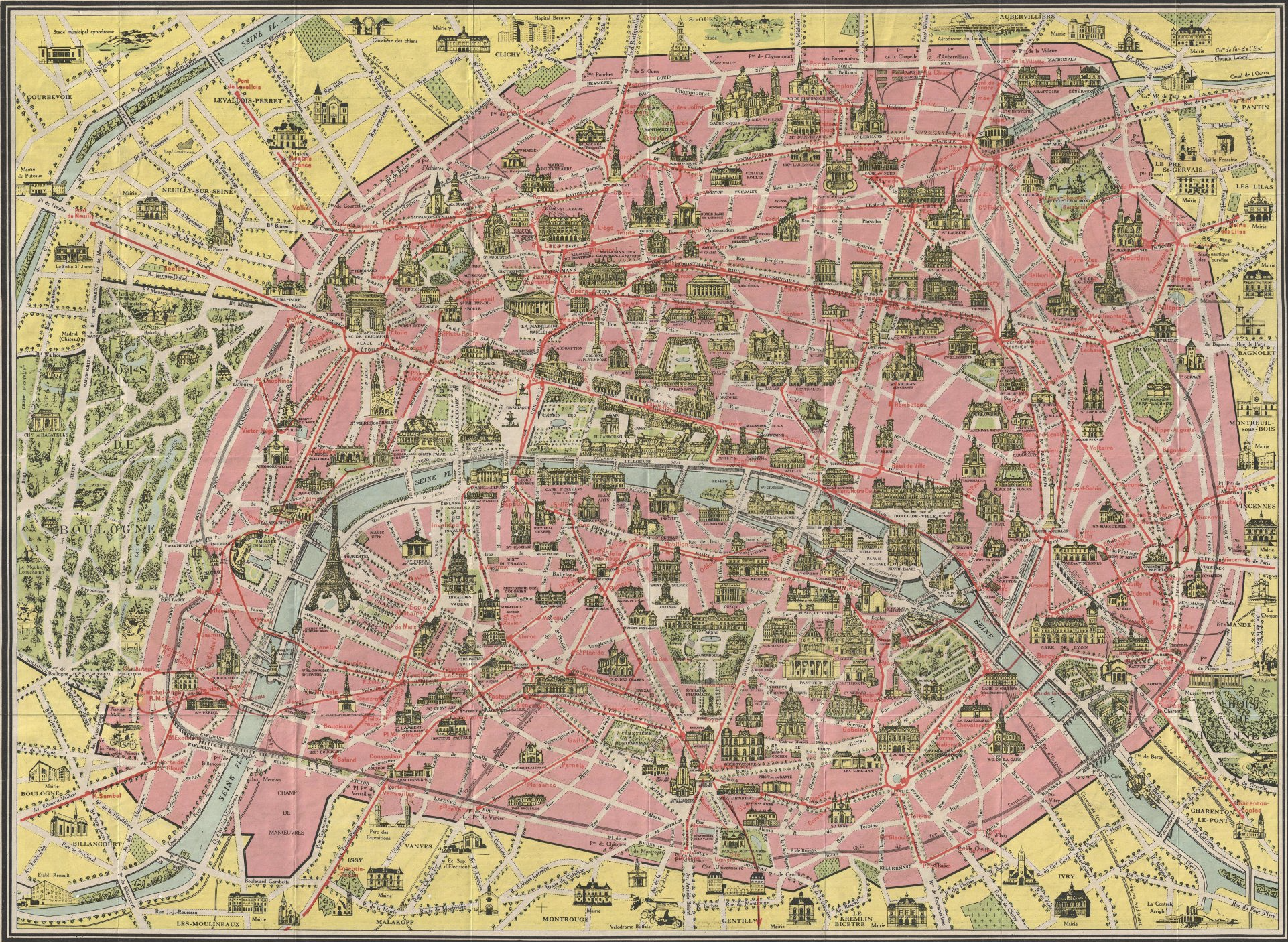
A friend who lives in the city of Sevres drifts, when he is in Paris, toward the rue des Saints-Peres and the rue de Sevres, even though he is going to see his mother in another part of town: these names articulate a sentence that his steps compose without his knowing it. Numbered streets and street numbers ( 112th St., or 9 rue Saint-Charles) orient the magnetic field of trajectories just as they can haunt dreams. Another friend unconsciously represses the streets whjch have names and, by this fact, transmit her - orders or identities in the same way as summonses and classifications; she goes instead along paths that have no name or signature. But her walking is thus still controlled negatively by proper names.
What is it then that they spell out? Disposed in constellations that hierarchize and semantically order the surface of the city, operating chronological arrangements and historical justifications, these words (Borrégo, Botzaris, Bougainville ... ) slowly lose, like worn coins, the value engraved on them, but their ability to signify outlives its first definition. Saint-Peres, Corentin Celton, Red Square ... these names make themselves available to the diverse meanings given them by passers-by; they detach themselves from the places they were supposed to define and serve as imaginary meeting-points on itineraries which, as metaphors, they determine for reasons that are foreign to their original value but may be recognized or not by passers-by. A strange toponymy that is detached from actual places and flies high over the city like a foggy geography of 'meanings' held in suspension, directing the physical deambulations below: Place de l'Etoile, Concorde, Poissonniere ... These constellations of names provide traffic patterns: they are stars directing itineraries. 'The Place de la Concorde does not exist,' Malaparte said, 'it is an idea.' It is much more than an 'idea'. A whole series of comparisons would be necessary to account for the magical powers proper names enjoy. They seem to be carried as emblems by the travellers they direct and simultaneously decorate.
Linking acts and footsteps, opening meanings and directions, these words operate in the name of an emptying-out and wearing-away of their primary role. They become liberated spaces that can be occupied. A rich indetermination gives them, by means of a semantic rarefaction, the function of articulating a second, poetic geography on top of the geography of the literal, forbidden or permitted meaning. They insinuate other routes into the functionalist and historical order of movement. Walking follows them: 'I fill this great empty space with a beautiful name.' People are put in motion by the remaining relics of meaning, and sometimes by their waste products, the inverted remainders of great ambitions. Things that amount to nothing, or almost nothing, symbolize and orient walkers' steps: names that have ceased precisely to be ‘proper'.
Ultimately, since proper names are already 'local authorities' or ‘superstitions', they are replaced by numbers: on the telephone, one no longer dials Opera, but 073. The same is true of the stories and legends that haunt urban space like superfluous or additional inhabitants. They are the object of a witch-hunt, by the very logic of the techno-structure. But their extermination (like the extermination of trees, forests, and hidden places in which such legends live) makes the city a 'suspended symbolic order'. The habitable city is thereby annulled. Thus, as a woman from Rouen put it, no, here 'there isn't any place special, except for my own home, that's all ... There isn't anything.' Nothing 'special': nothing that is marked, opened up by a memory or a story, signed by something or someone else. Only the cave of the home remains believable, still open for a certain time to legends, still full of shadows. Except for that, according to another city-dweller, there are only 'places in which one can no longer believe in anything’.
It is through the opportunity they offer to store up rich silences and wordless stories, or rather through their capacity to create cellars and garrets everywhere, that local legends (legenda: what is to be read, but also what can be read) permit exits, ways of going out and coming back in, and thus habitable spaces. Certainly walking about and travelling substitute for exits, for going away and coming back, which were formerly made available by a body of legends that places nowadays lack. Physical moving about has the itinerant function of yesterday's or today’s 'superstitions'. Travel (like walking) is a substitute for the legends that used to open up space to something different. What does travel ultimately produce if it is not, by a sort of reversal, 'an exploration of the deserted places of my memory’, the return to nearby exoticism by way of a detour through distant places, and the 'discovery' of relics and legends: 'fleeting visions of the French countryside’, 'fragments of music and poetry', in short, something like an 'uprooting in one’s origins' (Heidegger)? What this walking exile produces is precisely the body of legends that is currently lacking in one's own vicinity; it is a fiction, which moreover has the double characteristic, like dreams or pedestrian rhetoric, of being the effect of displacements and condensations. As a corollary, one can measure the importance of these signifying practices (to tell oneself legends) as practices that invent spaces.
From this point of view, their contents remain revelatory, and still more so is the principle that organizes them. Stories about places are makeshift things. They are composed with the world's debris. Even if the literary form and the actantial schema of 'superstitions' correspond to stable models whose structures and combinations have often been analysed over the past thirty years, the materials (all the rhetorical details of their 'manifestation') are furnished by the leftovers from nominations, taxonomies, heroic or comic predicates, etc., that is, by fragments of scattered semantic places. These heterogeneous and even contrary elements fill the homogeneous form of the story. Things extra and other ( details and excesses coming from elsewhere) insert themselves into the accepted framework, the imposed order. One thus has the very relationship between spatial practices and the constructed order. The surface of this order is everywhere punched and torn open by ellipses, drifts, and leaks of meaning: it is a sieve-order.
Michel de Certeau was a Jesuit Priest and Scholar who lived in Paris, France and contributed to innumerable fields of study. He was born in 1925 and died in 1986.

Brianna Wiest
1hr 43m
11.27.24
In this clip, Rick speaks with Brianna Wiest about the vulnerability of creating art.
<iframe width="100%" height="75" src="https://clyp.it/3rke0puv/widget?token=11975d9b523760e9719fdab1dbf59e22" frameborder="0"></iframe>
Film
<div style="padding:56.25% 0 0 0;position:relative;"><iframe src="https://player.vimeo.com/video/1029417897?badge=0&autopause=0&player_id=0&app_id=58479" frameborder="0" allow="autoplay; fullscreen; picture-in-picture; clipboard-write" style="position:absolute;top:0;left:0;width:100%;height:100%;" title="Timothy Leary, Bob Costas Interview clip 2"></iframe></div><script src="https://player.vimeo.com/api/player.js"></script>