
How Old Is The Sky? A Brief History Across Philosophies
Sander Priston July 22, 2025
Despite the ancient sounding ring to this rather abstract question, the first sign of an attempted answer in Western philosophy came only with the Moderns. Not the Stoics with their eternal return, nor the Christians with their metaphysical hesitations, it wasn’t until the 17th and 18th Centuries that two very different philosophers emerged with two very different answers to the question…

Sander Priston July 22, 2025
Despite the ancient sounding ring to this rather abstract question, the first sign of an attempted answer in Western philosophy came only with the Moderns. Not the Stoics with their eternal return, nor the Christians with their metaphysical hesitations, it wasn’t until the 17th and 18th Centuries that two very different philosophers emerged with two very different answers to the question.
The first came from a bishop named James Ussher, who in 1650 published Annales Veteris Testamenti - a chronology of the world using the Bible as a historical record. In this, he declared that the creation of the world — including the heavens and sky — occurred on
Sunday, 23 October, 4004 BC, at around 6:00 PM.
It is a strangely precise estimate for a first try, and implied the sky was roughly 6,000 years old in his time. This young sky abides by the Biblical notion that the earth and its heavens were invented for humanity’s sake.
65 years later, a natural philosopher watching molten iron cool in a furnace proposed a radically different answer. Edmond Halley, who famously predicted the date a comet would return decades before it did, used the salinity of the oceans and the rate of cooling of celestial bodies to estimate the sky's age.
In a 1714–1716 issue of the Philosophical Transactions, Edmond Halley presented what we now call the ‘salt clock’ method—using the rate of salt accumulation in the oceans to estimate the age of the Earth—and by implication, the atmosphere and sky. He declared that, “The sky is 75,000 years old. At least.”
Though Halley fell short of a definitive number like Ussher’s, he was among the first to suggest that a measurable, natural process could give us an empirical age of the cosmos. This kicked off the inquiry which led us to our most up-to-date estimate of ~13.8 billion years, reached through a combination of Cosmic microwave background radiation measurements (from missions like Planck and WMAP), Hubble’s law (expansion rate of the universe), and standard cosmological models (like ΛCDM).
Together, Ussher and Halley represent a major philosophical clash at the dawn of modern science. Ussher’s precise, scripture-based chronology reflected a worldview where the sky was young and created for humanity, while Halley’s naturalistic measurements hinted at a vast, ancient universe waiting to be understood through observation and reason.
Looking beyond Western thought, however, we find many interesting and creative attempts by philosophers at dating the age of the sky. In Hindu Cosmology, for example, the sky is 155.52 trillion years old.
In the Puranas and Mahabharata, important Hindu religious texts, time is structured into immense cosmic cycles. A kalpa (a "day of Brahma") is 4.32 billion years. A full cycle (including nights, years, lifetimes of Brahma) adds up to trillions of years. The current sky is said to be in the 51st year of Brahma, which places the age of this cycle of the universe at around 155.52 trillion years. The sky then has an age but no clear origin.
Madame Blavatsky, the 19th-century Russian-born mystic and founder of Theosophy, drew heavily on ancient Hindu cosmology and esoteric traditions to propose her own occultist answer, centered on the concept of “Manvantaras” — vast cosmic cycles. These cycles are measured in millions to billions of years, though Blavatsky’s calculations are symbolic and allegorical rather than scientific.
In her major work, The Secret Doctrine (1888), Blavatsky described Earth’s spiritual and physical evolution as unfolding through seven Root Races, or stages in humanity’s development, each corresponding metaphorically to vast astrological ages governed by star-beings. The Hindu-inspired cycles she describes imply a sky that is billions of years old, with a Mahayuga (Great Age) lasting 4.32 million years and a Day of Brahma lasting 4.32 billion years (1,000 Mahayugas).
Some Chinese Daoist alchemical texts, especially those concerned with immortality and the “Great Year” (da nian), describe time as cyclical in units of 129,600 years — tied to astronomical and numerological systems. The Taiyi Shengshui (The One Gave Birth to Water) and works like Huainanzi talk of sky and earth co-arising from primal qi, but some traditions suggest skies are reborn every great cycle. So the sky has a reset button, and its age is the circumference of a cosmic breath: 129,600 years.
In Zoroastrian cosmology, the universe is laid out across a 12,000-year timeline, divided into 4 epochs of 3,000 years. The sky (or firmament) was created in the second epoch, after the spiritual world but before humanity. So the sky is roughly 9,000 years old in this system – it was built in Year 3,000 and will collapse by Year 12,000.
“The sky, to our eyes, may rise, set, storm, and clear but this is theater, not ontology. The real sky — if such a thing exists — cannot age, because it does not become. It simply is.”
Our question, then, was considered across ancient cultures so why did no answer appear in Western thought prior to the Modern Period? For the Ancients, the reason is likely that they didn’t separate the sky from the cosmos. Asking “how old is the sky?” was like asking “How old is the stage before the play?” Time was something the sky measures, not something the sky experiences. As the realm of gods, stars, or divine harmony, giving it a number would be like putting a birthday on Zeus.
We see this in Plato, for whom the sky is not in time — time is in the sky; it is the first clock. Its age is synonymous with the very concept of age. For the Stoics, the sky has died a thousand times and will live again (ekpyrosis). It has no age because it is incapable of ceasing to be. It is a loop, not a line.
In many mythologies, the sky is not a natural object, but a deliberate covering — a veil stretched taut by the gods to conceal the raw machinery of existence. In Babylonian myth, Marduk slays the chaos-dragon Tiamat and stretches her body across the heavens to form the sky — a grim, cosmic tarp made of vanquished disorder. In Genesis, the firmament is created to divide the waters above from the waters below — a protective dome that makes human life possible. The sky is a curtain drawn for our benefit.
Gnostic texts, like On the Origin of the World and Apocryphon of John, consider the sky a deception – a rotating dome ruled by false gods (archons) who trap souls below it. The sky’s age is the length of our captivity — its number is how long we’ve been asleep.
Johannes Trithemius (1462–1516), a cryptographer-monk-mystic, wrote about celestial intelligences controlling the world in 800-year periods, rotating like gears — a secret calendar with no age, but a coded rhythm
Some of the most interesting philosophies of the sky come from pre-Socratic philosophers. Their fragmentary insights, handed down in cryptic scraps, do not ask for an age, but rather what the sky is, and how it comes to be. They all answered our question in their own way — not with numbers, but with metaphors of fire, breath, rhythm, and ruin.
For Parmenides, the sky had no age. All that exists is Being, and Being does not change. Time, movement, growth, decay — these are illusions conjured by unreliable senses. If we trust only reason, we must conclude that what is, always was and always will be. There is no birth or death, past or future. Only the eternal, seamless Now. If the sky is, then it has no age, because age presumes change — a before and after. But there is no before and after in truth.
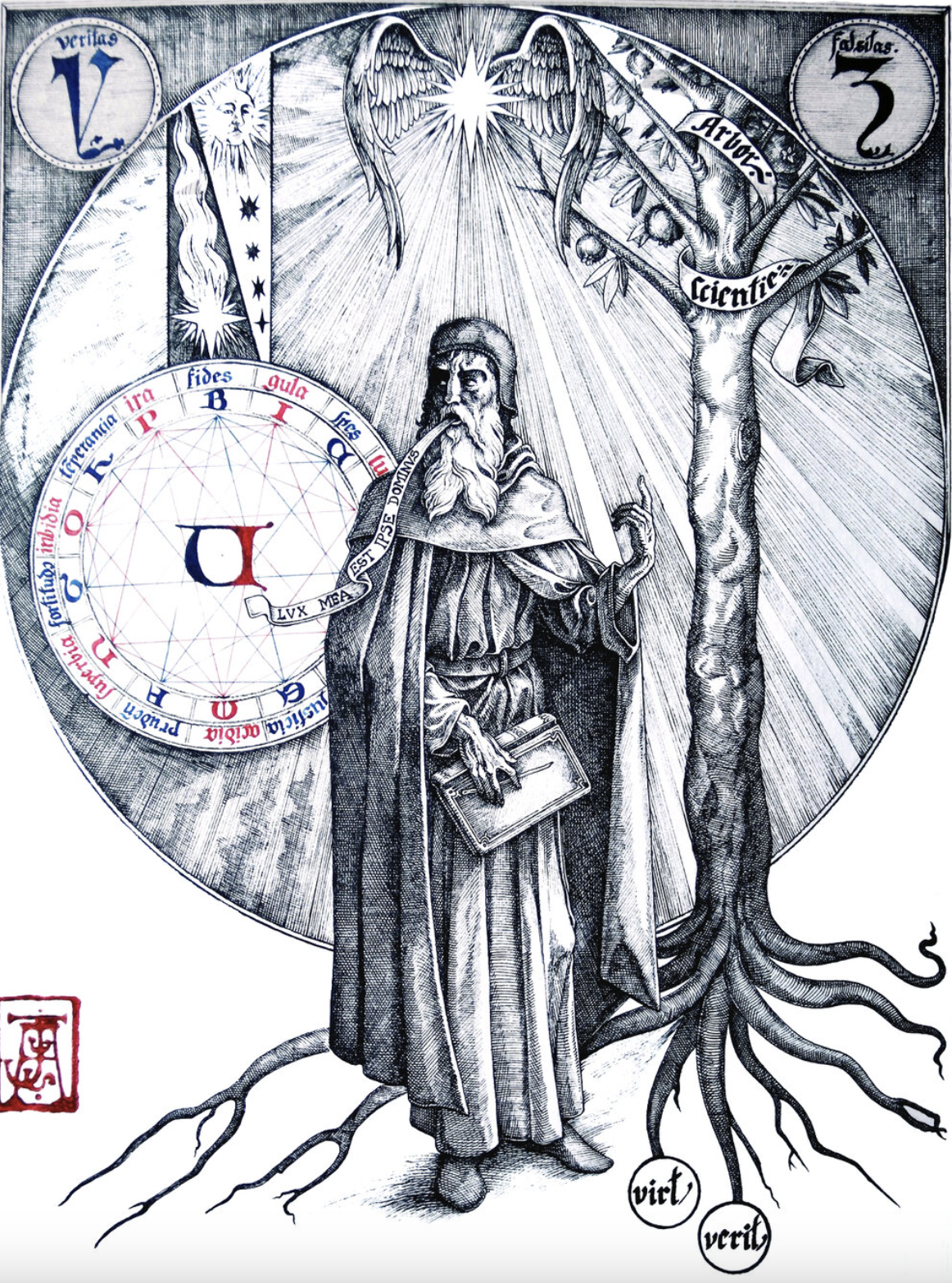
The sky, to our eyes, may rise, set, storm, and clear but this is theater, not ontology. The real sky — if such a thing exists — cannot age, because it does not become. It simply is. And if the sky as we perceive it is part of the grand illusion of Becoming, then the question of its age is a nonsense question — like asking for the temperature of a mirage.
Heraclitus of Ephesus (c. 500 BCE), known as the “weeping philosopher,” suggested a cosmos of ever-living fire. For him, the world — including the heavens — was not created, nor static, but constantly in flux:
“The cosmos, the same for all, was not made by gods or men, but always was and is and will be: an ever-living fire.”
For Heraclitus, to ask for the age of the sky is like asking the age of a flame. The fire exists because it burns. It is always old and always new. If there is time, it’s cyclical — the sky is not a container but a process: always kindling, always extinguishing, always returning.
Anaximenes of Miletus (c. 6th century BCE) conceived of the sky as breath. Air (aēr), he proposed, was the source of everything. The stars and sky condensed from rarefied air; the world breathing in and out.
“Just as our soul, being air, holds us together, so breath and air encompass the whole world.”
The sky was of organic origin, made of the same stuff as soul. Its “age” is not historical but elemental. If breath is continuous, then the sky is not old in years, but eternally emerging, an exhalation of the cosmos.
For Anaximander, a shadowy figure who may have drawn the first map of the earth, the sky is a wound in the boundless. He imagined the universe emerging from the apeiron, indefinite and boundless. Worlds rise and fall from it in cycles, like bubbles in water. He conceived of celestial bodies as wheels of fire, partially obscured by mist, with visible light shining through holes — the stars and sun are leaks in the firmament.
“Things perish into those things out of which they came to be, according to necessity.”
Anaximander gives us a sky with not one beginning and an end, but many. Skies emerge and dissolve in cycles like peeling skins off an onion, each cosmos reveals another behind it.
Pythagorean cosmology understood the heavens as music — spheres turning in mathematically perfect harmony. Planets were believed to emit tones as they moved, inaudible to human ears: the “music of the spheres.” Here, the sky is not aged like an object but measured like a chord. It is timeless in the way a song is: you may experience part of it, but it exists all at once, in ideal form.
Today, our scientific understanding of the sky’s billion year existence tends to conjure up dread about our human insignificance. But history teaches us the enormity of varying reactions to the belief that the sky is ancient. As our own living philosopher Thomas Nagel pithily puts it, ridiculing existentialism, “suppose we lived forever; would not a life that is absurd if it lasts seventy years be infinitely absurd even if it lasted through eternity?”
Our internet-age nihilism is expertly mocked by Nagel, whose optimistically objective “view from nowhere” just looks like an overcast Tuesday. The sky can be meaningful, he insists, even when drab. Sure it may be indifferent to us, but if it’s going to hang over us all our lives then we may as well recognise the meaning it has had for others and project a bit of our own selves onto it. Maybe time to get offline and engage in a more meaningful, non-digital kind of looking up.
Sander Priston is a busking philosopher, journalist, and musician.
Film
<div style="padding:73.63% 0 0 0;position:relative;"><iframe src="https://player.vimeo.com/video/1102879432?badge=0&autopause=0&player_id=0&app_id=58479" frameborder="0" allow="autoplay; fullscreen; picture-in-picture; clipboard-write; encrypted-media; web-share" referrerpolicy="strict-origin-when-cross-origin" style="position:absolute;top:0;left:0;width:100%;height:100%;" title="Rope clip 1"></iframe></div><script src="https://player.vimeo.com/api/player.js"></script>
Film
<div style="padding:56.25% 0 0 0;position:relative;"><iframe src="https://player.vimeo.com/video/1103061262?badge=0&autopause=0&player_id=0&app_id=58479" frameborder="0" allow="autoplay; fullscreen; picture-in-picture; clipboard-write; encrypted-media; web-share" referrerpolicy="strict-origin-when-cross-origin" style="position:absolute;top:0;left:0;width:100%;height:100%;" title="Carlo Rovelli on The Order of Time clip 2"></iframe></div><script src="https://player.vimeo.com/api/player.js"></script>
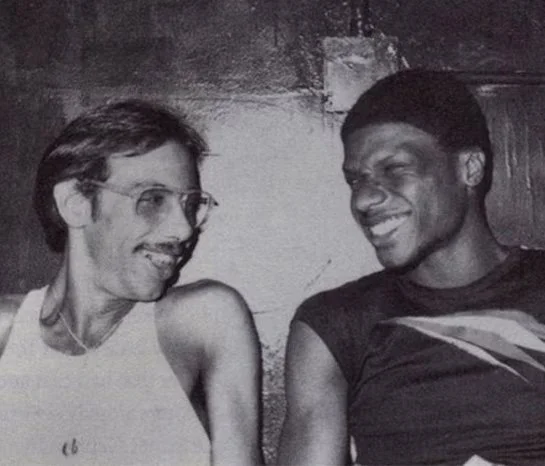
Larry Levan Playlist
Archival 1967-1987
Larry Levan was an influential American DJ who defined what modern dance clubs are today. He is most widely renowned for his long-time residency at Paradise Garage, also known as “Gay-Rage”, a former nightclub at 84 King Street in Manhattan, NY.

Hannah Peel Playlist
Archival - July 10, 2025
Mercury Prize, Ivor Novello and Emmy-nominated, RTS and Music Producers Guild winning composer, with a flow of solo albums and collaborative releases, Hannah Peel joins the dots between science, nature and the creative arts, through her explorative approach to electronic, classical and traditional music.
Film
<div style="padding:56.25% 0 0 0;position:relative;"><iframe src="https://player.vimeo.com/video/1102882854?badge=0&autopause=0&player_id=0&app_id=58479" frameborder="0" allow="autoplay; fullscreen; picture-in-picture; clipboard-write; encrypted-media; web-share" referrerpolicy="strict-origin-when-cross-origin" style="position:absolute;top:0;left:0;width:100%;height:100%;" title="Smokey the Bear, 1952"></iframe></div><script src="https://player.vimeo.com/api/player.js"></script>
The Tower (Tarot Triptych)
Chris Gabriel July 19, 2025
In the Tower we find the dual nature of energy perfectly expressed as creation and destruction. What Man makes, God shall destroy, what God makes, Man shall destroy…
Name: The Tower, the House of God
Number: XVI
Astrology: Mars
Qabalah: Pe, the Mouth
Chris Gabriel July 19, 2025
In the Tower we find the dual nature of energy perfectly expressed as creation and destruction. What Man makes, God shall destroy, what God makes, Man shall destroy. This is the Tower of Babel and the endlessly repeating Fall of Man. In each, divine fire destroys the high tower, and the inhabitants plummet below.

In Rider, a black sky is torn by a lightning strike. A bolt has thrown off the golden crown from atop a high stone tower with three windows. Flames devour what remains. Two royals fall below and little yellow yods rain from the clouds.

In Thoth, we have a rather cubist image; a tower warping down, the maw of Hell spitting out flames while an unblinking eye in the sky looks on as figures jump from the high tower. In the sky dwell a dove and a serpent (the lion headed snake god Ialdabaoth, the evil god of the world according to Gnostic Christians).

In Marseille, it is an almost playful scene, a feathery ray rips the crown off the tower, while two figures fall, their hands just touching the earth. Colorful balls fall along the three-windowed tower.
These are three very different depictions: one playful, one tragic, one horrific. Each is valid. Marseille strongly calls to mind the insight of Heraclitus; that God is but a child playing with toys. We have seen this juvenile God playfully make dolls kiss in the Lovers, but here we see the divine child knock down the blocks he’s been stacking.
Mankind cannot accept its own ephemeral nature. It desperately tries to create lasting works, to erect expressions of itself, contradictory to the natural flux of God. The Tower is simply God laughing at these vain attempts. We try to escape our nature in lofty ideas, but God kindly brings us back down to the earth.
As Mars, this card is the complement to the Empress’ Venus. The Empress maternally cultivates, protects, and grows while the Tower razes, attacks, and undoes. In this way, they are perfectly balanced. The Dove and the Serpent.
This duality is prominent in Christianity, the spiritual basis of Marseille, and in Thelema, the basis of Thoth.
Love is the law, love under will. Nor let the fools mistake love; for there are love and love. There is the dove, and there is the serpent. Choose ye well!
-Book of the Law I:57
Behold, I send you forth as sheep in the midst of wolves: be ye therefore wise as serpents, and harmless as doves.
-Matthew 10:16
This card answers one of the greatest difficulties of believers: why do bad things happen?
Simply because God wills it, because it amuses God, so says Nietzsche in Genealogy of Morals:
It is certain, at any rate, that the Greeks still knew of no tastier spice to offer their gods to season their happiness than the pleasures of cruelty. With what eyes do you think Homer made his gods look down upon the destinies of men? What was at bottom the ultimate meaning of Trojan Wars and other such tragic terrors? There can be no doubt whatever: they were intended as festival plays for the gods.
It is our own fear that manufactures the desire for a “Good” (according to our human morals) God, rather than accepting God as such. The Tarot is meant to be a complete image of God, a cosmogram. As such, it contains both the infinite love and infinite violence of a whole universe.
In the human sphere, this card is often directly sexual. When social facades crumble, the natural drives express themselves, either with the passion of sex, or violence. This can indicate that your well laid plans will go awry and the unexpected will occur. When we are aligned with the universe, this tends to be a pleasant surprise rather than a wretched accident.
Film
<div style="padding:75% 0 0 0;position:relative;"><iframe src="https://player.vimeo.com/video/1102130377?badge=0&autopause=0&player_id=0&app_id=58479" frameborder="0" allow="autoplay; fullscreen; picture-in-picture; clipboard-write; encrypted-media; web-share" referrerpolicy="strict-origin-when-cross-origin" style="position:absolute;top:0;left:0;width:100%;height:100%;" title="Firing Line clip 2"></iframe></div><script src="https://player.vimeo.com/api/player.js"></script>
Divine Warriors and Villains (Pronoia Pt. 3)
Molly Hankins July 17, 2025
We all have different roles to play in the great human drama advancing the plot of our evolution. A pronoia-informed perspective invites us to consider the possibility that characters we fear or dislike might be playing critical parts in our stories…

Kalīlah wa-Dimnah, ca. 1525–50.
Molly Hankins July 17, 2025
We all have different roles to play in the great human drama advancing the plot of our evolution. A pronoia-informed perspective invites us to consider the possibility that characters we fear or dislike might be playing critical parts in our stories. Pronoia author Rob Breszney’s worldview is that of a benevolent, conscious universe, one conspiring to facilitate evolutionary opportunities for our highest good and sometimes greatest delight. Those we perceive as enemies are often our greatest teachers and Breszney believes we owe them a debt of gratitude for “sharpening our wits and and sculpting our souls.” How could the universal conspiracy to give us exactly what our souls need operate without the plot twists facilitated by seemingly bad actors?
Breszney writes, “Imagine the people you fear and dislike as pivotal characters in a fascinating and ultimately redemptive plot that will take years or even lifetimes to elaborate.” By offering gratitude to those characters, we can neutralize our innate, egoic reaction to them and instead grease the wheels of evolution by welcoming their teachings. Kabbalah recommends responding to any stimulus that elicits a negative reaction by consciously pausing, followed by saying, “What a gift!” It can be said out loud or simply to yourself, but it’s an essential part of rewiring our perspective away from paranoia and towards pronoia. With practice it becomes muscle memory, and a means of washing our own brains to default to pronoia.
Those souls willing to play the villain are actually doing a great service,sacrificing their ego to play the part. By asking ourselves why someone is in our life story and what archetype they’re playing, we zoom out from the minutia of human drama and start to see such patterns as part of a greater cycle of life. Perhaps this moment of disidentification is all we need to be able to move with, “...the shifting conditions of the Wild Divine’s ever-fresh creation,” instead of fighting the flow. Practicing pronoia simply means training our perception to perceive life as giving us exactly what we need, exactly when we need it. To perceive our enemies as old, soul friends playing a tough part in our story is to both neutralize the emotional effect they have on us and to send them love.
Without villains, how can the hero become the warrior?? Breszney recommends always thanking our adversaries for the crucial roles they’ve played in our lives and believes we owe extra gratitude to those we feel have slowed us down. By causing blockage or delay in our journey these people are actually preventing things from happening too fast, which is often impossible to perceive as it’s happening. “Imagine that the evolution of your life or our culture is like a pregnancy: it needs to reach its full term,” he wrote. Life has its own timing and when we sync up with it we can feel it. This is the flow-state, and it’s often punctuated by an uptick in synchronicities and what the untrained eye might call coincidences.
Cultivating flow and authentic presence is a feature of the warrior archetype, which according to Tibetan texts, has four features of dignity.
Relaxed confidence (often mistranslated as “meekness”)
Relentless joy (perkiness)
Outrageousness (which can help us overcome both fear and hope)
Inscrutability (inability to be pinned down by a label that would only limit the warrior)
Many of us may play the villain in the story of another without meaning to or even realizing it, a reminder that our souls play every part, often in the same lifetime. By consciously cultivating the above features of dignity through focused attention, we wash our brains to act more in the interest of our higher, heroic warrior nature. Even if we’re playing the villain and stooping to our lower, animal nature in the process. however, we can still live in what Breszney calls “alignment with the infinity of the moment.” To be aligned with the infinity of the moment is to revel in pronoia as a practice.
He writes, “Even if some of us are temporarily in the midst of trial or tribulation, human evolution is proceeding exactly as it should, even if we can’t see the big picture of the puzzle that would clarify how all the pieces fit together perfectly.” Pronoia is not about absolute truth, which us humans don’t fully get to know anyway. It is about utility. Believing the universe is conspiring in our favor is useful because it’s empowering and accounts for the influence we have on reality just by perceiving it. As the book ends Breszney leaves readers with the assignment to imagine everything in the world belongs to us and take good care of it, the way we want others to.
“And make sure you also enjoy the level of fun that comes with such mastery,” he encourages us. “Glide through life as if all of creation is yearning to honor and entertain you.”
Molly Hankins is an Initiate + Reality Hacker serving the Ministry of Quantum Existentialism and Builders of the Adytum.
Film
<div style="padding:75% 0 0 0;position:relative;"><iframe src="https://player.vimeo.com/video/1102878385?badge=0&autopause=0&player_id=0&app_id=58479" frameborder="0" allow="autoplay; fullscreen; picture-in-picture; clipboard-write; encrypted-media; web-share" referrerpolicy="strict-origin-when-cross-origin" style="position:absolute;top:0;left:0;width:100%;height:100%;" title="Jane Eyre clip"></iframe></div><script src="https://player.vimeo.com/api/player.js"></script>
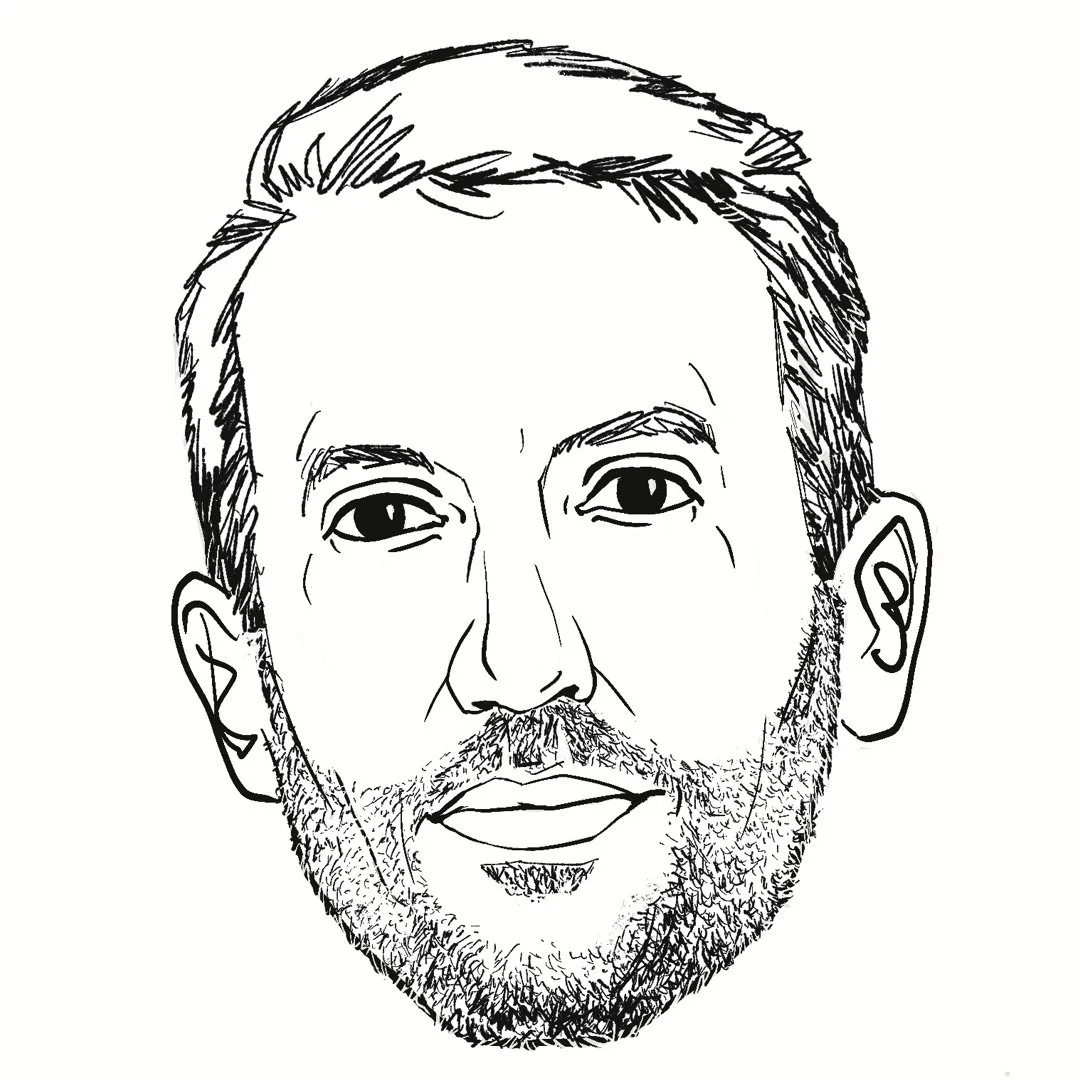
Alex Spiro
1h 7m
7.16.25
In this clip, Rick speaks with Alex Spiro about cynicism in law.
<iframe width="100%" height="265" src="https://clyp.it/jwg0t5n5/widget?token=4252c06921d5985e6727cd60c5f75af4" frameborder="0"></iframe>
Film
<div style="padding:75% 0 0 0;position:relative;"><iframe src="https://player.vimeo.com/video/1102124578?title=0&byline=0&portrait=0&badge=0&autopause=0&player_id=0&app_id=58479" frameborder="0" allow="autoplay; fullscreen; picture-in-picture; clipboard-write; encrypted-media; web-share" referrerpolicy="strict-origin-when-cross-origin" style="position:absolute;top:0;left:0;width:100%;height:100%;" title="Personal Legacies- Materiality and Abstraction clip 8"></iframe></div><script src="https://player.vimeo.com/api/player.js"></script>
She Unnames Them
Ursula Le Guin July 15, 2025
Most of them accepted namelessness with the perfect indifference with which they had so long accepted and ignored their names. Whales and dolphins, seals and sea otters consented with particular alacrity, sliding into anonymity as into their element…
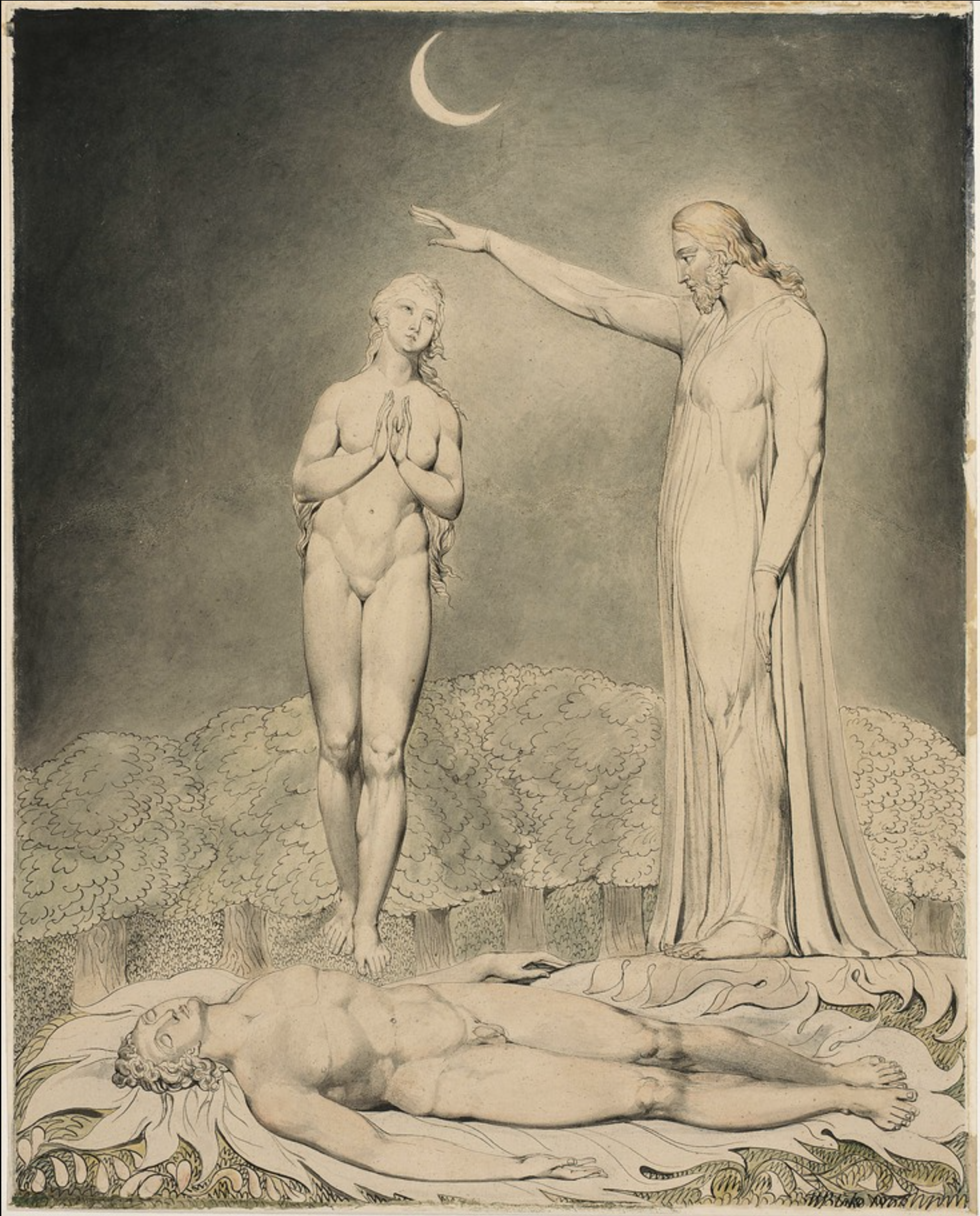
The Creation of Eve, William Blake. 1808.
First published in 1985, Ursula Le Guin’s now classic short story is a masterpiece of concise, flash fiction. Taking Genesis 2:19-20 - “So out of the ground the Lord God formed every animal of the field and every bird of the air, and brought them to the man to see what he would call them; and whatever the man called every living creature, that was its name” - as her starting point, Le Guin reframes the story with Eve, not Adam as the protagonist. Woman was named, just as the animals were, and this Bible verse implicitly suggests a hierarchy of power between the sexes. Le Guin gives the autonomy back to Eve, and allows her to give that same gift to the animals by ridding them of the names they never chose.
Ursula Le Guin July 15, 2025
Most of them accepted namelessness with the perfect indifference with which they had so long accepted and ignored their names. Whales and dolphins, seals and sea otters consented with particular alacrity, sliding into anonymity as into their element. A faction of yaks, however, protested. They said that "yak" sounded right, and that almost everyone who knew they existed called them that. Unlike the ubiquitous creatures such as rats and fleas, who had been called by hundreds or thousands of different names since Babel, the yaks could truly say, they said, that they had a name. They discussed the matter all summer. The councils of elderly females finally agreed that though the name might be useful to others it was so redundant from the yak point of view that they never spoke it themselves and hence might as well dispense with it. After they presented the argument in this light to their bulls, a full consensus was delayed only by the onset of severe early blizzards. Soon after the beginning of the thaw, their agreement was reached and the designation "yak" was returned to the donor.
Among the domestic animals, few horses had cared what anybody called them since the failure of Dean Swift's attempt to name them from their own vocabulary. Cattle, sheep, swine, asses, mules, and goats, along with chickens, geese, and turkeys, all agreed enthusiastically to give their names back to the people to whom, as they put it, they belonged.
A couple of problems did come up with pets. The cats, of course, steadfastly denied ever having had any name other than those self - given, unspoken, ineffably personal names which, as the poet named Eliot said, they spend long hours daily contemplating, though none of the contemplators has ever admitted that what they contemplate is their names and some onlookers have wondered if the object of that meditative gaze might not in fact be the Perfect, or Platonic, Mouse. In any case, it is a moot point now. It was with the dogs, and with some parrots, lovebirds, ravens, and mynahs, that the trouble arose. These verbally talented individuals insisted that their names were important to them, and flatly refused to part with them.
But as soon as they understood that the issue was precisely one of individual choice, and that anybody who wanted to be called Rover, or Froufrou, or Polly, or even Birdie in the personal sense, was perfectly free to do so, not one of them had the least objection to parting with the lowercase (or, as regards German creatures, uppercase) generic appellations "poodle," "parrot," "dog," or "bird," and all the Linnaean qualifiers that had trailed along behind them for two hundred years like tin cans tied to a tail.
The insects parted with their names in vast clouds and swarms of ephemeral syllables buzzing and stinging and humming and flitting and crawling and tunnelling away.
As for the fish of the sea, their names dispersed from them in silence throughout the oceans like faint, dark blurs of cuttlefish ink, and drifted off on the currents without a trace.
None were left now to unname, and yet how close I felt to them when I saw one of them swim or fly or trot or crawl across my way or over my skin, or stalk me in the night, or go along beside me for a while in the day. They seemed far closer than when their names had stood between myself and them like a clear barrier: so close that my fear of them and their fear of me became one same fear. And the attraction that many of us felt, the desire to feel or rub or caress one another’s scales or skin or feathers or fur, taste one another’s blood or flesh, keep one another warm -- that attraction was now all one with the fear, and the hunter could not be told from the hunted, nor the eater from the food.
This was more or less the effect I had been after. It was somewhat more powerful than I had anticipated, but I could not now, in all conscience, make an exception for myself. I resolutely put anxiety away, went to Adam, and said, "You and your father lent me this, gave it to me, actually. It's been really useful, but it doesn't exactly seem to fit very well lately. But thanks very much! It's really been very useful." It is hard to give back a gift without sounding peevish or ungrateful, and I did not want to leave him with that impression of me. He was not paying much attention, as it happened, and said only, "Put it down over there, O.K.?" and went on with what he was doing.
One of my reasons for doing what I did was that talk was getting us nowhere, but all the same I felt a little let down. I had been prepared to defend my decision. And I thought that perhaps when he did notice he might be upset and want to talk. I put some things away and fiddled around a little, but he continued to do what he was doing and to take no notice of anything else. At last I said, "Well, goodbye, dear. I hope the garden key turns up."
He was fitting parts together, and said, without looking around, "O.K., fine, dear. When’s dinner?" "I'm not sure," I said. I'm going now. With the… " I hesitated, and finally said, "With them, you know," and went on out. In fact, I had only just then realized how hard it would have been to explain myself. I could not chatter away as I used to do, taking it all for granted. My words must be as slow, as new, as single, as tentative as the steps I took going down the path away from the house, between the dark--branched, tall dancers motionless against the winter shining.
Ursula K. Le Guin ( 1929 – 2018) was an American author, best known for her science fiction works The Hainish Cycle and The Earthsea Cycle. Over the course of her life, she wrote more than twenty novels and more than a hundred shrot stories, as well as seminal works of literary criticism.
Film
<div style="padding:56.25% 0 0 0;position:relative;"><iframe src="https://player.vimeo.com/video/1102877780?badge=0&autopause=0&player_id=0&app_id=58479" frameborder="0" allow="autoplay; fullscreen; picture-in-picture; clipboard-write; encrypted-media; web-share" referrerpolicy="strict-origin-when-cross-origin" style="position:absolute;top:0;left:0;width:100%;height:100%;" title="Man with a Movie Camera clip 2"></iframe></div><script src="https://player.vimeo.com/api/player.js"></script>

Iggy Pop Playlist
Iggy Confidential
Archival - January 5, 2025
Iggy Pop is an American singer, songwriter, musician, record producer, and actor. Since forming The Stooges in 1967, Iggy’s career has spanned decades and genres. Having paved the way for ‘70’s punk and ‘90’s grunge, he is often considered “The Godfather of Punk.”
Film
<div style="padding:41.56% 0 0 0;position:relative;"><iframe src="https://player.vimeo.com/video/1099573449?badge=0&autopause=0&player_id=0&app_id=58479" frameborder="0" allow="autoplay; fullscreen; picture-in-picture; clipboard-write; encrypted-media; web-share" style="position:absolute;top:0;left:0;width:100%;height:100%;" title="The Valley of the Dolls clip 1"></iframe></div><script src="https://player.vimeo.com/api/player.js"></script>
King of Wands / Prince of Wands (Tarot Triptych)
Chris Gabriel July 12, 2025
The King of Wands is the highest of the face cards, the “King of Kings” with the biggest weapon in the deck. He holds fantastic power yet looks into the distance, hungry for more…
Name: King or Prince of Wands
Number: 1 or 3
Astrology: Leo, Fire of Fire or Air of Fire
Qabalah: Yod of Yod or Vau of Yod
Chris Gabriel July 12, 2025
The King of Wands is the highest of the face cards, the “King of Kings” with the biggest weapon in the deck. He holds fantastic power yet looks into the distance, hungry for more.
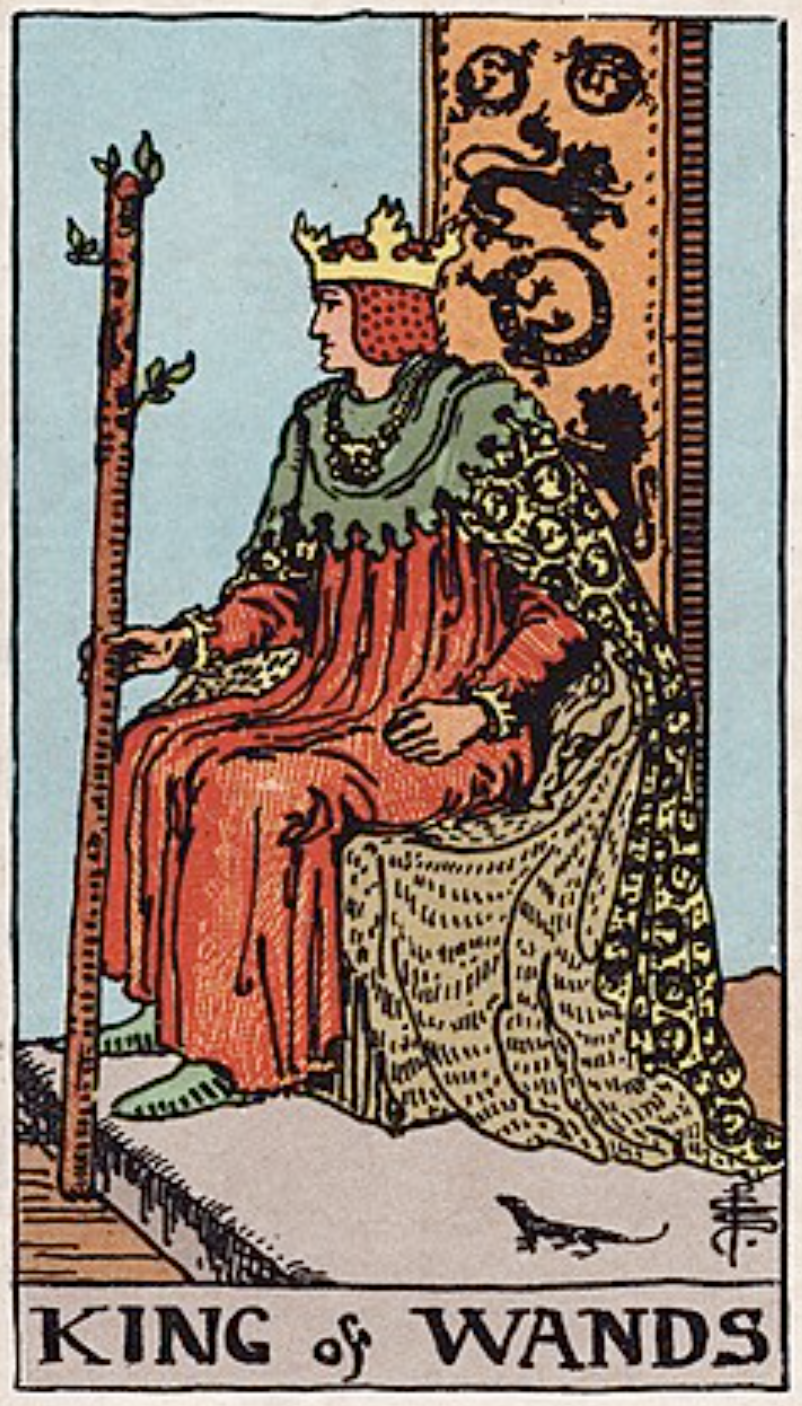
In Rider, the King is red haired with a crown of golden flames. He wears red, green, and yellow robes and sits in a high throne emblazoned with Lions and Salamanders, while a little Salamander stands beside him. His wand reaches from the ground to well above his head.

In Thoth, the Prince is naked, save for his radiant crown topped by a winged lion’s head. His chest is marked with Crowley’s phallic sigil. He holds a Phoenix wand in one hand and the reins of the Lion pulling his chariot in the other. The whole card is full of flames.
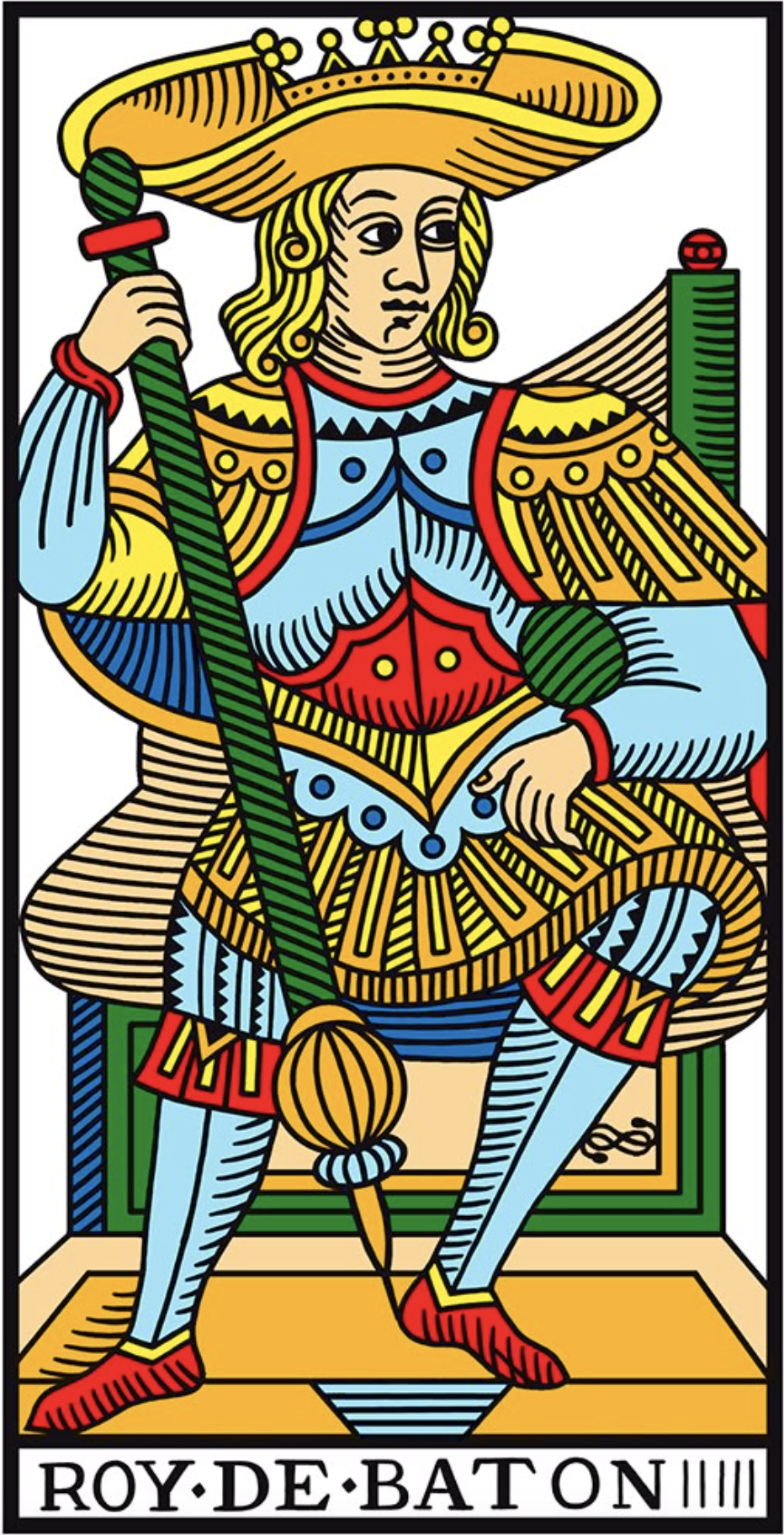
In Marseille, we have a blonde king in full armour. He is seated restlessly upon his throne, ready to pounce at any moment. His wand sits at his heel and reaches his head. He looks off into the distance, ready to conquer.
While Aquarius symbolizes “the people”, Leo is the King atop them. The fire of this card is doubled: the fire of Wands, and the fire of Kings. Leo, where the Sun takes joy, is embodied here. The Lion is the king of the jungle, his golden mane is like the radiant sun.
When I see the distant gaze of the King in Marseille, I think of Alexander weeping for there were no more worlds to conquer. I think of Napoleon, who felt the sacred fire of ambition in himself and sought for more than men had since Caesar. We must not think of the King as being almighty, high and satisfied, but rather, terribly hungry. The King of Wands achieved his position, not by desiring to rule any one thing, but by desiring to rule more.
The Page of Wands looks up to the height of his Wand; he desires to measure up, to be a knight, or with ambition, a King one day, but these sorts of desires do not make for greatness. Alexander did not wish to be a God, but already believed he was one and demanded worship. The Spartans rightly replied “If Alexander wishes to be a God, let him be.” At the other end of the King are “delusions of grandeur”. Many mad men believe themselves to be Napoleon, but it was Napoleon’s own delusions that made him such. Therein is the secret of the King of Wands. A will strong enough to make truth out of delusion.
When we pull this card, we can expect to encounter a strong, dominating character, maybe directly a Leo. It may also be that we must take on a leadership position. One must hold fast to their will to keep from being conquered or to keep from becoming a tyrant.
Film
<div style="padding:54.17% 0 0 0;position:relative;"><iframe src="https://player.vimeo.com/video/1099572173?title=0&byline=0&portrait=0&badge=0&autopause=0&player_id=0&app_id=58479" frameborder="0" allow="autoplay; fullscreen; picture-in-picture; clipboard-write; encrypted-media; web-share" style="position:absolute;top:0;left:0;width:100%;height:100%;" title="Tampopo clip 1"></iframe></div><script src="https://player.vimeo.com/api/player.js"></script>
Patterns of Authority: Sound is Spatial (II)
Robin Sparkes July 10, 2025
The social construction of space provides a vital lens through which to examine how architectural acoustics function as tools within a system of regulation…
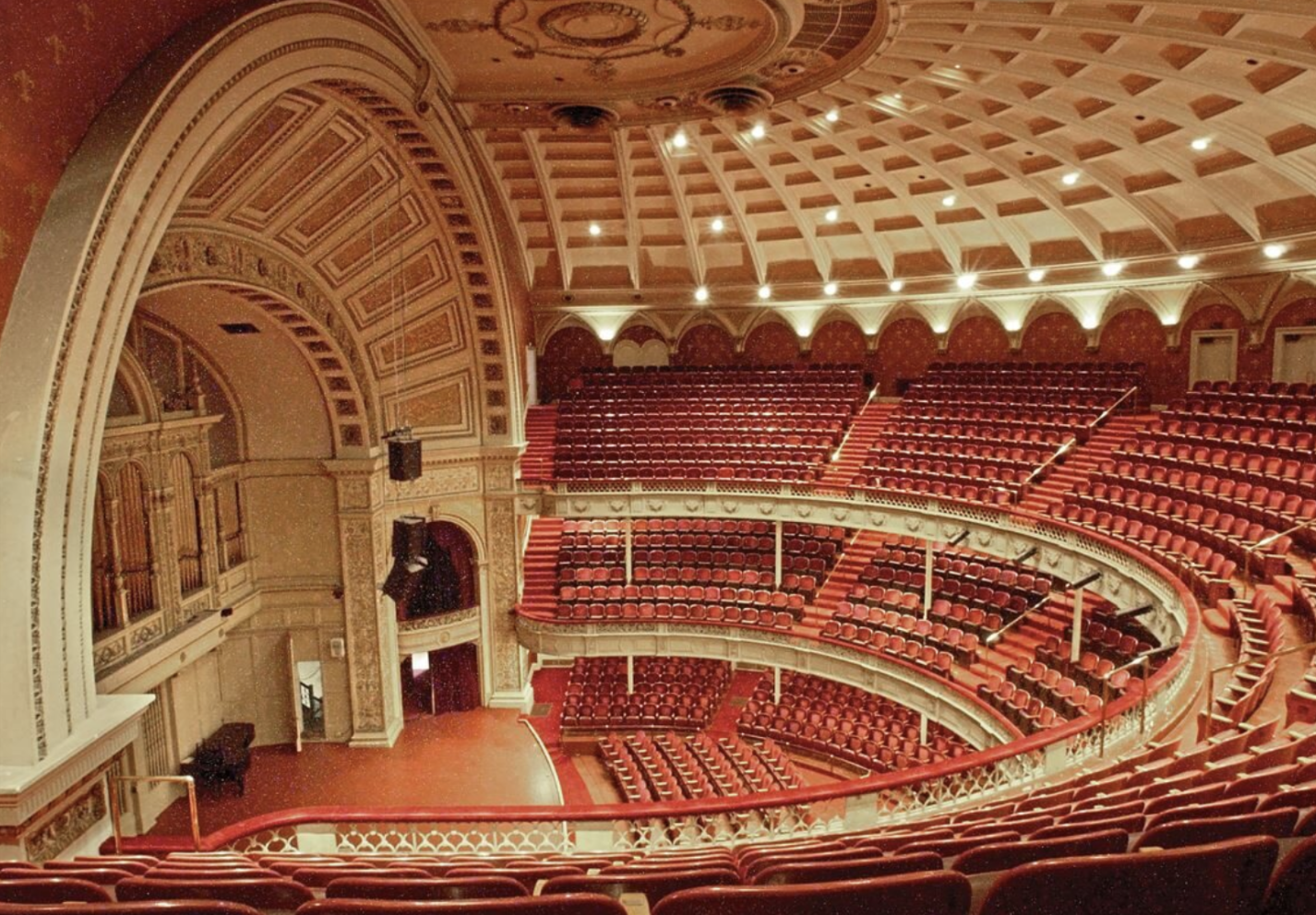
“Carnegie Music Hall.” Lewis and Clark Trail Experience, 2025.
Robin Sparkes July 10, 2025
The social construction of space provides a vital lens through which to examine how architectural acoustics function as tools within a system of regulation. Henri Lefebvre’s The Production of Space provides a comprehensive framework for understanding how spaces are socially constructed and used to maintain power. He writes, "Space is not a thing but rather a set of relations between things, a product of social interactions" (Lefebvre). This perspective resonates with architectural acoustics, as the design of spaces influences how sound is produced, transmitted, and experienced.
The spatial organization of a concert hall amplifies certain frequencies to enhance auditory experiences, while urban planning decisions often prioritize industrial sounds over human comfort. Carnegie Hall was designed by architect William Burnet Tuthill. Opened in 1891 in New York City, itis renowned for its exceptional acoustics due its sound duration for different pitches, where low and high frequencies resonate evenly throughout the room. The Hall’s initial programming for classical music, aimed at the upper class, exemplifies how spatial configurations not only influence acoustic experiences but reflect social value and hierarchy. The elliptical shape, smooth interior surfaces, slightly extended stage, and domed ceiling ensure that both soft and loud tones are projected with equal clarity throughout the venue.
Tuthill’s design choices align with the Renaissance pursuit of harmonic proportions, creating both visual and auditory harmony. Lefebvre argues that space is not merely a physical container but a product of social interactions and relations. In this light, Carnegie Hall’s design both reflects and reinforces the social hierarchies and cultural values of its time.. Examining its architectural and acoustic design through Lefebvre's spatial theory reveals how such spaces function as instruments that both reflect and shape societal values and hierarchies.
*
Patterns in Space
Acoustemology, a concept developed by Steven Feld in his studies of the Kaluli people, challenges the traditional visual-centric understanding of space. Feld demonstrates how soundscapes—the sonic equivalent of landscapes—reveal spatial patterns and societal structures. For the Kaluli, Feld notes in Sound and Sentiment, waterfalls, bird calls, and echoes create an auditory map of their environment, connecting space and culture. His work illustrates that patterns in space are as much auditory as they are physical, shaping how people inhabit and conceptualize their environments. In Kaluli ceremonies, vocal sounds and echoes connect people to ancestral spirits, reinforcing systems of authority and belief. Colonial impositions of Western soundscapes - such as church bells and industrial noise -disrupted indigenous acoustic environments, symbolizing new forms of dominance. Feld asserts, "Acoustic patterns have historically been used to assert authority, such as through ceremonies or colonial soundscapes."(Feld) These patterns reinforce cultural memory and social structure through sound. Feld’s work affirms that listening is a vital mode of spatial understanding, where soundscapes actively construct meaning and sustain authority.
“Acoustic design has long been a means through which power is exerted in space: from the controlling of sound to enforce silence, to the amplification of particular voices in ways that resonate with authority and command”
In The Audible Past: Cultural Origins of Sound Reproduction, Jonathan Sterne examines how sound technologies reflect and shape societal norms. His notion of the "auditory field" highlights the modern shift from communal soundscapes to private auditory experiences, such as through headphones or soundproofing. Sterne asserts, "The design of spaces and their acoustic properties are deeply intertwined with the values and priorities of the superstructure." This perspective aligns with architectural practices that use sound control—like noise barriers or acoustic panels—to shape spatial interactions and experiences.

Feld, Steven. “Acoustemology.” Environmental Humanities Center, University of California, Santa Barbara, 2025.
Moneo’s insights on typology link spatial patterns to cultural memory. He argues that architectural forms—like basilicas, amphitheaters, and courtyards—serve as anchors that organize social and cultural practices. Moneo writes, "The persistence of typology is a testament to its role in shaping collective experiences of space and time."(Moneo) Jonathan Sterne’s work complements this by exploring how modern sound technologies amplify authority. Public address systems, for instance, centralize power by privileging certain voices over others, often in architecturally designed spaces like stadiums or political arenas. Sterne writes, "The control of sound—its production, amplification, and dissemination—reinforces social and political hierarchies."(Sterne) Architectural acoustics consistently serve as tools of authority, shaping who is heard and how.
*
Modern Implications of Acoustic Authority
Urban planning and architectural acoustics often prioritize certain soundscapes while marginalizing others, reflecting broader societal hierarchies. Thompson observes that "the acoustics of power is not only about who is heard but also about how sound is shaped to convey dominance, unity, or submission in spatial terms".These spaces embody the intersection of sound and power, where architectural design mediates authority through acoustic patterns.
Moneo’s focus on typology provides a framework for understanding these dynamics. By analyzing how typological forms—such as auditoriums or legislative chambers—evolve over time, Moneo reveals how architectural design continues to shape authority and cultural identity. He writes, "The evolution of typology reflects shifting power structures, as new forms emerge to accommodate changes in societal organization and technological advancement."(Moneo) The systematic use of architectural acoustics in modern architecture reveals its intrinsic connection to the superstructure, as physical spaces embody and shape societal ideologies. Examining patterns in space and acoustic authority show how architecture expresses power, aligning human spaces with social orders. "Acoustic design has long been a means through which power is exerted in space: from the controlling of sound to enforce silence, to the amplification of particular voices in ways that resonate with authority and command" (Thompson). Understanding architecture’s historical and theoretical dimensions provides the tools to unpack how it reinforces power structures. As modern architectural practices continue to evolve, the integration of sound, space, and typology remains a vital tool for navigating and shaping the superstructure of society.
Robin Sparkes, is a spatial designer, studying the kinesthetic experience of architecture. Her design, research, and writing practice traverses the relationship between the body, temporality, and the acoustics of space.
Film
<div style="padding:56.25% 0 0 0;position:relative;"><iframe src="https://player.vimeo.com/video/1100535825?badge=0&autopause=0&player_id=0&app_id=58479" frameborder="0" allow="autoplay; fullscreen; picture-in-picture; clipboard-write; encrypted-media; web-share" style="position:absolute;top:0;left:0;width:100%;height:100%;" title="Acting Shakespeare - The Two Traditions clip 5"></iframe></div><script src="https://player.vimeo.com/api/player.js"></script>