
Film
<div style="padding:60% 0 0 0;position:relative;"><iframe src="https://player.vimeo.com/video/1112517611?badge=0&autopause=0&player_id=0&app_id=58479" frameborder="0" allow="autoplay; fullscreen; picture-in-picture; clipboard-write; encrypted-media; web-share" referrerpolicy="strict-origin-when-cross-origin" style="position:absolute;top:0;left:0;width:100%;height:100%;" title="Mysterious Island clip 1"></iframe></div><script src="https://player.vimeo.com/api/player.js"></script>
Dear Brother (1849)
Fyodor Dostoevsky August 21, 2025
At the age of twenty eight, Fyodor Dostoevsky was sentenced to death…

Dostoevsky, Vasily Perov. c. 1872.
At the age of twenty eight, Fyodor Dostoevsky was sentenced to death. He had written two novels, received to moderate acclaim, that had gained him entry to a social progressive literary circle known as the Petrashevsky Circle. Fearing another revolution, Tsar Nicholas I ordered the arrest and execution of the entire group, on the grounds of reading and distributing banned revolutionary material. At the last moment, while standing in front of the firing squad, Dostoevsky’s sentence was commuted and his life was spared - though he spent the next four years in a Siberian prison camp, followed by six years of compulsory military service in exile. He wrote this letter to his brother that very day, detailing the events, and sharing what he thought might be his final words. Dostoevsky survived the camp, and the service, and returning to society became the most acclaimed writer of his generation, leaving a legacy that is near unparalleled today.
Fyodor Dostoevsky August 21, 2025
Brother, my precious friend! All is settled! I am sentenced to four years' hard labour in the fortress (I believe, of Orenburg) and after that to serve as a private. Today, the 22nd of December, we were taken to the Semionov Drill Ground. There the sentence of death was read to all of us, we were told to kiss the Cross, our swords were broken over our heads, and our last toilet was made (white shirts). Then three were tied to the pillar for execution. I was the sixth. Three at a time were called out; consequently, I was in the second batch and no more than a minute was left me to live. I remembered you, brother, and all yours; during the last minute you, you alone, were in my mind, only then I realised how I love you, dear brother mine! I also managed to embrace Plescheyev and Durov who stood close to me and to say good-bye to them. Finally the retreat was sounded, and those tied to the pillar were led back, and it was announced to us that His Imperial Majesty granted us our lives. Then followed the present sentences. Palm alone has been pardoned, and returns with his old rank to the army.
I was just told, dear brother, that today or tomorrow we are to be sent off. I asked to see you. But I was told that this was impossible; I may only write you this letter: make haste and give me a reply as soon as you can. I am afraid that you may somehow have got to know of our death sentence. From the windows of the prison-van, when we were taken to the Semionov Drill Ground, I saw a multitude of people; perhaps the news reached you, and you suffered for me. Now you will be easier on my account. Brother! I have not become downhearted or low-spirited. Life is everywhere life, life in ourselves, not in what is outside us. There will be people near me, and to be a man among people and remain a man for ever, not to be downhearted nor to fall in whatever misfortunes may befall me — this is life; this is the task of life. I have realised this. This idea has entered into my flesh and into my blood. Yes, it 's true! The head which was creating, living with the highest life of art, which had realised and grown used to the highest needs of the spirit, that head has already been cut off from my shoulders. There remain the memory and the images created but not yet incarnated by me. They will lacerate me, it is true! But there remains in me my heart and the same flesh and blood which can also love, and suffer, and desire, and remember, and this, after all, is life. On voit le soleil! Now, good-bye, brother! Don't grieve for me!
Now about material things: my books (I have the Bible still) and several sheets of my manuscript, the rough plan of the play and the novel (and the finished story A Child's Tale) have been taken away from me, and in all probability will be got by you. I also leave my overcoat and old clothes, if you send to fetch them. Now, brother, I may perhaps have to march a long distance. Money is needed. My dear brother, when you receive this letter, and if there is any possibility of getting some money, send it me at once. Money I need now more than air (for one particular purpose). Send me also a few lines. Then if the money from Moscow comes, — remember me and do not desert me. Well, that is all! I have debts, but what can I do?
Kiss your wife and children. Remind them of me continually; see that they do not forget me. Perhaps, we shall yet meet some time! Brother, take care of yourself and of your family, live quietly and carefully. Think of the future of your children. . . . Live positively. There has never yet been working in me such a healthy abundance of spiritual life as now. But will my body endure? I do not know. I am going away sick, I suffer from scrofula. But never mind! Brother, I have already gone through so much in life that now hardly anything can frighten me. Let come what may! At the first opportunity I shall let you know about myself. Give the Maikovs my farewell and last greetings. Tell them that I thank them all for their constant interest in my fate. Say a few words for me, as warm as possible, as your heart will prompt you, to Eugenia Petrovna. I wish her much happiness, and shall ever remember her with grateful respect. Press the hands of Nikolay Apollonovich and Apollon Maikov, and also of all the others. Find Yanovsky. Press his hand, thank him. Finally, press the hands of all who have not forgotten me. And those who have forgotten me — remember me to them also. Kiss our brother Kolya. Write a letter to our brother Andrey and let him know about me. Write also to Uncle and Aunt. This I ask you in my own name, and greet them for me. Write to our sisters: I wish them happiness.
And maybe, we shall meet again some time, brother! Take care of yourself, go on living, for the love of God, until we meet. Perhaps some time we shall embrace each other and recall our youth, our golden time that was, our youth and our hopes, which at this very instant I am tearing out from my heart with my blood, to bury them. Can it indeed be that I shall never take a pen into my hands? I think that after the four years there may be a possibility. I shall send you everything that I may write, if I write anything, my God! How many imaginations, lived through by me, created by me anew, will perish, will be extinguished in my brain or will be spilt as poison in my blood! Yes, if I am not allowed to write, I shall perish. Better fifteen years of prison with a pen in my hands!
“Life is a gift, life is happiness, each minute might have been an age of happiness.”
Write to me more often, write more details, more, more facts. In every letter write about all kinds of family details, of trifles, don't forget. This will give me hope and life. If you knew how your letters revived me here in the fortress. These last two months and a half, when it was forbidden to write or receive a letter, have been very hard on me. I was ill. The fact that you did not send me money now and then worried me on your account; it meant you yourself were in great need ! Kiss the children once again; their lovely little faces do not leave my mind. Ah, that they may be happy! Be happy yourself too, brother, be happy!
But do not grieve, for the love of God, do not grieve for me! Do believe that I am not downhearted, do remember that hope has not deserted me. In four years there will be a mitigation of my fate. I shall be a private soldier, — no longer a prisoner, and remember that some time I shall embrace you. I was to-day in the grip of death for three-quarters of an hour; I have lived it through with that idea; I was at the last instant and now I live again!
If any one has bad memories of me, if I have quarrelled with any one, if I have created in any one an unpleasant impression — tell them they should forget it, if you manage to meet them. There is no gall or spite in my soul; I should dearly love to embrace any one of my former friends at this moment. It is a comfort, I experienced it to-day when saying good-bye to my dear ones before death. I thought at that moment that the news of the execution would kill you. But now be easy, I am still alive and shall live in the future with the thought that some time I shall embrace you. Only this is now in my mind.
What are you doing? What have you been thinking to-day? Do you know about us? How cold it was today!
Ah, if only my letter reaches you soon. Otherwise I shall be for four months without news of you. I saw the envelopes in which you sent money during the last two months; the address was written in your hand, and I was glad that you were well.
When I look back at the past and think how much time has been wasted in vain, how much time was lost in delusions, in errors, in idleness, in ignorance of how to live, how I did not value time, how often I sinned against my heart and spirit, — my heart bleeds. Life is a gift, life is happiness, each minute might have been an age of happiness. Si jeunesse savait! Now, changing my life, I am being reborn into a new form. Brother! I swear to you that I shall not lose hope, and shall preserve my spirit and heart in purity. I shall be reborn to a better thing. That is my whole hope, my whole comfort!
The life in prison has already sufficiently killed in me the demands of the flesh which were not wholly pure; I took little heed of myself before. Now privations are nothing to me, and, therefore, do not fear that any material hardship will kill me. This cannot be! Ah! To have health!
Good-bye, good-bye, my brother! When shall I write you again? You will receive from me as detailed an account as possible of my journey. If I can only preserve my health, then everything will be right!
Well, good-bye, good-bye, brother! I embrace you closely, I kiss you closely. Remember me without pain in your heart. Do not grieve, I pray you, do not grieve for me! In the next letter I shall tell you how I go on. Remember then what I have told you: plan out your life, do not waste it, arrange your destiny, think of your children. Oh, to see you, to see you! Good-bye! Now I tear myself away from everything that was dear; it is painful to leave it! It is painful to break oneself in two, to cut the heart in two. Good-bye! Good-bye! But I shall see you, I am convinced — I hope; do not change, love me, do not let your memory grow cold, and the thought of your love will be the best part of my life. Goodbye, good-bye, once more! Good-bye to all!
Your brother,
Fiodor Dostoevsky.
Ursula K. Le Guin ( 1929 – 2018) was an American author, best known for her science fiction works The Hainish Cycle and The Earthsea Cycle. Over the course of her life, she wrote more than twenty novels and more than a hundred shrot stories, as well as seminal works of literary criticism.
Film
<div style="padding:75% 0 0 0;position:relative;"><iframe src="https://player.vimeo.com/video/1112494170?badge=0&autopause=0&player_id=0&app_id=58479" frameborder="0" allow="autoplay; fullscreen; picture-in-picture; clipboard-write; encrypted-media; web-share" referrerpolicy="strict-origin-when-cross-origin" style="position:absolute;top:0;left:0;width:100%;height:100%;" title="Personal Legacies- Materiality and Abstraction clip 10"></iframe></div><script src="https://player.vimeo.com/api/player.js"></script>

Bernard MacMahon
2h 05m
8.20.25
In this clip, Rick speaks with Bernard MacMahon about the unlikely transition from “Beatlemania” to Led Zeppelin’s.
<iframe width="100%" height="265" src="https://clyp.it/gu2dlicg/widget?token=ef054e164082ff17de336a32a69c086e" frameborder="0"></iframe>

Film
<div style="padding:42.4% 0 0 0;position:relative;"><iframe src="https://player.vimeo.com/video/1112492584?badge=0&autopause=0&player_id=0&app_id=58479" frameborder="0" allow="autoplay; fullscreen; picture-in-picture; clipboard-write; encrypted-media; web-share" referrerpolicy="strict-origin-when-cross-origin" style="position:absolute;top:0;left:0;width:100%;height:100%;" title="A Rage to Live clip 1"></iframe></div><script src="https://player.vimeo.com/api/player.js"></script>
Enfolded in Living Reality Pt. 2
Tuukka Toivonen August 19, 2024
We were warned about the folly of viewing reality purely through an analytical or conceptual lens. The path to becoming fully human vanishes into thin air…
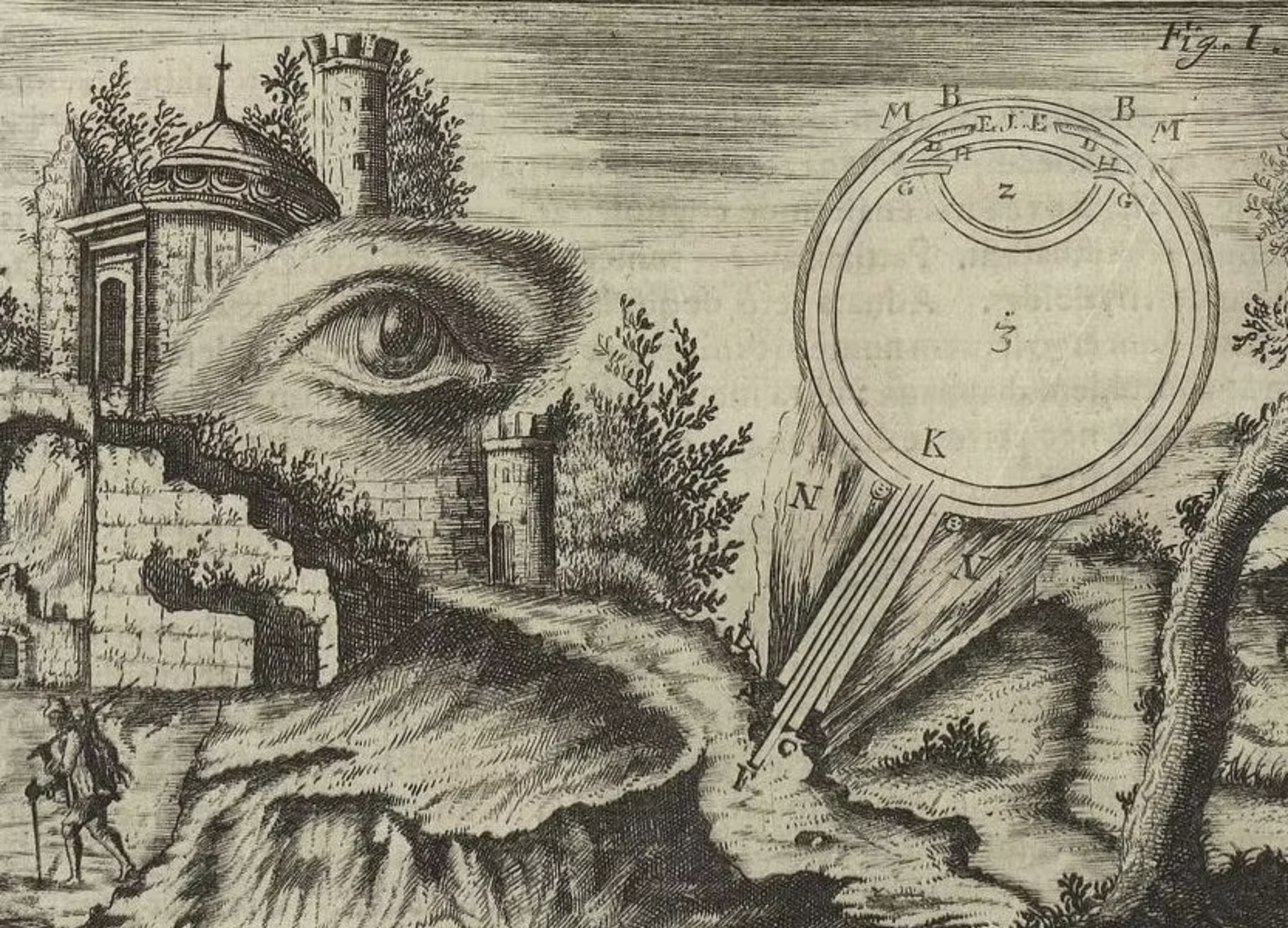
Plate from Oculus Artificialis, Johann Zahn. 1685.
Tuukka Toivonen August 19, 2025
Philosophers such as Maurice Merleau-Ponty (1908-1961) warned us decades ago about the folly of viewing reality purely through an analytical or conceptual lens. They were highly critical of the dominance of such “conceived” or analytical perception, or an excessive reliance on abstract concepts, fixed categories and the relentless dissection of phenomena into their constituent parts. For these philosophers, analytical seeing and comprehension was far less than the totality of reality. Instead, they suggested that a continuous, indivisible “lived” perception formed the true ground for all our experience, from the the physical to the cerebral. That perception was the gateway to fully entering the embodied, living reality that always already enfolds us. As society further devalues and grows blind to lived perception and the reality it gives access to, individuals and contemporary organizations not only delude themselves by treating imperfect models of reality as constituting actual reality, they risk distancing themselves from what the ecological thinker and phenomenologist David Abram has called the sensuous world. This deprives us of our very ability to relate to ourselves, other forms of life, and the wider cosmos within which we have always evolved and found profound meaning. As a result, the path to becoming fully human vanishes into thin air.
In the sobering words of philosopher, neuroscientist and psychiatrist Iain McGilchrist, “we live no longer in the presence of the world, but rather in a re-presentation of it”. We designate our abstract concepts, theories, images and other representations as primary and that which is truly present and alive as secondary. In this topsy-turvy rendering of existence, everything is reversed: health metrics, digital content, synthetic voices and scalable “nature-based solutions” come to be seen as more real and preferable than the dynamic and interrelated living wholes that they selectively abstract and exploit.¹ Indeed, in our reductionist fervour,² we have forgotten that complexity and constant change are the norm. Our disconnect mode of thought make it hard to accept this, but intuitively we know that, as McGilchrist puts it, simplicity represents “a special case of complexity, achieved by cleaving off and disregarding almost all of the vast reality that surrounds whatever it is we are for the moment as modelling as simple”.³ The act of simplifying what we experience or hope for does help us cope with our daily lives, but taking artificial representations of reality as truth effectively distorts and devitalizes our existence.
Consider how prioritizing unreal representations at the expense of a directly experienced living reality might manifest in relationships and communications. The relational space has become a site of active algorithmic mediation and intervention, with a rise in people developing intimate connections with chatbots of varying kinds. Consider a scenario where you are facing psychological hardship and long to be listened to, understood and supported, even if you are not (yet) able to expose the heart of the matter. In such a situation, an advanced AI chatbot may well serve as a supportive partner on the face of things, and it may even manage to intelligently unpick many of the root reasons behind your suffering. However, it would still amount to a situation where representations and cognition get treated as primary and where that which is truly alive and present is relegated to a secondary role. What gets devalued and displaced is the presence of another human being who feels your pain, their deeper potential for empathizing, and their simply being there, sharing time with you. In this and many other insidious and subtle ways, distorted takes on what constitutes primary reality have the power to corrupt our experiential fabric and the very foundations of our wellbeing.
Exploring the space between our familiar social realities and the awesome quantum worlds investigated by physicists, I feel that our prevailing assumptions about human reality need to be subjected to a profound test at an earthly level. Although I do not believe our universe is the product of a computer simulation, we have entered a simulated situation all the same by assigning the status of reality almost exclusively to the words, concepts and technologies we have invented rather than to the interconnected, mysterious and experientially rich reality that underpins our existence. This is a trap we cannot easily escape at a collective level, but at an individual level there is a lot that we can do to transcend the limits of our increasingly controlled experiential realities. Spending more time deeply immersed in art, music, meditation and natural environments is one enjoyable way to begin a journey back into living reality. For more ambitious moments, consider open discussions with those around you on which realities we might treat as primary and how we might define the ground upon which new ideas and technologies are to be built. Such engagements might reveal that many of us are much more seriously interested in exploring new ways to “live in the presence of the world” than common representations of our proclivities would have us believe.
Tuukka Toivonen, Ph.D. (Oxon.) is a sociologist interested in ways of being, relating and creating that can help us to reconnect with – and regenerate – the living world. Alongside his academic research, Tuukka works directly with emerging regenerative designers and startups in the creative, material innovation and technology sectors.
¹ This distinction between favouring specific solutions or products rather than the underlying life-giving wholes they are derived from offers a basis for assessing whether an action or enterprise is genuinely regenerative or not.
² McGilchrist traces this overwhelming tendency in contemporary culture back to the way society has systematically over-emphasized and amplified the linear, grasping disposition of the left side of the brain at the expense of the more integrative and holistic orientation of the right hemisphere, owing partly to the preponderance of Cartesian thought and economic ideologies of extraction. McGilchrist has an extensive background in neuroscience research and his work differs decisively with how pop neuroscience and psychology have contrasted the hemispheres and created simplified images of “left-brain” vs “right-brain” thinkers.
³ McGilchrist, I., 2021. The matter with things: Our brains, our delusions, and the unmaking of the world. Perspectiva Press, London, pp. 17-18.
Film
<div style="padding:56.25% 0 0 0;position:relative;"><iframe src="https://player.vimeo.com/video/1111230000?badge=0&autopause=0&player_id=0&app_id=58479" frameborder="0" allow="autoplay; fullscreen; picture-in-picture; clipboard-write; encrypted-media; web-share" referrerpolicy="strict-origin-when-cross-origin" style="position:absolute;top:0;left:0;width:100%;height:100%;" title="Acting Shakespeare - The Two Traditions clip 7"></iframe></div><script src="https://player.vimeo.com/api/player.js"></script>

Larry Levan Playlist
Archival 1967-1987
Larry Levan was an influential American DJ who defined what modern dance clubs are today. He is most widely renowned for his long-time residency at Paradise Garage, also known as “Gay-Rage”, a former nightclub at 84 King Street in Manhattan, NY.
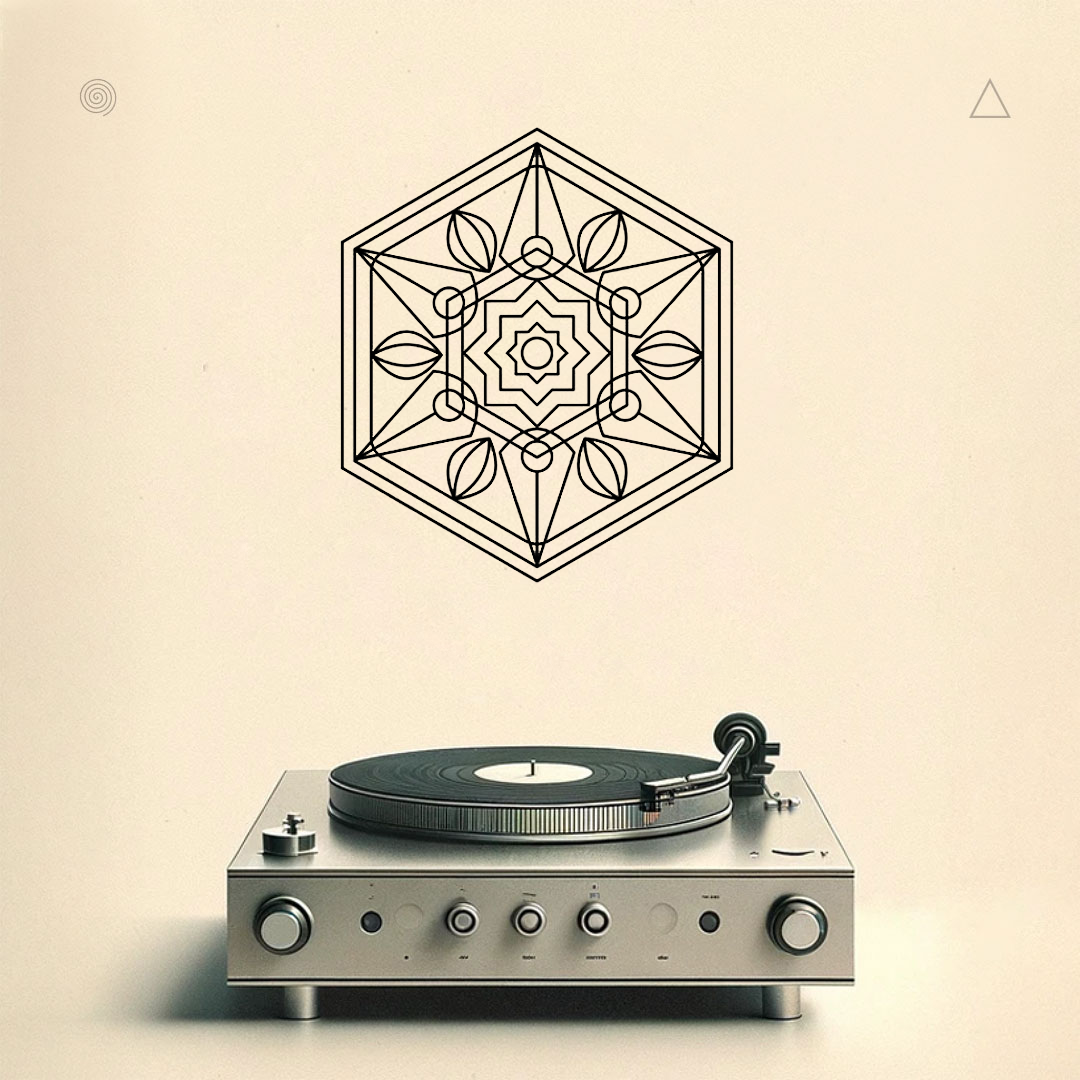
Hannah Peel Playlist
Archival - August 10, 2025
Mercury Prize, Ivor Novello and Emmy-nominated, RTS and Music Producers Guild winning composer, with a flow of solo albums and collaborative releases, Hannah Peel joins the dots between science, nature and the creative arts, through her explorative approach to electronic, classical and traditional music.
Film
<div style="padding:56.25% 0 0 0;position:relative;"><iframe src="https://player.vimeo.com/video/1110530874?title=0&byline=0&portrait=0&badge=0&autopause=0&player_id=0&app_id=58479" frameborder="0" allow="autoplay; fullscreen; picture-in-picture; clipboard-write; encrypted-media; web-share" referrerpolicy="strict-origin-when-cross-origin" style="position:absolute;top:0;left:0;width:100%;height:100%;" title="Pauahi Crater Eruption clip 1"></iframe></div><script src="https://player.vimeo.com/api/player.js"></script>
Happiness, the Nine of Cups (Tarot Triptych)
Chris Gabriel August 16, 2025
The Nine of Cups holds the sweetest water in the suit. As a nine, it is given to Yesod, the Unconscious, so this is the Lethean water of forgetfulness, the drink that puts you in a stupor…
Name: Happiness, the Nine of Cups
Number: 9
Astrology: Jupiter in Pisces
Qabalah: Yesod of He
Chris Gabriel August 16, 2025
The Nine of Cups holds the sweetest water in the suit. As a nine, it is given to Yesod, the Unconscious, so this is the Lethean water of forgetfulness, the drink that puts you in a stupor.

In Rider, a large man sits smugly in front of a table, upon which rests his horde of 9 cups. His arms are crossed and his face holds a haughty smile. He wears a white robe and a red turban. The table is draped with a watery table cloth.

In Thoth, we have Happiness; three rows of three pink cups flow into one another and golden lotuses move the water about the card through their orange stems. The card is given to Jupiter in Pisces, the domicile of Jupiter. As such, the Happiness of this card relates to religious ecstasy, fantasy, and metaphysics.

In Marseille, we have another matrix of cups, three by three, around which vegetation grows. At the bottom row of cups, the plants are wilting, atop they are growing strong. Qabalistically, the card is the ‘Foundation of the Queen’.
Happiness is a very pleasantly named card, and indeed the zodiacal placement which is attributed to it is one of the best. This is a restorative step in the suit of Cups where water returns to its essential nature after a difficult detour.
As Jupiter in Pisces, it brings to mind the dreams and promises offered by religion in its most base form. The promise of eternal life, paradise, and reunion with loved ones. Phrases like “pie in the sky” or “pipe dream” are particularly apt, and we can consider the root of the latter phrase being opium. The water in these cups is akin to Marx’s idea of religion as the ‘opium of the people.’ While the masses are tormented and oppressed, they hold onto the promises of the church to keep them going, rather than changing their material conditions. The pleasing water held in these nine cups is a spiritual opiate.
Many people drink and do drugs to attain this manner of dreamy hopefulness. In this state one can escape the misery and drudgery of reality, but it is ultimately temporary. The Happiness of this card is ephemeral and finite, and any attempts to make it prolong it lead to the rotting roots shown in Marseille.
The perfect image of this is the Lotus Eaters of The Odyssey, a people entirely dependent on their drugs and indifferent to the world. Many belief systems function this way as well; as numbing anesthetics for the body. The afterlife of the Greeks required the magical Lethean waters of forgetfulness to reach the end. An eternity being dumb and numb.
When we pull this card, we can expect a pleasant time, good dreams, and shared comfort. We may have a very strong imagination at this time or have sprawling dreams. Even in a reverie, we must ask ourselves: who is the dreamer? Are we in a dream of our own, or has someone trapped us in theirs?
Film
<div style="padding:56.25% 0 0 0;position:relative;"><iframe src="https://player.vimeo.com/video/1109937559?title=0&byline=0&portrait=0&badge=0&autopause=0&player_id=0&app_id=58479" frameborder="0" allow="autoplay; fullscreen; picture-in-picture; clipboard-write; encrypted-media; web-share" referrerpolicy="strict-origin-when-cross-origin" style="position:absolute;top:0;left:0;width:100%;height:100%;" title="Carlo Rovelli on The Order of Time clip 3"></iframe></div><script src="https://player.vimeo.com/api/player.js"></script>
The Soul Star Activation Protocol
Molly Hankins August 14, 2025
The Soul Star Activation Protocol was nearly lost to the world of the 21st century. A metaphysical technology passed down from Tibetan Master Djwhal Khul to Theosophical Society founder Helena Blavatsky to esoteric writer Alice A. Bailey, it was preserved in The Rainbow Bridge published in 1975…
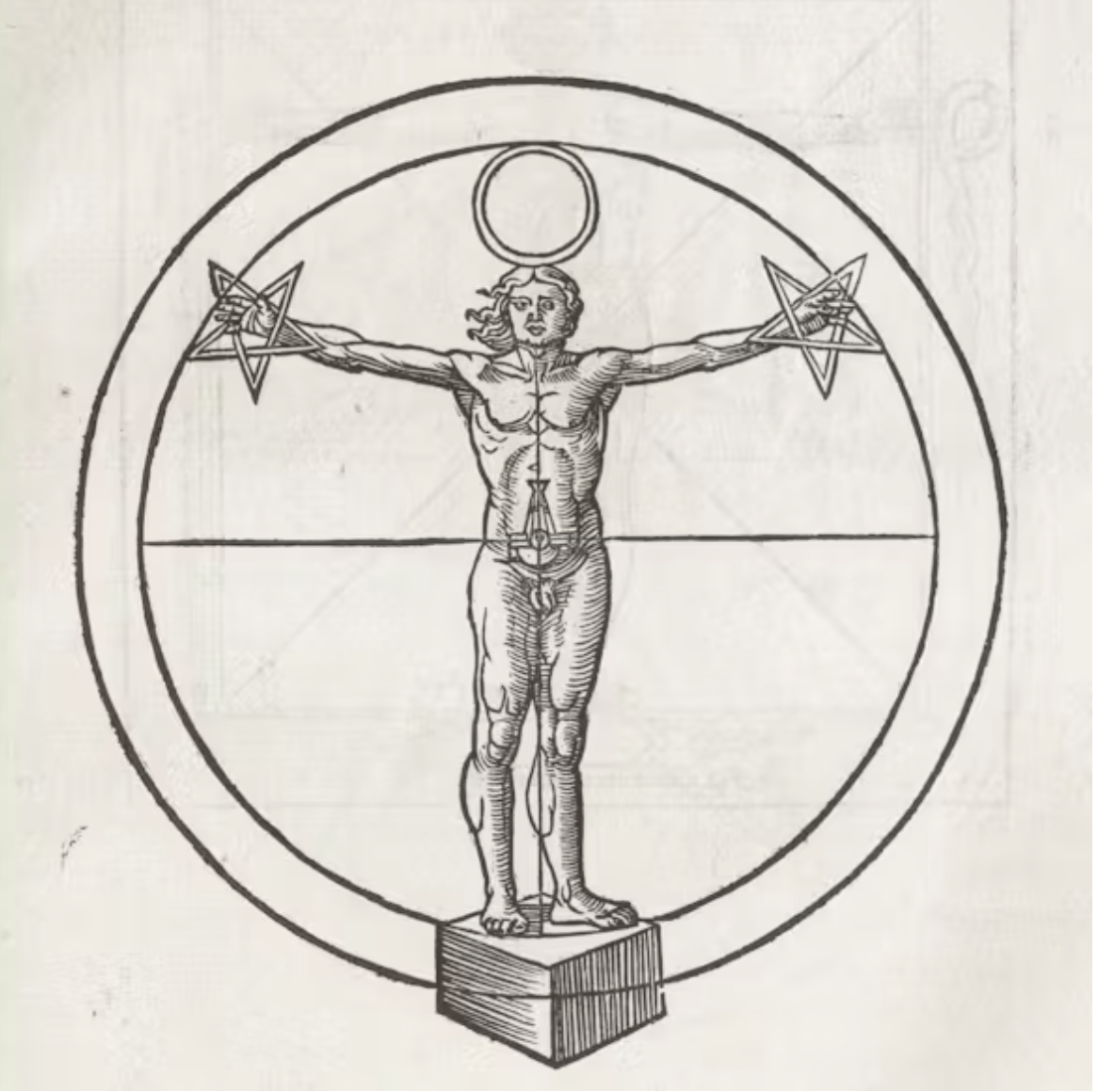
De Occulta Philosophia, Heinrich Agrippa.1533.
Molly Hankins August 14, 2025
The Soul Star Activation Protocol was nearly lost to the world of the 21st century. A metaphysical technology passed down from Tibetan Master Djwhal Khul to Theosophical Society founder Helena Blavatsky to esoteric writer Alice A. Bailey, it was preserved in The Rainbow Bridge published in 1975. It explains in elegantly simple detail how to build connection with our higher self beyond the world of form, expanding our consciousness, creativity, and magical capacity in the process. Inspired by The Kybalion, a book of Hermetic principles authored by three anonymous initiates, The Rainbow Bridge was anonymously published by two dedicated students of Theosophy and the transmission of this sacred knowledge continues.
The Rainbow Bridge describes an energetic thread “or vibration between states of consciousness” connecting our Earthly consciousness in third density to the totality of our soul’s consciousness beyond form. This thread is like a low-bandwidth data stream between worlds, that can be expanded by consciously working with this connection. The more data moving through the connection, the higher our state of consciousness and the more broad our capacity to respond to stimulus is. As it expands through effort, it hits critical mass,the bandwidth is suddenly expanded exponentially, and the connection is no longer a low bandwidth thread, but what the authors refer to as a “rainbow bridge”. When this happens, our soul star is activated.
“As consciousness moves from point to point or level to level from Earth upward, man’s nature changes even though his form appears to be the same; in reality it becomes more refined in the substance and energy of which it is composed. There comes a time when centers above the physical body are touched, and man finds himself in a state of being which, although new, seems to be the very essence of his being and somehow, strangely and wonderfully the essence of all being,” the introduction states. “At first there appears to be no difference in his outer vehicles or life, but, in time, he becomes something different, and he does not need to die to experience Heaven. Such experience is one of the goals of all occult teachings and practices.” When the centers above the physical body become activated, so does our soul star.
Master Djwhal Khul’s protocol has four qualifying requirements to build this connection and activate their soul star. Khul believes undertaking this work requires integration of the following principle beliefs into our consciousness before beginning the protocol:
The is one all inclusive, original source of consciousness also known as God, Intelligence, the Absolute, etc.
There is a law of rebirth, reincarnation or cyclic return.
Karma is a law of cause and effect we all live within.
There is a law of unification on the path of return from form back to the original source of consciousness, all souls are part of the one soul.
Once the above tenets are accepted and integrated, students may begin the Soul Star Activation Protocol. The soul star, the book tells us, is a bright, white indicator light that sits about 6 inches above the top of our heads and can be seen by energetically sensitive people when the data stream between our human and higher selves sufficiently expands. Activating it requires us to consciously build the connection within our physical and energetic bodies, referred to as the “central channel.” This channel runs through our heads and into the Earth. Those who are called to this work have at least a minimally activated soul star, and consciously engaging with it will begin the activation.
“Activating our soul star burns off so much psychic debris, as well as that accrued through traumas and the stress of daily life.”
To begin the Protocol, we must speak or sing the following soul mantram:

I am the soul, I am the light divine, I am love, I am will, I am fixed design.
The final phrase refers to the idea that our soul makes a plan for the lessons they need to learn in every incarnation, in order to reap the most benefit of being in form. The soul and personal self’s objectives are not the same, but part of this work is to begin identifying with the soul as much as possible. After vocalizing the soul mantra, the protocol begins by fixing our attention on our soul star and using triangulation to consciously move the star at a 45 degree angle in front of our forehead. Next we inhale to consciously move our soul star to our third eye, then exhale to move it along the pathway of the central channel and back to its resting place six inches above our heads. The conscious movement of our soul star is in the shape of a triangle.
“By this mental direction of energy, a student is enabled to clear away a channel for the continuous flow of spiritual energies through the lower vehicles or bodies,” the book says. “This is a slow and gradual process because it must be done under control and without haste or carelessness.” Students are advised to begin working just with the single triangulation through the third eye, practising l daily for at least two weeks before adding the second triangle, which moves the soul star just as before at a 45 degree angle in front of the throat then brings it back into the body and up the central channel. With each new triangle, spend two weeks practicing before moving on and introducing more. It takes four months to develop a central channel that fully utilizes the protocol, and the final two triangles through our feet into the Earth must be completed from a standing position.
Activating our soul star burns off so much psychic debris, as well as that accrued through traumas and the stress of daily life. After each session working the protocol we must clean our energy bodies using what’s called the ‘spiritual whirlwind’. You can imagine and concentrate on a tornado-like energy coming down above our heads and into the Earth, moving clockwise to remove all psychic debris. This part of the exercise should be performed for at least three minutes and be included as part of the protocol for those first four months. After that, the spiritual whirlwind may be used as needed, but most of the debris can be burned off in those early months through diligent practice. Recognizing when the whirlwind is no longer necessary is part of becoming more energetically sensitive from this training, so only individual intuition can inform the right time to remove it from the protocol.
Working with the central channel via triangulation, students typically find they don’t want to stop. Building the connection feels so good and is such a supercharge to our personal magic, most of those working with the Soul Star Activation Protocol find themselves integrating it into daily meditations and rituals. Not only does this work benefit our individual, Earthly lives, it also accelerates the evolution of planetary consciousness. “Effects increase with time, application and progressive purification,” the book promises, and as alignment with our soul increases, so does our personal and collective enjoyment of the human experience.
Molly Hankins is an Initiate + Reality Hacker serving the Ministry of Quantum Existentialism and Builders of the Adytum.
Film
<div style="padding:54.17% 0 0 0;position:relative;"><iframe src="https://player.vimeo.com/video/1110532579?badge=0&autopause=0&player_id=0&app_id=58479" frameborder="0" allow="autoplay; fullscreen; picture-in-picture; clipboard-write; encrypted-media; web-share" referrerpolicy="strict-origin-when-cross-origin" style="position:absolute;top:0;left:0;width:100%;height:100%;" title="Tampopo clip 2"></iframe></div><script src="https://player.vimeo.com/api/player.js"></script>
Film
<div style="padding:56.25% 0 0 0;position:relative;"><iframe src="https://player.vimeo.com/video/1109453794?badge=0&autopause=0&player_id=0&app_id=58479" frameborder="0" allow="autoplay; fullscreen; picture-in-picture; clipboard-write; encrypted-media; web-share" referrerpolicy="strict-origin-when-cross-origin" style="position:absolute;top:0;left:0;width:100%;height:100%;" title="Moonwalk One - Space Suit"></iframe></div><script src="https://player.vimeo.com/api/player.js"></script>
Against Fluency
Arcadia Molinas August 12, 2025
Reading is a vice. It is a pleasurable, emotional and intellectual vice. But what distinguishes it from most vices, and relieves it from any association to immoral behaviour, is that it is somatic too, and has the potential to move you…
Guilliaume Apollinaire, 1918. Calligram.
Arcadia Molinas August 12, 2025
Reading is a vice. It is a pleasurable, emotional and intellectual vice. But what distinguishes it from most vices, and relieves it from any association to immoral behaviour, is that it is somatic too, and has the potential to move you. A book can instantly transport you to cities, countries and worlds you’ve never set foot on. A book can take you to new climates, suggest the taste of new foods, introduce you to cultures and confront you with entirely different ways of being. It is a way to move and to travel without ever leaving the comfort of your chair.
Books in translation offer these readerly delights perhaps more readily than their native counterparts. Despite this, the work of translation is vastly overlooked and broadly underappreciated. In book reviews, the critique of the translation itself rarely takes up more than a throwaway line which comments on either the ‘sharpness’ or ‘clumsiness’ of the work. It is uncommon, too, to see the translator’s name on the cover of a book. A good translation, it seems, is meant to feel invisible. But is travelling meant to feel invisible – identical, seamless, homogenous? Or is travelling meant to provoke, cause discomfort, scream its presence in your face? The latter seems to me to be the more somatic, erotic, up in your body experience and thus, more conducive to the moral component of the vice of reading.
French translator Norman Shapiro describes the work of translation as “the attempt to produce a text so transparent that it does not seem to be translated. A good translation is like a pane of glass. You only notice that it’s there when there are little imperfections— scratches, bubbles. Ideally, there shouldn’t be any. It should never call attention to itself.” This view is shared by many: a good translation should show no evidence of the translator, and by consequence, no evidence that there was once another language involved in the first place at all. Fluency, naturalness, is what matters – any presence of the other must be smoothed out. For philosopher Friedreich Schlerimacher however, the matter is something else entirely. For him, “there are only two [methods of translation]. Either the translator leaves the author in peace, as much as possible, and moves the reader towards him; or he leaves the reader in peace, as much as possible, and moves the author towards him.” He goes on to argue for the virtues of the former, for a translation that is visible, that moves the reader’s body and is seen and felt. It’s a matter of ethics for the philosopher – why and how do we translate? These are not minor questions when considering the stakes of erasing the presence of the other. The repercussions of such actions could reflect and accentuate larger cultural attitudes to difference and diversity as a whole.
“The higher you climb, the further you travel, the greater the view”
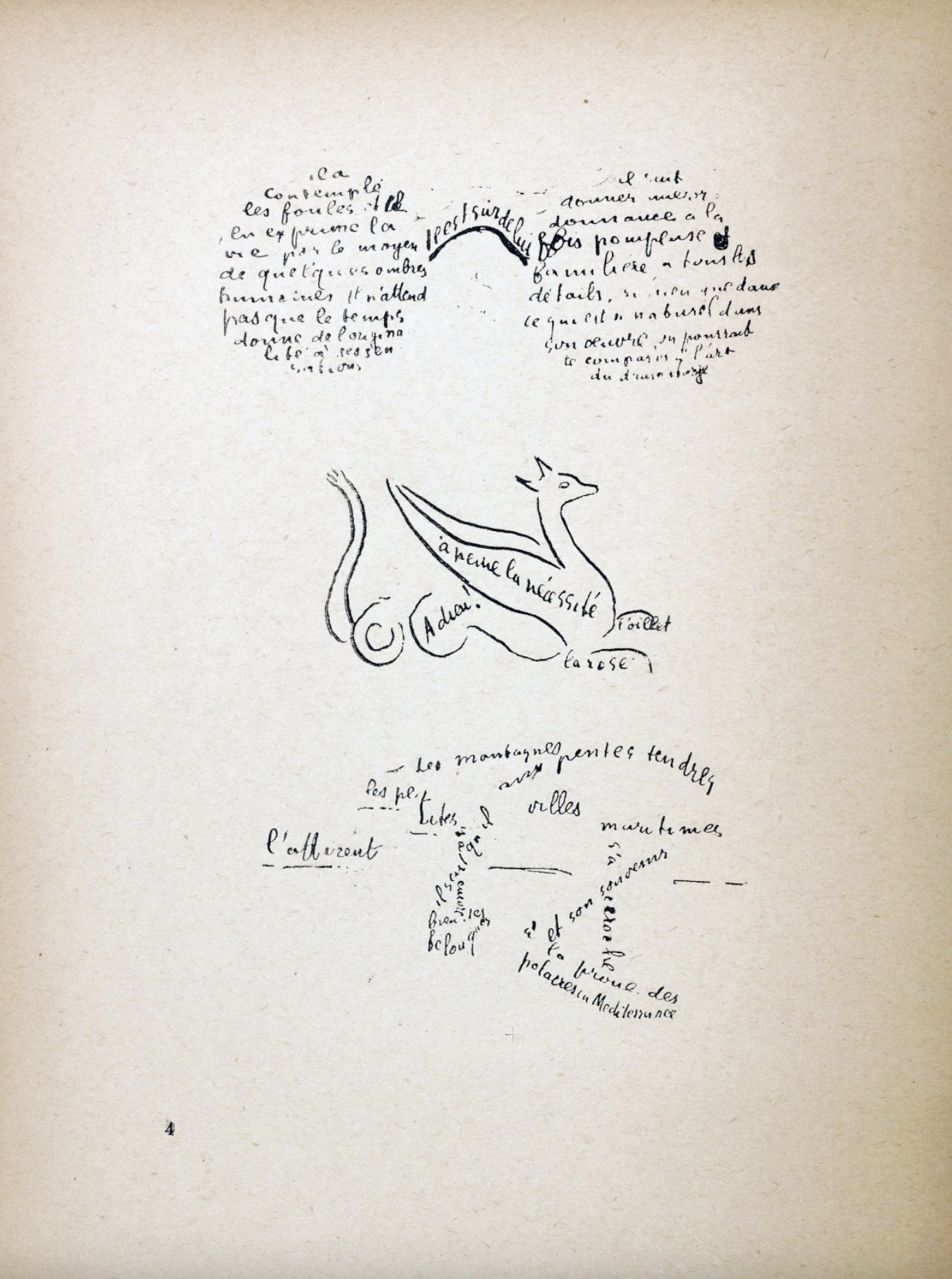
Guilliaume Apollinaire, 1918. Calligram.
Lawrence Venuti coins Schlerimacher’s two movements, from reader to author and author to reader, as ‘foreignization’ and ‘domestication’ in his book The Translator’s Invisibility. Foreignization is “leaving the author in peace and moving the reader towards him”, which means reflecting the cultural idiosyncrasies of the original language onto the translated/target one. It means making the translation visible. Domestication is the opposite, it irons out any awkwardness and imperfections caused by linguistic and cultural difference, “leaving the reader in peace and moving the author towards him”. It means making the translation invisible, and is the way translation is so often thought about today. Venuti says the aim of this type of translation is to “bring back a cultural other as the same, the recognizable, even the familiar; and this aim always risks a wholesale domestication of the foreign text, often in highly self- conscious projects, where translation serves an appropriation of foreign cultures for domestic agendas, cultural, economic, political.”
The direction of movement in these two strategies makes all the difference. Foreignization makes you move and travel towards the author, while domestication leaves you alone and doesn’t disturb you. There is, Venuti says, a cost of being undisturbed. He writes of the “partly inevitable” violence of translation when thinking about the process of ironing out differences. When foreign cultures are understood through the lens of a language inscribed with its own codes, and which consequently carry their own embedded ways of regarding other cultures, there is a risk of homogenisation of diversity. “Foreignizing translation in English”, Venuti argues, “can be a form of resistance against ethnocentrism and racism, cultural narcissism and imperialism, in the interests of democratic geopolitical relations.” The potential for this type of reading and of translating is by no means insignificant.
To embrace discomfort then, an uncomfortable practice of reading, is a moral endeavour. To read foreignizing works of translation is to expand one’s subjectivity and suspend one’s unified, blinkered understanding of culture and linguistics. Reading itself is a somatic practice, but to read a work in translation that purposefully alienates, is to travel even further, it’s to go abroad and stroll through foreign lands, feel the climate, chew the food. It’s well acknowledged that the higher you climb, the further you travel, the greater the view. And to get the bigger picture is as possible to do as sitting on your favourite chair, opening a book and welcoming alienation.
Arcadia Molinas is a writer, editor, and translator from Madrid. She currently works as the online editor of Worms Magazine and has published a Spanish translation of Virginia Woolf’s diaries with Funambulista.
Film
<div style="padding:42.5% 0 0 0;position:relative;"><iframe src="https://player.vimeo.com/video/1109455892?badge=0&autopause=0&player_id=0&app_id=58479" frameborder="0" allow="autoplay; fullscreen; picture-in-picture; clipboard-write; encrypted-media; web-share" referrerpolicy="strict-origin-when-cross-origin" style="position:absolute;top:0;left:0;width:100%;height:100%;" title="Thunderbirds Are GO clip 1"></iframe></div><script src="https://player.vimeo.com/api/player.js"></script>

Iggy Pop Playlist
Iggy Confidential
Archival - January 19, 2025
Iggy Pop is an American singer, songwriter, musician, record producer, and actor. Since forming The Stooges in 1967, Iggy’s career has spanned decades and genres. Having paved the way for ‘70’s punk and ‘90’s grunge, he is often considered “The Godfather of Punk.”
Film
<div style="padding:53.33% 0 0 0;position:relative;"><iframe src="https://player.vimeo.com/video/1109455672?badge=0&autopause=0&player_id=0&app_id=58479" frameborder="0" allow="autoplay; fullscreen; picture-in-picture; clipboard-write; encrypted-media; web-share" referrerpolicy="strict-origin-when-cross-origin" style="position:absolute;top:0;left:0;width:100%;height:100%;" title="Playtime clip 3"></iframe></div><script src="https://player.vimeo.com/api/player.js"></script>