
Film
<div style="padding:56.25% 0 0 0;position:relative;"><iframe src="https://player.vimeo.com/video/1135510530?badge=0&autopause=0&player_id=0&app_id=58479" frameborder="0" allow="autoplay; fullscreen; picture-in-picture; clipboard-write; encrypted-media; web-share" referrerpolicy="strict-origin-when-cross-origin" style="position:absolute;top:0;left:0;width:100%;height:100%;" title="George Washington Carver clip 2"></iframe></div><script src="https://player.vimeo.com/api/player.js"></script>
1 Heaven (Order) - The I Ching
Chris Gabriel November 8, 2025
Heaven is the origin of our pure and bountiful harvest…
Chris Gabriel November 8, 2025

Judgment
Heaven is the origin of our pure and bountiful harvest.
Lines
1
The Dragon is hidden, it goes unseen.
2
The Dragon is seen again in the field
3
The Sage is active day in, day out.
In the evening he is watchful. There’s danger.
4
Sometimes it jumps in the depths.
5
The Dragon flies in Heaven
6
The Dragon that flies too high has remorse
All:
There appears a flock of headless dragons.
Qabalah
Kether. The highest point on the Tree of Life. The 4 Aces.
We start at the top, with Heaven as the first hexagram of the I Ching. The hexagram is made of six solid lines, creating a picture of a clear blue sky. The ideogram, on the other hand, gives us a very profound image: the movement of the Heavenly bodies, mankind, and nature in unison. The phenomena depicted here is the ordering, creative principle. This is the Will of Occultists and philosophers, and the “Energy” of the New Ager. Wilhelm Reich called this “Orgone” and wrote very directly about this very thing:
“The same energy which governs the movements of animals and the growth of all living substance also actually moves the heavenly bodies.”
(An Introduction to Orgonomy pg. 289)
Heaven can be symbolized as light itself. The first utterance of God in the Bible is “Let there be light”, just as this is the start of the cosmology of the I Ching. We can think also of the rainbow as another good image to hold with Heaven, light refracted into an ordered and beautiful set of rays.
Crowley associated this Hexagram with the Phallus, and as we Qabalistically correspond it to Kether and the four aces in Tarot, we can associate this divine phallus with the Ace of Wands and Ace of Swords.
The hexagram calls to mind the Kinks song “Big Sky”, in which the Sky sees the problems of man, but is literally too big to sympathise. This is the very nature of Heaven for the Taoist. Consider chapter five of the Tao Te Ching:
“Heaven and Earth have no compassion
Everything is like a toy to them”
This great energy, called Will and Orgone, is essentially amoral; it moves the world, while it itself is unmoved.
As for the Dragon written about in the lines of the hexagram, we can think of what the Yogis call the Kundalini - a serpent or dragon that lays dormant in all humans, coiled at the base of the spine, waiting to ascend. They are an ambassador of Heaven within us. Significantly, Heaven features a unique 7th line, which none of the other hexagrams hold.
“There appears a flock of headless dragons.”
Here, like the Kundalini connection, we can relate it to the Great Work of Thelemic magick: the Headless Rite. Through self beheading, the individual unites with their greater self, the Guardian Angel, Daemon or Genius. One can say a beheaded man makes the whole sky his head.
Film
<div style="padding:56.25% 0 0 0;position:relative;"><iframe src="https://player.vimeo.com/video/1134395525?badge=0&autopause=0&player_id=0&app_id=58479" frameborder="0" allow="autoplay; fullscreen; picture-in-picture; clipboard-write; encrypted-media; web-share" referrerpolicy="strict-origin-when-cross-origin" style="position:absolute;top:0;left:0;width:100%;height:100%;" title="Acting Shakespeare - Using the Verse clip 2"></iframe></div><script src="https://player.vimeo.com/api/player.js"></script>
Past Life Billionaires (Lost Songs Project)
Molly Hankins November 5, 2025
We were all sitting in Marfa, and there's not much to do. And that's kind of the point…

Marfa, Texas, Early 1900s.
Molly Hankins November 6, 2025
Welcome to the first Lost Songs Project, a new series telling the stories behind songs lost to the world. The vulnerability of being seen, particularly in an emotional state, can be overwhelming but when all of that emotion is poured into a piece of music, it can sometimes feel too intimate to share. Those are exactly the type of songs this project was made for - the ones that didn’t fit an album, meet the expectations of a record label, or, in the case of the songs you're about to hear, were made by a couple of guys in Marfa, Texas helping their friend Dustin turn a broken heart into an album.
This is the story of an east Texas painter, builder and mechanic named Dustin Pevey, co-founder and singer of the short-lived band, Past Life Billionaires. They released their self-titled album on SoundCloud in 2012, and deleted it less than two years later. We spoke with Tavahn Ghazi, one of the producers, musicians and friends that brought these songs to life. After learning that Dustin, who'd never sang before, had “the voice of an angel,” Tavahn gave himself fully to the project knowing it might never be heard. With the help of Joe Trent, the only classically trained musician of the three, they recorded Dustin's heart-wrenching vocals on an iPad borrowed from the public school Joe was teaching at. Joe made the backing tracks to sketch out the songs, then Tavahn recorded all the instruments for each one in an art gallery-turned-crash-pad next to the train tracks. His recording set-up consisted of a laptop running GarageBand placed next to the drums, keyboard or guitar amp.
It is worth contemplating while listening to these heart-wrenching songs that the woman Dustin wrote this album about is now his wife. He declined to participate in the interview, but trusted his friend and former bandmate Tavahn to tell the story of how Past Life Billionaires came to be and not be.
Nothin’ But Your Tail Lights 2. Call Me 3. Right On The Money 4. Left Me Cold 5. Lohan Stain
6. Diamond Pillowcase 7. Winning Lotto Ticket. 8. Mercedes Benz Bounce 9. Criminals
MH: What were the conditions that created the anomaly known as Past Life Billionaires?
TG: We were all sitting in Marfa, and there's not much to do. And that's kind of the point. I’d been in Marfa seven years, and you become friends with all the other weirdos who have decided to isolate themselves entirely from reality or bill paying jobs and get a shed in the middle of the Chihuahuan plains, and figure yourself out. I bumped into these two characters from East Texas named Dustin Pevey and Joe Trent. Joe was a high school teacher, and Dustin was making paintings that were phenomenal. And we all had a musical background, but it was like, in Marfa, there's just nothing else to do. So the nothing of just getting the freedom to sit around and write or play music is almost too much. You think, ‘maybe I should watch the shadows move across that plane just for a few more days’ and see if that works.
Ultimately, that grows sort of old. I got this old guitar, and Joe just got an iPad from the school. We were using GarageBand and then something called iPad studio which was the most cursory software. That project started happening really quick, and it ended really quick because Dustin would just keep showing up to my house. I was living in a kind of gallery next to the train so my house would vibrate 22 times a day. We'd be recording and have to pause to feel an earthquake. Past Life Billionaires was that. It just started with learning that my friend Dustin had this soul singer inside of him, that this stoic East Texas mechanic kind of person had this vibrant, heartbroken soul singer inside of him was just wild.
We all knew that we're doing this for the sake of doing it, but we were listening to Miguel and Frank Ocean and these kind of ethereal, sad boy, R&B guys, but we're sitting in the country. And these kids are from East Texas, so they got twang in their hearts. And I'm from God knows where, and so I've got the whole universe in my heart.
MH: What was the recording process like? Were you just holding your MacBook up to the instruments?
TG: Oftentimes in underpants, with some just ferocious hangover and getting blasted by drums and guitar. We would just set the laptop up in front of the amp and just go. They would give me these sketches, and then I would work them out, and we'd expand them. And then after a few days, the whole thing was done. Dustin was going through this renaissance in himself of power and heartbreak and that's why that the record’s good, because it's very honest and direct, and you can feel that, and it doesn't need to be from someone who has had a music career or who had a background. I think that the transcendent aspect of it is just the direct, immediate honesty.
And you can relate to that, can tell it was done for the right reason. So at that point, we've already satisfied the whole experience, and then everything after that kind of would be, you know, how much does my ego need to be fed? And what am I willing to do to bring myself into that level of light? When it's that intimate, it doesn't really have to extend that far for it to have fulfilled its purpose. It was a whirlwind because neither of us were making music. I had gone to Marfa to produce for this other band, and they stopped making music, so I just sat there quietly and learned how to produce on my own. And it was nice to be given some project that I liked a lot with a dear friend that was a really exploratory, cathartic adventure. It just so happens to sound cool, so that's good.
MH: What's your musical background?
TG: I got a leftover guitar from my brother when he went to college, and I started listening to Jerry Garcia really intensely, taught myself to play guitar, and then failed out of high school miserably. I went to music school to make up for it, and learnt how to translate dreams or feelings through instruments, and then came home and didn't do much with it. So I went to Marfa to learn, and started producing.
I've just been making music non stop since I was a kid, and not releasing any of it.
MH: So Joe and Dustin would come to you with these ideas and then you'd bring them to life?
TG: Yeah, they'd do little beds, little chords, really cool changes. Dustin had a strange ability to capture melodies from other songs like you could put on any radio station in the world. He knows every lyric and every melodic run. He has a brain that sees those options and sees sort of how to fumble through which options you're gonna make, which choices you're gonna make. He was somehow also very fast at distilling that and then finding something.
People have such stringent ideas of their categories, like ‘I'm a singer, so you have to filter me as a person through this identity that I've chosen for myself’. But when you don’t define yourself by that, and it just becomes another tool or medium to figure out what's happening to you, and, it's just significantly more interesting.
Marfa at that time was full of a sense of ‘I'm here to be alone and to work on my craft’, but then the sheer vast loneliness will get you. And I watched a lot of people leave after six months. I think there were a handful of us that were just so committed to that, that emptiness. And the scene there was, how do you fill that in?
We knew Dustin didn't want to be in front of people playing music and so we already knew what the future of it was, which is a blessing and a curse. But we knew we weren't going to really support it or push it. Dustin was friends with Pat Carney, who's the drummer of The Black Keys, and had played it for him. And he's like, “Yo, this is, like, one of the best records I've heard this year.” Like, and so, like, we had people who were interested in that record in a very serious way. And somehow we got on NPR’s All Songs Considered.
But the scene in Marfa, there's really nothing there. Dustin was experiencing something that hurt him, and he's a person who happens to have a variety of tools with which to describe that. He had been, at that point, a visual artist, but has a background in just being able to do anything. Joe is this masterful human being, and really knew what chords are supposed to happen when and why, in a way Dustin and I didn't.
And so he would just give Dustin a little bed to lay on. I think they just trusted each other, having this old familial background. And then I'm likely to come into that process and want to throw every wrench I can find at it, because it's how you manage insecurity when you're talented and you don't know what to do with it. I've engaged with the recording process in so many different ways, and I've just never felt this immediate sense of ‘I get it and I'm doing it correctly, that's weird.’ And so it kind of blew us all away to feel that.
MH: So between writing and recording, how long do you think it took to make these songs?
TG: Oh, I mean, each of those songs would would take a day to sketch up, and then Dustin would go home and lay in bed and sing into the fucking iPad and and he next day they'd essentially be done. Then we just spent all this time on YouTube trying to learn how to mix in Garage Band, because none of us knew shit about a computer. So I think it took four years, but probably only two hours of work.
You know, this the last record I made, the releasing had to happen, sort of because of a tragedy that happened regarding that. But part of what stopped me from really giving it more credence was the question, ‘What am I going to do with it?’ It's almost going to be more heartbreaking to stretch that out. In Past Life Billionaires we were never really doing it, like, professionally.
Having known that earlier in the process was really cool, because you don't build this big idea up of what it's going to be and how people are going to react, you're just like, fuck, it's going to die on the vine with a lot of other delicious fruit.
There's a song “Diamond Pillowcases” that was the first song that was made, and the lyrics are so good. He says “A rock and roll souvenir that you bought with predatory lending from a Shell cashier.” And I was like, ‘What are you doing? What's happening inside of you?’ I love whatever story you're trying to tell me.
Molly Hankins is an Initiate + Reality Hacker serving the Ministry of Quantum Existentialism and Builders of the Adytum.
Film
<div style="padding:39.24% 0 0 0;position:relative;"><iframe src="https://player.vimeo.com/video/1134390033?badge=0&autopause=0&player_id=0&app_id=58479" frameborder="0" allow="autoplay; fullscreen; picture-in-picture; clipboard-write; encrypted-media; web-share" referrerpolicy="strict-origin-when-cross-origin" style="position:absolute;top:0;left:0;width:100%;height:100%;" title="The Cassandra Cat clip 2"></iframe></div><script src="https://player.vimeo.com/api/player.js"></script>

Mike Gordon
1h 55m
11.5.25
In this clip, Rick speaks with Mike Gordon about the musical language Phish used to communicate with each other.
<iframe width="100%" height="265" src="https://clyp.it/brlsawzn/widget?token=4ae5076db7186b5061556fbfa95f2223" frameborder="0"></iframe>
Film
<div style="padding:56.25% 0 0 0;position:relative;"><iframe src="https://player.vimeo.com/video/1133656245?title=0&byline=0&portrait=0&badge=0&autopause=0&player_id=0&app_id=58479" frameborder="0" allow="autoplay; fullscreen; picture-in-picture; clipboard-write; encrypted-media; web-share" referrerpolicy="strict-origin-when-cross-origin" style="position:absolute;top:0;left:0;width:100%;height:100%;" title="Mount St. Helens - Road to Recovery clip 1"></iframe></div><script src="https://player.vimeo.com/api/player.js"></script>
Towards an Interspecies Architecture
Robin Sparkes November 4, 2025
Bird’s songs are swallowed by human cacophony…

Robin Sparkes November 4, 2025
Bird’s songs are swallowed by human cacophony. The low hum of industrial noise, the pulse of traffic, the ongoing percussion of construction, drown out their call. Noise pollution erodes communication across the living networks, our resonant ecology. Birds, like so many species, are disrupted by the presence of humans in the places we build and live.
As architects and as humans, it is our responsibility to design for multispecies resilience in acts of attunement. It requires a sensitivity, a listening to the subtle soundscape of cohabitation. From the materiality and form of space - its orientation, its ecological companions - to trees and shrubs, wind and sun. Design, in this sense, becomes an instrument capable of amplifying or softening the audible world. Our task is to compose spaces that listen as much as they speak, acknowledging the lives of our neighbours as part of the living score.
To design for birds is to think like a bird. What works, they learn, what they learn, they remember, and what they remember, they refine, and adapt. "Cognition in birds is subject to a positive feedback loop involving niche breadth. Greater cognitive potentials permit more elaborate nests, which can enable species to enjoy broader niches" (Gould 2007). In this way, birds are architects of their own worlds, shaping and reshaping their environments in response to sound, space, and shelter. Therefore, when we observe the bird, we can begin to understand what needs are specific to their environment.
Just as it does for the bird, every element participates in shaping our domestic space. This is a matter of materials; vegetation shapes space and dampens intrusive noise. We can create acoustic shadows, subtly linking structure to substructure and the life around it. Porous, absorptive or diffusive surfaces help dissipate low-frequency noise, reducing reverberation. Precise orientation, elevation and spatial arrangement can preserve communication exchange.
How can we begin to imagine interventions in our design choices that sustain life in an anthropocentric world? Birdhouses and nesting niches can be incorporated into the surfaces, ornamentation and rhythm of a building, where we provide space to live alongside other species.
When we design with research-led intentions, paying close attention to how birds think, we engage in what Donna Haraway describes as "tentacular thinking”. Haraway uses the metaphor of tentacles to suggest that life is threaded, interconnected, and networked. Instead of thinking of individual beings as isolated points or bounded spheres, she urges us to see them connected by many lines, paths of relationship, influence, response, and affect. When we listen to the birds, we begin to hear our own environment anew. We can apply through the act of research and design, both the lives we neighbour and the spaces we ourselves inhabit.
“Designing with birds teaches us to listen differently”
History offers both architectural precedents and spiritual connection to living with birds. From the sixteenth to the nineteenth centuries, during the Ottoman empire, architects integrated birdhouses, known as kuş köşkü, serçe saray, or güvercinlik, into the walls of mosques, madrasas, fountains, mausolea, and other public and religious buildings. These miniature palaces were often ornately detailed, harmonizing with the aesthetic of the host structure. They were placed high to receive sunlight, oriented away from human made noise, and sheltered from predators. This careful integration reflects a cultural ethic of respect for birds and an understanding of their role in urban biodiversity. Many of these birdhouses still survive on the façades of Istanbul’s historical architecture.
Antoni Gaudí’s Park Güell (1900–1914) offers a modern parallel in Barcelona. Terraced walls and walkways incorporate built-in bird nests, while abundant vegetation and stonework create habitat niches, perches, and feeding grounds. The sheltered cavities reduce mortality from cold and rain and, acoustically, offer places where quieter calls have space to be heard. The park supports many bird species, for both resident and migratory birds. It uses organic geometries, local materials, and the subtle integration of built and natural elements to merge urban environment and nature. In this way, architecture, material choices, spatial arrangement, and flora converge to create spaces where birds thrive.
Both precedents demonstrate that designing for birds can be an act of cohabitation. Ottoman birdhouses and Gaudí’s integrated nests show that ornament and function can coexist. Vegetation continues to play a critical role by absorbing noise, partitioning space, and creating acoustic shadows. Elevation, orientation, and exposure to sunlight and wind enhance the transmission of high-frequency calls while also preserving cultural and spiritual practices in connecting us to nature.
Designing with birds teaches us to listen differently and to carefully observe the interplay of sound, space, and life. Through attentive research and considered intervention, we can learn about the birds and also about the sites we inhabit, the environments we shape, and the connections between human and nonhuman life. Here we can discover new ways of inhabiting the world ourselves. Architecture, therefore, can become a bridge across species, a reminder that responsible design is an act of listening, learning, and responding.
Robin Sparkes, is a spatial designer, studying the kinesthetic experience of architecture. Her design, research, and writing practice traverses the relationship between the body, temporality, and the acoustics of space.
Hannah Peel Playlist
Archival - October 15, 2025
Mercury Prize, Ivor Novello and Emmy-nominated, RTS and Music Producers Guild winning composer, with a flow of solo albums and collaborative releases, Hannah Peel joins the dots between science, nature and the creative arts, through her explorative approach to electronic, classical and traditional music.
The Trigrams
Chris Gabriel November 1, 2025
The Trigrams are the eight base elements which make up all of the hexagrams of the I Ching, they are made of three solid or broken lines, which form simple pictures of their elements…
A diagram of I Ching hexagrams sent to Gottfried Wilhelm Leibniz from Joachim Bouvet.
Chris Gabriel November 1, 2025
The Trigrams are the eight base elements which make up all of the hexagrams of the I Ching, they are made of three solid or broken lines, which form simple pictures of their elements. Their ideogrammic names can also help us understand the character of each element. Together they form a sort of visual poem from which we can feel the state of nature they signify.
A solid grasp of these eight elements and their names will allow you to intuitively grasp their combinations.
☰
Heaven
Heaven is the purest expression of Yang: positive, light, creative - it is natural harmony. Within a hexagram this can be “treasure”, divine manifestation, or clear sky.
When we see this trigram we can visualize the three solid lines as a clear, bright sky.
乾
When we look at the ideogram for Heaven, we can see the motion of the Sun through the sky, a little man, and a growing plant. Together, this is akin to Heaven as “Natural Order”.
Qabalistically, Heaven is given to Daath, the veil over the Supernal Triad of Kether, Chokmah, and Binah. But to simplify things, it is essentially Kether, the highest expression of the Divine among the trigrams.
☷
Earth
Earth is the purest expression of Yin: negative, dark, receptive - it is material reality. Within a hexagram this can be dirt or darkness.
When we see this trigram we can visualize the three broken lines as dark fertile soil, a tilled field.
坤
In the ideogram for Earth, we see soil and God. The good Earth.
Qabalistically, Earth is Malkuth, “the Kingdom”, the lowest part of the Tree and relates to Saturn and Earth.
☲
Fire
Fire is the second expression of Yang. It is called Clinging, for the way that fire clings to what it consumes. In a hexagram this can be either the Sun or fire itself.
When we see this trigram we can visualize the broken line as a piece of wood and the two solid lines as flames.
離
Looking at the ideogram for Fire, we see “Legendary” - a little creature with a tail, an X face, a crown, and a Bird. Together, these become “Legendary Bird” and I relate this to the Phoenix. In modern usage, the character means ‘to depart’, to fly away.
Qabalistically, Fire is Tiphereth, the sixth Sephiroth “Beauty”, and the Sun.
☵
Water
Water is the second expression of Yin. It is the Abysmal, in the way water falls. In a hexagram it can be a puddle, a body of water, or rain.
When we see this trigram we can visualize the solid line as a piece of wood floating and the two broken lines as the water upon which it floats.
埳
As we look at the ideogram for Water we see earth, and a man falling into an abyss.
Qabalistically, Water is Yesod, the ninth Sephiroth “Foundation”, and the Moon.
☳
Thunder
Thunder is the third expression of Yang. It is the Arousing or exciting. In a hexagram this can be thunder directly, or simply an excited movement.
When we see this trigram we can visualize the two broken lines as a dark sky, and the solid line below as the explosion of a lightning strike.
震
When we look at the ideogram for Thunder, we see rain, which is made up of sky 天, a big man, and the little drops of rain in his chest. Below is the character for shake, which is a cutting tool. Thunder is the shaking that accompanies rain.
Qabalistically, Thunder is Gevurah, the fifth Sephiroth “Severity”, and Mars.
☶
Mountain
Mountain is the third expression of Yin. It is stillness, focus, and heaviness. In a hexagram, this can be a mountain directly or simply something heavy.
When we see this trigram we can visualize the two broken lines as the dark mountain and the solid line as the point where the peaks reach the sky.
艮
The ideogram depicts an eye with legs, literally focusing.
Qabalistically, Mountain is Netzach, the seventh Sephiroth “Beauty”, and Venus.
☴
Wind/Wood
Wind is the fourth expression of Yang. It is subtle, gentle, and penetrating. In a hexagram this can be wind directly, a tree, or wood in general.
When we see this trigram we can visualize a growing tree reaching for the sky, the broken line below is the tree, the two solid lines are the sky.
巽
Fittingly, the ideogram for Wind depicts two serpents or two people kneeling at a table.
Qabalistically, Wind is Hod, the eighth Sephiroth “Intelligence”, and Mercury (the two serpents perfectly fit with his Caduceus)
☱
Lake
Lake is the fourth expression of Yin. It is joyous, pleasant, and easy. Unlike Water, the lake is contained, just as a cup contains. In a hexagram this can mean a literal lake, or pleasant easy movement.
When we see this trigram we can visualize the two solid lines as the depths of the lake and the broken line as the surface. Consider how the surface of water ripples and makes waves, but the depths remain calm.
兌
The ideogram for lake is a dancing man, a smiling face with arms and legs.
Qabalistically, Lake is Chesed, the fourth Sephiroth “Mercy”, and Jupiter (the Bringer of Joy).
Elements
In these eight trigrams we are given a doubling of the traditional four Western elements. Unlike Tarot, which draws from planets, signs, and elements, here we are dealing with a much more streamlined system. If you can grasp these eight elements, their interactions across the hexagrams will be much easier to understand. They form images of natural phenomena, rather than human characters.
By utilizing Qabalah and Astrology, we can make fascinating connections between the Tarot and I Ching. Consider the opposition of Thunder and Mountain, one excited and one still, their corresponding planets, Mars and Venus, function in exactly the same way. If you are familiar with Qabalah or Astrology, this will make the hexagrams far more accessible.
Film
<div style="padding:56.21% 0 0 0;position:relative;"><iframe src="https://player.vimeo.com/video/1131860224?badge=0&autopause=0&player_id=0&app_id=58479" frameborder="0" allow="autoplay; fullscreen; picture-in-picture; clipboard-write; encrypted-media; web-share" referrerpolicy="strict-origin-when-cross-origin" style="position:absolute;top:0;left:0;width:100%;height:100%;" title="Abbott and Costello meet Frankenstein clip 1"></iframe></div><script src="https://player.vimeo.com/api/player.js"></script>
Art Today and The Film (1965)
Rudolf Arnheim October 30, 2025
If the various arts of our time share certain traits and tendencies they probably do so in different ways, depending on the character of each medium.

Still from Federico Fellini’s ‘8 1/2’, 1963.
Written in a moment of existential change for Cinema, the great theorist of his time, Rudolf Arnheim, makes an impassioned plea for the continued importance of the medium. In a liberated, confused, post-war world that was moving away from detached, representational images and toward a more direct engagement with reality and physical existence, Cinema seemed particularly under threat. As the art form perhaps most directly built upon a mimesis of everyday life, it had to adapt or die. Arnheim makes the argument that, in 1965, this adaptation was already underway with a burgeoning new wave able to, by portraying reality itself as strange, ghostly, and disoriented, express the same existential unease that drives other modern arts away from images. Cinema, he argues, has the unique ability to explore the interior world of the mind, while other mediums must move towards a physicality.
Rudolf Arnheim October 30, 2025
If the various arts of our time share certain traits and tendencies they probably do so in different ways, depending on the character of each medium. At first glance, the photographic image, technically committed to mechanical reproduction, might be expected to fit modern art badly—a theoretical prediction not borne out, however, by some of the recent work of photographers and film directors. In the following I shall choose a key notion to describe central aspects of today's art and then apply this notion to the film, thereby suggesting particular ways in which the photochemical picture responds to some aesthetic demands of our time.
In search of the most characteristic feature of our visual art, one can conclude that it is the attempt of getting away from the detached images by which artists have been portraying physical reality. In the course of our civilization we have come to use images as tools of contemplation. We have set them up as a world of their own, separate from the world they depict, so that they may have their own completeness and develop more freely their particular style. These virtues, however, are outweighed by the anxiety such a detachment arouses when the mind cannot afford it because its own hold on reality has loosened too much. Under such conditions, the footlights separating a world of make-believe from its counterpart and the frame which protects the picture from merging with its surroundings become a handicap.
In a broader sense, the very nature of a recognizable likeness suffices to produce the frightening dichotomy, even without any explicit detachment of the image. A marble statue points to a world of flesh and blood, to which, however, it confesses not to belong—which leaves it without a dwelling-place in that world. It can acquire such a dwelling-place only by insisting that it is more than an image, and the most radical way of accomplishing it is to abandon the portrayal of the things of nature altogether. This is, of course, what modern art has done. By renouncing portrayal, the work of art establishes itself dearly as an object possessing an independent existence of its own.
But once this radical step has been taken, another, even more decisive one suggests itself forcefully. It consists in giving up image-making entirely. This can be illustrated by recent developments in painting. When the abstractionists had abandoned the portrayal of natural objects, their paintings were still representing colored shapes dwelling in pictorial space, that is, they were still pretending the presence of something that was not there. Painters tried various remedies. They resorted to collage, which introduced the "real object" into the world of visual illusion. They reverted to trompe l'oeil effects of the most humiliating dullness. They discredited picturemaking by mimicking its most commercialized products. They fastened plumbing fixtures to their canvases. None of these attempts carries conviction, except one, which seems most promising, namely, the attachment of abstract painting to architecture. Abstract painting fits the wall as no representational painting ever has, and in doing so it relinquishes the illusion of pictorial space and becomes, instead, the surface-texture of the three-dimensional block of stone.
In this three-dimensional space of physical existence, to which painting thus escapes, sculpture has always been settled. Even so, sculpture, as much as painting, has felt the need to get away from image-making. It replaces imitative shape with the left-overs of industrial machinery, it uses plaster casts, and it presents real objects as artifacts. All these characteristic tendencies in the realm of objectmaking are overshadowed, however, by the spectacular aesthetic success of industrial design. The machines, the bridges, the tools and surgical instruments enjoy all the closeness to the practical needs of society which the fine arts have lost. These useful objects are bona fide inhabitants of the physical world, with no pretense of imagemaking, and yet they mirror the condition of modern man with a purity and intensity that is hard to match.
To complete our rapid survey, we glance at the performing arts and note that the mimetic theatre, in spite of an occasional excellent production in the traditional style, has sprouted few shoots that would qualify it as a living medium. Significantly, its most vital branch has been Brecht's epic theatre, which spurns illusionism in its language, its style of acting, and its stage setting, and uses its actors as story-tellers and demonstrators of ideas. Musical comedy, although so different from the epic theatre otherwise, owes its success also to the playing down of narrative illusion. The spectacle of graceful and rhythmical motion addresses the audience as directly as do Brecht's pedagogical expositions. And the modern dance can be said to have made its victorious entrance where the costumed pantomime left off. The most drastic move toward undisguised action seems to have been made by the so-called happenings. They dispense the raw material of thrill, fear, curiosity, and prurience in a setting that unites actors and spectators in a common adventure.
If we have read the signs of the times at all correctly, the prospect of the cinema would seem to look dim—not because it lacks potential but because what it has to offer might appear to be the opposite of what is wanted. The film is mimetic by its very nature. As a branch of photography, it owes its existence to the imprint of things upon a sensitive surface. It is the image-maker par excellence, and much of its success derives from the mechanical faithfulness of its portrayals. What is such a medium to do when the artificiality of the detached image makes the minds uneasy?
Ironically, the motion picture must be viewed by the historian as a late product of a long development that began as a reaction to a detachment from reality. The motion picture is a grandchild of the Renaissance. It goes back to the birth of natural science, the search for techniques by which to reproduce and measure nature more reliably, back to the camera obscura, which for centuries was used by painters as a welcome crutch, back to the tracings of shadow profiles, which created a vogue of objective portraiture shortly before photography was invented. The moving photograph was a late victory in the struggle for the grasp of concrete reality. But there are two ways of losing contact with the World of perceivable objects, to which our senses and feelings are attuned. One can move away from this world to find reality in abstract speculation, as did the pre-Renaissance era of the Middle Ages, or one can lose this World by piercing the visible surface of things and finding reality in their inside, as did post-Renaissance science—physics, chemistry, psychology. Thus our very concern with factual concreteness has led us beyond the surfaces to which our eyes respond. At the same time, a surfeit of pictures in magazines and newspapers, in the movies and on television has blunted our reactions to the indiscretions and even the horrors of the journalistic snapshot and the Grand Guignol. Today's children look at the tears of tragedy and at maimed corpses every day.
The cinema responded to the demand for concreteness by making the photographic image look more and more like reality. It added sound, it added color, and the latest developments of photography promise us a new technique that will not only produce genuine three-dimensionality but also abolish the fixed perspective, thus replacing the image with total illusion. The live television show got rid of the time gap between the pieture and the pictured event. And as the painters took to large-size canvases in order to immerse the eye in an endless spectacle of color, blurring the border between the figment and the outer world, the cinema expanded the screen for similar purposes. This openness of form was supplemented by an openness of content: the short-story type of episode no longer presented a closed and detached entity but seemed to emerge briefly from real life only to vanish again in the continuum of everyday existence.
The extreme attempt of capturing the scenes of life unposed and unrehearsed, by means of hidden cameras was received with no more than a mild, temporary stir—somewhere between the keyhole pleasures of the peeping Tom and those of the sidewalk superintendent. For the curious paradox in the nature of any image is, of course, that the more faithful it becomes, the more it loses the highest function of imagery, namely, that of synthesizing and interpreting what it represents. And thereby it loses the interest. In this sense, even the original addition of motion to the still photograph was a risky step to take because the enormous enrichment gained by action in the time dimension had to be paid with the loss of the capacity to preserve the lasting character of things, safely reomoved from their constant changes in time.
“The cinema remains faithful to its nature. It derives its new nightmares from old authenticity.”
Following the example of painting, the cinema has tried the remedy of abstraction. But the experiments, from Hans Richter and Viking Eggeling to Oskar Fischinger, Norman McLaren and Len Lye, have amounted mainly to a museum's collection of venerable curiosities. This may seem surprising, considering the great aesthetic potential of colored shapes in motion. But since abstract painting is also on the decline, my guess is that once the artist abandons image-making he has no longer a good reason to cling to the two-dimensional surface, that is, to the twilight area between image-making and object-making. Hence the temporary or permanent desertion of so many artists from painting to sculpture and, as I said, the attempts to make painting three-dimensional or attach it to architecture.
The film cannot do this. There seems to be general agreement that the cinema has scored its most lasting and most specifically cinematic successes when it drew its interpretations of life from authentic realism. This has been true all the way from Lumière to Pudovkin, Eisenstein, and Robert Flaherty and more recently de Sica and Zavattini. And I would find it hard to argue with somebody who maintained that he would be willing to give the entire film production of the last few years for Jacques-Yves Cousteau's recent under-water documentary, World Without Sun.
However—and this brings me to the main point of my argument—Cousteau's film creates fascination not simply as an extension of our visual knowledge obtained by the documentary presentation of an unexplored area of our earth. These most authentically realistic pictures reveal a world of profound mystery, a darkness momentarily lifted by flashes of unnatural light, a complete suspension of the familiar vertical and horizontal coordinates of space. Spatial orientation is upset also by the weightlessness of these animals and dehumanized humans, floating up and down without effort, emerging nowhere and disappearing into nothingness, constantly in motion without any recognizable purpose, and totally indifferent to each other. There is an overwhelming display of dazzling color and intricate motion, tied to no experience we ever had and performed for the discernible benefit of nobody. There are innumerable monstrous variations of faces and bodies as we know them, passing by with the matter-of-factness of herring or perch, in a profound silence, most unnatural for such visual commotion and rioting color, and interrupted only by noises nobody ever heard. What we have here, if a nasty pun is permissible, is the New Wave under water.
For it seems evident that what captures us in this documentary film is a most successful although surely unintentional display of what the most impressive films of the last few years have been trying to do, namely, to interpret the ghostliness of the visible world by means of authentic appearances drawn directly from that world. The cinema has been making its best contribution to the general trend I have tried to describe, not by withdrawing from imagery, as the other arts have, but by using imagery to describe reality as a ghostly figment. It thereby seizes and interprets the experience from which the other visual arts tend to escape and to which they are reacting.
In exploiting this opportunity, the cinema remains faithful to its nature. It derives its new nightmares from old authenticity. Take the spell-binding opening of Fellini's 8½, the scene of the heart attack in the closed car, stared at without reaction by the other drivers, so near by and yet so distant in their glass and steel containers, take the complete paralysis of motion, realistically justified by the traffic jam in the tunnel, and compare this frightening mystery with the immediately following escape of the soul, which has all the ludicrous clumsiness of the special-effects department. How much more truly unreal are the mosquito swarms of the reporters persecuting the widowed woman in La Dolce Vita than is the supposedly fantastic harem bath of the hero in 8½ And how unforgettable, on the other hand, is the grey nothingness of the steam bath in which the pathetic movie makers do penitence and which transfigures the ancient cardinal.
The actors of Alain Robbe-Griilet move without reason like Cousteau's fishes and contemplate each other with a similar indifference. They practice absent-mindedness as a way of life and they cohabit across long distances of empty floor. In their editing technique, the directors of the Nouvelle Vague destroy the relations of time, which is the dimension of action, and of space,. which is the dimension of human contact, by violating all the rules in the book—and some readers will guess what book I am referring to. Those rules, of course, presupposed that the film maker wished to portray the physical continuity of time and space by the discontinuity of the pictures.
The destruction of the continuity of time and space is a nightmare when applied to the physical world but it is a sensible order in the realm of the mind. The human mind, in fact, stores the experiences of the past as memory traces, and in a storage vault there are no time sequences or spatial connections, only affinities and associations based on similarity or contrast. It is this different but positive order of the mind that novelists and film directors of the last few years have presented as a new reality while demolishing the old. By eliminating the difference between what is presently perceived and what is only remembered from the past, they have created a new homogeneity and unity of all experience, independent of the order of physical things. When in Michel Butor's novel, La Modification, the sequence of the train voyage from Paris to Rome constantly interacts with a spray of atomized episodes of the past, the dismemberment of physical time and space creates a new time sequence and a new spatial continuum, namely, those of the mind.
It is the creation and exploitation of this new order of the mind in its independence of the order of physical things which, I believe, will keep the cinema busy while the other visual arts explore the other side of the dichotomy—the world of physical things from which the mind seems so pleasantly absent.
Rudolf Arnheim (1904 – 2007) was a German-born film theorist, writer, art critic, and psychologist, who helped develop an academic language around cinema.
Film
<div style="padding:56.25% 0 0 0;position:relative;"><iframe src="https://player.vimeo.com/video/1131882992?badge=0&autopause=0&player_id=0&app_id=58479" frameborder="0" allow="autoplay; fullscreen; picture-in-picture; clipboard-write; encrypted-media; web-share" referrerpolicy="strict-origin-when-cross-origin" style="position:absolute;top:0;left:0;width:100%;height:100%;" title="Carlo Rovelli on The Order of Time clip 7"></iframe></div><script src="https://player.vimeo.com/api/player.js"></script>

Woody Allen
1h 30m
10.29.25
In this clip, Rick speaks with Woody Allen about the liberation from reality that the magic of movies has to offer.
<iframe width="100%" height="265" src="https://clyp.it/vhqmuhgf/widget?token=1a9ad43ba175746f93a40671ccb0a3d6" frameborder="0"></iframe>
Film
<div style="padding:54.17% 0 0 0;position:relative;"><iframe src="https://player.vimeo.com/video/1131859554?title=0&byline=0&portrait=0&badge=0&autopause=0&player_id=0&app_id=58479" frameborder="0" allow="autoplay; fullscreen; picture-in-picture; clipboard-write; encrypted-media; web-share" referrerpolicy="strict-origin-when-cross-origin" style="position:absolute;top:0;left:0;width:100%;height:100%;" title="An American Werewolf in London clip"></iframe></div><script src="https://player.vimeo.com/api/player.js"></script>
The Healing Wisdom in a Cup of Sayu
Tuukka Toivonen October 28, 2024
Contemporary society has invented a virtually infinite variety of beverages to help keep us hydrated and provide us with refreshment…

Woodblock Print, c.1800.
Tuukka Toivonen October 28, 2025
“It means that this ability to improve, to be healthy and happy, is always within us. […] Illness occurs when we don’t live according to the law of nature—when we are in dis-ease with nature.” —Kazuko Hillyer Tatsumura, in Healing Your Healing Power (2020)
Contemporary society has invented a virtually infinite variety of beverages to help keep us hydrated and provide us with refreshment. The mere act of selecting a coffee, tea, soda, smoothie or milk to suit our taste has become a feat of some complexity, requiring special attention. But, in the midst of such abundance, how often do we pay serious attention to the temperature of the drink we choose? Beyond opting for cold drinks in the summer or hot teas and coffees in cooler seasons, how likely are we to think about temperature beyond this crude hot-cold binary? And how attuned are we to sensing which drink temperature might actually feel best and have a beneficial effect on our bodies?
I gave little attention to such subtleties until recently, when I began to notice a strange habit proliferating among my Japanese friends. Instead of unthinkingly accepting the usual offer of cold water with ice while sitting at a Tokyo restaurant, they would insist on being served sayu instead. While the word literally translates as ‘white’ or plain hot water (白湯), what normally arrives is a cup of warm water that is comfortable to drink—neither too hot or tepid.
The standard response to a casual inquiry about a person’s preference for sayu is that it helps one’s body and intestines remain warm. Prodded further, a sayu drinker usually goes on to explain that excessively cooling the insides of one’s body is not only unnecessary and uncomfortable but also harmful to health, especially for women. The slight inconvenience of politely refusing icy drinks therefore seems well worth the effort as it is viewed as a way to ward off disease.¹ For many of my friends it therefore appears to be the natural and obvious thing to do (even if the vast majority of restaurants in Japan do not appreciate this preference just yet!).
When the opportunity arose, a few months back, to join a well-known Japanese holistic summer retreat rooted in East Asian notions of self-healing I began to reflect further on the significance of sayu. I began to see how the simple practice of ingesting warm water might conceal within it an entire system of thought, built around notions of energy, balance, and non-interference in natural processes.
The minimalistic retreat in the foothills of Mt. Ariake—housed in calming wooden buildings carefully embedded in the local terrain—was designed around the three simple pillars of food, rest and light movement. Nurtured by two daily macrobiotic meals, ample sleep and long walks along pristine mountain rivers and forest paths away from urban noise, I proceeded to undergo an unexpected, quiet transformation during my five-day stay. This culminated in a profound sense of lightness, insight and joy and there was a sensation of simultaneous physical and mental healing and wholeness. I found myself leaving the retreat with a greatly strengthened interest in the nature of self-healing.
Soon after returning to my urban life I began to perceive how, my regenerative research interests notwithstanding, I had previously hesitated to fully embrace the total intelligence of my own body, from astonishing intrinsic ability to heal to its tendency to align with myriad rhythms beyond its boundaries. I had not appreciated deeply enough the ways that such intelligence—from subtle bodily sensations to circadian rhythms, the fluctuations of the nervous system and the aliveness of the microbiome—sustain us as living beings and constantly interact with and adapt to the world around us.
“The underlying system of healing views nature’s energy as immensely more powerful and superior to anything that humans might themselves invent or implement.”
Having been through a powerful healing experience in a setting that was distinctly non-interventionist was, therefore, a rather humbling experience. I began to wonder anew whether our conscious rational selves had much to do at all with fundamental healing processes. Perhaps we were no more in charge of the dynamics of our bodily health than we were able to consciously control our billions of gut microbes. Is our equating of self-healing with ‘self-care’ a delusion, owing to a misplaced confidence in the ability of the self to direct and, indeed, lead the healing process? Just as millions of cells within our body regenerate second-by-second through what is an essentially automated process, perhaps healing in general was simply something that our bodies did naturally when not disrupted or hampered in some way. I came to understand that the essential thing to do—very nearly the only thing we could do—was to create the conditions that would allow natural processes to unfold to their fullest extent, without disturbance from things like chronic stress, excessive stimulation or the ingestion of harmful foods and drinks.
This basic principle—doing what we can to enact ideal conditions for self-healing while minimizing harmful disruptions—lies at the very heart of East Asian medicine as it is generally practiced in Japan, China and beyond. Though rarely articulated at this level of abstraction, the daily nutritional choices and other health-related behaviors of contemporary Japanese people (including those that have to do with temperatures) still reflect this central principle and it is through this lens that they can be situated and understood as a coherent whole. Part of an expansive field of richly diverse practices, the underlying system of healing views nature’s energy (expressed as ki in Japan and chi in China) as immensely more powerful and superior to anything that humans might themselves invent or implement. This means that even medicinal herbs, central as they are for Eastern medicine, are administered with great caution and moderation, so as to avoid negative effects from excessive energy. Humans may seek to borrow from nature’s wisdom and power, but we must do so from a position of humility and great care. In the final instance, Eastern traditions hold that the natural flows of energy and unimpeded healing processes ultimately sustain health and vitality. This transcends the restoration of health after disease: those who engage in resonant practices can hope to reach tremendous levels of vitality, energy and thriving well beyond minimal standards of health, defined as the absence of illness.
Although too vast a topic to properly explore here, the more one begins to engage with Eastern healing beliefs and practices, the more one starts to also question the role of the self in relation to healing. Could it be that genuine self-healing can only unfold when we side-step, or overcome, our conventional or habitual focus on the self and the ego? Perhaps a more helpful way to understand ‘self-healing’ as a phenomenon is through a paradoxical inversion of terms: rather than perceiving it as a process of ‘healing by yourself’ or ‘through a self-led practice or process’, it seems to be equally—or perhaps even primarily—about ‘healing from the self’ and from its afflictions. A part of me was left with a strong intuition that it was only through reducing the centrality of the self could we allow organic healing processes to reach their fullest potential.
Through all these experiences and reflections, my friends’ preference for sayu over water with ice began to make a lot more sense. Even if the drinkers themselves could not always fully articulate the underlying philosophy, theirs was a practice that sought to be in tune with the body’s naturally occurring processes and energies, causing the least amount of disturbance and stress on internal organs and the body as a whole. With time, I have also personally become more attuned to how it feels to ingest drinks of different temperatures and I pay much more attention to keeping myself warm as the seasons change, especially when short on sleep or healthy food.
In the meantime, even as adjustments such as these tend to be made by individuals in the context of private lives, I have noticed that in some cases their influence can reverberate more widely, encouraging social change. Beyond merely fulfilling their own preferences and protecting their own bodies, perhaps my sayu-drinking friends are subconsciously quietly reshaping their wider environment by gently prompting others to get curious about what they ingest and why. With a bit of luck, maybe even the baffled restaurant staff asked to serve warm water instead of cold drinks will one day start inquiring into the healing secrets concealed in a plain cup of sayu.
*I would like to thank my wife, Eri, for first opening my eyes to Eastern healing systems — including the subtle benefits of sayu — and for so beautifully embodying that wisdom in her own gentle way of being.
Tuukka Toivonen, Ph.D. (Oxon.) is a sociologist interested in ways of being, relating and creating that can help us to reconnect with – and regenerate – the living world. Alongside his academic research, Tuukka works directly with emerging regenerative designers and startups in the creative, material innovation and technology sectors.
¹ There is a vast health literature in Japan that echoes this belief. For instance, the highly regarded immunologist Toru Abo (1947-2016) elaborated as follows: “Since energy is utilized more easily when it is first burned or transformed, when you’re deprived of heat you waste energy. In other words, if your body is cold, you need a certain amount of energy to warm it. Wearing something that makes your body cold, staying too long in a cold environment such as an air-conditioned room, or making your intestines cold by drinking too many cold drinks all cause you to lose energy. If you’re already in a weakened state, this can lead to illness.” (From Toru Abo’s Secret of Immunity, 2020, p.31)
Film
<div style="padding:75% 0 0 0;position:relative;"><iframe src="https://player.vimeo.com/video/1131480929?badge=0&autopause=0&player_id=0&app_id=58479" frameborder="0" allow="autoplay; fullscreen; picture-in-picture; clipboard-write; encrypted-media; web-share" referrerpolicy="strict-origin-when-cross-origin" style="position:absolute;top:0;left:0;width:100%;height:100%;" title="Personal Legacies- Materiality and Abstraction clip 13"></iframe></div><script src="https://player.vimeo.com/api/player.js"></script>

Iggy Pop Playlist
Iggy Confidential
Archival - February 23, 2025
Iggy Pop is an American singer, songwriter, musician, record producer, and actor. Since forming The Stooges in 1967, Iggy’s career has spanned decades and genres. Having paved the way for ‘70’s punk and ‘90’s grunge, he is often considered “The Godfather of Punk.”
The I Ching
Chris Gabriel October 25, 2025
If you have interacted with the I Ching, you may know it as a book of poetry used for divination. You throw coins, draw the hexagram, and check the guide in the back to find the number. You read the six line poem and contemplate. This is a very modern means of interacting with the oracle and misses the soul, the meat, and the true purpose of the work…
A diagram of I Ching hexagrams sent to Gottfried Wilhelm Leibniz from Joachim Bouvet.
Chris Gabriel October 25, 2025
What is the I Ching?
If you have interacted with the I Ching, you may know it as a book of poetry used for divination. You throw coins, draw the hexagram, and check the guide in the back to find the number. You read the six line poem and contemplate. This is a very modern means of interacting with the oracle and misses the soul, the meat, and the true purpose of the work!
The I Ching is by far the oldest “book” in the world. In primordial times, the story goes, a dragon named Fu Xi sat patiently and studied nature. While looking at the shell of a turtle, the Trigrams came to him as an eightfold set of elements. From these, he constructed the I Ching and taught humanity his wisdom.
The Chinese written language is one of the oldest, nearly 5,000 years old, yet the trigrams predate it, and are in fact the basis for it.
The Trigrams alone existed for a long time, then the 64 hexagrams came about, a stacking of two trigrams. Long after that, they were numbered and named. Far later, the accompanying poems were written. By our modern focus on the writing, we are essentially missing the whole picture.
In this exploration of the I Ching we will focus on the symbolism of the Trigrams, and the ideogrammic study of their names. By focusing on the oldest, and most visual parts of the text, we will illuminate the oracle.
This Translation
I studied the I Ching for 7 years before I started this translation in 2022. After reading Carl Jung’s work on the I Ching, I was moved enough to buy a copy, though I found the text academic, and harder to grasp than the visual Tarot.
It was after studying Ezra Pound and Ernest Fenollosa’s “Ideogrammic Method” of interpreting Chinese characters that I began to grasp the nature of the I Ching as a set of natural images, much like the Tarot, but “Eastern” enough for the ‘Western’ world to be blind to.
We are reading what we should be seeing.
Aleister Crowley recognized the 64 hexagrams as a direct mirror to the 32 paths of the Qabalah. He mapped the Tao, the Yin and Yang, and the eight trigrams to the Tree of Life, but did not follow through with his translation and commentary. I sought to complete the work he began, and as such have created the first fully corresponded I Ching.
My study of Nursery Rhymes then gave me the profoundly simple and effective language with which I could express the “simple and easy” truths of the text. I sought to make the I Ching accessible to anyone.
The Cosmology of the I Ching
As with all things, we start with the Tao.
1
Form of Tao
The Tao that is spoken
Is not the Tao
The Name that is Named
Is not the Name
The Nameless is the origin of Heaven and Earth
The Name is the Mother of the ten thousand things
The Desireless sees its marvels
The Desirer sees only its shadows
Two move as One
Yet their names are different
One is Mystery; Mystery within Mystery
This is the gate to all marvels
-Tao Te Ching
From the “Creative Nothing” of the Tao, duality emerged. Magickally, this is expressed as 0=2, but we can understand it also as, Yin and Yang, a feminine and a masculine energy. These are the black and white halves of the whole. Yang is light and masculine and is symbolized by a solid line —, Yin is dark and feminine and is symbolized by a broken line - -.
Within these halves exist a dot of the opposite, these are the “four elements”. Younger Yang is two solid lines, while Older Yang is a solid line topped by a broken one. Younger Yin is two broken lines, while Older Yin is a broken line topped by a solid line.
These four also mirror the first line of the I Ching:

Heaven Origin Prosperity Reap Pure
The four characters following the first fill the rest of the book endlessly, they are essentially the four elemental virtues of the I Ching.
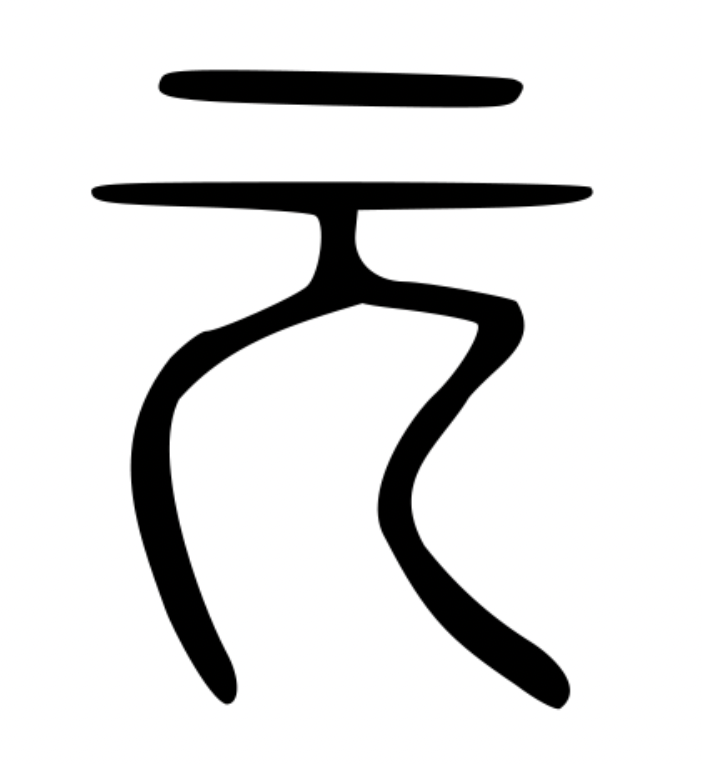
元 -Yen
亨 -Heng
利 -Li
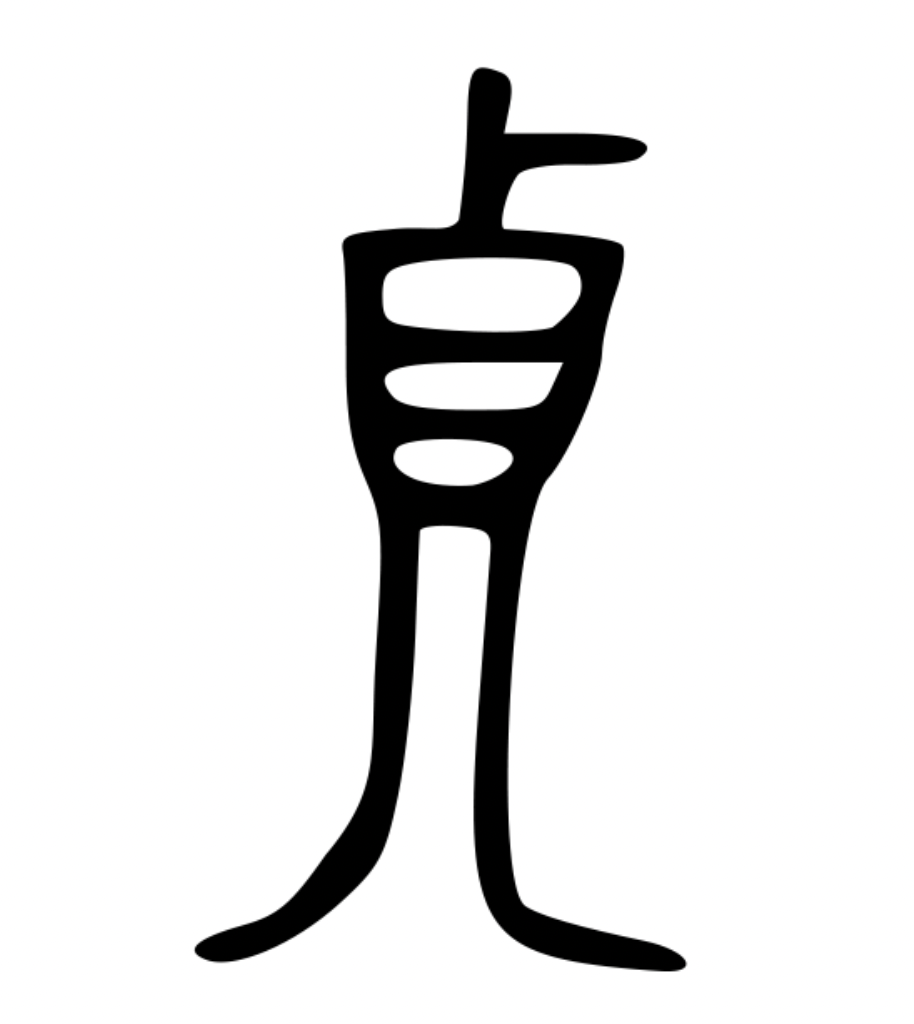
貞- Ching
元
Yen depicts a Man with a big Head.
This is often translated as some form of “Origin” or, “Generation”, etc. It is “first”, in the way that the Head of an organization is - , the Capo.

亨
Heng depicts a Child and a Shrine.
Often translated as “progress” and “prosperity”, this is the prosperity in the way that the children of God, the Sons of Heaven experience prosper. Or, progress and prosperity through child sacrifice is an equally possible understanding.

利
Li depicts wheat and a knife
It is “harvesting” and “gaining”, reaping rewards gains after sowing work.
貞
Ching, or Ding depicts a vessel.
It is purity, like the Grail.
They can mapped to the Western elements as:
Fire: Yen, Younger Yang
Water: Ching, Younger Yin
Air: Heng, Older Yang
Earth: Li, Older Yin
Film
<div style="padding:56.25% 0 0 0;position:relative;"><iframe src="https://player.vimeo.com/video/1130079853?badge=0&autopause=0&player_id=0&app_id=58479" frameborder="0" allow="autoplay; fullscreen; picture-in-picture; clipboard-write; encrypted-media; web-share" referrerpolicy="strict-origin-when-cross-origin" style="position:absolute;top:0;left:0;width:100%;height:100%;" title="George Washington Carver clip 1"></iframe></div><script src="https://player.vimeo.com/api/player.js"></script>