

The Red Coat
ALBERT ANDRÉ
Albert André is perhaps best remembered as Pierre-Auguste Renoir’s closest friend, and André was devoted to this friendship past Renoir’s death. Arriving in Paris in 1889 as an industrial designer, he began to study at the Academie Julien where he met the new class of French artists shaping the world around them. Yet he never formally joined a movement or integrated himself in the milieu until his paintings caught the eye of Renoir. Though much older than him, the two became friends quickly and Renoir served also as a mentor to the young André. When Renoir died, it was André who produced the most significant monograph and he who persevered above all else to cement his friend’s legacy. He saw in his mentor that which he struggled to find himself, a pure and true genius and he was devoted to the sharing of this. Yet André was a skilled painter in his own right, learning from Renoir but with a unique eye, his work stands alone, vibrant, moody and revelatory. He sacrificed recognition of his own in awe and admiration of his friend.
Albert André
ALBERT ANDRE, 1913. OIL ON CANVAS.
Albert André is perhaps best remembered as Pierre-Auguste Renoir’s closest friend, and André was devoted to this friendship past Renoir’s death. Arriving in Paris in 1889 as an industrial designer, he began to study at the Academie Julien where he met the new class of French artists shaping the world around them. Yet he never formally joined a movement or integrated himself in the milieu until his paintings caught the eye of Renoir. Though much older than him, the two became friends quickly and Renoir served also as a mentor to the young André. When Renoir died, it was André who produced the most significant monograph and he who persevered above all else to cement his friend’s legacy. He saw in his mentor that which he struggled to find himself, a pure and true genius and he was devoted to the sharing of this. Yet André was a skilled painter in his own right, learning from Renoir but with a unique eye, his work stands alone, vibrant, moody and revelatory. He sacrificed recognition of his own in awe and admiration of his friend.

Hardedge Line Painting
LORSER FEITELSON
In the late 50s and early 60s in California, a group of artists reacted against the gestural, painterly style of abstract expression to create a new genre known as ‘Hard-Edge Painting’. It is as the name suggests defined by abrupt transitions from one plane of colour to another, decisive and sudden with no gentle movement. At the heart of this burgeoning movement was Lorser Feitelson who distilled the abstract forms of figurative art into evocative, hypnotic, and ambiguous compositions. A working artist since 1945, Feitelson’s career reads as a microcosm of art history, moving from Cubism to surrealism, to abstraction and finally to the style that defined him and offered him the home he had been searching for, Hard-Edge painting. Feitelson was informed by the biomorphic curves of the body and of the nature around him but reduced it into simple formal elements. His work is one of geometric beauty, elegantly proportioned and sensuous in its clarity.
Lorser Feitelson
LORSER FEITELSON, 1963. ENAMEL ON CANVAS.
In the late 50s and early 60s in California, a group of artists reacted against the gestural, painterly style of abstract expression to create a new genre known as ‘Hard-Edge Painting’. It is as the name suggests defined by abrupt transitions from one plane of colour to another, decisive and sudden with no gentle movement. At the heart of this burgeoning movement was Lorser Feitelson who distilled the abstract forms of figurative art into evocative, hypnotic, and ambiguous compositions. A working artist since 1945, Feitelson’s career reads as a microcosm of art history, moving from Cubism to surrealism, to abstraction and finally to the style that defined him and offered him the home he had been searching for, Hard-Edge painting. Feitelson was informed by the biomorphic curves of the body and of the nature around him but reduced it into simple formal elements. His work is one of geometric beauty, elegantly proportioned and sensuous in its clarity.

Acrobat and Young Harlequin
PABLO PICASSO
As the circus in Montmatre, Paris, closed for the night, Picasso would stay behind and converse late into the night with the performers. They existed in these hours in a kind of netherworld, a liminal space between the cosmopolitan reality outside and the escapist spectacle that had just been. It was this bridge-like state between two worlds that drew the young Picasso to them, finding refuge, solace, and solidarity as he was navigating a similar transition. Painted at the very end of his ‘Blue Period’, characteristic by the morose subjects and blue hues, and as he began to enter his ‘Rose Period which was more optimistic and livelier and ultimately brought him his first taste of the fame and success that would follow, this work is one of ambiguity. The two performers stare out listlessly, the dimensionless background behind fades into them as they stand, with the suggestion of applause yet it brings them neither joy nor sadness – instead they exist between the two.
Pablo Picasso
PABLO PICASSO, 1905. OIL ON CANVAS.
As the circus in Montmatre, Paris, closed for the night, Picasso would stay behind and converse late into the night with the performers. They existed in these hours in a kind of netherworld, a liminal space between the cosmopolitan reality outside and the escapist spectacle that had just been. It was this bridge-like state between two worlds that drew the young Picasso to them, finding refuge, solace, and solidarity as he was navigating a similar transition. Painted at the very end of his ‘Blue Period’, characteristic by the morose subjects and blue hues, and as he began to enter his ‘Rose Period which was more optimistic and livelier and ultimately brought him his first taste of the fame and success that would follow, this work is one of ambiguity. The two performers stare out listlessly, the dimensionless background behind fades into them as they stand, with the suggestion of applause yet it brings them neither joy nor sadness – instead they exist between the two.

Self Portrait with Dishevelled Hair
REMBRANDT
Few painters documented themselves as prolifically and honestly as Rembrandt. More than 70 self-portraits are known, not including the numerous works of biblical stories where he inserted his image as a bystander, a saint, or a historical figure. He spent hours staring into a mirror, contemplating his face and the minutiae of changes different expressions produced – often using these as studies for larger works. He was, in this way, his own muse, finding inspiration for soaring works of religious significance in the lines of his mouth and the lilt of his face. Yet this work, early in his oeuvre, is something altogether different. It is not preparatory or in service of a greater work but a complete artwork in its own right. The artist is in shadows, quiet contemplation looks out from his eyes as if asking the viewer for reassurance of the painting’s quality. As Rembrandt aged, his self-portraits became more explicit, more comfortable in the bright light that revealed the intricacies of his character, yet here there exist a youthful lack of surety that retreats into the safety of darkness.
Rembrandt
REMBRANDT, 1628. OIL ON OAK WOOD.
Few painters documented themselves as prolifically and honestly as Rembrandt. More than 70 self-portraits are known, not including the numerous works of biblical stories where he inserted his image as a bystander, a saint, or a historical figure. He spent hours staring into a mirror, contemplating his face and the minutiae of changes different expressions produced – often using these as studies for larger works. He was, in this way, his own muse, finding inspiration for soaring works of religious significance in the lines of his mouth and the lilt of his face. Yet this work, early in his oeuvre, is something altogether different. It is not preparatory or in service of a greater work but a complete artwork in its own right. The artist is in shadows, quiet contemplation looks out from his eyes as if asking the viewer for reassurance of the painting’s quality. As Rembrandt aged, his self-portraits became more explicit, more comfortable in the bright light that revealed the intricacies of his character, yet here there exist a youthful lack of surety that retreats into the safety of darkness.

Pleasing Numbers
GIACOMO BALLA
While his contemporaries depicted their ideas of movement through violence, machines, and the violence of machines, Balla explored it with a lightness of touch, a sense of beauty and whimsy in the word and a pervading witticism. A leading Italian Futurist, a movement which as the name suggests was concerned with the dynamism of the hyper-modern, it’s speed, youth, automation and movement, Balla embraced the central philosophies of the movement while implicitly rejecting the sanctioned approach. He instead saw modernity as not something to be feared, not something lacking humanity in the face of machines but instead found the idiosyncrasies of the everyday experience and depicted them through the cerebral ideas of the contemporary age. In his depiction of numbers, Balla brought the warmth of the human and the beauty of imperfection to the great signifiers of rationality and objectivity. His title is revealing, by bringing mathematics into art, it not only helps the latter but makes the former pleasing, freeing them from the confines of their need for perfection.
Giacomo Balla
GIACOMO BALLA, 1919. OIL ON CANVAS.
While his contemporaries depicted their ideas of movement through violence, machines, and the violence of machines, Balla explored it with a lightness of touch, a sense of beauty and whimsy in the word and a pervading witticism. A leading Italian Futurist, a movement which as the name suggests was concerned with the dynamism of the hyper-modern, it’s speed, youth, automation and movement, Balla embraced the central philosophies of the movement while implicitly rejecting the sanctioned approach. He instead saw modernity as not something to be feared, not something lacking humanity in the face of machines but instead found the idiosyncrasies of the everyday experience and depicted them through the cerebral ideas of the contemporary age. In his depiction of numbers, Balla brought the warmth of the human and the beauty of imperfection to the great signifiers of rationality and objectivity. His title is revealing, by bringing mathematics into art, it not only helps the latter but makes the former pleasing, freeing them from the confines of their need for perfection.

The Ascension of Christ
SALVADOR DALÍ
In the 1950s, still reeling from the psychological shock of the atomic bomb and frustrated with the growing ‘I, Me, Mine’ mindset of post war individualism, Salvador DalÍ found his faith. Integrating a fascination with atomic physics with Spanish mysticism, DalÍ began to see the two schools of thought as one and the same. The atom took on a metaphysical form, representing the unity of the universe, Christ himself. We see this clearly in this most strange of religious painting, as a foreshortened Christ, seen as if from a human perspective as he rises above and away from us on the ground. His body forms a triangle representing the holy trinity and he moves towards a glowing, yellow circle, the nucleus of an enlarged atom. DalÍ plays with perspective, each element of the painting seemingly seen from a different viewpoint and as Christ ascends, he does so not into some distant nothingness or faraway heaven but towards a nearby sun, into the atom that binds all of us together as one.
Salvador Dalí
SALVADOR DALÍ, 1958. OIL ON CANVAS.
In the 1950s, still reeling from the psychological shock of the atomic bomb and frustrated with the growing ‘I, Me, Mine’ mindset of post war individualism, Salvador Dalí found his faith. Integrating a fascination with atomic physics with Spanish mysticism, Dalí began to see the two schools of thought as one and the same. The atom took on a metaphysical form, representing the unity of the universe, Christ himself. We see this clearly in this most strange of religious painting, as a foreshortened Christ, seen as if from a human perspective as he rises above and away from us on the ground. His body forms a triangle representing the holy trinity and he moves towards a glowing, yellow circle, the nucleus of an enlarged atom. Dalí plays with perspective, each element of the painting seemingly seen from a different viewpoint and as Christ ascends, he does so not into some distant nothingness or faraway heaven but towards a nearby sun, into the atom that binds all of us together as one.

I Await You
YVES TANGUY
A strange alien landscape in gradated shades of grey that offer no clear horizon, only an infinite expanse towards nothingness. On the front plane, a dense smattering of anthropomorphic objects that appear at a glance familiar reveal themselves to be wholly unknowable on inspection. Yves Tanguy met the father of Surrealism in 1925 and, a year later, wholeheartedly joined the movement, with his involvement reaching something of a culmination in this large scale canvas that meticulously depicts the impossible world of our dreams, while calling towards the desolate Brittany landscape of Tanguy’s childhood. The work was called, with typical surrealist mystery, ‘I Await You’, and three years after its completion it enraptured an American painted named Kay Savage. She arranged an introduction through a mutual friend and within a few years they began a marriage that lasted the rest of their lives. There were no coincidences in surrealism – Tanguy painted with the subconscious knowledge that someone was missing from his life and it was the painting, not him, that found her.
Yves Tanguy
YVES TANGUY, 1934. OIL ON CANVAS.
A strange alien landscape in gradated shades of grey that offer no clear horizon, only an infinite expanse towards nothingness. On the front plane, a dense smattering of anthropomorphic objects that appear at a glance familiar reveal themselves to be wholly unknowable on inspection. Yves Tanguy met the father of Surrealism in 1925 and, a year later, wholeheartedly joined the movement, with his involvement reaching something of a culmination in this large scale canvas that meticulously depicts the impossible world of our dreams, while calling towards the desolate Brittany landscape of Tanguy’s childhood. The work was called, with typical surrealist mystery, ‘I Await You’, and three years after its completion it enraptured an American painted named Kay Savage. She arranged an introduction through a mutual friend and within a few years they began a marriage that lasted the rest of their lives. There were no coincidences in surrealism – Tanguy painted with the subconscious knowledge that someone was missing from his life and it was the painting, not him, that found her.

Univers
BANG HAI JA
As a sickly child growing up in South Korea, Bang Hai Ja lay in bed and watched through the window as light danced off a stream in her grandparents garden. While other children played, she became obsessed with sunlight and how she could capture its illusive beauty through brushes and paints. When she died at the age of 85, Hai Ja was known the world over as ‘the artist of light’, and so celebrated for her depictions of light in all of its forms that the young girl looking out her window would not believe how well she accomplished her dream. Hai Ja’s dedication to light was not purely aesthetic, she understood light as the beginning and end of the everything, the first creation of the universe and to where the universe and its being will all return. This is reflected not just in the work, but in the process. Hai Ja only uses natural materials, infusing her work with the lifeblood of the universe, and begins each piece with a crumpled piece of handmade paper placed in the centre, from which the rest of the composition is built around. This is the first light, the origins of the universe, brought alive by Hai Ja again and again.
Bang Hai Ja
BANG HAI JA, 1989. NATURAL PIGMENT AND HANJI PAPER ON CANVAS.
As a sickly child growing up in South Korea, Bang Hai Ja lay in bed and watched through the window as light danced off a stream in her grandparents garden. While other children played, she became obsessed with sunlight and how she could capture its illusive beauty through brushes and paints. When she died at the age of 85, Hai Ja was known the world over as ‘the artist of light’, and so celebrated for her depictions of light in all of its forms that the young girl looking out her window would not believe how well she accomplished her dream. Hai Ja’s dedication to light was not purely aesthetic, she understood light as the beginning and end of the everything, the first creation of the universe and to where the universe and its being will all return. This is reflected not just in the work, but in the process. Hai Ja only uses natural materials, infusing her work with the lifeblood of the universe, and begins each piece with a crumpled piece of handmade paper placed in the centre, from which the rest of the composition is built around. This is the first light, the origins of the universe, brought alive by Hai Ja again and again.

Two Triangles within a Square #2
ROBERT MANGOLD
An architect’s lines against a field of colour with hues so subtle it almost becomes transparent. Robert Mangold’s work takes the simplest formal objects, the base geometric shapes, and through subtle manipulation, makes us dwell on them. Working as a security guard at the MOMA in 1962, his colleagues were Robert Ryman, Sol Lewitt, Dan Flavin and Lucy Lippard, and he began to develop his abstract language. His career has been uncompromising and certain, developing a single theme for more than 50 years in various iterations, he stands amongst a small group who have been able to sustain their position. He relies on the intuitive, and the apparent reductiveness of his paintings gives way to a complex understanding of space. Painting is, for Mangold, “the most difficult art to grasp”. “If you come into a room where there’s an installation or a sculpture, you know to walk around it, it exists in your space with you; there’s no way to kill time in front of a painting.”
Robert Mangold
ROBERT MANGOLD, 1975. ACRYLIC AND COLORED PENCIL ON CANVAS.
An architect’s lines against a field of colour with hues so subtle it almost becomes transparent. Robert Mangold’s work takes the simplest formal objects, the base geometric shapes, and through subtle manipulation, makes us dwell on them. Working as a security guard at the MOMA in 1962, his colleagues were Robert Ryman, Sol Lewitt, Dan Flavin and Lucy Lippard, and he began to develop his abstract language. His career has been uncompromising and certain, developing a single theme for more than 50 years in various iterations, he stands amongst a small group who have been able to sustain their position. He relies on the intuitive, and the apparent reductiveness of his paintings gives way to a complex understanding of space. Painting is, for Mangold, “the most difficult art to grasp”. “If you come into a room where there’s an installation or a sculpture, you know to walk around it, it exists in your space with you; there’s no way to kill time in front of a painting.”

Untitled
MILTON AVERY
At the start of his career, in the first quarter of the 20th Century, Milton Avery was overlooked for being too radical, too abstract and not figurative enough for the vogue of the day. Some 20 years later, when Abstract Expression rose to be the dominant American art movement, Milton Avery was overlooked once again for being too figurative and not abstract enough. An artist perpetually caught in the middle, he was nonetheless a hugely respected figure and a mentor and inspiration to a young Mark Rothko and Adolph Gottleib who saw a way forward through his abstracted, flat, colourful images. Avery and his wife Sally created what became known as the Avery Style, developing a color plane style of painting and color theory to go alongside, they were considered on par only with Matisse in their understanding of palettes. Today, Avery’s images feel contemporary and familiar, so influential and stolen has his style been. Yet more than 100 years, Avery was taking unknown steps into representation, striving towards a new future that was as beautiful as it was colorful.
Milton Avery
MILTON AVERY, 1954. OIL ON CANVAS.
At the start of his career, in the first quarter of the 20th Century, Milton Avery was overlooked for being too radical, too abstract and not figurative enough for the vogue of the day. Some 20 years later, when Abstract Expression rose to be the dominant American art movement, Milton Avery was overlooked once again for being too figurative and not abstract enough. An artist perpetually caught in the middle, he was nonetheless a hugely respected figure and a mentor and inspiration to a young Mark Rothko and Adolph Gottleib who saw a way forward through his abstracted, flat, colourful images. Avery and his wife Sally created what became known as the Avery Style, developing a color plane style of painting and color theory to go alongside, they were considered on par only with Matisse in their understanding of palettes. Today, Avery’s images feel contemporary and familiar, so influential and stolen has his style been. Yet more than 100 years, Avery was taking unknown steps into representation, striving towards a new future that was as beautiful as it was colorful.

Monte Carlo Bond
MARCEL DUCHAMP
Part joke, part conceptual artwork, part legally binding financial document, the Monte Carlo Bonds capture so much of what was brilliant, chaotic and confounding about the great Marcel Duchamp. Having once again tried to abandon his calling as an artist, Duchamp spent night after night in the Monte Carlo Casino in Monaco, devising what he thought was a perfect system for roulette involving increasingly intricate dice rolls to decide the numbers to bet on. It was slow, economical and, he said, played over enough time tipped the odds to give him a slight edge over the house, guaranteeing eventual profit. Yet the process was slow using Duchamp’s capital and so he looked outwards, offering friends the chance to buy into his scheme if only they would front him the money. Those that did, received these bonds in return, which entitled them to profit shares after every 100,000th roll on the wheel. Even in his attempted rejection of art, Duchamp made the world conceptual and beautiful.
Marcel Duchamp
MARCEL DUCHAMP, 1924. PHOTO-COLLAGE ON LETTERPRESS.
Part joke, part conceptual artwork, part legally binding financial document, the Monte Carlo Bonds capture so much of what was brilliant, chaotic and confounding about the great Marcel Duchamp. Having once again tried to abandon his calling as an artist, Duchamp spent night after night in the Monte Carlo Casino in Monaco, devising what he thought was a perfect system for roulette involving increasingly intricate dice rolls to decide the numbers to bet on. It was slow, economical and, he said, played over enough time tipped the odds to give him a slight edge over the house, guaranteeing eventual profit. Yet the process was slow using Duchamp’s capital and so he looked outwards, offering friends the chance to buy into his scheme if only they would front him the money. Those that did, received these bonds in return, which entitled them to profit shares after every 100,000th roll on the wheel. Even in his attempted rejection of art, Duchamp made the world conceptual and beautiful.

Supper at Emmaus
CARAVAGGIO
In domesticity, holiness can appear. The sublime enters daily life and interrupts routine, and we may not recognise it without being told. Such is the story of the resurrected Jesus appearing in the town of Emmaus that the great Renaissance master Caravaggio depicts here. Two disciples, Luke and Cleophas, and an innkeeper are having dinner when Christ appears in a different form, here represented as without his beard, and joins them. They do not recognise him at first, and it is only when he has broken bread to they realise that they are in the presence of their teacher and the Son of God, risen from the dead. Just as soon as they do, he vanishes before their eyes and is not seen again. Caravaggio paints this moment of realisation, the two men in awe while the innkeeper looks on, seemingly oblivious to their moment of clarity. The painting does not emphasise holiness, Christ’s glory is unexalted, he is but a man, though more delicate and pure than the rugged disciples either side of him. This is the height of Jesus’ humanity, so at one with the mortal that he is able to join them for dinner as an equal and Caravaggio urges us not to ignore where the glory of god may appear in our daily, domestic lives.
CARAVAGGIO
CARAVAGGIO, 1601. OIL ON CANVAS
In domesticity, holiness can appear. The sublime enters daily life and interrupts routine, and we may not recognise it without being told. Such is the story of the resurrected Jesus appearing in the town of Emmaus that the great Renaissance master Caravaggio depicts here. Two disciples, Luke and Cleophas, and an innkeeper are having dinner when Christ appears in a different form, here represented as without his beard, and joins them. They do not recognise him at first, and it is only when he has broken bread to they realise that they are in the presence of their teacher and the Son of God, risen from the dead. Just as soon as they do, he vanishes before their eyes and is not seen again. Caravaggio paints this moment of realisation, the two men in awe while the innkeeper looks on, seemingly oblivious to their moment of clarity. The painting does not emphasise holiness, Christ’s glory is unexalted, he is but a man, though more delicate and pure than the rugged disciples either side of him. This is the height of Jesus’ humanity, so at one with the mortal that he is able to join them for dinner as an equal and Caravaggio urges us not to ignore where the glory of god may appear in our daily, domestic lives.
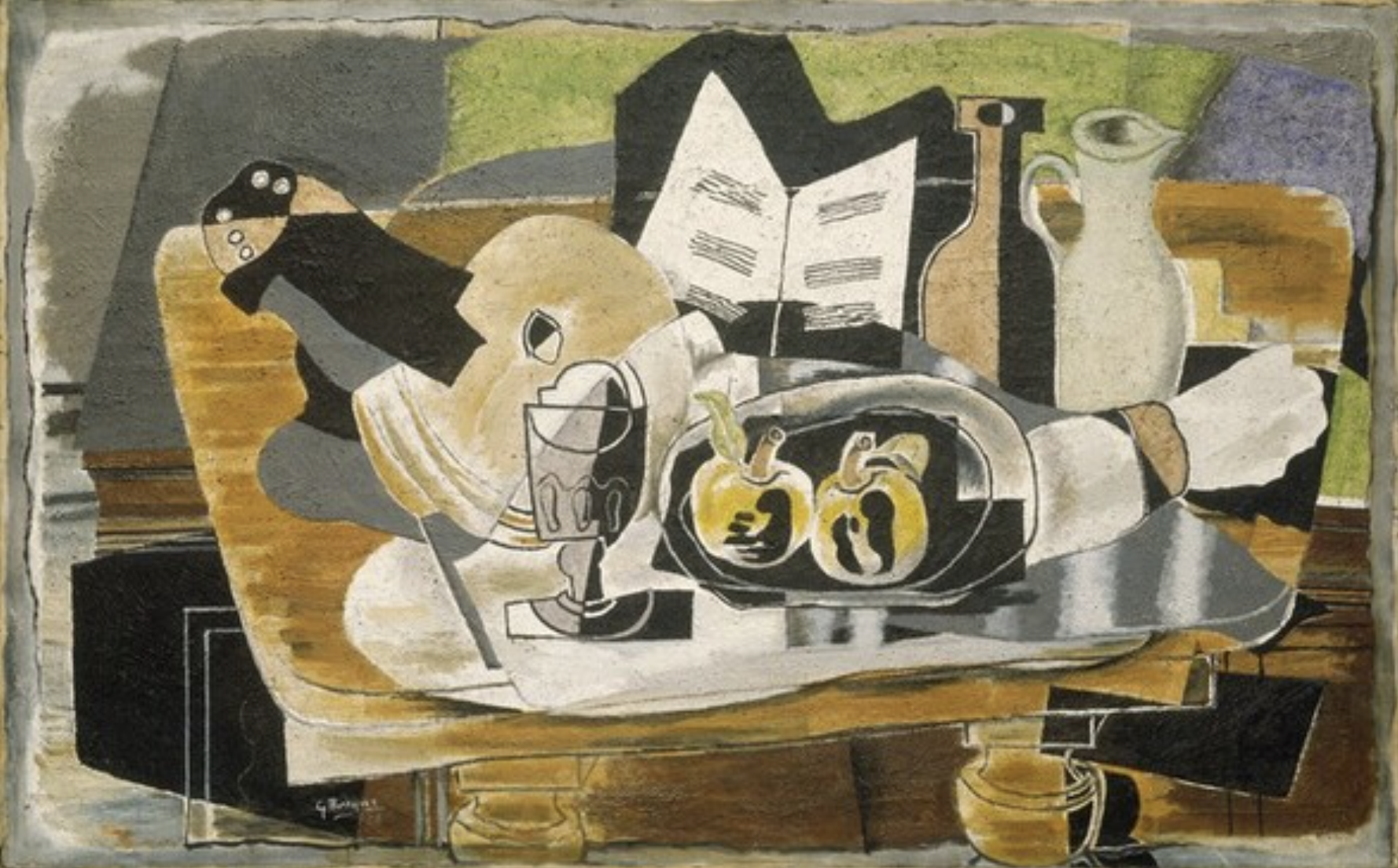
Still Life: The Table
GEORGES BRAQUE
To upend art history, you have to be committed to its traditions. For Georges Braque and Pablo Picasso, who together created the visual vocabulary of modernity, this tradition began and would be dismantled with the ‘Still Life’. Using the motifs, objects and arrangements that have pervaded painted works for centuries, they disorientate the viewer while giving just enough context and knowledge to ground them. To look at Braque’s work today is to see it fitting neatly within the very art history he sought to topple, but this still life was a radical work. We are given the base of a table, its legs strangely foreshortened but it places us within a known entity. So too, the objects are familiar iconography – fruit, a guitar, a stoneware jug, music sheets and others. Yet each object has it’s own perspective, it does not conform within a singular vision but instead shows a world of multiplicity. Braque’s table could be viewed from infinite angles and still the objects upon it would never unify.
Georges Braque
GEORGES BRAQUE, 1928. OIL ON CANVAS.
To upend art history, you have to be committed to its traditions. For Georges Braque and Pablo Picasso, who together created the visual vocabulary of modernity, this tradition began and would be dismantled with the ‘Still Life’. Using the motifs, objects and arrangements that have pervaded painted works for centuries, they disorientate the viewer while giving just enough context and knowledge to ground them. To look at Braque’s work today is to see it fitting neatly within the very art history he sought to topple, but this still life was a radical work. We are given the base of a table, its legs strangely foreshortened but it places us within a known entity. So too, the objects are familiar iconography – fruit, a guitar, a stoneware jug, music sheets and others. Yet each object has it’s own perspective, it does not conform within a singular vision but instead shows a world of multiplicity. Braque’s table could be viewed from infinite angles and still the objects upon it would never unify.

Vase with Flowers
PIERRE BONNARD
Art was Pierre Bonnard’s only option. After failing his entry examination to practice law, he fell in with a group of disparate but commonly ambitious young artists who soon became known as the Nabis. They were unified by a common idea – that a work of art was not about a depiction of nature but rather a synthesis of metaphors and symbols into a unified aesthetic work. Their name derived from the Hebrew term for prophet, as this group of radical young creatives were, even in their contemporary age, ushering in a new way of understanding. Bonnard was the greatest of the Nabis, a prophet among prophets who unified a love of Japanese art, graphic illustration and Gaugin’s paintings into works of decadent, detailed, simple beauty.
<div id="elevenlabs-audionative-widget" data-height="90" data-width="100%" data-frameborder="no" data-scrolling="no" data-publicuserid="835854e5e03b7daab051fcfebb2e32c4c7b8d5d50d221235e6ba4c44a7a554fd" data-playerurl="https://elevenlabs.io/player/index.html" data-projectid="lttXFQznAow4FK1cvNXV" >Loading the <a href="https://elevenlabs.io/text-to-speech" target="_blank" rel="noopener">Elevenlabs Text to Speech</a> AudioNative Player...</div><script src="https://elevenlabs.io/player/audioNativeHelper.js" type="text/javascript"></script>
Pierre Bonnard
PIERRE BONNARD, 1920. OIL ON CANVAS.
Art was Pierre Bonnard’s only option. After failing his entry examination to practice law, he fell in with a group of disparate but commonly ambitious young artists who soon became known as the Nabis. They were unified by a common idea – that a work of art was not about a depiction of nature but rather a synthesis of metaphors and symbols into a unified aesthetic work. Their name derived from the Hebrew term for prophet, as this group of radical young creatives were, even in their contemporary age, ushering in a new way of understanding. Bonnard was the greatest of the Nabis, a prophet among prophets who unified a love of Japanese art, graphic illustration and Gaugin’s paintings into works of decadent, detailed, simple beauty.

Jean Cocteau
BERNARD BUFFET
In the 1950s, Bernard Buffet was one of the most famous artists in the world. Talked about in the same breath as Picasso, at the age of 21 he was a star of Post-War Paris with a prolific output of paintings and solo shows every year. Buffet was known as a ‘Miserabilist’, an art movement of just one that was characterised by his long faced subjects, thick, impassioned black lines, palette of grays, and often bleak subject matter. He was internationally famous, escaping the confines of the art world to become a known entity to the general public who caused stampedes with each new exhibitions and work that adorned magazines, albums, plastic bags, postage stamps, and posters. Yet as his fame rose, so did his wealth and he began to live a wildly decadent life complete with a chauffeured Rolls-Royce and a castle in the countryside. His life seemed to be at odds with the style and subjects of his paintings, and as images of this decadence became proliferated, the public turned against Buffet. By the late 1960s, he was but a footnote in art history, though to look at his paintings now is to still see the same power, intensity, and misery that was the cause for so much celebration in the post-war years.
Bernard Buffet
BERNARD BUFFET, 1955. OIL ON CANVAS.
In the 1950s, Bernard Buffet was one of the most famous artists in the world. Talked about in the same breath as Picasso, at the age of 21 he was a star of Post-War Paris with a prolific output of paintings and solo shows every year. Buffet was known as a ‘Miserabilist’, an art movement of just one that was characterised by his long faced subjects, thick, impassioned black lines, palette of grays, and often bleak subject matter. He was internationally famous, escaping the confines of the art world to become a known entity to the general public who caused stampedes with each new exhibitions and work that adorned magazines, albums, plastic bags, postage stamps, and posters. Yet as his fame rose, so did his wealth and he began to live a wildly decadent life complete with a chauffeured Rolls-Royce and a castle in the countryside. His life seemed to be at odds with the style and subjects of his paintings, and as images of this decadence became proliferated, the public turned against Buffet. By the late 1960s, he was but a footnote in art history, though to look at his paintings now is to still see the same power, intensity, and misery that was the cause for so much celebration in the post-war years.

Jeanne Lanvin
ÉDOUARD VUILLARD
Vuillard was a Nabi. A member of the semi-secret, semi-mystic group of artists who met at apartments and coffee shops in the late 1800s, plotting a revolution of art by stripping it down to its most base elements. Yet Vuillard’s ambitions and influences could not be contained, and when the group splintered and split up at the turn of the century, he found a new freedom of expression. Integrating a love of Japanese art, theatre and set design and decorative arts, he returned to interior scenes he had painted as a Nabi with a newfound vigour. Vuillard matches his subject with their surroundings, spending more time in the exterior world around them than on the subject themselves. Here, the fashion designer Jeanne Lanvin exists in exquisite harmony with the room, each object, detail, brushstroke of the interiors reveals something of Lanvin’s interior life.
Edouard Vuillard
EDOUARD VUILLARD, 1933. DISTEMPER ON CANVAS.
Vuillard was a Nabi. A member of the semi-secret, semi-mystic group of artists who met at apartments and coffee shops in the late 1800s, plotting a revolution of art by stripping it down to its most base elements. Yet Vuillard’s ambitions and influences could not be contained, and when the group splintered and split up at the turn of the century, he found a new freedom of expression. Integrating a love of Japanese art, theatre and set design and decorative arts, he returned to interior scenes he had painted as a Nabi with a newfound vigour. Vuillard matches his subject with their surroundings, spending more time in the exterior world around them than on the subject themselves. Here, the fashion designer Jeanne Lanvin exists in exquisite harmony with the room, each object, detail, brushstroke of the interiors reveals something of Lanvin’s interior life.

La Poésie Est Comme Lui. Voila Haviland
FRANCIS PICABIA
Dada was raging, the machines were taking over, and Francis Picabia was amongst the most celebrated artists in the world. Automation, industrialization and war were in the air, and the avant-garde responded with the embrace of nonsense. In precarious times, why pay any attention to logic, reason, or the accepted philosophies of the day when they had led to nothing but pain and strife? It was in this epoch that Picabia began his ‘mechanical drawings’, inspired equally by the machine like works of Duchamp as he was by the military illustrations of weaponry, he drew works of aesthetic rigidity, seemingly educational at first glance, but which fell apart into surreal irrationality with any close inspection. This work is from a series of portraits depicting his friends as various mechanical objects. Here, the photographer and critic Paul Haviland is shown as a desk lamp, disconnected from his power source as he left New York to look after his father. The translation of Picabia’s fittingly absurd title is simple: ‘Poetry is like him. Here is Haviland’
Francis Picabia
FRANCIS PICABIA, 1915. MIXED MEDIA ON BOARD.
Dada was raging, the machines were taking over, and Francis Picabia was amongst the most celebrated artists in the world. Automation, industrialization and war were in the air, and the avant-garde responded with the embrace of nonsense. In precarious times, why pay any attention to logic, reason, or the accepted philosophies of the day when they had led to nothing but pain and strife? It was in this epoch that Picabia began his ‘mechanical drawings’, inspired equally by the machine like works of Duchamp as he was by the military illustrations of weaponry, he drew works of aesthetic rigidity, seemingly educational at first glance, but which fell apart into surreal irrationality with any close inspection. This work is from a series of portraits depicting his friends as various mechanical objects. Here, the photographer and critic Paul Haviland is shown as a desk lamp, disconnected from his power source as he left New York to look after his father. The translation of Picabia’s fittingly absurd title is simple: ‘Poetry is like him. Here is Haviland’

Untitled
ETEL ADNAN
“ Every painting by [Paul] Klee”, Annan once said of her artistic hero and early influence, “is like an act of discovery, achieved through a process of exploration, like a boat in the ocean.” To look at her work is to see much the same process - a compositional world rife with color and figuration that seems to morph and change before our very eyes. Centered with a sun like mass, simple forms in rudimentary but perfectly balanced color move around it, offering interpretations of landscape but not requiring such formal or prescriptive description. It is unsurprising, not just in looking at Adnan’s paintings, to see a kinship between herself and Paul Klee, one of the great geniuses of early 20th century modernism. Like Klee, Adnan cannot be defined simply by one practice, and does not want to be. She is considered one of the most important and certainly most celebrated Arab writers of the modern age. As a poet, essayist, and journalist, Adnan pushes the written word to bold, unusual, tender, and exciting spaces - writing on myriad topics yet finding such lyrical life in all of them. Her visual art, like Klee’s, should not be seen or understood differently, simply as a different medium to express consistent ideas and questions; her brilliance can not be bound to simply paper or canvas alone, and throughout her life she let it find its home wherever it sought refuge.
Etel Adnan
ETEL ADNAN, 2010. OIL ON CANVAS.
“ Every painting by [Paul] Klee”, Annan once said of her artistic hero and early influence, “is like an act of discovery, achieved through a process of exploration, like a boat in the ocean.” To look at her work is to see much the same process - a compositional world rife with color and figuration that seems to morph and change before our very eyes. Centered with a sun like mass, simple forms in rudimentary but perfectly balanced color move around it, offering interpretations of landscape but not requiring such formal or prescriptive description. It is unsurprising, not just in looking at Adnan’s paintings, to see a kinship between herself and Paul Klee, one of the great geniuses of early 20th century modernism. Like Klee, Adnan cannot be defined simply by one practice, and does not want to be. She is considered one of the most important and certainly most celebrated Arab writers of the modern age. As a poet, essayist, and journalist, Adnan pushes the written word to bold, unusual, tender, and exciting spaces - writing on myriad topics yet finding such lyrical life in all of them. Her visual art, like Klee’s, should not be seen or understood differently, simply as a different medium to express consistent ideas and questions; her brilliance can not be bound to simply paper or canvas alone, and throughout her life she let it find its home wherever it sought refuge.
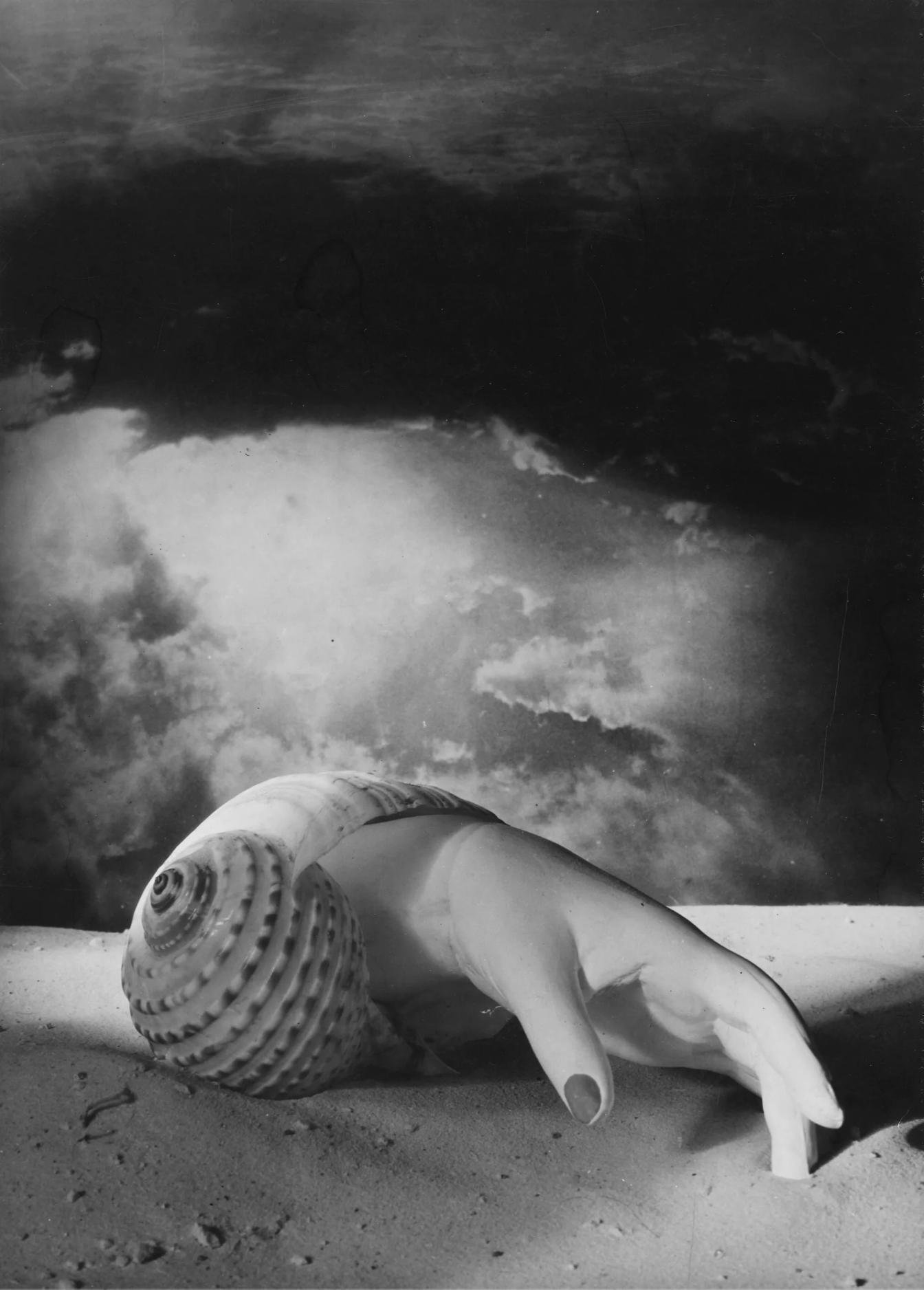
Untitled (Hand-Shell)
DORA MAAR
In the public imagination, Dora Maar is perhaps most readily known as Picasso’s great lover and the subject of Weeping Woman, amongst his most important and famous works. Yet this understanding is grounded in so much historical misogyny, and the constant erasure and redefinition of female artists as muses for their male counterparts. Maar was seismic and seminal in her own right, one of the most important photographers in the mediums burgeoning days, and a pioneering image maker across the camera and brush. Studying painting and photography at one of Paris’ most progressive art schools in the 1920s, she quickly began creating remarkable works, combining her images into surreal photomontages and staging eerie, uncanny scenes. She was commissioned by fashion brands, advertisers, and galleries to construct her strange worlds that seemed to blend dreams and reality, with a level of subconscious eroticism throughout them all. Alongside this, she worked as a street photographer, documenting the increasing poverty in Europe with a fast action Rollei-Flex, which she would in turn sometimes use in her collages. Maar has, in recent years, reclaimed her place as a pioneering and foundation figure of surrealism, and a leader of early centuries’ photography movement, on par with Man Ray.
Dora Maar
DORA MAAR, 1934. GELATIN SILVER PRINT.
In the public imagination, Dora Maar is perhaps most readily known as Picasso’s great lover and the subject of Weeping Woman, amongst his most important and famous works. Yet this understanding is grounded in so much historical misogyny, and the constant erasure and redefinition of female artists as muses for their male counterparts. Maar was seismic and seminal in her own right, one of the most important photographers in the mediums burgeoning days, and a pioneering image maker across the camera and brush. Studying painting and photography at one of Paris’ most progressive art schools in the 1920s, she quickly began creating remarkable works, combining her images into surreal photomontages and staging eerie, uncanny scenes. She was commissioned by fashion brands, advertisers, and galleries to construct her strange worlds that seemed to blend dreams and reality, with a level of subconscious eroticism throughout them all. Alongside this, she worked as a street photographer, documenting the increasing poverty in Europe with a fast action Rollei-Flex, which she would in turn sometimes use in her collages. Maar has, in recent years, reclaimed her place as a pioneering and foundation figure of surrealism, and a leader of early centuries’ photography movement, on par with Man Ray.

Tänzerin
JEAN ARP
An animalistic figure, at once grotesque and elegant with flowing blue hair, a sprawling bust, and strange heeled legs dances across a golden plain. After some years away from the Dada movement, of which he had been a founding member, Tänzenir is a sort of reconnection with the humour and irony that defined the group. It is playful and surreal, defying our expectations of how a dancer should be represented - the figure is not graceful in a classic sense, their body seems to escape its confines at each turn and the bright primary colors of their form add a playful, childlike energy to the movements. Arp’s wife, Sophie Tauber-Arp, was herself a great artist and also a dancer and this ethereal evocation can be understood as a representation of her modernist choreography, making this a surreal, humorousness portrait of a wife by her husband.
Jean Arp
JEAN ARP, 1925. OIL ON CUT AND GLUED WOOD.
An animalistic figure, at once grotesque and elegant with flowing blue hair, a sprawling bust, and strange heeled legs dances across a golden plain. After some years away from the Dada movement, of which he had been a founding member, Tänzenir is a sort of reconnection with the humour and irony that defined the group. It is playful and surreal, defying our expectations of how a dancer should be represented - the figure is not graceful in a classic sense, their body seems to escape its confines at each turn and the bright primary colors of their form add a playful, childlike energy to the movements. Arp’s wife, Sophie Tauber-Arp, was herself a great artist and also a dancer and this ethereal evocation can be understood as a representation of her modernist choreography, making this a surreal, humorousness portrait of a wife by her husband.