

Portrait of a Lady
ROGIER VAN DER WEYDEN
A portrait hides elegant geometry. Rogier van der Weyden was breaking from the traditional norms across multiple planes. He rejected the Western Renaissance’s attempt to create idealised figures, instead focusing on naturalistic depictions of his subjects. Their imperfection is their beauty, and he attempted to capture his sitters as he saw them, emphasising their features with dramatic lighting that creates an almost gothic realism. Yet if you un-focus your eyes, the work becomes a study of mathematics. The rectangles of her veil, the triangle of her neckline and sharp angles of her face turn the sitter into a figure of profound compositional simplicity. Van der Weyden’s portrait of an unnamed woman has become amongst the most famous and revered portraits in history. It’s power lies in it’s remarkable austerity, capturing a moment of emotion told in the lines and sight of a face.
<div id="elevenlabs-audionative-widget" data-height="90" data-width="100%" data-frameborder="no" data-scrolling="no" data-publicuserid="835854e5e03b7daab051fcfebb2e32c4c7b8d5d50d221235e6ba4c44a7a554fd" data-playerurl="https://elevenlabs.io/player/index.html" data-projectid="lttXFQznAow4FK1cvNXV" >Loading the <a href="https://elevenlabs.io/text-to-speech" target="_blank" rel="noopener">Elevenlabs Text to Speech</a> AudioNative Player...</div><script src="https://elevenlabs.io/player/audioNativeHelper.js" type="text/javascript"></script>
Rogier van der Weyden
ROGIER VAN DER WEYDEN, c.1460. OIL ON OAK PANEL.
A portrait hides elegant geometry. Rogier van der Weyden was breaking from the traditional norms across multiple planes. He rejected the Western Renaissance’s attempt to create idealised figures, instead focusing on naturalistic depictions of his subjects. Their imperfection is their beauty, and he attempted to capture his sitters as he saw them, emphasising their features with dramatic lighting that creates an almost gothic realism. Yet if you un-focus your eyes, the work becomes a study of mathematics. The rectangles of her veil, the triangle of her neckline and sharp angles of her face turn the sitter into a figure of profound compositional simplicity. Van der Weyden’s portrait of an unnamed woman has become amongst the most famous and revered portraits in history. It’s power lies in it’s remarkable austerity, capturing a moment of emotion told in the lines and sight of a face.

Segments
JOSEF ALBERS
When the Bauhaus closed in 1933 under the order of the Nazi party, Josef and Anni Albers fled Germany to America where they became the first permanent faculty at the Black Mountain College. A radical centre for artistic education that became a breeding ground for so many of the figures who defined American modernity, the Albers were a central part of the cultural and creative ecosystem. Both in Germany, and in America, Josef Albers primary concern was color, and his ‘Homage to a Square’ series was produced throughout his life and laid the foundation for contemporary color theory. Yet coming to rural North Carolina from the flatlands of Weimar seemed to open up a new geometric, formal interest in Albers. As illustrated with this print, made just a year after his arrival, he explores how organic curves and gentle forms play with sharp, rigid lines. Produced in monochrome, this is a work uninterested in color and fascinated with shape, a work that represents new possibilities in the face of such devastation.
Josef Albers
JOSEF ALBERS, 1934. LINOCUT PRINT ON JAPANESE PAPER.
When the Bauhaus closed in 1933 under the order of the Nazi party, Josef and Anni Albers fled Germany to America where they became the first permanent faculty at the Black Mountain College. A radical centre for artistic education that became a breeding ground for so many of the figures who defined American modernity, the Albers were a central part of the cultural and creative ecosystem. Both in Germany, and in America, Josef Albers primary concern was color, and his ‘Homage to a Square’ series was produced throughout his life and laid the foundation for contemporary color theory. Yet coming to rural North Carolina from the flatlands of Weimar seemed to open up a new geometric, formal interest in Albers. As illustrated with this print, made just a year after his arrival, he explores how organic curves and gentle forms play with sharp, rigid lines. Produced in monochrome, this is a work uninterested in color and fascinated with shape, a work that represents new possibilities in the face of such devastation.

Cold Mountain 6 (Bridge)
BRICE MARDEN
Inspired by the poems of Hanshan, a 9th Century Chinese poet who lived in willing exile in the mountains where he wrote his poems on rocks, trees and cave walls, Marden created 6 large scale works. Hanshan’s poems are immensely spirituality in the Taoist and Zen traditions, and Marden’s work are implicitly informed by this. Bridging a gap between the real and the imagined, the formal and the abstract, the natural and the unnatural, Cold Mountain 6 is about the in-between space where peace lives. He painted the canvases from the bottom to top and left to write, so as to mirror the Chinese writing system and in this way the painting can be seen also as calligraphic abstractions. What is left behind when we remove meaning from beauty?
Brice Marden
BRICE MARDEN, 1991. OIL ON LINEN.
Inspired by the poems of Hanshan, a 9th Century Chinese poet who lived in willing exile in the mountains where he wrote his poems on rocks, trees and cave walls, Marden created 6 large scale works. Hanshan’s poems are immensely spirituality in the Taoist and Zen traditions, and Marden’s work are implicitly informed by this. Bridging a gap between the real and the imagined, the formal and the abstract, the natural and the unnatural, Cold Mountain 6 is about the in-between space where peace lives. He painted the canvases from the bottom to top and left to write, so as to mirror the Chinese writing system and in this way the painting can be seen also as calligraphic abstractions. What is left behind when we remove meaning from beauty?
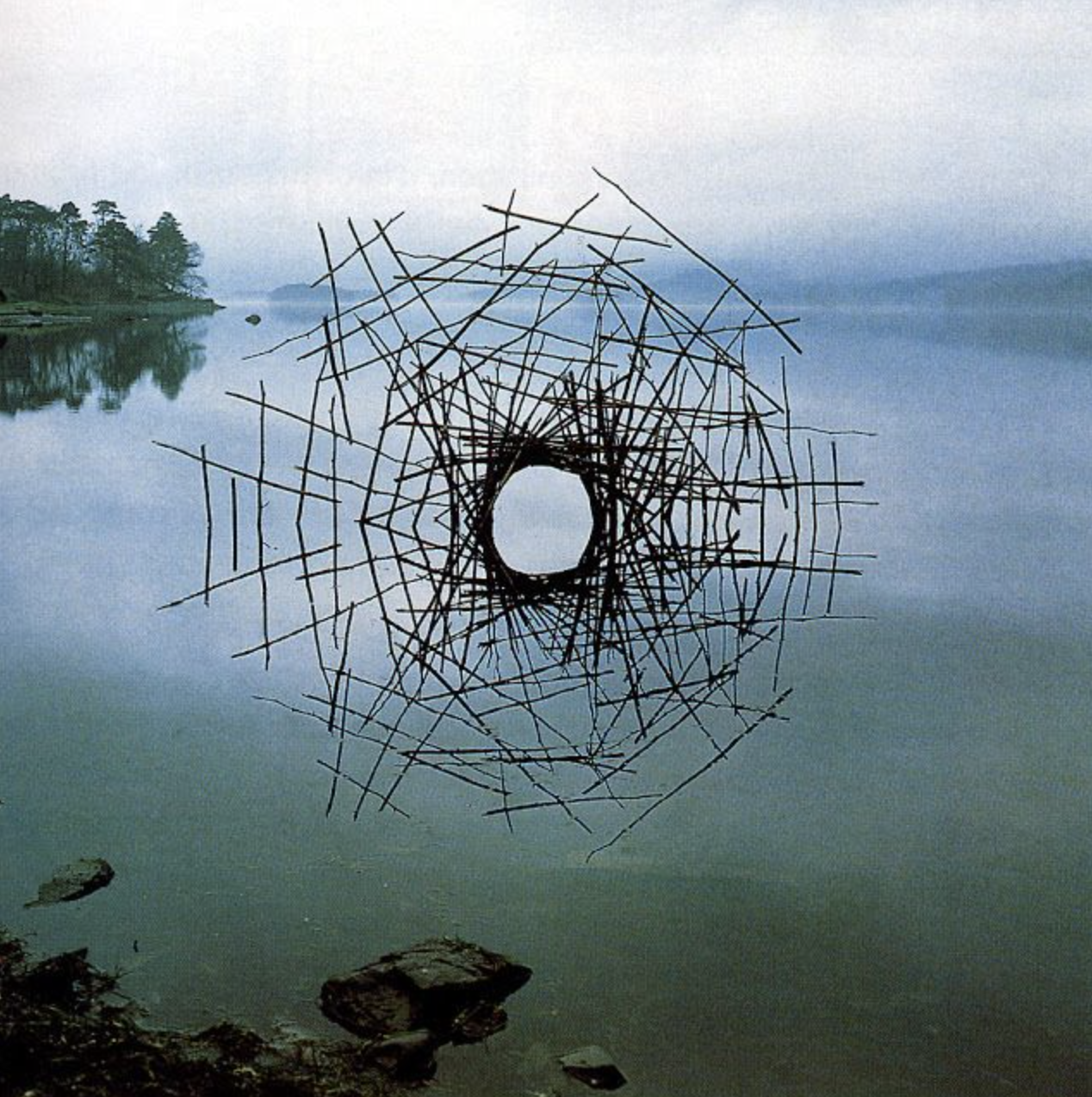
Sticks Framing A Lake
ANDY GOLDSWORTHY
Goldsworthy is not monumental; he is but a vehicle to amplify the world he loves. Small, subtle interventions in the landscape are the root of his practice. Sculptures that last as long as nature dictates, piles of leaves painstakingly organised are dispersed with the wind and formations of sticks live at the will of the tides. In their brief moments of life, Goldsworthy’s works are exemplars of staggering beauty, but this beauty can only exist if we accept that they are transient. Nature is Goldsworthy’s collaborator and his teacher. “I take the opportunities each day offers”, he says, “if it is snowing, I work with snow, at leaf-fall it will be with leaves; a blown-over tree becomes a source of twigs and branches. I stop at a place or pick up a material because I feel that there is something to be discovered. Here is where I can learn.”
Andy Goldsworthy
ANDY GOLDSWORTHY, 1986. FOUND STICKS.
Goldsworthy is not monumental; he is but a vehicle to amplify the world he loves. Small, subtle interventions in the landscape are the root of his practice. Sculptures that last as long as nature dictates, piles of leaves painstakingly organised are dispersed with the wind and formations of sticks live at the will of the tides. In their brief moments of life, Goldsworthy’s works are exemplars of staggering beauty, but this beauty can only exist if we accept that they are transient. Nature is Goldsworthy’s collaborator and his teacher. “I take the opportunities each day offers”, he says, “if it is snowing, I work with snow, at leaf-fall it will be with leaves; a blown-over tree becomes a source of twigs and branches. I stop at a place or pick up a material because I feel that there is something to be discovered. Here is where I can learn.”

The Angelus
JEAN-FRANÇOIS MILLET
The Angelus took on spiritual and religious significance far beyond its painter’s intentions. It spawned a patriotic fervour when it nearly left France, inspired a madman to attack it with a knife, became an obsession of Salvador Dali, spawned an artistic revolution that informed Van Gogh, Matisse, Seurat and Cezanne and is well regarded as one of the greatest religious works of all time. All of this for a work of tranquil reverence, made from nostalgia Millet felt towards his grandmother. It depicts two labourers, upon hearing the church bell toll for the end of the day, in quiet prayer. Millet did not paint it as a religious work, yet he captured the essence of faith, of the serenity of devotion across society. It is not grand nor biblical, but honest and humble, truer to religious values that so many works of splendour. The significance of The Angelus comes from its depiction of the seemingly insignificant.
Jean-François Millet
JEAN-FRANÇOIS MILLET, 1859. OIL ON CANVAS.
The Angelus took on spiritual and religious significance far beyond its painter’s intentions. It spawned a patriotic fervour when it nearly left France, inspired a madman to attack it with a knife, became an obsession of Salvador Dali, spawned an artistic revolution that informed Van Gogh, Matisse, Seurat and Cezanne and is well regarded as one of the greatest religious works of all time. All of this for a work of tranquil reverence, made from nostalgia Millet felt towards his grandmother. It depicts two labourers, upon hearing the church bell toll for the end of the day, in quiet prayer. Millet did not paint it as a religious work, yet he captured the essence of faith, of the serenity of devotion across society. It is not grand nor biblical, but honest and humble, truer to religious values that so many works of splendour. The significance of The Angelus comes from its depiction of the seemingly insignificant.

House Behind Trees
GEORGES BRAQUE
Under the strong light of Southern France, Georges Braque started a brief and important affair with Fauvism. He joined the movement late and left early, the whole relationship lasting less than a year and few works resulting from it. Within a year of this work, together with Picasso, Braque would lay the foundations of Cubism, bring sharp geometry and simultaneous perspective to a more subdued colour palette, but it was his time in southern France as temporary Fauvist that allowed this revolution to happen. Braque painted most of his Fauvist works in the fishing villages of La Ciotat and l’Estaque, favourites of Paul Cézanne. Under the shadow of Cézanne’s legacy, Braque drew the ordinary ahead of him and imbued it with magic. Cubism was, for Braque, purely an extension of the ideas Cézanne had started a half-century before, and Braque’s affair with Fauvism was, more than anything, an affair with the spirit of Cézanne who guided him to stranger, more powerful things.
Georges Braque
GEORGES BRAQUE, 1906-7. OIL ON CANVAS.
Under the strong light of Southern France, Georges Braque started a brief and important affair with Fauvism. He joined the movement late and left early, the whole relationship lasting less than a year and few works resulting from it. Within a year of this work, together with Picasso, Braque would lay the foundations of Cubism, bring sharp geometry and simultaneous perspective to a more subdued colour palette, but it was his time in southern France as temporary Fauvist that allowed this revolution to happen. Braque painted most of his Fauvist works in the fishing villages of La Ciotat and l’Estaque, favourites of Paul Cézanne. Under the shadow of Cézanne’s legacy, Braque drew the ordinary ahead of him and imbued it with magic. Cubism was, for Braque, purely an extension of the ideas Cézanne had started a half-century before, and Braque’s affair with Fauvism was, more than anything, an affair with the spirit of Cézanne who guided him to stranger, more powerful things.

Kitchen Scene, Yellow House
BILL TRAYLOR
Bill Traylor was born into slavery in rural Alabama in the mid 1950s. He spent most of life after emancipation working as a sharecropper until he moved, in 1939, to Montgomery and at the age of 85 took up a pencil and scraps of cardboard and began to document his past. Drawing on street corners and selling his wares to passers-by, over the next 3 years he produced nearly 1,500 pieces of art. Like so many outsider artists, Traylor could have remained unknown, and despite having a solo show in 1940, it was not until the late 1970s, some 30 years after his death, that his work began to receive wide attention. Today, Traylor is considered one of the most important 20th century artists in American history, and a leader in the folk art movement. Traylor’s works are unflinching in their depiction of the brutality of his life and American history, yet as works of a self-taught artist, their naivety is able to express raw emotion quite unlike more technical works. Traylor’s works are the only substantial collection of artworks created by someone born into slavery and they serve as a testament to perseverance and a poignant reflection of his country’s history.
Bill Traylor
BILL TRAYLOR, c.1942. PENCIL AND COLORED PENCIL ON CARDBOARD
Bill Traylor was born into slavery in rural Alabama in the mid 1950s. He spent most of life after emancipation working as a sharecropper until he moved, in 1939, to Montgomery and at the age of 85 took up a pencil and scraps of cardboard and began to document his past. Drawing on street corners and selling his wares to passers-by, over the next 3 years he produced nearly 1,500 pieces of art. Like so many outsider artists, Traylor could have remained unknown, and despite having a solo show in 1940, it was not until the late 1970s, some 30 years after his death, that his work began to receive wide attention. Today, Traylor is considered one of the most important 20th century artists in American history, and a leader in the folk art movement. Traylor’s works are unflinching in their depiction of the brutality of his life and American history, yet as works of a self-taught artist, their naivety is able to express raw emotion quite unlike more technical works. Traylor’s works are the only substantial collection of artworks created by someone born into slavery and they serve as a testament to perseverance and a poignant reflection of his country’s history.

Untitled (Bolsena)
CY TWOMBLY
In a lonely farmhouse, just north of Rome, the world changed around Cy Twombly. An artist who had always dealt with the ancients, an artist of myths and antiquity, of the twin forces of Dionysus’ chaos and Apollo’s order, was thrust into modernity when a Rocketship took three men to the moon. The Bolsena series was painted in the shadow of the Apollo mission, the very name almost a challenge to the artist to update his ancient associations. In these works, he embraces the rationality and order of the God Apollo to deal with contemporary events, a rare instance in his artistic career. Thoughts of space and science, of numbers, calculations and ascension filled his mind as he worked, after a summer spent closely watching the news of the mission. Twombly translated his primal mark making style into something that could speak to its opposite, to an undisputed mark of progressed civilization. His work becomes almost diagrammatic, the lyricism of his fluid style seem like calculations, the diagonal arc capturing a sense of the rocket’s movement across the sky. The painting exists in a tension, between gravity and weightlessness, movement and stasis, antiquity and technology. Twombly was reckoning with his place as a contemporary artist who had, up until now, not dealt with his contemporary world.
Cy Twombly
CY TWOMBLY, 1969. OIL, WAX CRAYON, GRAPHITE AND FELT-TIP ON CANVAS.
In a lonely farmhouse, just north of Rome, the world changed around Cy Twombly. An artist who had always dealt with the ancients, an artist of myths and antiquity, of the twin forces of Dionysus’ chaos and Apollo’s order, was thrust into modernity when a Rocketship took three men to the moon. The Bolsena series was painted in the shadow of the Apollo mission, the very name almost a challenge to the artist to update his ancient associations. In these works, he embraces the rationality and order of the God Apollo to deal with contemporary events, a rare instance in his artistic career. Thoughts of space and science, of numbers, calculations and ascension filled his mind as he worked, after a summer spent closely watching the news of the mission. Twombly translated his primal mark making style into something that could speak to its opposite, to an undisputed mark of progressed civilization. His work becomes almost diagrammatic, the lyricism of his fluid style seem like calculations, the diagonal arc capturing a sense of the rocket’s movement across the sky. The painting exists in a tension, between gravity and weightlessness, movement and stasis, antiquity and technology. Twombly was reckoning with his place as a contemporary artist who had, up until now, not dealt with his contemporary world.

Green Tea
LEONORA CARRINGTON
In the verdant landscapes of Leonora Carrington’s mind, nothing is hidden for long. Nighttime and strangeness lurk under the surface, and the veneers of domesticity cannot contain them. Carrington was born into the British upper class, raised in a Gothic mansion that provoked imagination at every turn. She ran away as a teenager, escaping an ordered and predictable life to travel across Europe, America, and South America. In each city, she found herself at the centre of the avant-garde and became one of the most significant figures in 20th century art, defining the late surrealist movement across the globe. Carrington’s pristine, suffocating childhood remained with her, and here we see it in the labyrinthine garden that extends behind her. She is wrapped in a cow-skin straitjacket and magical beasts are chained to gentle, English trees. The underworld is visible below the grass, bats, cadavers, and strange birds that protect new life. As above so below, there is darkness in the light and light in darkness, and Carrington embraces it all.
Leonora Carrington
LEONORA CARRINGTON, 1942. OIL ON CANVAS.
In the verdant landscapes of Leonora Carrington’s mind, nothing is hidden for long. Nighttime and strangeness lurk under the surface, and the veneers of domesticity cannot contain them. Carrington was born into the British upper class, raised in a Gothic mansion that provoked imagination at every turn. She ran away as a teenager, escaping an ordered and predictable life to travel across Europe, America, and South America. In each city, she found herself at the centre of the avant-garde and became one of the most significant figures in 20th century art, defining the late surrealist movement across the globe. Carrington’s pristine, suffocating childhood remained with her, and here we see it in the labyrinthine garden that extends behind her. She is wrapped in a cow-skin straitjacket and magical beasts are chained to gentle, English trees. The underworld is visible below the grass, bats, cadavers, and strange birds that protect new life. As above so below, there is darkness in the light and light in darkness, and Carrington embraces it all.

Band in Boston
ROBERT IRWIN
Painting was the not the medium that would come to define Irwin’s practice, but the same ideas, same themes, same grasps towards the unanswerable and unknowable are present here. Irwin was one of the leaders of the ‘Light and Space’ movement, alongside James Turrell, that shaped California’s post war art scene. In the late 60s, he moved away from works on canvas to create site-specific instillations and dynamic sculptures made with illuminated rods of neon and halogen bulbs. Yet we see, in this simple canvas, the architectural enquiry that existed in his practice across mediums. The square is broken up by simple, irregularly spaced lines – it is elegant and beautiful but we cannot quite understand why. “This world is not just somehow given to us whole.”, said Robert Irwin, ‘We perceive, we shape the world, and as artists we discover and give value to our human potential to ‘see’ the infinite richness in everything, creating an extended aesthetic reality.”
Robert Irwin
ROBERT IRWIN, 1962. OIL ON CANVAS.
Painting was the not the medium that would come to define Irwin’s practice, but the same ideas, same themes, same grasps towards the unanswerable and unknowable are present here. Irwin was one of the leaders of the ‘Light and Space’ movement, alongside James Turrell, that shaped California’s post war art scene. In the late 60s, he moved away from works on canvas to create site-specific instillations and dynamic sculptures made with illuminated rods of neon and halogen bulbs. Yet we see, in this simple canvas, the architectural enquiry that existed in his practice across mediums. The square is broken up by simple, irregularly spaced lines – it is elegant and beautiful but we cannot quite understand why. “This world is not just somehow given to us whole.”, said Robert Irwin, ‘We perceive, we shape the world, and as artists we discover and give value to our human potential to ‘see’ the infinite richness in everything, creating an extended aesthetic reality.”
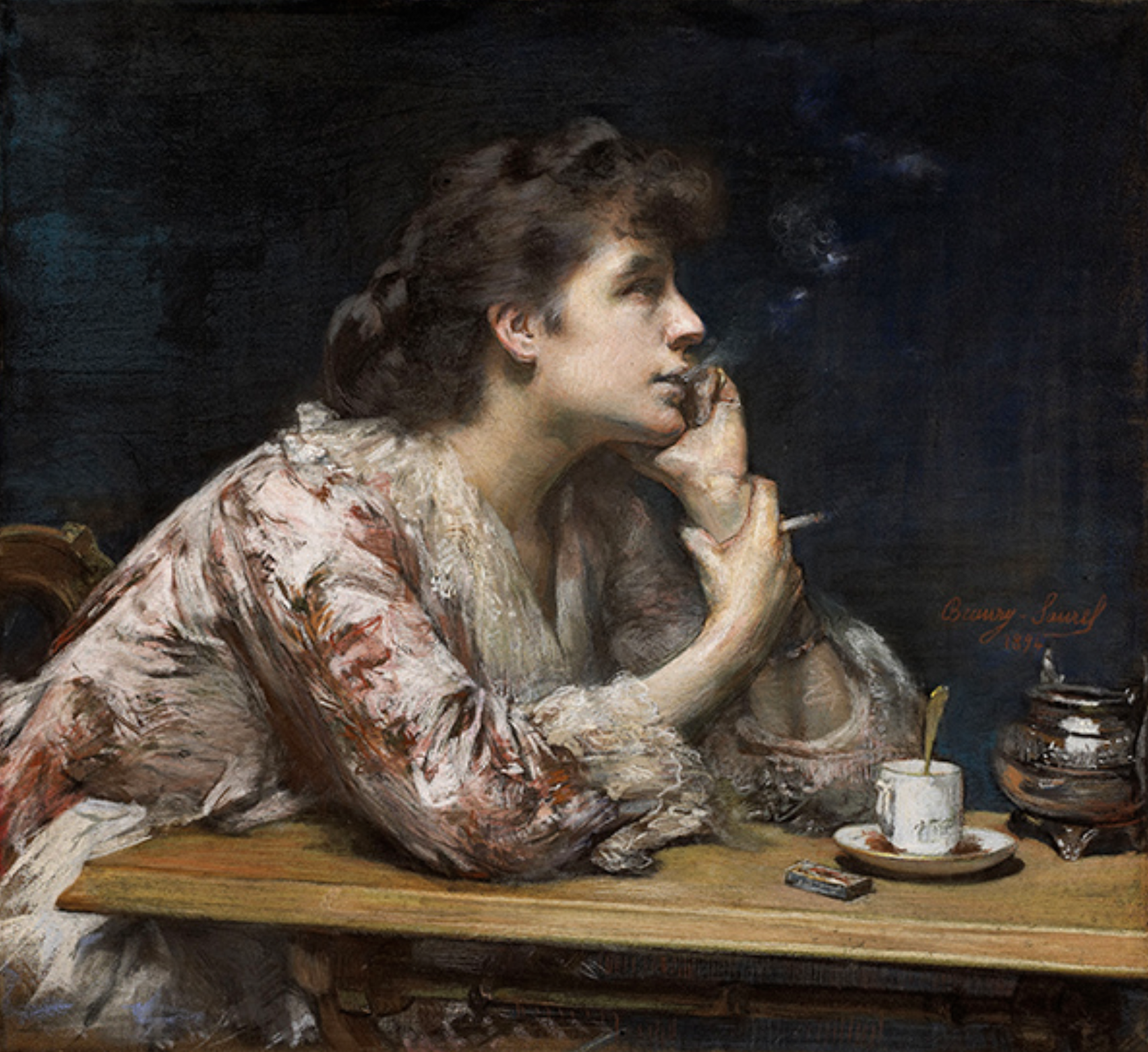
Into The Blue
BEAURY-SAUREL
A work of straightforward rebellion, Beaury-Saurel’s ‘Into The Blue’ is indicative of her life of fighting. A darling of the 1890 Paris Salon, matriarch of the Académie Julian, Beaury-Saurel’s portrait of a lady was shocking when first debuted. It would be another 40 years until women openly smoking became socially acceptable, and yet here we have our figure nonchalant, exhaling against a background of deep blue. Beaury-Saurel was a ‘femme moderne’, and wanted to depict similar women. She presents her subjects as strong and undaunted. In loose brush strokes she frees them from societal gaze and subjugation to become their own authors. Now faded into obscurity, Beaury-Saurel blazed a path for female painters in France to reclaim their image
Amélie Beary-Saurel

AMÉLIE BEAURY-SAUREL, 1894. PASTEL ON CANVAS
A work of straightforward rebellion, Beaury-Saurel’s ‘Into The Blue’ is indicative of her life of fighting. A darling of the 1890 Paris Salon, matriarch of the Académie Julian, Beaury-Saurel’s portrait of a lady was shocking when first debuted. It would be another 40 years until women openly smoking became socially acceptable, and yet here we have our figure nonchalant, exhaling against a background of deep blue. Beaury-Saurel was a ‘femme moderne’, and wanted to depict similar women. She presents her subjects as strong and undaunted. In loose brush strokes she frees them from societal gaze and subjugation to become their own authors. Now faded into obscurity, Beaury-Saurel blazed a path for female painters in France to reclaim their image.

The Calling of Saint Matthew
CARAVAGGIO
Caravaggio was a rebel, an outcast, a murderer, and a genius. Almost single-handedly, he shifted the Renaissance away from the heavens and brought it crashing down to earth. He cast prostitutes as life models for the mother Mary, pimps and street urchins as disciples, and found religion, salvation and divinity in the dark streets and underbelly of Rome. His paintings exist in back rooms, illuminated by the rare light that finds its way through cracks and dirty windows, and depict biblical stories as contemporary scenes, with all figures dressed in the garb of the day. The calling of Matthew is one of a series of painting depicting Matthew’s story, culminating in his vicious and visceral murder, all hanging at the French Church in Rome. They are a masterclass in chiaroscuro, the interplay between intense darkness and bright light, and exemplify a new understanding of religious art - one that is applicable and relatable to the everyman.
Caravaggio
MICHELANGELO MERISI DA CARAVAGGIO, 1600. OIL ON CANVAS.
Caravaggio was a rebel, an outcast, a murderer, and a genius. Almost single-handedly, he shifted the Renaissance away from heavens and brought it crashing down to earth. He cast prostitutes as life models for the mother Mary, pimps and street urchins as disciples, and found religion, salvation and divinity in the dark streets and underbelly of Rome. His paintings exist in back rooms, illuminated by the rare light that finds its way through cracks and dirty windows, and depict biblical stories as contemporary scenes, with all figures dressed in the garb of the day. The calling of Matthew is one of a series of painting depicting Matthew’s story, culminating in his vicious and visceral murder, all hanging at the French Church in Rome. They are a masterclass in chiaroscuro, the interplay between intense darkness and bright light, and exemplify a new understanding of religious art - one that is applicable and relatable to the everyman.

Still Life
GIORGIO MORANDI
Giorgio Morandi’s work is humble. It does not overtly place him in a lineage of art history, nor does it try to elevate or reach towards the eternal. It is unpretentious, his subjects are limited and his lines are technically imperfect. The works are quiet, receding, and do not shout. Yet, in any gallery, their singular character is unmistakable and unignorable. Morandi was a painter of household objects in muted colours, his restraint and deliberation almost monastic, yet he established himself as one of the most important artists of the 20th century. This is partly because, Morandi was not really concerned with the objects but with the light, and the way it interacted with them and the colours it produced. It is this obsessive documentation of light, in the minutiae of it’s variations that made Morandi such a key figure for the color-field artists such as Rothko and minimalists like Donald Judd. Morandi elevated the mundane and ordinary to the exquisite and worthwhile.
Giorgio Morandi
GIORGIO MORANDI, c.1955. OIL ON CANVAS.
Giorgio Morandi’s work is humble. It does not overtly place him in a lineage of art history, nor does it try to elevate or reach towards the eternal. It is unpretentious, his subjects are limited and his lines are technically imperfect. The works are quiet, receding, and do not shout. Yet, in any gallery, their singular character is unmistakable and unignorable. Morandi was a painter of household objects in muted colours, his restraint and deliberation almost monastic, yet he established himself as one of the most important artists of the 20th century. This is partly because, Morandi was not really concerned with the objects but with the light, and the way it interacted with them and the colours it produced. It is this obsessive documentation of light, in the minutiae of it’s variations that made Morandi such a key figure for the color-field artists such as Rothko and minimalists like Donald Judd. Morandi elevated the mundane and ordinary to the exquisite and worthwhile.

Tristan Tzara
MAN RAY
“I have finally freed myself from the sticky medium of paint”, said Man Ray, “and am working directly with light itself.” He was amongst the first to understand the importance of this liberation, for it was Man Ray, with a small group of others, who established photography as a medium for fine art. A multidisciplinary artist who had worked across different fields, when Tristan Tzara, the founder of Dada and the man pictured in this image, introduced Ray to photography, he felt at home. The sculpture hanging over Tzara’s head is one of Ray’s, a sword of Damocles that seems to spell certain death for the avant-garde genius, for this picture was taking on the precipice of movements. Dada was starting to fade, taken over by the fledgling surrealist artists, their sexually charged works represented here by the spectre of a nude women that looms over the old leader. Ray indeed used the camera as a canvas, not restricting himself to depictions of tangible reality but painting visions with light.
Man Ray
MAN RAY, 1921. PHOTOGRAPH ON SILVER GELATIN PAPER.
“I have finally freed myself from the sticky medium of paint”, said Man Ray, “and am working directly with light itself.” He was amongst the first to understand the importance of this liberation, for it was Man Ray, with a small group of others, who established photography as a medium for fine art. A multidisciplinary artist who had worked across different fields, when Tristan Tzara, the founder of Dada and the man pictured in this image, introduced Ray to photography, he felt at home. The sculpture hanging over Tzara’s head is one of Ray’s, a sword of Damocles that seems to spell certain death for the avant-garde genius, for this picture was taking on the precipice of movements. Dada was starting to fade, taken over by the fledgling surrealist artists, their sexually charged works represented here by the spectre of a nude women that looms over the old leader. Ray indeed used the camera as a canvas, not restricting himself to depictions of tangible reality but painting visions with light.

Number 7, 1951
JACKSON POLLOCK
Jackson Pollock was rediscovering his creativity after a long battle with alcoholism and an adjustment to his newfound fame. Recently moved in with his new wife Lee Krasner, he allowed himself to experiment and bring in forgotten elements of his work. He began to draw again, and exercise greater control and restraint over his work. The automatic works of the abstract subconscious merged with his draughtsman origins. He combined passion with rigour to create these sparse and lyrical paintings, no less affecting than his preceding works. He began also to reintroduce bodily figures, contorted and distressed, they bring Pollock out of representations of his mind and place him as a person in the canvas and the world. It is perhaps not surprising that these figures come into his oeuvre after he has got sober and settled, his internal fight has waned, and he can see himself as part of the wider world. On the right-hand side, the enamel paint is dispensed with a turkey baster and allows collaboration with his materials. No. 7 can be seen as a dialogue between a past Pollock and a present one, and an ability for the two to live in harmony.
Jackson Pollock
JACKSON POLLOCK, 1951. ENAMEL ON CANVAS.
Jackson Pollock was rediscovering his creativity after a long battle with alcoholism and an adjustment to his newfound fame. Recently moved in with his new wife Lee Krasner, he allowed himself to experiment and bring in forgotten elements of his work. He began to draw again, and exercise greater control and restraint over his work. The automatic works of the abstract subconscious merged with his draughtsman origins. He combined passion with rigour to create these sparse and lyrical paintings, no less affecting than his preceding works. He began also to reintroduce bodily figures, contorted and distressed, they bring Pollock out of representations of his mind and place him as a person in the canvas and the world. It is perhaps not surprising that these figures come into his oeuvre after he has got sober and settled, his internal fight has waned, and he can see himself as part of the wider world. On the right-hand side, the enamel paint is dispensed with a turkey baster and allows collaboration with his materials. No. 7 can be seen as a dialogue between a past Pollock and a present one, and an ability for the two to live in harmony.

The Ascetic
PABLO PICASSO
In a deep depression, Picasso could paint in nothing but blue. For three years, he works became all but monochromatic; rendered in shades of blue and blue-green, they are overwhelming in their coldness and affecting in the totality of moroseness they represent. It was the suicide of a close friend that led Picasso into his aptly named ‘Blue Period’, and his art was changed not just in palette but in subject. He retreated into the darkness of society, finding solace in the outcasts: the sick, disabled, marginalised, and rejected, as he saw himself in his misery as equally apart from the world he once inhabited. The works made during this period are more than melancholy - they are entirely absent of joy, and amongst the most urgent and potent communications of sadness ever created. This work, of an older man, ailing with little food to eat, is an exemplary work of this period. There is something unsettling in his depiction, as he moves between dimensions his body seems to exist both as rounded, fully formed flesh in the face, neck and hands, and as a flat, false image in his torso and arms. The table appears to retreat back against the wall, trapping him in a purgatorial space between planes. In social position and depiction, Picasso’s unnamed subject exists as an outsider, unplaced within the physical world he is painted in and rejected by the one he inhabits.
Pablo Picasso
PABLO PICASSO, 1903. OIL ON CANVAS.
In a deep depression, Picasso could paint in nothing but blue. For three years, he works became all but monochromatic; rendered in shades of blue and blue-green, they are overwhelming in their coldness and affecting in the totality of moroseness they represent. It was the suicide of a close friend that led Picasso into his aptly named ‘Blue Period’, and his art was changed not just in palette but in subject. He retreated into the darkness of society, finding solace in the outcasts: the sick, disabled, marginalised, and rejected, as he saw himself in his misery as equally apart from the world he once inhabited. The works made during this period are more than melancholy - they are entirely absent of joy, and amongst the most urgent and potent communications of sadness ever created. This work, of an older man, ailing with little food to eat, is an exemplary work of this period. There is something unsettling in his depiction, as he moves between dimensions his body seems to exist both as rounded, fully formed flesh in the face, neck and hands, and as a flat, false image in his torso and arms. The table appears to retreat back against the wall, trapping him in a purgatorial space between planes. In social position and depiction, Picasso’s unnamed subject exists as an outsider, unplaced within the physical world he is painted in and rejected by the one he inhabits.

View of Saint Maurice lès Charencey
MAURICE DE VLAMINCK
Vlaminck ignored the details. From an early age he rejected the traditional teaching methods of copying masterpieces from museums, keen to make sure that his inspiration was pure and his style unadulterated by influence. Landscapes were but a vehicle for a violent expression told through brushstrokes. The subjects of the scenes were carefully considered but Vlaminck felt no allegiance or responsibility towards them, in both landscape and portraiture. Instead, he was deeply committed to himself, and prioritised the authenticity of his own expression above all else. A lifelong fauvist, art was for him a wild and personal thing, and he saw Picasso and Braques cubism as a dead-end that dragged painting into a state of confusion, away from the expression of human emotion and into something all the headier and more distant. This painting of Vue Saint Maurice tells us little of the road, but in the furious snow and aggressive sky, we learn a lot about Vlaminck.
Maurice De Vlaminck
MAURICE DE VLAMINCK, 1950. OIL ON CANVAS.
Vlaminck ignored the details. From an early age he rejected the traditional teaching methods of copying masterpieces from museums, keen to make sure that his inspiration was pure and his style unadulterated by influence. Landscapes were but a vehicle for a violent expression told through brushstrokes. The subjects of the scenes were carefully considered but Vlaminck felt no allegiance or responsibility towards them, in both landscape and portraiture. Instead, he was deeply committed to himself, and prioritised the authenticity of his own expression above all else. A lifelong fauvist, art was for him a wild and personal thing, and he saw Picasso and Braques cubism as a dead-end that dragged painting into a state of confusion, away from the expression of human emotion and into something all the headier and more distant. This painting of Vue Saint Maurice tells us little of the road, but in the furious snow and aggressive sky, we learn a lot about Vlaminck.

The Blank Signature
RENÉ MAGRITTE
Surrealists were delving the unconscious depths of their mind to create works that transcended reality, turning their dreams and visions of impossible worlds into visual actualities. Magritte, however, while participating in this element of the movement, was simultaneously exploring something altogether different. ‘The Blank Signature’ is not about the visions of the subconscious but instead about the inner workings of it. An optical illusion of the highest order - at first glance it is a simple scene, masterfully rendered, but on the second something seems off. Our brain constructs the picture we assume is there, that of a woman riding her horse through a forest, partially obscured by trees. Instead, the horse is bisected by nothingness, exists simultaneously in front of and behind the plane it rides on. We do not need painting to show us the world of our dreams, Magritte seems to say with this work, when the mind already constructs the impossible.
René Magritte
RENÉ MAGRITTE, 1965. OIL ON CANVAS.
Surrealists were delving the unconscious depths of their mind to create works that transcended reality, turning their dreams and visions of impossible worlds into visual actualities. Magritte, however, while participating in this element of the movement, was simultaneously exploring something altogether different. ‘The Blank Signature’ is not about the visions of the subconscious but instead about the inner workings of it. An optical illusion of the highest order - at first glance it is a simple scene, masterfully rendered, but on the second something seems off. Our brain constructs the picture we assume is there, that of a woman riding her horse through a forest, partially obscured by trees. Instead, the horse is bisected by nothingness, exists simultaneously in front of and behind the plane it rides on. We do not need painting to show us the world of our dreams, Magritte seems to say with this work, when the mind already constructs the impossible.

Saint John the Baptist and Saint Jerome
UNKNOWN RHENISH MASTER
The two men stand at ease as if caught unexpectedly in oil paint, a candid moment granted immortality. Yet for the naturalistic pose that Saint John the Baptist and Saint Jerome exhibit, they are laden with symbolism in every element of their depiction. The small, rather surreal lamb that sits atop St. John’s leather book is recognition of Christ as the sacrificial Lamb of God, while his camel hair tunic is testament to the patience of his faith and the power of endurance. Jerome is clad in red cardinal garments that honour his religious scholarship; bestowing upon him an honour that was not granted in his life. He holds the thorn he removed from a lions paw and a book, most likely the Bible that he translated into Latin from Hebrew. This symbolically and aesthetically dense work was most likely adornment for a larger painting of Christ’s crucifixion, a wing on a possible triptych, that has now been lost. For all of its visual poetry and the impossibility of the scene it depicts, for the two saints lived centuries apart, it feels strangely intimate, deeply personal and painted with the honesty of faith and respect.
Unknown Rhenish Master
UNKNOWN RHENISH MASTER, c.1478. OIL AND GOLD ON PANEL.
The two men stand at ease as if caught unexpectedly in oil paint, a candid moment granted immortality. Yet for the naturalistic pose that Saint John the Baptist and Saint Jerome exhibit, they are laden with symbolism in every element of their depiction. The small, rather surreal lamb that sits atop St. John’s leather book is recognition of Christ as the sacrificial Lamb of God, while his camel hair tunic is testament to the patience of his faith and the power of endurance. Jerome is clad in red cardinal garments that honour his religious scholarship; bestowing upon him an honour that was not granted in his life. He holds the thorn he removed from a lions paw and a book, most likely the Bible that he translated into Latin from Hebrew. This symbolically and aesthetically dense work was most likely adornment for a larger painting of Christ’s crucifixion, a wing on a possible triptych, that has now been lost. For all of its visual poetry and the impossibility of the scene it depicts, for the two saints lived centuries apart, it feels strangely intimate, deeply personal and painted with the honesty of faith and respect.

Venus
HENRI MATISSE
In the late 1940s, Henri Matisse put down the paint brush and picked up the scissors. Cut paper became his primary medium, cutting paper into various shapes of vegetal and abstract form, and then arranging them in lively compositions. The cut-outs renewed Matisse’s commitment to form and color as his ability to paint the intricate, emotive works of his youth left him as his body aged. They were questioned everything that had come before, asking the nature of the status of the work of art, whether as a unique object, environment, ornament, or a hybrid of all of these. There is a tension inherent in this, the cut-outs existed between traditional artworks and decoration, they are at once a finished product and a work in process, drawings and colour fields. The cut-outs reduce formal ideas to simplicity, bringing Matisse towards the end of his life back to his most youthful self. Simple, unassuming, and remarkable in their depth.
Henri Matisse
HENRI MATISSE, 1952. GOUACHE ON PAPER.
In the late 1940s, Henri Matisse put down the paint brush and picked up the scissors. Cut paper became his primary medium, cutting paper into various shapes of vegetal and abstract form, and then arranging them in lively compositions. The cut-outs renewed Matisse’s commitment to form and color as his ability to paint the intricate, emotive works of his youth left him as his body aged. They were questioned everything that had come before, asking the nature of the status of the work of art, whether as a unique object, environment, ornament, or a hybrid of all of these. There is a tension inherent in this, the cut-outs existed between traditional artworks and decoration, they are at once a finished product and a work in process, drawings and colour fields. The cut-outs reduce formal ideas to simplicity, bringing Matisse towards the end of his life back to his most youthful self. Simple, unassuming, and remarkable in their depth.