
15 Modesty - The I Ching
Chris Gabriel February 14, 2026
Judgment
Modesty is prosperity. The Sage achieves his ends.
Lines
1
The Sage is modestly modest, he can cross the river.
2
The sound of modesty.
3
The toils of the modest Sage have an end.
4
Humble modesty.
5
Not rich, he calls on his neighbors, and they raise an army.
6
The sound of modesty directs the army to the city.
Qabalah
Malkuth to Netzach: The Path of Qoph. The Moon.
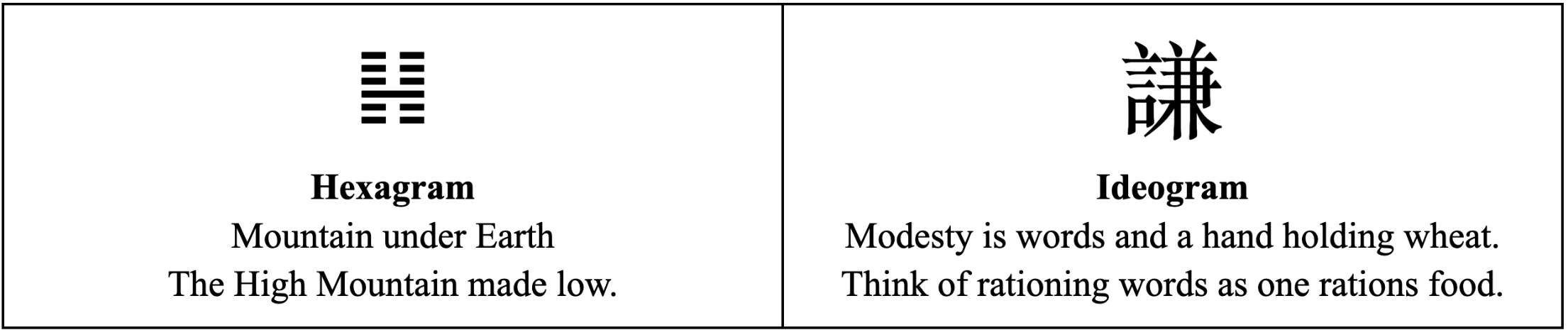
In this hexagram, we see the high making itself low. The image is that of a mountain buried under the earth. This is the colossal pyramids covered by the sands of time, a beautiful statue covered in dirt. It is also the nature of wisdom, for the ideogram shows us modesty as rationed words - someone who does not make a show of themselves, but hides their immense power.
1 A wise person is not so modest as to do nothing, they simply move when the time is right.
2 The wise sage, while not making a show of himself, emits a powerful aura. Spiritual energy can palpably arise from an individual, be it with a simple gesture, or a word of advice.
3 While a wise person will work hard, they do not work for the sake of working: they have clear goals and do nothing that does not further them.
4 Often, an ascetic makes a show of their own modesty. Many are proud of their apparent virtues, while true wisdom is humble even in their virtue.
5 A wise person is capable of rousing the many to achieve their own goals, without the promise of payment.
6 It is good to be led by a wise general. This line can also go back to the image of the buried pyramid, radar waves penetrating the ground and discovering the contours of what lay beneath.
When we do not choose or engage in modesty, we will be forcibly made humble. This is the irony of pride: no matter how high one makes oneself, we will fall. Shelley shows us best in his poem Ozymandias:
I met a traveller from an antique land,
Who said—“Two vast and trunkless legs of stone
Stand in the desert. . . . Near them, on the sand,
Half sunk a shattered visage lies, whose frown,
And wrinkled lip, and sneer of cold command,
Tell that its sculptor well those passions read
Which yet survive, stamped on these lifeless things,
The hand that mocked them, and the heart that fed;
And on the pedestal, these words appear:
My name is Ozymandias, King of Kings;
Look on my Works, ye Mighty, and despair!"
Nothing beside remains. Round the decay
Of that colossal Wreck, boundless and bare
The lone and level sands stretch far away.
As Hamlet puts it, “Imperious Caesar, dead and turned to clay”. This truth is why the Pharaohs of Egypt and the Emperors of China would depict themselves humbly as children and orphans on their tombs and documents. By humbling oneself, one assures a greater longevity.
Though the next hexagram, excitement, shows the squeaky wheel getting oil, the quiet, humble wheel is the least likely to get thrown away.
As the hexagram is given to Qoph, the letter of the Moon card in Tarot, we can see the act of veiling, hiding, and occulting at play. Dreams speak in a veiled way, just like spies communicate in an occulted fashion. Even when they are not understood, a symbol can influence a great deal unconsciously, and when understood, its power is enormous.
Therefore, let us humble ourselves, be modest, and let our work and power speak for itself.