
Sapir-Whorf Hypothesis in 5D
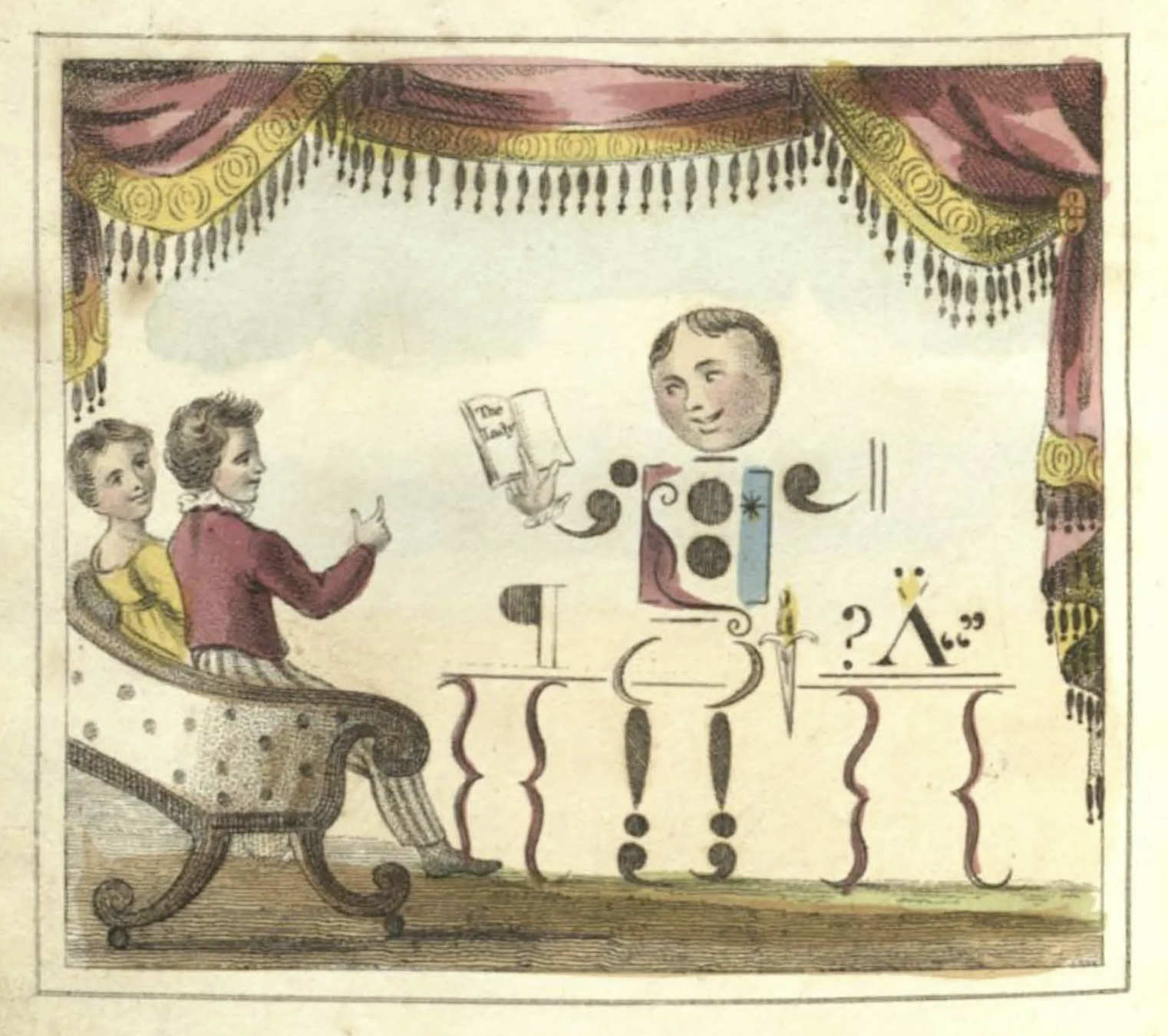
Punctuation Personified: or, Pointing Made Easy, John Harris. 1824.
Molly Hankins February 12, 2026
Linguistic relativity, as described by anthropology Professor Edward Sapir and his student Benjamin Lee Whorf in the early part of the 20th century, is a worldview shaped by the structure of language. Known as the Sapir-Whorf hypothesis, the theory claims that different languages equate to different interpretations of reality, creating different cognitive patterns. As global consciousness continues its rapid evolution to what many spiritual teachers call the 5th dimension, our use of language can aid that progression, as well stall it.
Author, scientist and magician Peter J. Carroll believes that 5th dimensional consciousness includes access to what’s known as the causal plane, and that 3D life is just the world of effects. When we’re precise with words, we refine our ability to access the causal dimension and create effects in our day-to-day lives, which is easier said than done depending on what languages you speak. English, the language best known for facilitating international commerce, can be especially tricky when it comes to describing higher dimensional concepts. In her book, Waking Up In 5D, author and teacher Maureen St. Germain describes how she found herself moving away from polarized language as her consciousness expanded.
“To discover your own habits, all you have to do is notice the way you speak of your experiences and how that colors your current situation. When you discover your own ‘source code,’ you can change it,” she writes. “Language is a strong and significant key to creating more mastery at every level. Let your language be open-ended, without preference or prejudice, so you can speak the language of the 5th dimension.” Our source code sends the programming instructions for 3D effects to the causal plane, and if the language we use is empowering, then those instructions are far more likely to be carried out with precision. An entire chapter of Waking Up In 5D is devoted to extracting polarizing and disempowering language from our 3D lives so that we can stabilize our ability to affect causality.
She recommends watching our verbs and adverbs first to see where they may have, what she calls, a “polarizing charge.” For example, a verb like the word ‘trying’ combined with an adverb like ‘hopefully’ completely undermines any possibility of acting on the causal plane. If we’re ‘hopefully trying’ or ‘trying hopefully,’ we’re not owning our ability to cause any effect. Instead of saying ‘I can’t’, saying ‘I won’t’ or ‘I don’t want to’ empowers us as active participants in reality creation. Even adjectives like ‘weird’ or ‘strange’ are polarizing, whereas we could just as easily call something ‘interesting’ and neutralize any charge.
“Playfulness is the right energy to come with, because play is creativity without attachment to outcome, and thus play is non-polarizing.”
Sapir describes the same concept in a different way: “It is quite an illusion to imagine that one adjusts to reality essentially without the use of language and that language is merely an incidental means of solving specific problems of communication or reflection. The fact of the matter is that the ‘real world’ is to a large extent unconsciously built upon the language habits of the group.” So for those who only speak and understand English, a language with many words for describing products and value but only one word for love, we must become especially creative with how we use it. Adjectives like ‘detached’ or ‘unconditional’ describe higher dimensional ways of loving that take the word love, as both a noun and verb, beyond polarity.
To consciously shift our use of language is to actively participate in our own evolution. “This is a time to find nonpolarizing, nonpejorative words to describe new and different choices and experiences. The most profound shift will occur in the way you operate, the way you think, and you will discover that you do not need to ‘work.’ Rather, you need to be playful,” St. Germain writes. “The original purpose of the third dimension was to explore the vast variety that polarity can provide. Just imagine the amazing variety we have explored around the extremes of polarity. This cycle has ended and we are winding up the way we did things in the third dimension. Things have changed, the rules have changed, and it’s not the same game.”
Of course we can choose to remain in the same old game of the 3D world, allowing life to happen to us and staying passive in the process. But when we choose to become active agents of our evolution and edit our “source code” to remove polarized and limiting language and emphasize neutrality, we’re stepping into the new game. And playfulness is the right energy to come with, because play is creativity without attachment to outcome, and thus play is non-polarizing.
Author Cormac McCarthy described it best in his novel Blood Meridian, with language serving as the thread of order weaving through our reality: “The man who believes the secrets of the world are forever hidden lives in mystery and fear. Superstition will drag him down. The rain will erode the deeds of his life. But that man who sets himself the task of singling out the thread of order from the tapestry will by that very decision alone have taken charge of the world and it is only by such taking charge that he will effect a way to dictate the terms of his own fate.”
Molly Hankins is an Initiate + Reality Hacker serving the Ministry of Quantum Existentialism and Builders of the Adytum.