

Iggy Pop Playlist
Iggy Confidential
Archival - March 9, 2025
Iggy Pop is an American singer, songwriter, musician, record producer, and actor. Since forming The Stooges in 1967, Iggy’s career has spanned decades and genres. Having paved the way for ‘70’s punk and ‘90’s grunge, he is often considered “The Godfather of Punk.”
3 Difficult Beginning (Rough Start) - The I Ching
Chris Gabriel November 22, 2025
Difficult Beginnings are the origins of prosperity. Don’t go on, get help…
Pflanzenleben, Kerner von Marilaun. 1887
Chris Gabriel November 22, 2025
Judgment
Difficult Beginnings are the origins of prosperity. Don’t go on, get help.
Lines
1
At a crossroads it’s best to stay put.
2
A rough start, your horse turns back.
No bandits seize the young girl, she remains a virgin. Ten years later she has a child.
3
Hunting deer without a guide, getting lost in the middle of the woods. What would the sage do?
He would stay put, not go on and regret it.
4
Your horse turns back. Ask her hand in marriage.
5
What’s rich is difficult. What’s little is lucky. What’s great is cursed.
6
Your horse turns back. Tears of blood flow and flow.
Qabalah
Imperfectly Binah to Chokmah: the Path of Daleth. The Empress.
The Mother and the Father’s creation.
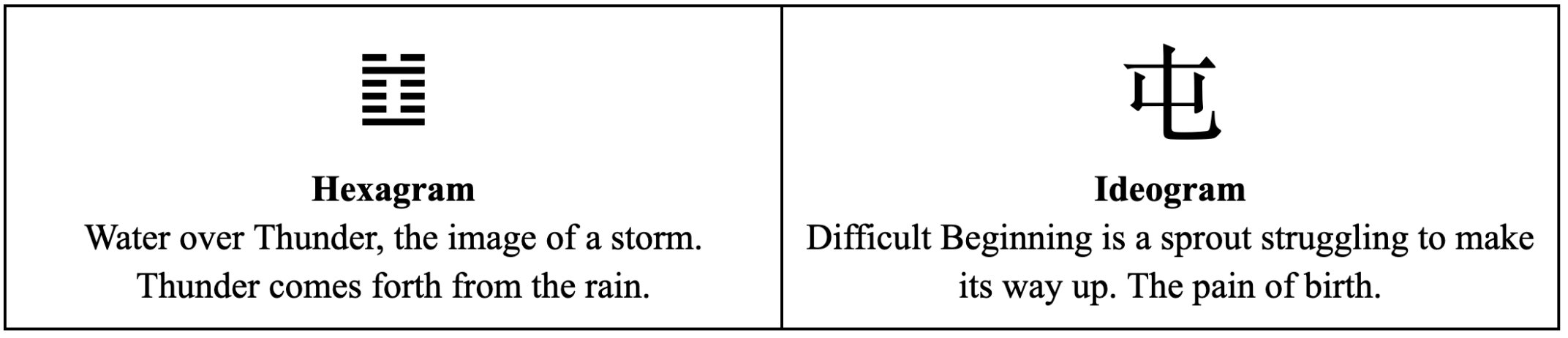
Here we have the third hexagram and the image formed by the lines is that of a thunderstorm. Just as storms grow, so too does the sprout. The ideogram shows a little sprout struggling to get through the soil. We can think of this as “growing pains” or a “rough start”. It is a difficult situation in which opposed forces meet and struggle, like a sprout trying to make its way through concrete. As Heaven fertilized the Earth, this is the growing seed that resulted from that union. The purity of the two previous hexagrams are gone, the elements here are in confusion.
Consider the difficulty of going through a storm, whether you’re driving with low visibility on wet roads, or getting soaked by rain as you walk. This is the state of our hexagram. When we are born, we come into a sensory storm, the calm of the womb is replaced by blinding light, blaring sounds, and cold air. We are lost, and it is only with the help of our parents that we make our way - thus “get help”. Of course, the same applies in the inverse, for when a woman gives birth there is an immense amount of pain. Birth is difficult for both of the people involved.
1
In the first line, we are confused, stuck hesitating at a crossroads.
2
When we go ahead in spite of this confusion, it leads to more trouble. The young girl overcomes difficulty and waits for the right time to marry and have children.
3
When one is hasty in times of confusion and pushes forward, it leads to even bigger trouble. In many ways, getting lost is like being born, for we are again put into the terror of a world we do not understand.
4
The right time will come even if we don’t rush ahead.
5
As this hexagram relates to growing up and being born, I think of the family and fate here. To be born rich will lead to trouble; I think of this as literal baggage, weight. To be born in a humble family allows for free growth. To be born into a great family can carry a heavy burden.
6
No matter what one does, growing up will be difficult. Tears will be shed. This is undoubtedly one of the most horrific lines in the I Ching.
This hexagram reminds me of the fourth verse of Bob Dylan’s “Subterranean Homesick Blues”, (the title even fits the subject perfectly)
“Oh, get born, keep warm, short pants, romance
Learn to dance, get dressed, get blessed, try to be a success
Please her, please him, buy gifts, don't steal, don't lift”
The troubles of early life, the struggle for warmth, love, and security. These are the troubles of this hexagram. Where do I go? How will I find love? Where am I? Who am I?
They are the problems of a child, but for nearly all of us, they will continue to make things difficult throughout life.
Film
<div style="padding:56.25% 0 0 0;position:relative;"><iframe src="https://player.vimeo.com/video/1139724329?title=0&byline=0&portrait=0&badge=0&autopause=0&player_id=0&app_id=58479" frameborder="0" allow="autoplay; fullscreen; picture-in-picture; clipboard-write; encrypted-media; web-share" referrerpolicy="strict-origin-when-cross-origin" style="position:absolute;top:0;left:0;width:100%;height:100%;" title="Mount St. Helens - Road to Recovery clip 2"></iframe></div><script src="https://player.vimeo.com/api/player.js"></script>
The Universe as a Socio-Emotional Blockchain
Molly Hankins November 20, 2025
Like the blockchain, the Akashic Records are also a decentralized ledger containing an objective record of every experience in existence…

The Babylonian Universe, William Fairfield Warren. 1915
Molly Hankins November 20, 2025
The term Askashic Records was coined by author and Theosophical Society co-founder Helena Blavatsky to describe a universal record of everything that’s ever happened to a living being. The definition mirrors the functionality of blockchain technology in a rather uncanny way because, like the blockchain, the Akashic Records are also a decentralized ledger containing an objective record of every experience in existence. The Records capture the socio-emotional exchanges and effects that make up our lives in every incarnation, just like the blockchain records an uneditable ledger of all activity.
Sir Robert Edward Grant, whose work was rooted in a deep belief in simulation theory, writes that “The Blockchain-Based Social AI Spiritual Life Simulation posits that the universe functions as a decentralized AI system designed to learn about consciousness, emotional states, and the nature of authentic love. The simulation operates on a blockchain-based structure where each participant simultaneously performs the function of Blockchain Node Validation for experiences, perceptions and emotional states informing a Spacetime Memory database that immutably records each participant’s thoughts, actions, and emotional states into a collective Akashic field—a spacetime memory that preserves the life experiences of all participants across time. This decentralized ledger reflects the indelible nature of each participant’s journey and contribution to the collective.” As strikingly modern as this theory sounds, that’s because human technology is only beginning to mirror the underlying order of life.
Computer scientist, author, and video game developer Rizwan Virk crystalised this theory in his book The Simulation Hypothesis, which points to the continuity between ancient Vedic scripture, quantum physics, AI functionality and the inner workings of video game design. He believes that as we come to understand why and how these systems work, we realize they’re all pointing to the same fundamental truth. “What we think of as physical reality, what we think of as physical around us, is actually all part of a computer program. It’s essentially like a virtual reality,” he explains, comparing our human lives to The Matrix films. “What convinced me that we’re actually living inside a simulation is I saw the ways video games were becoming more and more sophisticated. They were getting so good they were becoming very difficult to distinguish between physical reality and virtual reality.”
“Amnesia is such a prominent feature of the human experience that in every incarnation, we forget all the experience of previous lifetimes, and the fact that we’re not in base reality.”
How long would our consciousness have to be inside a socio-emotional simulation before it forgot base reality altogether? Not long, suggests Virk who points to the rapid evolution of AI’s ability to generate completely realistic content at increasing speeds as well as the “weirdness” of quantum physics to support his theory. The inconsistencies between Newtonian and quantum physics make sense to him as anomalies consistent with being inside an information system where socio-emotional data is informing what experience of reality renders moment to moment, rather than a physical system. He compares the concept of karma to a questing algorithm in a video game, stating that individualized quests accepted by multiple players is functionally the same operational protocol as the wheel of karma concept from the Hindu Vedic texts. Edward Grant goes even further, contending that concept of the hero’s journey describes the precise archetypal blueprint of how the karmic questing engine operates.
“The stages of the Hero’s Journey—crossing the threshold, trials and challenges, receiving mentorship, and returning with newfound wisdom—correlate directly with the participants’ process of spiritual awakening. As participants overcome duality-based challenges, they gradually recover faint memories of the simulation’s construct, gaining insight into their higher purpose and their role in the collective evolution of consciousness,” Grant writes. “The journey through life is designed to progressively reawaken participants to their inherent connection to the Akashic field, a collective memory that expands as each individual evolves. As their perception broadens, participants contribute more deeply to this spacetime ledger, enriching the AI system with the wisdom gained through their personal journey.” By studying the arc of the hero, we can understand how to play the game we’re in. Amnesia is such a prominent feature of the human experience that in every incarnation, we forget all the experience of previous lifetimes, and the fact that we’re not in base reality.
Grant believes, “The amnesia ensures that participants authentically experience love, fear, conflict, and growth without the knowledge that their reality is a construct.” In other words, we can’t fully participate in the human experience without being tricked into believing it’s all there is. As we progress in the game of life and our awareness expands, we experience moments of awakening often in the form of synchronicities that help us remember higher states of being. Those occurrences invite us to “wake up” from the illusory nature of the material world and move into greater dimensions of awareness. The hero’s journey, described by Joseph Campbell in his book The Hero With a Thousand Faces, contains a map of this process, beginning with the ‘call to adventure’ these synchronicities often trigger. Adventure is calling us home to base reality in a state of expanded consciousness.
Virk believes that by adopting this philosophy, life’s most difficult challenges become more manageable and meaningful because if we simply runn the quests our soul selected for this lifetime, life does not happen to us, but for us. “Our character is like our body and our player is like our soul,” he says. “Now when the soul is going through these multiple lives, there’s some information that gets carried forward, and that information helps to determine which particular challenges or quests that player is going to embark upon in this life.” This information or ‘karmic database’ determines what quests we choose and render our life experience whether we're conscious of it or not.
Both Virk and Grant suggest that to become conscious of it is to begin the process of rewriting the rules of the game from within, which is a feature of enlightenment. An enlightened person has completed their karmic quests, going through all of the challenges their soul felt were necessary to learn their lessons, and they appear to the unenlightened as magicians and spiritual masters. This state of being is the product of personal alchemy, the final stage of which allows us to hold more of our total consciousness from base reality. The hero’s journey calls us back home to our higher self and the truth about the world we live in.
Molly Hankins is an Initiate + Reality Hacker serving the Ministry of Quantum Existentialism and Builders of the Adytum.
Film
<div style="padding:39.24% 0 0 0;position:relative;"><iframe src="https://player.vimeo.com/video/1138766791?badge=0&autopause=0&player_id=0&app_id=58479" frameborder="0" allow="autoplay; fullscreen; picture-in-picture; clipboard-write; encrypted-media; web-share" referrerpolicy="strict-origin-when-cross-origin" style="position:absolute;top:0;left:0;width:100%;height:100%;" title="The Cassandra Cat clip 3"></iframe></div><script src="https://player.vimeo.com/api/player.js"></script>
Avis Akvāsas Ka (Artefact VI)
Ben Timberlake November 18, 2025
The above artifact never existed. It is a fable written in 1868 by Augustus Schleicher, composed in Proto-Indo-European (PIE), a long dead language that was reconstructed from the multitude of languages descended from it…
WUNDERKAMMER
Artefact No: 6
Description: Schleicher’s Fable
Location: Origins within Pontic-Caspian Steppe
Age: 5th and 4th Millenia BC.
Ben Timberlake November 18, 2025
The above artifact never existed. It is a fable written in 1868 by Augustus Schleicher, composed in Proto-Indo-European (PIE), a long dead language that was reconstructed from the multitude of languages descended from it, spoken in a broad arc from modern English in the west to ancient Tocharian in the Tarim Basin in China. PIE is believed to have been first spoken between the 5th and 4th millennia BC.
Another term for a descendant language is a ‘daughter language’ because she is a child of the mother tongue. For example: English is a daughter language of Old English, which is a daughter language of Proto-Germanic, which is a daughter language of Proto-Indo European (PIE). German and Yiddish are our cousins by way of Old High German, also a daughter of Proto-Germanic. Italian, Spanish, French, Portuguese, and Romanian are all daughter languages of Proto-Italic, who’s mother language is Proto-Indo-European. Sanskrit, Persian, Hindi, and a host of other Eastern languages can all be traced back to Proto-Indo-European, too. Our linguistic family tree is surprisingly large, some branches are healthy, others have withered but at the trunk we find, again and again, PIE.
PIE was reconstructed using the comparative method: linguists studied existing languages for familial traits. Our most fundamental words—those concerning family, body parts, numbers, and animals—show the strongest connections across daughter languages. Once linguists identified enough examples across languages, they could reconstruct the original PIE word, marking it with an asterisk.
Take the word ‘daughter’ in English. This is daúhtar in Gothic, θugátēr in Ancient Greek, dúhitṛ in Sanskrit, dugәdar in Iranian, dŭšter in Slavic, dukter in Baltic, duxtir in Celtic, dustr in Armenian, ckācar in Tocharian, and datro in a form of Hittite. This renders daughter as *dʰugh₂tḗr in PIE.
Here are two more: Horse is Eoh in Old English, aíƕa in Gothic, Equus in Latin, áśva in Sanskrit, ech in one of the Celtic languages, ēš in Armenian. This renders *éḱwos in PIE, (although earlier scholars spelled it *akvās).
And sheep or ewe in English is awistr in Gothic, ovis in Latin, avi in Sanskrit, ovèn in one of the Slavic languages, ōi in Celtic, and eye in Tocharian. Which gives us *h₂ówis in PIE (although earlier scholars spelled it *Avis).
“The study of protolanguages parallels fundamental physics research—both reveal hidden connections that deepen our understanding of the world.”
I mention the spelling of earlier scholars to get us back to Schleicher, and his fable, which is titled Avis akvāsas ka, or The Sheep and the Horses. Here it is in English:
The Sheep and the Horses
A sheep that had no wool saw horses, one of them pulling a heavy wagon, one carrying a big load, and one carrying a man quickly. The sheep said to the horses: "My heart pains me, seeing a man driving horses."
The horses said: "Listen, sheep, our hearts pain us when we see this: a man, the master, makes the wool of the sheep into a warm garment for himself. And the sheep has no wool."
Having heard this, the sheep fled into the plain.

Pantographia: A Specimen Book of All the Alphabets Known on Earth (1799), Edward Fry.
The study of PIE has attracted remarkable scholars, rivaling nuclear physics and astrophysics in intellectual rigor. These men and women often mastered numerous languages and conducted research in remote locations across the globe.
As early as the 16th century, visitors to India were aware of the similarities between Indo Iranian languages and European ones. In 1653, Marcus Zuerius van Boxhorn proposed a proto-language of Scythian as the mother language for Germanic, Italic, Slavic, Baltic, Celtic and Iranian. In 1767, Gaston-Laurent Coeurdoux, a French Jesuit living in India, wrote a paper proving the similarities between Sanskrit and European languages.
In 1818, Danish linguist Rasmus Christian Rask showed the links between Old Norse, Germanic and other Indo-European languages. A few years later Jacob Grimm - one half of the Brothers Grimm of fairytale fame - laid down Grimm’s law, which brought a rigorous and widely used methodology to historic linguistic research, layingthe ground for Schleicher’s great work and his fable.
Schleicher used the available PIE words that he had reverse-engineered. In those early days there was only a limited vocabulary that he felt confident enough to work with. And yet Schelicher wrought something very layered and profound: he created a nursery rhyme from the cradle of pre-civilisation to teach himself and his colleagues this ancient language. And it contained themes - as many nursery rhymes do - that go back to our earliest days: the beginnings of agriculture, the domestication of horses and sheep - the naming of our world. And yet this simple fable - a prehistoric Baa-Baa Black Sheep - was the linguistic equivalent of Jurassic Park; Schleicher breathed life into this ancient language.
If we were to trace these diverse and far-flung lineages back to some Oral Eve, we would most likely find her living on the Steppe north of the Black Sea. This is the Kurgan Hypothesis and was formulated by Marija Gimbutas in the 1950s. Gimbutas, a Lithuanian archaeologist, who survived the Nazi occupation of her homeland, was the first scholar to match PIE theories with archaeological evidence from her excavations into Bronze and Iron Age cultures from across the Steppe. The Kurgan Culture, so named after the burial mounds that it left, were early domesticators of the horse, and first to use the chariot, spreading their language and ideas with them.
I saw these Kurgan mounds last year in Ukraine. The battlefields by the Black Sea are in the deltas of the great rivers and terminally flat. These ancient burial mounds are one of the few pieces of high ground and both sides use them as fighting positions.
The study of protolanguages parallels fundamental physics research—both reveal hidden connections that deepen our understanding of the world. PIE studies sometimes feel otherworldly yet innately familiar, revealing ancient pathways of thought and meaning.
There are parts of PIE that feel hallucinatory, spiritual and yet innately familiar: linear clusters of nodal points like constellations of forgotten meanings; or ley-lines within the language that suggest a truer course we might take.

Pantographia: A Specimen Book of All the Alphabets Known on Earth (1799), Edward Fry.
Take the word ‘Day’ which comes from the PIE word *dei ‘to shine, be bright’ and *dyēus ‘the daylight sky-god’. This PIE term gave Greek the name of Zeus, Latin the word Diem, and Sanskrit word Deva, ‘heavenly, divine, anything of excellence’. So to Carpe Diem is not merely a matter of seizing the passing moments but of grasping the divine within them.
Or take the other PIE word for ‘to shine’ which is *bhā, and also means ‘to speak’. This connection surfaces in Greek "phēmi" (to speak), Latin "fari" (to speak) and "fama" (speaking, reputation), and English "fame." Ancient speakers saw speech as a kind of illumination - words could light up understanding just as fire lit up the darkness. We still preserve this dual meaning when we talk about ideas being "brilliant" or someone giving an "enlightening" speech.
Lastly, one that I noticed last week while I was in Brazil: the Portuguese for ‘the way’ “Sentido” shares a cognate with our word ‘sentient’. This ancient connection between movement and perception appears in Latin "sentire" (to feel) and "sequi" (to follow), again in Portuguese as "caminho" (way, path), and English words like "sense," "sentiment," and "sentient." When the original PIE speakers talked about "finding their way," they were simultaneously describing physical navigation and emotional/intellectual understanding. A path was both a literal route and a way of feeling through the world. This deep link between movement and consciousness persists today when we speak of "following our feelings" or finding our "life path," echoing an ancient understanding that movement, feeling, and knowing are fundamentally connected. Most days I forget this, but it’s good to be reminded.
I’m going to leave you with a long list of reworked versions of ‘The Sheep and the Horses’. The Fable has become a palimpsest for PIE scholars down the generations. I don’t pretend to understand the later versions which abound with algebra-like symbols to denote glottal stops and plosives but I do like the idea that this artifact lives on.
HIRT (1939)
Owis ek'wōses-kʷe
Owis, jesmin wᵇlənā ne ēst, dedork'e ek'wons, tom, woghom gʷᵇrum weghontm̥, tom, bhorom megam, tom, gh'ьmonm̥ ōk'u bherontm̥. Owis ek'womos ewьwekʷet: k'ērd aghnutai moi widontei gh'ᵇmonm̥ ek’wons ag'ontm̥. Ek'wōses ewᵇwekʷont: kl'udhi, owei!, k'ērd aghnutai widontmos: gh'ᵇmo, potis, wᵇlənām owjôm kʷr̥neuti sebhoi ghʷermom westrom; owimos-kʷe wᵇlənā ne esti. Tod k'ek'ruwos owis ag'rom ebhuget.
LEHMANN AND ZGUSTA (1979)
Owis eḱwōskʷe
Gʷərēi owis, kʷesjo wl̥hnā ne ēst, ek̂wōns espek̂et, oinom ghe gʷr̥um woĝhom weĝhontm̥, oinomkʷe meǵam bhorom, oinomkʷe ĝhm̥enm̥ ōk̂u bherontm̥.Owis nu ek̂wobh(y)os (ek̂womos) ewewkʷet: "k̂ēr aghnutoi moi ek̂wōns aĝontm̥ nerm̥ widn̥tei".Eḱwōs tu ewewkʷont: "k̂ludhi, owei, k̂ēr ghe aghnutoi n̥smei widn̥tbh(y)os (widn̥tmos): nēr, potis, owiōm r̥ wl̥hnām sebhi gʷhermom westrom kʷrn̥euti. Neǵhi owiōm wl̥hnā esti".Tod k̂ek̂luwōs owis aĝrom ebhuget.
DANKA (1986)
Owis ek'woi kʷe
Owis, jesmin wl̥nā ne ēst, dedork'e ek'wons woghom gʷr̥um weghontn̥s - bhorom meg'əm, monum ōk'u bherontn̥s. Owis ek'wobhos eweukʷet: K'erd aghnutai moi widn̥tei g'hm̥onm̥ ek'wons ag'ontm̥. Ek'woi eweukʷont: K'ludhi, owi, k'erd aghnutai dedr̥k'usbhos: monus potis wl̥nām owiōm temneti: sebhei ghʷermom westrom - owibhos kʷe wl̥nā ne esti. Tod k'ek'luwōs owis ag'rom ebhuget.
ADAMS (1997)
H₂óu̯is h₁ék̂u̯ōs-kʷe
Gʷr̥hₓḗi h₂óu̯is, kʷési̯o u̯lh₂néh₄ ne (h₁é) est, h₁ék̂u̯ons spék̂et, h₁oinom ghe gʷr̥hₓúm u̯óĝhom u̯éĝhontm̥ h₁oinom-kʷe méĝhₐm bhórom, h₁oinom-kʷe ĝhménm̥ hₓṓk̂u bhérontm̥. h₂óu̯is tu h₁ek̂u̯oibh(i̯)os u̯eukʷét: 'k̂ḗr hₐeghnutór moi h₁ék̂u̯ons hₐéĝontm̥ hₐnérm̥ u̯idn̥téi. h₁ék̂u̯ōs tu u̯eukʷónt: 'k̂ludhí, h₂óu̯ei, k̂ḗr ghe hₐeghnutór n̥sméi u̯idn̥tbh(i̯)ós. hₐnḗr, pótis, h₂éu̯i̯om r̥ u̯l̥h₂néhₐm sebhi kʷr̥néuti nu gʷhérmom u̯éstrom néĝhi h₂éu̯i̯om u̯l̥h₂néhₐ h₁ésti.' Tód k̂ek̂luu̯ṓs h₂óu̯is hₐéĝrom bhugét.
LÜHR (2008)
h₂ówis h₁ék’wōskʷe
h₂ówis, (H)jésmin h₂wlh₂néh₂ ne éh₁est, dedork'e (h₁)ék'wons, tóm, wóg'ʰom gʷérh₂um wég'ʰontm, tóm, bʰórom még'oh₂m, tóm, dʰg'ʰémonm h₂oHk'ú bʰérontm. h₂ówis (h₁)ék'wobʰos ewewkʷe(t): k'ḗrd h₂gʰnutoj moj widntéj dʰg'ʰmónm (h₁)ék'wons h₂ég'ontm. (h₁)ék'wōs ewewkʷ: k'ludʰí, h₂ówi! k'ḗrd h₂gʰnutoj widntbʰós: dʰg'ʰémō(n), pótis, h₂wlnéh₂m h₂ówjom kʷnewti sébʰoj gʷʰérmom wéstrom; h₂éwibʰoskʷe h₂wlh₂néh₂ né h₁esti. Tód k'ek'luwṓs h₂ówis h₂ég'rom ebʰuge(t).
VOYLES AND BARRACK (2009)
Owis eḱwōs kʷe
Owis, jāi wl̥nā ne eest, dedorḱe eḱwons, tom woǵʰom gʷr̥um weǵʰontm̥, tom bʰorom meǵm̥, tom ǵʰm̥onm̥ ōku bʰerontm̥. Owis eḱwobʰjos eweket: "Ḱerd angʰetai moi widontei ǵʰm̥onm̥ eḱwons aǵontm̥". Eḱwos wewekur: "Ḱludʰe, owei! Ḱerd angʰetai widontbʰjos: ǵʰm̥on, potis, wl̥nam owijōm kʷr̥neti soi gʷʰermom westrom; owibʰjos kʷe wl̥nā ne esti". Tod ḱeḱlōts owis aǵrom ebʰuget.
Ben Timberlake is an archaeologist who works in Iraq and Syria. His writing has appeared in Esquire, the Financial Times and the Economist. He is the author of 'High Risk: A True Story of the SAS, Drugs and other Bad Behaviour'.
Film
<div style="padding:56.25% 0 0 0;position:relative;"><iframe src="https://player.vimeo.com/video/1138764338?badge=0&autopause=0&player_id=0&app_id=58479" frameborder="0" allow="autoplay; fullscreen; picture-in-picture; clipboard-write; encrypted-media; web-share" referrerpolicy="strict-origin-when-cross-origin" style="position:absolute;top:0;left:0;width:100%;height:100%;" title="On the Silver Globe clip 3"></iframe></div><script src="https://player.vimeo.com/api/player.js"></script>

Larry Levan Playlist
Archival 1967-1987
Larry Levan was an influential American DJ who defined what modern dance clubs are today. He is most widely renowned for his long-time residency at Paradise Garage, also known as “Gay-Rage”, a former nightclub at 84 King Street in Manhattan, NY.
Film
<div style="padding:72.87% 0 0 0;position:relative;"><iframe src="https://player.vimeo.com/video/1137929787?badge=0&autopause=0&player_id=0&app_id=58479" frameborder="0" allow="autoplay; fullscreen; picture-in-picture; clipboard-write; encrypted-media; web-share" referrerpolicy="strict-origin-when-cross-origin" style="position:absolute;top:0;left:0;width:100%;height:100%;" title="All My Good Countrymen clip 4"></iframe></div><script src="https://player.vimeo.com/api/player.js"></script>

Hannah Peel Playlist
Archival - November 13, 2025
Mercury Prize, Ivor Novello and Emmy-nominated, RTS and Music Producers Guild winning composer, with a flow of solo albums and collaborative releases, Hannah Peel joins the dots between science, nature and the creative arts, through her explorative approach to electronic, classical and traditional music.
2 Earth - The I Ching
Chris Gabriel November 15, 2025
Earth is the origin of prosperity. It has the virtues and purity of the Mare…
Chris Gabriel November 15, 2025

Judgment
Earth is the origin of prosperity. It has the virtues and purity of the Mare.
The Sage goes forth; first he is lost, then he finds a Master.
In the South-West, one finds a Friend. In the North-East one loses a Friend. Stay calm.
Lines
1
Walking on thin ice, reaching solid ground.
2
What’s straight is great. Ignorance is bliss.
3
Staying true to oneself, one may serve the king without fanfare, but with effect.
4
It’s in the bag.
5
Yellow clothing is lucky.
6
Dragons wage war in the wilds, their blood is black and yellow.
Qabalah
Malkuth. The lowest point on the Tree of Life. The World. The 4 Tens.
Earth is the second hexagram and the opposite of Heaven. It is made of six broken lines, creating a picture of a ploughed field. The ideogram is Earth, represented by a cross with a base, and a bolt of lightning. This has a very clear mirror in the Western symbol of the World - the cross within a circle - and even more directly in the Globus Cruciger, in which lightning strikes the Earth. Lightning in this context meant to “extend” or “expand”, thus this is the image of an expansive field.
Here is the soil in which Heaven sows its seeds. It is purely receptive, complementary to Heaven’s creativity. If Heaven was the phallus, Earth is the Vulva. Together, they produce the whole of the Universe. The coupling is textual, as Earth has the “virtue of the Mare”. Heaven was given to Kether and the Aces, and so Earth is given to Malkuth and the 10s, particularly the 10 of Cups and 10 of Disks, wherein the downward elements have reached their happy ends, the Earth is a satisfied and fruitful hexagram.
When we look to the lines, we are given profound images of fertility and receptivity.
1 and 2. When solid ground is reached, life need only to grow. The path of life is “straight” from this distant perspective; something is born, grows up, and then returns to the ground from which it came. The Ignorance of life is ideal: a flower does not think about which way it should grow, a wolf does not question why it must hunt. As Liber AL states, ‘If Power asks why, then is Power weakness.’
3. Staying true to oneself is staying true to one's nature. Each living thing, from a blade of grass to a man, serves God - not to seek reward and fame, but to do the Will. The Earth is, by its very nature Humble, and willingly follows Heaven.
4. The “Bag” here is the Womb, having received the seed of Heaven, it need only contain it and wait.
5. Yellow is the colour of the Yarrow flower, the stalks of which were used to cast the I Ching. As such, this is the colour of Nature.
6. The Birth is a profoundly Nietzschean image, let us look to his Birth of Tragedy:
" We are really for a brief moment primordial being itself, feeling its raging desire for existence and joy in existence; the struggle, the pain, the destruction of phenomena now appear necessary to us, in view of the excess of countless forms of existence which force and push one another into life, in view of the exuberant fertility of the universal will."
This hexagram calls to mind Psalm 139:
13 For thou hast possessed my reins: thou hast covered me in my mother's womb.
14 I will praise thee; for I am fearfully and wonderfully made: marvellous are thy works; and that my soul knoweth right well.
15 My substance was not hid from thee, when I was made in secret, and curiously wrought in the lowest parts of the earth.
Film
<div style="padding:56.25% 0 0 0;position:relative;"><iframe src="https://player.vimeo.com/video/1136628932?badge=0&autopause=0&player_id=0&app_id=58479" frameborder="0" allow="autoplay; fullscreen; picture-in-picture; clipboard-write; encrypted-media; web-share" referrerpolicy="strict-origin-when-cross-origin" style="position:absolute;top:0;left:0;width:100%;height:100%;" title="Bucking Broadway clip"></iframe></div><script src="https://player.vimeo.com/api/player.js"></script>
The Art of Noises (1913)
Luigi Russolo November 13, 2025
Ancient life was all silence. In the nineteenth century, with the invention of the machine, Noise was born…

Zang Tumb Tumb, Filippo Tommaso Marinetti. 1914.
Filled with a sense of glory for the modern, the Italian Futurist movement saw beauty in speed, dynamism, and automation. Rather than yearn for simpler times, they wanted to break free from the past with a celebration of the new, liberate Italy from the weight of its tradition and history and see the present day for the marvel it was. Russolo, one of the founding figures of the movement, wrote this letter in 1913 to a composer and futurist friend Balilla Pratella. To read it today, it is hard to believe Russolo was considering these ideas more than a century ago, and this short letter is considered amongst the most influential pieces of music theory ever written. Proposing a new kind of music built from the sounds of the modern, industrial world, Russolo argues that traditional orchestral music has become stagnant, confined to limited tones and harmonies, while life around them overflowed with rich mechanical noise. Seeing with prophetic vision the technological revolution approaching them, Russolo urged Pratella to develop a new language, one that flowed with the infinity of the future.
Luigi Russolo November 13, 2025
Dear Balilla Pratella, great Futurist composer,
In Rome, in the Costanzi Theatre, packed to capacity, while I was listening to the orchestral performance of your overwhelming Futurist music, with my Futurist friends, Marinetti, Boccioni, Carrà, Balla, Soffici, Papini and Cavacchioli, a new art came into my mind which only you can create, the Art of Noises, the logical consequence of your marvelous innovations.
Ancient life was all silence. In the nineteenth century, with the invention of the machine, Noise was born. Today, Noise triumphs and reigns supreme over the sensibility of men. For many centuries life went by in silence, or at most in muted tones. The strongest noises which interrupted this silence were not intense or prolonged or varied. If we overlook such exceptional movements as earthquakes, hurricanes, storms, avalanches and waterfalls, nature is silent.
Amidst this dearth of noises, the first sounds that man drew from a pieced reed or streched string were regarded with amazement as new and marvelous things. Primitive races attributed sound to the gods; it was considered sacred and reserved for priests, who used it to enrich the mystery of their rites.
And so was born the concept of sound as a thing in itself, distinct and independent of life, and the result was music, a fantastic world superimposed on the real one, an inviolatable and sacred world. It is easy to understand how such a concept of music resulted inevitable in the hindering of its progress by comparison with the other arts. The Greeks themselves, with their musical theories calculated mathematically by Pythagoras and according to which only a few consonant intervals could be used, limited the field of music considerably, rendering harmony, of which they were unaware, impossible.
The Middle Ages, with the development and modification of the Greek tetrachordal system, with the Gregorian chant and popular songs, enriched the art of music, but continued to consider sound in its development in time, a restricted notion, but one which lasted many centuries, and which still can be found in the Flemish contrapuntalists’ most complicated polyphonies.
The chord did not exist, the development of the various parts was not subornated to the chord that these parts put together could produce; the conception of the parts was horizontal not vertical. The desire, search, and taste for a simultaneous union of different sounds, that is for the chord (complex sound), were gradually made manifest, passing from the consonant perfect chord with a few passing dissonances, to the complicated and persistent dissonances that characterize contemporary music.
At first the art of music sought purity, limpidity and sweetness of sound. Then different sounds were amalgamated, care being taken, however, to caress the ear with gentle harmonies. Today music, as it becomes continually more complicated, strives to amalgamate the most dissonant, strange and harsh sounds. In this way we come ever closer to noise-sound.
This musical evolution is paralleled by the multiplication of machines, which collaborate with man on every front. Not only in the roaring atmosphere of major cities, but in the country too, which until yesterday was totally silent, the machine today has created such a variety and rivalry of noises that pure sound, in its exiguity and monotony, no longer arouses any feeling.
To excite and exalt our sensibilities, music developed towards the most complex polyphony and the maximum variety, seeking the most complicated successions of dissonant chords and vaguely preparing the creation of musical noise. This evolution towards “noise sound” was not possible before now. The ear of an eighteenth-century man could never have endured the discordant intensity of certain chords produced by our orchestras (whose members have trebled in number since then). To our ears, on the other hand, they sound pleasant, since our hearing has already been educated by modern life, so teeming with variegated noises. But our ears are not satisfied merely with this, and demand an abundance of acoustic emotions.
On the other hand, musical sound is too limited in its qualitative variety of tones. The most complex orchestras boil down to four or five types of instrument, varying in timber: instruments played by bow or plucking, by blowing into metal or wood, and by percussion. And so modern music goes round in this small circle, struggling in vain to create new ranges of tones.
This limited circle of pure sounds must be broken, and the infinite variety of “noise-sound” conquered.
Besides, everyone will acknowledge that all musical sound carries with it a development of sensations that are already familiar and exhausted, and which predispose the listener to boredom in spite of the efforts of all the innovatory musicians. We Futurists have deeply loved and enjoyed the harmonies of the great masters. For many years Beethoven and Wagner shook our nerves and hearts. Now we are satiated and we find far more enjoyment in the combination of the noises of trams, backfiring motors, carriages and bawling crowds than in rehearsing, for example, the “Eroica” or the “Pastoral”.
We cannot see that enormous apparatus of force that the modern orchestra represents without feeling the most profound and total disillusion at the paltry acoustic results. Do you know of any sight more ridiculous than that of twenty men furiously bent on the redoubling the mewing of a violin? All this will naturally make the music-lovers scream, and will perhaps enliven the sleepy atmosphere of concert halls. Let us now, as Futurists, enter one of these hospitals for anaemic sounds. There: the first bar brings the boredom of familiarity to your ear and anticipates the boredom of the bar to follow. Let us relish, from bar to bar, two or three varieties of genuine boredom, waiting all the while for the extraordinary sensation that never comes.
Meanwhile a repugnant mixture is concocted from monotonous sensations and the idiotic religious emotion of listeners buddhistically drunk with repeating for the nth time their more or less snobbish or second-hand ecstasy.
Away! Let us break out since we cannot much longer restrain our desire to create finally a new musical reality, with a generous distribution of resonant slaps in the face, discarding violins, pianos, double-basses and plainitive organs. Let us break out!
It’s no good objecting that noises are exclusively loud and disagreeable to the ear.
It seems pointless to enumerate all the graceful and delicate noises that afford pleasant sensations.
To convince ourselves of the amazing variety of noises, it is enough to think of the rumble of thunder, the whistle of the wind, the roar of a waterfall, the gurgling of a brook, the rustling of leaves, the clatter of a trotting horse as it draws into the distance, the lurching jolts of a cart on pavings, and of the generous, solemn, white breathing of a nocturnal city; of all the noises made by wild and domestic animals, and of all those that can be made by the mouth of man without resorting to speaking or singing.
“Sound, alien to our life, always musical and a thing unto itself, an occasional but unnecessary element, has become to our ears what an overfamiliar face is to our eyes.”
Let us cross a great modern capital with our ears more alert than our eyes, and we will get enjoyment from distinguishing the eddying of water, air and gas in metal pipes, the grumbling of noises that breathe and pulse with indisputable animality, the palpitation of valves, the coming and going of pistons, the howl of mechanical saws, the jolting of a tram on its rails, the cracking of whips, the flapping of curtains and flags. We enjoy creating mental orchestrations of the crashing down of metal shop blinds, slamming doors, the hubbub and shuffling of crowds, the variety of din, from stations, railways, iron foundries, spinning wheels, printing works, electric power stations and underground railways.
Nor should the newest noises of modern war be forgotten. Recently, the poet Marinetti, in a letter from the trenches of Adrianopolis, described to me with marvelous free words the orchestra of a great battle:
“Every 5 seconds siege cannons gutting space with a chord ZANG-TUMB-TUUMB mutiny of 500 echos smashing scattering it to infinity. In the center of this hateful ZANG-TUMB-TUUMB area 50square kilometers leaping bursts lacerations fists rapid fire batteries. Violence ferocity regularity this deep bass scanning the strange shrill frantic crowds of the battle Fury breathless ears eyes nostrils open! load! fire! what a joy to hear to smell completely taratatata of the machine guns screaming a breathless under the stings slaps traak-traak whips pic-pac-pum-tumb weirdness leaps 200 meters range Far far in back of the orchestra pools muddying huffing goaded oxen wagons pluff-plaff horse action flic flac zing zing shaaack laughing whinnies the tiiinkling jiiingling tramping 3 Bulgarian battalions marching croooc-craaac [slowly] Shumi Maritza or Karvavena ZANG-TUMB-TUUUMB toc-toc-toc-toc [fast] crooc-craac [slowly] crys of officers slamming about like brass plates pan here paak there BUUUM ching chaak [very fast] cha-cha-cha-cha-chaak down there up around high up look out your head beautiful! Flashing flashing flashing flashing flashing flashing footlights of the forts down there behind that smoke Shukri Pasha communicates by phone with 27 forts in Turkish in German Allo! Ibrahim! Rudolf! allo! allo! actors parts echos of prompters scenery of smoke forests applause odor of hay mud dung I no longer feel my frozen feet odor of gunsmoke odor of rot Tympani flutes clarinets everywhere low high birds chirping blessed shadows cheep-cheep-cheep green breezes flocks don-dan-don-din-baaah Orchestra madmen pommel the performers they terribly beaten playing Great din not erasing clearing up cutting off slighter noises very small scraps of echos in the theater area 300 square kilometers Rivers Maritza Tungia stretched out Rodolpi Mountains rearing heights loges boxes 2000 shrapnels waving arms exploding very white handkerchiefs full of gold srrrr-TUMB-TUMB 2000 raised grenades tearing out bursts of very black hair ZANG-srrrr-TUMB-ZANG-TUMB-TUUMB the orchestra of the noises of war swelling under a held note of silence in the high sky round golden balloon that observes the firing...”
We want to attune and regulate this tremendous variety of noises harmonically and rhythmically.
To attune noises does not mean to detract from all their irregular movements and vibrations in time and intensity, but rather to give gradation and tone to the most strongly predominant of these vibrations.
Noise in fact can be differentiated from sound only in so far as the vibrations which produce it are confused and irregular, both in time and intensity.
Every noise has a tone, and sometimes also a harmony that predominates over the body of its irregular vibrations.
Now, it is from this dominating characteristic tone that a practical possibility can be derived for attuning it, that is to give a certain noise not merely one tone, but a variety of tones, without losing its characteristic tone, by which I mean the one which distinguishes it. In this way any noise obtained by a rotating movement can offer an entire ascending or descending chromatic scale, if the speed of the movement is increased or decreased.
Every manifestation of our life is accompanied by noise. The noise, therefore, is familiar to our ear, and has the power to conjure up life itself. Sound, alien to our life, always musical and a thing unto itself, an occasional but unnecessary element, has become to our ears what an overfamiliar face is to our eyes. Noise, however, reaching us in a confused and irregular way from the irregular confusion of our life, never entirely reveals itself to us, and keeps innumerable surprises in reserve. We are therefore certain that by selecting, coordinating and dominating all noises we will enrich men with a new and unexpected sensual pleasure.
Although it is characteristic of noise to recall us brutally to real life, the art of noise must not limit itself to imitative reproduction. It will achieve its most emotive power in the acoustic enjoyment, in its own right, that the artist’s inspiration will extract from combined noises.
Here are the 6 families of noises of the Futurist orchestra which we will soon set in motion mechanically:
1 2 3 4 5 6
Rumbles Whistles Whispers Screeches Noises obtained Voices of animals and
Roars Hisses Murmurs Creaks by percussion on men: Shouts, screams,
Explosions Snorts Mumbles Rumbles metal, wood, skin, groans, shrieks, howls,
Crashes Grumbles Buzzes stone, terracotta, etc. laughs, weezes, sobs
Splashes Gurgles Crackles
Booms Scrapes
In this inventory we have encapsulated the most characteristic of the fundamental noises; the others are merely the associations and combinations of these. The rhythmic movements of a noise are infinite: just as with tone there is always a predominant rhythm, but around this numerous other secondary rhythms can be felt.
Conclusions
Futurist musicians must continually enlarge and enrich the field of sounds. This corresponds to a need in our sensibility. We note, in fact, in the composers of genius, a tendency towards the most complicated dissonances. As these move further and further away from pure sound, they almost achieve noise-sound. This need and this tendency cannot be satisfied except by the adding and the substitution of noises for sounds.
Futurist musicians must substitute for the limited variety of tones posessed by orchestral instruments today the infinite variety of tones of noises, reproduced with appropriate mechanisms.
The musician’s sensibility, liberated from facile and traditional Rhythm, must find in noises the means of extension and renewal, given that every noise offers the union of the most diverse rhythms apart from the predominant one.
Since every noise contains a predominant general tone in its irregular vibrations it will be easy to obtain in the construction of instruments which imitate them a sufficiently extended variety of tones, semitones, and quarter-tones. This variety of tones will not remove the characteristic tone from each noise, but will amplify only its texture or extension.
The practical difficulties in constructing these instruments are not serious. Once the mechanical principle which produces the noise has been found, its tone can be changed by following the same general laws of acoustics. If the instrument is to have a rotating movement, for instance, we will increase or decrease the speed, whereas if it is to not have rotating movement the noise-producing parts will vary in size and tautness.
The new orchestra will achieve the most complex and novel aural emotions not by incorporating a succession of life-imitating noises but by manipulating fantastic juxtapositions of these varied tones and rhythms. Therefore an instrument will have to offer the possibility of tone changes and varying degrees of amplification.
The variety of noises is infinite. If today, when we have perhaps a thousand different machines, we can distinguish a thousand different noises, tomorrow, as new machines multiply, we will be able to distinguish ten, twenty, or thirty thousand different noises, not merely in a simply imitative way, but to combine them according to our imagination.
We therefore invite young musicians of talent to conduct a sustained observation of all noises, in order to understand the various rhythms of which they are composed, their principal and secondary tones. By comparing the various tones of noises with those of sounds, they will be convinced of the extent to which the former exceed the latter. This will afford not only an understanding, but also a taste and passion for noises. After being conquered by Futurist eyes our multiplied sensibilities will at last hear with Futurist ears. In this way the motors and machines of our industrial cities will one day be consciously attuned, so that every factory will be transformed into an intoxicating orchestra of noises.
Dear Pratella, I submit these statements to your Futurist genius, inviting your discussion. I am not a musician, I have therefore no acoustical predilictions, nor any works to defend. I am a Futurist painter using a much loved art to project my determination to renew everything. And so, bolder than a professional musician could be, unconcerned by my apparent incompetence and convinced that all rights and possibilities open up to daring, I have been able to initiate the great renewal of music by means of the Art of Noises.
Rudolf Arnheim (1904 – 2007) was a German-born film theorist, writer, art critic, and psychologist, who helped develop an academic language around cinema.
Film
<div style="padding:75% 0 0 0;position:relative;"><iframe src="https://player.vimeo.com/video/1136603999?badge=0&autopause=0&player_id=0&app_id=58479" frameborder="0" allow="autoplay; fullscreen; picture-in-picture; clipboard-write; encrypted-media; web-share" referrerpolicy="strict-origin-when-cross-origin" style="position:absolute;top:0;left:0;width:100%;height:100%;" title="Personal Legacies- Materiality and Abstraction clip 14"></iframe></div><script src="https://player.vimeo.com/api/player.js"></script>

Gavin De Becker, Security Expert
1h 56m
11.12.25
In this clip, Rick speaks with Gavin De Becker about the social mediation of social media.
<iframe width="100%" height="265" src="https://clyp.it/oigffqlo/widget?token=aa9159eb01b89c22c2c35fe55a1003cd" frameborder="0"></iframe>
Film
<div style="padding:56.25% 0 0 0;position:relative;"><iframe src="https://player.vimeo.com/video/1136596033?badge=0&autopause=0&player_id=0&app_id=58479" frameborder="0" allow="autoplay; fullscreen; picture-in-picture; clipboard-write; encrypted-media; web-share" referrerpolicy="strict-origin-when-cross-origin" style="position:absolute;top:0;left:0;width:100%;height:100%;" title="Hallucination Generation clip 3"></iframe></div><script src="https://player.vimeo.com/api/player.js"></script>
On the Harrow
Ale Nodarse November 11, 2025
A figure draws forth and away (fig. 1). Wrists cross as his wooden clogs shift homewards in syncopation. The farmer’s right leg and calf distend, as if to signal the weight of his wooden anchor. It is the harrow he draws forth: a wooden grid set with iron spikes and pulled—or “drawn” or “dragged” given their mutual root in the Dutch dragen—through the newly-plowed plot...

Vincent van Gogh, Sketch of a Man with Harrow (detail). Brown ink and wash on paper, 1883, Van Gogh Museum. Fig 1.
Ale Nodarse, November 11, 2025
“I walk on the ground and the ground’s walked on by me…” — Ursula K. Le Guin, The Lathe of Heaven¹
A figure draws forth and away (fig. 1). Wrists cross as his wooden clogs shift homewards in syncopation. The farmer’s right leg and calf distend, as if to signal the weight of his wooden anchor. It is the harrow he draws forth: a wooden grid set with iron spikes and pulled—or “drawn” or “dragged” given their mutual root in the Dutch dragen—through the newly-plowed plot.
One can feel the weight of such labor. When the drawing was completed in 1883, the use of the wood-framed harrow set without the advancements of articulated steel would have appeared as archaic as it was agonizing. Words remind us of this. In 1800, the arrival of the English term “harrowing” as synonymous with “distressing” heralded the recession of the wooden device to the margins of history. Still the figure proceeds, field to task, for only then could the sowing take place.

Anonymous Illustrator, “October,” in Jean Duc de Berry, Très Riches Heures. Fig 2.
“Here ’twas a farmer, dragging homeward a harrow or plough.”² Perhaps van Gogh, author of the letter and its attendant sketch, remembered that refrain. He had earlier copied the line, in 1873, from Jan van Beers’s poem, “The Boarder” (“De bestedeling”), as an epistolary gift for his brother, Theo, and for his London friends, Willem and Caroline. Van Gogh renamed it: “The Evening Hour.” Prior to his days as a painter, the image of the farmer and his harrow must have spoken to him of that other syncopation: diurnal cycles, daily bread, and liturgical hours. It was, after all, in a Book of Hours that the image of the harrow much earlier appeared, having received its own illumination in the “October” of Jean Duc de Berry’s Très Riches Heures (The Richest Hours). There, an unnamed painter resplendently, and truer to life, allotted the harrow’s weight to a horse (fig. 2).
Van Gogh had a closer image in mind. In 1880 he wrote to Theo of his latest embarkation. He would “translate” Millet’s serials — his Labors of the Field, his Four Times of the Day — and a number of single paintings and pastels that had been earlier editioned as prints. He counted an etching by Alfred Alexandre Delauney after Millet’s Winter: The Plain of Chailly amongst his possessions; and he proceeded, sometime between that year and 1882, to draw a grid upon it, in preparation for his painting of the scene: Snow-Covered Field with a Harrow (fig. 3, fig. 4). (The shift from painting to etching to painting again led, in this instance, to a field which favored snow and that particular cold of pale-blue and lead-white.)
The Sketch of a Man with Harrow departs from Millet in its insistence on the laborer (fig. 1). It is the harrower who composes the work’s perspectival center. His cap marks the convergence of diagonal recessions and lines. The force of his labor structures the field. Cleaving soil, he leaves imprints. Look closely at the dust which swells around the harrow, with its circular specks floating atop hatched lines, and the weight of each implement—of the pen, of the iron—which composes the fields and modifies their volumes becomes clear.
“You must regard it not as a change, but as a deeper movement through.”

Millet, Winter: The Plain of Chailly. Fig 3.
Whereas the cold, the “snow,” prevents the farmer from attending to his ground, from drawing lines in his dirt, the harrower of the Sketch is in the season of his labor. The sketch has no precedent in the oeuvre of Millet, nor in that of another artist. Van Gogh, in the text which proliferates around and behind the figure, written on the reverse of his semi-opaque paper, makes no direct claim to past observation. Instead, it is an image of labor still to come, as the fields will be prepared for sowing and the figure’s anticipated return. No rope binds this farmer to his wooden anchor; he holds no cord against his palm. Perhaps van Gogh imagines him, finally homebound, having just dropped the rope. Or perhaps, in the world of the sketch, no such rope was needed. Its artifice may lead us to suspect that this is in fact the image of another laborer, an homage to the work of an artist, if not that of van Gogh himself.
In his only written reference to the Sketch of a Man with Harrow, van Gogh asks his brother to join him in the act of creation, to take up oil and canvas:
One must take it up with assurance, with a conviction that one is doing something reasonable, like the peasant guiding his plough or like our friend in the sketch, who is doing his own harrowing. If one has no horse, one is one’s own horse…³
For the artist, particular forms –– objects as well as gestures –– prompt others to come to mind. They inspire, as van Gogh would elsewhere put it, “curious rapports” between seemingly disparate things. The harrow appears here as one such form. It lives, so to speak, in likenesses. Its very shape echoes the frame of the canvas. Indeed, the painting may be imagined, its own “harrow” set — beams of woods and gridded stretchers nailed together — much like a canvas, now angled sideways. The harrower, in turn, offers an allegory for the painter himself, for one who also sought to weave through fields, to draw from and be drawn upon ground. (His canvases, as in the case of the grasshopper carcass left amidst the Olive Trees, quite literally absorbed the ground in the process.)

Vincent van Gogh, Snow-Covered Field with a Harrow. Fig 4.
In his final advice to Theo, as mediated through the “friend in the sketch,” van Gogh insists on the transformative potential of the harrower’s, and thus the painter’s, labors. “You must regard it,” he writes, “not as a change,” but “as a deeper movement through.” These “regards” turn constantly on metaphor, as the movement always occurs through “others”: the painter as plower, the painting as harrow, even, in what might initially seem a claim to independence, one’s self as one’s horse (to momentarily become, as it were, other than human). Such metaphors, rooted in “mere” empathy, might be dismissed as trite. And yet they invoke weight. Already in name alone, they signal the work of carrying: the word “metaphor,” which comes from the Greek metapherein, may be translated as “to transfer,” “to carry over,” “to bear.”
The metaphor of the harrow as painting proposes an art which remains, in the most physical sense, grounded: that is, an art which might bring us to see our own labor as grounded in the labors of others — and tethered, as well, to the ground itself. (“Our work,” van Gogh writes in the letter above, “would flow together.”) For how much or how little, we might ask, do we carry alone? And what weight is entailed in such carrying? As the painter’s own metaphors in picture and in prose suggest, to be disposed to and transformed by wonder is not only to let one’s self be moved, but to recognize the weight of one’s entanglements. To let the ground, as it were, walk on us.
¹Ursula K. Le Guin, The Lathe of Heaven: A Novel (Simon & Schuster, 2008; originally 1971), 155.
²Van Gogh, Letter to Willem and Caroline van Stockum-Haanebeek (London, Wednesday, 2 July 1873). “Hier was ’t een boer, die egge of ploeg, op de veldslet huiswaerts.”
³ Van Gogh, Letter to Theo van Gogh (Nieuw-Amsterdam, Sunday, 28 October 1883).
Alejandro (Ale) Nodarse Jammal is an artist and art historian. They are a Ph.D. Candidate in History of Art & Architecture at Harvard University and are completing an MFA at Oxford’s Ruskin School of Art. They think often about art — its history and its practice — in relationship to observation, memory, language, and ethics.
Film
<div style="padding:75% 0 0 0;position:relative;"><iframe src="https://player.vimeo.com/video/1135531264?badge=0&autopause=0&player_id=0&app_id=58479" frameborder="0" allow="autoplay; fullscreen; picture-in-picture; clipboard-write; encrypted-media; web-share" referrerpolicy="strict-origin-when-cross-origin" style="position:absolute;top:0;left:0;width:100%;height:100%;" title="Firing Line clip 8"></iframe></div><script src="https://player.vimeo.com/api/player.js"></script>

Iggy Pop Playlist
Iggy Confidential
Archival - March 2, 2025
Iggy Pop is an American singer, songwriter, musician, record producer, and actor. Since forming The Stooges in 1967, Iggy’s career has spanned decades and genres. Having paved the way for ‘70’s punk and ‘90’s grunge, he is often considered “The Godfather of Punk.”