

Sleeping Woman - Julia
LYONEL FEININGER
The human becomes landscape, as mountains emerge from the angles of her face and folds of her clothes. The chaise longue she reclines upon take on the tones of earthliness while the drapes and walls behind her become a sky, framing the subject in her duality. The subject, Julia, is Feininger’s wife and this is perhaps his most intimate study of her. A New York born artist of German heritage, as a teenager Feininger was sent to Hamburg to study where he was introduced to an burgeoning avant-garde movement that was sweeping Europe. Profoundly influenced by cubism, but not a member of the close-knit group of artists who developed it, he brought the ideas and philosophies of this new style back to America. This merged with an American optimism and a German romanticism to create a style distinctly his own, one which pays homage to the contemporary European scene and the modern styles of the day, while speaking to a spiritual love of his partner and the natural world that seem to blend into one before his eyes.
Lyonel Feininger
LYONEL FEININGER, 1913. OIL ON CANVAS.
The human becomes landscape, as mountains emerge from the angles of her face and folds of her clothes. The chaise longue she reclines upon take on the tones of earthliness while the drapes and walls behind her become a sky, framing the subject in her duality. The subject, Julia, is Feininger’s wife and this is perhaps his most intimate study of her. A New York born artist of German heritage, as a teenager Feininger was sent to Hamburg to study where he was introduced to an burgeoning avant-garde movement that was sweeping Europe. Profoundly influenced by cubism, but not a member of the close-knit group of artists who developed it, he brought the ideas and philosophies of this new style back to America. This merged with an American optimism and a German romanticism to create a style distinctly his own, one which pays homage to the contemporary European scene and the modern styles of the day, while speaking to a spiritual love of his partner and the natural world that seem to blend into one before his eyes.

Seated Riffian
HENRI MATISSE
On a visit to French-ruled Morocco, Matisse spent time in the Rif mountains and met the native tribes who lived there. As was so often the case with works made during colonialism, Matisse depicted this tribesman with an obsessive sense of ‘exoticism’, which comes through clearer in this work than any attempt at showing the truth of the man he painted. The bright colours and composition speak to faraway lands and a sense of unknowable mystery exudes from the canvas – capturing a traveller’s sense of the country as a magical place but one not wholly grounded in the reality of local existence. Yet the work is beautiful, and the tribesman fills the frame from top to bottom; he is bigger than the confines of Matisse’s canvas, his head and feet spilling over the tops of the work. He gazes, almost confrontationally, at the viewer, and with no external adornment we have no option but to meet his eyeline, admire his garb and revel in the glory of his stature.
Henri Matisse
HENRI MATISSE, 1912. OIL ON CANVAS.
On a visit to French-ruled Morocco, Matisse spent time in the Rif mountains and met the native tribes who lived there. As was so often the case with works made during colonialism, Matisse depicted this tribesman with an obsessive sense of ‘exoticism’, which comes through clearer in this work than any attempt at showing the truth of the man he painted. The bright colours and composition speak to faraway lands and a sense of unknowable mystery exudes from the canvas – capturing a traveller’s sense of the country as a magical place but one not wholly grounded in the reality of local existence. Yet the work is beautiful, and the tribesman fills the frame from top to bottom; he is bigger than the confines of Matisse’s canvas, his head and feet spilling over the tops of the work. He gazes, almost confrontationally, at the viewer, and with no external adornment we have no option but to meet his eyeline, admire his garb and revel in the glory of his stature.

Saint George and the Dragon
ODILON REDLON
The action is obscured but the glory remains. Depicting the climax of the legend that sees the venerated soldier Saint George slay a dragon that has been terrorising either a British, Cappadocian, or Libyan city, depending what version of the legend you listen to, Redon pushes the violence and gore of the killing to the edge and shrouds it in the mist of oil paint. Instead, the work functions first as a landscape, with the Christian narrative serving as adornment to a beach scene at sunset. Yet the scene is not short on drama – the fierey red of the sun bounces off the greens and blues of a selling sea that seems to defy gravity. Clouds bloom overhead like plumes of smoke and the whole image seems to be participating in an act of pathetic fallacy. Redon commemorated St. Georges act of bravery by basking him in the glory of the natural world, not focusing on the act of violence he commits.
Odilon Redon
ODILON REDON, c.1910. OIL ON PAPERBOARD.
The action is obscured but the glory remains. Depicting the climax of the legend that sees the venerated soldier Saint George slay a dragon that has been terrorising either a British, Cappadocian, or Libyan city, depending what version of the legend you listen to, Redon pushes the violence and gore of the killing to the edge and shrouds it in the mist of oil paint. Instead, the work functions first as a landscape, with the Christian narrative serving as adornment to a beach scene at sunset. Yet the scene is not short on drama – the firey red of the sun bounces off the greens and blues of a selling sea that seems to defy gravity. Clouds bloom overhead like plumes of smoke and the whole image seems to be participating in an act of pathetic fallacy. Redon commemorated St. Georges act of bravery by basking him in the glory of the natural world, not focusing on the act of violence he commits.

The Jewel
JAY DEFEO
In 1958, Jay DeFeo began two works. One would take her eight years, end up weighing more than a ton, and cause her to take a four-year break from art – it’s final name would be The Rose and it is regarded as a seminal piece of 20th century creation. The other, The Jewel shown here, took a little over a year and shares many qualities with its birth partner. Monumental in scale, it is more than three metres tall and a metre wide, it shares the same composition of rays that emanate from a central point and both works seem to speak to a religious transcendence, a divine light that provokes and inspires. Above all, these paintings blur the line between mediums. Oil paint is layered on so thick, so repeatedly, that the two-dimensional canvases are transformed into three dimensional sculptures, the process of creation literally reaching out to the viewer, escaping from flatness to hold physical space in the gallery. Textural density combines with geometric abstraction to create a modern work of alchemy.
Jay DeFeo
JAY DEFEOM, 1959. OIL ON CANVAS.
In 1958, Jay DeFeo began two works. One would take her eight years, end up weighing more than a ton, and cause her to take a four-year break from art – it’s final name would be The Rose and it is regarded as a seminal piece of 20th century creation. The other, The Jewel shown here, took a little over a year and shares many qualities with its birth partner. Monumental in scale, it is more than three metres tall and a metre wide, it shares the same composition of rays that emanate from a central point and both works seem to speak to a religious transcendence, a divine light that provokes and inspires. Above all, these paintings blur the line between mediums. Oil paint is layered on so thick, so repeatedly, that the two-dimensional canvases are transformed into three dimensional sculptures, the process of creation literally reaching out to the viewer, escaping from flatness to hold physical space in the gallery. Textural density combines with geometric abstraction to create a modern work of alchemy.

Woman with Pigeons
GUSTAVE COURBET
The subject of this unusual portrait seems either uninterested or unaware that she is being painted. None of the typical signs of portraiture are present – no polished pose, three-quarter turn, or watchful eyes rendered in oil paint. Instead, the woman is turned away from the viewer, the folds of her neck suggesting that she is in motion, her body occupied with the two pigeons she holds. Courbet was a virtuoso who had spent the start of his career painting scenes of the French peasant class before moving in his maturity to works that focused on animals. His uncanny ability for naturalistic depiction and his attempt to capture people in candid moments, despite the lengthy period of posing they would have to perform, set him apart from his French contemporaries. Here, the delicate brushstrokes of the birds and their owner invite comparison between the two, the flows of her curled hair turn like the feathers in motion, the glimmer of her earing matches the eyes of the pigeons and both she and the pigeon she holds closest to her chest year a ribbon that hangs loosely atop their heads.
Gustave Courbet
GUSTAVE COURBET, c.1865. OIL ON CANVAS.
The subject of this unusual portrait seems either uninterested or unaware that she is being painted. None of the typical signs of portraiture are present – no polished pose, three-quarter turn, or watchful eyes rendered in oil paint. Instead, the woman is turned away from the viewer, the folds of her neck suggesting that she is in motion, her body occupied with the two pigeons she holds. Courbet was a virtuoso who had spent the start of his career painting scenes of the French peasant class before moving in his maturity to works that focused on animals. His uncanny ability for naturalistic depiction and his attempt to capture people in candid moments, despite the lengthy period of posing they would have to perform, set him apart from his French contemporaries. Here, the delicate brushstrokes of the birds and their owner invite comparison between the two, the flows of her curled hair turn like the feathers in motion, the glimmer of her earing matches the eyes of the pigeons and both she and the pigeon she holds closest to her chest year a ribbon that hangs loosely atop their heads.

In the Month of July
PAUL JOSEPH CONSTANTIN GABRIËL
Gabriël’s paintings were acts of patriotism, intended not only to celebrate the beauty of his homeland but to make other’s see it in the glory that he did. An influential member of the Hague School, a group of artists working in The Hague and painting realist scenes rich in atmosphere and mood, he was an outlier within the group. So fond of muted tones and a limited, sombre palette, the Hague School is still today sometimes referred to as the ‘Gray School’. Yet Gabriël saw colour everywhere, and the Dutch country side swelled before him, ‘colorful, juice, [and] fat’. ‘Our country is saturated with color’, he wrote in a letter, ‘I repeat, our country is not gray, not even in grayweather’. In direct opposition to his contemporaries, he saw in front of him a bounty of shades, vivid and moving in their density and variety and hoped that all those who looked closely would see this beauty too.
Paul Joseph Constantin Gabriël
PAUL JOSEPH CONSTANTIN GABRIËL, 1889. OIL ON CANVAS.
Gabriël’s paintings were acts of patriotism, intended not only to celebrate the beauty of his homeland but to make other’s see it in the glory that he did. An influential member of the Hague School, a group of artists working in The Hague and painting realist scenes rich in atmosphere and mood, he was an outlier within the group. So fond of muted tones and a limited, sombre palette, the Hague School is still today sometimes referred to as the ‘Gray School’. Yet Gabriël saw colour everywhere, and the Dutch country side swelled before him, ‘colorful, juice, [and] fat’. ‘Our country is saturated with color’, he wrote in a letter, ‘I repeat, our country is not gray, not even in grayweather’. In direct opposition to his contemporaries, he saw in front of him a bounty of shades, vivid and moving in their density and variety and hoped that all those who looked closely would see this beauty too.

Our Lady of Perfection
PEDRO FRESQUIS
In Hispanic New Mexico in the early 1800s, works for personal worship offered protection against the ills and ailments of the day. Small paintings such as this, done of wood and metal panels, adorned family homes as religion became increasingly individualised and the santeros who created them drew from diverse sources of inspiration, incorporating contemporary styles alongside Byzantine, Greek, Roman and Renaissance compositions. Neither folk art in the modern sense, for these artists were established in their unique fields, yet totally removed from the ornate, detailed, and realistic contemporary artistic visions, the interpretation of biblical stories through the multifaceted lens created an unintentional but distinctly modern feeling to the works. There is brevity to the brush strokes and a natural ease to the depiction, Mary’s features drawn from a single, calligraphic line, that flew in the face of academic aesthetic thought. Fresquis’ work seems almost eternal, outside of time or geography and only placeable in its reverence to divinity.
Pedro Fresquis
PEDRO FRESQUIS, c.1815. WATER BASED PAINT ON WOOD PANEL.
In Hispanic New Mexico in the early 1800s, works for personal worship offered protection against the ills and ailments of the day. Small paintings such as this, done of wood and metal panels, adorned family homes as religion became increasingly individualised and the santeros who created them drew from diverse sources of inspiration, incorporating contemporary styles alongside Byzantine, Greek, Roman and Renaissance compositions. Neither folk art in the modern sense, for these artists were established in their unique fields, yet totally removed from the ornate, detailed, and realistic contemporary artistic visions, the interpretation of biblical stories through the multifaceted lens created an unintentional but distinctly modern feeling to the works. There is brevity to the brush strokes and a natural ease to the depiction, Mary’s features drawn from a single, calligraphic line, that flew in the face of academic aesthetic thought. Fresquis’ work seems almost eternal, outside of time or geography and only placeable in its reverence to divinity.

The Maiastra
CONSTANTIN BRANCUSI
A beneficent, dazzlingly plumed golden bird flew around Brancusi’s mind since childhood. The Maiastra is a character in the Romanian folklore he heard growing up and his preoccupation with the bird as a formal object, plastic and changeable, started in his teenage years. Brancusi made more than 30 variations of this theme, the most minute adjustments radically changing the sculpture’s weight and feeling within space. The plumage is simplified into medium, polished bronze that catches the light and seems to take flight, and the bird is reduced to it’s constituents parts, delicate in its balance on a small base but imposing in its power. Brancusi’s genius was in the finding of an essence, removing the pomp and ornament of people, objects, and beings and distilling them into something approaching pure truth. His bird is a platonic ideal, universally recognisable and yet open to the possibility of immense and infinite variation.
Constantin Brancusi
CONSTANTIN BRANCUSI, c.1912. BRASS ON LIMESTONE BASE.
A beneficent, dazzlingly plumed golden bird flew around Brancusi’s mind since childhood. The Maiastra is a character in the Romanian folklore he heard growing up and his preoccupation with the bird as a formal object, plastic and changeable, started in his teenage years. Brancusi made more than 30 variations of this theme, the most minute adjustments radically changing the sculpture’s weight and feeling within space. The plumage is simplified into medium, polished bronze that catches the light and seems to take flight, and the bird is reduced to it’s constituents parts, delicate in its balance on a small base but imposing in its power. Brancusi’s genius was in the finding of an essence, removing the pomp and ornament of people, objects, and beings and distilling them into something approaching pure truth. His bird is a platonic ideal, universally recognisable and yet open to the possibility of immense and infinite variation.

Tarring a Boat
ÉDOUARD MANET
Rejecting the naval life his upper-class family envisioned for him, Manet chose instead to depict modern life in the 19th century in a way no artist had done before. Blazing a trail of loose brushstrokes, simplified forms, and emotive works that rejected the realist painting that had come before and came to inform so much of the impressionist style that followed him, Manet never felt comfortable in any one group or movement. Despite his role as a guiding light for the Impressionists, and a close friendship and mentorship with many of its key members, he did not want to formally join the group. For all his avant-garde sensibilities and radical aesthetics, Manet wanted to exhibit in the Salon, a bastion of French artistic tradition that the Impressionists rejected. Yet the Salon didn’t embrace him, and Manet, despite his acclaim and success, was too radical for the institutions and too respectful of the same institutions for the radicals.
Édouard Manet
ÉDOUARD MANET, 1873. OIL ON CANVAS.
Rejecting the naval life his upper-class family envisioned for him, Manet chose instead to depict modern life in the 19th century in a way no artist had done before. Blazing a trail of loose brushstrokes, simplified forms, and emotive works that rejected the realist painting that had come before and came to inform so much of the impressionist style that followed him, Manet never felt comfortable in any one group or movement. Despite his role as a guiding light for the Impressionists, and a close friendship and mentorship with many of its key members, he did not want to formally join the group. For all his avant-garde sensibilities and radical aesthetics, Manet wanted to exhibit in the Salon, a bastion of French artistic tradition that the Impressionists rejected. Yet the Salon didn’t embrace him, and Manet, despite his acclaim and success, was too radical for the institutions and too respectful of the same institutions for the radicals.

Officer and the Laughing Girl
JOHANNES VERMEER
Vermeer’s work lives in the details. Look at the panes of glass, the white wall, the mundane features that for so many other artists serve but as dressing and decoration, considered for their contribution to the main subject but not given the time, respect, and obsession to bring out their quiet beauty. Vermeer was different – amongst the most technically gifted painters in history, he found the beauty in the everyday object and was obsessive in his pursuit to capture it. The light that falls through the open window creates an unparalleled variety of hues within the glass, and the wall moves from an ivory to an eggshell with such depth and subtlety that our eyes read it as reality. There are many theories as to how Vermeer was able to capture such profound detail and how he could seemingly understand light like no other before him, but one needs only to look at his paintings to understand that it was born out of a deep reverence for the everyday beauty he saw all around him.
Johannes Vermeer
JOHANNES VERMEER, c.1657. OIL ON CANVAS.
Vermeer’s work lives in the details. Look at the panes of glass, the white wall, the mundane features that for so many other artists serve but as dressing and decoration, considered for their contribution to the main subject but not given the time, respect, and obsession to bring out their quiet beauty. Vermeer was different – amongst the most technically gifted painters in history, he found the beauty in the everyday object and was obsessive in his pursuit to capture it. The light that falls through the open window creates an unparalleled variety of hues within the glass, and the wall moves from an ivory to an eggshell with such depth and subtlety that our eyes read it as reality. There are many theories as to how Vermeer was able to capture such profound detail and how he could seemingly understand light like no other before him, but one needs only to look at his paintings to understand that it was born out of a deep reverence for the everyday beauty he saw all around him.

Portrait of Sebastià Junyer Vidal
PABLO PICASSO
As he sunk into depression, catalysed by the suicide of a close friend, Picasso entered one of his most celebrated and devastating eras – what is now known as his ‘Blue Period’. From 1901 to 1904, his paintings became monochromatic, depicting all manner of subjects in shades of blue with irregular spots of bright colour that seem to break through the morose monotony of the rest of the canvas. The cool hues make the content of the work seem detached; a sadness pervades every corner as Picasso’s inner life bleeds into his creation. As the period developed, he moved towards painting outsiders in society – sex workers, beggars, and down-and-outs – and increasingly became one himself. The blue work inspired little affection from the buying public and Picasso’s fortunes, which at the turn of the century had seemed so bright, turned for the worse. He became the outsiders he painted, and so much of Picasso’s wildly successful career that followed originated in both the work and the experiences of this difficult time.
Pablo Picasso
PABLO PICASSO, 1903. OIL ON CANVAS.
As he sunk into depression, catalysed by the suicide of a close friend, Picasso entered one of his most celebrated and devastating eras – what is now known as his ‘Blue Period’. From 1901 to 1904, his paintings became monochromatic, depicting all manner of subjects in shades of blue with irregular spots of bright colour that seem to break through the morose monotony of the rest of the canvas. The cool hues make the content of the work seem detached; a sadness pervades every corner as Picasso’s inner life bleeds into his creation. As the period developed, he moved towards painting outsiders in society – sex workers, beggars, and down-and-outs – and increasingly became one himself. The blue work inspired little affection from the buying public and Picasso’s fortunes, which at the turn of the century had seemed so bright, turned for the worse. He became the outsiders he painted, and so much of Picasso’s wildly successful career that followed originated in both the work and the experiences of this difficult time.

Young Woman of the People
AMEDEO MODIGLIANI
At the turn of the century, African Art began to be imported into Europe and by the mid 1910s, it was flooding Paris. So many of the era’s greatest artists, from Picasso to Cezanne, were inspired by the sculptural, ethereal faces of these masks, and each interpreted the aesthetic philosophy in a different way. Modigliani, a young Italian painter who was to die at the age of 35 with little commercial success, combined an inspiration from the masks with a deep understanding of the antiquity and Italian Renaissance paintings that he had studied as an adolescent. The resulting works are surreal and modern, elongated figures with his trademark almond faces seem to exist outside of time, the women painted become a bridge between centuries and continents. It was only five years before his death that the synthesis of his two founding influences reached its apex and created one of the most distinctive styles of portraiture. Modigliani’s paintings are piercing and uncanny, works of a strange nature that lure you in.
Amedeo Mogiliani
AMEDEO MODIGLIANI, 1918. OIL ON CANVAS.
At the turn of the century, African Art began to be imported into Europe and by the mid 1910s, it was flooding Paris. So many of the era’s greatest artists, from Picasso to Cezanne, were inspired by the sculptural, ethereal faces of these masks, and each interpreted the aesthetic philosophy in a different way. Modigliani, a young Italian painter who was to die at the age of 35 with little commercial success, combined an inspiration from the masks with a deep understanding of the antiquity and Italian Renaissance paintings that he had studied as an adolescent. The resulting works are surreal and modern, elongated figures with his trademark almond faces seem to exist outside of time, the women painted become a bridge between centuries and continents. It was only five years before his death that the synthesis of his two founding influences reached its apex and created one of the most distinctive styles of portraiture. Modigliani’s paintings are piercing and uncanny, works of a strange nature that lure you in.

Black and White Number 20
JACKSON POLLOCK
In furious movement and palpable energy, a new dawn broke. Pollock was the figurehead and the engine behind a new conception and understanding of art, one that built on Surrealist ideas of unconscious drawing, where the hand was allowed to move freely, unchained from the ideas of the waking mind, but pushed it further to truly represent emotion. Called Abstract Expressionism, it removed not only conscious thought from the creation of artworks but, in Pollocks case, interaction between the hand and the canvas. Pollock would stand above the blank page and splatter paint in wild gestures, allowing the chaos of the natural, physical world to serve as his collaborator. The work is visceral and immediate, for all its abstraction it provides a clearer representation of the psyche than any works that came before. Black and White Number 20 was made just 5 years before Pollocks untimely death and at a time when his alcoholism was worsening. It feature little brushwork, but is more deliberate than earlier examples, the monochromatic nature not allowing us to get lost in anything other than the texture and Rorschach form.
Jackson Pollock
JACKSON POLLOCK, 1951. OIL ON CANVAS.
In furious movement and palpable energy, a new dawn broke. Pollock was the figurehead and the engine behind a new conception and understanding of art, one that built on Surrealist ideas of unconscious drawing, where the hand was allowed to move freely, unchained from the ideas of the waking mind, but pushed it further to truly represent emotion. Called Abstract Expressionism, it removed not only conscious thought from the creation of artworks but, in Pollocks case, interaction between the hand and the canvas. Pollock would stand above the blank page and splatter paint in wild gestures, allowing the chaos of the natural, physical world to serve as his collaborator. The work is visceral and immediate, for all its abstraction it provides a clearer representation of the psyche than any works that came before. Black and White Number 20 was made just 5 years before Pollocks untimely death and at a time when his alcoholism was worsening. It feature little brushwork, but is more deliberate than earlier examples, the monochromatic nature not allowing us to get lost in anything other than the texture and Rorschach form.

The Treachery of Images
MAGRITTE
Magritte does not tell us anything we don’t know. And yet in a single graphic, paired with a single line so obvious it goes without saying, he turns the world of art on its head. This is not a pipe, he proclaims in cursive lettering under a drawing that is unmistakably of a pipe. It is, this painting reminds us explicitly, a mere representation, it is a painting of a pipe and can never transcend its medium. It was a radical proposition to make, that artworks are signifiers and not to be mistaken for the actualities. For most of history, artworks were cherished, worshipped things depicting unbridled truth, and even as modernity crept up with Impressionism and the dawn of abstraction, paintings still were vessels of emotion, feeling and showed the world as it really was. This painting was a flag in the ground declaring revolution, marking a new age where surrealism would thrive and the painting would be freed from any requirements of truth or reality. All of a sudden, a painting needed to be nothing but a painting.
René Magritte
RENÉ MAGRITTE, 1929. OIL ON CANVAS.
Magritte does not tell us anything we don’t know. And yet in a single graphic, paired with a single line so obvious it goes without saying, he turns the world of art on its head. This is not a pipe, he proclaims in cursive lettering under a drawing that is unmistakably of a pipe. It is, this painting reminds us explicitly, a mere representation, it is a painting of a pipe and can never transcend its medium. It was a radical proposition to make, that artworks are signifiers and not to be mistaken for the actualities. For most of history, artworks were cherished, worshipped things depicting unbridled truth, and even as modernity crept up with Impressionism and the dawn of abstraction, paintings still were vessels of emotion, feeling and showed the world as it really was. This painting was a flag in the ground declaring revolution, marking a new age where surrealism would thrive and the painting would be freed from any requirements of truth or reality. All of a sudden, a painting needed to be nothing but a painting.

Bal du Moulin de la Galette
RENOIR
The totality of a single moment, frozen in time, is captured on canvas. Each Sunday, working class Parisians would gather at the Moulin de la Galette in Montmartre, dress up in their finest clothes and dance, drink, and eat late into the evenings. Renoir’s depiction of this ritual came not from his mind nor his memory but rather from intense observation of the scene. Each figure depicted is representative of someone Renoir knew, each relationship painted is storied, complicated and real, and for many of the figures, they themselves modelled for Renoir, adopting the poses they had thrown organically weekends before. This painting is considered, rightly so, one of the masterpieces of Impressionism. It contains all of the technical trademarks, from fluid depictions of movement, richness of form and sun-dappled lighting. Yet, more than this, it captures so perfectly, so precisely and so poetically, a snapshot, an impression that lives in the mind as well as the canvas.
Pierre-Auguste Renoir
PIERRE-AUGUSTE RENOIR, 1876. OIL ON CANVAS.
The totality of a single moment, frozen in time, is captured on canvas. Each Sunday, working class Parisians would gather at the Moulin de la Galette in Montmartre, dress up in their finest clothes and dance, drink, and eat late into the evenings. Renoir’s depiction of this ritual came not from his mind nor his memory but rather from intense observation of the scene. Each figure depicted is representative of someone Renoir knew, each relationship painted is storied, complicated and real, and for many of the figures, they themselves modelled for Renoir, adopting the poses they had thrown organically weekends before. This painting is considered, rightly so, one of the masterpieces of Impressionism. It contains all of the technical trademarks, from fluid depictions of movement, richness of form and sun-dappled lighting. Yet, more than this, it captures so perfectly, so precisely and so poetically, a snapshot, an impression that lives in the mind as well as the canvas.

Wall-Eyed Carp/ROCI JAPAN
RAUSCHENBERG
Robert Rauschenberg saw the beauty in everything. Throughout his career, he experimented with countless mediums, taking inspiration from disparate movements before him and anticipating those that came after. He was a graphic artist, a painter, printmaker, a sculptor, photographer and performance artist, and each medium could not contain the breadth of ideas he wanted to express. After studying at Black Mountain College, he spent several years creating single colour works in the vein of Malevich, huge soaring canvases of pure white, black, or red. Yet in 1954 he began to work in the medium he called ‘Combines’. Rauschenberg collected discarded objects from the streets of New York and integrated them into painted works. More than simply found artworks, the objects entered a dialogue with colour, movement and Rauschenberg’s mind. For him, everything could be beautiful – from the Japanese kite in this work to toothpaste tubes and roadkill. ‘I really feel sorry for people who think things like soap dishes or mirrors or Coke bottles are ugly’, he said, ‘because they’re surrounded by things like that all day long, and it must make them miserable.’
Robert Rauschenberg
ROBERT RAUSCHENBERG, 1987. ACRYLIC AND FABRIC COLLAGE ON CANVAS.
Robert Rauschenberg saw the beauty in everything. Throughout his career, he experimented with countless mediums, taking inspiration from disparate movements before him and anticipating those that came after. He was a graphic artist, a painter, printmaker, a sculptor, photographer and performance artist, and each medium could not contain the breadth of ideas he wanted to express. After studying at Black Mountain College, he spent several years creating single colour works in the vein of Malevich, huge soaring canvases of pure white, black, or red. Yet in 1954 he began to work in the medium he called ‘Combines’. Rauschenberg collected discarded objects from the streets of New York and integrated them into painted works. More than simply found artworks, the objects entered a dialogue with colour, movement and Rauschenberg’s mind. For him, everything could be beautiful – from the Japanese kite in this work to toothpaste tubes and roadkill. ‘I really feel sorry for people who think things like soap dishes or mirrors or Coke bottles are ugly’, he said, ‘because they’re surrounded by things like that all day long, and it must make them miserable.’
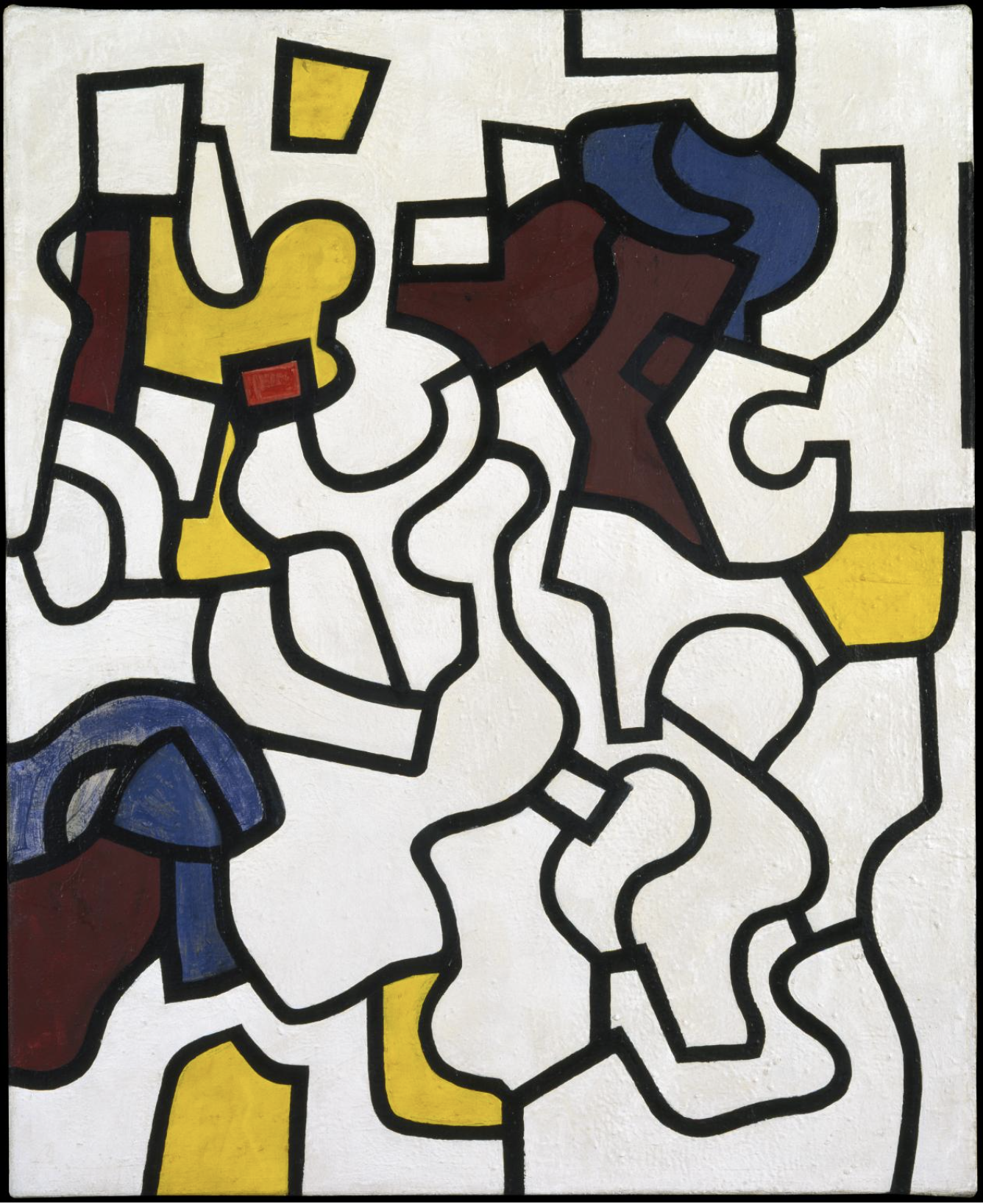
Untitled Composition
ROTHSCHILD
Judith Rothschild’s artistic journey was marked by experimentation and evolution. Gaining success as a young artist in New York in the 1940s, she moved through styles and subjects, informed by the cultural milieu that surrounded her. A part of the group of radical abstract artists known as the Jane Street Artists, she was involved in a proto-abstract expressionism, exploring emotional states through colour and non-figurative form. Yet, Rothschild, rather out of fashion, burned a flame for Cubism and Piet Mondrian especially was her most constant source of inspiration as she matured. She moved away from biomorphic forms and gestural brush work into compositional explorations that brought order and feeling to simple colors and organisations. Throughout her life she collected artworks by those who inspired her and, since her death, has become more known for her post-mortem philanthropy, her estate selling the works she accumulated to support lesser-known artists, of which she considered herself one.
Judith Rothschild
JUDITH ROTHSCHILD, 1945. OIL ON CANVAS.
Judith Rothschild’s artistic journey was marked by experimentation and evolution. Gaining success as a young artist in New York in the 1940s, she moved through styles and subjects, informed by the cultural milieu that surrounded her. A part of the group of radical abstract artists known as the Jane Street Artists, she was involved in a proto-abstract expressionism, exploring emotional states through colour and non-figurative form. Yet, Rothschild, rather out of fashion, burned a flame for Cubism and Piet Mondrian especially was her most constant source of inspiration as she matured. She moved away from biomorphic forms and gestural brush work into compositional explorations that brought order and feeling to simple colors and organisations. Throughout her life she collected artworks by those who inspired her and, since her death, has become more known for her post-mortem philanthropy, her estate selling the works she accumulated to support lesser-known artists, of which she considered herself one.

Untitled
ROTHKO
Rothko’s works are not intellectual. To try and understand them academically is to miss the point entirely. Though he exists in the genre of colour-field painting, mentored by none other than the father of modern colour theory Josef Albers, Rothko digested the ideas and conceptualisation and synthesised them into works of pure, unbridled emotion. Inspired by vases of antiquities with colour bands, Native American spiritual art and European surrealism, these paintings, now signatures of the artist, did not come out of nowhere. They developed slowly, from early figurative work Rothko fell more and more into a world of expression unaltered and uncorrupted by figuration. Rothko chose not to title these works unless it was numerical, ensuring that the viewer was free from context in their experience. Rothko’s work do not depict an external world but an interior one, and to see them in person is to get lost in a expanse of total feeling.
Mark Rothko
MARK ROTHKO, 1957. PIGMENTED HIDE GLUE AND OIL ON CANVAS.
Rothko’s works are not intellectual. To try and understand them academically is to miss the point entirely. Though he exists in the genre of colour-field painting, mentored by none other than the father of modern colour theory Josef Albers, Rothko digested the ideas and conceptualisation and synthesised them into works of pure, unbridled emotion. Inspired by vases of antiquities with colour bands, Native American spiritual art and European surrealism, these paintings, now signatures of the artist, did not come out of nowhere. They developed slowly, from early figurative work Rothko fell more and more into a world of expression unaltered and uncorrupted by figuration. Rothko chose not to title these works unless it was numerical, ensuring that the viewer was free from context in their experience. Rothko’s work do not depict an external world but an interior one, and to see them in person is to get lost in a expanse of total feeling.

Leaf Forms #8 (Copy)
LEWIS
“The goal of the artist must be aesthetic development”, said Norman Lewis, “And in a universal sense, to make in his own way some contribution to culture.” These two concepts – aesthetic expression and cultural reflection – define Lewis’ career of two halves. Born to two Bermudan parents in Harlem, Lewis discovered a passion art through a mentee relationship with Augusta Savage when he was working in a textile shop and tailor above her studio. Lewis began to paint social realism, depicting the scenes in Harlem with spirit and energy. Yet he struggled to capture the social conflict and communicate the truth of his existence through figurative work. It was out of this dissatisfaction that Lewis turned to the burgeoning Abstract Expressionism movement. He felt that his art was not able to make the social change he needed, and a dissatisfaction with post-war America led him to reject realism in favour of purely aesthetic work. Yet, despite his suggestions that these works rejected social issues, they are laden with both anger and beauty, reflecting politics implicitly in their feeling.
Norman Lewis
NORMAN LEWIS, 1953. INK ON PAPER.
“The goal of the artist must be aesthetic development”, said Norman Lewis, “And in a universal sense, to make in his own way some contribution to culture.” These two concepts – aesthetic expression and cultural reflection – define Lewis’ career of two halves. Born to two Bermudan parents in Harlem, Lewis discovered a passion art through a mentee relationship with Augusta Savage when he was working in a textile shop and tailor above her studio. Lewis began to paint social realism, depicting the scenes in Harlem with spirit and energy. Yet he struggled to capture the social conflict and communicate the truth of his existence through figurative work. It was out of this dissatisfaction that Lewis turned to the burgeoning Abstract Expressionism movement. He felt that his art was not able to make the social change he needed, and a dissatisfaction with post-war America led him to reject realism in favour of purely aesthetic work. Yet, despite his suggestions that these works rejected social issues, they are laden with both anger and beauty, reflecting politics implicitly in their feeling.

Jackie Triptych
WARHOL
John F. Kennedy was assassinated and Andy Warhol turned his, the nations, and Jackie’s pain into art. Dissatisfied with the media coverage, and acutely aware of the symbol that Jackie Kennedy was becoming, without agency or choice, Warhol re-enacted the event over and over again by silk-screening images of the grieving Kennedy taken from Life magazine. The work is at once compassionate and detached; by focusing on the first lady’s face, he emphasis and reminds us of her bravery, her courage and her grief, but he also participates in the process of removing her humanity and making her become an image, a representation of the nation and a historical event. Warhol, in 1964, was only beginning to get to grips with the new art of screen-printing, having started less than two years earlier. The Jackie works marked a turning point, as he realised the power of a repeatable medium, and how the images that were flooding public consciousness could be replicated, distorted and recontextualised to speak to a wider idea permeating the culture.
Andy Warhol
ANDY WARHOL, 1964. ACRYLIC PAINT, SILKSCREEN INK AND SPRAY PAINT ON LINEN.
John F. Kennedy was assassinated and Andy Warhol turned his, the nations, and Jackie’s pain into art. Dissatisfied with the media coverage, and acutely aware of the symbol that Jackie Kennedy was becoming, without agency or choice, Warhol re-enacted the event over and over again by silk-screening images of the grieving Kennedy taken from Life magazine. The work is at once compassionate and detached; by focusing on the first lady’s face, he emphasis and reminds us of her bravery, her courage and her grief, but he also participates in the process of removing her humanity and making her become an image, a representation of the nation and a historical event. Warhol, in 1964, was only beginning to get to grips with the new art of screen-printing, having started less than two years earlier. The Jackie works marked a turning point, as he realised the power of a repeatable medium, and how the images that were flooding public consciousness could be replicated, distorted and recontextualised to speak to a wider idea permeating the culture.