

Interior at Nice
HENRI MATISSE
Matisse had spend the decade preceding this work systematically dismantling centuries of art historical traditions. He revolutionised colour, perspective and form in bold works that almost single-handedly ushered in a new modernism, to rave reviews from the academic, artistic establishment and criticism and disdain from much of the general public. So when, after this revolutionary run of creation, he escaped Paris to settle in an isolated area of Nice and began to paint a series of works that seem almost fit for a postcard, the reaction was one of surprise above all. The paintings return to a figurative impressionism, and to many they seemed a betrayal of the new world that Matisse himself had begun, a step backwards away from progress and challenge and into safety, comfort and mundanity. Matisse, however, saw things differently; “I am seeking a new synthesis”, he said, “In which I have combined all that I have gained recently with what I knew and could do before.”
Henri Matisse
HENRI MATISSE, 1919. OIL ON CANVAS.
Matisse had spend the decade preceding this work systematically dismantling centuries of art historical traditions. He revolutionised colour, perspective and form in bold works that almost single-handedly ushered in a new modernism, to rave reviews from the academic, artistic establishment and criticism and disdain from much of the general public. So when, after this revolutionary run of creation, he escaped Paris to settle in an isolated area of Nice and began to paint a series of works that seem almost fit for a postcard, the reaction was one of surprise above all. The paintings return to a figurative impressionism, and to many they seemed a betrayal of the new world that Matisse himself had begun, a step backwards away from progress and challenge and into safety, comfort and mundanity. Matisse, however, saw things differently; “I am seeking a new synthesis”, he said, “In which I have combined all that I have gained recently with what I knew and could do before.”

Starry Night and the Astronauts
ALMA THOMAS
Alma Thomas never flew in an airplane, but as she aged, she began to dream of the skies and see the world from above. She started her artistic journey as a figurative artist, before adopting a more abstract approach and then, in the 1960s, she transformed once again and developed a style uniquely her own. Taking elements of pointillism, inspiration from Byzantine mosaics and West African painting, and finding thematic subjects in the burgeoning American Space Program, Thomas elevated her color-field painting into something altogether unique. Here, in the expanse of blue, where each brushstroke seems to shimmer and the glimpses of raw canvas below become flickering stars in the night sky, the small pool of red and orange burn bright as if a sign of life in the vastness. The flat canvas comes into staggering dimension that seem to speak of a birds eye view that undulates with light and form below us. Thomas’s work makes the viewer feel small in the face of color; it taps into something primal and earthly all the while suggesting the impossibility of scale in a universe that we cannot begin to understand or conquer.
Alma Thomas
ALMA THOMAS, 1972. ACRYLIC ON CANVAS.
Alma Thomas never flew in an airplane, but as she aged, she began to dream of the skies and see the world from above. She started her artistic journey as a figurative artist, before adopting a more abstract approach and then, in the 1960s, she transformed once again and developed a style uniquely her own. Taking elements of pointillism, inspiration from Byzantine mosaics and West African painting, and finding thematic subjects in the burgeoning American Space Program, Thomas elevated her color-field painting into something altogether unique. Here, in the expanse of blue, where each brushstroke seems to shimmer and the glimpses of raw canvas below become flickering stars in the night sky, the small pool of red and orange burn bright as if a sign of life in the vastness. The flat canvas comes into staggering dimension that seem to speak of a birds eye view that undulates with light and form below us. Thomas’s work makes the viewer feel small in the face of color; it taps into something primal and earthly all the while suggesting the impossibility of scale in a universe that we cannot begin to understand or conquer.

The Herring Net
WINSLOW HOMER
Spending a year in a small fishing village on the English coast, the through and through New Englander Winslow Homer’s life changed. He had spent decades making a living as an illustrator, and was moving into painting with moderate success. His subjects were society folks, historical vignettes and scenes of pastoral, rural idyl that spoke to a nostalgic view of America. A naturally gifted painted, and almost entirely self-taught, the work is moving, delicate, and beautifully rendered though at times emotionally shallow. His time spent in England changed his understanding of the purpose of painting, as he saw the quiet, everyday heroism of working people. For the rest of his life, after that year, he rarely painted anything else. His theme became the eternal battle between man and nature, and he depicted with respect and revelry those who fought small battles for sustenance every day. Here, two men, precarious in their small boat against a rolling sea, pull in herring from a net. Winslow’s use of scale is remarkable - the figures absorb the eye, looming large against the horizon as if by their sheer heft they conquered nature. Yet the boat is small, and their actions, though painted in drama, are mundane and ordinary. Homer elevated daily life into something profound, and found the heroism in the overlooked.
Winslow Homer
WINSLOW HOMER, 1885. OIL ON CANVAS..
Spending a year in a small fishing village on the English coast, the through and through New Englander Winslow Homer’s life changed. He had spent decades making a living as an illustrator, and was moving into painting with moderate success. His subjects were society folks, historical vignettes and scenes of pastoral, rural idyl that spoke to a nostalgic view of America. A naturally gifted painted, and almost entirely self-taught, the work is moving, delicate, and beautifully rendered though at times emotionally shallow. His time spent in England changed his understanding of the purpose of painting, as he saw the quiet, everyday heroism of working people. For the rest of his life, after that year, he rarely painted anything else. His theme became the eternal battle between man and nature, and he depicted with respect and revelry those who fought small battles for sustenance every day. Here, two men, precarious in their small boat against a rolling sea, pull in herring from a net. Winslow’s use of scale is remarkable - the figures absorb the eye, looming large against the horizon as if by their sheer heft they conquered nature. Yet the boat is small, and their actions, though painted in drama, are mundane and ordinary. Homer elevated daily life into something profound, and found the heroism in the overlooked.

Carnival in Arcueil
LYONEL FEININGER
At the age of thirty six, already well into a successful career as a cartoonist, Lionel Feininger began to pursue a full time career as a fine artist. It did not take long for this career change to prove fruitful, his already well-learnt hand adapted well from ink to oil and even his early paintings, such as this, show a seemly effortless mastery of form, color and composition. In this circus scene located in the town of Arcueil, just south of Paris, the dual mediums are clear, painter and cartoonist work together in a dizzy blend that entices and disturbs. The background and the setting are painterly, drawing form the Seccessionists in its yellow hues and elegant architectural renderings as much as it shows a clear influence of Van Gogh in the swelling roofs of the house blocks and the swirling sky above. The figures however, grotesque and exaggerated as they march through the town, point to his past as a cartoonist. They are vaguely sinister, and their faces are rendered in minimal details, expressionists brought out by simple lines from years of training with ink drawings. Set against the more delicate, painterly background, there is a strange duality to the work that creates a subconscious discomfort that lends itself perfectly to the subject matter Feininger depicts.
Lyonel Feininger
LYONEL FEININGER, 1911. OIL ON CANVAS.
At the age of thirty six, already well into a successful career as a cartoonist, Lyonel Feininger began to pursue a full time career as a fine artist. It did not take long for this career change to prove fruitful, his already well-learnt hand adapted well from ink to oil and even his early paintings, such as this, show a seemly effortless mastery of form, color and composition. In this circus scene located in the town of Arcueil, just south of Paris, the dual mediums are clear, painter and cartoonist work together in a dizzy blend that entices and disturbs. The background and the setting are painterly, drawing form the Seccessionists in its yellow hues and elegant architectural renderings as much as it shows a clear influence of Van Gogh in the swelling roofs of the house blocks and the swirling sky above. The figures however, grotesque and exaggerated as they march through the town, point to his past as a cartoonist. They are vaguely sinister, and their faces are rendered in minimal details, expressionists brought out by simple lines from years of training with ink drawings. Set against the more delicate, painterly background, there is a strange duality to the work that creates a subconscious discomfort that lends itself perfectly to the subject matter Feininger depicts.

The Railway Crossing
FERNAND LÉGER
Informed and inspired by the fledgling Cubism of Picasso and Braque, Léger imbued the movement with a joyousness expressed in curvature and color. He saw machines and industrialisation as subjects just as important as people in his work, and the optimism he felt for the modern age is clear in every brushstroke. This was a study for a larger piece named ‘The Level Crossing’, and the scaffolding, tubular pipes, and signposts depicted take on an almost photo-pop art quality as the industrial workings of a train yard are transformed into a wonderland of bright shapes and shifting perspectives. Trains long represented the beginning of a new age, and in this study for what Léger would consider a portrait of sorts, he elevates the elder statesman of modernity into a beacon of hope for the future, and a triumph of the contemporary age.
Fernand Léger
FERNAND LÉGER, 1919. OIL ON CANVAS.
Informed and inspired by the fledgling Cubism of Picasso and Braque, Léger imbued the movement with a joyousness expressed in curvature and color. He saw machines and industrialisation as subjects just as important as people in his work, and the optimism he felt for the modern age is clear in every brushstroke. This was a study for a larger piece named ‘The Level Crossing’, and the scaffolding, tubular pipes, and signposts depicted take on an almost photo-pop art quality as the industrial workings of a train yard are transformed into a wonderland of bright shapes and shifting perspectives. Trains long represented the beginning of a new age, and in this study for what Léger would consider a portrait of sorts, he elevates the elder statesman of modernity into a beacon of hope for the future, and a triumph of the contemporary age.

Christ Crucified
DIEGO VELÁZQUEZ
The flesh of Christ is so alive, so exquisitely rendered in oil such that we can almost see the pores of his skin, as to cause devotion and reverence at the sheer sight of it. This was the intended effect. Velazquez was painting at the time of the Catholic Reformation where an enormous emphasis was placed on Transubstantiation and thus the body of Christ was seen as a symbol of rebellious Catholicism in the face of the rising Protestantism. Hired as a court painter of the Spanish King Phillip IV, who tolerated a slow pace of work because he saw that he was a once-in-a-generation genius, Velazquez moved more towards religious imagery and away from the historical work and portraiture that had made his name. The paintings made under this patronage are amongst his most famous and significant, using his immense technical skill and a deep understanding of the transformational power of art to create stirring works of holy ordinance that elevate history and allegory into something tangible.
Diego Velázquez
DIEGO VELÁZQUEZ, 1632. OIL ON CANVAS.
The flesh of Christ is so alive, so exquisitely rendered in oil such that we can almost see the pores of his skin, as to cause devotion and reverence at the sheer sight of it. This was the intended effect. Velázquez was painting at the time of the Catholic Reformation where an enormous emphasis was placed on Transubstantiation and thus the body of Christ was seen as a symbol of rebellious Catholicism in the face of the rising Protestantism. Hired as a court painter of the Spanish King Phillip IV, who tolerated a slow pace of work because he saw that he was a once-in-a-generation genius, Velázquez moved more towards religious imagery and away from the historical work and portraiture that had made his name. The paintings made under this patronage are amongst his most famous and significant, using his immense technical skill and a deep understanding of the transformational power of art to create stirring works of holy ordinance that elevate history and allegory into something tangible.

Golden Bird
CONSTANTIN BRANCUSI
As a child, Brancusi was told folk tales of a beneficent, dazzlingly plumed golden bird. The Maiastra is a character in the Romanian folklore and the descriptions he heard from stories told by matriarchs flew around his mind as a child. As he begun to understand his calling as an artist in his teenage, his preoccupation with the image of this bird as a formal object, plastic and changeable, began. Brancusi made more than 30 variations of this theme, the most minute adjustments radically changing the sculpture’s weight and feeling within space. The plumage is simplified into medium, polished bronze that catches the light and seems to take flight, and the bird is reduced to it’s constituents parts, delicate in its balance on a small base but imposing in its power. This example is amongst the most minimal, simplified down to a single form with no adornment and little suggestion of subject yet, if you know what you are looking for, the bird takes flight and elegance. Brancusi’s genius was in the finding of an essence, removing the pomp and ornament of people, objects, and beings and distilling them into something approaching pure truth. His bird is a platonic ideal, universally recognisable and yet open to the possibility of immense and infinite variation.
Constantin Brancusi
CONSTANTIN BRANCUSI, c.1919. BRONZE, STONE, AND WOOD.
As a child, Brancusi was told folk tales of a beneficent, dazzlingly plumed golden bird. The Maiastra is a character in the Romanian folklore and the descriptions he heard from stories told by matriarchs flew around his mind as a child. As he begun to understand his calling as an artist in his teenage, his preoccupation with the image of this bird as a formal object, plastic and changeable, began. Brancusi made more than 30 variations of this theme, the most minute adjustments radically changing the sculpture’s weight and feeling within space. The plumage is simplified into medium, polished bronze that catches the light and seems to take flight, and the bird is reduced to it’s constituents parts, delicate in its balance on a small base but imposing in its power. This example is amongst the most minimal, simplified down to a single form with no adornment and little suggestion of subject yet, if you know what you are looking for, the bird takes flight and elegance. Brancusi’s genius was in the finding of an essence, removing the pomp and ornament of people, objects, and beings and distilling them into something approaching pure truth. His bird is a platonic ideal, universally recognisable and yet open to the possibility of immense and infinite variation.

Dream on the Beach
FEDERICO CASTELLÓN
A self-taught artist and young prodigy, Catellón moved from his native Spain to Brooklyn, New York with his family at the age of seven. He was, even at this age, a gifted draughtsman and sketched relentlessly, and he spent his childhood taking advantage of the new city he lived in by visiting museums and exhibitions constantly. By the time he was a teenager, Castellón’s inspirations ranged from the Old Masters at the Metropolitan Museum of Art to the burgeoning, contemporary Surrealist scene he had witnessed at small galleries. Before he had even graduated high school, he had caught the attention of Diego Rivera, who by this point was internationally acclaimed with public murals across the country. It was with Rivera’s help that Catellón travelled across Europe in his early twenties, taking in the emerging avant-garde and, on his return to New York, laid his claim as the very first American Surrealist. His etchings and sketches circulated the country and contributed to the rise of one of the most consequential movements of the century.
Federico Castellón
FEDERICO CASTELLÓN, 1936. GRAPHITE PENCIL ON PAPER.
A self-taught artist and young prodigy, Catellón moved from his native Spain to Brooklyn, New York with his family at the age of seven. He was, even at this age, a gifted draughtsman and sketched relentlessly, and he spent his childhood taking advantage of the new city he lived in by visiting museums and exhibitions constantly. By the time he was a teenager, Castellón’s inspirations ranged from the Old Masters at the Metropolitan Museum of Art to the burgeoning, contemporary Surrealist scene he had witnessed at small galleries. Before he had even graduated high school, he had caught the attention of Diego Rivera, who by this point was internationally acclaimed with public murals across the country. It was with Rivera’s help that Catellón travelled across Europe in his early twenties, taking in the emerging avant-garde and, on his return to New York, laid his claim as the very first American Surrealist. His etchings and sketches circulated the country and contributed to the rise of one of the most consequential movements of the century.
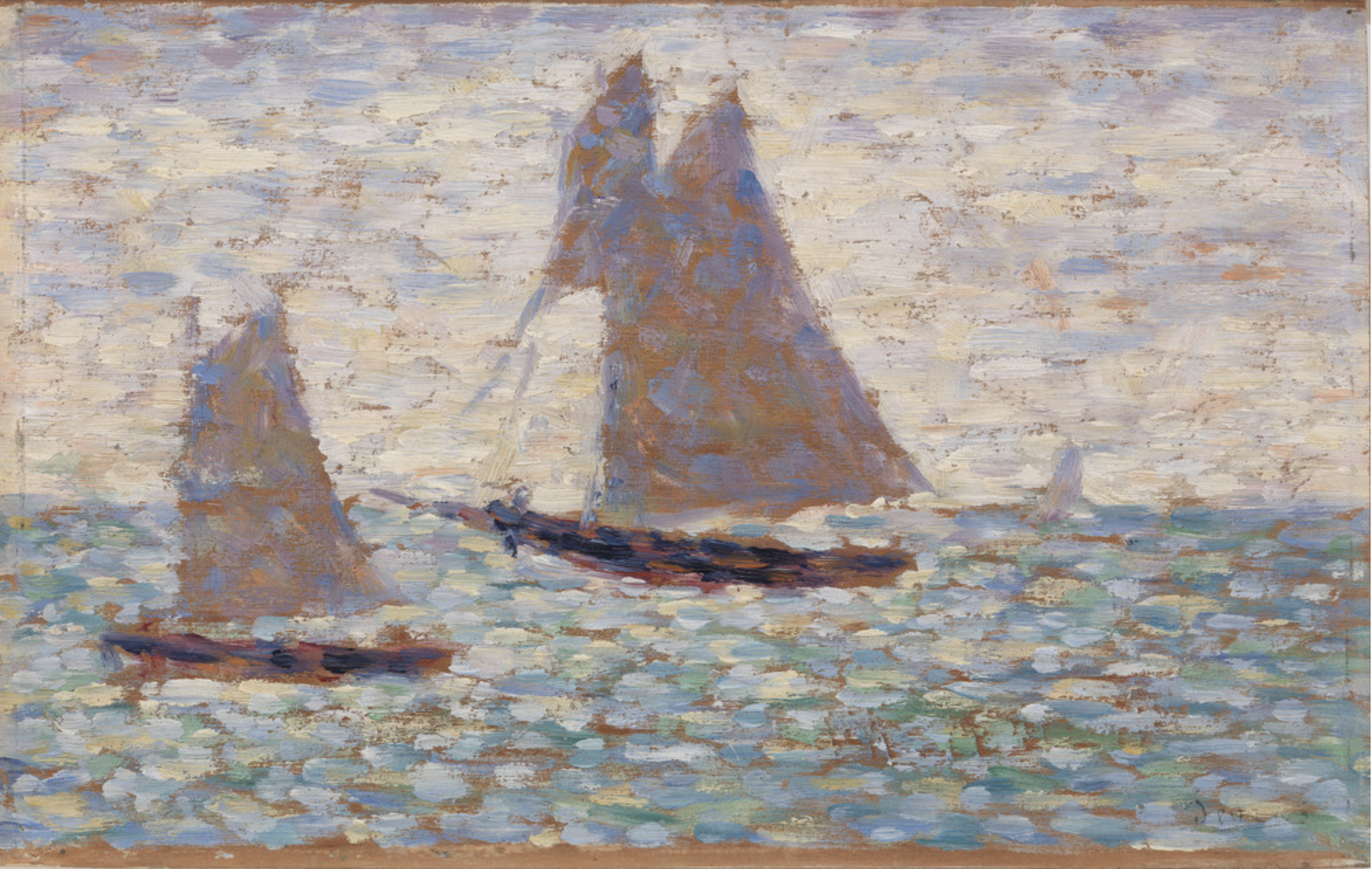
Two Sailboats at Grandcamp
GEORGES SEURAT
Known for his exacting, pointillist style where thousands of precise points of color create a soaring, monumental work - this painting is an example of Seurat’s process. Painting en plein air, which was the vogue of the day where artists would paint outside from life to capture the extreme present of light and atmosphere, Seurat would take these studies back to his studio to transform them into larger works. Out in the wild, the points are transformed into broad, loose brushstrokes and the blues, grays, and greens of the Normandy coastline are suggested by the evidence of a human hand, smearing work on the panel. Seurat, like so many of the avant-garde artists of his day, spent his summer in the boating towns of Northern France. The slower pace of life let him develop his process and style, and it is in these small studies on panels that we can see the inner working of his mind, grappling with his ambitions to capture space and time in a radical new way.
Georges Seurat
GEORGES SEURAT, 1885. OIL ON PANEL.
Known for his exacting, pointillist style where thousands of precise points of color create a soaring, monumental work - this painting is an example of Seurat’s process. Painting en plein air, which was the vogue of the day where artists would paint outside from life to capture the extreme present of light and atmosphere, Seurat would take these studies back to his studio to transform them into larger works. Out in the wild, the points are transformed into broad, loose brushstrokes and the blues, grays, and greens of the Normandy coastline are suggested by the evidence of a human hand, smearing work on the panel. Seurat, like so many of the avant-garde artists of his day, spent his summer in the boating towns of Northern France. The slower pace of life let him develop his process and style, and it is in these small studies on panels that we can see the inner working of his mind, grappling with his ambitions to capture space and time in a radical new way.
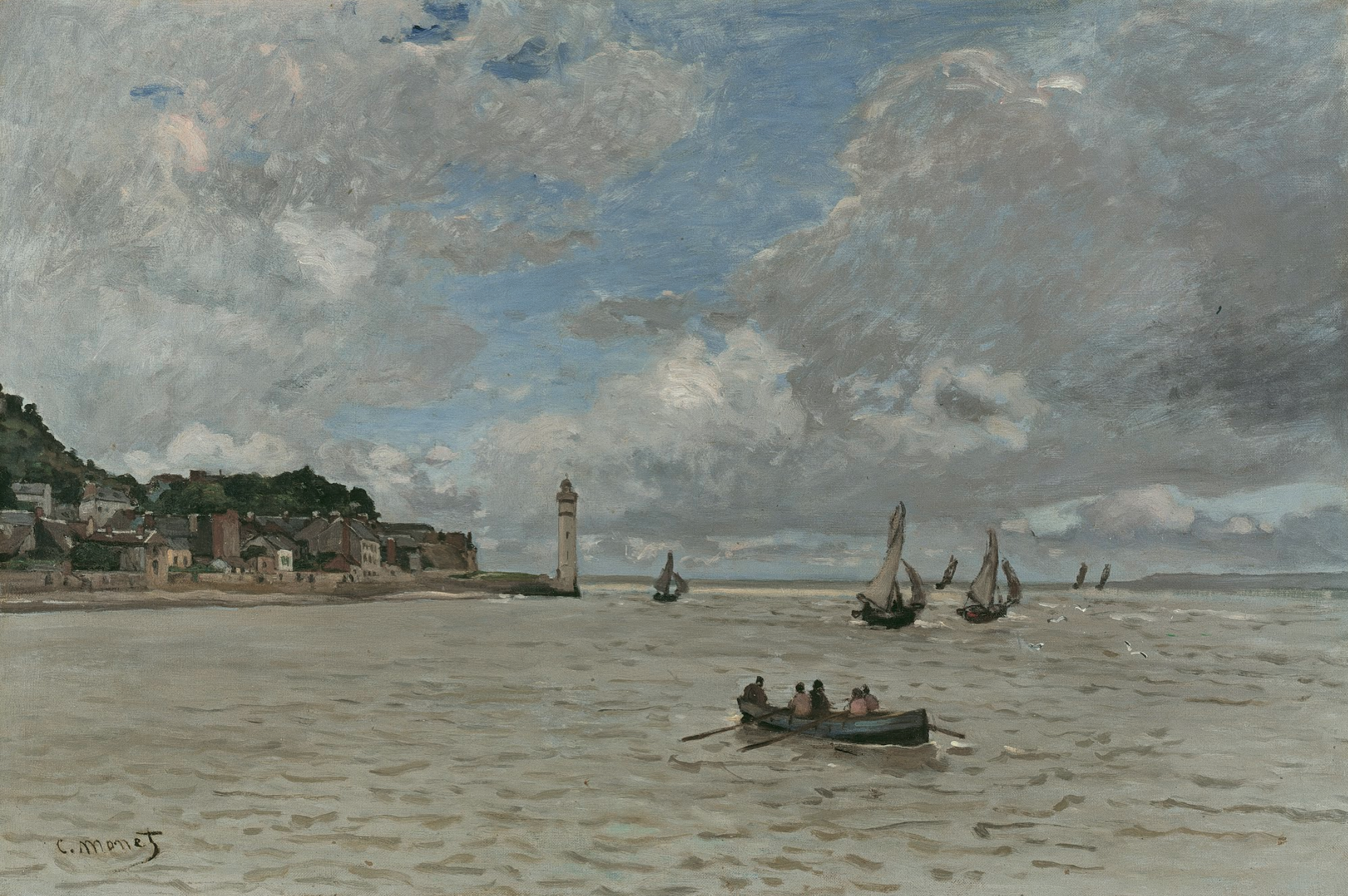
The Lighthouse at Honfleur
CLAUDE MONET
Monet and his friend, the artist Frédéric Bazille, spent the summer of 1864 on the Northern French coast at the summer house of Monet’s parents. There, they kept gentle hours and spent the days painting en plein air, depicting the area around Honfleur from dozens of different viewpoints. The works are typically Impressionist in the style, short thick brushstrokes that capture a feeling of summertime, but they are perhaps more exacting in their detail than later works by Monet where a looseness on display here became more dominant. Monet was a young man, still finding the essence of the style he would come to represent, and Bazille was his closest friend in these years. Together, the two artists traveled France in search of motifs, and they found it in Honfleur. The varied landscape provided ample opportunity to experiment and refine, and by the end of the summer Monet had broken through into a new maturity of style that would rise as he became the most significant painter of his generation.
CLAUDE MONET
CLAUDE MONET, 1864. OIL ON CANVAS.
Monet and his friend, the artist Frédéric Bazille, spent the summer of 1864 on the Northern French coast at the summer house of Monet’s parents. There, they kept gentle hours and spent the days painting en plein air, depicting the area around Honfleur from dozens of different viewpoints. The works are typically Impressionist in the style, short thick brushstrokes that capture a feeling of summertime, but they are perhaps more exacting in their detail than later works by Monet where a looseness on display here became more dominant. Monet was a young man, still finding the essence of the style he would come to represent, and Bazille was his closest friend in these years. Together, the two artists traveled France in search of motifs, and they found it in Honfleur. The varied landscape provided ample opportunity to experiment and refine, and by the end of the summer Monet had broken through into a new maturity of style that would rise as he became the most significant painter of his generation.

Orestes and Pylades Disputing at the Altar
PIETER LASTMAN
In the throngs of a crowd, as the heat of a burning altar warms their faces, two friends decide which one of them is to die and which is to live. Orestes and Pylades, so goes the ancient Greek tale, had travelled to Tauris to steal the statue of Artemis, but were found out and, as was custom for any unwanted visitor, sentenced to death at the altar. Yet, taking pity on the friends, the priestess of the temple allowed them to chose between them who was to be sacrificed for the other. Both fought for their own death, to save their friend and, in the end, neither were killed as the priestess of the temple was none other than Orestes long lost sister Iphigenia. Lastman was the first artist to paint this story, and for all of it’s complications, his rendering is succinct and effective. He cuts through much of the contextual difficulty of the story to find the heart of the fable - one of sacrifice, and the platonic love between friends and siblings.
Pieter Pieterzs Lastman
PIETER PIETERZS LASTMAN, 1614. ON ON PANEL.
In the throngs of a crowd, as the heat of a burning altar warms their faces, two friends decide which one of them is to die and which is to live. Orestes and Pylades, so goes the ancient Greek tale, had travelled to Tauris to steal the statue of Artemis, but were found out and, as was custom for any unwanted visitor, sentenced to death at the altar. Yet, taking pity on the friends, the priestess of the temple allowed them to chose between them who was to be sacrificed for the other. Both fought for their own death, to save their friend and, in the end, neither were killed as the priestess of the temple was none other than Orestes long lost sister Iphigenia. Lastman was the first artist to paint this story, and for all of it’s complications, his rendering is succinct and effective. He cuts through much of the contextual difficulty of the story to find the heart of the fable - one of sacrifice, and the platonic love between friends and siblings.

Special Drawing Number 8
GEORGIA O’KEEFE
While cubism swept America and predominantly male artists found sacred abstraction in harsh, geometric forms, Georgia O’Keefe was looking elsewhere. A pioneer of the abstract American painting, she was not interested in the rigorous, almost mathematical deconstruction of the European schools that found its abstraction through an imposed distance from the natural seen world. Instead, she looked directly to nature, finding beauty and inspiration in the organic forms that surrounded her and the rhythms of the living world. She began a series of charcoal drawings that tried to place the images she found in her subconscious, forms that for her were perhaps a part of the universal psyche but difficult to access. They are grasps towards the unknown, ways to capture a feeling of existence by isolating the movement of nature, and she returned, over the course of her career to the spiral. Seen here in fleshy monotone, it speaks at once to life and death, a dark void that moves downwards until it finds the centre and here, experiences rebirth.
Georgia O’Keefe
GEORGIA O’KEEFE, 1916. CHARCOAL ON PAPER.
While cubism swept America and predominantly male artists found sacred abstraction in harsh, geometric forms, Georgia O’Keefe was looking elsewhere. A pioneer of the abstract American painting, she was not interested in the rigorous, almost mathematical deconstruction of the European schools that found its abstraction through an imposed distance from the natural seen world. Instead, she looked directly to nature, finding beauty and inspiration in the organic forms that surrounded her and the rhythms of the living world. She began a series of charcoal drawings that tried to place the images she found in her subconscious, forms that for her were perhaps a part of the universal psyche but difficult to access. They are grasps towards the unknown, ways to capture a feeling of existence by isolating the movement of nature, and she returned, over the course of her career to the spiral. Seen here in fleshy monotone, it speaks at once to life and death, a dark void that moves downwards until it finds the centre and here, experiences rebirth.

Milk Drop Coronet
HAROLD E. EDGERTON
With new mediums come new realities. In the fledgling days of photography, Eadweard Muybridge photographed movement to show a hidden world, capturing for the first time with a camera that which the human eye could not see and freezing time into thousands of single moments that could be analysed, explored and understood. It would be another 50 years, with the electrical engineer Harold Edgerton, for the very fabric of our perception to be changed by the camera again. Edgerton built a device capable of shooting quickly, and at close range, with the shutter responding to the a disruption caused by the falling drip across a laser sight. It is, perfectly, at the intersection between art and science and the resulting photograph, though it exists in many guises over the 20 years Edgerton experimented, has become one of the most important and significant photographs ever taken. Edgerton did not consider himself an artist, and it is true that the process of creation was entirely mechanical, but he did set the scenes, and build the device that allowed the removal of his hand from the process. And yet in this way, he did so successfully what all artists strive to do: capture truth and show through creation a new perspective on the world around us.
Harold E. Edgerton
HAROLD E. EDGERTON, c.1936. GELATIN SILVER PRINT.
With new mediums come new realities. In the fledgling days of photography, Eadweard Muybridge photographed movement to show a hidden world, capturing for the first time with a camera that which the human eye could not see and freezing time into thousands of single moments that could be analysed, explored and understood. It would be another 50 years, with the electrical engineer Harold Edgerton, for the very fabric of our perception to be changed by the camera again. Edgerton built a device capable of shooting quickly, and at close range, with the shutter responding to the a disruption caused by the falling drip across a laser sight. It is, perfectly, at the intersection between art and science and the resulting photograph, though it exists in many guises over the 20 years Edgerton experimented, has become one of the most important and significant photographs ever taken. Edgerton did not consider himself an artist, and it is true that the process of creation was entirely mechanical, but he did set the scenes, and build the device that allowed the removal of his hand from the process. And yet in this way, he did so successfully what all artists strive to do: capture truth and show through creation a new perspective on the world around us.

Allegory of the Catholic Faith
JOHANNES VERMEER
The Dutch Republic of the 1600s was ruled by an aristocratic merchant class of predominantly Calvinists, a Christian branch that emphasised modesty, frugality, and hard work. To advance this belief system as the dominant understanding of the day, they outlawed the public practice of Catholicism, including Mass. Yet while the open display of faith was illegal, to believe was not, so Catholicism retreated inside, to private homes and personal churches built in living rooms and attics across the Netherlands. Johannes Vermeer, a converted Catholic through marriage, painted this, one of his rare allegorical works, in an act of defiant rebellion. Drawing on common symbolism, he paints the Catholic Faith as a woman, conquering the world and the keystone of Christ crushing the evil snake ahead of her. A tapestry is drawn back to reveal the scene, placing us in a ‘hidden church’ and so Vermeer is able, in this way, to stay true to his style of domestic scenes while making allusions to the largest of ideas. Each object is rich in meaning, and Vermeer tells a complicated story through a straightforward scene but the overarching feeling in the painting is one of defiance. Through hardship and rejection, faith will persevere and stand atop the world, broken, tired perhaps, but proud.
Johannes Vermeer
JOHANNES VERMEER, c.1670. OIL ON CANVAS.
The Dutch Republic of the 1600s was ruled by an aristocratic merchant class of predominantly Calvinists, a Christian branch that emphasised modesty, frugality, and hard work. To advance this belief system as the dominant understanding of the day, they outlawed the public practice of Catholicism, including Mass. Yet while the open display of faith was illegal, to believe was not, so Catholicism retreated inside, to private homes and personal churches built in living rooms and attics across the Netherlands. Johannes Vermeer, a converted Catholic through marriage, painted this, one of his rare allegorical works, in an act of defiant rebellion. Drawing on common symbolism, he paints the Catholic Faith as a woman, conquering the world and the keystone of Christ crushing the evil snake ahead of her. A tapestry is drawn back to reveal the scene, placing us in a ‘hidden church’ and so Vermeer is able, in this way, to stay true to his style of domestic scenes while making allusions to the largest of ideas. Each object is rich in meaning, and Vermeer tells a complicated story through a straightforward scene but the overarching feeling in the painting is one of defiance. Through hardship and rejection, faith will persevere and stand atop the world, broken, tired perhaps, but proud.

River Landscape with a Boar Hunt
JOOS DE MOMPER
Some artists cannot escape the death of their tradition. After a century of public adoration and a meteoric rise to the visual vogue, World Landscapes, those imagined, idyllic scenes with biblical influence where figures are dwarfed by their beautiful surroundings, were falling out of favour. Joos de Momper, born in 1567, was too much a man of his time. A master of these dreamlike landscapes, he was not able to adapt to the changing styles that found beauty in realism and more mundane depictions of life. Instead, he found himself as the figurehead of the death of a movement, representing a tradition that the contemporary age found little purpose for. His attempts to adapt were noble in effort, and as he aged the vantage point of his work moved downwards - his fantasy worlds were seen from above while the real world from below; in the former he had the gaze of a creator, and in the latter only that of a common man. He found little success with these later works, and his reputation was tarnished beyond repair such that he died in debt to little acclaim. But though he was caught on the precipice of history, de Momper’s works are feats of beauty and imagination that seem to transcend time today.
Joos de Momper
JOOS DE MOMPER, c.1600. OIL ON PANEL.
Some artists cannot escape the death of their tradition. After a century of public adoration and a meteoric rise to the visual vogue, World Landscapes, those imagined, idyllic scenes with biblical influence where figures are dwarfed by their beautiful surroundings, were falling out of favour. Joos de Momper, born in 1567, was too much a man of his time. A master of these dreamlike landscapes, he was not able to adapt to the changing styles that found beauty in realism and more mundane depictions of life. Instead, he found himself as the figurehead of the death of a movement, representing a tradition that the contemporary age found little purpose for. His attempts to adapt were noble in effort, and as he aged the vantage point of his work moved downwards - his fantasy worlds were seen from above while the real world from below; in the former he had the gaze of a creator, and in the latter only that of a common man. He found little success with these later works, and his reputation was tarnished beyond repair such that he died in debt to little acclaim. But though he was caught on the precipice of history, de Momper’s works are feats of beauty and imagination that seem to transcend time today.
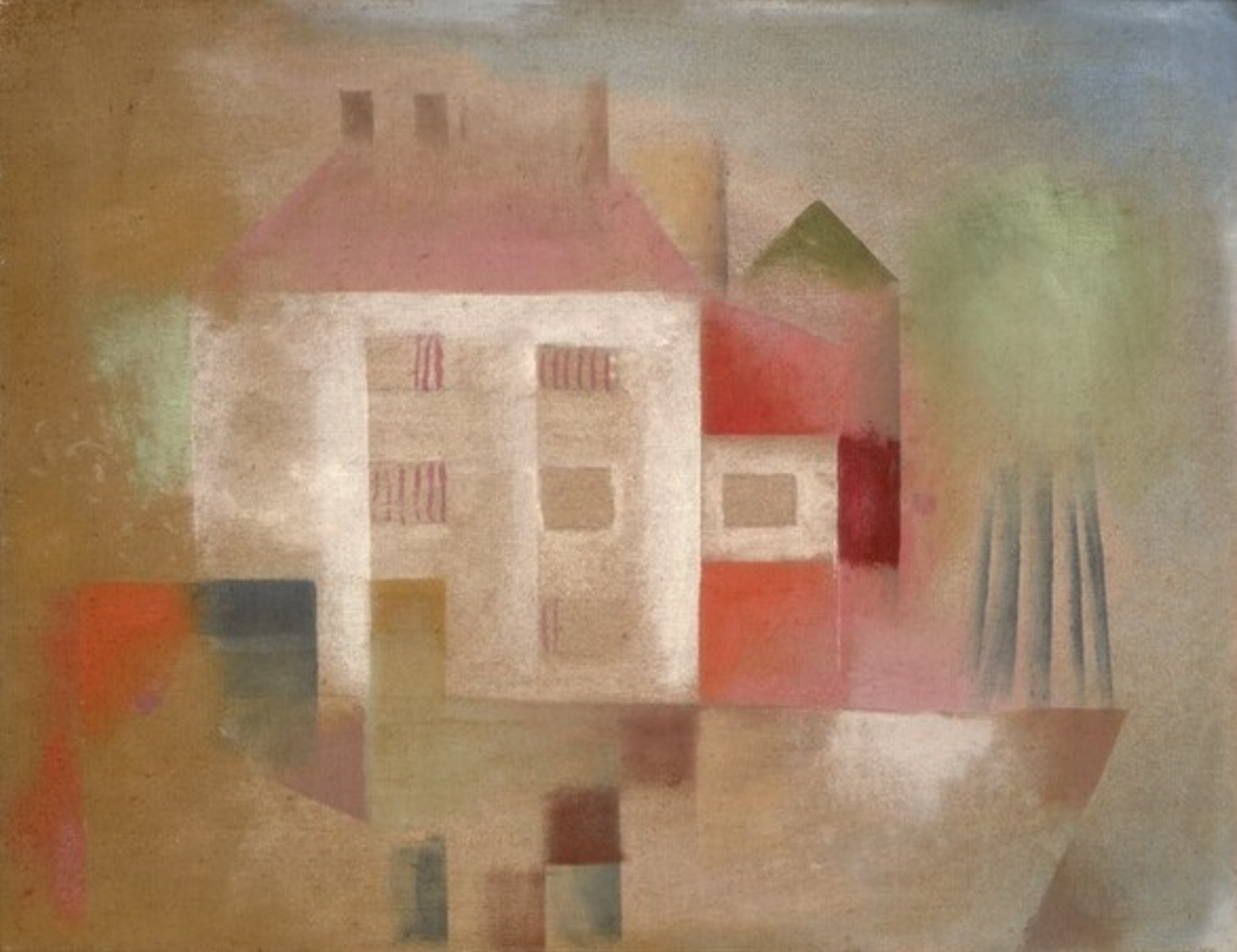
New House in the Suburbs
PAUL KLEE
When the spirit of rebellion and revolution is in you, the medium to express it becomes secondary. Encouraged by his parents to become a musician, Paul Klee was drawn to the traditional compositions of the 18th century and couldn’t find meaning or the space for radical change in modern music. So, despite a natural talent and expectations, Klee abandoned the practice of music in favour of visual arts where he felt free to express his yearnings for revolution. The decision proved fruitful, and a near forty year career that took Klee across the word resulted in works and writings that radically changed the direction of modern art. A teacher at the Bauhaus, alongside his great friend Wassily Kandinsky, Klee’s images are studies of colour theory, underpinned by a dry wit. It was through a lack of natural understanding of colour but skill as a draftsman that drove Klee to find a new theory of colour, one that would become the standard understanding for generations to come.
Paul Klee
PAUL KLEE, 1924. GOUACHE ON CANVAS.
When the spirit of rebellion and revolution is in you, the medium to express it becomes secondary. Encouraged by his parents to become a musician, Paul Klee was drawn to the traditional compositions of the 18th century and couldn’t find meaning or the space for radical change in modern music. So, despite a natural talent and expectations, Klee abandoned the practice of music in favour of visual arts where he felt free to express his yearnings for revolution. The decision proved fruitful, and a near forty year career that took Klee across the word resulted in works and writings that radically changed the direction of modern art. A teacher at the Bauhaus, alongside his great friend Wassily Kandinsky, Klee’s images are studies of colour theory, underpinned by a dry wit. It was through a lack of natural understanding of colour but skill as a draftsman that drove Klee to find a new theory of colour, one that would become the standard understanding for generations to come.

Untitled
ALEKSANDER RODCHENKO
One year after this artwork was made, Rodchenko declared the end of painting. In a seminal exhibition in his native Russia, he presented three works, each a canvas displaying a single colour - the first monochromatic paintings in art history. “I reduced painting to its logical conclusion”, he said, “I affirmed: it’s all over”. But this did not come from nowhere, in fact Rodchenko had been engaging in quiet revolution and dissent for most of his artistic life, creating work that built off of Kazemir Malevich’s Suprematism to find the simplest reduction of form possible. For all of his work as a painter, it is graphic design that perhaps owes its greatest debt to Rodchenko’s geometric renderings. He worked methodically, trying to illuminate human visibility in his works, making his brushstrokes so clinical as to look machine operated. He had an innate understanding of composition and colour, and so much of the simplicity of contemporary design was born from a young man in 1920’s Russia’s attempts at finding order in a world of chaos.
Aleksander Rodchenko
ALEKSANDER RODCHENKO, 1920. OIL ON WOOD.
One year after this artwork was made, Rodchenko declared the end of painting. In a seminal exhibition in his native Russia, he presented three works, each a canvas displaying a single colour - the first monochromatic paintings in art history. “I reduced painting to its logical conclusion”, he said, “I affirmed: it’s all over”. But this did not come from nowhere, in fact Rodchenko had been engaging in quiet revolution and dissent for most of his artistic life, creating work that built off of Kazemir Malevich’s Suprematism to find the simplest reduction of form possible. For all of his work as a painter, it is graphic design that perhaps owes its greatest debt to Rodchenko’s geometric renderings. He worked methodically, trying to illuminate human visibility in his works, making his brushstrokes so clinical as to look machine operated. He had an innate understanding of composition and colour, and so much of the simplicity of contemporary design was born from a young man in 1920’s Russia’s attempts at finding order in a world of chaos.

Portrait of Louis Pasteur
ALBERT EDELFELT
Edelfelt took the techniques of the past to a distinctly contemporary scene. As one of the founders of the Finnish Realism movement, he painted the world as he saw it, adding no adornment and instead trying to depict the beauty in the everyday. In this, his most famous work and the most significant representation of the great scientist Louis Pasteur, Edelfelt found his perfect subject. Depicting Pasteur in his laboratory, surrounded by the cutting edge technology of the day, Edelfelt was able to depict the inherent beauty of modernity, and how the elegance of functionality and labour could be as aesthetically significant as the loftiest subjects. Though Pasteur was already revered when this portrait was painted, in fact he is depicted holding a rabbit’s spine that helped him develop the vaccine for Rabies and save untold lives across the centuries, there is a humbleness to the reality of the scene around him. The lighting, though reminiscent of the chiaroscuro of the Renaissance, is realistic, and the generosity paid is only to detail, Edelfelt is able to at once elevate the man and place him firmly within reality, depicting the simple truth that an everyday man and a genius can be one and the same.
Albert Edelfelt
ALBERT EDELFT, 1885. OIL ON CANVAS.
Edelfelt took the techniques of the past to a distinctly contemporary scene. As one of the founders of the Finnish Realism movement, he painted the world as he saw it, adding no adornment and instead trying to depict the beauty in the everyday. In this, his most famous work and the most significant representation of the great scientist Louis Pasteur, Edelfelt found his perfect subject. Depicting Pasteur in his laboratory, surrounded by the cutting edge technology of the day, Edelfelt was able to depict the inherent beauty of modernity, and how the elegance of functionality and labour could be as aesthetically significant as the loftiest subjects. Though Pasteur was already revered when this portrait was painted, in fact he is depicted holding a rabbit’s spine that helped him develop the vaccine for Rabies and save untold lives across the centuries, there is a humbleness to the reality of the scene around him. The lighting, though reminiscent of the chiaroscuro of the Renaissance, is realistic, and the generosity paid is only to detail, Edelfelt is able to at once elevate the man and place him firmly within reality, depicting the simple truth that an everyday man and a genius can be one and the same.

Mosaic Head
HENRY DE WAROQUIER
Studies of architecture and mythology shifted the young de Waroquier away from a career in biology and towards one in art. From the latter, he learnt of Greek art, and its foundational idea that man existed at the centre of the universe. From the former, the ability and power to shape that universe, to respect it through the act of creation and the values that contributions to its landscape have in the right hands. As a child he had spent hours at the Natural History Museum of France, and was drawn to the minerals and fossils that seemed to speak of a unknown world hidden from public view; it was unsurprising then, that as he began to create images it was ones that spoke to a past, unknowable and often created world. His paintings combined the surreal imagery of the unconscious with the historical mediums of popular imagination, combining in a gentle cohesion that seems to transcend time.
Henry de Waroquier
HENRY DE WAROQUIER, 1937. OIL UNDER GLASS.
Studies of architecture and mythology shifted the young de Waroquier away from a career in biology and towards one in art. From the latter, he learnt of Greek art, and its foundational idea that man existed at the centre of the universe. From the former, the ability and power to shape that universe, to respect it through the act of creation and the values that contributions to its landscape have in the right hands. As a child he had spent hours at the Natural History Museum of France, and was drawn to the minerals and fossils that seemed to speak of a unknown world hidden from public view; it was unsurprising then, that as he began to create images it was ones that spoke to a past, unknowable and often created world. His paintings combined the surreal imagery of the unconscious with the historical mediums of popular imagination, combining in a gentle cohesion that seems to transcend time.

Woman in an Armchair
ANDRÉ DERAIN
While studying to be an engineer, André Derain attended a series of painting classes that would change the course of his life. He met Henri Matisse, who convinced Derain’s parents to let the young man abandon his engineering career and devote himself solely to painting, after his stint in the military. The two artists spent the first few years of the new century in each others company, and together they founded Fauvism, characterised by a wildness of form and vivid colors. Derain became one of the most celebrated and influential artists of the avant-garde, yet by the end of the decade, he had tired of the new and retreated into study of the Old Masters. His paintings became austere in their palettes and traditional in their compositions, and after military service in the first World War, Derain’s days of wildness were long behind him. The young rebel of the art world became the leader of a classicist revival and celebrated the world over for restrained paintings in the noble European traditions; assured, beautiful but deeply rooted into the past in an act of rejection of the very modernity he had helped begin.
André Derain
ANDRÉ DERAIN, c.1923. OIL ON CANVAS.
While studying to be an engineer, André Derain attended a series of painting classes that would change the course of his life. He met Henri Matisse, who convinced Derain’s parents to let the young man abandon his engineering career and devote himself solely to painting, after his stint in the military. The two artists spent the first few years of the new century in each others company, and together they founded Fauvism, characterised by a wildness of form and vivid colors. Derain became one of the most revered and influential artists of the avant-garde, yet by the end of the decade, he had tired of the new and retreated into study of the Old Masters. His paintings became austere in their palettes and traditional in their compositions, and after military service in the first World War, Derain’s days of wildness were long behind him. The young rebel of the art world became the leader of a classicist revival and celebrated the world over for restrained paintings in the noble European traditions; assured, beautiful but deeply rooted into the past in an act of rejection of the very modernity he had helped begin.