

The Crucifixion
ANDREA DI BARTOLO
In brilliance and brightness, the tragedy and drama of the crucifixion is played out. The technicolor masses that gather below the cross exist in vignettes of action - Mary collapses and is looked after by saintly figures, three wise men gather below Christ to confer, guards gamble in the foreground for the punished’s belonging, and a watchmen breaks the leg of the crucified man to Christ’s left. The moral theatre is rendered in unusually joyful color such that each figure seems like a gemstone, bringing the weight of the picture to the base and leaving the top half adrift in rich gold. The Bartolo family of which Andrea was a part had a long lineage as artists and craftspeople, and the ornate decoration of gold backgrounds had become a calling card for the lineage. The haloes of Christ and the angels around him are punched with delicate geometric patterns into the wood itself, and the gold background has a border of subtly decorated relief running its length. While the bright colors of below may immediately draw the eye, it is Christ, the gold sky behind him, and the angels around him who Bartolo has paid the most attention to.
Andrea di Bartolo
ANDREA DI BARTOLO, c1400. TEMPERA ON WOOD PANEL.
In brilliance and brightness, the tragedy and drama of the crucifixion is played out. The technicolor masses that gather below the cross exist in vignettes of action - Mary collapses and is looked after by saintly figures, three wise men gather below Christ to confer, guards gamble in the foreground for the punished’s belonging, and a watchmen breaks the leg of the crucified man to Christ’s left. The moral theatre is rendered in unusually joyful color such that each figure seems like a gemstone, bringing the weight of the picture to the base and leaving the top half adrift in rich gold. The Bartolo family of which Andrea was a part had a long lineage as artists and craftspeople, and the ornate decoration of gold backgrounds had become a calling card for the lineage. The haloes of Christ and the angels around him are punched with delicate geometric patterns into the wood itself, and the gold background has a border of subtly decorated relief running its length. While the bright colors of below may immediately draw the eye, it is Christ, the gold sky behind him, and the angels around him who Bartolo has paid the most attention to.
The Syndics of the Amsterdam Goldsmiths Guild
THOMAS DE KEYSER
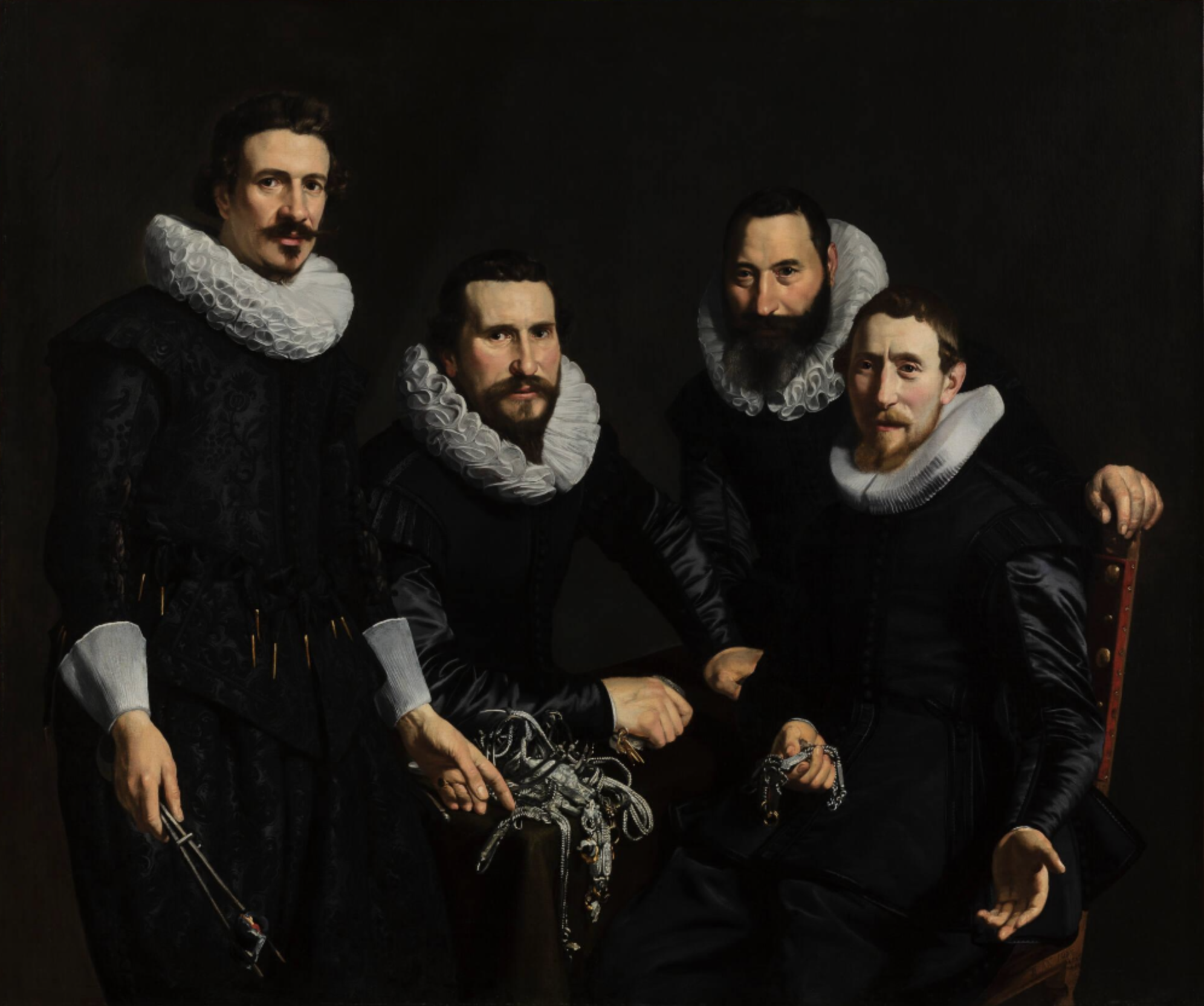
In a time before mass produced imagery, a painting served as both aesthetic form and, often, advertising. When Thomas de Keyser was commissioned by the guild of Goldsmiths, responsible for ensuring the quality of raw material and products of the cities metal workers, there were certain requirements that the portrait had to meet. It was to be hung in the guildhall, and immediately visible to all customers and members, often as a first impression. It’s purpose then was to communicate immediately and effectively the authority, professionalism, and trustworthiness of the syndics who ran the guild. Set against a black background, and with each subject staring directly at the viewer, the work is an invitation towards them, the open hand of the seated man almost ushering us further into the building. The men clasp various tools of the trade, signalling a practiced knowledge of their work, and are depicted from a slightly lowered angle to emphasise their authority. Yet for all of its utility, it remains a most beautiful work, delicately rendered and dramatically composed. Its function does not overpower, no undermine, its aesthetic value.
Thomas de Keyser
THOMAS DE KEYSER, 1627. OIL ON CANVAS.
In a time before mass produced imagery, a painting served as both aesthetic form and, often, advertising. When Thomas de Keyser was commissioned by the guild of Goldsmiths, responsible for ensuring the quality of raw material and products of the cities metal workers, there were certain requirements that the portrait had to meet. It was to be hung in the guildhall, and immediately visible to all customers and members, often as a first impression. It’s purpose then was to communicate immediately and effectively the authority, professionalism, and trustworthiness of the syndics who ran the guild. Set against a black background, and with each subject staring directly at the viewer, the work is an invitation towards them, the open hand of the seated man almost ushering us further into the building. The men clasp various tools of the trade, signalling a practiced knowledge of their work, and are depicted from a slightly lowered angle to emphasise their authority. Yet for all of its utility, it remains a most beautiful work, delicately rendered and dramatically composed. Its function does not overpower, no undermine, its aesthetic value.

Fear
JEAN-BAPTISTE LE PRINCE
A whole story is told in a single frame, a narrative unfolds through clues that deepen with each further look. A woman reclines in anything but calm, her nightdress dishevelled and open to reveal her skin underneath. A dog jumps in excitement out of frame, as if excited to see a familiar face unknown to the viewer. Two cups and a cafetière sit on the table, but only one figure exists in the scene. A chair lies tipped on the ground as if knocked over in a hasty retreat. Le Prince titilates us with every element of this painting, giving us just enough information to piece together a narrative but never so much as to be confident in our version of the story. We know an interruption has occurred, though not by who. We can assume a male suitor who was not meant to be in the boudoir of the central character has recently left the scene, just as another, more familiar to her, has entered. It is intriguing and amusing in equal measure, and an extraordinary example of Boudoir Paintings that were popular at this time. Giving the viewer a glimpse behind the curtain into the private lives of women, these paintings were playful in nature but radical in their free depictions of sexuality and the lack of shame or judgement associated with it.
Jean-Baptiste
JEAN-BAPTISTE LE PRINCE, 1769. OIL ON CANVAS.
A whole story is told in a single frame, a narrative unfolds through clues that deepen with each further look. A woman reclines in anything but calm, her nightdress dishevelled and open to reveal her skin underneath. A dog jumps in excitement out of frame, as if excited to see a familiar face unknown to the viewer. Two cups and a cafetière sit on the table, but only one figure exists in the scene. A chair lies tipped on the ground as if knocked over in a hasty retreat. Le Prince titilates us with every element of this painting, giving us just enough information to piece together a narrative but never so much as to be confident in our version of the story. We know an interruption has occurred, though not by who. We can assume a male suitor who was not meant to be in the boudoir of the central character has recently left the scene, just as another, more familiar to her, has entered. It is intriguing and amusing in equal measure, and an extraordinary example of Boudoir Paintings that were popular at this time. Giving the viewer a glimpse behind the curtain into the private lives of women, these paintings were playful in nature but radical in their free depictions of sexuality and the lack of shame or judgement associated with it.

Meadow I
GEORGE TOOKER
Tooker told stories of anxiety. He became, and remains, known for paintings of claustrophobic urbanity, cubicled domestic life, and labyrinthine liminal spaces populated by the seemingly trapped city dweller. His images are often surreal, always disquieting, and filled with a profoundly modern sense of dread. Save, that is, for Meadow I. Painted in the aftermath of his mother’s death when the painter was racked with grief and loneliness, he moved his visual language out of the metropolitan and into the pastoral. The work speaks directly to Renaissance religious works, not only in the parallel he draws between himself and his mother to Joseph and Mary weeping at the crucifixion of Christ but also in the very medium itself. Using a 17th century technique of egg tempera, he painstakingly applied fast drying homemade paint over months to create a scene of misery and calm. Painting became, in this instance, a process of grieving for Tooker - a respite from his pain that existed not only in his self but in the paintings he normally produced were replaced with a meditation of rural beauty.
George Tooker
GEORGE TOOKER, 1960. EGG TEMPERA ON GESSO PANEL.
Tooker told stories of anxiety. He became, and remains, known for paintings of claustrophobic urbanity, cubicled domestic life, and labyrinthine liminal spaces populated by the seemingly trapped city dweller. His images are often surreal, always disquieting, and filled with a profoundly modern sense of dread. Save, that is, for Meadow I. Painted in the aftermath of his mother’s death when the painter was racked with grief and loneliness, he moved his visual language out of the metropolitan and into the pastoral. The work speaks directly to Renaissance religious works, not only in the parallel he draws between himself and his mother to Joseph and Mary weeping at the crucifixion of Christ but also in the very medium itself. Using a 17th century technique of egg tempera, he painstakingly applied fast drying homemade paint over months to create a scene of misery and calm. Painting became, in this instance, a process of grieving for Tooker - a respite from his pain that existed not only in his self but in the paintings he normally produced were replaced with a meditation of rural beauty.

Head of an Old Man
GIOVANNI DOMENICO TIEPOLO
In 18th century Venice, the Rococo style reigned supreme. Characterised by lively figures and bright colors, the images of this movement are rich in adornment and decoration that seems indulgently joyful at every step. They adorned the walls and ceilings of churches, palazzos, and government buildings across the city, and there was no artist more associated with and celebrated for this style than Giovanni Battista Tiepolo. One of the last old masters of Italy, his work helped define the end of the Renaissance in his native city and far across Europe. His shadow was long across the art world at this time, and particularly so for his son Giovanni Domenico who followed in his footsteps, having trained first as his apprentice. The young Tiepolo worked in his father’s studio, and executed this painting after a series that that the elder Tiepolo had completed years earlier. Giovanni Domenico first turned his father’s series into etchings that were sold and disseminated across the country for financial gain, and then painted works based on the etchings of the originals, making this work a copy of a copy.
Giovanni Domenico Tiepolo
GIOVANNI DOMENICO TIEPOLO, c.1765. OIL ON CANVAS.
In 18th century Venice, the Rococo style reigned supreme. Characterised by lively figures and bright colors, the images of this movement are rich in adornment and decoration that seems indulgently joyful at every step. They adorned the walls and ceilings of churches, palazzos, and government buildings across the city, and there was no artist more associated with and celebrated for this style than Giovanni Battista Tiepolo. One of the last old masters of Italy, his work helped define the end of the Renaissance in his native city and far across Europe. His shadow was long across the art world at this time, and particularly so for his son Giovanni Domenico who followed in his footsteps, having trained first as his apprentice. The young Tiepolo worked in his father’s studio, and executed this painting after a series that that the elder Tiepolo had completed years earlier. Giovanni Domenico first turned his father’s series into etchings that were sold and disseminated across the country for financial gain, and then painted works based on the etchings of the originals, making this work a copy of a copy.

Flamma
SIMON GROUVENEUR
Simon Grouveneur’s paintings are ciphers. Dense labyrinths of mythological symbolism, they are heavily encoded visual matrices of numbers, patterns, colors, and icons. Throughout his life he obsessively examined structures of philosophy, linguistics and mysticism and built a personal language and grammar of symbols, using his paintings to seek a truth and express complex ideas in aesthetic and balanced beauty. As obsessive as he was in his search for knowledge, he was more so in the process of creating the works. He created his paints by hand and spent months on each small canvas, working with an exacting and rigorous precision that left nothing to chance and no drop out of place. “Art is not to please or entertain”, he said, “art is to tell truth, not because artists are the only truth tellers but because art is the right media to tell truth.”
Simon Gouverneur
SIMON GOUVERNEUR, 1989. TEMPERA ON CANVAS.
Simon Grouveneur’s paintings are ciphers. Dense labyrinths of mythological symbolism, they are heavily encoded visual matrices of numbers, patterns, colors, and icons. Throughout his life he obsessively examined structures of philosophy, linguistics and mysticism and built a personal language and grammar of symbols, using his paintings to seek a truth and express complex ideas in aesthetic and balanced beauty. As obsessive as he was in his search for knowledge, he was more so in the process of creating the works. He created his paints by hand and spent months on each small canvas, working with an exacting and rigorous precision that left nothing to chance and no drop out of place. “Art is not to please or entertain”, he said, “art is to tell truth, not because artists are the only truth tellers but because art is the right media to tell truth.”

Along the River Front, New York
EVERETT LONGLEY WARNER
A leading figure of a doomed movement, Warner’s career faltered right as it was beginning what looked an astronomical rise. After years of training both in America and Europe as a young man, he established himself as a seminal figure of American impressionism at the turn of the century. The movement was by now past its prime in Europe but across the Atlantic was only beginning to rear its head. Warner was well positioned and building a significant public profile with solo and group shows, presenting work at the Worlds fair, winning awards for his paintings, and joining a Connecticut artist community that was the preeminent breeding ground for this new Impressionist movement. Yet in 1913, at the legendary Armory Show in New York, the American public were introduced to the European modernism, and the effective beginning of what we now understand as modern art. Just as soon as it entered the vogue, American Impressionism was out of date, out of touch, and undesirable in the face of this radical avant-garde. Warner continued to paint throughout his life, achieving moderate success and holding positions at important schools as a teacher, but the career that once seemed inevitable never materialised, despite his talents.
Everett Longley Warner
EVERETT LONGLEY WARNER, 1912. OIL ON CANVAS.
A leading figure of a doomed movement, Warner’s career faltered right as it was beginning what looked an astronomical rise. After years of training both in America and Europe as a young man, he established himself as a seminal figure of American impressionism at the turn of the century. The movement was by now past its prime in Europe but across the Atlantic was only beginning to rear its head. Warner was well positioned and building a significant public profile with solo and group shows, presenting work at the Worlds fair, winning awards for his paintings, and joining a Connecticut artist community that was the preeminent breeding ground for this new Impressionist movement. Yet in 1913, at the legendary Armory Show in New York, the American public were introduced to the European modernism, and the effective beginning of what we now understand as modern art. Just as soon as it entered the vogue, American Impressionism was out of date, out of touch, and undesirable in the face of this radical avant-garde. Warner continued to paint throughout his life, achieving moderate success and holding positions at important schools as a teacher, but the career that once seemed inevitable never materialised, despite his talents.

The Wedding at Cana
PAOLO VERONESE
At a wedding in Galilee, Jesus performs his first attributed miracle when he turns water into wine to satiate thirsty guests. The story appears only in the Gospel of John, but has long been held not only as an important proof of Jesus’ divinity, but also as a symbol of the Christian approval of marriage and acceptance of earthly celebration. Some fifteen hundred years later, in an era of Venetian indulges rife with feast and celebration, the great Mannerist, Renaissance painter Veronese brings the story into his contemporary world. Feasts such as the one depicted here were common in society, sumptuous displays of food that not were not just about presenting wealth, sophistication, and power, but literally passing on these qualities to the guests via food. Jesus sits at the centre of the table, surrounded by more than one hundred and thirty figures on all sides, dressed in extravagant garb of the day. A story of a humble miracle becomes indicative of a celebratory society, and brings the sacred into the profane, reminding viewers that the act of sharing food and drink is more than just community but communion.
Paolo Veronese
PAOLO VERONESE, 1563. OIL ON CANVAS.
At a wedding in Galilee, Jesus performs his first attributed miracle when he turns water into wine to satiate thirsty guests. The story appears only in the Gospel of John, but has long been held not only as an important proof of Jesus’ divinity, but also as a symbol of the Christian approval of marriage and acceptance of earthly celebration. Some fifteen hundred years later, in an era of Venetian indulges rife with feast and celebration, the great Mannerist, Renaissance painter Veronese brings the story into his contemporary world. Feasts such as the one depicted here were common in society, sumptuous displays of food that not were not just about presenting wealth, sophistication, and power, but literally passing on these qualities to the guests via food. Jesus sits at the centre of the table, surrounded by more than one hundred and thirty figures on all sides, dressed in extravagant garb of the day. A story of a humble miracle becomes indicative of a celebratory society, and brings the sacred into the profane, reminding viewers that the act of sharing food and drink is more than just community but communion.

The Judge
GEORGES ROUAULT
Born in a Parisian cellar to a poor family, Georges Rouault rose through the ranks of France’s burgeoning avant-garde to become one of the most significant figures in Expressionism and Fauvism. At the age of 14, Rouault began an apprenticeship as a glass painter and restorer and his time working with heavy glass bonded by thick lead is evident in his later painting style. The thick black lines and brash energetic brushstrokes speak to both the medieval style of stained glass and the Expressionist movement that sought to capture a human emotion in both medium and content. The painting here, of a court judge, was one of 23 produced when Rouault was invited to observe proceedings in a courtroom. At the time of painting, he had become most known for paintings of Christ rendered in a similar style. He applies here the same generosity to the Judge as he does to religious figures. “If I have made of the judges lamentable figures,”, he said, “it is no doubt because I was betraying the anguish that I feel at the sight of one human being having to judge another. I would not be a judge for all the wealth and happiness in the world.”
Georges Rouault
GEORGES ROUAULT, 1937. OIL ON CANVAS.
Born in a Parisian cellar to a poor family, Georges Rouault rose through the ranks of France’s burgeoning avant-garde to become one of the most significant figures in Expressionism and Fauvism. At the age of 14, Rouault began an apprenticeship as a glass painter and restorer and his time working with heavy glass bonded by thick lead is evident in his later painting style. The thick black lines and brash energetic brushstrokes speak to both the medieval style of stained glass and the Expressionist movement that sought to capture a human emotion in both medium and content. The painting here, of a court judge, was one of 23 produced when Rouault was invited to observe proceedings in a courtroom. At the time of painting, he had become most known for paintings of Christ rendered in a similar style. He applies here the same generosity to the Judge as he does to religious figures. “If I have made of the judges lamentable figures,”, he said, “it is no doubt because I was betraying the anguish that I feel at the sight of one human being having to judge another. I would not be a judge for all the wealth and happiness in the world.”

Two Sisters on the Terrace
PIERRE-AUGUSTE RENOIR
A gentle joy exudes from every brushstroke. The radiance of youth and the calm of a warm summers day wash over us as Renoir’s delicate hand creates an image that seems to exist in both reality and fantasy at once. The central figure gazes absentmindedly into the distance, her face filled with contentment while her younger sister stares at us, rendered in a looser hand to look as if she has just run into the frame. This is at the heart of Renoir’s brilliance; he is able to create scenes that are at once totally accessible, concerned with beauty and leisure, while hiding in them something of the radical. The background, in sharp contrast to the realism of the girls, appears almost as a stage set, lacking focus and depth. Colors dance alongside each other, trees disappear into shimmering rivers and a town emerges like a fairytale across the water. Every element is perfectly balanced, it glows with the light of a dream and exists in a world without worry.
Pierre-Auguste Renoir
PIERRE-AUGUSTE RENOIR, 1881. OIL ON CANVAS.
A gentle joy exudes from every brushstroke. The radiance of youth and the calm of a warm summers day wash over us as Renoir’s delicate hand creates an image that seems to exist in both reality and fantasy at once. The central figure gazes absentmindedly into the distance, her face filled with contentment while her younger sister stares at us, rendered in a looser hand to look as if she has just run into the frame. This is at the heart of Renoir’s brilliance; he is able to create scenes that are at once totally accessible, concerned with beauty and leisure, while hiding in them something of the radical. The background, in sharp contrast to the realism of the girls, appears almost as a stage set, lacking focus and depth. Colors dance alongside each other, trees disappear into shimmering rivers and a town emerges like a fairytale across the water. Every element is perfectly balanced, it glows with the light of a dream and exists in a world without worry.

Alom I
VICTOR VASARELY
Between the kinetic sculpture of Alexander Calder, Marcel Duchamp, and Jean Tinguely and the Pop Art of Andy Warhol sits the great Victor Vasarely. Working as an advertising designer in the 1930s, Vasarely developed a deep understanding of the power of geometric forms as a tool for attention. He became almost scientific about the behaviour of the human eye on a visual plane, and saw that the subtle optical illusions commanded discomfort, focus, and intrigue. Using industrially manufactured paints in their most slickly seductive forms, he created flat, one dimensional planes that he imbued with an impossible movement in the viewers mind. 'For me,’, he said, ‘Kineticism is what moves through the soul of the spectator when the eye is forced to organise an unstable perceptive field’. For all the visual trickery, his work is deeply soulful. It swallows you, begins to vibrate at the frequency of your neurons, ebbing and flowing in line with the viewers own energy. Vasarely lay the groundwork for a generation of artists who came to define the 20th century, and his own fingerprints can still be seen across contemporary art and design.
Victor Vasarely
VICTOR VASARELY, c.1968. TEMPERA ON CANVAS.
Between the kinetic sculpture of Alexander Calder, Marcel Duchamp, and Jean Tinguely and the Pop Art of Andy Warhol sits the great Victor Vasarely. Working as an advertising designer in the 1930s, Vasarely developed a deep understanding of the power of geometric forms as a tool for attention. He became almost scientific about the behaviour of the human eye on a visual plane, and saw that the subtle optical illusions commanded discomfort, focus, and intrigue. Using industrially manufactured paints in their most slickly seductive forms, he created flat, one dimensional planes that he imbued with an impossible movement in the viewers mind. 'For me,’, he said, ‘Kineticism is what moves through the soul of the spectator when the eye is forced to organise an unstable perceptive field’. For all the visual trickery, his work is deeply soulful. It swallows you, begins to vibrate at the frequency of your neurons, ebbing and flowing in line with the viewers own energy. Vasarely lay the groundwork for a generation of artists who came to define the 20th century, and his own fingerprints can still be seen across contemporary art and design.

Still Life with Fish
GEORGES BRAQUE
While Georges Braque and Pablo Picasso began together, creating the vocabulary of cubism that would go on to inform the entire 20th century art movement, by 1941 the two had gone their separate ways. Picasso was restless, experimenting further and defying boundaries at every turn as he became increasingly unclassifiable in his practice. Braque, on the other hand, was rigorous, disciplined, and singularly focused on mastering Cubism and continuing to burn the torch for the art movement that he developed. His later works, such as Still Life with Fish here, are some decades removed from the origins of the movement and the increased wisdom is clear. Gone are the dizzying, erratic geometries that obscured the subject into kaleidoscopic wonder and in their place is a gentle, deftly handled study of perspective. The wildness of youth and excitement of the new has been tempered by a deep understanding of his forms and style, and Still Life with Fish is a masterful example. Its radicalness creeps up on you - at first glance it looks like a recognisable scene but the more you engage, the more you see just how many perspectives Braque shows this simplicity in. While Picasso may have answered more questions in his wild career, Braque answers are perhaps more concise.
Georges Braque
GEORGES BRAQUE, 1941. OIL ON CANVAS.
While Georges Braque and Pablo Picasso began together, creating the vocabulary of cubism that would go on to inform the entire 20th century art movement, by 1941 the two had gone their separate ways. Picasso was restless, experimenting further and defying boundaries at every turn as he became increasingly unclassifiable in his practice. Braque, on the other hand, was rigorous, disciplined, and singularly focused on mastering Cubism and continuing to burn the torch for the art movement that he developed. His later works, such as Still Life with Fish here, are some decades removed from the origins of the movement and the increased wisdom is clear. Gone are the dizzying, erratic geometries that obscured the subject into kaleidoscopic wonder and in their place is a gentle, deftly handled study of perspective. The wildness of youth and excitement of the new has been tempered by a deep understanding of his forms and style, and Still Life with Fish is a masterful example. Its radicalness creeps up on you - at first glance it looks like a recognisable scene but the more you engage, the more you see just how many perspectives Braque shows this simplicity in. While Picasso may have answered more questions in his wild career, Braque answers are perhaps more concise.

Helene’s Florist
RICHARD ESTES
Perfectly empty, eerily perfect - Estes’ worlds are devoid of people and rendered in such remarkable detail as to almost appear as photographs. Yet it is their perfection that belies their truth, for no camera at the time would have been able to capture such even focus across such a vast depth of field as Estes could do with oil and a brush. His works are uncanny and uncomfortable, the abandoned spaces give us nothing to grab onto. He paints the visual complexity of urban life and reveals it for its difficulties by removing the human, leaving us only able to stare in aesthetic appreciation or horror at the world we inhabit. In this way, Este asks us to slow down with his work, to show that all around us there is room for visual appreciation for those with the eyes to see. To see through the noise of city life, details begin to emerge everywhere - the beauty of typography on a sign, the arrangement of flowers and paving stones, the subtle architecture of storefronts. In Estes’ hands, the mundane comes to life on the page and in the viewers mind.
Richard Estes
RICHARD ESTE, 1932. OIL ON CANVAS.
Perfectly empty, eerily perfect - Estes’ worlds are devoid of people and rendered in such remarkable detail as to almost appear as photographs. Yet it is their perfection that belies their truth, for no camera at the time would have been able to capture such even focus across such a vast depth of field as Estes could do with oil and a brush. His works are uncanny and uncomfortable, the abandoned spaces give us nothing to grab onto. He paints the visual complexity of urban life and reveals it for its difficulties by removing the human, leaving us only able to stare in aesthetic appreciation or horror at the world we inhabit. In this way, Este asks us to slow down with his work, to show that all around us there is room for visual appreciation for those with the eyes to see. To see through the noise of city life, details begin to emerge everywhere - the beauty of typography on a sign, the arrangement of flowers and paving stones, the subtle architecture of storefronts. In Este’s hands, the mundane comes to life on the page and in the viewers mind.

Summer #2
ADOLF GOTTLIEB
A floating orb glows with searing intensity. It is the summer sun that brings with it joys and dangers in equal measure, that enforces a regularity and order to life dictated by its rising and falling. Below, a violent, calligraphic, abstract form grounds us in entropy, chaos, and the fallibility of humans. “I feel that I use color in terms of an emotional quality... a vehicle for the expression of feeling.”, said Gottlieb, “Now what this feeling is, is something I probably can't define, but since I eliminated almost everything from my painting except a few colors and perhaps two or three shapes, I feel a necessity for making the particular colors that I use, or the particular shapes, carry the burden of everything that I want to express, and all has to be concentrated within these few elements. Therefore, the color has to carry the burden of this effort”. And carry the burden, his colors do: soft pink hues, electric scarlet, dark blood reds, and the brown of earth speak to apocalypse as much as to connection and human flesh. Gottlieb represents summer as something that engulfs us, that we long for and fear, and mustn’t look at too long in case it damages our eyes.
Adolf Gottlieb
ADOLF GOTTLIEB, 1964. OIL ON LINEN.
A floating orb glows with searing intensity. It is the summer sun that brings with it joys and dangers in equal measure, that enforces a regularity and order to life dictated by its rising and falling. Below, a violent, calligraphic, abstract form grounds us in entropy, chaos, and the fallibility of humans. “I feel that I use color in terms of an emotional quality... a vehicle for the expression of feeling.”, said Gottlieb, “Now what this feeling is, is something I probably can't define, but since I eliminated almost everything from my painting except a few colors and perhaps two or three shapes, I feel a necessity for making the particular colors that I use, or the particular shapes, carry the burden of everything that I want to express, and all has to be concentrated within these few elements. Therefore, the color has to carry the burden of this effort”. And carry the burden, his colors do: soft pink hues, electric scarlet, dark blood reds, and the brown of earth speak to apocalypse as much as to connection and human flesh. Gottlieb represents summer as something that engulfs us, that we long for and fear, and mustn’t look at too long in case it damages our eyes.

Agony in the Garden
EL GRECO
As the Last Supper finished, Jesus retreated to the Garden of Gethsemane. He brought with him Peter, John, and James, and asked them to stay awake and pray, while he went further ahead, alone and began to ask his father for salvation. "My Father,”, he said, “if it is possible, let this cup pass me by. Nevertheless, let it be as You, not I, would have it. If this cup cannot pass by, but I must drink it, Your will be done!” Knowing his fate, that he was destined for the cross, and the agony of death, his humanness shows. He fears what is ahead of him, and bargains one last time for a world in which his fated end may be escaped. Yet, despite it all, he is adamant that if this really is what is required, he will do it willingly. Leaving the garden, he finds the three apostles who had accompanied him fast asleep, and declares them strong in spirit but weak in flesh. One of the most important stories in the Passion of Jesus, El Greco renders this moment in perfect duality. Christ exists in the centre, flanked by humanity and divinity, caught between worlds with dignity and fear.
El Greco
EL GRECO, 1590. OIL ON CANVAS.
As the Last Supper finished, Jesus retreated to the Garden of Gethsemane. He brought with him Peter, John, and James, and asked them to stay awake and pray, while he went further ahead, alone and began to ask his father for salvation. "My Father,”, he said, “if it is possible, let this cup pass me by. Nevertheless, let it be as You, not I, would have it. If this cup cannot pass by, but I must drink it, Your will be done!” Knowing his fate, that he was destined for the cross, and the agony of death, his humanness shows. He fears what is ahead of him, and bargains one last time for a world in which his fated end may be escaped. Yet, despite it all, he is adamant that if this really is what is required, he will do it willingly. Leaving the garden, he finds the three apostles who had accompanied him fast asleep, and declares them strong in spirit but weak in flesh. One of the most important stories in the Passion of Jesus, El Greco renders this moment in perfect duality. Christ exists in the centre, flanked by humanity and divinity, caught between worlds with dignity and fear.

Antibes Seen from La Salis
CLAUDE MONET
Even the great master of Impressionism himself, who had taught the world how to capture nature, light, color, and form in all of its beauty and translate the splendour of the environment into oil and canvas, felt humbled by the view ahead of him. Spending the summer in France’s southern coast in the old town of Antibes, Claude Monet would walk the landscapes along the Azure Coast with his easel and canvas, setting up to paint en plein air, wherever the beauty struck him. Yet, unusually, he laboured over the works here. The sun, the trees, the sea, all were, as he wrote in letters to friends and contemporaries, almost too beautiful to bear - ‘In order to paint here one would need gold and precious stones’, he wrote to the sculptor Auguste Rodin. He saw Antibes as a fairy-tale town, one that existed as much in the imagination as it did in reality, and so his usually deftness of capturing the impression, the feeling of a moment was further out of reach. Yet his work here is some of the most delicate and beautiful of his career, the dazzling sweetness of the landscape is abundant and intoxicating.
Claude Monet
CLAUDE MONET, 1888. OIL ON CANVAS.
Even the great master of Impressionism himself, who had taught the world how to capture nature, light, color, and form in all of its beauty and translate the splendour of the environment into oil and canvas, felt humbled by the view ahead of him. Spending the summer in France’s southern coast in the old town of Antibes, Claude Monet would walk the landscapes along the Azure Coast with his easel and canvas, setting up to paint en plein air, wherever the beauty struck him. Yet, unusually, he laboured over the works here. The sun, the trees, the sea, all were, as he wrote in letters to friends and contemporaries, almost too beautiful to bear - ‘In order to paint here one would need gold and precious stones’, he wrote to the sculptor Auguste Rodin. He saw Antibes as a fairy-tale town, one that existed as much in the imagination as it did in reality, and so his usually deftness of capturing the impression, the feeling of a moment was further out of reach. Yet his work here is some of the most delicate and beautiful of his career, the dazzling sweetness of the landscape is abundant and intoxicating.

Blue Jay
HELEN FRANKENTHALER
“A line is a line, but is [also] a color. It does this here, but that there. The canvas surface is flat and yet the space extends for miles.” This is at the very heart of Helen Frankenthaler’s work. In every corner of the canvas, there is the opportunity for change, for deception, and for interpretation. Developing a technique known as ‘soak-staining’, whereby she loosed oil paint and allowed the natural flow of a viscous matter to guide the formal shapes of the work, Frankenthaler’s process was open to the chaos of the world. Oil paints take on the quality of watercolour, and what would once be considered mistakes become acts of deep intention. For all of its aesthetic beauty and apparent simplicity, in her hand the artwork becomes a vehicle for painterly deception. Perhaps, then, Frankenthaler is simply making explicit that which we have always known about painting; that we are willing tricked in each instance we engage with it.
Helen Frankenthaler
HELEN FRANKENTHALER, 1963. OIL ON CANVAS.
“A line is a line, but is [also] a color. It does this here, but that there. The canvas surface is flat and yet the space extends for miles.” This is at the very heart of Helen Frankenthaler’s work. In every corner of the canvas, there is the opportunity for change, for deception, and for interpretation. Developing a technique known as ‘soak-staining’, whereby she loosed oil paint and allowed the natural flow of a viscous matter to guide the formal shapes of the work, Frankenthaler’s process was open to the chaos of the world. Oil paints take on the quality of watercolour, and what would once be considered mistakes become acts of deep intention. For all of its aesthetic beauty and apparent simplicity, in her hand the artwork becomes a vehicle for painterly deception. Perhaps, then, Frankenthaler is simply making explicit that which we have always known about painting; that we are willing tricked in each instance we engage with it.

Lac Laronge IV
FRANK STELLA
Restless forms are constrained by their canvas. Arcs and circles push against their geometric home, straining their boundaries and compressing against the confinement of the rectangle. Stella had, in the period before this series of works was executed, been using canvases of irregular shapes, defined by the forms of the painting themselves. The same ideas are at play here, namely those of the relationship between the surface and the image upon it, but the surface now takes precedence. Stella’s forms, made by a protractor and paint, seem to fight against each other for prominence; as you stare into the flat expanse of the image the colors dance between the foreground and background. Despite it’s pleasing, almost gentle appearance, there is a fight happening in every aspect of the painting, a battle for visual priority between forms and right of space between surface and image. The painting, in this way, transcends its abstract forms to become something tangibly real - Stella imbues visual forms with a life-force quite unlike any other.
Frank Stella
FRANK STELLA, 1969. ACRYLIC POLYMER ON CANVAS.
Restless forms are constrained by their canvas. Arcs and circles push against their geometric home, straining their boundaries and compressing against the confinement of the rectangle. Stella had, in the period before this series of works was executed, been using canvases of irregular shapes, defined by the forms of the painting themselves. The same ideas are at play here, namely those of the relationship between the surface and the image upon it, but the surface now takes precedence. Stella’s forms, made by a protractor and paint, seem to fight against each other for prominence; as you stare into the flat expanse of the image the colors dance between the foreground and background. Despite it’s pleasing, almost gentle appearance, there is a fight happening in every aspect of the painting, a battle for visual priority between forms and right of space between surface and image. The painting, in this way, transcends its abstract forms to become something tangibly real - Stella imbues visual forms with a life-force quite unlike any other.

Reclining Woman
FERNAND LÉGER
Cubism, war, and industrialism - these were the three muses of Léger’s career in the early 1920s. One of the first artists to join Georges Braque and Pablo Picasso’s new movement of Cubism, he exhibited in all of the early shows and helped define the new art language to the public. While his contemporaries cubist forms were rigid and angular, Léger’s style came to be known as “Tubism”, so named for the tubular, pipe like mechanical structures that served as the subjects or motifs for so much of his early work. Yet experiences fighting at the front in World War I softened his allegiances to industrial forms, and by 1922 he had swapped metal for flesh, and abstracted still lives had been replaced by figurative forms, still retaining his ‘Tubist’ influences. Léger felt that art was more important than ever in the post-war period, and that the work he had been doing before the war was academic, restrictive and inaccessible to most save for the privileged, educated few. His movement toward portraiture and nudes was an attempt to show the poetry of the everyday experience, to take images and scenes familiar to the masses and elevate them into something unusual, thought-provoking and beautiful.
Fernand Léger
FERNAND LÉGER, 1922. OIL ON CANVAS.
Cubism, war, and industrialism - these were the three muses of Léger’s career in the early 1920s. One of the first artists to join Georges Braque and Pablo Picasso’s new movement of Cubism, he exhibited in all of the early shows and helped define the new art language to the public. While his contemporaries cubist forms were rigid and angular, Léger’s style came to be known as “Tubism”, so named for the tubular, pipe like mechanical structures that served as the subjects or motifs for so much of his early work. Yet experiences fighting at the front in World War I softened his allegiances to industrial forms, and by 1922 he had swapped metal for flesh, and abstracted still lives had been replaced by figurative forms, still retaining his ‘Tubist’ influences. Léger felt that art was more important than ever in the post-war period, and that the work he had been doing before the war was academic, restrictive and inaccessible to most save for the privileged, educated few. His movement toward portraiture and nudes was an attempt to show the poetry of the everyday experience, to take images and scenes familiar to the masses and elevate them into something unusual, thought-provoking and beautiful.
Parade
ABRAHAM WALKOWITZ
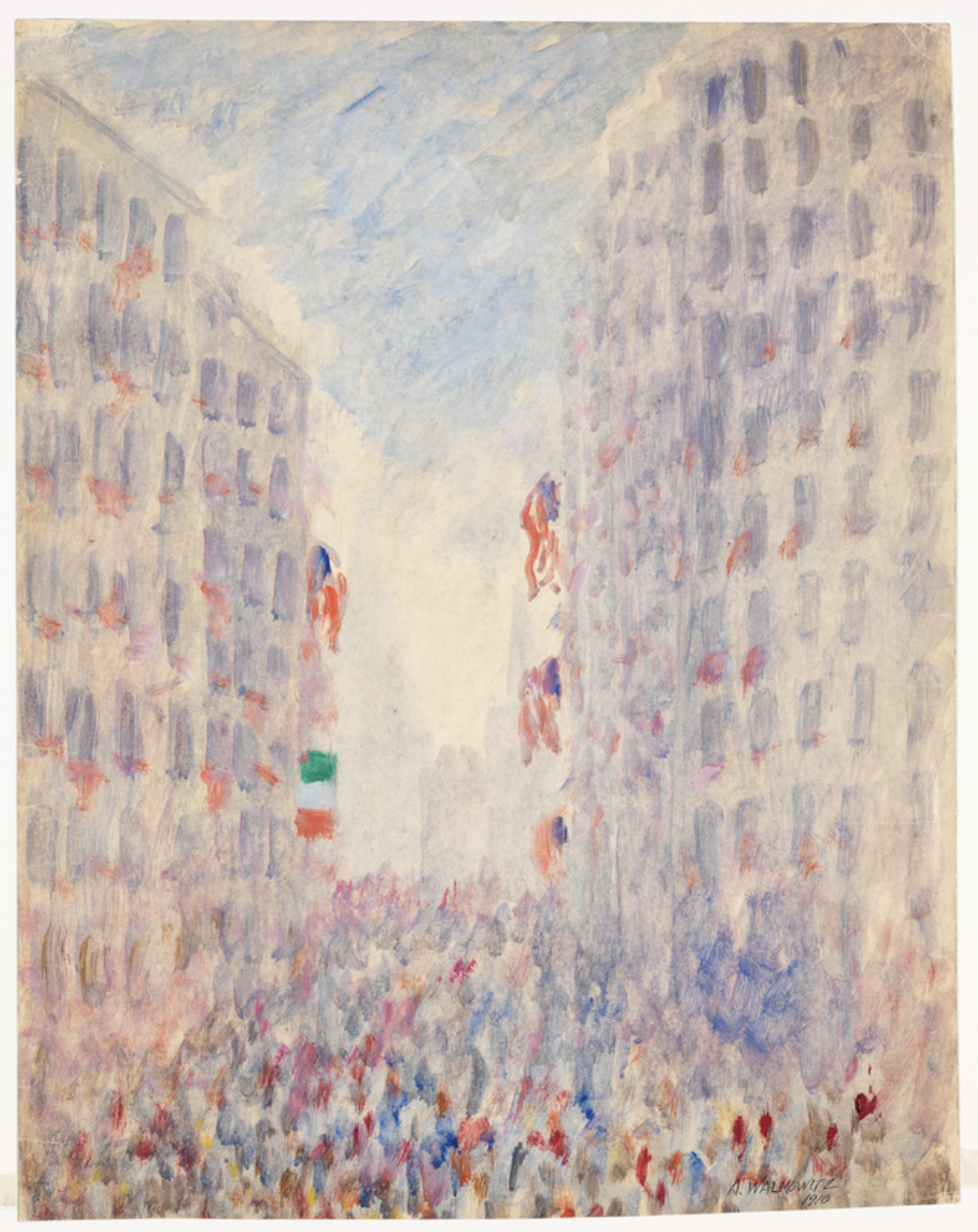
The intensity of simple, human experiences - this is what Abraham Walkowitz strove for in his work. Part of the first wave of American Moderists who brought the European ideals and philosophies to the United States, Walkowtiz interpreted these ideas in a uniquely American way. Where the European leading figures, such as Kandinsky, Klee, and Braque, were pushing the boundaries of thought and making art that was intentionally intellectual, laden with concepts as much as beauty that challenged and inspired, Walkowtiz digested these same progressions but approached them with what the artist and critic Oscar Bluemner called ‘an inner necessity.’ This is clear in his parade scene. The work is a masterful display of early abstraction, loose, sparing brushstrokes and vivid, varied colours give the suggestion of a scene without rigid focus of detail. Yet, for all the revolution in the technique and composition, the work is brimming with life and with joy. The essence of the parade is captured, the excitement of the human experience bounds across the paper. The viewer does not need education or information to understand the heart of Walkowtiz’s work, it exists for all to see.
Abraham Walkowitz
ABRAHAM WALKOWITZ, 1910. OIL ON PAPER.
The intensity of simple, human experiences - this is what Abraham Walkowitz strove for in his work. Part of the first wave of American Moderists who brought the European ideals and philosophies to the United States, Walkowtiz interpreted these ideas in a uniquely American way. Where the European leading figures, such as Kandinsky, Klee, and Braque, were pushing the boundaries of thought and making art that was intentionally intellectual, laden with concepts as much as beauty that challenged and inspired, Walkowtiz digested these same progressions but approached them with what the artist and critic Oscar Bluemner called ‘an inner necessity.’ This is clear in his parade scene. The work is a masterful display of early abstraction, loose, sparing brushstrokes and vivid, varied colours give the suggestion of a scene without rigid focus of detail. Yet, for all the revolution in the technique and composition, the work is brimming with life and with joy. The essence of the parade is captured, the excitement of the human experience bounds across the paper. The viewer does not need education or information to understand the heart of Walkowtiz’s work, it exists for all to see.