
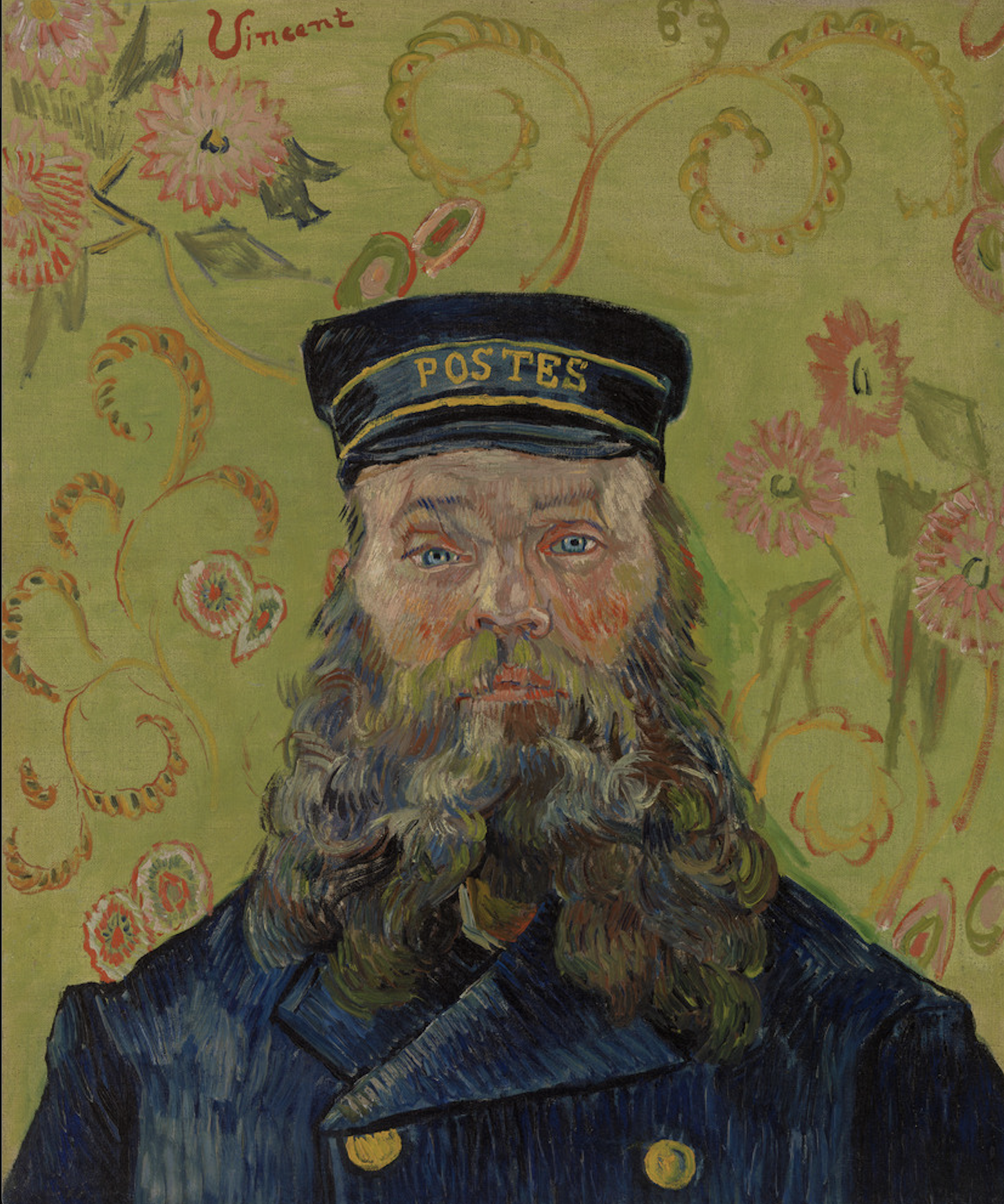
The Postman
VINCENT VAN GOGH
A chance meeting in a train station cafe led to the most fruitful sitter relationship of Van Gogh’s career. Joseph-Éttiene Roulin was the post master at the Arles train station, and a heavy drinker in the neighbouring bar. He was, by all accounts, a kindly man, towering in stature with a long beard and a soft, ‘socratic face’, according to Van Gogh. The two men became drinking buddies, and then as Van Gogh fell into his most severe depressive episode, leading to the mutilation of his ear, Roulin became his carer and a big brother figure to the struggling artist. It was Roulin, in fact, who cleaned the Yellow House of the blood, who brought Van Gogh to hospital, visited him in his months long stay in the asylum, and updated his brother Theo about Vincent’s state. Van Gogh felt indebted to Roulin, and over a six month period he painted six portraits of the postman, and 17 of his family, including his wife and all of his children. No other subject besides Van Gogh himself was depicted so frequently by his brush, and he brings a nobility to his humble friend, painting him against an ornate background that speaks to the portraiture of royalty.
Vincent Van Gogh
VINCENT VAN GOGH, 1889. OIL ON CANVAS.
A chance meeting in a train station cafe led to the most fruitful sitter relationship of Van Gogh’s career. Joseph-Éttiene Roulin was the post master at the Arles train station, and a heavy drinker in the neighbouring bar. He was, by all accounts, a kindly man, towering in stature with a long beard and a soft, ‘socratic face’, according to Van Gogh. The two men became drinking buddies, and then as Van Gogh fell into his most severe depressive episode, leading to the mutilation of his ear, Roulin became his carer and a big brother figure to the struggling artist. It was Roulin, in fact, who cleaned the Yellow House of the blood, who brought Van Gogh to hospital, visited him in his months long stay in the asylum, and updated his brother Theo about Vincent’s state. Van Gogh felt indebted to Roulin, and over a six month period he painted six portraits of the postman, and 17 of his family, including his wife and all of his children. No other subject besides Van Gogh himself was depicted so frequently by his brush, and he brings a nobility to his humble friend, painting him against an ornate background that speaks to the portraiture of royalty.

Christ in the Sepulchre, Guarded by Angels
BLAKE
William Blake was steeped in the Bible. A deeply spiritual man who rejected organised religion, he found endless inspiration in the Testaments contained within and understood them as works to be interpreted -“Both read the Bible day and night”, he wrote, “But thou readst black where I read white”. It was not, for him, a prescriptive book but an inspiring one, the stories told were not historical fact or laws for life, but ways to understand oneself and the world around them. In every medium Blake worked in, from poetry and scholarship to watercolour and sculpture, the Bible played a part in his process and creation. The work here was commissioned as part of an enormous series depicting 80 subjects from the Bible. ‘The Whole Bible is filld with Imaginations & Visions from End to End”, he said, “And not with Moral virtues that is the baseness of Plato & the Greeks & all Warriors. The Moral Virtues are continual Accusers of Sin & promote Eternal Wars & Domineering over others”.
William Blake
WILLIAM BLAKE, 1805. WATERCOLOR ON PAPER.
William Blake was steeped in the Bible. A deeply spiritual man who rejected organised religion, he found endless inspiration in the Testaments contained within and understood them as works to be interpreted -“Both read the Bible day and night”, he wrote, “But thou readst black where I read white”. It was not, for him, a prescriptive book but an inspiring one, the stories told were not historical fact or laws for life, but ways to understand oneself and the world around them. In every medium Blake worked in, from poetry and scholarship to watercolour and sculpture, the Bible played a part in his process and creation. The work here was commissioned as part of an enormous series depicting 80 subjects from the Bible. ‘The Whole Bible is filld with Imaginations & Visions from End to End”, he said, “And not with Moral virtues that is the baseness of Plato & the Greeks & all Warriors. The Moral Virtues are continual Accusers of Sin & promote Eternal Wars & Domineering over others”.

Madame Monet Embroidering
CLAUDE MONET
For a brief moment, the beauty of domesticity was greater than that of nature. Monet mostly painted outside, bringing his canvas out for long days in the fresh air, working en plein air to capture waterlilies, sunsets, rivers, and fields. The great father of modernism, and the creator of the painting for which Impressionism took its name, wanted to capture the world not as it necessarily was, but as he saw it. Here, however, he brought his easel and brushes inside, and painted this delicate, beautiful work of his wife quietly absorbed in her embroidery loom. Light remains a focus, it ebbs through the large windows and dances off her dress and her face. There is such tenderness in every brush stroke, the whole painting seems to exude a powerful, understated romance. It is not wild with passion or energy, nor is it attempting at objectivity. Instead it is a quiet ode to love and marriage, and to the beauty of co-habitation as Monet saw it.
Claude Monet
CLAUDE MONET, 1875. OIL ON CANVAS.
For a brief moment, the beauty of domesticity was greater than that of nature. Monet mostly painted outside, bringing his canvas out for long days in the fresh air, working en plein air to capture waterlilies, sunsets, rivers, and fields. The great father of modernism, and the creator of the painting for which Impressionism took its name, wanted to capture the world not as it necessarily was, but as he saw it. Here, however, he brought his easel and brushes inside, and painted this delicate, beautiful work of his wife quietly absorbed in her embroidery loom. Light remains a focus, it ebbs through the large windows and dances off her dress and her face. There is such tenderness in every brush stroke, the whole painting seems to exude a powerful, understated romance. It is not wild with passion or energy, nor is it attempting at objectivity. Instead it is a quiet ode to love and marriage, and to the beauty of co-habitation as Monet saw it.

Paris Abstraction
ISAMU NOGUCHI
Born in Los Angeles to a Japanese poet father and am American writer mother, by the age of 24 Isamu Noguchi had lived many lives across multiple continents and found himself apprenticing for the great sculptor Constantin Brâncuşi in Paris. The two could hardly communicate - Noguchi spoke almost no French and Brâncuşi little English - but for two years he learnt from this master of modernism not just how to render wood, stone, and steel, but how to appreciate the ‘value of a moment’. Noguchi would go on to become one of the most significant sculptors and furniture designers of the 20th century, combining a Japanese design aesthetic with a western modernist philosophy, but in the summer of 1927, the young man was learning how to reduce the world to it’s most elegant, pure, and beautiful forms. Brâncuşi’s mastery was in finding the platonic ideal of a given subject, discovering the fewest elements that could be combined to create a truthful likeness and it was this quality that Noguchi was learning from. His drawing here, a medium he felt he lost mastery of as he aged, shows both the influence of his teacher and omens of his career to come.
Isamu Noguchi
ISAMU NOGUCHI, c.1927. WATERCOLOUR, INK, AND GRAPHIC ON PAPER.
Born in Los Angeles to a Japanese poet father and am American writer mother, by the age of 24 Isamu Noguchi had lived many lives across multiple continents and found himself apprenticing for the great sculptor Constantin Brâncuşi in Paris. The two could hardly communicate - Noguchi spoke almost no French and Brâncuşi little English - but for two years he learnt from this master of modernism not just how to render wood, stone, and steel, but how to appreciate the ‘value of a moment’. Noguchi would go on to become one of the most significant sculptors and furniture designers of the 20th century, combining a Japanese design aesthetic with a western modernist philosophy, but in the summer of 1927, the young man was learning how to reduce the world to it’s most elegant, pure, and beautiful forms. Brâncuşi’s mastery was in finding the platonic ideal of a given subject, discovering the fewest elements that could be combined to create a truthful likeness and it was this quality that Noguchi was learning from. His drawing here, a medium he felt he lost mastery of as he aged, shows both the influence of his teacher and omens of his career to come.

Keepsake from Corsica
DORA BOTHWELL
A deep, lifelong passion for travel defined Dora Bothwell’s life, far more than her art or relationships. A native San Franciscan, she trained as a dancer while a teenager but, following the death of her father in her early 20s, she used a small inheritance to travel to Samoa where she was adopted by a village chief and his family. There, she learn the Samoan language, dance practices, traditional ceremonies and the artistry of the local textile designers and manufactures. For the two years she spent in Samoa, she developed a visual language and art practice that would stay with her for the rest of her life. Incorporating rigorous training and European avant-garde influences, she made work that spoke to the place she was in with insight and reverence but remained recognisably hers. Her art, then, serves as a kind of scrapbook of her travels, a visual record of the way that movement changed, informed, and inspired her. This ‘Keepsake from Corsica’ immediately conjures blue seas and iridescent shells, and the dance of sunlight as it dapples across the land.
Dora Bothwell
DORA BOTHWELL, 1950. OIL ON CANVAS.
A deep, lifelong passion for travel defined Dora Bothwell’s life, far more than her art or relationships. A native San Franciscan, she trained as a dancer while a teenager but, following the death of her father in her early 20s, she used a small inheritance to travel to Samoa where she was adopted by a village chief and his family. There, she learn the Samoan language, dance practices, traditional ceremonies and the artistry of the local textile designers and manufactures. For the two years she spent in Samoa, she developed a visual language and art practice that would stay with her for the rest of her life. Incorporating rigorous training and European avant-garde influences, she made work that spoke to the place she was in with insight and reverence but remained recognisably hers. Her art, then, serves as a kind of scrapbook of her travels, a visual record of the way that movement changed, informed, and inspired her. This ‘Keepsake from Corsica’ immediately conjures blue seas and iridescent shells, and the dance of sunlight as it dapples across the land.

Portrait of Ephraim Bueno
REMBRANDT VAN RIJN
For most artists of the 17th century, the oil painting was the final form of any image. Preparatory sketches, drawings, and small paintings were all standard elements of the process, used to refining the composition and formal elements of a picture before taking oil to panel or canvas. This piece, then, is unusual in the canon of art history - an oil painting with a primary purpose of preparation for an etching, a medium at the time that was just over a century old. Rembrandt’s focus here was on the facial features of his subject and the interplay of light and dark. We can see in his rendering of Ephraim Beuno’s hands and garments, composed with loose, thick brushstrokes, that this work was not intended as a finished piece fit for display. Instead, in the delicate rendering of his facial features and the subtle changes in light, we get an insight into the artist at work, working through specific details ahead of a finer, more exacting work in a different medium. Yet, despite it’s function, the work still contains some of Rembrandt’s magic, capturing emotion, dignity, and humanity in oil.
Rembrandt Van Rijn
REMBRANDT VAN RIJN, c.1647. OIL ON PANEL.
For most artists of the 17th century, the oil painting was the final form of any image. Preparatory sketches, drawings, and small paintings were all standard elements of the process, used to refining the composition and formal elements of a picture before taking oil to panel or canvas. This piece, then, is unusual in the canon of art history - an oil painting with a primary purpose of preparation for an etching, a medium at the time that was just over a century old. Rembrandt’s focus here was on the facial features of his subject and the interplay of light and dark. We can see in his rendering of Ephraim Beuno’s hands and garments, composed with loose, thick brushstrokes, that this work was not intended as a finished piece fit for display. Instead, in the delicate rendering of his facial features and the subtle changes in light, we get an insight into the artist at work, working through specific details ahead of a finer, more exacting work in a different medium. Yet, despite it’s function, the work still contains some of Rembrandt’s magic, capturing emotion, dignity, and humanity in oil.

White Squares
LEE KRASNER
As a child in an Orthodox Jewish family, Lee Krasner looked upon the Hebrew texts with awe. Unable to read the language, she nonetheless studied the characters religiously, removing them from their context they took on purely abstract, aesthetic forms. It was this experience that Krasner credits with her lifelong fascination with calligraphy, ancient languages, and hieroglyphics. The rigidity of the structure and evenness of placement within the canvas lend this work a textual feeling. It is communicating a message we cannot read, requiring us to dissasociate the forms from meaning and interpret them purely emotionally. She herself described it as ‘hieroglyphic’, and it was her goal to merge the organic and the abstract together in formalism. The abstraction is clear, but the organic forms emerge as much in the sense of process as the subjects. Shards of yellow, green, and blue emerge out of the dense black background as if stones glistening at the bottom of a sea. We fall into the work, down the rectangular spiral into a natural world, familiar and yet altogether alien.
Lee Krasner
LEE KRASNER, 1948. ENAMEL AND OIL ON CANVAS.
As a child in an Orthodox Jewish family, Lee Krasner looked upon the Hebrew texts with awe. Unable to read the language, she nonetheless studied the characters religiously, removing them from their context they took on purely abstract, aesthetic forms. It was this experience that Krasner credits with her lifelong fascination with calligraphy, ancient languages, and hieroglyphics. The rigidity of the structure and evenness of placement within the canvas lend this work a textual feeling. It is communicating a message we cannot read, requiring us to dissaciate the forms from meaning and interpret them purely emotionally. She herself described it as ‘hieroglyphic’, and it was her goal to merge the organic and the abstract together in formalism. The abstraction is clear, but the organic forms emerge as much in the sense of process as the subjects. Shards of yellow, green, and blue emerge out of the dense black background as if stones glistening at the bottom of a sea. We fall into the work, down the rectangular spiral into a natural world, familiar and yet altogether alien.

J-1952
JAMES BROOKS
James Brooks fought the Second World War with his paintbrush as an official combat artist for the US military, and on his return home, fought a battle with his self through radical, abstract expression. Stationed in Cairo, but deployed across the Middle East and Northern Africa, Brooks would head to the front line of battle, take photographs, and then create paintings, collages, and drawings from these photographs to be submitted to and filed by the military for posterity. The role was not quite that of a documentarian, but it was, by necessity, figurative. So, when he returned to New York and reconnected with his old friend Jackson Pollock, he found freedom and catharsis in distancing himself from the military style of his past. Brooks developed a technique of staining the canvas from the underside, letting the chance operations of thinned oil serve as a basis for his work, and then drawing deliberately atop these stains to create artworks with dual authors - entropy and himself. These painterly accidents provided Brooks with the freedom to explore the repressed and hidden parts of himself in collaboration with a sort of higher power.
James Brooks
JAMES BROOKS, 1953. OIL ON CANVAS MOUNTED ON COMPOSITION BOARD.
James Brooks fought the Second World War with his paintbrush as an official combat artist for the US military, and on his return home, fought a battle with his self through radical, abstract expression. Stationed in Cairo, but deployed across the Middle East and Northern Africa, Brooks would head to the front line of battle, take photographs, and then create paintings, collages, and drawings from these photographs to be submitted to and filed by the military for posterity. The role was not quite that of a documentarian, but it was, by necessity, figurative. So, when he returned to New York and reconnected with his old friend Jackson Pollock, he found freedom and catharsis in distancing himself from the military style of his past. Brooks developed a technique of staining the canvas from the underside, letting the chance operations of thinned oil serve as a basis for his work, and then drawing deliberately atop these stains to create artworks with dual authors - entropy and himself. These painterly accidents provided Brooks with the freedom to explore the repressed and hidden parts of himself in collaboration with a sort of higher power.
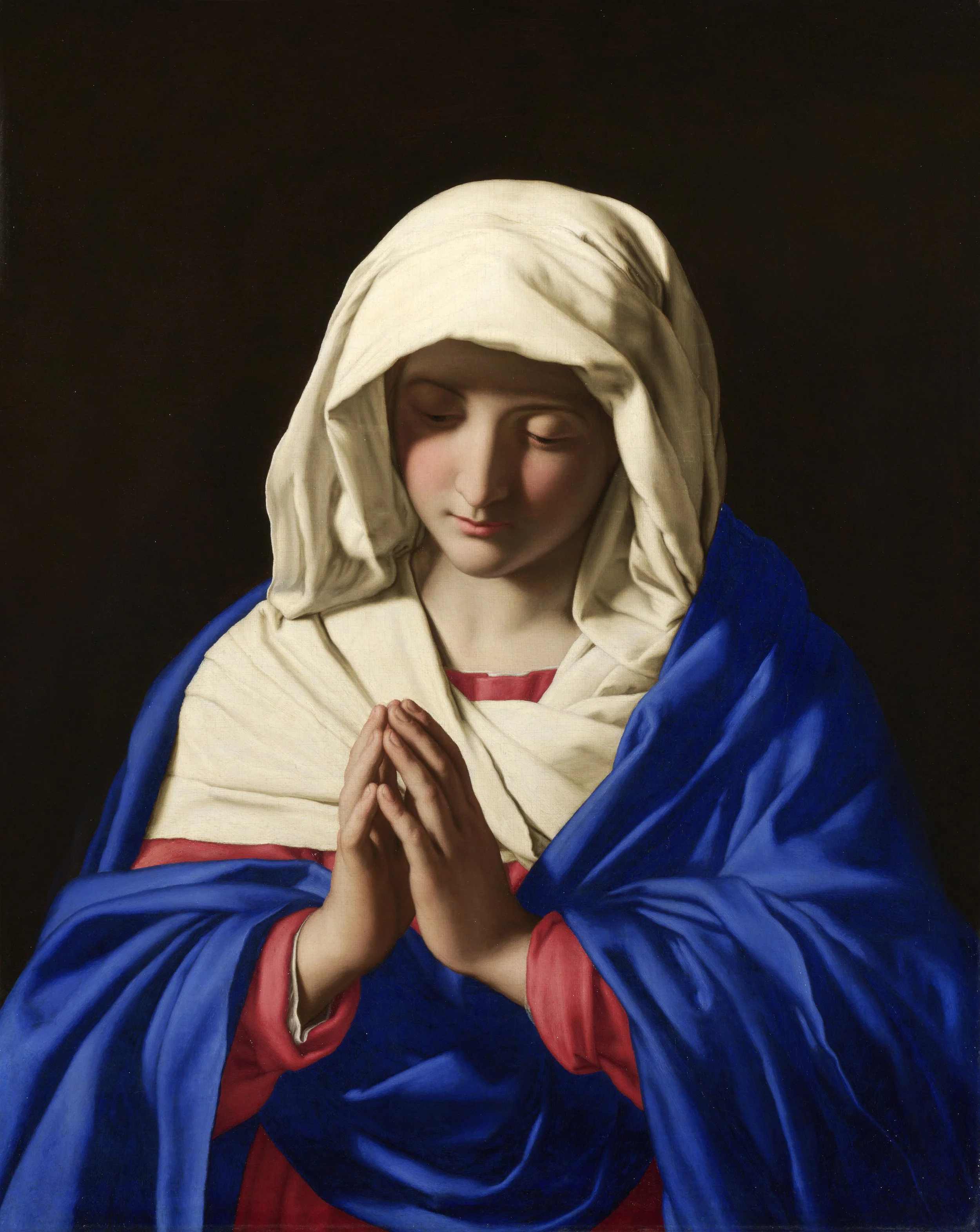
The Virgin in Prayer
SASSOFERRATO
In the 17th Century, the Virgin Mary in prayer had come into vogue, aided by the Roman Catholic Reformation that placed personal, solitary worship as one of its central tenets. Wealthy patrons, churches, and religious orders began to collect images of this scene and Sassoferrato, a committed follower of Raphael’s style, became widely regarded as the master of the genre. Looking at this work, one of many that he painted and sold over his life, it is easy to see why. There are no distractions from the subject and the action at hand. The Virgin Mary is framed by a black background, and depicted in three colours: red, blue, and white. He skin is rendered with such exacting delicacy that she seems to come to life, and the lighting offer such clarity as to seem almost hyperreal. For all the technical mastery and compositional genius on show, the star of the work is something far simpler - the Lapus Lazuli blue of her robes. A pigment made from rare stone sourced in contemporary Afghanistan, it brims with life and energy, drawing the eye in and framing the scene with infectious splendour.
Giovanni Battista Salvi da Sassoferrato
GIOVANNI BATTISTA SALVI DA SASSOFERRATO, c.1645. OIL ON CANVAS.
In the 17th Century, the Virgin Mary in prayer had come into vogue, aided by the Roman Catholic Reformation that placed personal, solitary worship as one of its central tenets. Wealthy patrons, churches, and religious orders began to collect images of this scene and Sassoferrato, a committed follower of Raphael’s style, became widely regarded as the master of the genre. Looking at this work, one of many that he painted and sold over his life, it is easy to see why. There are no distractions from the subject and the action at hand. The Virgin Mary is framed by a black background, and depicted in three colours: red, blue, and white. He skin is rendered with such exacting delicacy that she seems to come to life, and the lighting offer such clarity as to seem almost hyperreal. For all the technical mastery and compositional genius on show, the star of the work is something far simpler - the Lapus Lazuli blue of her robes. A pigment made from rare stone sourced in contemporary Afghanistan, it brims with life and energy, drawing the eye in and framing the scene with infectious splendour.

Arrival of the Normandy Train
CLAUDE MONET
For the last time, Monet lent his brush to the urban, man-made world. Almost every painting Monet was to make after this would be a natural landscape that sung the praises or showcased the power of nature. He had spent the last decade or more paying tribute to a new landscape of Paris, its grand boulevards, metal structures, glass exhibition spaces, and towering bridges, but now all of that modernity had lost its allure. It is fitting, then, that the subject of his swan song to the city and the industrialised world it represented would be this particular train. This was the terminal that linked Paris and Normandy, where Monet honed his en plein air landscapes, and the terminal that took the Impressionists to rural villages north and west of the city to escape and practice. The subject of Monet’s goodbye is the very means of his escape, and he paints it with such tenderness, as it to thank the train itself, or the invention of the steam engine, for what it has provided him: peace, solitude, and a way to connect with himself by connecting to the world around him.
Claude Monet
CLAUDE MONET, 1877. OIL ON CANVAS.
For the last time, Monet lent his brush to the urban, man-made world. Almost every painting Monet was to make after this would be a natural landscape that sung the praises or showcased the power of nature. He had spent the last decade or more paying tribute to the new landscape of Paris, its grand boulevards, metal structures, glass exhibition spaces, and towering bridges but all of that modernity had lost its allure. It is fitting, then, that the subject of his swan song to the city and the industrialised world it represented would be this particular train. This was the terminal that linked Paris and Normandy, where Monet honed his en plein air landscapes, and the terminal that took the Impressionists to rural villages north and west of the city to escape and practice. The subject of Monet’s goodbye is the very means of his escape, and he paints it with such tenderness, as it to thank the train itself, or the invention of the steam engine, for what it has provided him: peace, solitude, and a way to connect with himself by connecting to the world around him.

Inventions of the Monsters
SALVADOR DALI
Spain was in the midst of a civil war, and Salvador Dalí was hiding out in the Semmering mountains near Vienna painting this work, unaware that the city below him was months away from the Anschluss, whereby Nazi Germany was to annexe Austria. “According to Nostradamus the apparition of monsters presages the outbreak of war”, wrote Dalí about this painting, “Horse women equal maternal river monsters. Flaming giraffe equals masculine apocalyptic monster. Cat angel equals divine heterosexual monster. Hourglass equals metaphysical monster. Gala and Dalí equal sentimental monster. The little blue dog is not a true monster.” The canvas is ripe with omens, every inch brings with it foreboding and terror, even in the depiction of the love between the artist and his wife. The great Catalonian, despite his comfort with the subconscious world, was in touch with the frequencies of his culture and in this work he did not invent the monsters, only showed their approach towards a world increasingly willing to have them.
Salvador Dalí
SALVADOR DALÍ, 1937. OIL ON CANVAS.
Spain was in the midst of a civil war, and Salvador Dalí was hiding out in the Semmering mountains near Vienna painting this work, unaware that the city below him was months away from the Anschluss, whereby Nazi Germany was to annexe Austria. “According to Nostradamus the apparition of monsters presages the outbreak of war”, wrote Dalí about this painting, “Horse women equal maternal river monsters. Flaming giraffe equals masculine apocalyptic monster. Cat angel equals divine heterosexual monster. Hourglass equals metaphysical monster. Gala and Dalí equal sentimental monster. The little blue dog is not a true monster.” The canvas is ripe with omens, every inch brings with it foreboding and terror, even in the depiction of the love between the artist and his wife. The great Catalonian, despite his comfort with the subconscious world, was in touch with the frequencies of his culture and in this work he did not invent the monsters, only showed their approach towards a world increasingly willing to have them.

Monologue
JOHN STORRS
An architectural sculptor who, late in his career, began to translate three dimensions into two. John Storrs arrived at a style we would now firmly understand as Art Deco almost entirely independently, predating the widespread consolidation of the movement by nearly a decade. Abandoning his family business and forsaking his inheritance to seek new physical forms in Europe, he studied under Rodin, fraternised with Brancusi, Duchamp, and Man Ray. He translated these ideas and education into sculptural forms that incorporated Native American patterns, Gaelic structures, and Babylonian ziggurats. His work has an architectural eye, and uses the material of American industrialism; steel, brass and vulcanite replace stone in small sculptures that seem to speak to the soaring scale of the skyscrapers he grew up around. Though different in medium, his later paintings manage to bring the same philosophies of sculpture to linen. Interlocking forms and sharply defined colors create a sense of depth and scale that elevates them out of flatness and into a modernist world of dimensionality.
John Storrs
JOHN STORRS, 1932. OIL ON LINEN.
An architectural sculptor who, late in his career, began to translate three dimensions into two. John Storrs arrived at a style we would now firmly understand as Art Deco almost entirely independently, predating the widespread consolidation of the movement by nearly a decade. Abandoning his family business and forsaking his inheritance to seek new physical forms in Europe, he studied under Rodin, fraternised with Brancusi, Duchamp, and Man Ray. He translated these ideas and education into sculptural forms that incorporated Native American patterns, Gaelic structures, and Babylonian ziggurats. His work has an architectural eye, and uses the material of American industrialism; steel, brass and vulcanite replace stone in small sculptures that seem to speak to the soaring scale of the skyscrapers he grew up around. Though different in medium, his later paintings manage to bring the same philosophies of sculpture to linen. Interlocking forms and sharply defined colors create a sense of depth and scale that elevates them out of flatness and into a modernist world of dimensionality.
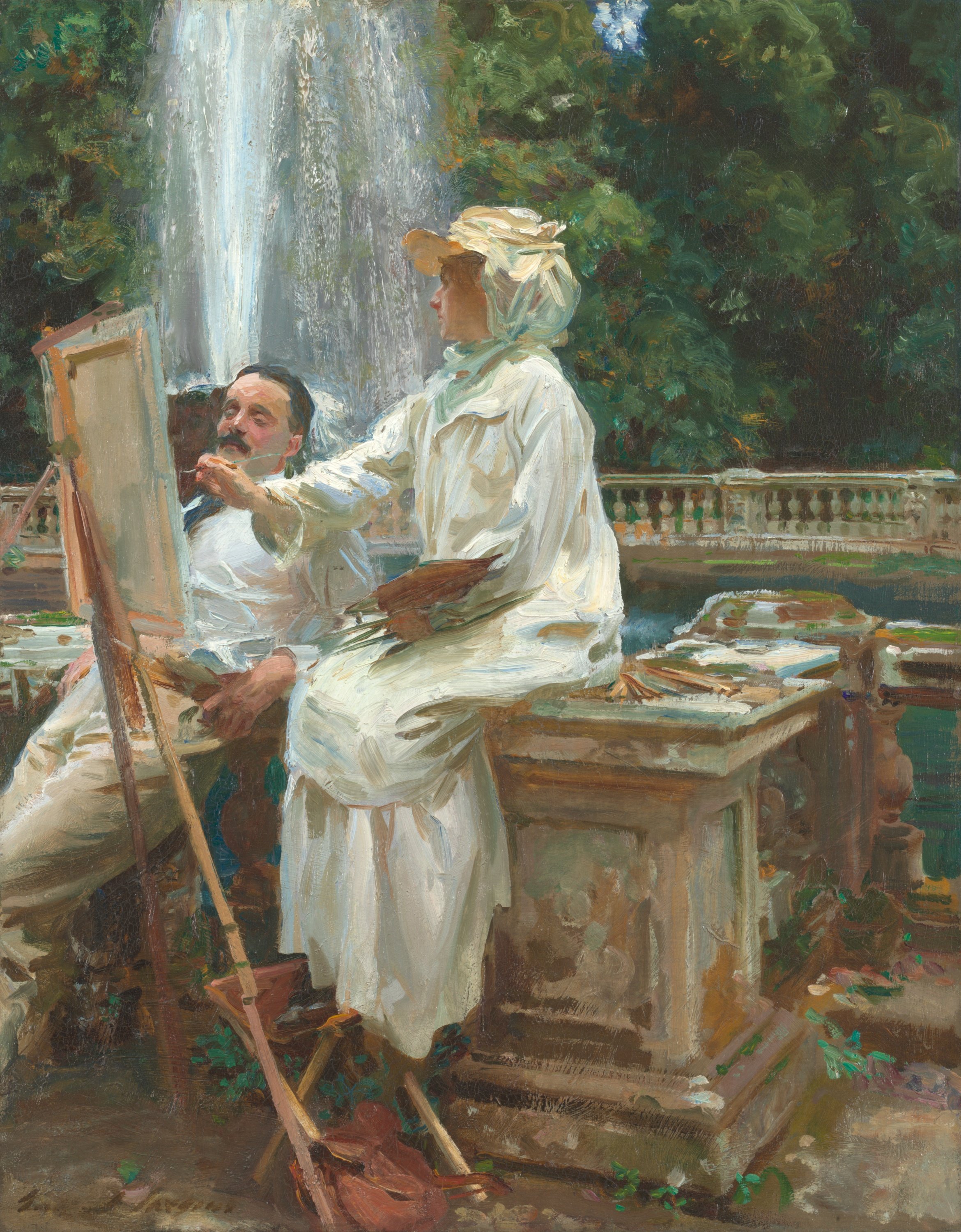
The Fountain
JOHN SINGER SARGENT
John Singer Sargent lived a life of two halves. The first was as a wildly successful portrait artist, amongst the greatest of his generation and celebrated across American high society, who’s inhabitants he most often depicted. He had a natural confidence with the brush, so sure in his hand that he commenced works without pencil sketches and his portraits captured a loose essence with Edwardian luxury, and occasional eroticism. The second was as a landscape artist, rejecting the grandiosity and traditionalism of his portraiture for painting en plein air in a far more impressionist style. 1907, when this work was painted during his travels around Italy, was the exact year of transition between these two movements. One can see in ‘The Fountain’ his internal conflict; the work is both portrait and landscape, painted outside of his friends and frequent travelling companions. They are an epitome of turn of the century decadent luxury and yet the landscape they exist in has a relaxed, definitively impressionist air - on a single canvas we see a collision between worlds, times, and Sargent’s split lives.
John Singer Sargent
JOHN SINGER SARGENT, 1907. OIL ON CANVAS.
John Singer Sargent lived a life of two halves. The first was as a wildly successful portrait artist, amongst the greatest of his generation and celebrated across American high society, who’s inhabitants he most often depicted. He had a natural confidence with the brush, so sure in his hand that he commenced works without pencil sketches and his portraits captured a loose essence with Edwardian luxury, and occasional eroticism. The second was as a landscape artist, rejecting the grandiosity and traditionalism of his portraiture for painting en plein air in a far more impressionist style. 1907, when this work was painted during his travels around Italy, was the exact year of transition between these two movements. One can see in ‘The Fountain’ his internal conflict; the work is both portrait and landscape, painted outside of his friends and frequent travelling companions. They are an epitome of turn of the century decadent luxury and yet the landscape they exist in has a relaxed, definitively impressionist air - on a single canvas we see a collision between worlds, times, and Sargent’s split lives.

Melting Point of Ice
JEAN-MICHEL BASQUIAT
Continents collide, antiquity butts up against modernity, and a primal spirituality comes into conflict with an industrialised capitalism. The work of Jean-Michel Basquiat has been explored perhaps as much as any post-war artist, and yet the depth of imagery, allegory, and references in his work continues to reward deep looking. Like few others, he was able to synthesise ideas from different movements, epochs, and civilisations, bringing traditional African art, as visible here in the mask-like face that dominates the top right corner, with a sensibility developed from his time as a graffiti artist, which the tightly coordinated chaos of the composition speaks to, and underpin the entire thing with a profound understanding of art history. Every inch of the canvas of ‘The Melting Point of Snow’ is used deliberately, weaving a tapestry of biblical stories, themes of childhood, and contemporary culture. Through all of it exists a theme of healing, from the Ritalin trademarks and copyrighted drug names, to the description of the Eye of Horus and it’s benefits, and the comforting stuffed toy labelled as non-toxic. The entirety of human history is fair game to Basquiat, and he manages to draw a line between disparate ideas in a single canvas that becomes greater than the sum of its parts.
Jean-Michel Basquiat
JEAN-MICHEL BASQUIAT, 1984. ACRYLIC, OILSTICK, AND SILKSCREEN ON CANVAS
Continents collide, antiquity butts up against modernity, and a primal spirituality comes into conflict with an industrialised capitalism. The work of Jean-Michel Basquiat has been explored perhaps as much as any post-war artist, and yet the depth of imagery, allegory, and references in his work continues to reward deep looking. Like few others, he was able to synthesise ideas from different movements, epochs, and civilisations, bringing traditional African art, as visible here in the mask-like face that dominates the top right corner, with a sensibility developed from his time as a graffiti artist, which the tightly coordinated chaos of the composition speaks to, and underpin the entire thing with a profound understanding of art history. Every inch of the canvas of ‘The Melting Point of Snow’ is used deliberately, weaving a tapestry of biblical stories, themes of childhood, and contemporary culture. Through all of it exists a theme of healing, from the Ritalin trademarks and copyrighted drug names, to the description of the Eye of Horus and it’s benefits, and the comforting stuffed toy labelled as non-toxic. The entirety of human history is fair game to Basquiat, and he manages to draw a line between disparate ideas in a single canvas that becomes greater than the sum of its parts.

Fisherman
GIFFORD R. BEAL
Gifford Beal found inspiration up and down America’s east coast. A native New Yorker, every element of New England appealed to his painterly eye, and he found equal romance in the urban landscapes of Manhattan, the society scenes of Hudson Bay, and the rural, maritime life of Massachusetts and Provincetown. His journeys up and down the coast, staying in family estates and country houses, took him the the Caribbean, where the vibrant colors of the native art scene combined with his more rigorous, European inspired art education, which was the norm for the day. The results of this synthesis are works like ‘Fishermen’ which combine a rendering of light and form that speaks to Impressionism, capturing in the mind of the viewer an immediate feeling of the place and time of day, while using colours that are so bright and vibrant they seem all but unbelievable. The setting sun illuminates the fisherman as he balances in motion, casting him and the jib of his boat in a rich orange hue while the sky scream with an iridescent blue, moments away from fading into black. Beal’s scene is exquisitely balanced, in color and composition - rope lines dissect the landscape into organised thirds, and the horizon offers a solid ground for our fisherman to lean out onto. It is a work that seems so simple, yet displays mastery at every level.
Gifford R. Beal
GIFFORD R. BEAL, 1928. OIL ON LINEN.
Gifford Beal found inspiration up and down America’s east coast. A native New Yorker, every element of New England appealed to his painterly eye, and he found equal romance in the urban landscapes of Manhattan, the society scenes of Hudson Bay, and the rural, maritime life of Massachusetts and Provincetown. His journeys up and down the coast, staying in family estates and country houses, took him the the Caribbean, where the vibrant colors of the native art scene combined with his more rigorous, European inspired art education, which was the norm for the day. The results of this synthesis are works like ‘Fishermen’ which combine a rendering of light and form that speaks to Impressionism, capturing in the mind of the viewer an immediate feeling of the place and time of day, while using colours that are so bright and vibrant they seem all but unbelievable. The setting sun illuminates the fisherman as he balances in motion, casting him and the jib of his boat in a rich orange hue while the sky scream with an iridescent blue, moments away from fading into black. Beal’s scene is exquisitely balanced, in color and composition - rope lines dissect the landscape into organised thirds, and the horizon offers a solid ground for our fisherman to lean out onto. It is a work that seems so simple, yet displays mastery at every level.

The Descent from the Cross
REMBRANDT VAN RIJN
Divine light illuminates the deeply human body of Christ as it twists and contorts in meekness and sorrow. Rembrandt does not shy away from the pain and suffering of the crucifixion, rejecting an idealised image of divinity and instead embracing the unsettling rawness of a tortured death. This sort of depiction was nigh on unprecedented - finding weight and humanity in his lifeless form that had long been shown as beautiful, Rembrandt forces us to reckon with the darkness of Christianity’s foundational tale. His etching is extraordinarily delicate, the interplay of light and shadow impossibly subtle, and compositionally, the brightness guides us towards importance and illuminates Christ and his followers, while the rest remain in the shadows. The figure on the ladder is Rembrandt himself, his features lent to this follower of Christ as if to say that act of creation is akin to that of salvation - he draws a parallel between those who helped Christ of the cross and those who keep him alive through art.
Rembrandt van Rijn
REMBRANDT VAN RIJN, 1633. ETCHING AND BURIN.
Divine light illuminates the deeply human body of Christ as it twists and contorts in meekness and sorrow. Rembrandt does not shy away from the pain and suffering of the crucifixion, rejecting an idealised image of divinity and instead embracing the unsettling rawness of a tortured death. This sort of depiction was nigh on unprecedented - finding weight and humanity in his lifeless form that had long been shown as beautiful, Rembrandt forces us to reckon with the darkness of Christianity’s foundational tale. His etching is extraordinarily delicate, the interplay of light and shadow impossibly subtle, and compositionally, the brightness guides us towards importance and illuminates Christ and his followers, while the rest remain in the shadows. The figure on the ladder is Rembrandt himself, his features lent to this follower of Christ as if to say that act of creation is akin to that of salvation - he draws a parallel between those who helped Christ of the cross and those who keep him alive through art.

Anne
LEON KROLL
In his time, Leon Kroll was most known for two things - painterly nudes and heroic landscapes. Part of a group known as ‘The Independents’ headed up by Robert Henri and counting Edward Hopper amongst their ranks, Kroll was quintessentially American in his style. His paintings are figurative, but with the loose and easy brushstrokes that lend them an air of the laissez-faire. The work is bright and pastoral, splitting with his contemporaries who favoured dark and gritty urban scenes. Instead, he renders women with a delicacy and reverence quite unusual for the time, bringing a fauvist palette to something uniquely of it’s era. In his portrait of ‘Anne’, he displays a confidence in his hand, and an ability to capture his subject in a candid moment. She looks away from the viewer, almost knowingly, aware of our gaze and unfazed by the attention. Kroll is relaxed in his style, such that it extends to our feelings towards the painting. We are at ease with Anne, happy to sit in her presence.
Leon Kroll
LEON KROLL, 1930. OIL ON LINEN.
In his time, Leon Kroll was most known for two things - painterly nudes and heroic landscapes. Part of a group known as ‘The Independents’ headed up by Robert Henri and counting Edward Hopper amongst their ranks, Kroll was quintessentially American in his style. His paintings are figurative, but with the loose and easy brushstrokes that lend them an air of the laissez-faire. The work is bright and pastoral, splitting with his contemporaries who favoured dark and gritty urban scenes. Instead, he renders women with a delicacy and reverence quite unusual for the time, bringing a fauvist palette to something uniquely of it’s era. In his portrait of ‘Anne’, he displays a confidence in his hand, and an ability to capture his subject in a candid moment. She looks away from the viewer, almost knowingly, aware of our gaze and unfazed by the attention. Kroll is relaxed in his style, such that it extends to our feelings towards the painting. We are at ease with Anne, happy to sit in her presence.

Charlie Chaplin
EDWARD STEICHEN
At the turn of the 20th Century, Edward Steichen was creating the genre of fashion photography. Working in the contemporary milieu of artists who used the camera as a means to create fine-art image, he applied avant-garde aesthetics to commercial means and photographed dresses, celebrities and advertisements with soft focus and physical manipulation of the prints. He was, by merit of these techniques, firmly in the world of Pictorialism - a style that was concerned with not straightforwardly recording through the camera, but creating art with it through manipulation of the images it captured. However, at the onset of the first World War, he was recruited by the American military to head up a photographic unit. Steichen took thousands of Ariel photographs for the military, and any sense of the camera as a tool for self-expression disappeared as it became an increasingly essential utilitarian object. After the war, Steichen continued to photograph, but his style changed drastically. Informed by his war-time efforts, he photographed elegantly simple portraits, creating art in the room but allowing the camera to capture only what was ahead of it. The images are detached, almost cold, and for the same reason, a strikingly truthful depiction of their subjects - Steichen found beauty and art not inside the camera, but in the world outside.
Edward Steichen
EDWARD STEICHEN, 1931. GELATIN SILVER PRINT.
At the turn of the 20th Century, Edward Steichen was creating the genre of fashion photography. Working in the contemporary milieu of artists who used the camera as a means to create fine-art image, he applied avant-garde aesthetics to commercial means and photographed dresses, celebrities and advertisements with soft focus and physical manipulation of the prints. He was, by merit of these techniques, firmly in the world of Pictorialism - a style that was concerned with not straightforwardly recording through the camera, but creating art with it through manipulation of the images it captured. However, at the onset of the first World War, he was recruited by the American military to head up a photographic unit. Steichen took thousands of Ariel photographs for the military, and any sense of the camera as a tool for self-expression disappeared as it became an increasingly essential utilitarian object. After the war, Steichen continued to photograph, but his style changed drastically. Informed by his war-time efforts, he photographed elegantly simple portraits, creating art in the room but allowing the camera to capture only what was ahead of it. The images are detached, almost cold, and for the same reason, a strikingly truthful depiction of their subjects - Steichen found beauty and art not inside the camera, but in the world outside.

The Inquisitor
CONRAD MARCA-RELLI
As a founding member of the first generation of the New York School, Marca-Relli counted amongst his friends and contemporaries De Kooning, Pollock, Kline, and Motherwell. Together, this group laid the foundations of Abstract Expressionism, moving art away from representation and context, and bringing it deep into the interior of themselves. Yet Marca-Relli, deeply knowledgable in art history and infatuated with the renaissance, could not fully abandon the traditions that inspired him. By the start of the 1950s, he had found a middle ground that married the Italian romance of his heart and heritage with the American, abstract workings of his mind. He created muted collages of canvas sheets, cut in anthropomorphic shapes and dyed in simple, sombre, earthly hues. The work’s exist in perfect contradiction - they paraphrase scenes of glorious, figurative depiction and turn them into abstract renderings, viewable both as pieces of aesthetic abstraction and direct expressions of people and place. Marca-Relli would not go on to achieve the fame of his comrades, but his bridge between Renaissance tradition and contemporary avant-garde continues to inform artists across the world.
Conrad Marca-Relli
CONRAD MARCA-RELLI, 1954. COLLAGED CANVAS AND VINYL, EPOXY, AND OIL ON CANVAS.
As a founding member of the first generation of the New York School, Marca-Relli counted amongst his friends and contemporaries De Kooning, Pollock, Kline, and Motherwell. Together, this group laid the foundations of Abstract Expressionism, moving art away from representation and context, and bringing it deep into the interior of themselves. Yet Marca-Relli, deeply knowledgable in art history and infatuated with the renaissance, could not fully abandon the traditions that inspired him. By the start of the 1950s, he had found a middle ground that married the Italian romance of his heart and heritage with the American, abstract workings of his mind. He created muted collages of canvas sheets, cut in anthropomorphic shapes and dyed in simple, sombre, earthly hues. The work’s exist in perfect contradiction - they paraphrase scenes of glorious, figurative depiction and turn them into abstract renderings, viewable both as pieces of aesthetic abstraction and direct expressions of people and place. Marca-Relli would not go on to achieve the fame of his comrades, but his bridge between Renaissance tradition and contemporary avant-garde continues to inform artists across the world.

Improvisation No. 30 ( Cannons)
VASILY KANDINSKY
Kandinsky wanted to shorten the distance between painter and musician. In his seminal treatise ‘Regarding the Spiritual in Art’, written the year before this work, he wrote that it was music, not painting, that was most readily able to capture and stir the “vibrations of the soul”. For tangible art to reach these heights, it would have to do so in the mode of abstraction. This was, for Kandinsky, the most musical, lyrical, and free form of painterly expression. For four years, he created these series of abstractions, trying to bring his subconscious to canvas with as little dilution or distraction as possible. He saw them as spontaneous expressions of his inner mind, and while the majority of the painting is truly abstract, a firing cannon, falling building, and a crowd appear. These were no less spontaneous than the abstract forms and colors, instead they represented the tangible aspects of the material world that he was grappling with in the moment of creation - here, it is clear that war was on his mind. Kandinsky’s Improvisations are just that: imperfect, free expressions that grasp towards the intangible, searing power of music.
Vasily Kandinsky
VASILY KANDINSKY, 1913. OIL ON CANVAS.
Kandinsky wanted to shorten the distance between painter and musician. In his seminal treatise ‘Regarding the Spiritual in Art’, written the year before this work, he wrote that it was music, not painting, that was most readily able to capture and stir the “vibrations of the soul”. For tangible art to reach these heights, it would have to do so in the mode of abstraction. This was, for Kandinsky, the most musical, lyrical, and free form of painterly expression. For four years, he created these series of abstractions, trying to bring his subconscious to canvas with as little dilution or distraction as possible. He saw them as spontaneous expressions of his inner mind, and while the majority of the painting is truly abstract, a firing cannon, falling building, and a crowd appear. These were no less spontaneous than the abstract forms and colors, instead they represented the tangible aspects of the material world that he was grappling with in the moment of creation - here, it is clear that war was on his mind. Kandinsky’s Improvisations are just that: imperfect, free expressions that grasp towards the intangible, searing power of music.