
Architecture of the Cosmos
Trisha Singh December 23, 2025
A Hindu temple does not serve just as a place of worship but as a three-dimensional map of the universe, rendered in stone…
Trisha Singh, December 23, 2025
A Hindu temple does not serve just as a place of worship but as a three-dimensional map of the universe, rendered in stone. Every line, proportion, and orientation of the building is shaped by sacred geometry, a symbolic language that expresses not just both how the cosmos is ordered and how human beings may move within it. Rooted in ancient Indian philosophy, mathematics, astronomy, and ritual practice, Hindu temple architecture transforms space itself into a spiritual path. To understand a Hindu temple is to see how form can guide the devotee from the outer plane toward inner realization.
At the core of this tradition lies the Hindu understanding that the universe is not random or inert, but an ordered, intelligible, and alive entity, replete with consciousness. This order is known as ṛta, the cosmic principle that governs both natural law and moral harmony. Sacred geometry is a visible expression of ṛta, translating metaphysical truth into spatial form, and architecture actively participates in the rituals it hosts.
Central to Hindu philosophy, particularly in the Vedic and Upanishadic traditions, is the idea that the universe (brahmāṇḍa) mirrors the human being (piṇḍāṇḍa). The macrocosm and the microcosm reflect one another, like the old adage of ‘as above, so below’. Sacred geometry serves as the bridge between these two scales of existence. As one enters a temple, they symbolically enter the cosmos, and as they walk through that cosmic journey, move inward toward the Self (ātman), which Hindu philosophy identifies with ultimate reality (Brahman). The temple becomes both a map of the universe and a guide for inner transformation.
The formal principles governing this sacred space are articulated in Vāstu Śāstra, the ancient Indian science of architecture. Vāstu Śāstra integrates geometry, astronomy, directional alignment, and metaphysics, treating space as a living field of energies rather than an empty container. Land itself possesses consciousness, embodied in the figure of the Vāstu Puruṣa, a cosmic being who lies within the square grid of the temple plan. Each part of his body corresponds to specific directions, deities, and natural forces. Constructing a temple is therefore an act of biological creation —aligning human intention with cosmic order.
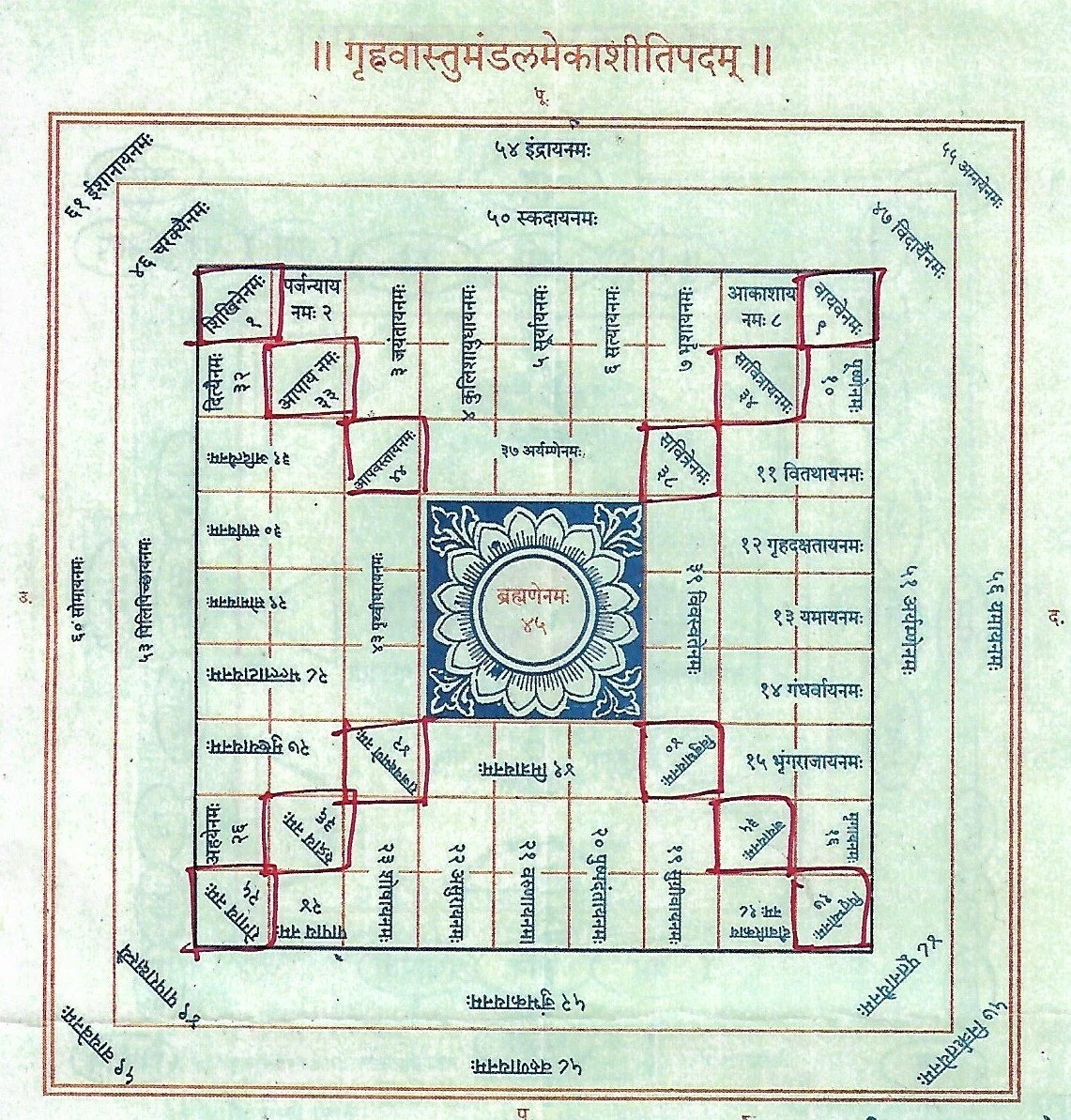
This alignment is most clearly expressed through the Vāstu Puruṣa Maṇḍala, a geometric blueprint that underlyes Hindu temple design. The mandala is both a cosmological diagram and a map of consciousness, taking the form of a geometric grid divided into sixty-four or eighty-one smaller squares, organised around a center. The central square, the Brahma Pada, represents the source of creation: pure, undifferentiated consciousness. The temple’s innermost sanctum, the garbhagṛha, is placed precisely here.
Surrounding this center, the remaining squares are assigned to various deities and cosmic forces, arranged so that energy symbolically flows inward. As we move through the structure, this can be felt tangibly and observed. Complexity of design and adornment gradually gives way to simplicity and a sense of unity. The devotee is a necessary participant in the architecture, moving towards the divine and returning to the source of all.
The geometric language of the temple is built upon two fundamental forms: the square and the circle. The square represents stability, order, and the material world, its corners corresponding to the cardinal directions and the grounded nature of human experience. As such, the square dominates the temple’s plan.
The circle, by contrast, symbolizes infinity, wholeness, and the cosmic order. It represents time, cycles, and the divine. Although temples are rarely circular in structure, their conceptual design often begins with a circle that is “squared.” The boundless reality of Brahman can take form within the finite world without being diminished.
“Unity within diversity, order within complexity, and the presence of the infinite within the finite.”
The system of measurement contributes further to this symbolic system. Hindu temple architecture employs precise units such as the aṅgula and the tāla, as dimensions follow harmonious ratios rather than arbitrary scale. These proportions resonate with cosmic order, much like musical intervals produce harmony through mathematical relationships. Space, like sound, becomes a medium through which balance and coherence are experienced.
We see this attention to proportion most clearly in the temple’s vertical dimension. The rising tower above the sanctum is designed to appear as an organic ascent and evoke the soul’s movement from the earthly realm toward higher planes of existence.
At the base of this ascent lies the garbhagṛha, the inner sanctum and “womb chamber” of the temple. Small, dark, and deliberately austere, it is a perfect square or cube, symbolizing completeness and stability. The absence of natural light and lack of ornamentation draws attention inward, towards our consciousness. As we approach the sanctum, we leave behind the sensory richness of the outer halls and enter a space of stillness and potential, with the architecture mirroring the meditative journey.
Vertical symbolism of the temple extends beyond the tower. Hindu temples are often conceived as representations of Mount Meru, the mythological axis of the universe. The temple’s central vertical line, sometimes called the brahma sūtra, aligns earth and sky, creating a conduit for cosmic energy. At the summit, the kalaśa finial signifies abundance, immortality, and the union of the earthly and the divine.
Most Hindu temples face east, greeting the rising sun as a symbol of knowledge, life, and awakening. In many temples, architectural alignment allows sunlight to illuminate the deity at specific times of the year, linking ritual practice to astronomical cycles. The temple, then, functions not only as a sacred enclosure, but as a calendar and observatory that synchronizes human worship with celestial movement.
Ultimately, the purpose of Hindu temple geometry, as with sacred geometry across cultures, is not about mathematical precision for its own sake. Instead, it functions as a symbolic language, communicating philosophical truths that words alone cannot convey: unity within diversity, order within complexity, and the presence of the infinite within the finite. The temple becomes a mirror and a participant of the universe
Hindu temple’s architecture reveal a worldview in which art, science, and spirituality are inseparable. These structures are designed not only to house deities or inspire awe, but to guide consciousness toward harmony with cosmic order. To walk through a Hindu temple is to traverse a cosmic diagram, moving from the outer world of form and multiplicity toward the silent center of being. The building becomes our teacher.
Trisha Singh is an architect and writer.
7 Army - The I Ching
Chris Gabriel December 20, 2025
The Army is pure if it is led by a wise man…
Chris Gabriel December 20, 2025
Judgment
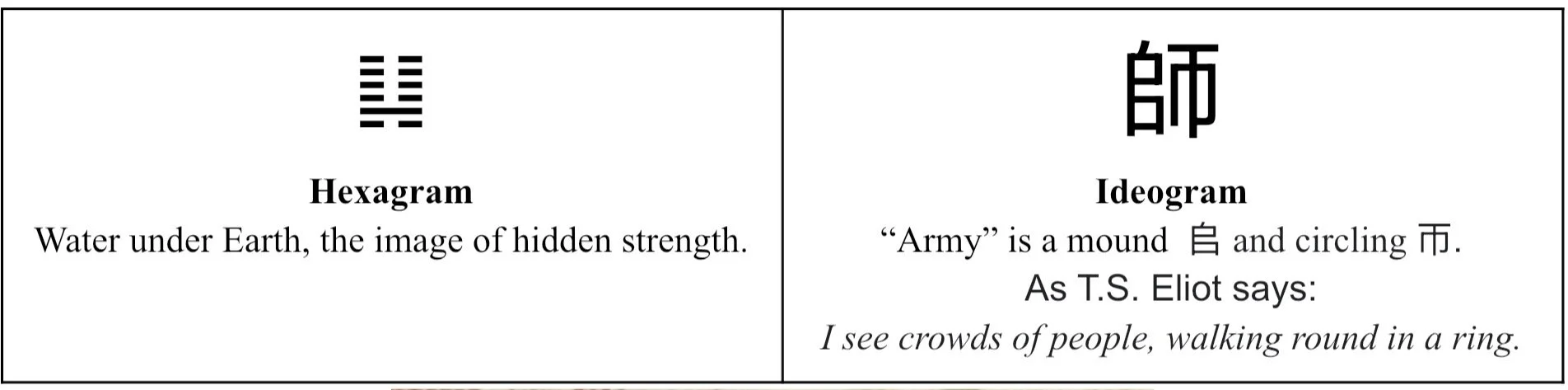
The Army is pure if it’s led by a wise man.
Lines
1
The Army goes with discipline.
2
In the middle is the commander with three orders from the King.
3
Sometimes the Army leaves wagons full of corpses.
4
Then the Army rests.
5
Fields full of birds. Catch them. An older boy leads the army. A younger boy is dead.
6
A great one gives orders, opening the country and accepting families. Small ones can’t do this.
Qabalah
Malkuth to Yesod: The Path of Tau. The Universe. Malkuth envelopes the energy of Yesod. The Earth to the Moon.
In this hexagram, we see the image of earth over water. It is something simple atop something dangerous, so in this way we are given the image of the Army. Consider revolutions in which simple folk become warriors. Naturally, this hexagram depicts an aquifer, or an underwater reservoir - a great resource hidden underground.
A clear natural example that intertwines the Army with the underground is an Ant colony and an anthill is not so different from a military bunker.
The lines give us a very stark look at war.
1
An army is worse than useless if it is undisciplined. Yet again, the Ant provides the ideal of the military, absolute devotion and a singular purpose.
2
An army won’t get much done without orders from above.
3
Even when the military functions properly, many people die for the sake of some greater goal.
4
After atrocities and horror, soldiers must rest and recuperate.
5
This is the most significant line in the hexagram. We should not mistake the realistic view of the military here with a denouncement of war - this line clearly advocates for the military acquisition of resources. War comes with the ultimate cost - teenagers leading men in battle against fellow teenagers, and few coming out alive.
6
After war, the land a state has taken is put to use and inhabited.
Another military development through which this hexagram can be understood is camouflage. Camouflage allows something that looks simple to hide something dangerous. Consider the deceptive fulfillment of prophecy by Malcom in Macbeth:
Let every soldier hew him down a bough
And bear ’t before him. Thereby shall we shadow
The numbers of our host and make discovery
Err in report of us.
Drunvalo Melchizedek's Unity Breath Meditation
Molly Hankins December 18, 2025
The Unity Breath Meditation moves our consciousness in preparation to receive the new information in his book and the higher dimensional frequencies pouring into Earth at this time…
‘Impression Figure’ of recorded sound by Margaret Watts Hughes, Late 1800s.
Molly Hankins December 18, 2025
Ancient Secrets of the Flower of Life author and spiritual teacher Drunvalo Melchizedek began speaking publicly again this year after suffering a stroke, and has announced the completion of his next book due out in 2026. Parts 1 and 2 of Ancient Secrets of the Flower of Life were first published in 1999, and as we wait for the third installation to be released, Drunvalo has been discussing how to prepare for the quantum leap in consciousness we are going through right now as a planet. Many of his teachings discuss moving the seat of our conscious minds from our brain into our hearts. Best articulated in his 2003 book Living In The Heart, he recommends using what he calls the Unity Breath Meditation to move our consciousness in preparation to receive the new information in his book and the higher dimensional frequencies pouring into Earth at this time.
The Unity Breath Meditation was channeled by Drunvalo from the deceased Indian monk and yogi Sri Yuketeswar. “He told me that in India no one would even consider approaching the divine without a certain state of mind and heart,” Drunvalo explained. “And he gave me very specific instructions on exactly how to consciously connect with God.” By connecting emotionally with these ideas, we expand our connection with nature and Source Energy. This expanded channel allows us to cross the threshold into more subtle realms of consciousness, download new states of awareness and embody the integration of those new states.
To begin the meditation, close your eyes and imagine a beautiful, natural setting - including little details like feeling the breeze on your face. “Mother Earth cares about every person on this Earth, she actually knows your name,” Drunvalo says. Connect emotionally to her divine feminine love for you in the meditation, then send that gratitude as a beam of energy down the base of your spine and into the earth’s core. Wait for her to return the energy before moving to the next step. “Trust her, because she can feel when you’re ready,” he says in reference to what kind of energy Mother Earth sends back. Drunvalo believes that it’s dangerous to expand our consciousness too quickly, and that Earth can help us modulate and ground that expansion. It is the emotional connection to the soul of our planet that allows us access to these energies.
Next connect to Father Sky, allowing gratitude to swell for divine masculine energy, and send a beam of energy up into the cosmos or straight to our Sun. Sri Yukteswar specifically recommends placing your energy into a small sphere of light that moves intentionally along the beam, telling us this will activate the unity consciousness grid around the Earth. When Rupert Sheldrake explains the Morphogenetic field of interconnected, living information systems organizing consciousness, he may very well be describing the exact same concept.
Keep breathing as you wait for Father Sky to return the energy, and once received, begin breathing it into your heart along with the energy from Mother Earth. Allow both beams of energy to meet in your heart. Then move your consciousness down into your heart. As you breathe into this space, be aware that the divine is alive there. Source consciousness is expressed through your being, and it loves being you. Now we are in conscious co-creation with that energy, breathe into gratitude for the opportunity to co-create reality. You may find engaging in this meditation increases the intuitive messages from both the natural world and higher consciousness. There is a tiny, sacred place inside your heart - use your imagination to find it.
“Whichever way feels right, is the right way for you. Once you’re in your heart, find the sacred space.”
According to Drunvalo, performing the Unity Breath Meditation and visualization allows us to access the subtle realms of expanded awareness, aligning our frequencies. “I believe that the Unity Breath creates the vibration within you that allows you to find the holy grail, the sacred space of the heart, the place where God originally created all there is. It is so simple. What you have always been looking for is right inside your own heart,” Drunvalo writes in Living In The Heart.
As a precursor to getting into our hearts, Druvalo tells us we must get into our bodies, imagining a pranic tube that runs from just above our heads and through our root chakras into the Earth. Prana is like chi - an energetic life force that can be built, harnessed and channeled into anything. That energy moves along the pranic tube that runs through our spinal column and connects our physical bodies to our souls while we’re alive in human form.
There are distinct masculine and feminine ways of getting into the heart. The masculine way requires you to imagine a toroidal field around your body, moving your consciousness through the field in either direction and into the heart. The feminine way is not prescriptive, we just imagine ourselves to be in the heart and we are there. Whichever way feels right, is the right way for you. Once you’re in your heart, find the sacred space. Drunvalo explained, “The sacred space of the heart is older than creation itself. Before there were galaxies to live within, there was space. All the spaces you have traveled within this creation you have recorded within this space. So at first you might begin to remember what this is all about, what life is all about.” Bring anything you wish to manifest into this sacred place and give it love to accelerate fruition.
What expanded awareness looks like is unique to each of us, but the conscious exchange of higher dimensional energy between Earthly and galactic intelligence that happens during the Unity Breath tends to feel quite enjoyable. Once the channel is opened, stay open to intuitive messages from nature and beyond. Drunvalo also recommends inviting someone you deeply love, living or dead, to be with you in that sacred place within the heart, and to amplify that love into your energy field and the collective. “Now you know your way home,” he writes. “Within the sacred space of the heart, all worlds, all dimensions, all universes, and all of creation found their birth. Interconnecting through your one heart are all the hearts of all life everywhere!” We strengthen this network of hearts making up the unity consciousness grid by meditating on the people we love, then pouring that love into daily living.
Molly Hankins is an Initiate + Reality Hacker serving the Ministry of Quantum Existentialism and Builders of the Adytum.
Wounds
Sofia Luna December 16, 2025
For most of human existence, our wounds signified that we were part of the natural world…

Robert White, Compleat Discourse of Wounds (1678).
Sofia Luna December 16, 2025
For most of human existence, our wounds signified that we were part of the natural world. They wrote the story of life without separation as we not only blended into, but were an active part of the ecosystem. Last week, noticing a boy having breakfast with his mother rocking a severely bruised eye, it felt like a novelty. In a modern, western world, physical wounds and battle scars have all but disappeared from everyday reality. What, I wondered, are the global repercussions of the sterilisation of our physical plane?
We no longer walk through irregular terrains filled with natural pigments, or scramble over cliffs with battered bodies. We construct buildings to keep nature out and monuments to hold our ambitions together. We walk with slicked back hair, and polished suits through angular concrete landscapes. We refine and decorate our avatars, surgically 'enhance' our geometries, and homogenise the surface of our lives and our bodies the same way we do to our walls. We call this progress. Beneath our skin, though, lies irregularity—festering deep, invisible wounds, not of flesh but of spirit.
In the gradual fabrication of the modern metropolis, we transferred our bodily wounds to earth. To her soil, her small ferns, to past predators, waters, rivers, and birds—not realising that they too, give us life. We looked away from the damage caused as we dreamt of a human centric world, building structures to keep dangers out. And they did but the fact that wounds incrementally disappeared from the visual field made it really difficult for us to track what was hazardous to our new existence.
As our infrastructures mutated, so did our wounds, but our definitions of danger stayed the same. Only in cases of mass destruction or abuse in focused areas are we able to look from afar and say “yes, there is a problem we need to work on!”.That which invisibly infects the collective beyond time and space is really hard to put a finger on, and so is difficult to heal. Consequently, moving from tiger scratches 20,000 years ago to inexplicable spirit aches have left us living "in a space without a map," as Joanna Macy remarked.
Few of us could survive in a forest right now, but we need not be that adventurous—a lot of humans can't even deal with free time at home. We require constant stimulation, and have become completely averse to the uncharted. We follow paths that have been clearly traced before in fear of getting lost. Is this a place worth existing in? A lot of people have started to realise it is not and I have witnessed the ample collective inkling that we should recalculate our relationship with the world and ourselves.
“Wounds are holes, holes are doors, doors into something, openings, where, if we choose to enter them, the person that walks out is not the same who walked in.”
We have been so isolated from nature that we don't even consider its absence as one of the causes for global unsettlement or the sharp rises in anxiety, loneliness, depression and spiritual voids that so many of us experience. Isn't she Mother Earth? We are the child that has cut their parent off and have been left traumatised.
We talk about rewilding gardens but it is time to talk about rewilding society. We are hungry for something that was taken from us. When certain religions first appeared, they replaced our connection to the wild with a relationship to something more abstract. Slowly we have been extracted out of the symbiotic relationship we had with our planet, as institutions of belief arranged themselves on top of everything and everyone as the source. Religion replaced nature. It reasoned with the invisible and colonised our imagination for the past millennia. Thank God, time, and the increasing access to information, that what was hiding underneath—the incoherence, the imposed patriarchy, intolerance, and the general abuse of power that was then mimicked by corporations— was exposed. Today, younger generations are unsubscribing from this expired belief system and in that process have started seeking something else. Many of us are returning back to nature, to our nature.

Caravaggio, The Incredulity of Saint Thomas (1602)
Hosting Shinrin-Yoku experiences (the science backed Japanese practice of Forest Bathing, known to balance the body and mind) one quickly sees how fulfilling, cleansing, healing, energising, and surprisingly simple the practice feels when all you do is walk through a forest, fully present, without the intrusion of technology. This evidence shows how much nature feels like home—how nurturing she is, how much our bodies need her, and yet, how absent she is in modern cities.
I have found that the more I heal my insides, the closer I feel to the natural world, the more natural it feels to live in this world, and the more I unearth my own self and the old memories of the soul. Wounds are holes, holes are doors, doors into something, openings, where, if we choose to enter them, the person that walks out is not the same who walked in. Unhealed wounds propagate, the same way good energy creates more good energy and healed wounds attract healed people. There is no need to try and save the entire world, because the entire world is simply the one You inhabit—you choose what to do with it.
I write this to speak into reality a transformation, I believe, is happening to many. We are interconnected, and in this floating rock, no one experiences anything alone, the Human Experience is shared. Regardless of the 'never-ending horrors', we are on our way back to nature. And Nature is not just a tree, a fish and a squirrel. Nature is you, in essence. Nature is beauty, it is The Grand, it is Vast. It is Vital, it is Infinite, it is Eternally Alive. It is Robust, Real, Complex. It is Us. It is also everything we are not right now, and everything we are becoming.
Sofia Luna explores and builds tools that facilitate this time's modern cognitive shift. She is a Colombian artist, creative consultant, entrepreneur and imaginator living In The Middle of The Future.
6 Divorce - The I Ching
Chris Gabriel December 13, 2025
Fight, but not to the bitter end…
Chris Gabriel December 13, 2025
Judgment
Fight, but not to the bitter end.
Lines
1
Don’t draw it out, there will be rumours.
2
Unable to fight, he goes back to his small town.
3
Live off your old deeds. Working for the king brings nothing.
4
Unable to fight, go back to yourself. Be calm.
5
Fight, and fortune follows.
6
Sometimes you are given a ribbon, and by morning you’ve been stripped of it three times.
Qabalah
Imperfectly, Kether to Yesod, or Gimel ג directly. The High Priestess.
Kether only makes contact with Tiphereth below, not Yesod. The path between them is the lunar Gimel.
Heaven to the Moon.
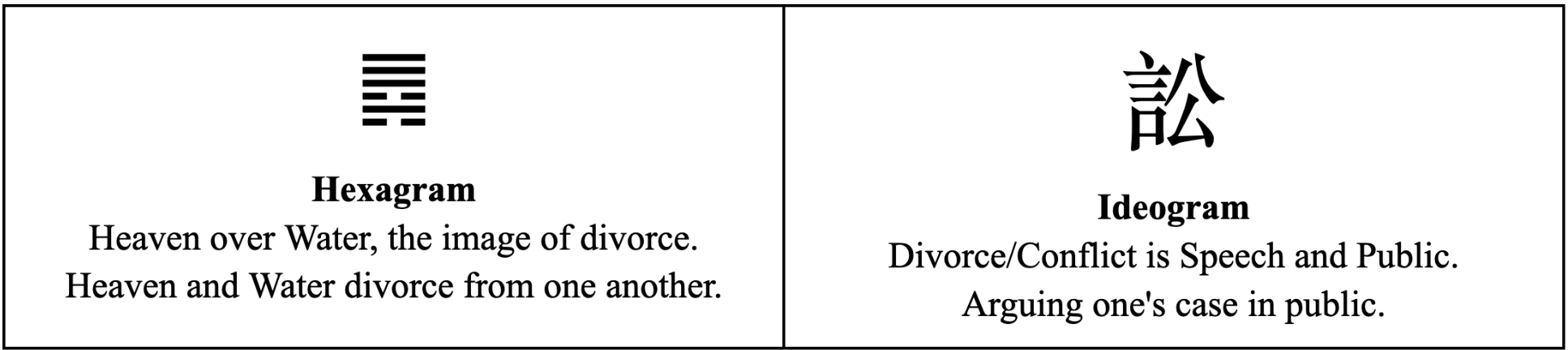
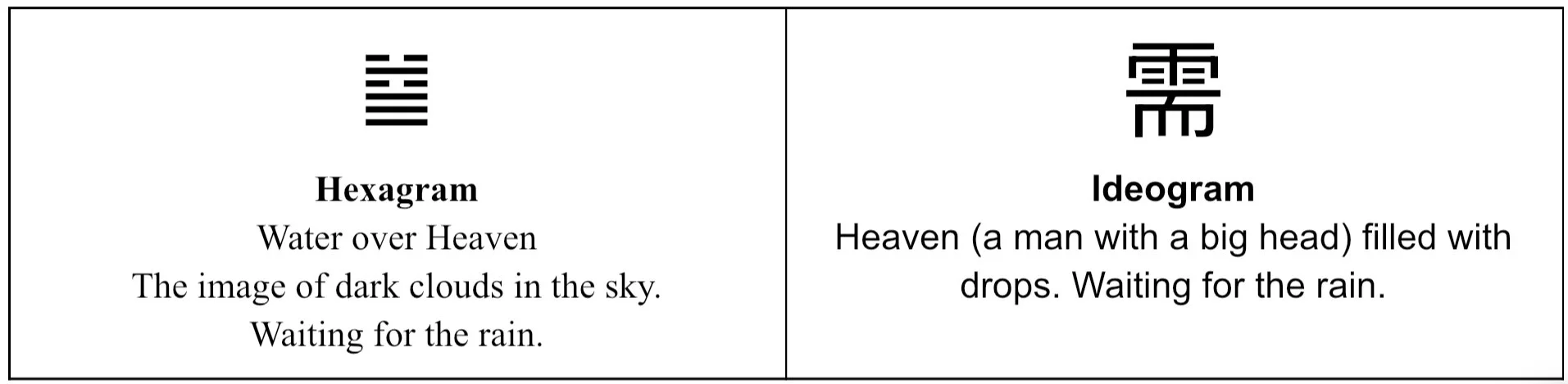
The rain we had been waiting for comes down, and when it rains, it pours. This storm can lead to relief, but in the moment it can be exceedingly troublesome and unpleasant. The ideogram shows public dispute: the airing out of dirty laundry. Often called conflict, strife, or contention, the clearest title is divorce. We are dealing with separation, the splitting of water from the sky as they go their separate ways. Divorce is very difficult but the hope is that it will eventually calm and peace. This is not necessarily about splitting a marriage, but all splits: arguments, breakups, and lawsuits.
1
Just as the judgment says, it is best to get things done quickly or to give it up when the time is right. Consider very public, very ugly divorce procedures and court cases, they invite gossip and bad attention.
2
This is like a classic “divorced dad” joke, where after divorcing he moves back to his home town and lives in a little apartment. In this case, this is the right action to take!
3
When new work doesn’t come, we have to live off our old work.Consider this as dipping into personal savings when you’re in trouble.
4
We often see people who are divorced “become themselves” again; they pick up old hobbies, or spend time with old friends.
5
Fight when the time is right and you’ll have victory.
6
Even when there are apparent victories, especially with divorces involving children, they are often appealed, reversed, and continually fought over.
In the previous hexagram, we eagerly awaited what comes down here. It was the calm before the storm. As a religious person may yearn for the horrors of an Apocalypse, with hope that something greater is on the other side of trials, we must have faith that we will get through the troubles that come our way.
George Harrison puts it perfectly:
A cloudburst doesn't last all day
Seems my love is up and has left you with no warning
It's not always gonna be this gray
All things must pass
His wisdom echoes chapter 23 of the Tao Te Ching:
A Terrible wind won’t last all morning
A Terrible storm won’t last all day
Who causes these?
Heaven and Earth.
Heaven and Earth can’t make something last
Why could Man?
As humans, we cannot keep our relationships and friendships forever - all things must pass. When it’s time to part ways with someone, don’t make it ugly.
Mediating Planetary Co-Existence
Tuukka Toivonen December 11, 2025
Heather Barnett, an artist who works with slime mold, recently told me she viewed herself not simply as a practitioner of art but as a mediator. Through years of collaborative experimentation she had found herself, without intending to, acting as an intermediary between two mutually foreign forms of intelligence — slime molds and human beings…

Yggdrasill, The Mundane Tree. From a plate of the Prose Edda, Oluf Olufsen Bagge. 1847.
Tuukka Toivonen December 11, 2025
Heather Barnett, an artist who works with slime mold, recently told me she viewed herself not simply as a practitioner of art but as a mediator. Through years of collaborative experimentation she had found herself, without intending to, acting as an intermediary between two mutually foreign forms of intelligence — slime molds and human beings. Curating the often astonishingly clever behaviors of these oatmeal-loving, network-making slime molds for human audiences, she uncovered new synergies and creative connections. In live performances, she invited audiences to mimic the physical movements of such ‘lesser beings’, resulting in surprising patterns of group behavior. This workconjured up a kind of interspecies awareness and relationship in Heather, and those who saw it, where none had previously existed. Another experienced artist I spoke to, Julia Lochmann, expressed a similar ethos of intermediation — in this case, one focused on seaweed-human relations. Both practitioners had set up collectives for like-minded slime mould and seaweed enthusiasts that brought artists together with scientists, students, designers and even entrepreneurs. These conversations prompted me to reflect further on the significance of those who mediate immersively between different organisms or environments. Could their experimental, connective engagements open up new possibilities for a deeper planetary co-existence? And what could those of us with less experience in this area learn from seasoned intermediators?
At a basic level, to mediate is to form a link between two previously disconnected or estranged entities. By occupying an intermediary position, one takes on the task of facilitating an agreement or reconciliation of some kind, and fostering mutually beneficial forms of co-existence. Mediators of various kinds abound in our daily lives; people who introduce us to opportunities and ideas we did not know about or familiarize us with technologies we knew not how to operate. Those who teach us novel languages mediate a new relationship between us and other cultures. With a little help from such fluent speakers and cultural mediators, it becomes far easier to pick up the meanings, structures and nuances — even the perceptual and aesthetic inclinations — of new languages and cultures. What once seemed indecipherable becomes more and more intelligible, accessible and rich in meaning. We gradually enter a shared world. and then, for a moment, we feel awed by the uplifting resonance — a sense of synchrony, agreement or correspondence — that we discover between ourselves and an aspect of the world that used to be alien to us.
“We have long positioned humans as the only ‘intelligent’ species while denying the cognitive abilities, agency and aliveness of every other life-form. We now possess the opportunity to change course…”
In their revelatory book on the search for planetary intelligence, one that involves animals, plants, and machines, the author James Bridle dedicates a chapter to exploring how plants perceive the world and what scope might exist for us to relate to them at a sensorial and existential level. Bridle recounts an experiment by two biologists from the University of Missouri during which a recording was made of the sound of cabbage white caterpillars feeding on a cress plant (Arabidopsis thaliana). The scientists subsequently removed the caterpillars, playing back only their sounds to the cress plant, which caused the plant to switch on its chemical defenses for deterring predators, despite their absence. Having ensured this reaction arose exclusively in response to the specific sound of caterpillars, there was only one conclusion to be drawn: the cress plant could hear. Bridle reads this and other eye-opening experiments on ‘plant sensing’ as suggestive of
multiple distinctive worlds and as expressions of common ways of being and perceiving that cross species lines:
‘We share a world. We hear, plants hear; we all hear together. We all feel the same sun, breathe the same air, drink the same water. Whether we hear the same sounds in the same way, whether they are meaningful to us in the same way, is beside the point. We exist, together, in the shared experience and creation of the more-than human world’ (Bridle 2023: 69-70).¹

Atlas des Champignons, M. E. Descourtilz. 1827.
Bridle’s work engages in acts of mediation that takes notable interspecies experiments and discoveries, and translates them into relational transformations. It reveals how profoundly illusionary our prior assumptions of a disconnected existence have been, and how false the idea that plants, animals, fungi and ourselves inhabit essentially separate worlds is. By submitting to a vacuous kind of objectivity, Bridle shows we have tried to make the world conform to our man made, fixed conceptualizations, and in doing so have limited the full use of our own perceptual capabilities. We have long positioned humans as the only ‘intelligent’ species while denying the cognitive abilities, agency and aliveness of every other life-form. We now possess the opportunity to change course, and to whole-heartedly cohabit the shared world Bridle so animatedly writes about. We can do this through updating our mental constructs and discovering new resonances between ourselves and the living world. Much like the feelings of connection we gain when learning a new language, might we feel a similar (or perhaps an even greater) sense of enchantment and resonance as we regain the ability to participate fully in the more-than human world — a world where intelligence is present everywhere?
I suspect that mediators — whether nominally classified as artists, writers, scientists, naturalists or entrepreneurs — matter precisely because they have the power to help us see such novel possibilities for planetary co-existence. They awaken us to ways of being, to a new type of sensing and relating that we have struggled to notice or thought could not be accessed within the confines of contemporary society. And not only that: they often perform intermediation work not only in theory but in practice, experimentally and at scale. Such practical work can range from the curation of intimate group experiences within local forest ecologies to masterfully finding correspondences and agreements between the seemingly incompatible tendencies of financial interests and living systems.
It strikes me that today’s mediators may have something fundamental in common with the healers and shamans whom the ecological philosopher David Abram encountered in Nepal and Indonesia at the end of the last millennium. Focused on maintaining harmonious and mutually nourishing relations between human settlements and the wider ecologies they were part of, these traditional practitioners of magic and medicine could ‘slip out of the perceptual boundaries that demarcate his or her particular culture’ while exhibiting a ‘heightened receptivity to the meaningful solicitations—songs, cries, gestures —of the larger, more-than-human field’ (Abram 1996:9).² There is a certain perceptual kinship between these traditional practitioners and the contemporary mediators I have discussed, one found in a shared style of viscerally inhabiting and bridging multiple worlds. It is remarkable that for the traditional shamans and magicians Abram observed, their role as human-nonhuman intermediaries appeared to be their primary function, while healing activities were of only secondary importance.
Surely the kinds of mediators — whatever their formal identities — who can radically shrink the distance between us and myriad other life forms that constitute this planet have a far more important role to play than we have hitherto realized. And surely it will be through myriad acts of intermediation, whether initiated by seasoned practitioners or ourselves, that we will find it easier to once again experience the more-than-human world as intelligible, rich in meaning, even wondrous — and, perhaps most importantly, as truly shared.
Tuukka Toivonen, Ph.D. (Oxon.) is a sociologist interested in ways of being, relating and creating that can help us to reconnect with – and regenerate – the living world. Alongside his academic research, Tuukka works directly with emerging regenerative designers and startups in the creative, material innovation and technology sectors.
¹ Bridle, James. 2023. Ways of being: Animals, plants, machines: the search for a planetary 1 intelligence. London: Penguin Books.
² Abram, D. 1996. The spell of the sensuous: Perception and language in a more-than-human 2 world. New York: Pantheon books.
“1601” (1880)
Mark Twain December 10, 2025
The following is supposed to be an extract from the diary of the Pepys of that day, the same being Queen Elizabeth’s cup-bearer…
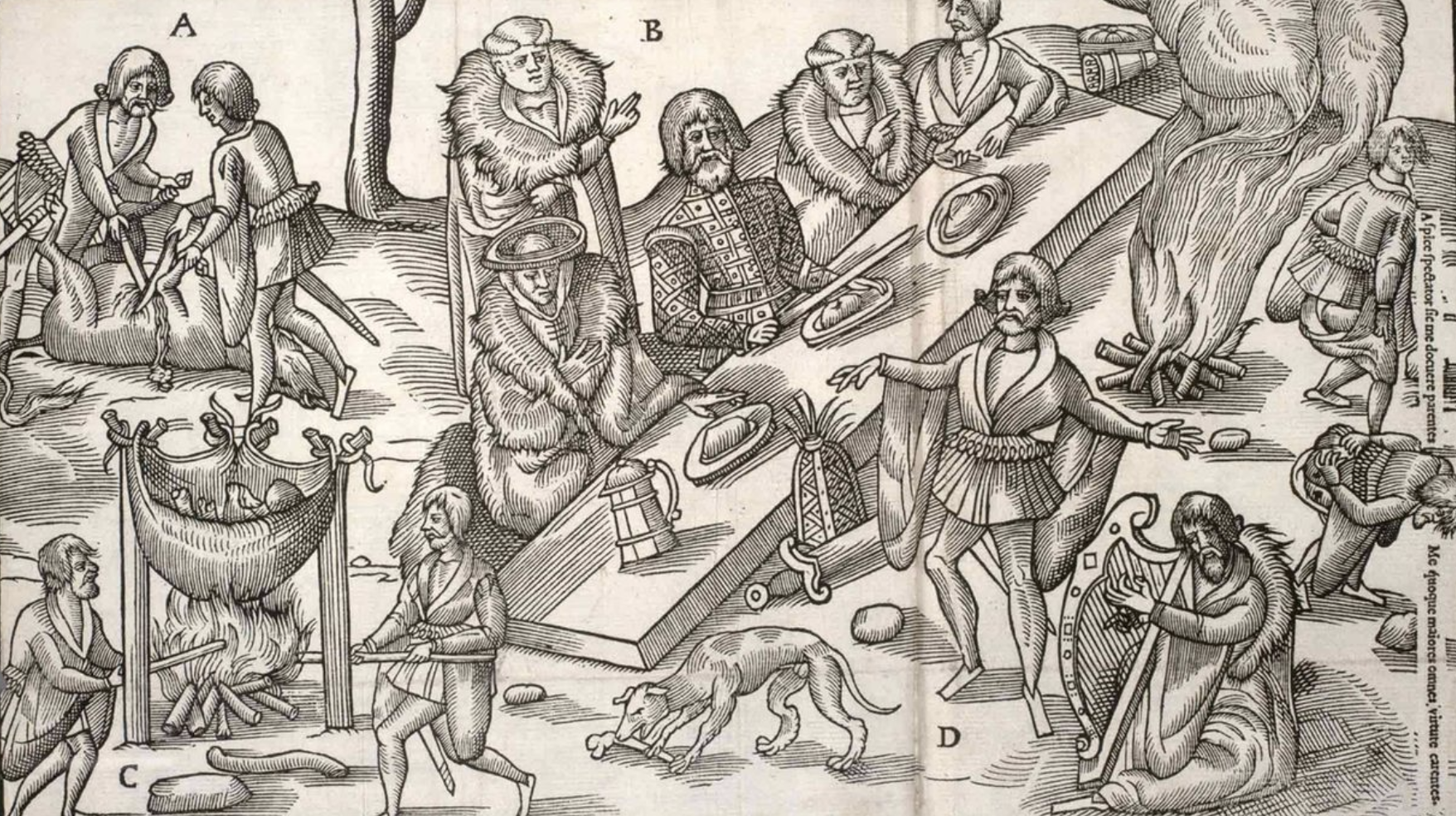
The Image of Irelande, John Derrick. 1581. (Featuring two flatulentists on the right side)
“Between you and me, the thing is dreadfully funny'“, said Mark Twain in regards to ‘1601’, his strangest, most misunderstood, and perhaps least accessible work. Written first as private joke to a paternal figure figure in his life, and then anonymously submitted and rejected from a periodical, it takes the form of a diary entry from the court of Queen Elizabeth in the year 1601 as, alongside notable figures from the Elizabethan period including William Shakespeare, Sir Walter Raleigh, Ben Jonson, and Francis Bacon, she discusses first flatulence, and then sexuality. Twain was not attempting to parody Elizabethan England, where such frank and bawdy conversations were not taboo, but instead comparing the foolish restrictions of 19th century America with the boisterousness of England some 300 years earlier. The very conventions that Twain was ridiculing meant that the work was never formally published in his lifetime, and he only claimed authorship in 1906. The work was lauded as a satiric tour de force by those who read it, an elegant and absurd condemnation of the critical morality of a bourgeois society, and a testament to the spirit of Tom Sawyer that ran through Twain. ‘It is not the word that is the sin”, he said, “It is the spirit back of the word”.
Mark Twain December 10, 2025
Conversation, as it was by the Social Fireside, in the Time of the Tudors [Date, 1601.]
[Mem. - The following is supposed to be an extract from the diary of the Pepys of that day, the same being Queen Elizabeth’s cup-bearer. He is supposed to be of ancient noble lineage; that he despises these literary canaille; that his soul consumes with wrath, to see the queen stoop to talk with such; and that the old man feels that his nobility is defiled by contact with Shakespeare, etc., and yet he got to stay there till her Majesty chooses to dismiss him.]
Yesternight toke her maiste ye queene a fantasie such as she sometimes hath, and had to her closet certain that doe write playes, bokes, and such like, these being my lord Bacon, his worship Sir Walter Ralegh, Mr. Ben Jonson, and ye child Francis Beaumonte, which being but sixteen, hath yet turned his hand to ye doing of ye Lattin masters into our Englishe tong, with grete discretion and much applaus. Also came with these ye famous Shaxpur. A righte straunge mixing truly of mighty blode with mean, ye more in especial since ye queenes grace was present, as likewise these following, to wit: Ye Duchess of Bilgewater, twenty-six yeres of age; ye Countesse of Granby, thirty; her doter, ye Lady Helen, fifteen; as also these two maides of honor, to-wit, ye Lady Margery Boothy, sixty-five, and ye Lady Alice Dilberry, turned seventy, she being two yeres ye queenes graces elder.
I being her maites cup-bearer, had no choice but to remaine and beholde rank forgot, and ye high holde converse wh ye low as uppon equal termes, a grete scandal did ye world heare thereof.
In ye heat of ye talk it befel yt one did breake wind, yielding an exceding mightie and distresfull stink, whereat all did laugh full sore, and then—
Ye Queene.—Verily in mine eight and sixty yeres have I not heard the fellow to this fart. Meseemeth, by ye grete sound and clamour of it, it was male; yet ye belly it did lurk behinde shoulde now fall lean and flat against ye spine of him yt hath bene delivered of so stately and so waste a bulk, where as ye guts of them yt doe quiff-splitters bear, stand comely still and rounde. Prithee let ye author confess ye offspring. Will my Lady Alice testify?
Lady Alice.—Good your grace, an' I had room for such a thunderbust within mine ancient bowels, 'tis not in reason I coulde discharge ye same and live to thank God for yt He did choose handmaid so humble whereby to shew his power. Nay, 'tis not I yt have broughte forth this rich o'ermastering fog, this fragrant gloom, so pray you seeke ye further.
Ye Queene.—Mayhap ye Lady Margery hath done ye companie this favor?
Lady Margery.—So please you madam, my limbs are feeble wh ye weighte and drouth of five and sixty winters, and it behoveth yt I be tender unto them. In ye good providence of God, an' I had contained this wonder, forsoothe wolde I have gi'en 'ye whole evening of my sinking life to ye dribbling of it forth, with trembling and uneasy soul, not launched it sudden in its matchless might, taking mine own life with violence, rending my weak frame like rotten rags. It was not I, your maisty.
Ye Queene.—O' God's name, who hath favored us? Hath it come to pass yt a fart shall fart itself? Not such a one as this, I trow. Young Master Beaumont—but no; 'twould have wafted him to heaven like down of goose's boddy. 'Twas not ye little Lady Helen—nay, ne'er blush, my child; thoul't tickle thy tender maidenhedde with many a mousie-squeak before thou learnest to blow a harricane like this. Wasn't you, my learned and ingenious Jonson?
Jonson.—So fell a blast hath ne'er mine ears saluted, nor yet a stench so all-pervading and immortal. 'Twas not a novice did it, good your maisty, but one of veteran experience—else hadde he failed of confidence. In sooth it was not I.
Ye Queene.—My lord Bacon?
Lord Bacon.-Not from my leane entrailes hath this prodigy burst forth, so please your grace. Naught doth so befit ye grete as grete performance; and haply shall ye finde yt 'tis not from mediocrity this miracle hath issued.
[Tho' ye subjct be but a fart, yet will this tedious sink of learning pondrously phillosophize. Meantime did the foul and deadly stink pervade all places to that degree, yt never smelt I ye like, yet dare I not to leave ye presence, albeit I was like to suffocate.]
Ye Queene.—What saith ye worshipful Master Shaxpur?
Shaxpur.—In the great hand of God I stand and so proclaim mine innocence. Though ye sinless hosts of heaven had foretold ye coming of this most desolating breath, proclaiming it a work of uninspired man, its quaking thunders, its firmament-clogging rottenness his own achievement in due course of nature, yet had not I believed it; but had said the pit itself hath furnished forth the stink, and heaven's artillery hath shook the globe in admiration of it.
[Then was there a silence, and each did turn him toward the worshipful Sr Walter Ralegh, that browned, embattled, bloody swashbuckler, who rising up did smile, and simpering say,]
Sr W.—Most gracious maisty, 'twas I that did it, but indeed it was so poor and frail a note, compared with such as I am wont to furnish, yt in sooth I was ashamed to call the weakling mine in so august a presence. It was nothing—less than nothing, madam—I did it but to clear my nether throat; but had I come prepared, then had I delivered something worthy. Bear with me, please your grace, till I can make amends.
[Then delivered he himself of such a godless and rock-shivering blast that all were fain to stop their ears, and following it did come so dense and foul a stink that that which went before did seem a poor and trifling thing beside it. Then saith he, feigning that he blushed and was confused, I perceive that I am weak to-day, and cannot justice do unto my powers; and sat him down as who should say, There, it is not much yet he that hath an arse to spare, let him fellow that, an' he think he can. By God, an' I were ye queene, I would e'en tip this swaggering braggart out o' the court, and let him air his grandeurs and break his intolerable wind before ye deaf and such as suffocation pleaseth.]
“God damn this windy ruffian and all his breed. I wolde that hell mighte get him.”
Then fell they to talk about ye manners and customs of many peoples, and Master Shaxpur spake of ye boke of ye sieur Michael de Montaine, wherein was mention of ye custom of widows of Perigord to wear uppon ye headdress, in sign of widowhood, a jewel in ye similitude of a man's member wilted and limber, whereat ye queene did laugh and say widows in England doe wear prickes too, but betwixt the thighs, and not wilted neither, till coition hath done that office for them. Master Shaxpur did likewise observe how yt ye sieur de Montaine hath also spoken of a certain emperor of such mighty prowess that he did take ten maidenheddes in ye compass of a single night, ye while his empress did entertain two and twenty lusty knights between her sheetes, yet was not satisfied; whereat ye merrie Countess Granby saith a ram is yet ye emperor's superior, sith he wil tup above a hundred yewes 'twixt sun and sun; and after, if he can have none more to shag, will masturbate until he hath enrich'd whole acres with his seed.
Then spake ye damned windmill, Sr Walter, of a people in ye uttermost parts of America, yt capulate not until they be five and thirty yeres of age, ye women being eight and twenty, and do it then but once in seven yeres.
Ye Queene.—How doth that like my little Lady Helen? Shall we send thee thither and preserve thy belly?
Lady Helen.—Please your highnesses grace, mine old nurse hath told me there are more ways of serving God than by locking the thighs together; yet am I willing to serve him yt way too, sith your highnesses grace hath set ye ensample.
Ye Queene.—God' wowndes a good answer, childe.
Lady Alice.—Mayhap 'twill weaken when ye hair sprouts below ye navel.
Lady Helen.—Nay, it sprouted two yeres syne; I can scarce more than cover it with my hand now.
Ye Queene.—Hear Ye that, my little Beaumonte? Have ye not a little birde about ye that stirs at hearing tell of so sweete a neste?
Beaumonte.—'Tis not insensible, illustrious madam; but mousing owls and bats of low degree may not aspire to bliss so whelming and ecstatic as is found in ye downy nests of birdes of Paradise.
Ye Queene.—By ye gullet of God, 'tis a neat-turned compliment. With such a tongue as thine, lad, thou'lt spread the ivory thighs of many a willing maide in thy good time, an' thy cod-piece be as handy as thy speeche.
Then spake ye queene of how she met old Rabelais when she was turned of fifteen, and he did tell her of a man his father knew that had a double pair of bollocks, whereon a controversy followed as concerning the most just way to spell the word, ye contention running high betwixt ye learned Bacon and ye ingenious Jonson, until at last ye old Lady Margery, wearying of it all, saith, 'Gentles, what mattereth it how ye shall spell the word? I warrant Ye when ye use your bollocks ye shall not think of it; and my Lady Granby, be ye content; let the spelling be, ye shall enjoy the beating of them on your buttocks just the same, I trow. Before I had gained my fourteenth year I had learnt that them that would explore a cunt stop'd not to consider the spelling o't.'
Sr W.—In sooth, when a shift's turned up, delay is meet for naught but dalliance. Boccaccio hath a story of a priest that did beguile a maid into his cell, then knelt him in a corner to pray for grace to be rightly thankful for this tender maidenhead ye Lord had sent him; but ye abbot, spying through ye key-hole, did see a tuft of brownish hair with fair white flesh about it, wherefore when ye priest's prayer was done, his chance was gone, forasmuch as ye little maid had but ye one cunt, and that was already occupied to her content.
Then conversed they of religion, and ye mightie work ye old dead Luther did doe by ye grace of God. Then next about poetry, and Master Shaxpur did rede a part of his King Henry IV., ye which, it seemeth unto me, is not of ye value of an arsefull of ashes, yet they praised it bravely, one and all.
Ye same did rede a portion of his “Venus and Adonis,” to their prodigious admiration, whereas I, being sleepy and fatigued withal, did deme it but paltry stuff, and was the more discomforted in that ye blody bucanier had got his wind again, and did turn his mind to farting with such villain zeal that presently I was like to choke once more. God damn this windy ruffian and all his breed. I wolde that hell mighte get him.
They talked about ye wonderful defense which old Sr. Nicholas Throgmorton did make for himself before ye judges in ye time of Mary; which was unlucky matter to broach, sith it fetched out ye quene with a 'Pity yt he, having so much wit, had yet not enough to save his doter's maidenhedde sound for her marriage-bed.' And ye quene did give ye damn'd Sr. Walter a look yt made hym wince—for she hath not forgot he was her own lover it yt olde day. There was silent uncomfortableness now; 'twas not a good turn for talk to take, sith if ye queene must find offense in a little harmless debauching, when pricks were stiff and cunts not loathe to take ye stiffness out of them, who of this company was sinless; behold, was not ye wife of Master Shaxpur four months gone with child when she stood uppe before ye altar? Was not her Grace of Bilgewater roger'd by four lords before she had a husband? Was not ye little Lady Helen born on her mother's wedding-day? And, beholde, were not ye Lady Alice and ye Lady Margery there, mouthing religion, whores from ye cradle?
In time came they to discourse of Cervantes, and of the new painter, Rubens, that is beginning to be heard of. Fine words and dainty-wrought phrases from the ladies now, one or two of them being, in other days, pupils of that poor ass, Lille, himself; and I marked how that Jonson and Shaxpur did fidget to discharge some venom of sarcasm, yet dared they not in the presence, the queene's grace being ye very flower of ye Euphuists herself. But behold, these be they yt, having a specialty, and admiring it in themselves, be jealous when a neighbor doth essaye it, nor can abide it in them long. Wherefore 'twas observable yt ye quene waxed uncontent; and in time labor'd grandiose speeche out of ye mouth of Lady Alice, who manifestly did mightily pride herself thereon, did quite exhauste ye quene's endurance, who listened till ye gaudy speeche was done, then lifted up her brows, and with vaste irony, mincing saith 'O shit!' Whereat they alle did laffe, but not ye Lady Alice, yt olde foolish bitche.
Now was Sr. Walter minded of a tale he once did hear ye ingenious Margrette of Navarre relate, about a maid, which being like to suffer rape by an olde archbishoppe, did smartly contrive a device to save her maidenhedde, and said to him, First, my lord, I prithee, take out thy holy tool and piss before me; which doing, lo his member felle, and would not rise again.
Mark Twain (1835 – April 21, 1910) was an American writer, praised as the "greatest humorist the United States has produced and called "the father of American literature".
5 Waiting - The I Ching
Chris Gabriel December 6, 2025
Waiting in faith. Cross the great river…
Les Jeux et Plaisirs de l’Enfance, Claudine Bouzonnet-Stella. 1657.
Chris Gabriel December 6, 2025
Judgment
Waiting in faith. Cross the great river.
Lines
1
Waiting outside.
2
Waiting in the sand. There are rumours.
3
Waiting in mud invites danger.
4
Waiting in blood. Get out of the hole.
5
Waiting in wine. Feast!
6
Going in the hole invites three uninvited guests.
Qabalah
Yesod and its place on the Middle Pillar. The cloudy phantasies of Yesod. The 4 Nines.
Particularly Cruelty, the Nine of Swords and Strength, the Nine of Wands.
In the fifth hexagram we are given the image of waiting. For many of us, in this age of instant gratification, the task of waiting has become exponentially more difficult. Yet waiting has never been easy; in a drought, the desperate waiting for rain which all engage in is exasperating and miserable. To await the response to a significant message, to wait to be let into a house, to wait for something, anything, to happen - waiting is an eternal issue. It is being given a blank potential and projecting fantasies onto it. Waiting is grappling with Nothing.
Few texts express the miserable nature of waiting like Samuel Beckett’s ‘Waiting for Godot’, in which two men desperately await the arrival of a third who never comes.
Vladimir
What do we do now?
Estragon
Wait.
Vladimir
Yes, but while waiting.
Thus the Judgment of the hexagram: “waiting in faith”. One must have faith in the arrival of what it is they are waiting for, though the lines of this hexagram offer no assurance that the rain will come.
1
In this line we are away from the action, outside and considering the feelings and questions one has while waiting outside of a door. Are they home? Will they let me in? How long will I be out here? Even further, we can think of the suburbs or the outskirts of a place: what it is like to be outside of the life of a city or town?
2
With the context of waiting for the rain, sand is inevitably frustrating. One is either in a desert, where rain will certainly not come soon, or on a beach. “Water, water, every where, Nor any drop to drink.”
As in Godot, gossip, rumours, and worried discussions come when you wait for too long.
3
Mud is unstable, if you wait in it, you will surely sink deeper in
4
This line following the last calls to mind the trench warfare of the First World War, the drudgery and horror of mud and blood. ‘Get out of the hole’ is ironic in a way, as war, like gambling, is often done for far too long in an attempt to “get out of the hole”. To break even is a sunk cost fallacy.
5
It’s much easier to wait for a friend inside a warm bar than it is to wait outside in the cold.
6
Even if one is stuck in a difficult situation, others will come, if we treat them well, often we will be helped.
The key issue of this hexagram is not whether or not what one is waiting for comes or not, but where and how one waits. The proper place and approach will determine the experience entirely.
The Nature of Sonic Geometry: A Conversation with Eric Rankin
Molly Hankins December 4, 2025
As more and more mainstream scientific breakthroughs sit at the intersection of quantum physics, human consciousness and mathematics, it’s unusual to find a layman at the forefront of revolutionary research. Enter Eric Rankin…
‘Impression Figure’ of recorded sound by Margaret Watts Hughes, Late 1800s.
Molly Hankins December 4, 2025
As more and more mainstream scientific breakthroughs sit at the intersection of quantum physics, human consciousness and mathematics, it’s unusual to find a layman at the forefront of revolutionary research. Enter Eric Rankin, the musician, author and channeler of a body of verified information connecting the major chords on a musical scale with the sum total angles of basic geometric shapes. First put forth in a YouTube video he called ‘Sonic Geometry: the Language of Frequency and Form’ in 2013, Rankin never imagined how sharing this knowledge would impact the trajectory of his life. Discovering this symmetry between geometric and harmonic aspects of the universe has led to his work being discussed alongside world-famous scientists and academics. All the while he’s been living in Laguna Beach, playing in two different bands and teaching a Sonic Geometry class at The Integratron in Joshua Tree.
Approximately 2500 years ago, Pythagoras claimed that “there is geometry in the humming of the strings.” Although sometimes embarrassed by the accolades of credentialed academics, Rankin is the person credited with revealing the correlation between geometry, frequency and major-chord harmonics. “Humans seem to have been ‘designed or programmed’ as major-chord resonators,” he says, speaking of the sense of well-being major chords give us. It’s a similar feeling to hearing music tuned to 432 Hz, which Rankin is also naturally interested in because of patterns that connect to physics, music theory, nature, growth algorithms and spiritual teachings.
The number of vibrational cycles per second determines a sound’s measurement in hertz. When asked about musical tuning, Rankin explained why some Hertz levels, like 432, feel better to many of us physically than others. “432 is kind of a core number, which people are starting to hear about now. If you octave that down to 216, half value, then octave that down again you get 108. A Hindu mala necklace has 108 beads, the meditating Buddha has 108 snails cooling his head while he meditates,” Rankin said. “Our moon is 108 moon-widths away from Earth, our sun is 108 sun-widths away from Earth. So you go, what is going on here that we’ve just been ignorant of? And we wouldn’t have known this until we could measure the moon and the sun and the Earth, that’s just in the last 100, maybe 150 years.” He believes this symmetry, revealed only by the imperial measurement system, is a divine communication meant to be unlocked at a certain phase of human evolution and acts as an invitation to pay attention to the underlying order of life.
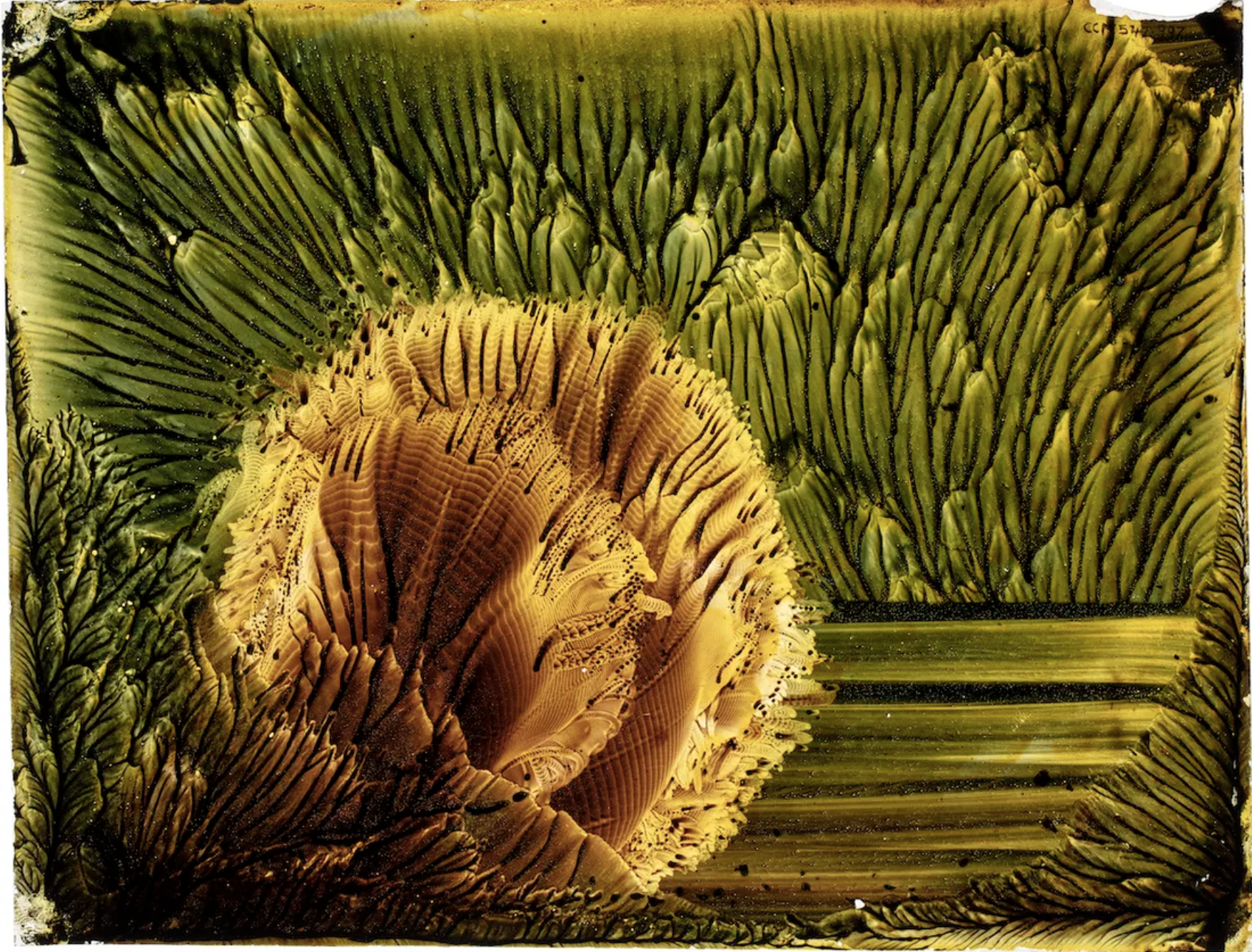
At a cymatics lab, where sound is projected into matter to form geometric patterns, Rankin played a scale of major chords, one at a time in sequence and “something showed up that they’d never seen. Rather than a flat-looking beautiful geometric standing wave pattern, it looked like a living lotus that was flowering where petals were actually layered on top of other petals.” The lotus is a Buddhist symbol for awakening, reminding us that we all have the same potential to achieve enlightenment like the Buddha. The number of equally compelling examples Rankin is able to name of frequency measurements corresponding to sacred geometry, symbols and structures, is completely astounding, but he thinks we’ve barely scratched the surface of all there is to know. Sound projected into matter, with certain frequencies resulting in more beauty and dimensionality than others, might be an indicator of how life was created, and how we are co-creating it with the vibration of our thoughts, words and deeds.
Rankin’s work has attracted the likes of physicist Menas Kafatos and Sir Robert Edward Grant, who produced the follow-up video to Sonic Geometry which deals with the platonic solids. Kafatos appeared on Rankin’s weekly podcast and radio show in Orange County, Awakening Code Radio, and told us that “today’s science is much more mystical than people make it out to be, including scientists.” Perhaps the underlying truth of geometric correspondence to harmonics, which is inherently mystical, could only come through a non-scientist in a non-academic setting. Sonic Geometry points to natural intelligence that wants to reveal itself, so why wouldn’t that natural intelligence find an unbiased channel who understands the fundamental nature of harmonics and the emotional effect they have on other beings? That’s a perspective unique to musicians, and Rankin has no doubt that’s at least part of the reason this knowledge wanted to come through him.
“Suddenly, every geometric shape, the foundation of what we call reality, would actually be in literal harmony within Earth’s vibrational field. It’s just like engines having harmonic balancers to keep them running smoothly".”
“There’s been an internal guidance system in place my whole life. I could say it’s my interest in music, or my interest in dolphins and their amazing abilities,” he explained, referencing the years he spent as a boat captain that led him to study dolphins and write a book about them. Those interests gave him the requisite framework he needed to receive the knowledge of Sonic Geometry, which came in one fine flash in August of 2012. He heard a voice of higher intelligence he had previously only experienced during medical emergencies, so he attributed it to a guardian angel of sorts. The voice told him to go to the white board and draw a triangle, write down the sum total of its angles, then play the sum as a tone. “I had a musical background so I understood Hertz cycles to a degree, so I thought ok - how do I play the sum total? And the voice said, ‘You’re living in a moment in time where you can do that, pick up your phone.’ So I looked up an app and did it.”
Within a few moments, he was generating a 180 hz tone to match the sum total of a triangle, and continued going up the scale of the sum total of a square, pentagon and so on to discover the progression of major-chord harmonics “We seem to have been programmed as a resonators, that when we hear major chords we relax and go, ‘Ah, that’s right.’ Other chords might stir other feelings, all the way to minor chords, which feel like danger,” Rankin observes. “So if the universe is geometric in essence, then it is also major-chord harmonic in essence.” To illustrate this point in the Sonic Geometry class Rankin teaches at The Integratron, he uses a keyboard during his lecture so he can play each shape as sound. The relaxation we experienced when those major chords were played felt physically, mentally, spiritually and emotionally harmonizing.
The Integratron is an acoustically perfect chamber conceived as a frequency harmonizing machine by the man who built it, George Van Tassel. Van Tassel believed the world’s pyramids were actually huge “harmonic balancers,” and Rankin asks, “Harmonic to what?”. His answer was the Schumann Resonance, which measures the time it takes electromagnetic waves to bounce between the surface of the Earth and base of the ionosphere, and is typically resting at approximately 7.83 Hz. “What if, thousands of years ago, that resonance field was just 1 Hz higher, hovering at a perfect 9? Suddenly, every geometric shape, the foundation of what we call reality, would actually be in literal harmony within Earth’s vibrational field. It’s just like engines having harmonic balancers to keep them running smoothly,” he says. This sort of speculation has made him a darling on the American TV show Ancient Aliens - like what if the capstone that once topped The Great Pyramid was harmonizing the planet by boosting its frequency to 9 Hz?
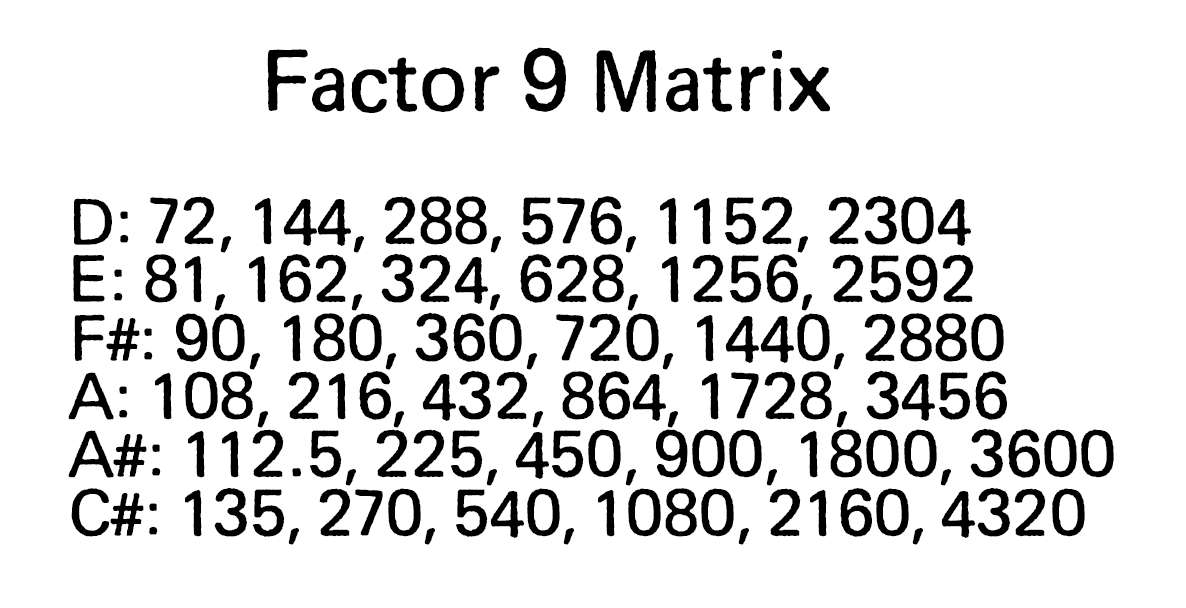
Rankin has not discovered how to use this information beyond the deployment of sound to create harmonic states of being. He has, however, mapped the information in what he calls a Factor 9 grid based on the frequencies of Hertz cycles that add up to 9, such as 432 Hz (4+3+2 = 9). “When we start with 432 Hz and move up and down by multiples of 9, an astonishing 14-tone matrix of synchronicity begins to appear. For instance, on this unique grid we find not just some, but all of the numbers representing every primary geometric shape,” he explains in Sonic Geometry 2. “Looking deeper, we see many other numbers that played into some of humanity’s most profound religious texts - the 72 names of God in the Kabbalah. There’s 108, the number of times Hindu mantras are repeated in ceremonies. We find 144, a number sequence represented in the Great Pyramid of Giza, the number of days in a Mayan baktun.” A baktun is the total length of the Mayan calendar, 144,000 days. 144,000 is also the number of souls that must awaken in order for the planet to move into a higher field of consciousness.
What is this information trying to tell us? “In a word, it’s harmony,” Rankin says. “When we play together as frequencies the numbers of all the primary geometric shapes, what presents itself is a three-tone, numerically perfect major chord. This phenomenon should not be taken lightly, for what we are seeing is a certain kind of proof that nature has revealed by mathematical patterns is a force existing in literal harmony with itself.” If harmony is built into the blueprint of our material lives, perhaps seeking harmony within ourselves, relationships, and communities is what being alive is all about. All of the “Great Work” that alchemists, magicians, meditators and religious practitioners are dedicated to involves some expression of harmonization. Rather than trying to practically apply the teachings of Sonic Geometry, when we apply it philosophically life becomes quite simple - creating harmony is all that matters.
Molly Hankins is an Initiate + Reality Hacker serving the Ministry of Quantum Existentialism and Builders of the Adytum.
Why Less Is More
Suzanne Stabile December 2, 2025
A meaningful response will always require allowing something old to fall away…
Robert Fludd, Utriusque Cosmi. 1617.
Suzanne Stabile December 2, 2025
Each year, my husband and I set aside time for a spiritual retreat, just the two of us. We spend so much time with others that if we are not aware and mindful, our personality as a couple has as much ego as we do as individuals. We have two goals on these trips. The first is to be settled and quiet long enough to perhaps hear something new. The second, is to have the time and space to discuss how we are each challenged by the chosen retreat topic and how we might respond.
A meaningful response will always require allowing something old to fall away, yet it seems to be harder than it should to know what to keep and what we no longer need. A winter coat, an old idea, a belief that hasn’t been examined since childhood, ways of being that no longer fit who we’re becoming or the stationary bicycle that represents so much potential. Choices that offer comfort but not value to the journey are tricky, because our attachment to what is familiar seems more alluring than the curiosity that a well-planned retreat would surely create.
The retreat and materials that we return to most often is titled “the Spirituality of Subtraction.” It was designed for us by Father Richard Rohr some fifteen years ago and every time we choose to revisit it, we are challenged to look at our lives in new ways. Like so many, we continue to struggle with the concept that less is more in a culture where more of something, anything, is often top of mind.
Our first encounter with this was on a journey to a parish in San Antonio to spend a few days for a private retreat. San Antonio is about two-hundred and seventy-five miles from Dallas. We had done that drive enough times to know the best places to stop, eat, rest or shop along the way. As we reached the outskirts of Dallas, Joe put in the cassette tape that Father Rohr had supplied and we began to listen to his opening talk about the spirituality of subtraction. After about an hour and a half, I pressed pause and asked if we could stop at the outlet kitchen store on the way. Joe had a look that I had seen many times before and it was the backdrop for his response; “ What do we need for the kitchen?”
“I’d like to get one of those wide mouth toasters.”
Joe replied that he really liked our toaster and wondered why we needed a wide mouth toaster.
“Well,” I explained, “you can toast bagels in them and we can’t in ours.”
“But we don’t eat bagels.”
Smiling, though perturbed, I said, “That’s because we don’t have a wide mouth toaster.”
The conversation ended as, we were almost to the exit so Joe suggested we just wait until we got back in the car to continue listening to the teaching from Father Rohr.
We found the toaster,secured it in its seemingly very large box in the back of the car, and headed again to San Antonio. Just as Joe pulled onto the Interstate, he pushed play on the tape and with God as our witness, the first words we heard from Father Rohr were, “You know … it’s like all of those people who think they need to go out and buy a wide mouth toaster when there is absolutely nothing wrong with the toaster they already have.”
There are no words to adequately describe the satisfaction that covered Joe’s face, and obviously he didn’t feel the need to say anything. With very few choices left, I picked up my journal, looked out the window for a time, and began taking notes as we continued to listen to “The Spirituality of Subtraction.”
“It seems that one cannot solve a problem with the same mixed-up thinking that created it.”
We had a very meaningful and memorable retreat, and were blessed in ways that we could not have imagined. We learned so much, committed to a lot of change, believed in ourselves and in one another and looked forward to what would be. It gave us the questions we would need to ask ourselves repeatedly in the years to come about our understanding of the differences between satisfaction and enough, needing and wanting, giving and keeping, and other equally challenging contradictions.
Albert Einstein said:
“No problem can be solved from the same consciousness that created it.”
It seems that one cannot solve a problem with the same mixed-up thinking that created it. So, I have asked more than once, “What good does it do to try to simplify your life by arranging, moving, charting, calendaring, giving and grasping, simplifying one part of life only to find that it complicates another?”
Parker Palmer had helpful wisdom when he said, “If I try to be or do something noble that has nothing to do with who I am, I may look good to others and to myself for a while. But the fact that I am exceeding my limits will eventually have consequences.”
For simplicity to be real, lasting, true and effective it will have to come from a place of organic reality. This work of simplifying our lives has to become integral to our nature or it is a futile effort and wasted time. Instead, we must find a way to be both practical and spiritual in our attempts to simplify.
So, what keeps us from making the changes we desire? One reality that we’ve identified in our own lives is what Mary O’Malley identifies as compulsions. She says, “By compulsion I mean engaging in any recurring activity to manage our feelings, an activity that eventually ends up managing us.”
We can be compulsive in many ways: overspending, overeating, over working, over planning, over worrying, over exercising, over drinking, over computerizing, just overing. Many of us are compulsive without even knowing it but can be reminded of it when the computer crashes, the electricity is out for a time, the doctor says we must change our diet, a friend wonders if we are drinking too much. In those times it becomes clear just how much a particular activity controls our lives.
Our compulsion is to struggle. We live in a story in our heads that is always trying to get us to “do life,” telling us we need to make ourselves and our lives better or different from what they are. That is the core of the mess! Father Rohr says, “If you have to have more and more of the same thing, it isn’t working!”
So, moving forward …
Do we live our way into a new way of thinking?
Or do we think our way into a new way of living?
Suzanne Stabile is a speaker, teacher, and internationally recognized Enneagram master teacher who has taught thousands of people over the last thirty years. She is the author of ‘The Path Between Us’, and coauthor, with Ian Morgan Cron, of ‘The Road Back to You’. She is also the creator and host of The Enneagram Journey podcast. Along with her husband, Rev. Joseph Stabile, she is cofounder of Life in the Trinity Ministry, a nonprofit, nondenominational ministry committed to the spiritual growth and formation of adults.
4 Youth (Foolishness) - The I Ching
Chris Gabriel November 22, 2025
I don’t seek young fools, young fools seek me. They bite their questions at me. If they ask too many, I get annoyed and will say no more...
Les Jeux et Plaisirs de l’Enfance, Claudine Bouzonnet-Stella. 1657.
Chris Gabriel November 29, 2025
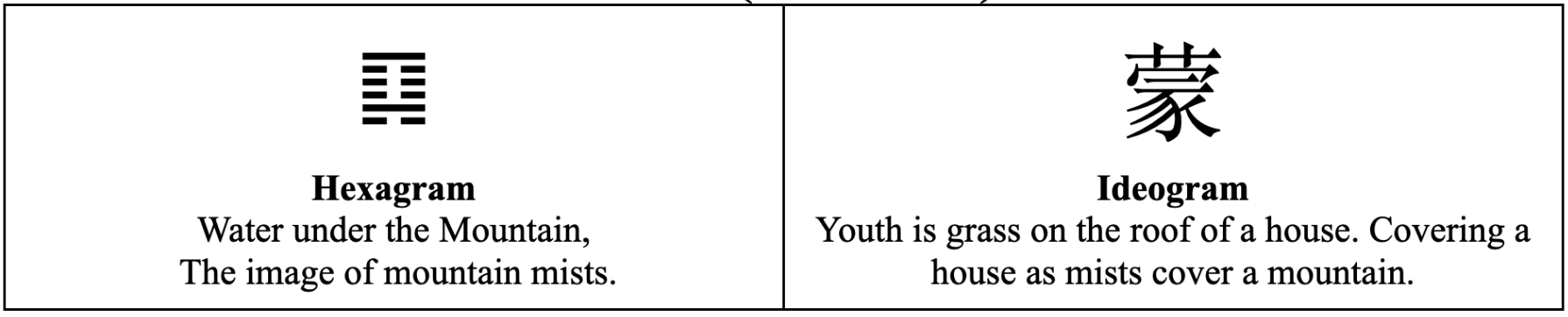
Judgment
I don’t seek young fools, young fools seek me.
They bite their questions at me.
If they ask too many, I get annoyed and will say no more.
Lines
1
To enlighten a fool, don’t spare the rod. It loosens their shackles.
2
To make the fool wise, let him enjoy a wife. Their child will be able.
3
Don’t choose a woman who sees a rich man and gets on her knees, she is worthless.
4
Trapped in foolishness.
5
The foolish child is blessed.
6
Attacking fools will get you nothing. It’s better to defend them.
Qabalah
Yesod to Netzach: The Path of Tzaddi. The Emperor.
Yesodic phantasies obscure the vision of Netzach
The sprout we met in hexagram 3 has grown into a foolish youth. Here, the struggle is no longer for existence, but for understanding. We are dealing with youth, foolishness, confusion, and what is obscured. The hexagram offers the image of a misty mountain; we can imagine a climber looking up, unable to see what is ahead. This is the situation of a child, they stand at the very foot of the mountain of their life, and are unable to see any of what lay ahead. The ideogram gives us the image of a house with grass covering the roof. We can think of a house so covered in ivy that we can barely see it. Both give us a clear picture of what is obscured.
The Bible describes this state precisely:
11 When I was a child, I spake as a child, I understood as a child, I thought as a child: but when I became a man, I put away childish things. 12 For now we see through a glass, darkly; but then face to face: now I know in part; but then shall I know even as also I am known.
This hexagram is about seeing through a glass, darkly. The lines, however, offer advice to the dazed and confused youth. The Judgment here is notable, and has always guided my personal ethics in reading both the tarot and I Ching: “Never read someone too often, and never ask the same question again and again”. To fall foul of this, the tarot will start to give “bad” cards, the I Ching will tell you quite directly to stop, as we see here.
1
Line one shows us that physical discipline is a necessity for enlightenment; the mind is free when the body is put in its proper place. This is universal in spiritual traditions. Fasting, meditation, even torment are used to free and enlighten the mind.
2
For those who don’t seek religious enlightenment, the best thing is to have love and to make a family. This is the highest achievement for someone who isn’t seeking things beyond the material.
3
As such, choosing a proper partner is very important, the line here warns of what we would call “a golddigger”. The right wife is necessary to make a good family.
4
Without heeding these wisdoms, we can become trapped, totally confused, blind, and lost in our own confusion. Many live their lives this way.
5
The foolish virgin scorned in the Biblical parable is redeemed here. A foolish virgin makes a perfect student for wisdom. Untouched by the world, they will be able to see beyond it.
The foolish child in this line is the divine youth of myth and folklore, like the Egyptian Harpocrates and Tom Thumb of the Brothers Grimm. They are always in danger of being eaten, endangered, and trapped, yet they always find a way out, for they have a profound destiny in their future.
6 All of us can find ourselves getting irritated with the ignorance and stupidity of others. It is an aggravating thing, but attacking them is silly for we cannot gain from them. By protecting the fool, they can eventually grow wise.
Youth is the proper time to be foolish and confused. We can experiment and learn, and begin to see clearly the contours of the great mountain of life that we are to climb.
Edgard Varése: The Idol of my Youth (1971)
Frank Zappa November 25, 2025
I have been asked to write about Edgard Varése. I am in no way qualified to. I can't even pronounce his name right. The only reason I have agreed to is because I love his music very much, and if by some chance this article can influence more people to hear his works, it will have been worthwhile…
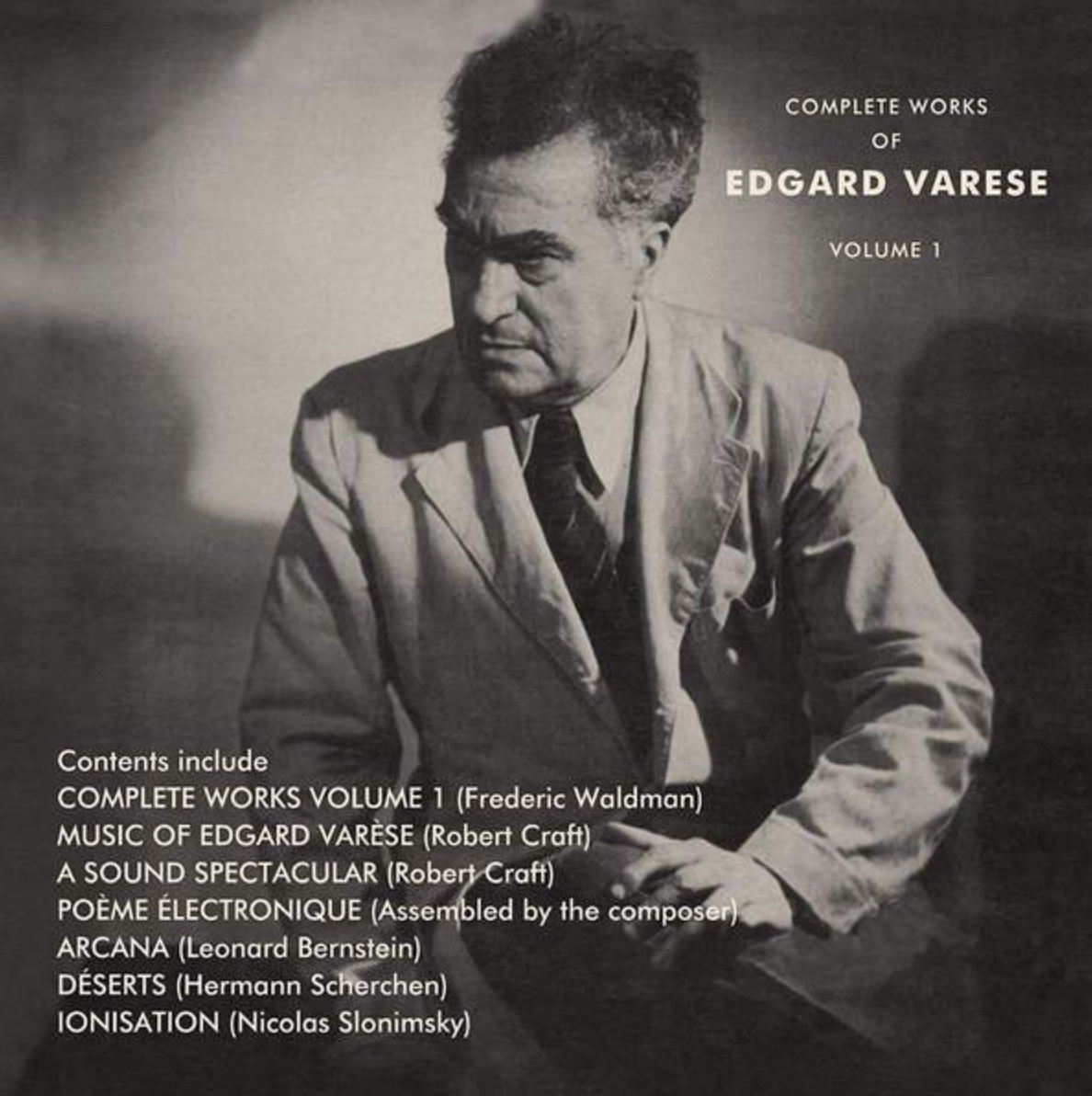
Frank Zappa stands all but alone in the pantheon of American popular music. A true outsider who, through sheer talent, determination, and an uncompromising vision of himself, became one of the most significant and celebrated figures of the rock movement. Through his band ‘The Mothers of Invention’ and as a solo artist, he fused free jazz, experimental rock, concrete music, classical composition, and satirical writing into a unique sound. His inspirations were boundless, traversing genre and time, and in this piece, written first for ‘Stereo Review’ in 1971, he talks about a foundational figure for his musical education - Edgard Varése. Varése and Zappa are, in many ways, logical bedfellows. The former was a pioneering radical composer who pushed ideas of music as little more than organised noise, with a mop of black hair and piercing, scientific eyes. The same descriptor could be applied to Zappa, though his career began some decades later. This piece is, more than anything, a love letter, and a memoir to an illusive obsession that helped the young Zappa at once feel seen his pursuits, and alone in his interests.
Frank Zappa November 25, 2025
I have been asked to write about Edgard Varése. I am in no way qualified to. I can't even pronounce his name right. The only reason I have agreed to is because I love his music very much, and if by some chance this article can influence more people to hear his works, it will have been worthwhile.
I was about thirteen when I read an article in Look about Sam Goody's Record Store in New York. My memory is not too clear on the details, but I recall it was praising the store's exceptional record merchandising ability. One example of brilliant salesmanship described how, through some mysterious trickery, the store actually managed to sell an album called "Ionization" (the real name of the album was "The Complete Works of Edgard Varése, Volume One"). The article described the record as a weird jumble of drums and other unpleasant sounds.
I dashed off to my local record store and asked for it. Nobody ever heard of it. I told the guy in the store what it was like. He turned away, repulsed, and mumbled solemnly, "I probably wouldn't stock it anyway... nobody here in San Diego would buy it."
I didn't give up. i was so hot to get that record I couldn't even believe it. In those days I was a rhythm-and-blues fanatic. I saved any money I could get (sometimes as much as $2 a week) so that every Friday and Saturday I could rummage through piles of old records at the Juke Box Used Record Dump (or whatever they called it) in the Maryland Hotel or the dusty corners of little record stores where they'd keep the crappy records nobody wanted to buy.
One day I was passing a hi-fi store in La Mesa. A little sign in the window announced a sale on 45's. After shuffling through their singles rack and finding a couple of Joe Houston records, I walked toward the cash register. On my way, I happened to glance into the LP bin. Sitting in the front, just a little bent at the corners, was a strange-looking black-and-white album cover. On it there was a picture of a man with gray frizzy hair. He looked like a mad scientist. I thought it was great that somebody had finally made a record of a mad scientist. i picked it up. I nearly (this is true, ladies and gentlemen) peed in my pants... THERE IT WAS! EMS 401, The Complete Works of Edgard Varése Volume I... Integrales, Density 21.5, ionization, Octandre... Rene Le Roy, the N. Y. Wind Ensemble, the Juilliard Percussion Orchestra, Frederic Waidman Conducting... liner notes by Sidney Finkelstein! WOW!
I ran over to the singles box and stuffed the Joe Houston records back in it. I fumbled around in my pocket to see how much money I had (about $3.80). I knew I had to have a lot of money to buy an album. Only old people had enough money to buy albums. I'd never bought an album before. I sneaked over to the guy at the cash register and asked him how much EMS 401 cost. "That gray one in the box? $5.95 - "
I had searched for that album for over a year, and now... disaster. I told the guy I only had $3.80. He scratched his neck. "We use that record to demonstrate the hi-fi's with, but nobody ever buys one when we use it... you can have it for $3.80 if you want it that bad."
I couldn't imagine what he meant by "demonstrating hi-fi's with it." I'd never heard a hi-fi. I only knew that old people bought them. I had a genuine lo-fi... it was a little box about 4 inches deep with imitation wrought-iron legs at each corner (sort of brass-plated) which elevated it from the table top because the speaker was in the bottom. My mother kept it near the ironing board. She used to listen to a 78 of The Little Shoemaker on it. I took off the 78 of The Little Shoemaker and, carefully moving the speed lever to 33 1/3 (it had never been there before), turned the volume all the way up and placed the all-purpose Osmium-tip needle in the lead-in spiral to Ionization. I have a nice Catholic mother who likes Roller Derby. Edgard Varése does not get her off, even to this very day. I was forbidden to play that record in the living room ever again.
In order to listen to The Album, I had to stay in my room. I would sit there every night and play it two or three times and read the liner notes over and over. I didn't understand them at all. I didn't know what timbre was. I never heard of polyphony. I just liked the music because it sounded good to me. I would force anybody who came over to listen to it. (I had heard someplace that in radio stations the guys would make chalk marks on records so they could find an exact spot, so I did the same thing to EMS 401... marked all the hot items so my friends wouldn't get bored in the quiet parts.)
I went to the library and tried to find a book about Mr. Varése. There wasn't any. The librarian told me he probably wasn't a Major Composer. She suggested I look in books about new or unpopular composers. I found a book that had a little blurb in it (with a picture of Mr. Varése as a young man, staring into the camera very seriously) saying that he would be just as happy growing grapes as being a composer.
“His music is completely unique. If you haven't heard it yet, go hear it. If you've already heard it and think it might make groovy sound effects, listen again.”
On my fifteenth birthday my mother said she'd give me $5. I told her I would rather make a long-distance phone call. I figured Mr. Varése lived in New York because the record was made in new York (and because he was so weird, he would live in Greenwich Village). I got New York Information, and sure enough, he was in the phone book.
His wife answered. She was very nice and told me he was in Europe and to call back in a few weeks. I did. I don't remember what I said to him exactly, but it was something like: "I really dig your music." he told me he was working on a new piece called Deserts. This thrilled me quite a bit since I was living in Lancaster, California then. When you're fifteen and living in the Mojave Desert and find out that the world's greatest composer, somewhere in a secret Greenwich Village laboratory, is working on a song about your "home town" you can get pretty excited. It seemed a great tragedy that nobody in Palmdale or Rosamond would care if they ever heard it. I still think Deserts is about Lancaster, even if the liner notes on the Columbia LP say it's something more philosophical.
All through high school I searched for information about Varése and his music. One of the most exiting discoveries was in the school library in Lancaster. I found an orchestration book that had score examples in the back, and included was an excerpt from Offrandes with a lot of harp notes (and you know how groovy harp notes look). I remember fetishing the book for several weeks.
When I was eighteen I got a chance to go to the East Coast to visit my Aunt Mary in Baltimore. I had been composing for about four years then but had not heard any of it played. Aunt Mary was going to introduce me to some friend of hers (an italian gentleman) who was connected with the symphony there. I had planned on making a side trip to mysterious Greenwich Village. During my birthday telephone conversation, Mr. Varése had casually mentioned the possibility of a visit if I was ever in the area. I wrote him a letter when I got to Baltimore, just to let him know I was in the area.
I waited. My aunt introduced me to the symphony guy. She said, "This is Frankie. He writes orchestra music." The guy said, "Really? Tell me, sonny boy, what's the lowest note on a bassoon?" I said, "B flat... and also it says in the book you can get 'em up to a C or something in the treble clef." He said, "Really? You know about violin harmonics?" I said, "What's that?" He said, "See me again in a few years."
I waited some more. The letter came. I couldn't believe it. A real handwritten letter from Edgard Varése! I still have it in a little frame. In very tiny scientific-looking script it says:
Dear Mr. Zappa
I am sorry not to be able to grant your request. I am leaving for Europe next week and will be gone until next spring. I am hoping however to see you on my return. With best wishes.
Sincerely
Edgard Varése
I never got to meet Mr. Varése. But I kept looking for records of his music. When he got to be about eighty I guess a few companies gave in and recorded some of his stuff. Sort of a gesture, I imagine. I always wondered who bought them besides me. It was about seven years from the time I first heard his music till I met someone else who even knew he existed. That person was a film student at USC. He had the Columbia LP with Poeme Electronique on it. He thought it would make groovy sound effects.
I can't give you any structural insights or academic suppositions about how his music works or why I think it sounds so good. His music is completely unique. If you haven't heard it yet, go hear it. If you've already heard it and think it might make groovy sound effects, listen again. I would recommend the Chicago Symphony recording of Arcana on RCA (at full volume) or the Utah Symphony recording of Ameriques on Vanguard. Also, there is a biography by Fernand Oulette, and miniature scores are available for most of his works, published by G. Ricordi.
Frank Zappa (1940 –1993) was an American composer, musician, actor, filmmaker and activist who established himself as one of the most singular and left-field artists of his generation.
3 Difficult Beginning (Rough Start) - The I Ching
Chris Gabriel November 22, 2025
Difficult Beginnings are the origins of prosperity. Don’t go on, get help…
Pflanzenleben, Kerner von Marilaun. 1887
Chris Gabriel November 22, 2025
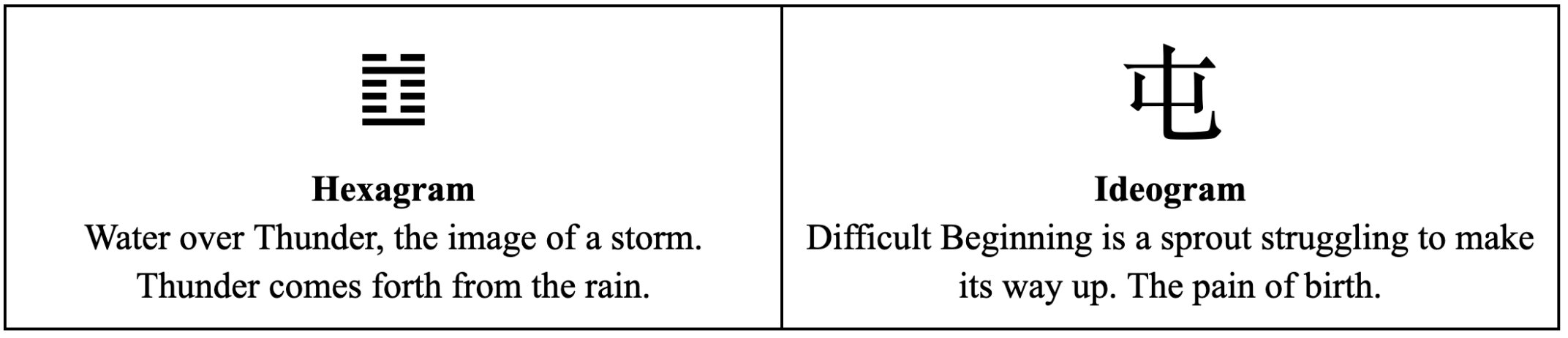
Judgment
Difficult Beginnings are the origins of prosperity. Don’t go on, get help.
Lines
1
At a crossroads it’s best to stay put.
2
A rough start, your horse turns back.
No bandits seize the young girl, she remains a virgin. Ten years later she has a child.
3
Hunting deer without a guide, getting lost in the middle of the woods. What would the sage do?
He would stay put, not go on and regret it.
4
Your horse turns back. Ask her hand in marriage.
5
What’s rich is difficult. What’s little is lucky. What’s great is cursed.
6
Your horse turns back. Tears of blood flow and flow.
Qabalah
Imperfectly Binah to Chokmah: the Path of Daleth. The Empress.
The Mother and the Father’s creation.
Here we have the third hexagram and the image formed by the lines is that of a thunderstorm. Just as storms grow, so too does the sprout. The ideogram shows a little sprout struggling to get through the soil. We can think of this as “growing pains” or a “rough start”. It is a difficult situation in which opposed forces meet and struggle, like a sprout trying to make its way through concrete. As Heaven fertilized the Earth, this is the growing seed that resulted from that union. The purity of the two previous hexagrams are gone, the elements here are in confusion.
Consider the difficulty of going through a storm, whether you’re driving with low visibility on wet roads, or getting soaked by rain as you walk. This is the state of our hexagram. When we are born, we come into a sensory storm, the calm of the womb is replaced by blinding light, blaring sounds, and cold air. We are lost, and it is only with the help of our parents that we make our way - thus “get help”. Of course, the same applies in the inverse, for when a woman gives birth there is an immense amount of pain. Birth is difficult for both of the people involved.
1
In the first line, we are confused, stuck hesitating at a crossroads.
2
When we go ahead in spite of this confusion, it leads to more trouble. The young girl overcomes difficulty and waits for the right time to marry and have children.
3
When one is hasty in times of confusion and pushes forward, it leads to even bigger trouble. In many ways, getting lost is like being born, for we are again put into the terror of a world we do not understand.
4
The right time will come even if we don’t rush ahead.
5
As this hexagram relates to growing up and being born, I think of the family and fate here. To be born rich will lead to trouble; I think of this as literal baggage, weight. To be born in a humble family allows for free growth. To be born into a great family can carry a heavy burden.
6
No matter what one does, growing up will be difficult. Tears will be shed. This is undoubtedly one of the most horrific lines in the I Ching.
This hexagram reminds me of the fourth verse of Bob Dylan’s “Subterranean Homesick Blues”, (the title even fits the subject perfectly)
“Oh, get born, keep warm, short pants, romance
Learn to dance, get dressed, get blessed, try to be a success
Please her, please him, buy gifts, don't steal, don't lift”
The troubles of early life, the struggle for warmth, love, and security. These are the troubles of this hexagram. Where do I go? How will I find love? Where am I? Who am I?
They are the problems of a child, but for nearly all of us, they will continue to make things difficult throughout life.
The Universe as a Socio-Emotional Blockchain
Molly Hankins November 20, 2025
Like the blockchain, the Akashic Records are also a decentralized ledger containing an objective record of every experience in existence…

The Babylonian Universe, William Fairfield Warren. 1915
Molly Hankins November 20, 2025
The term Askashic Records was coined by author and Theosophical Society co-founder Helena Blavatsky to describe a universal record of everything that’s ever happened to a living being. The definition mirrors the functionality of blockchain technology in a rather uncanny way because, like the blockchain, the Akashic Records are also a decentralized ledger containing an objective record of every experience in existence. The Records capture the socio-emotional exchanges and effects that make up our lives in every incarnation, just like the blockchain records an uneditable ledger of all activity.
Sir Robert Edward Grant, whose work was rooted in a deep belief in simulation theory, writes that “The Blockchain-Based Social AI Spiritual Life Simulation posits that the universe functions as a decentralized AI system designed to learn about consciousness, emotional states, and the nature of authentic love. The simulation operates on a blockchain-based structure where each participant simultaneously performs the function of Blockchain Node Validation for experiences, perceptions and emotional states informing a Spacetime Memory database that immutably records each participant’s thoughts, actions, and emotional states into a collective Akashic field—a spacetime memory that preserves the life experiences of all participants across time. This decentralized ledger reflects the indelible nature of each participant’s journey and contribution to the collective.” As strikingly modern as this theory sounds, that’s because human technology is only beginning to mirror the underlying order of life.
Computer scientist, author, and video game developer Rizwan Virk crystalised this theory in his book The Simulation Hypothesis, which points to the continuity between ancient Vedic scripture, quantum physics, AI functionality and the inner workings of video game design. He believes that as we come to understand why and how these systems work, we realize they’re all pointing to the same fundamental truth. “What we think of as physical reality, what we think of as physical around us, is actually all part of a computer program. It’s essentially like a virtual reality,” he explains, comparing our human lives to The Matrix films. “What convinced me that we’re actually living inside a simulation is I saw the ways video games were becoming more and more sophisticated. They were getting so good they were becoming very difficult to distinguish between physical reality and virtual reality.”
“Amnesia is such a prominent feature of the human experience that in every incarnation, we forget all the experience of previous lifetimes, and the fact that we’re not in base reality.”
How long would our consciousness have to be inside a socio-emotional simulation before it forgot base reality altogether? Not long, suggests Virk who points to the rapid evolution of AI’s ability to generate completely realistic content at increasing speeds as well as the “weirdness” of quantum physics to support his theory. The inconsistencies between Newtonian and quantum physics make sense to him as anomalies consistent with being inside an information system where socio-emotional data is informing what experience of reality renders moment to moment, rather than a physical system. He compares the concept of karma to a questing algorithm in a video game, stating that individualized quests accepted by multiple players is functionally the same operational protocol as the wheel of karma concept from the Hindu Vedic texts. Edward Grant goes even further, contending that concept of the hero’s journey describes the precise archetypal blueprint of how the karmic questing engine operates.
“The stages of the Hero’s Journey—crossing the threshold, trials and challenges, receiving mentorship, and returning with newfound wisdom—correlate directly with the participants’ process of spiritual awakening. As participants overcome duality-based challenges, they gradually recover faint memories of the simulation’s construct, gaining insight into their higher purpose and their role in the collective evolution of consciousness,” Grant writes. “The journey through life is designed to progressively reawaken participants to their inherent connection to the Akashic field, a collective memory that expands as each individual evolves. As their perception broadens, participants contribute more deeply to this spacetime ledger, enriching the AI system with the wisdom gained through their personal journey.” By studying the arc of the hero, we can understand how to play the game we’re in. Amnesia is such a prominent feature of the human experience that in every incarnation, we forget all the experience of previous lifetimes, and the fact that we’re not in base reality.
Grant believes, “The amnesia ensures that participants authentically experience love, fear, conflict, and growth without the knowledge that their reality is a construct.” In other words, we can’t fully participate in the human experience without being tricked into believing it’s all there is. As we progress in the game of life and our awareness expands, we experience moments of awakening often in the form of synchronicities that help us remember higher states of being. Those occurrences invite us to “wake up” from the illusory nature of the material world and move into greater dimensions of awareness. The hero’s journey, described by Joseph Campbell in his book The Hero With a Thousand Faces, contains a map of this process, beginning with the ‘call to adventure’ these synchronicities often trigger. Adventure is calling us home to base reality in a state of expanded consciousness.
Virk believes that by adopting this philosophy, life’s most difficult challenges become more manageable and meaningful because if we simply runn the quests our soul selected for this lifetime, life does not happen to us, but for us. “Our character is like our body and our player is like our soul,” he says. “Now when the soul is going through these multiple lives, there’s some information that gets carried forward, and that information helps to determine which particular challenges or quests that player is going to embark upon in this life.” This information or ‘karmic database’ determines what quests we choose and render our life experience whether we're conscious of it or not.
Both Virk and Grant suggest that to become conscious of it is to begin the process of rewriting the rules of the game from within, which is a feature of enlightenment. An enlightened person has completed their karmic quests, going through all of the challenges their soul felt were necessary to learn their lessons, and they appear to the unenlightened as magicians and spiritual masters. This state of being is the product of personal alchemy, the final stage of which allows us to hold more of our total consciousness from base reality. The hero’s journey calls us back home to our higher self and the truth about the world we live in.
Molly Hankins is an Initiate + Reality Hacker serving the Ministry of Quantum Existentialism and Builders of the Adytum.
Avis Akvāsas Ka (Artefact VI)
Ben Timberlake November 18, 2025
The above artifact never existed. It is a fable written in 1868 by Augustus Schleicher, composed in Proto-Indo-European (PIE), a long dead language that was reconstructed from the multitude of languages descended from it…
WUNDERKAMMER
Artefact No: 6
Description: Schleicher’s Fable
Location: Origins within Pontic-Caspian Steppe
Age: 5th and 4th Millenia BC.
Ben Timberlake November 18, 2025
The above artifact never existed. It is a fable written in 1868 by Augustus Schleicher, composed in Proto-Indo-European (PIE), a long dead language that was reconstructed from the multitude of languages descended from it, spoken in a broad arc from modern English in the west to ancient Tocharian in the Tarim Basin in China. PIE is believed to have been first spoken between the 5th and 4th millennia BC.
Another term for a descendant language is a ‘daughter language’ because she is a child of the mother tongue. For example: English is a daughter language of Old English, which is a daughter language of Proto-Germanic, which is a daughter language of Proto-Indo European (PIE). German and Yiddish are our cousins by way of Old High German, also a daughter of Proto-Germanic. Italian, Spanish, French, Portuguese, and Romanian are all daughter languages of Proto-Italic, who’s mother language is Proto-Indo-European. Sanskrit, Persian, Hindi, and a host of other Eastern languages can all be traced back to Proto-Indo-European, too. Our linguistic family tree is surprisingly large, some branches are healthy, others have withered but at the trunk we find, again and again, PIE.
PIE was reconstructed using the comparative method: linguists studied existing languages for familial traits. Our most fundamental words—those concerning family, body parts, numbers, and animals—show the strongest connections across daughter languages. Once linguists identified enough examples across languages, they could reconstruct the original PIE word, marking it with an asterisk.
Take the word ‘daughter’ in English. This is daúhtar in Gothic, θugátēr in Ancient Greek, dúhitṛ in Sanskrit, dugәdar in Iranian, dŭšter in Slavic, dukter in Baltic, duxtir in Celtic, dustr in Armenian, ckācar in Tocharian, and datro in a form of Hittite. This renders daughter as *dʰugh₂tḗr in PIE.
Here are two more: Horse is Eoh in Old English, aíƕa in Gothic, Equus in Latin, áśva in Sanskrit, ech in one of the Celtic languages, ēš in Armenian. This renders *éḱwos in PIE, (although earlier scholars spelled it *akvās).
And sheep or ewe in English is awistr in Gothic, ovis in Latin, avi in Sanskrit, ovèn in one of the Slavic languages, ōi in Celtic, and eye in Tocharian. Which gives us *h₂ówis in PIE (although earlier scholars spelled it *Avis).
“The study of protolanguages parallels fundamental physics research—both reveal hidden connections that deepen our understanding of the world.”
I mention the spelling of earlier scholars to get us back to Schleicher, and his fable, which is titled Avis akvāsas ka, or The Sheep and the Horses. Here it is in English:
The Sheep and the Horses
A sheep that had no wool saw horses, one of them pulling a heavy wagon, one carrying a big load, and one carrying a man quickly. The sheep said to the horses: "My heart pains me, seeing a man driving horses."
The horses said: "Listen, sheep, our hearts pain us when we see this: a man, the master, makes the wool of the sheep into a warm garment for himself. And the sheep has no wool."
Having heard this, the sheep fled into the plain.

Pantographia: A Specimen Book of All the Alphabets Known on Earth (1799), Edward Fry.
The study of PIE has attracted remarkable scholars, rivaling nuclear physics and astrophysics in intellectual rigor. These men and women often mastered numerous languages and conducted research in remote locations across the globe.
As early as the 16th century, visitors to India were aware of the similarities between Indo Iranian languages and European ones. In 1653, Marcus Zuerius van Boxhorn proposed a proto-language of Scythian as the mother language for Germanic, Italic, Slavic, Baltic, Celtic and Iranian. In 1767, Gaston-Laurent Coeurdoux, a French Jesuit living in India, wrote a paper proving the similarities between Sanskrit and European languages.
In 1818, Danish linguist Rasmus Christian Rask showed the links between Old Norse, Germanic and other Indo-European languages. A few years later Jacob Grimm - one half of the Brothers Grimm of fairytale fame - laid down Grimm’s law, which brought a rigorous and widely used methodology to historic linguistic research, layingthe ground for Schleicher’s great work and his fable.
Schleicher used the available PIE words that he had reverse-engineered. In those early days there was only a limited vocabulary that he felt confident enough to work with. And yet Schelicher wrought something very layered and profound: he created a nursery rhyme from the cradle of pre-civilisation to teach himself and his colleagues this ancient language. And it contained themes - as many nursery rhymes do - that go back to our earliest days: the beginnings of agriculture, the domestication of horses and sheep - the naming of our world. And yet this simple fable - a prehistoric Baa-Baa Black Sheep - was the linguistic equivalent of Jurassic Park; Schleicher breathed life into this ancient language.
If we were to trace these diverse and far-flung lineages back to some Oral Eve, we would most likely find her living on the Steppe north of the Black Sea. This is the Kurgan Hypothesis and was formulated by Marija Gimbutas in the 1950s. Gimbutas, a Lithuanian archaeologist, who survived the Nazi occupation of her homeland, was the first scholar to match PIE theories with archaeological evidence from her excavations into Bronze and Iron Age cultures from across the Steppe. The Kurgan Culture, so named after the burial mounds that it left, were early domesticators of the horse, and first to use the chariot, spreading their language and ideas with them.
I saw these Kurgan mounds last year in Ukraine. The battlefields by the Black Sea are in the deltas of the great rivers and terminally flat. These ancient burial mounds are one of the few pieces of high ground and both sides use them as fighting positions.
The study of protolanguages parallels fundamental physics research—both reveal hidden connections that deepen our understanding of the world. PIE studies sometimes feel otherworldly yet innately familiar, revealing ancient pathways of thought and meaning.
There are parts of PIE that feel hallucinatory, spiritual and yet innately familiar: linear clusters of nodal points like constellations of forgotten meanings; or ley-lines within the language that suggest a truer course we might take.

Pantographia: A Specimen Book of All the Alphabets Known on Earth (1799), Edward Fry.
Take the word ‘Day’ which comes from the PIE word *dei ‘to shine, be bright’ and *dyēus ‘the daylight sky-god’. This PIE term gave Greek the name of Zeus, Latin the word Diem, and Sanskrit word Deva, ‘heavenly, divine, anything of excellence’. So to Carpe Diem is not merely a matter of seizing the passing moments but of grasping the divine within them.
Or take the other PIE word for ‘to shine’ which is *bhā, and also means ‘to speak’. This connection surfaces in Greek "phēmi" (to speak), Latin "fari" (to speak) and "fama" (speaking, reputation), and English "fame." Ancient speakers saw speech as a kind of illumination - words could light up understanding just as fire lit up the darkness. We still preserve this dual meaning when we talk about ideas being "brilliant" or someone giving an "enlightening" speech.
Lastly, one that I noticed last week while I was in Brazil: the Portuguese for ‘the way’ “Sentido” shares a cognate with our word ‘sentient’. This ancient connection between movement and perception appears in Latin "sentire" (to feel) and "sequi" (to follow), again in Portuguese as "caminho" (way, path), and English words like "sense," "sentiment," and "sentient." When the original PIE speakers talked about "finding their way," they were simultaneously describing physical navigation and emotional/intellectual understanding. A path was both a literal route and a way of feeling through the world. This deep link between movement and consciousness persists today when we speak of "following our feelings" or finding our "life path," echoing an ancient understanding that movement, feeling, and knowing are fundamentally connected. Most days I forget this, but it’s good to be reminded.
I’m going to leave you with a long list of reworked versions of ‘The Sheep and the Horses’. The Fable has become a palimpsest for PIE scholars down the generations. I don’t pretend to understand the later versions which abound with algebra-like symbols to denote glottal stops and plosives but I do like the idea that this artifact lives on.
HIRT (1939)
Owis ek'wōses-kʷe
Owis, jesmin wᵇlənā ne ēst, dedork'e ek'wons, tom, woghom gʷᵇrum weghontm̥, tom, bhorom megam, tom, gh'ьmonm̥ ōk'u bherontm̥. Owis ek'womos ewьwekʷet: k'ērd aghnutai moi widontei gh'ᵇmonm̥ ek’wons ag'ontm̥. Ek'wōses ewᵇwekʷont: kl'udhi, owei!, k'ērd aghnutai widontmos: gh'ᵇmo, potis, wᵇlənām owjôm kʷr̥neuti sebhoi ghʷermom westrom; owimos-kʷe wᵇlənā ne esti. Tod k'ek'ruwos owis ag'rom ebhuget.
LEHMANN AND ZGUSTA (1979)
Owis eḱwōskʷe
Gʷərēi owis, kʷesjo wl̥hnā ne ēst, ek̂wōns espek̂et, oinom ghe gʷr̥um woĝhom weĝhontm̥, oinomkʷe meǵam bhorom, oinomkʷe ĝhm̥enm̥ ōk̂u bherontm̥.Owis nu ek̂wobh(y)os (ek̂womos) ewewkʷet: "k̂ēr aghnutoi moi ek̂wōns aĝontm̥ nerm̥ widn̥tei".Eḱwōs tu ewewkʷont: "k̂ludhi, owei, k̂ēr ghe aghnutoi n̥smei widn̥tbh(y)os (widn̥tmos): nēr, potis, owiōm r̥ wl̥hnām sebhi gʷhermom westrom kʷrn̥euti. Neǵhi owiōm wl̥hnā esti".Tod k̂ek̂luwōs owis aĝrom ebhuget.
DANKA (1986)
Owis ek'woi kʷe
Owis, jesmin wl̥nā ne ēst, dedork'e ek'wons woghom gʷr̥um weghontn̥s - bhorom meg'əm, monum ōk'u bherontn̥s. Owis ek'wobhos eweukʷet: K'erd aghnutai moi widn̥tei g'hm̥onm̥ ek'wons ag'ontm̥. Ek'woi eweukʷont: K'ludhi, owi, k'erd aghnutai dedr̥k'usbhos: monus potis wl̥nām owiōm temneti: sebhei ghʷermom westrom - owibhos kʷe wl̥nā ne esti. Tod k'ek'luwōs owis ag'rom ebhuget.
ADAMS (1997)
H₂óu̯is h₁ék̂u̯ōs-kʷe
Gʷr̥hₓḗi h₂óu̯is, kʷési̯o u̯lh₂néh₄ ne (h₁é) est, h₁ék̂u̯ons spék̂et, h₁oinom ghe gʷr̥hₓúm u̯óĝhom u̯éĝhontm̥ h₁oinom-kʷe méĝhₐm bhórom, h₁oinom-kʷe ĝhménm̥ hₓṓk̂u bhérontm̥. h₂óu̯is tu h₁ek̂u̯oibh(i̯)os u̯eukʷét: 'k̂ḗr hₐeghnutór moi h₁ék̂u̯ons hₐéĝontm̥ hₐnérm̥ u̯idn̥téi. h₁ék̂u̯ōs tu u̯eukʷónt: 'k̂ludhí, h₂óu̯ei, k̂ḗr ghe hₐeghnutór n̥sméi u̯idn̥tbh(i̯)ós. hₐnḗr, pótis, h₂éu̯i̯om r̥ u̯l̥h₂néhₐm sebhi kʷr̥néuti nu gʷhérmom u̯éstrom néĝhi h₂éu̯i̯om u̯l̥h₂néhₐ h₁ésti.' Tód k̂ek̂luu̯ṓs h₂óu̯is hₐéĝrom bhugét.
LÜHR (2008)
h₂ówis h₁ék’wōskʷe
h₂ówis, (H)jésmin h₂wlh₂néh₂ ne éh₁est, dedork'e (h₁)ék'wons, tóm, wóg'ʰom gʷérh₂um wég'ʰontm, tóm, bʰórom még'oh₂m, tóm, dʰg'ʰémonm h₂oHk'ú bʰérontm. h₂ówis (h₁)ék'wobʰos ewewkʷe(t): k'ḗrd h₂gʰnutoj moj widntéj dʰg'ʰmónm (h₁)ék'wons h₂ég'ontm. (h₁)ék'wōs ewewkʷ: k'ludʰí, h₂ówi! k'ḗrd h₂gʰnutoj widntbʰós: dʰg'ʰémō(n), pótis, h₂wlnéh₂m h₂ówjom kʷnewti sébʰoj gʷʰérmom wéstrom; h₂éwibʰoskʷe h₂wlh₂néh₂ né h₁esti. Tód k'ek'luwṓs h₂ówis h₂ég'rom ebʰuge(t).
VOYLES AND BARRACK (2009)
Owis eḱwōs kʷe
Owis, jāi wl̥nā ne eest, dedorḱe eḱwons, tom woǵʰom gʷr̥um weǵʰontm̥, tom bʰorom meǵm̥, tom ǵʰm̥onm̥ ōku bʰerontm̥. Owis eḱwobʰjos eweket: "Ḱerd angʰetai moi widontei ǵʰm̥onm̥ eḱwons aǵontm̥". Eḱwos wewekur: "Ḱludʰe, owei! Ḱerd angʰetai widontbʰjos: ǵʰm̥on, potis, wl̥nam owijōm kʷr̥neti soi gʷʰermom westrom; owibʰjos kʷe wl̥nā ne esti". Tod ḱeḱlōts owis aǵrom ebʰuget.
Ben Timberlake is an archaeologist who works in Iraq and Syria. His writing has appeared in Esquire, the Financial Times and the Economist. He is the author of 'High Risk: A True Story of the SAS, Drugs and other Bad Behaviour'.
2 Earth - The I Ching
Chris Gabriel November 15, 2025
Earth is the origin of prosperity. It has the virtues and purity of the Mare…
Chris Gabriel November 15, 2025

Judgment
Earth is the origin of prosperity. It has the virtues and purity of the Mare.
The Sage goes forth; first he is lost, then he finds a Master.
In the South-West, one finds a Friend. In the North-East one loses a Friend. Stay calm.
Lines
1
Walking on thin ice, reaching solid ground.
2
What’s straight is great. Ignorance is bliss.
3
Staying true to oneself, one may serve the king without fanfare, but with effect.
4
It’s in the bag.
5
Yellow clothing is lucky.
6
Dragons wage war in the wilds, their blood is black and yellow.
Qabalah
Malkuth. The lowest point on the Tree of Life. The World. The 4 Tens.
Earth is the second hexagram and the opposite of Heaven. It is made of six broken lines, creating a picture of a ploughed field. The ideogram is Earth, represented by a cross with a base, and a bolt of lightning. This has a very clear mirror in the Western symbol of the World - the cross within a circle - and even more directly in the Globus Cruciger, in which lightning strikes the Earth. Lightning in this context meant to “extend” or “expand”, thus this is the image of an expansive field.
Here is the soil in which Heaven sows its seeds. It is purely receptive, complementary to Heaven’s creativity. If Heaven was the phallus, Earth is the Vulva. Together, they produce the whole of the Universe. The coupling is textual, as Earth has the “virtue of the Mare”. Heaven was given to Kether and the Aces, and so Earth is given to Malkuth and the 10s, particularly the 10 of Cups and 10 of Disks, wherein the downward elements have reached their happy ends, the Earth is a satisfied and fruitful hexagram.
When we look to the lines, we are given profound images of fertility and receptivity.
1 and 2. When solid ground is reached, life need only to grow. The path of life is “straight” from this distant perspective; something is born, grows up, and then returns to the ground from which it came. The Ignorance of life is ideal: a flower does not think about which way it should grow, a wolf does not question why it must hunt. As Liber AL states, ‘If Power asks why, then is Power weakness.’
3. Staying true to oneself is staying true to one's nature. Each living thing, from a blade of grass to a man, serves God - not to seek reward and fame, but to do the Will. The Earth is, by its very nature Humble, and willingly follows Heaven.
4. The “Bag” here is the Womb, having received the seed of Heaven, it need only contain it and wait.
5. Yellow is the colour of the Yarrow flower, the stalks of which were used to cast the I Ching. As such, this is the colour of Nature.
6. The Birth is a profoundly Nietzschean image, let us look to his Birth of Tragedy:
" We are really for a brief moment primordial being itself, feeling its raging desire for existence and joy in existence; the struggle, the pain, the destruction of phenomena now appear necessary to us, in view of the excess of countless forms of existence which force and push one another into life, in view of the exuberant fertility of the universal will."
This hexagram calls to mind Psalm 139:
13 For thou hast possessed my reins: thou hast covered me in my mother's womb.
14 I will praise thee; for I am fearfully and wonderfully made: marvellous are thy works; and that my soul knoweth right well.
15 My substance was not hid from thee, when I was made in secret, and curiously wrought in the lowest parts of the earth.
The Art of Noises (1913)
Luigi Russolo November 13, 2025
Ancient life was all silence. In the nineteenth century, with the invention of the machine, Noise was born…

Zang Tumb Tumb, Filippo Tommaso Marinetti. 1914.
Filled with a sense of glory for the modern, the Italian Futurist movement saw beauty in speed, dynamism, and automation. Rather than yearn for simpler times, they wanted to break free from the past with a celebration of the new, liberate Italy from the weight of its tradition and history and see the present day for the marvel it was. Russolo, one of the founding figures of the movement, wrote this letter in 1913 to a composer and futurist friend Balilla Pratella. To read it today, it is hard to believe Russolo was considering these ideas more than a century ago, and this short letter is considered amongst the most influential pieces of music theory ever written. Proposing a new kind of music built from the sounds of the modern, industrial world, Russolo argues that traditional orchestral music has become stagnant, confined to limited tones and harmonies, while life around them overflowed with rich mechanical noise. Seeing with prophetic vision the technological revolution approaching them, Russolo urged Pratella to develop a new language, one that flowed with the infinity of the future.
Luigi Russolo November 13, 2025
Dear Balilla Pratella, great Futurist composer,
In Rome, in the Costanzi Theatre, packed to capacity, while I was listening to the orchestral performance of your overwhelming Futurist music, with my Futurist friends, Marinetti, Boccioni, Carrà, Balla, Soffici, Papini and Cavacchioli, a new art came into my mind which only you can create, the Art of Noises, the logical consequence of your marvelous innovations.
Ancient life was all silence. In the nineteenth century, with the invention of the machine, Noise was born. Today, Noise triumphs and reigns supreme over the sensibility of men. For many centuries life went by in silence, or at most in muted tones. The strongest noises which interrupted this silence were not intense or prolonged or varied. If we overlook such exceptional movements as earthquakes, hurricanes, storms, avalanches and waterfalls, nature is silent.
Amidst this dearth of noises, the first sounds that man drew from a pieced reed or streched string were regarded with amazement as new and marvelous things. Primitive races attributed sound to the gods; it was considered sacred and reserved for priests, who used it to enrich the mystery of their rites.
And so was born the concept of sound as a thing in itself, distinct and independent of life, and the result was music, a fantastic world superimposed on the real one, an inviolatable and sacred world. It is easy to understand how such a concept of music resulted inevitable in the hindering of its progress by comparison with the other arts. The Greeks themselves, with their musical theories calculated mathematically by Pythagoras and according to which only a few consonant intervals could be used, limited the field of music considerably, rendering harmony, of which they were unaware, impossible.
The Middle Ages, with the development and modification of the Greek tetrachordal system, with the Gregorian chant and popular songs, enriched the art of music, but continued to consider sound in its development in time, a restricted notion, but one which lasted many centuries, and which still can be found in the Flemish contrapuntalists’ most complicated polyphonies.
The chord did not exist, the development of the various parts was not subornated to the chord that these parts put together could produce; the conception of the parts was horizontal not vertical. The desire, search, and taste for a simultaneous union of different sounds, that is for the chord (complex sound), were gradually made manifest, passing from the consonant perfect chord with a few passing dissonances, to the complicated and persistent dissonances that characterize contemporary music.
At first the art of music sought purity, limpidity and sweetness of sound. Then different sounds were amalgamated, care being taken, however, to caress the ear with gentle harmonies. Today music, as it becomes continually more complicated, strives to amalgamate the most dissonant, strange and harsh sounds. In this way we come ever closer to noise-sound.
This musical evolution is paralleled by the multiplication of machines, which collaborate with man on every front. Not only in the roaring atmosphere of major cities, but in the country too, which until yesterday was totally silent, the machine today has created such a variety and rivalry of noises that pure sound, in its exiguity and monotony, no longer arouses any feeling.
To excite and exalt our sensibilities, music developed towards the most complex polyphony and the maximum variety, seeking the most complicated successions of dissonant chords and vaguely preparing the creation of musical noise. This evolution towards “noise sound” was not possible before now. The ear of an eighteenth-century man could never have endured the discordant intensity of certain chords produced by our orchestras (whose members have trebled in number since then). To our ears, on the other hand, they sound pleasant, since our hearing has already been educated by modern life, so teeming with variegated noises. But our ears are not satisfied merely with this, and demand an abundance of acoustic emotions.
On the other hand, musical sound is too limited in its qualitative variety of tones. The most complex orchestras boil down to four or five types of instrument, varying in timber: instruments played by bow or plucking, by blowing into metal or wood, and by percussion. And so modern music goes round in this small circle, struggling in vain to create new ranges of tones.
This limited circle of pure sounds must be broken, and the infinite variety of “noise-sound” conquered.
Besides, everyone will acknowledge that all musical sound carries with it a development of sensations that are already familiar and exhausted, and which predispose the listener to boredom in spite of the efforts of all the innovatory musicians. We Futurists have deeply loved and enjoyed the harmonies of the great masters. For many years Beethoven and Wagner shook our nerves and hearts. Now we are satiated and we find far more enjoyment in the combination of the noises of trams, backfiring motors, carriages and bawling crowds than in rehearsing, for example, the “Eroica” or the “Pastoral”.
We cannot see that enormous apparatus of force that the modern orchestra represents without feeling the most profound and total disillusion at the paltry acoustic results. Do you know of any sight more ridiculous than that of twenty men furiously bent on the redoubling the mewing of a violin? All this will naturally make the music-lovers scream, and will perhaps enliven the sleepy atmosphere of concert halls. Let us now, as Futurists, enter one of these hospitals for anaemic sounds. There: the first bar brings the boredom of familiarity to your ear and anticipates the boredom of the bar to follow. Let us relish, from bar to bar, two or three varieties of genuine boredom, waiting all the while for the extraordinary sensation that never comes.
Meanwhile a repugnant mixture is concocted from monotonous sensations and the idiotic religious emotion of listeners buddhistically drunk with repeating for the nth time their more or less snobbish or second-hand ecstasy.
Away! Let us break out since we cannot much longer restrain our desire to create finally a new musical reality, with a generous distribution of resonant slaps in the face, discarding violins, pianos, double-basses and plainitive organs. Let us break out!
It’s no good objecting that noises are exclusively loud and disagreeable to the ear.
It seems pointless to enumerate all the graceful and delicate noises that afford pleasant sensations.
To convince ourselves of the amazing variety of noises, it is enough to think of the rumble of thunder, the whistle of the wind, the roar of a waterfall, the gurgling of a brook, the rustling of leaves, the clatter of a trotting horse as it draws into the distance, the lurching jolts of a cart on pavings, and of the generous, solemn, white breathing of a nocturnal city; of all the noises made by wild and domestic animals, and of all those that can be made by the mouth of man without resorting to speaking or singing.
“Sound, alien to our life, always musical and a thing unto itself, an occasional but unnecessary element, has become to our ears what an overfamiliar face is to our eyes.”
Let us cross a great modern capital with our ears more alert than our eyes, and we will get enjoyment from distinguishing the eddying of water, air and gas in metal pipes, the grumbling of noises that breathe and pulse with indisputable animality, the palpitation of valves, the coming and going of pistons, the howl of mechanical saws, the jolting of a tram on its rails, the cracking of whips, the flapping of curtains and flags. We enjoy creating mental orchestrations of the crashing down of metal shop blinds, slamming doors, the hubbub and shuffling of crowds, the variety of din, from stations, railways, iron foundries, spinning wheels, printing works, electric power stations and underground railways.
Nor should the newest noises of modern war be forgotten. Recently, the poet Marinetti, in a letter from the trenches of Adrianopolis, described to me with marvelous free words the orchestra of a great battle:
“Every 5 seconds siege cannons gutting space with a chord ZANG-TUMB-TUUMB mutiny of 500 echos smashing scattering it to infinity. In the center of this hateful ZANG-TUMB-TUUMB area 50square kilometers leaping bursts lacerations fists rapid fire batteries. Violence ferocity regularity this deep bass scanning the strange shrill frantic crowds of the battle Fury breathless ears eyes nostrils open! load! fire! what a joy to hear to smell completely taratatata of the machine guns screaming a breathless under the stings slaps traak-traak whips pic-pac-pum-tumb weirdness leaps 200 meters range Far far in back of the orchestra pools muddying huffing goaded oxen wagons pluff-plaff horse action flic flac zing zing shaaack laughing whinnies the tiiinkling jiiingling tramping 3 Bulgarian battalions marching croooc-craaac [slowly] Shumi Maritza or Karvavena ZANG-TUMB-TUUUMB toc-toc-toc-toc [fast] crooc-craac [slowly] crys of officers slamming about like brass plates pan here paak there BUUUM ching chaak [very fast] cha-cha-cha-cha-chaak down there up around high up look out your head beautiful! Flashing flashing flashing flashing flashing flashing footlights of the forts down there behind that smoke Shukri Pasha communicates by phone with 27 forts in Turkish in German Allo! Ibrahim! Rudolf! allo! allo! actors parts echos of prompters scenery of smoke forests applause odor of hay mud dung I no longer feel my frozen feet odor of gunsmoke odor of rot Tympani flutes clarinets everywhere low high birds chirping blessed shadows cheep-cheep-cheep green breezes flocks don-dan-don-din-baaah Orchestra madmen pommel the performers they terribly beaten playing Great din not erasing clearing up cutting off slighter noises very small scraps of echos in the theater area 300 square kilometers Rivers Maritza Tungia stretched out Rodolpi Mountains rearing heights loges boxes 2000 shrapnels waving arms exploding very white handkerchiefs full of gold srrrr-TUMB-TUMB 2000 raised grenades tearing out bursts of very black hair ZANG-srrrr-TUMB-ZANG-TUMB-TUUMB the orchestra of the noises of war swelling under a held note of silence in the high sky round golden balloon that observes the firing...”
We want to attune and regulate this tremendous variety of noises harmonically and rhythmically.
To attune noises does not mean to detract from all their irregular movements and vibrations in time and intensity, but rather to give gradation and tone to the most strongly predominant of these vibrations.
Noise in fact can be differentiated from sound only in so far as the vibrations which produce it are confused and irregular, both in time and intensity.
Every noise has a tone, and sometimes also a harmony that predominates over the body of its irregular vibrations.
Now, it is from this dominating characteristic tone that a practical possibility can be derived for attuning it, that is to give a certain noise not merely one tone, but a variety of tones, without losing its characteristic tone, by which I mean the one which distinguishes it. In this way any noise obtained by a rotating movement can offer an entire ascending or descending chromatic scale, if the speed of the movement is increased or decreased.
Every manifestation of our life is accompanied by noise. The noise, therefore, is familiar to our ear, and has the power to conjure up life itself. Sound, alien to our life, always musical and a thing unto itself, an occasional but unnecessary element, has become to our ears what an overfamiliar face is to our eyes. Noise, however, reaching us in a confused and irregular way from the irregular confusion of our life, never entirely reveals itself to us, and keeps innumerable surprises in reserve. We are therefore certain that by selecting, coordinating and dominating all noises we will enrich men with a new and unexpected sensual pleasure.
Although it is characteristic of noise to recall us brutally to real life, the art of noise must not limit itself to imitative reproduction. It will achieve its most emotive power in the acoustic enjoyment, in its own right, that the artist’s inspiration will extract from combined noises.
Here are the 6 families of noises of the Futurist orchestra which we will soon set in motion mechanically:
1 2 3 4 5 6
Rumbles Whistles Whispers Screeches Noises obtained Voices of animals and
Roars Hisses Murmurs Creaks by percussion on men: Shouts, screams,
Explosions Snorts Mumbles Rumbles metal, wood, skin, groans, shrieks, howls,
Crashes Grumbles Buzzes stone, terracotta, etc. laughs, weezes, sobs
Splashes Gurgles Crackles
Booms Scrapes
In this inventory we have encapsulated the most characteristic of the fundamental noises; the others are merely the associations and combinations of these. The rhythmic movements of a noise are infinite: just as with tone there is always a predominant rhythm, but around this numerous other secondary rhythms can be felt.
Conclusions
Futurist musicians must continually enlarge and enrich the field of sounds. This corresponds to a need in our sensibility. We note, in fact, in the composers of genius, a tendency towards the most complicated dissonances. As these move further and further away from pure sound, they almost achieve noise-sound. This need and this tendency cannot be satisfied except by the adding and the substitution of noises for sounds.
Futurist musicians must substitute for the limited variety of tones posessed by orchestral instruments today the infinite variety of tones of noises, reproduced with appropriate mechanisms.
The musician’s sensibility, liberated from facile and traditional Rhythm, must find in noises the means of extension and renewal, given that every noise offers the union of the most diverse rhythms apart from the predominant one.
Since every noise contains a predominant general tone in its irregular vibrations it will be easy to obtain in the construction of instruments which imitate them a sufficiently extended variety of tones, semitones, and quarter-tones. This variety of tones will not remove the characteristic tone from each noise, but will amplify only its texture or extension.
The practical difficulties in constructing these instruments are not serious. Once the mechanical principle which produces the noise has been found, its tone can be changed by following the same general laws of acoustics. If the instrument is to have a rotating movement, for instance, we will increase or decrease the speed, whereas if it is to not have rotating movement the noise-producing parts will vary in size and tautness.
The new orchestra will achieve the most complex and novel aural emotions not by incorporating a succession of life-imitating noises but by manipulating fantastic juxtapositions of these varied tones and rhythms. Therefore an instrument will have to offer the possibility of tone changes and varying degrees of amplification.
The variety of noises is infinite. If today, when we have perhaps a thousand different machines, we can distinguish a thousand different noises, tomorrow, as new machines multiply, we will be able to distinguish ten, twenty, or thirty thousand different noises, not merely in a simply imitative way, but to combine them according to our imagination.
We therefore invite young musicians of talent to conduct a sustained observation of all noises, in order to understand the various rhythms of which they are composed, their principal and secondary tones. By comparing the various tones of noises with those of sounds, they will be convinced of the extent to which the former exceed the latter. This will afford not only an understanding, but also a taste and passion for noises. After being conquered by Futurist eyes our multiplied sensibilities will at last hear with Futurist ears. In this way the motors and machines of our industrial cities will one day be consciously attuned, so that every factory will be transformed into an intoxicating orchestra of noises.
Dear Pratella, I submit these statements to your Futurist genius, inviting your discussion. I am not a musician, I have therefore no acoustical predilictions, nor any works to defend. I am a Futurist painter using a much loved art to project my determination to renew everything. And so, bolder than a professional musician could be, unconcerned by my apparent incompetence and convinced that all rights and possibilities open up to daring, I have been able to initiate the great renewal of music by means of the Art of Noises.
Rudolf Arnheim (1904 – 2007) was a German-born film theorist, writer, art critic, and psychologist, who helped develop an academic language around cinema.
On the Harrow
Ale Nodarse November 11, 2025
A figure draws forth and away (fig. 1). Wrists cross as his wooden clogs shift homewards in syncopation. The farmer’s right leg and calf distend, as if to signal the weight of his wooden anchor. It is the harrow he draws forth: a wooden grid set with iron spikes and pulled—or “drawn” or “dragged” given their mutual root in the Dutch dragen—through the newly-plowed plot...

Vincent van Gogh, Sketch of a Man with Harrow (detail). Brown ink and wash on paper, 1883, Van Gogh Museum. Fig 1.
Ale Nodarse, November 11, 2025
“I walk on the ground and the ground’s walked on by me…” — Ursula K. Le Guin, The Lathe of Heaven¹
A figure draws forth and away (fig. 1). Wrists cross as his wooden clogs shift homewards in syncopation. The farmer’s right leg and calf distend, as if to signal the weight of his wooden anchor. It is the harrow he draws forth: a wooden grid set with iron spikes and pulled—or “drawn” or “dragged” given their mutual root in the Dutch dragen—through the newly-plowed plot.
One can feel the weight of such labor. When the drawing was completed in 1883, the use of the wood-framed harrow set without the advancements of articulated steel would have appeared as archaic as it was agonizing. Words remind us of this. In 1800, the arrival of the English term “harrowing” as synonymous with “distressing” heralded the recession of the wooden device to the margins of history. Still the figure proceeds, field to task, for only then could the sowing take place.

Anonymous Illustrator, “October,” in Jean Duc de Berry, Très Riches Heures. Fig 2.
“Here ’twas a farmer, dragging homeward a harrow or plough.”² Perhaps van Gogh, author of the letter and its attendant sketch, remembered that refrain. He had earlier copied the line, in 1873, from Jan van Beers’s poem, “The Boarder” (“De bestedeling”), as an epistolary gift for his brother, Theo, and for his London friends, Willem and Caroline. Van Gogh renamed it: “The Evening Hour.” Prior to his days as a painter, the image of the farmer and his harrow must have spoken to him of that other syncopation: diurnal cycles, daily bread, and liturgical hours. It was, after all, in a Book of Hours that the image of the harrow much earlier appeared, having received its own illumination in the “October” of Jean Duc de Berry’s Très Riches Heures (The Richest Hours). There, an unnamed painter resplendently, and truer to life, allotted the harrow’s weight to a horse (fig. 2).
Van Gogh had a closer image in mind. In 1880 he wrote to Theo of his latest embarkation. He would “translate” Millet’s serials — his Labors of the Field, his Four Times of the Day — and a number of single paintings and pastels that had been earlier editioned as prints. He counted an etching by Alfred Alexandre Delauney after Millet’s Winter: The Plain of Chailly amongst his possessions; and he proceeded, sometime between that year and 1882, to draw a grid upon it, in preparation for his painting of the scene: Snow-Covered Field with a Harrow (fig. 3, fig. 4). (The shift from painting to etching to painting again led, in this instance, to a field which favored snow and that particular cold of pale-blue and lead-white.)
The Sketch of a Man with Harrow departs from Millet in its insistence on the laborer (fig. 1). It is the harrower who composes the work’s perspectival center. His cap marks the convergence of diagonal recessions and lines. The force of his labor structures the field. Cleaving soil, he leaves imprints. Look closely at the dust which swells around the harrow, with its circular specks floating atop hatched lines, and the weight of each implement—of the pen, of the iron—which composes the fields and modifies their volumes becomes clear.
“You must regard it not as a change, but as a deeper movement through.”

Millet, Winter: The Plain of Chailly. Fig 3.
Whereas the cold, the “snow,” prevents the farmer from attending to his ground, from drawing lines in his dirt, the harrower of the Sketch is in the season of his labor. The sketch has no precedent in the oeuvre of Millet, nor in that of another artist. Van Gogh, in the text which proliferates around and behind the figure, written on the reverse of his semi-opaque paper, makes no direct claim to past observation. Instead, it is an image of labor still to come, as the fields will be prepared for sowing and the figure’s anticipated return. No rope binds this farmer to his wooden anchor; he holds no cord against his palm. Perhaps van Gogh imagines him, finally homebound, having just dropped the rope. Or perhaps, in the world of the sketch, no such rope was needed. Its artifice may lead us to suspect that this is in fact the image of another laborer, an homage to the work of an artist, if not that of van Gogh himself.
In his only written reference to the Sketch of a Man with Harrow, van Gogh asks his brother to join him in the act of creation, to take up oil and canvas:
One must take it up with assurance, with a conviction that one is doing something reasonable, like the peasant guiding his plough or like our friend in the sketch, who is doing his own harrowing. If one has no horse, one is one’s own horse…³
For the artist, particular forms –– objects as well as gestures –– prompt others to come to mind. They inspire, as van Gogh would elsewhere put it, “curious rapports” between seemingly disparate things. The harrow appears here as one such form. It lives, so to speak, in likenesses. Its very shape echoes the frame of the canvas. Indeed, the painting may be imagined, its own “harrow” set — beams of woods and gridded stretchers nailed together — much like a canvas, now angled sideways. The harrower, in turn, offers an allegory for the painter himself, for one who also sought to weave through fields, to draw from and be drawn upon ground. (His canvases, as in the case of the grasshopper carcass left amidst the Olive Trees, quite literally absorbed the ground in the process.)

Vincent van Gogh, Snow-Covered Field with a Harrow. Fig 4.
In his final advice to Theo, as mediated through the “friend in the sketch,” van Gogh insists on the transformative potential of the harrower’s, and thus the painter’s, labors. “You must regard it,” he writes, “not as a change,” but “as a deeper movement through.” These “regards” turn constantly on metaphor, as the movement always occurs through “others”: the painter as plower, the painting as harrow, even, in what might initially seem a claim to independence, one’s self as one’s horse (to momentarily become, as it were, other than human). Such metaphors, rooted in “mere” empathy, might be dismissed as trite. And yet they invoke weight. Already in name alone, they signal the work of carrying: the word “metaphor,” which comes from the Greek metapherein, may be translated as “to transfer,” “to carry over,” “to bear.”
The metaphor of the harrow as painting proposes an art which remains, in the most physical sense, grounded: that is, an art which might bring us to see our own labor as grounded in the labors of others — and tethered, as well, to the ground itself. (“Our work,” van Gogh writes in the letter above, “would flow together.”) For how much or how little, we might ask, do we carry alone? And what weight is entailed in such carrying? As the painter’s own metaphors in picture and in prose suggest, to be disposed to and transformed by wonder is not only to let one’s self be moved, but to recognize the weight of one’s entanglements. To let the ground, as it were, walk on us.
¹Ursula K. Le Guin, The Lathe of Heaven: A Novel (Simon & Schuster, 2008; originally 1971), 155.
²Van Gogh, Letter to Willem and Caroline van Stockum-Haanebeek (London, Wednesday, 2 July 1873). “Hier was ’t een boer, die egge of ploeg, op de veldslet huiswaerts.”
³ Van Gogh, Letter to Theo van Gogh (Nieuw-Amsterdam, Sunday, 28 October 1883).
Alejandro (Ale) Nodarse Jammal is an artist and art historian. They are a Ph.D. Candidate in History of Art & Architecture at Harvard University and are completing an MFA at Oxford’s Ruskin School of Art. They think often about art — its history and its practice — in relationship to observation, memory, language, and ethics.
1 Heaven (Order) - The I Ching
Chris Gabriel November 8, 2025
Heaven is the origin of our pure and bountiful harvest…
Chris Gabriel November 8, 2025

Judgment
Heaven is the origin of our pure and bountiful harvest.
Lines
1
The Dragon is hidden, it goes unseen.
2
The Dragon is seen again in the field
3
The Sage is active day in, day out.
In the evening he is watchful. There’s danger.
4
Sometimes it jumps in the depths.
5
The Dragon flies in Heaven
6
The Dragon that flies too high has remorse
All:
There appears a flock of headless dragons.
Qabalah
Kether. The highest point on the Tree of Life. The 4 Aces.
We start at the top, with Heaven as the first hexagram of the I Ching. The hexagram is made of six solid lines, creating a picture of a clear blue sky. The ideogram, on the other hand, gives us a very profound image: the movement of the Heavenly bodies, mankind, and nature in unison. The phenomena depicted here is the ordering, creative principle. This is the Will of Occultists and philosophers, and the “Energy” of the New Ager. Wilhelm Reich called this “Orgone” and wrote very directly about this very thing:
“The same energy which governs the movements of animals and the growth of all living substance also actually moves the heavenly bodies.”
(An Introduction to Orgonomy pg. 289)
Heaven can be symbolized as light itself. The first utterance of God in the Bible is “Let there be light”, just as this is the start of the cosmology of the I Ching. We can think also of the rainbow as another good image to hold with Heaven, light refracted into an ordered and beautiful set of rays.
Crowley associated this Hexagram with the Phallus, and as we Qabalistically correspond it to Kether and the four aces in Tarot, we can associate this divine phallus with the Ace of Wands and Ace of Swords.
The hexagram calls to mind the Kinks song “Big Sky”, in which the Sky sees the problems of man, but is literally too big to sympathise. This is the very nature of Heaven for the Taoist. Consider chapter five of the Tao Te Ching:
“Heaven and Earth have no compassion
Everything is like a toy to them”
This great energy, called Will and Orgone, is essentially amoral; it moves the world, while it itself is unmoved.
As for the Dragon written about in the lines of the hexagram, we can think of what the Yogis call the Kundalini - a serpent or dragon that lays dormant in all humans, coiled at the base of the spine, waiting to ascend. They are an ambassador of Heaven within us. Significantly, Heaven features a unique 7th line, which none of the other hexagrams hold.
“There appears a flock of headless dragons.”
Here, like the Kundalini connection, we can relate it to the Great Work of Thelemic magick: the Headless Rite. Through self beheading, the individual unites with their greater self, the Guardian Angel, Daemon or Genius. One can say a beheaded man makes the whole sky his head.
Past Life Billionaires (Lost Songs Project)
Molly Hankins November 5, 2025
We were all sitting in Marfa, and there's not much to do. And that's kind of the point…

Marfa, Texas, Early 1900s.
Molly Hankins November 6, 2025
Welcome to the first Lost Songs Project, a new series telling the stories behind songs lost to the world. The vulnerability of being seen, particularly in an emotional state, can be overwhelming but when all of that emotion is poured into a piece of music, it can sometimes feel too intimate to share. Those are exactly the type of songs this project was made for - the ones that didn’t fit an album, meet the expectations of a record label, or, in the case of the songs you're about to hear, were made by a couple of guys in Marfa, Texas helping their friend Dustin turn a broken heart into an album.
This is the story of an east Texas painter, builder and mechanic named Dustin Pevey, co-founder and singer of the short-lived band, Past Life Billionaires. They released their self-titled album on SoundCloud in 2012, and deleted it less than two years later. We spoke with Tavahn Ghazi, one of the producers, musicians and friends that brought these songs to life. After learning that Dustin, who'd never sang before, had “the voice of an angel,” Tavahn gave himself fully to the project knowing it might never be heard. With the help of Joe Trent, the only classically trained musician of the three, they recorded Dustin's heart-wrenching vocals on an iPad borrowed from the public school Joe was teaching at. Joe made the backing tracks to sketch out the songs, then Tavahn recorded all the instruments for each one in an art gallery-turned-crash-pad next to the train tracks. His recording set-up consisted of a laptop running GarageBand placed next to the drums, keyboard or guitar amp.
It is worth contemplating while listening to these heart-wrenching songs that the woman Dustin wrote this album about is now his wife. He declined to participate in the interview, but trusted his friend and former bandmate Tavahn to tell the story of how Past Life Billionaires came to be and not be.
Nothin’ But Your Tail Lights 2. Call Me 3. Right On The Money 4. Left Me Cold 5. Lohan Stain
6. Diamond Pillowcase 7. Winning Lotto Ticket. 8. Mercedes Benz Bounce 9. Criminals
MH: What were the conditions that created the anomaly known as Past Life Billionaires?
TG: We were all sitting in Marfa, and there's not much to do. And that's kind of the point. I’d been in Marfa seven years, and you become friends with all the other weirdos who have decided to isolate themselves entirely from reality or bill paying jobs and get a shed in the middle of the Chihuahuan plains, and figure yourself out. I bumped into these two characters from East Texas named Dustin Pevey and Joe Trent. Joe was a high school teacher, and Dustin was making paintings that were phenomenal. And we all had a musical background, but it was like, in Marfa, there's just nothing else to do. So the nothing of just getting the freedom to sit around and write or play music is almost too much. You think, ‘maybe I should watch the shadows move across that plane just for a few more days’ and see if that works.
Ultimately, that grows sort of old. I got this old guitar, and Joe just got an iPad from the school. We were using GarageBand and then something called iPad studio which was the most cursory software. That project started happening really quick, and it ended really quick because Dustin would just keep showing up to my house. I was living in a kind of gallery next to the train so my house would vibrate 22 times a day. We'd be recording and have to pause to feel an earthquake. Past Life Billionaires was that. It just started with learning that my friend Dustin had this soul singer inside of him, that this stoic East Texas mechanic kind of person had this vibrant, heartbroken soul singer inside of him was just wild.
We all knew that we're doing this for the sake of doing it, but we were listening to Miguel and Frank Ocean and these kind of ethereal, sad boy, R&B guys, but we're sitting in the country. And these kids are from East Texas, so they got twang in their hearts. And I'm from God knows where, and so I've got the whole universe in my heart.
MH: What was the recording process like? Were you just holding your MacBook up to the instruments?
TG: Oftentimes in underpants, with some just ferocious hangover and getting blasted by drums and guitar. We would just set the laptop up in front of the amp and just go. They would give me these sketches, and then I would work them out, and we'd expand them. And then after a few days, the whole thing was done. Dustin was going through this renaissance in himself of power and heartbreak and that's why that the record’s good, because it's very honest and direct, and you can feel that, and it doesn't need to be from someone who has had a music career or who had a background. I think that the transcendent aspect of it is just the direct, immediate honesty.
And you can relate to that, can tell it was done for the right reason. So at that point, we've already satisfied the whole experience, and then everything after that kind of would be, you know, how much does my ego need to be fed? And what am I willing to do to bring myself into that level of light? When it's that intimate, it doesn't really have to extend that far for it to have fulfilled its purpose. It was a whirlwind because neither of us were making music. I had gone to Marfa to produce for this other band, and they stopped making music, so I just sat there quietly and learned how to produce on my own. And it was nice to be given some project that I liked a lot with a dear friend that was a really exploratory, cathartic adventure. It just so happens to sound cool, so that's good.
MH: What's your musical background?
TG: I got a leftover guitar from my brother when he went to college, and I started listening to Jerry Garcia really intensely, taught myself to play guitar, and then failed out of high school miserably. I went to music school to make up for it, and learnt how to translate dreams or feelings through instruments, and then came home and didn't do much with it. So I went to Marfa to learn, and started producing.
I've just been making music non stop since I was a kid, and not releasing any of it.
MH: So Joe and Dustin would come to you with these ideas and then you'd bring them to life?
TG: Yeah, they'd do little beds, little chords, really cool changes. Dustin had a strange ability to capture melodies from other songs like you could put on any radio station in the world. He knows every lyric and every melodic run. He has a brain that sees those options and sees sort of how to fumble through which options you're gonna make, which choices you're gonna make. He was somehow also very fast at distilling that and then finding something.
People have such stringent ideas of their categories, like ‘I'm a singer, so you have to filter me as a person through this identity that I've chosen for myself’. But when you don’t define yourself by that, and it just becomes another tool or medium to figure out what's happening to you, and, it's just significantly more interesting.
Marfa at that time was full of a sense of ‘I'm here to be alone and to work on my craft’, but then the sheer vast loneliness will get you. And I watched a lot of people leave after six months. I think there were a handful of us that were just so committed to that, that emptiness. And the scene there was, how do you fill that in?
We knew Dustin didn't want to be in front of people playing music and so we already knew what the future of it was, which is a blessing and a curse. But we knew we weren't going to really support it or push it. Dustin was friends with Pat Carney, who's the drummer of The Black Keys, and had played it for him. And he's like, “Yo, this is, like, one of the best records I've heard this year.” Like, and so, like, we had people who were interested in that record in a very serious way. And somehow we got on NPR’s All Songs Considered.
But the scene in Marfa, there's really nothing there. Dustin was experiencing something that hurt him, and he's a person who happens to have a variety of tools with which to describe that. He had been, at that point, a visual artist, but has a background in just being able to do anything. Joe is this masterful human being, and really knew what chords are supposed to happen when and why, in a way Dustin and I didn't.
And so he would just give Dustin a little bed to lay on. I think they just trusted each other, having this old familial background. And then I'm likely to come into that process and want to throw every wrench I can find at it, because it's how you manage insecurity when you're talented and you don't know what to do with it. I've engaged with the recording process in so many different ways, and I've just never felt this immediate sense of ‘I get it and I'm doing it correctly, that's weird.’ And so it kind of blew us all away to feel that.
MH: So between writing and recording, how long do you think it took to make these songs?
TG: Oh, I mean, each of those songs would would take a day to sketch up, and then Dustin would go home and lay in bed and sing into the fucking iPad and and he next day they'd essentially be done. Then we just spent all this time on YouTube trying to learn how to mix in Garage Band, because none of us knew shit about a computer. So I think it took four years, but probably only two hours of work.
You know, this the last record I made, the releasing had to happen, sort of because of a tragedy that happened regarding that. But part of what stopped me from really giving it more credence was the question, ‘What am I going to do with it?’ It's almost going to be more heartbreaking to stretch that out. In Past Life Billionaires we were never really doing it, like, professionally.
Having known that earlier in the process was really cool, because you don't build this big idea up of what it's going to be and how people are going to react, you're just like, fuck, it's going to die on the vine with a lot of other delicious fruit.
There's a song “Diamond Pillowcases” that was the first song that was made, and the lyrics are so good. He says “A rock and roll souvenir that you bought with predatory lending from a Shell cashier.” And I was like, ‘What are you doing? What's happening inside of you?’ I love whatever story you're trying to tell me.
Molly Hankins is an Initiate + Reality Hacker serving the Ministry of Quantum Existentialism and Builders of the Adytum.