


Film
<div style="padding:72.92% 0 0 0;position:relative;"><iframe src="https://player.vimeo.com/video/1144921411?badge=0&autopause=0&player_id=0&app_id=58479" frameborder="0" allow="autoplay; fullscreen; picture-in-picture; clipboard-write; encrypted-media; web-share" referrerpolicy="strict-origin-when-cross-origin" style="position:absolute;top:0;left:0;width:100%;height:100%;" title="It's a Wonderful Life clip 2"></iframe></div><script src="https://player.vimeo.com/api/player.js"></script>
“1601” (1880)
Mark Twain December 10, 2025
The following is supposed to be an extract from the diary of the Pepys of that day, the same being Queen Elizabeth’s cup-bearer…
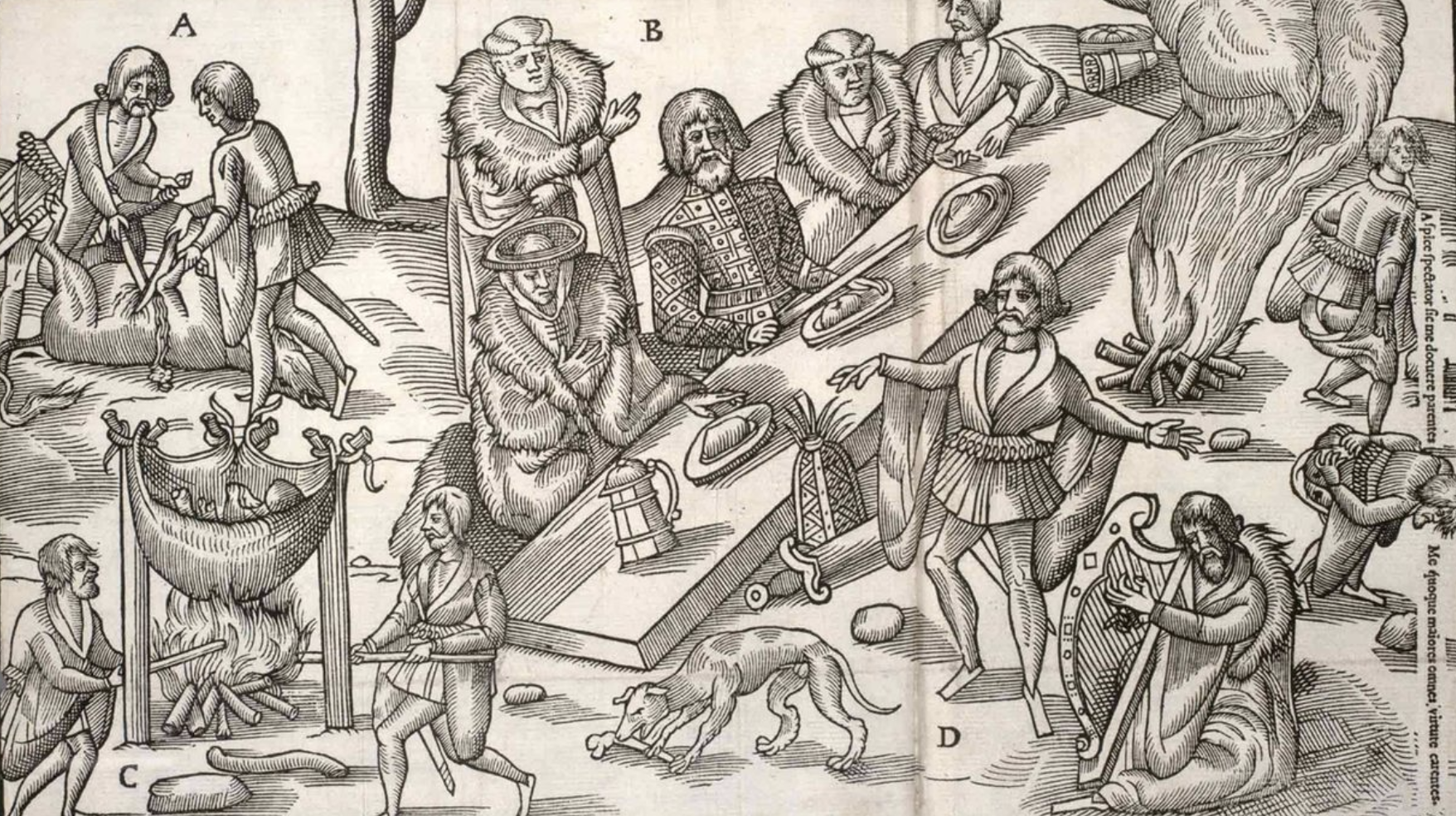
The Image of Irelande, John Derrick. 1581. (Featuring two flatulentists on the right side)
“Between you and me, the thing is dreadfully funny'“, said Mark Twain in regards to ‘1601’, his strangest, most misunderstood, and perhaps least accessible work. Written first as private joke to a paternal figure figure in his life, and then anonymously submitted and rejected from a periodical, it takes the form of a diary entry from the court of Queen Elizabeth in the year 1601 as, alongside notable figures from the Elizabethan period including William Shakespeare, Sir Walter Raleigh, Ben Jonson, and Francis Bacon, she discusses first flatulence, and then sexuality. Twain was not attempting to parody Elizabethan England, where such frank and bawdy conversations were not taboo, but instead comparing the foolish restrictions of 19th century America with the boisterousness of England some 300 years earlier. The very conventions that Twain was ridiculing meant that the work was never formally published in his lifetime, and he only claimed authorship in 1906. The work was lauded as a satiric tour de force by those who read it, an elegant and absurd condemnation of the critical morality of a bourgeois society, and a testament to the spirit of Tom Sawyer that ran through Twain. ‘It is not the word that is the sin”, he said, “It is the spirit back of the word”.
Mark Twain December 10, 2025
Conversation, as it was by the Social Fireside, in the Time of the Tudors [Date, 1601.]
[Mem. - The following is supposed to be an extract from the diary of the Pepys of that day, the same being Queen Elizabeth’s cup-bearer. He is supposed to be of ancient noble lineage; that he despises these literary canaille; that his soul consumes with wrath, to see the queen stoop to talk with such; and that the old man feels that his nobility is defiled by contact with Shakespeare, etc., and yet he got to stay there till her Majesty chooses to dismiss him.]
Yesternight toke her maiste ye queene a fantasie such as she sometimes hath, and had to her closet certain that doe write playes, bokes, and such like, these being my lord Bacon, his worship Sir Walter Ralegh, Mr. Ben Jonson, and ye child Francis Beaumonte, which being but sixteen, hath yet turned his hand to ye doing of ye Lattin masters into our Englishe tong, with grete discretion and much applaus. Also came with these ye famous Shaxpur. A righte straunge mixing truly of mighty blode with mean, ye more in especial since ye queenes grace was present, as likewise these following, to wit: Ye Duchess of Bilgewater, twenty-six yeres of age; ye Countesse of Granby, thirty; her doter, ye Lady Helen, fifteen; as also these two maides of honor, to-wit, ye Lady Margery Boothy, sixty-five, and ye Lady Alice Dilberry, turned seventy, she being two yeres ye queenes graces elder.
I being her maites cup-bearer, had no choice but to remaine and beholde rank forgot, and ye high holde converse wh ye low as uppon equal termes, a grete scandal did ye world heare thereof.
In ye heat of ye talk it befel yt one did breake wind, yielding an exceding mightie and distresfull stink, whereat all did laugh full sore, and then—
Ye Queene.—Verily in mine eight and sixty yeres have I not heard the fellow to this fart. Meseemeth, by ye grete sound and clamour of it, it was male; yet ye belly it did lurk behinde shoulde now fall lean and flat against ye spine of him yt hath bene delivered of so stately and so waste a bulk, where as ye guts of them yt doe quiff-splitters bear, stand comely still and rounde. Prithee let ye author confess ye offspring. Will my Lady Alice testify?
Lady Alice.—Good your grace, an' I had room for such a thunderbust within mine ancient bowels, 'tis not in reason I coulde discharge ye same and live to thank God for yt He did choose handmaid so humble whereby to shew his power. Nay, 'tis not I yt have broughte forth this rich o'ermastering fog, this fragrant gloom, so pray you seeke ye further.
Ye Queene.—Mayhap ye Lady Margery hath done ye companie this favor?
Lady Margery.—So please you madam, my limbs are feeble wh ye weighte and drouth of five and sixty winters, and it behoveth yt I be tender unto them. In ye good providence of God, an' I had contained this wonder, forsoothe wolde I have gi'en 'ye whole evening of my sinking life to ye dribbling of it forth, with trembling and uneasy soul, not launched it sudden in its matchless might, taking mine own life with violence, rending my weak frame like rotten rags. It was not I, your maisty.
Ye Queene.—O' God's name, who hath favored us? Hath it come to pass yt a fart shall fart itself? Not such a one as this, I trow. Young Master Beaumont—but no; 'twould have wafted him to heaven like down of goose's boddy. 'Twas not ye little Lady Helen—nay, ne'er blush, my child; thoul't tickle thy tender maidenhedde with many a mousie-squeak before thou learnest to blow a harricane like this. Wasn't you, my learned and ingenious Jonson?
Jonson.—So fell a blast hath ne'er mine ears saluted, nor yet a stench so all-pervading and immortal. 'Twas not a novice did it, good your maisty, but one of veteran experience—else hadde he failed of confidence. In sooth it was not I.
Ye Queene.—My lord Bacon?
Lord Bacon.-Not from my leane entrailes hath this prodigy burst forth, so please your grace. Naught doth so befit ye grete as grete performance; and haply shall ye finde yt 'tis not from mediocrity this miracle hath issued.
[Tho' ye subjct be but a fart, yet will this tedious sink of learning pondrously phillosophize. Meantime did the foul and deadly stink pervade all places to that degree, yt never smelt I ye like, yet dare I not to leave ye presence, albeit I was like to suffocate.]
Ye Queene.—What saith ye worshipful Master Shaxpur?
Shaxpur.—In the great hand of God I stand and so proclaim mine innocence. Though ye sinless hosts of heaven had foretold ye coming of this most desolating breath, proclaiming it a work of uninspired man, its quaking thunders, its firmament-clogging rottenness his own achievement in due course of nature, yet had not I believed it; but had said the pit itself hath furnished forth the stink, and heaven's artillery hath shook the globe in admiration of it.
[Then was there a silence, and each did turn him toward the worshipful Sr Walter Ralegh, that browned, embattled, bloody swashbuckler, who rising up did smile, and simpering say,]
Sr W.—Most gracious maisty, 'twas I that did it, but indeed it was so poor and frail a note, compared with such as I am wont to furnish, yt in sooth I was ashamed to call the weakling mine in so august a presence. It was nothing—less than nothing, madam—I did it but to clear my nether throat; but had I come prepared, then had I delivered something worthy. Bear with me, please your grace, till I can make amends.
[Then delivered he himself of such a godless and rock-shivering blast that all were fain to stop their ears, and following it did come so dense and foul a stink that that which went before did seem a poor and trifling thing beside it. Then saith he, feigning that he blushed and was confused, I perceive that I am weak to-day, and cannot justice do unto my powers; and sat him down as who should say, There, it is not much yet he that hath an arse to spare, let him fellow that, an' he think he can. By God, an' I were ye queene, I would e'en tip this swaggering braggart out o' the court, and let him air his grandeurs and break his intolerable wind before ye deaf and such as suffocation pleaseth.]
“God damn this windy ruffian and all his breed. I wolde that hell mighte get him.”
Then fell they to talk about ye manners and customs of many peoples, and Master Shaxpur spake of ye boke of ye sieur Michael de Montaine, wherein was mention of ye custom of widows of Perigord to wear uppon ye headdress, in sign of widowhood, a jewel in ye similitude of a man's member wilted and limber, whereat ye queene did laugh and say widows in England doe wear prickes too, but betwixt the thighs, and not wilted neither, till coition hath done that office for them. Master Shaxpur did likewise observe how yt ye sieur de Montaine hath also spoken of a certain emperor of such mighty prowess that he did take ten maidenheddes in ye compass of a single night, ye while his empress did entertain two and twenty lusty knights between her sheetes, yet was not satisfied; whereat ye merrie Countess Granby saith a ram is yet ye emperor's superior, sith he wil tup above a hundred yewes 'twixt sun and sun; and after, if he can have none more to shag, will masturbate until he hath enrich'd whole acres with his seed.
Then spake ye damned windmill, Sr Walter, of a people in ye uttermost parts of America, yt capulate not until they be five and thirty yeres of age, ye women being eight and twenty, and do it then but once in seven yeres.
Ye Queene.—How doth that like my little Lady Helen? Shall we send thee thither and preserve thy belly?
Lady Helen.—Please your highnesses grace, mine old nurse hath told me there are more ways of serving God than by locking the thighs together; yet am I willing to serve him yt way too, sith your highnesses grace hath set ye ensample.
Ye Queene.—God' wowndes a good answer, childe.
Lady Alice.—Mayhap 'twill weaken when ye hair sprouts below ye navel.
Lady Helen.—Nay, it sprouted two yeres syne; I can scarce more than cover it with my hand now.
Ye Queene.—Hear Ye that, my little Beaumonte? Have ye not a little birde about ye that stirs at hearing tell of so sweete a neste?
Beaumonte.—'Tis not insensible, illustrious madam; but mousing owls and bats of low degree may not aspire to bliss so whelming and ecstatic as is found in ye downy nests of birdes of Paradise.
Ye Queene.—By ye gullet of God, 'tis a neat-turned compliment. With such a tongue as thine, lad, thou'lt spread the ivory thighs of many a willing maide in thy good time, an' thy cod-piece be as handy as thy speeche.
Then spake ye queene of how she met old Rabelais when she was turned of fifteen, and he did tell her of a man his father knew that had a double pair of bollocks, whereon a controversy followed as concerning the most just way to spell the word, ye contention running high betwixt ye learned Bacon and ye ingenious Jonson, until at last ye old Lady Margery, wearying of it all, saith, 'Gentles, what mattereth it how ye shall spell the word? I warrant Ye when ye use your bollocks ye shall not think of it; and my Lady Granby, be ye content; let the spelling be, ye shall enjoy the beating of them on your buttocks just the same, I trow. Before I had gained my fourteenth year I had learnt that them that would explore a cunt stop'd not to consider the spelling o't.'
Sr W.—In sooth, when a shift's turned up, delay is meet for naught but dalliance. Boccaccio hath a story of a priest that did beguile a maid into his cell, then knelt him in a corner to pray for grace to be rightly thankful for this tender maidenhead ye Lord had sent him; but ye abbot, spying through ye key-hole, did see a tuft of brownish hair with fair white flesh about it, wherefore when ye priest's prayer was done, his chance was gone, forasmuch as ye little maid had but ye one cunt, and that was already occupied to her content.
Then conversed they of religion, and ye mightie work ye old dead Luther did doe by ye grace of God. Then next about poetry, and Master Shaxpur did rede a part of his King Henry IV., ye which, it seemeth unto me, is not of ye value of an arsefull of ashes, yet they praised it bravely, one and all.
Ye same did rede a portion of his “Venus and Adonis,” to their prodigious admiration, whereas I, being sleepy and fatigued withal, did deme it but paltry stuff, and was the more discomforted in that ye blody bucanier had got his wind again, and did turn his mind to farting with such villain zeal that presently I was like to choke once more. God damn this windy ruffian and all his breed. I wolde that hell mighte get him.
They talked about ye wonderful defense which old Sr. Nicholas Throgmorton did make for himself before ye judges in ye time of Mary; which was unlucky matter to broach, sith it fetched out ye quene with a 'Pity yt he, having so much wit, had yet not enough to save his doter's maidenhedde sound for her marriage-bed.' And ye quene did give ye damn'd Sr. Walter a look yt made hym wince—for she hath not forgot he was her own lover it yt olde day. There was silent uncomfortableness now; 'twas not a good turn for talk to take, sith if ye queene must find offense in a little harmless debauching, when pricks were stiff and cunts not loathe to take ye stiffness out of them, who of this company was sinless; behold, was not ye wife of Master Shaxpur four months gone with child when she stood uppe before ye altar? Was not her Grace of Bilgewater roger'd by four lords before she had a husband? Was not ye little Lady Helen born on her mother's wedding-day? And, beholde, were not ye Lady Alice and ye Lady Margery there, mouthing religion, whores from ye cradle?
In time came they to discourse of Cervantes, and of the new painter, Rubens, that is beginning to be heard of. Fine words and dainty-wrought phrases from the ladies now, one or two of them being, in other days, pupils of that poor ass, Lille, himself; and I marked how that Jonson and Shaxpur did fidget to discharge some venom of sarcasm, yet dared they not in the presence, the queene's grace being ye very flower of ye Euphuists herself. But behold, these be they yt, having a specialty, and admiring it in themselves, be jealous when a neighbor doth essaye it, nor can abide it in them long. Wherefore 'twas observable yt ye quene waxed uncontent; and in time labor'd grandiose speeche out of ye mouth of Lady Alice, who manifestly did mightily pride herself thereon, did quite exhauste ye quene's endurance, who listened till ye gaudy speeche was done, then lifted up her brows, and with vaste irony, mincing saith 'O shit!' Whereat they alle did laffe, but not ye Lady Alice, yt olde foolish bitche.
Now was Sr. Walter minded of a tale he once did hear ye ingenious Margrette of Navarre relate, about a maid, which being like to suffer rape by an olde archbishoppe, did smartly contrive a device to save her maidenhedde, and said to him, First, my lord, I prithee, take out thy holy tool and piss before me; which doing, lo his member felle, and would not rise again.
Mark Twain (1835 – April 21, 1910) was an American writer, praised as the "greatest humorist the United States has produced and called "the father of American literature".
Film
<div style="padding:75% 0 0 0;position:relative;"><iframe src="https://player.vimeo.com/video/1144914517?badge=0&autopause=0&player_id=0&app_id=58479" frameborder="0" allow="autoplay; fullscreen; picture-in-picture; clipboard-write; encrypted-media; web-share" referrerpolicy="strict-origin-when-cross-origin" style="position:absolute;top:0;left:0;width:100%;height:100%;" title="Firing Line clip 9"></iframe></div><script src="https://player.vimeo.com/api/player.js"></script>

Iggy Pop Playlist
Iggy Confidential
Archival - March 16, 2025
Iggy Pop is an American singer, songwriter, musician, record producer, and actor. Since forming The Stooges in 1967, Iggy’s career has spanned decades and genres. Having paved the way for ‘70’s punk and ‘90’s grunge, he is often considered “The Godfather of Punk.”
Film
<div style="padding:56.25% 0 0 0;position:relative;"><iframe src="https://player.vimeo.com/video/1144901360?badge=0&autopause=0&player_id=0&app_id=58479" frameborder="0" allow="autoplay; fullscreen; picture-in-picture; clipboard-write; encrypted-media; web-share" referrerpolicy="strict-origin-when-cross-origin" style="position:absolute;top:0;left:0;width:100%;height:100%;" title="Moonwalk One 1970 Human Body"></iframe></div><script src="https://player.vimeo.com/api/player.js"></script>

Hannah Peel Playlist
Archival - November 12, 2025
Mercury Prize, Ivor Novello and Emmy-nominated, RTS and Music Producers Guild winning composer, with a flow of solo albums and collaborative releases, Hannah Peel joins the dots between science, nature and the creative arts, through her explorative approach to electronic, classical and traditional music.
5 Waiting - The I Ching
Chris Gabriel December 6, 2025
Waiting in faith. Cross the great river…
Les Jeux et Plaisirs de l’Enfance, Claudine Bouzonnet-Stella. 1657.
Chris Gabriel December 6, 2025
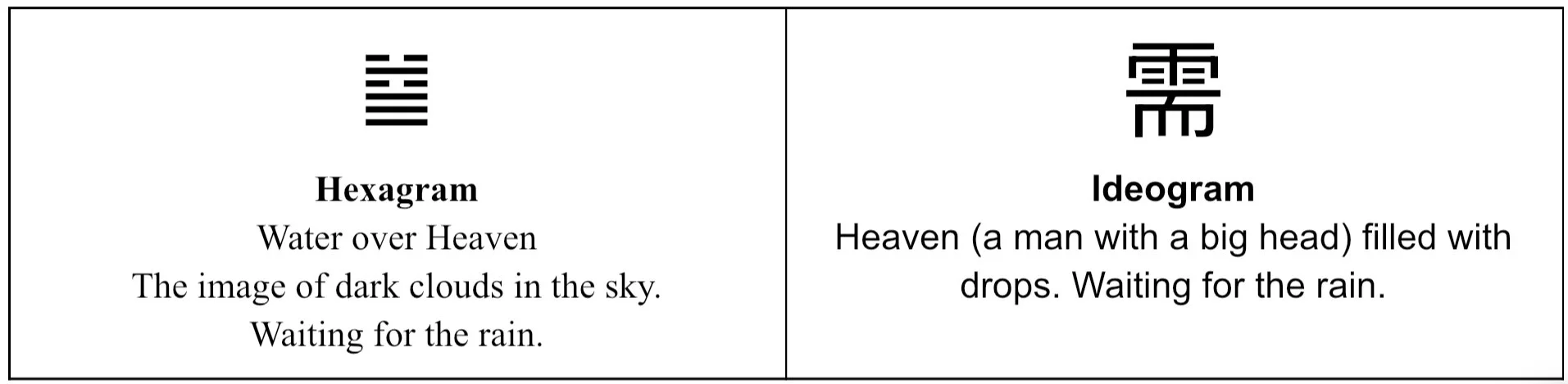
Judgment
Waiting in faith. Cross the great river.
Lines
1
Waiting outside.
2
Waiting in the sand. There are rumours.
3
Waiting in mud invites danger.
4
Waiting in blood. Get out of the hole.
5
Waiting in wine. Feast!
6
Going in the hole invites three uninvited guests.
Qabalah
Yesod and its place on the Middle Pillar. The cloudy phantasies of Yesod. The 4 Nines.
Particularly Cruelty, the Nine of Swords and Strength, the Nine of Wands.
In the fifth hexagram we are given the image of waiting. For many of us, in this age of instant gratification, the task of waiting has become exponentially more difficult. Yet waiting has never been easy; in a drought, the desperate waiting for rain which all engage in is exasperating and miserable. To await the response to a significant message, to wait to be let into a house, to wait for something, anything, to happen - waiting is an eternal issue. It is being given a blank potential and projecting fantasies onto it. Waiting is grappling with Nothing.
Few texts express the miserable nature of waiting like Samuel Beckett’s ‘Waiting for Godot’, in which two men desperately await the arrival of a third who never comes.
Vladimir
What do we do now?
Estragon
Wait.
Vladimir
Yes, but while waiting.
Thus the Judgment of the hexagram: “waiting in faith”. One must have faith in the arrival of what it is they are waiting for, though the lines of this hexagram offer no assurance that the rain will come.
1
In this line we are away from the action, outside and considering the feelings and questions one has while waiting outside of a door. Are they home? Will they let me in? How long will I be out here? Even further, we can think of the suburbs or the outskirts of a place: what it is like to be outside of the life of a city or town?
2
With the context of waiting for the rain, sand is inevitably frustrating. One is either in a desert, where rain will certainly not come soon, or on a beach. “Water, water, every where, Nor any drop to drink.”
As in Godot, gossip, rumours, and worried discussions come when you wait for too long.
3
Mud is unstable, if you wait in it, you will surely sink deeper in
4
This line following the last calls to mind the trench warfare of the First World War, the drudgery and horror of mud and blood. ‘Get out of the hole’ is ironic in a way, as war, like gambling, is often done for far too long in an attempt to “get out of the hole”. To break even is a sunk cost fallacy.
5
It’s much easier to wait for a friend inside a warm bar than it is to wait outside in the cold.
6
Even if one is stuck in a difficult situation, others will come, if we treat them well, often we will be helped.
The key issue of this hexagram is not whether or not what one is waiting for comes or not, but where and how one waits. The proper place and approach will determine the experience entirely.
Film
<div style="padding:56.25% 0 0 0;position:relative;"><iframe src="https://player.vimeo.com/video/1143603790?badge=0&autopause=0&player_id=0&app_id=58479" frameborder="0" allow="autoplay; fullscreen; picture-in-picture; clipboard-write; encrypted-media; web-share" referrerpolicy="strict-origin-when-cross-origin" style="position:absolute;top:0;left:0;width:100%;height:100%;" title="Acting Shakespeare - Using the Verse clip 3"></iframe></div><script src="https://player.vimeo.com/api/player.js"></script>
The Nature of Sonic Geometry: A Conversation with Eric Rankin
Molly Hankins December 4, 2025
As more and more mainstream scientific breakthroughs sit at the intersection of quantum physics, human consciousness and mathematics, it’s unusual to find a layman at the forefront of revolutionary research. Enter Eric Rankin…
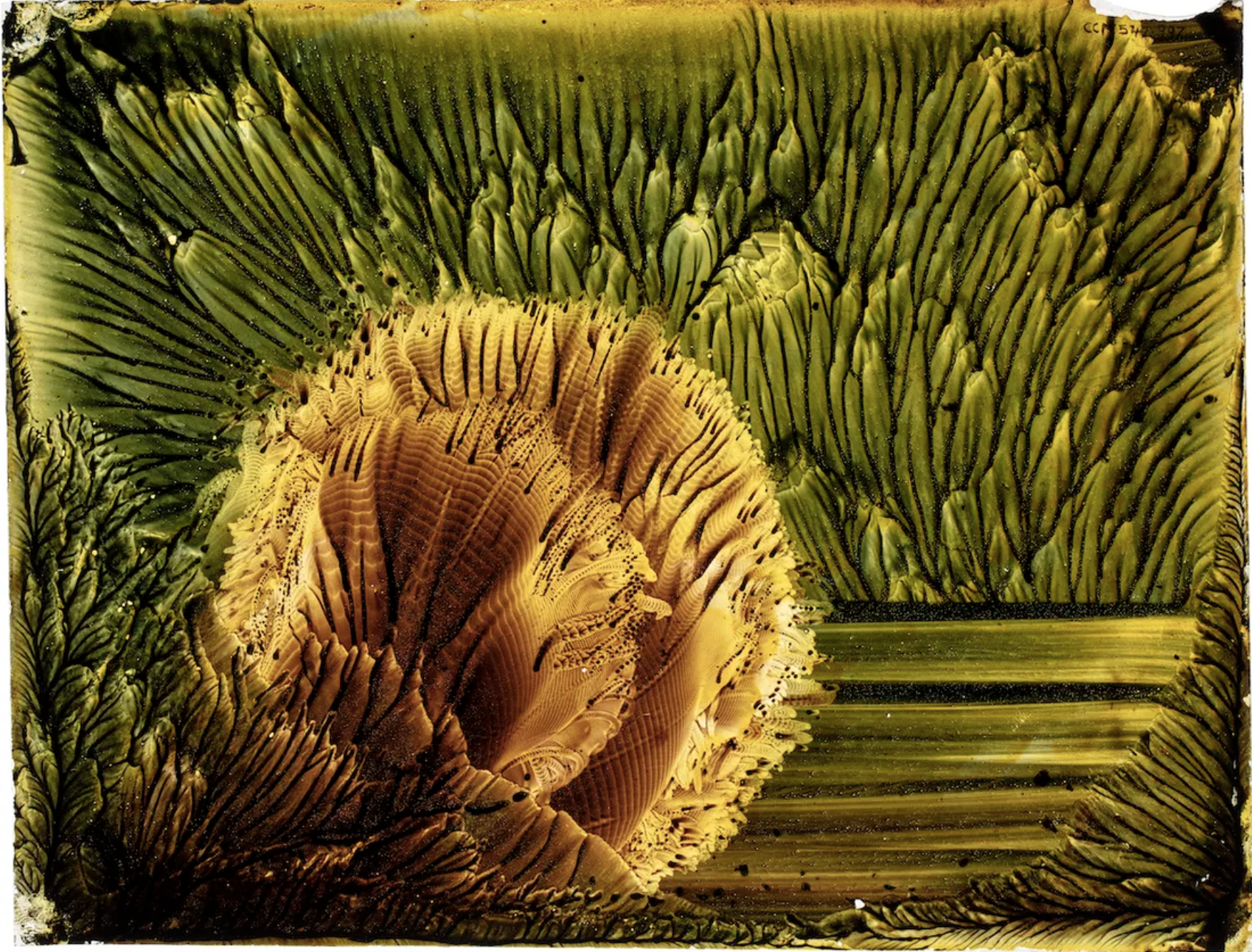
‘Impression Figure’ of recorded sound by Margaret Watts Hughes, Late 1800s.
Molly Hankins December 4, 2025
As more and more mainstream scientific breakthroughs sit at the intersection of quantum physics, human consciousness and mathematics, it’s unusual to find a layman at the forefront of revolutionary research. Enter Eric Rankin, the musician, author and channeler of a body of verified information connecting the major chords on a musical scale with the sum total angles of basic geometric shapes. First put forth in a YouTube video he called ‘Sonic Geometry: the Language of Frequency and Form’ in 2013, Rankin never imagined how sharing this knowledge would impact the trajectory of his life. Discovering this symmetry between geometric and harmonic aspects of the universe has led to his work being discussed alongside world-famous scientists and academics. All the while he’s been living in Laguna Beach, playing in two different bands and teaching a Sonic Geometry class at The Integratron in Joshua Tree.
Approximately 2500 years ago, Pythagoras claimed that “there is geometry in the humming of the strings.” Although sometimes embarrassed by the accolades of credentialed academics, Rankin is the person credited with revealing the correlation between geometry, frequency and major-chord harmonics. “Humans seem to have been ‘designed or programmed’ as major-chord resonators,” he says, speaking of the sense of well-being major chords give us. It’s a similar feeling to hearing music tuned to 432 Hz, which Rankin is also naturally interested in because of patterns that connect to physics, music theory, nature, growth algorithms and spiritual teachings.
The number of vibrational cycles per second determines a sound’s measurement in hertz. When asked about musical tuning, Rankin explained why some Hertz levels, like 432, feel better to many of us physically than others. “432 is kind of a core number, which people are starting to hear about now. If you octave that down to 216, half value, then octave that down again you get 108. A Hindu mala necklace has 108 beads, the meditating Buddha has 108 snails cooling his head while he meditates,” Rankin said. “Our moon is 108 moon-widths away from Earth, our sun is 108 sun-widths away from Earth. So you go, what is going on here that we’ve just been ignorant of? And we wouldn’t have known this until we could measure the moon and the sun and the Earth, that’s just in the last 100, maybe 150 years.” He believes this symmetry, revealed only by the imperial measurement system, is a divine communication meant to be unlocked at a certain phase of human evolution and acts as an invitation to pay attention to the underlying order of life.
At a cymatics lab, where sound is projected into matter to form geometric patterns, Rankin played a scale of major chords, one at a time in sequence and “something showed up that they’d never seen. Rather than a flat-looking beautiful geometric standing wave pattern, it looked like a living lotus that was flowering where petals were actually layered on top of other petals.” The lotus is a Buddhist symbol for awakening, reminding us that we all have the same potential to achieve enlightenment like the Buddha. The number of equally compelling examples Rankin is able to name of frequency measurements corresponding to sacred geometry, symbols and structures, is completely astounding, but he thinks we’ve barely scratched the surface of all there is to know. Sound projected into matter, with certain frequencies resulting in more beauty and dimensionality than others, might be an indicator of how life was created, and how we are co-creating it with the vibration of our thoughts, words and deeds.
Rankin’s work has attracted the likes of physicist Menas Kafatos and Sir Robert Edward Grant, who produced the follow-up video to Sonic Geometry which deals with the platonic solids. Kafatos appeared on Rankin’s weekly podcast and radio show in Orange County, Awakening Code Radio, and told us that “today’s science is much more mystical than people make it out to be, including scientists.” Perhaps the underlying truth of geometric correspondence to harmonics, which is inherently mystical, could only come through a non-scientist in a non-academic setting. Sonic Geometry points to natural intelligence that wants to reveal itself, so why wouldn’t that natural intelligence find an unbiased channel who understands the fundamental nature of harmonics and the emotional effect they have on other beings? That’s a perspective unique to musicians, and Rankin has no doubt that’s at least part of the reason this knowledge wanted to come through him.
“Suddenly, every geometric shape, the foundation of what we call reality, would actually be in literal harmony within Earth’s vibrational field. It’s just like engines having harmonic balancers to keep them running smoothly".”
“There’s been an internal guidance system in place my whole life. I could say it’s my interest in music, or my interest in dolphins and their amazing abilities,” he explained, referencing the years he spent as a boat captain that led him to study dolphins and write a book about them. Those interests gave him the requisite framework he needed to receive the knowledge of Sonic Geometry, which came in one fine flash in August of 2012. He heard a voice of higher intelligence he had previously only experienced during medical emergencies, so he attributed it to a guardian angel of sorts. The voice told him to go to the white board and draw a triangle, write down the sum total of its angles, then play the sum as a tone. “I had a musical background so I understood Hertz cycles to a degree, so I thought ok - how do I play the sum total? And the voice said, ‘You’re living in a moment in time where you can do that, pick up your phone.’ So I looked up an app and did it.”
Within a few moments, he was generating a 180 hz tone to match the sum total of a triangle, and continued going up the scale of the sum total of a square, pentagon and so on to discover the progression of major-chord harmonics “We seem to have been programmed as a resonators, that when we hear major chords we relax and go, ‘Ah, that’s right.’ Other chords might stir other feelings, all the way to minor chords, which feel like danger,” Rankin observes. “So if the universe is geometric in essence, then it is also major-chord harmonic in essence.” To illustrate this point in the Sonic Geometry class Rankin teaches at The Integratron, he uses a keyboard during his lecture so he can play each shape as sound. The relaxation we experienced when those major chords were played felt physically, mentally, spiritually and emotionally harmonizing.
The Integratron is an acoustically perfect chamber conceived as a frequency harmonizing machine by the man who built it, George Van Tassel. Van Tassel believed the world’s pyramids were actually huge “harmonic balancers,” and Rankin asks, “Harmonic to what?”. His answer was the Schumann Resonance, which measures the time it takes electromagnetic waves to bounce between the surface of the Earth and base of the ionosphere, and is typically resting at approximately 7.83 Hz. “What if, thousands of years ago, that resonance field was just 1 Hz higher, hovering at a perfect 9? Suddenly, every geometric shape, the foundation of what we call reality, would actually be in literal harmony within Earth’s vibrational field. It’s just like engines having harmonic balancers to keep them running smoothly,” he says. This sort of speculation has made him a darling on the American TV show Ancient Aliens - like what if the capstone that once topped The Great Pyramid was harmonizing the planet by boosting its frequency to 9 Hz?
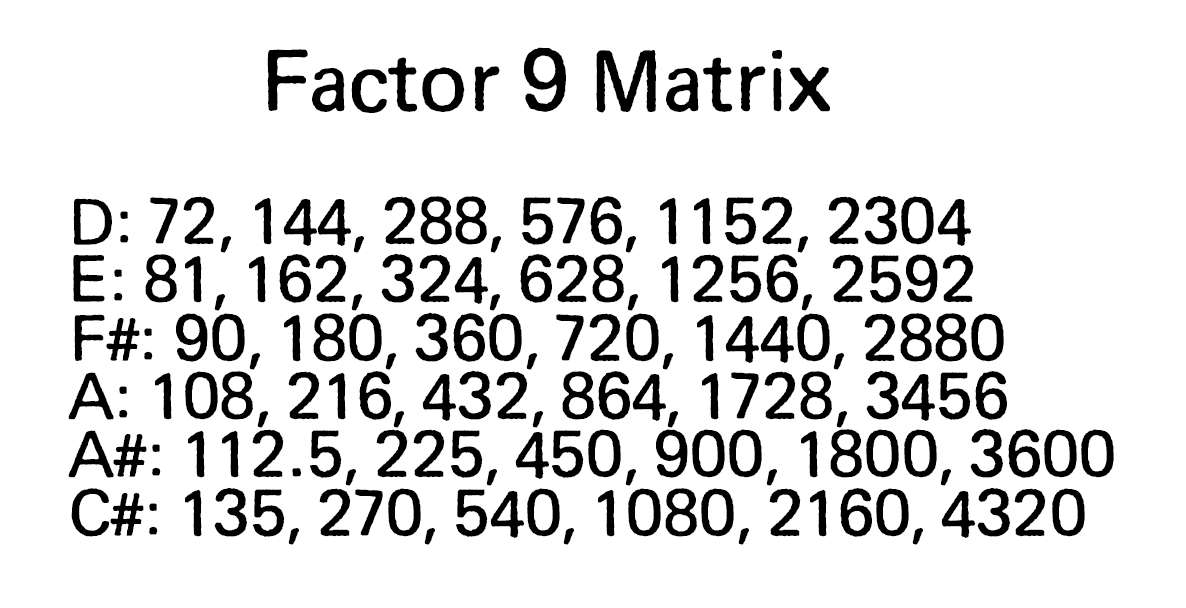
Rankin has not discovered how to use this information beyond the deployment of sound to create harmonic states of being. He has, however, mapped the information in what he calls a Factor 9 grid based on the frequencies of Hertz cycles that add up to 9, such as 432 Hz (4+3+2 = 9). “When we start with 432 Hz and move up and down by multiples of 9, an astonishing 14-tone matrix of synchronicity begins to appear. For instance, on this unique grid we find not just some, but all of the numbers representing every primary geometric shape,” he explains in Sonic Geometry 2. “Looking deeper, we see many other numbers that played into some of humanity’s most profound religious texts - the 72 names of God in the Kabbalah. There’s 108, the number of times Hindu mantras are repeated in ceremonies. We find 144, a number sequence represented in the Great Pyramid of Giza, the number of days in a Mayan baktun.” A baktun is the total length of the Mayan calendar, 144,000 days. 144,000 is also the number of souls that must awaken in order for the planet to move into a higher field of consciousness.
What is this information trying to tell us? “In a word, it’s harmony,” Rankin says. “When we play together as frequencies the numbers of all the primary geometric shapes, what presents itself is a three-tone, numerically perfect major chord. This phenomenon should not be taken lightly, for what we are seeing is a certain kind of proof that nature has revealed by mathematical patterns is a force existing in literal harmony with itself.” If harmony is built into the blueprint of our material lives, perhaps seeking harmony within ourselves, relationships, and communities is what being alive is all about. All of the “Great Work” that alchemists, magicians, meditators and religious practitioners are dedicated to involves some expression of harmonization. Rather than trying to practically apply the teachings of Sonic Geometry, when we apply it philosophically life becomes quite simple - creating harmony is all that matters.
Molly Hankins is an Initiate + Reality Hacker serving the Ministry of Quantum Existentialism and Builders of the Adytum.
Film
<div style="padding:71.71% 0 0 0;position:relative;"><iframe src="https://player.vimeo.com/video/1142228160?badge=0&autopause=0&player_id=0&app_id=58479" frameborder="0" allow="autoplay; fullscreen; picture-in-picture; clipboard-write; encrypted-media; web-share" referrerpolicy="strict-origin-when-cross-origin" style="position:absolute;top:0;left:0;width:100%;height:100%;" title="Lost Horizon clip 1"></iframe></div><script src="https://player.vimeo.com/api/player.js"></script>

Nick Broomfield
1h 41m
12.3.25
In this clip, Rick speaks with Nick Broomfield about identity in Hollywood.
<iframe width="100%" height="265" src="https://clyp.it/ybp2rtmc/widget?token=241b0815e1baf92bf8fc298be84dd075" frameborder="0"></iframe>

Why Less Is More
Suzanne Stabile December 2, 2025
A meaningful response will always require allowing something old to fall away…
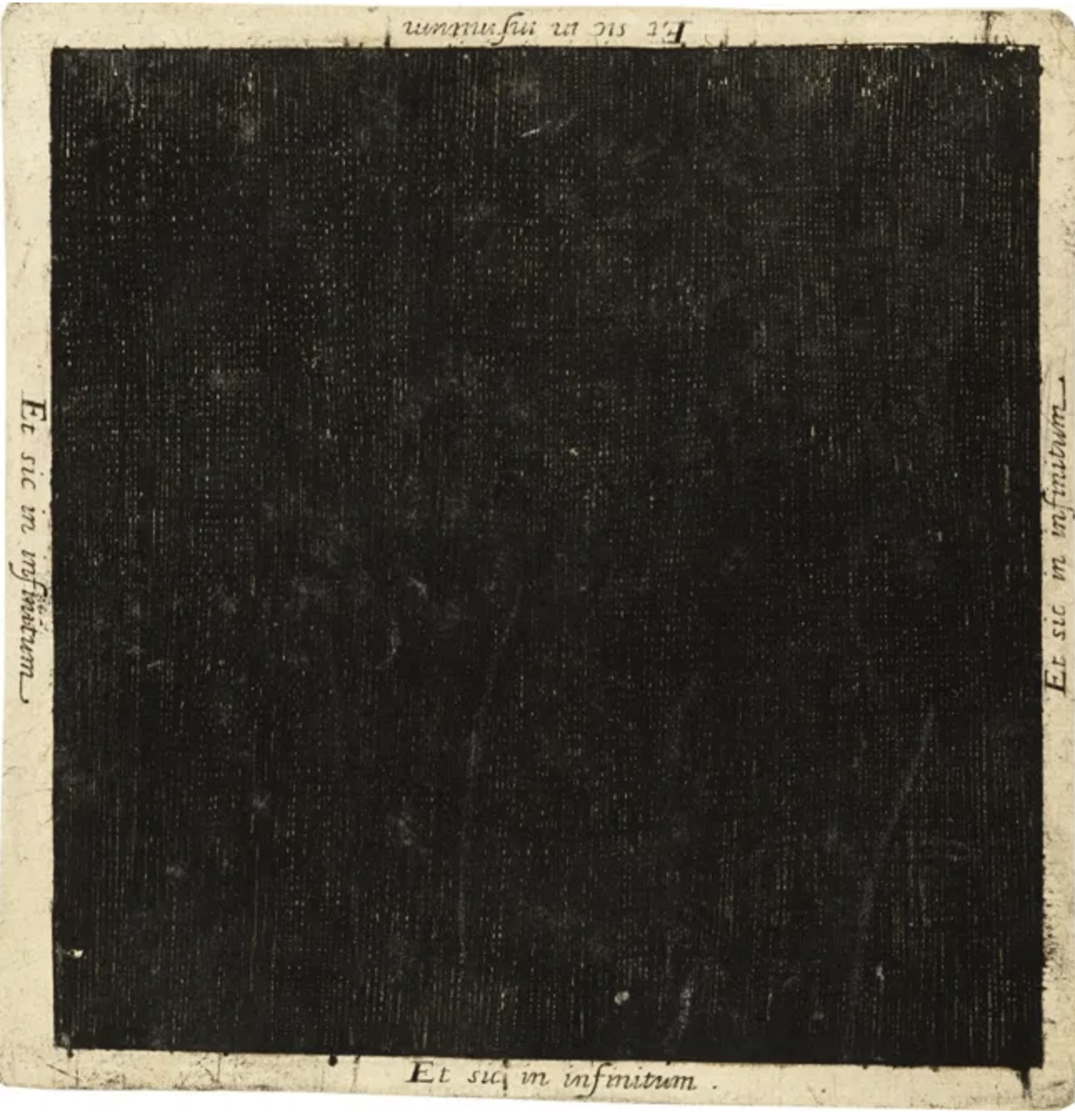
Robert Fludd, Utriusque Cosmi. 1617.
Suzanne Stabile December 2, 2025
Each year, my husband and I set aside time for a spiritual retreat, just the two of us. We spend so much time with others that if we are not aware and mindful, our personality as a couple has as much ego as we do as individuals. We have two goals on these trips. The first is to be settled and quiet long enough to perhaps hear something new. The second, is to have the time and space to discuss how we are each challenged by the chosen retreat topic and how we might respond.
A meaningful response will always require allowing something old to fall away, yet it seems to be harder than it should to know what to keep and what we no longer need. A winter coat, an old idea, a belief that hasn’t been examined since childhood, ways of being that no longer fit who we’re becoming or the stationary bicycle that represents so much potential. Choices that offer comfort but not value to the journey are tricky, because our attachment to what is familiar seems more alluring than the curiosity that a well-planned retreat would surely create.
The retreat and materials that we return to most often is titled “the Spirituality of Subtraction.” It was designed for us by Father Richard Rohr some fifteen years ago and every time we choose to revisit it, we are challenged to look at our lives in new ways. Like so many, we continue to struggle with the concept that less is more in a culture where more of something, anything, is often top of mind.
Our first encounter with this was on a journey to a parish in San Antonio to spend a few days for a private retreat. San Antonio is about two-hundred and seventy-five miles from Dallas. We had done that drive enough times to know the best places to stop, eat, rest or shop along the way. As we reached the outskirts of Dallas, Joe put in the cassette tape that Father Rohr had supplied and we began to listen to his opening talk about the spirituality of subtraction. After about an hour and a half, I pressed pause and asked if we could stop at the outlet kitchen store on the way. Joe had a look that I had seen many times before and it was the backdrop for his response; “ What do we need for the kitchen?”
“I’d like to get one of those wide mouth toasters.”
Joe replied that he really liked our toaster and wondered why we needed a wide mouth toaster.
“Well,” I explained, “you can toast bagels in them and we can’t in ours.”
“But we don’t eat bagels.”
Smiling, though perturbed, I said, “That’s because we don’t have a wide mouth toaster.”
The conversation ended as, we were almost to the exit so Joe suggested we just wait until we got back in the car to continue listening to the teaching from Father Rohr.
We found the toaster,secured it in its seemingly very large box in the back of the car, and headed again to San Antonio. Just as Joe pulled onto the Interstate, he pushed play on the tape and with God as our witness, the first words we heard from Father Rohr were, “You know … it’s like all of those people who think they need to go out and buy a wide mouth toaster when there is absolutely nothing wrong with the toaster they already have.”
There are no words to adequately describe the satisfaction that covered Joe’s face, and obviously he didn’t feel the need to say anything. With very few choices left, I picked up my journal, looked out the window for a time, and began taking notes as we continued to listen to “The Spirituality of Subtraction.”
“It seems that one cannot solve a problem with the same mixed-up thinking that created it.”
We had a very meaningful and memorable retreat, and were blessed in ways that we could not have imagined. We learned so much, committed to a lot of change, believed in ourselves and in one another and looked forward to what would be. It gave us the questions we would need to ask ourselves repeatedly in the years to come about our understanding of the differences between satisfaction and enough, needing and wanting, giving and keeping, and other equally challenging contradictions.
Albert Einstein said:
“No problem can be solved from the same consciousness that created it.”
It seems that one cannot solve a problem with the same mixed-up thinking that created it. So, I have asked more than once, “What good does it do to try to simplify your life by arranging, moving, charting, calendaring, giving and grasping, simplifying one part of life only to find that it complicates another?”
Parker Palmer had helpful wisdom when he said, “If I try to be or do something noble that has nothing to do with who I am, I may look good to others and to myself for a while. But the fact that I am exceeding my limits will eventually have consequences.”
For simplicity to be real, lasting, true and effective it will have to come from a place of organic reality. This work of simplifying our lives has to become integral to our nature or it is a futile effort and wasted time. Instead, we must find a way to be both practical and spiritual in our attempts to simplify.
So, what keeps us from making the changes we desire? One reality that we’ve identified in our own lives is what Mary O’Malley identifies as compulsions. She says, “By compulsion I mean engaging in any recurring activity to manage our feelings, an activity that eventually ends up managing us.”
We can be compulsive in many ways: overspending, overeating, over working, over planning, over worrying, over exercising, over drinking, over computerizing, just overing. Many of us are compulsive without even knowing it but can be reminded of it when the computer crashes, the electricity is out for a time, the doctor says we must change our diet, a friend wonders if we are drinking too much. In those times it becomes clear just how much a particular activity controls our lives.
Our compulsion is to struggle. We live in a story in our heads that is always trying to get us to “do life,” telling us we need to make ourselves and our lives better or different from what they are. That is the core of the mess! Father Rohr says, “If you have to have more and more of the same thing, it isn’t working!”
So, moving forward …
Do we live our way into a new way of thinking?
Or do we think our way into a new way of living?
Suzanne Stabile is a speaker, teacher, and internationally recognized Enneagram master teacher who has taught thousands of people over the last thirty years. She is the author of ‘The Path Between Us’, and coauthor, with Ian Morgan Cron, of ‘The Road Back to You’. She is also the creator and host of The Enneagram Journey podcast. Along with her husband, Rev. Joseph Stabile, she is cofounder of Life in the Trinity Ministry, a nonprofit, nondenominational ministry committed to the spiritual growth and formation of adults.
Film
<div style="padding:75% 0 0 0;position:relative;"><iframe src="https://player.vimeo.com/video/1143579219?badge=0&autopause=0&player_id=0&app_id=58479" frameborder="0" allow="autoplay; fullscreen; picture-in-picture; clipboard-write; encrypted-media; web-share" referrerpolicy="strict-origin-when-cross-origin" style="position:absolute;top:0;left:0;width:100%;height:100%;" title="Personal Legacies- Materiality and Abstraction clip 15"></iframe></div><script src="https://player.vimeo.com/api/player.js"></script>
4 Youth (Foolishness) - The I Ching
Chris Gabriel November 22, 2025
I don’t seek young fools, young fools seek me. They bite their questions at me. If they ask too many, I get annoyed and will say no more...
Les Jeux et Plaisirs de l’Enfance, Claudine Bouzonnet-Stella. 1657.
Chris Gabriel November 29, 2025
Judgment
I don’t seek young fools, young fools seek me.
They bite their questions at me.
If they ask too many, I get annoyed and will say no more.
Lines
1
To enlighten a fool, don’t spare the rod. It loosens their shackles.
2
To make the fool wise, let him enjoy a wife. Their child will be able.
3
Don’t choose a woman who sees a rich man and gets on her knees, she is worthless.
4
Trapped in foolishness.
5
The foolish child is blessed.
6
Attacking fools will get you nothing. It’s better to defend them.
Qabalah
Yesod to Netzach: The Path of Tzaddi. The Emperor.
Yesodic phantasies obscure the vision of Netzach
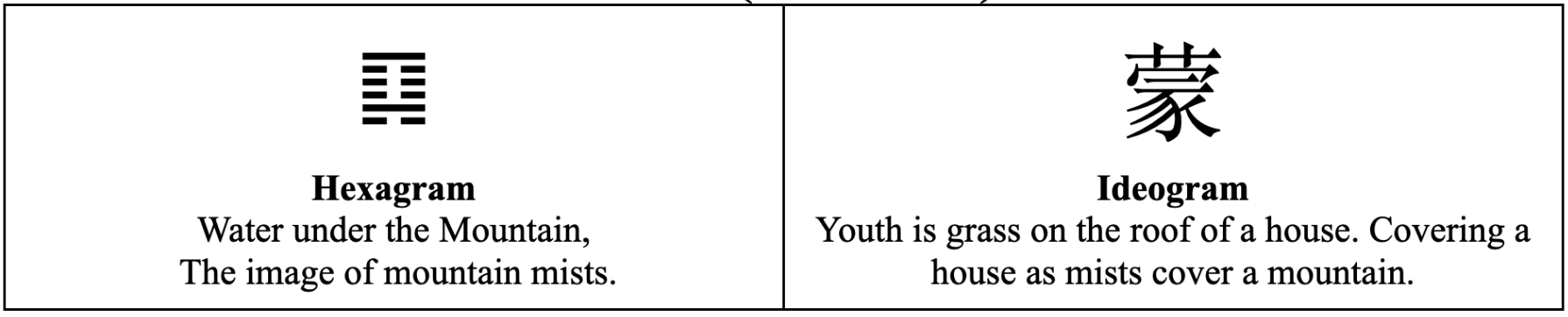
The sprout we met in hexagram 3 has grown into a foolish youth. Here, the struggle is no longer for existence, but for understanding. We are dealing with youth, foolishness, confusion, and what is obscured. The hexagram offers the image of a misty mountain; we can imagine a climber looking up, unable to see what is ahead. This is the situation of a child, they stand at the very foot of the mountain of their life, and are unable to see any of what lay ahead. The ideogram gives us the image of a house with grass covering the roof. We can think of a house so covered in ivy that we can barely see it. Both give us a clear picture of what is obscured.
The Bible describes this state precisely:
11 When I was a child, I spake as a child, I understood as a child, I thought as a child: but when I became a man, I put away childish things. 12 For now we see through a glass, darkly; but then face to face: now I know in part; but then shall I know even as also I am known.
This hexagram is about seeing through a glass, darkly. The lines, however, offer advice to the dazed and confused youth. The Judgment here is notable, and has always guided my personal ethics in reading both the tarot and I Ching: “Never read someone too often, and never ask the same question again and again”. To fall foul of this, the tarot will start to give “bad” cards, the I Ching will tell you quite directly to stop, as we see here.
1
Line one shows us that physical discipline is a necessity for enlightenment; the mind is free when the body is put in its proper place. This is universal in spiritual traditions. Fasting, meditation, even torment are used to free and enlighten the mind.
2
For those who don’t seek religious enlightenment, the best thing is to have love and to make a family. This is the highest achievement for someone who isn’t seeking things beyond the material.
3
As such, choosing a proper partner is very important, the line here warns of what we would call “a golddigger”. The right wife is necessary to make a good family.
4
Without heeding these wisdoms, we can become trapped, totally confused, blind, and lost in our own confusion. Many live their lives this way.
5
The foolish virgin scorned in the Biblical parable is redeemed here. A foolish virgin makes a perfect student for wisdom. Untouched by the world, they will be able to see beyond it.
The foolish child in this line is the divine youth of myth and folklore, like the Egyptian Harpocrates and Tom Thumb of the Brothers Grimm. They are always in danger of being eaten, endangered, and trapped, yet they always find a way out, for they have a profound destiny in their future.
6 All of us can find ourselves getting irritated with the ignorance and stupidity of others. It is an aggravating thing, but attacking them is silly for we cannot gain from them. By protecting the fool, they can eventually grow wise.
Youth is the proper time to be foolish and confused. We can experiment and learn, and begin to see clearly the contours of the great mountain of life that we are to climb.
Film
<div style="padding:56.25% 0 0 0;position:relative;"><iframe src="https://player.vimeo.com/video/1141713739?badge=0&autopause=0&player_id=0&app_id=58479" frameborder="0" allow="autoplay; fullscreen; picture-in-picture; clipboard-write; encrypted-media; web-share" referrerpolicy="strict-origin-when-cross-origin" style="position:absolute;top:0;left:0;width:100%;height:100%;" title="Carlo Rovelli on The Order of Time clip 8"></iframe></div><script src="https://player.vimeo.com/api/player.js"></script>

Jimmy Iovine
1h 25m
11.26.25
In this clip, Rick speaks with Jimmy Iovine about his unfulfilled desires for music streaming.
<iframe width="100%" height="265" src="https://clyp.it/1a2rmuue/widget?token=476fa8527a4fdfdd70e59106c6ae1b3d" frameborder="0"></iframe>

Film
<div style="padding:56.25% 0 0 0;position:relative;"><iframe src="https://player.vimeo.com/video/1140539569?title=0&byline=0&portrait=0&badge=0&autopause=0&player_id=0&app_id=58479" frameborder="0" allow="autoplay; fullscreen; picture-in-picture; clipboard-write; encrypted-media; web-share" referrerpolicy="strict-origin-when-cross-origin" style="position:absolute;top:0;left:0;width:100%;height:100%;" title="The Man Who Shot LIberty Valence clip 1"></iframe></div><script src="https://player.vimeo.com/api/player.js"></script>
Edgard Varése: The Idol of my Youth (1971)
Frank Zappa November 25, 2025
I have been asked to write about Edgard Varése. I am in no way qualified to. I can't even pronounce his name right. The only reason I have agreed to is because I love his music very much, and if by some chance this article can influence more people to hear his works, it will have been worthwhile…
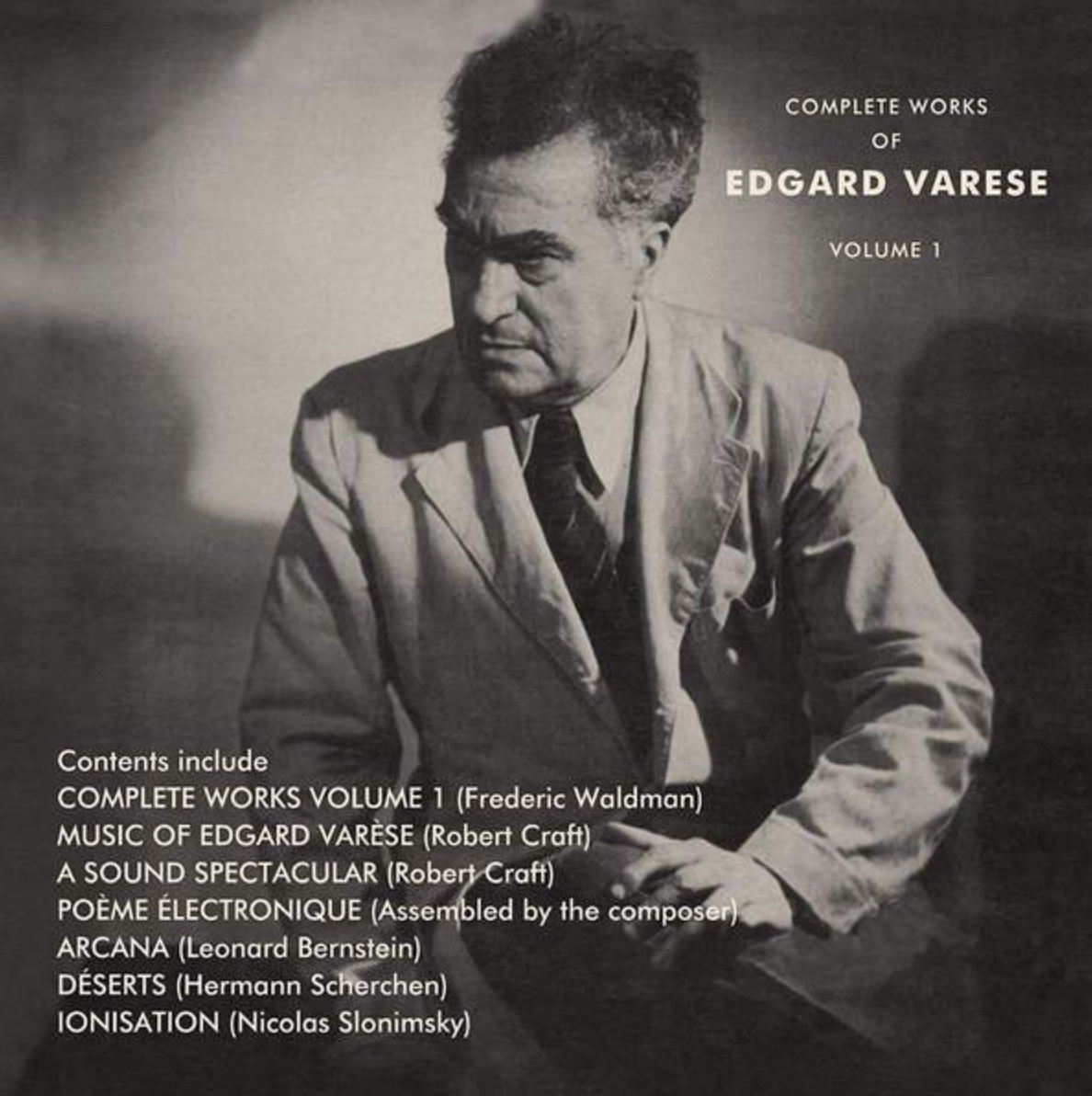
Frank Zappa stands all but alone in the pantheon of American popular music. A true outsider who, through sheer talent, determination, and an uncompromising vision of himself, became one of the most significant and celebrated figures of the rock movement. Through his band ‘The Mothers of Invention’ and as a solo artist, he fused free jazz, experimental rock, concrete music, classical composition, and satirical writing into a unique sound. His inspirations were boundless, traversing genre and time, and in this piece, written first for ‘Stereo Review’ in 1971, he talks about a foundational figure for his musical education - Edgard Varése. Varése and Zappa are, in many ways, logical bedfellows. The former was a pioneering radical composer who pushed ideas of music as little more than organised noise, with a mop of black hair and piercing, scientific eyes. The same descriptor could be applied to Zappa, though his career began some decades later. This piece is, more than anything, a love letter, and a memoir to an illusive obsession that helped the young Zappa at once feel seen his pursuits, and alone in his interests.
Frank Zappa November 25, 2025
I have been asked to write about Edgard Varése. I am in no way qualified to. I can't even pronounce his name right. The only reason I have agreed to is because I love his music very much, and if by some chance this article can influence more people to hear his works, it will have been worthwhile.
I was about thirteen when I read an article in Look about Sam Goody's Record Store in New York. My memory is not too clear on the details, but I recall it was praising the store's exceptional record merchandising ability. One example of brilliant salesmanship described how, through some mysterious trickery, the store actually managed to sell an album called "Ionization" (the real name of the album was "The Complete Works of Edgard Varése, Volume One"). The article described the record as a weird jumble of drums and other unpleasant sounds.
I dashed off to my local record store and asked for it. Nobody ever heard of it. I told the guy in the store what it was like. He turned away, repulsed, and mumbled solemnly, "I probably wouldn't stock it anyway... nobody here in San Diego would buy it."
I didn't give up. i was so hot to get that record I couldn't even believe it. In those days I was a rhythm-and-blues fanatic. I saved any money I could get (sometimes as much as $2 a week) so that every Friday and Saturday I could rummage through piles of old records at the Juke Box Used Record Dump (or whatever they called it) in the Maryland Hotel or the dusty corners of little record stores where they'd keep the crappy records nobody wanted to buy.
One day I was passing a hi-fi store in La Mesa. A little sign in the window announced a sale on 45's. After shuffling through their singles rack and finding a couple of Joe Houston records, I walked toward the cash register. On my way, I happened to glance into the LP bin. Sitting in the front, just a little bent at the corners, was a strange-looking black-and-white album cover. On it there was a picture of a man with gray frizzy hair. He looked like a mad scientist. I thought it was great that somebody had finally made a record of a mad scientist. i picked it up. I nearly (this is true, ladies and gentlemen) peed in my pants... THERE IT WAS! EMS 401, The Complete Works of Edgard Varése Volume I... Integrales, Density 21.5, ionization, Octandre... Rene Le Roy, the N. Y. Wind Ensemble, the Juilliard Percussion Orchestra, Frederic Waidman Conducting... liner notes by Sidney Finkelstein! WOW!
I ran over to the singles box and stuffed the Joe Houston records back in it. I fumbled around in my pocket to see how much money I had (about $3.80). I knew I had to have a lot of money to buy an album. Only old people had enough money to buy albums. I'd never bought an album before. I sneaked over to the guy at the cash register and asked him how much EMS 401 cost. "That gray one in the box? $5.95 - "
I had searched for that album for over a year, and now... disaster. I told the guy I only had $3.80. He scratched his neck. "We use that record to demonstrate the hi-fi's with, but nobody ever buys one when we use it... you can have it for $3.80 if you want it that bad."
I couldn't imagine what he meant by "demonstrating hi-fi's with it." I'd never heard a hi-fi. I only knew that old people bought them. I had a genuine lo-fi... it was a little box about 4 inches deep with imitation wrought-iron legs at each corner (sort of brass-plated) which elevated it from the table top because the speaker was in the bottom. My mother kept it near the ironing board. She used to listen to a 78 of The Little Shoemaker on it. I took off the 78 of The Little Shoemaker and, carefully moving the speed lever to 33 1/3 (it had never been there before), turned the volume all the way up and placed the all-purpose Osmium-tip needle in the lead-in spiral to Ionization. I have a nice Catholic mother who likes Roller Derby. Edgard Varése does not get her off, even to this very day. I was forbidden to play that record in the living room ever again.
In order to listen to The Album, I had to stay in my room. I would sit there every night and play it two or three times and read the liner notes over and over. I didn't understand them at all. I didn't know what timbre was. I never heard of polyphony. I just liked the music because it sounded good to me. I would force anybody who came over to listen to it. (I had heard someplace that in radio stations the guys would make chalk marks on records so they could find an exact spot, so I did the same thing to EMS 401... marked all the hot items so my friends wouldn't get bored in the quiet parts.)
I went to the library and tried to find a book about Mr. Varése. There wasn't any. The librarian told me he probably wasn't a Major Composer. She suggested I look in books about new or unpopular composers. I found a book that had a little blurb in it (with a picture of Mr. Varése as a young man, staring into the camera very seriously) saying that he would be just as happy growing grapes as being a composer.
“His music is completely unique. If you haven't heard it yet, go hear it. If you've already heard it and think it might make groovy sound effects, listen again.”
On my fifteenth birthday my mother said she'd give me $5. I told her I would rather make a long-distance phone call. I figured Mr. Varése lived in New York because the record was made in new York (and because he was so weird, he would live in Greenwich Village). I got New York Information, and sure enough, he was in the phone book.
His wife answered. She was very nice and told me he was in Europe and to call back in a few weeks. I did. I don't remember what I said to him exactly, but it was something like: "I really dig your music." he told me he was working on a new piece called Deserts. This thrilled me quite a bit since I was living in Lancaster, California then. When you're fifteen and living in the Mojave Desert and find out that the world's greatest composer, somewhere in a secret Greenwich Village laboratory, is working on a song about your "home town" you can get pretty excited. It seemed a great tragedy that nobody in Palmdale or Rosamond would care if they ever heard it. I still think Deserts is about Lancaster, even if the liner notes on the Columbia LP say it's something more philosophical.
All through high school I searched for information about Varése and his music. One of the most exiting discoveries was in the school library in Lancaster. I found an orchestration book that had score examples in the back, and included was an excerpt from Offrandes with a lot of harp notes (and you know how groovy harp notes look). I remember fetishing the book for several weeks.
When I was eighteen I got a chance to go to the East Coast to visit my Aunt Mary in Baltimore. I had been composing for about four years then but had not heard any of it played. Aunt Mary was going to introduce me to some friend of hers (an italian gentleman) who was connected with the symphony there. I had planned on making a side trip to mysterious Greenwich Village. During my birthday telephone conversation, Mr. Varése had casually mentioned the possibility of a visit if I was ever in the area. I wrote him a letter when I got to Baltimore, just to let him know I was in the area.
I waited. My aunt introduced me to the symphony guy. She said, "This is Frankie. He writes orchestra music." The guy said, "Really? Tell me, sonny boy, what's the lowest note on a bassoon?" I said, "B flat... and also it says in the book you can get 'em up to a C or something in the treble clef." He said, "Really? You know about violin harmonics?" I said, "What's that?" He said, "See me again in a few years."
I waited some more. The letter came. I couldn't believe it. A real handwritten letter from Edgard Varése! I still have it in a little frame. In very tiny scientific-looking script it says:
Dear Mr. Zappa
I am sorry not to be able to grant your request. I am leaving for Europe next week and will be gone until next spring. I am hoping however to see you on my return. With best wishes.
Sincerely
Edgard Varése
I never got to meet Mr. Varése. But I kept looking for records of his music. When he got to be about eighty I guess a few companies gave in and recorded some of his stuff. Sort of a gesture, I imagine. I always wondered who bought them besides me. It was about seven years from the time I first heard his music till I met someone else who even knew he existed. That person was a film student at USC. He had the Columbia LP with Poeme Electronique on it. He thought it would make groovy sound effects.
I can't give you any structural insights or academic suppositions about how his music works or why I think it sounds so good. His music is completely unique. If you haven't heard it yet, go hear it. If you've already heard it and think it might make groovy sound effects, listen again. I would recommend the Chicago Symphony recording of Arcana on RCA (at full volume) or the Utah Symphony recording of Ameriques on Vanguard. Also, there is a biography by Fernand Oulette, and miniature scores are available for most of his works, published by G. Ricordi.
Frank Zappa (1940 –1993) was an American composer, musician, actor, filmmaker and activist who established himself as one of the most singular and left-field artists of his generation.
Film
<div style="padding:56.25% 0 0 0;position:relative;"><iframe src="https://player.vimeo.com/video/1140536249?badge=0&autopause=0&player_id=0&app_id=58479" frameborder="0" allow="autoplay; fullscreen; picture-in-picture; clipboard-write; encrypted-media; web-share" referrerpolicy="strict-origin-when-cross-origin" style="position:absolute;top:0;left:0;width:100%;height:100%;" title="Yosemite Valley 1924 clip 1"></iframe></div><script src="https://player.vimeo.com/api/player.js"></script>