
The Big Rock Candy Figgy Pudding Pitfall (1966)
Joan Didion December 25, 2025
You will perhaps have difficulty understanding why I conceived the idea of making 20 hard-candy topiary trees and 20 figgy puddings in the first place…
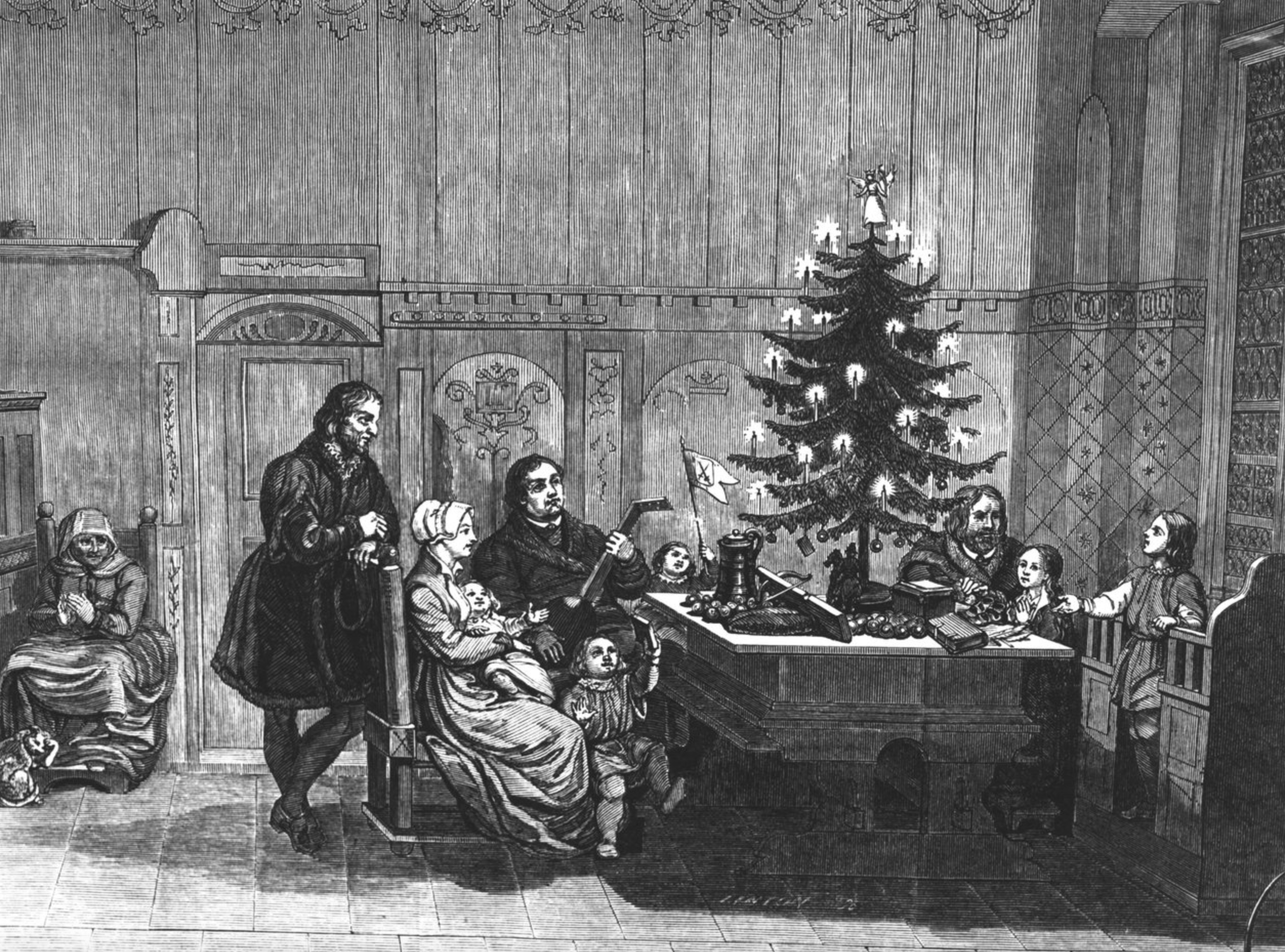
Capturing, with her inimitable wit and poignancy, the grand ambitions and subsequent disappointments of the Christmas period, Didion’s short essay from 1966 sparkles with self deprecation and recognition. The work is a gentler, slighter piece than those that made her one of the most celebrated and influential writers of her generation and beyond, yet it is abundant in trademark charm and acutely observed.
Joan Didion December 25, 2025
You will perhaps have difficulty understanding why I conceived the idea of making 20 hard-candy topiary trees and 20 figgy puddings in the first place. The heart of it is that although I am frail, lazy, and unsuited to doing anything except what I am paid to do, which is sit by myself and type with one finger, I like to imagine myself a “can-do” kind of woman, capable of patching the corral fence, pickling enough peaches to feed the hands all winter, and then winning a trip to Minneapolis in the Pillsbury Bake-Off. In fact, the day I stop believing that if put to it I could win the Pillsbury Bake-Off will signal the death of something.
It was late in September, about the time certain canny elves began strategically spotting their Make It Yourself for Christmas books near supermarket checkout counters, when I sensed the old familiar discontent. I would stand there in the Westward Ho market, waiting to check out my frozen chicken tetrazzini and leafing through the books, and I would see how far I had drifted from the real pleasures. I did not “do” things. I did not sew spangles on potholders for my friends. I did not make branches of marzipan mistletoe for my hostesses. I did not give Corn Dog and Caroling Parties for neighborhood children (Did I know any neighborhood children? Were there any neighborhood children? What exactly was my neighborhood?), the Corn Dogs to be accompanied by Hot Santa’s Grog.
Nor had it ever occurred to me to buy Styrofoam balls, cover them with hard candies, plant them on wooden stalks in small flowerpots, and end up with amusingly decorative hard-candy topiary trees, perfect for centerpieces or last-minute gifts. At the checkout counter, I recognized clearly that my plans for the Christmas season — making a few deadlines — were stale and unprofitable. Had my great-great-grandmother come west in a covered wagon and strung cranberries on scrub oaks so that I might sit by myself in a room typing with one finger and ordering Italian twinkle lights by mail from Hammacher Schlemmer?
I wanted to be the kind of woman who made hard-candy topiary trees and figgy puddings. The figgy puddings were not in the Make It Yourself for Christmas books but something I remembered from a carol. “Oh, bring us a figgy pudding and a happy new year,” the line went. I was unsure what a figgy pudding was, but it had the ring of the real thing.
“Exactly what kind of therapy are we up to this week?” my husband asked when I arrived home with 20 Styrofoam balls, 20 flowerpots, and 60 pounds of, or roughly 6,000, hard candies, each wrapped in cellophane.
“Hard-candy topiary trees, if you don’t mind,” I said briskly, to gain the offensive before he could mention my last project, a hand-knitted sweater which would have cost $60 at Jax, the distinction being that, had I bought it at Jax, it would very probably be finished. “Twenty of them. Decorative. Amusing.”
He said nothing.
“Christmas presents,” I said.
There was a moment of silence as we contemplated the dining room table, covered now with shifting dunes of lemon drops.
“Presents for whom?” he said.
“Your mother might like one.”
“That leaves 19.”
“All right. Let’s just say they’re centerpieces.”
“Let’s just say that if you’re making 20 centerpieces, I hope you’re under contract to Chasen’s. Or maybe to Hilton.”
“That’s all you know,” I countered, wittily.
Provisions for the figgy puddings were rather more a problem. The Vogue Book of Menus and Recipes made no mention of figgy pudding, nor did my cookbook, although the latter offered a recipe for “Steamed Date or Fig Pudding.” This had a tentative sound, and so I merely laid in 20 pounds of dried figs and planned, when the time came, to improvise from there. I thought it unnecessary to mention the puddings to my husband just yet.
Meanwhile, work on the topiary trees proceeded. Pebbles were gathered from the driveway to line the flowerpots. (“Next time it rains and that driveway washes out,” I was informed, “there’s going to be one unhappy Santa’s Helper around here.”) Lengths of doweling to be used as stalks were wrapped with satin ribbons. The 20 Styrofoam balls glistened with candies, each affixed with an artfully concealed silk pin. (As it happened I had several thousand silk pins left from the time I planned to improvise a copy of a Grès evening dress.) There was to be a lemon-drop tree and an ice-mint tree and a cinnamon-lump tree. There was to be a delicate crystallized-violet tree. There was to be a witty-licorice tree.
All in all, the operation went more smoothly than any I had undertaken since I was 16 and won third prize in the Sacramento Valley Elimination Make-It-Yourself-with-Wool Contest. I framed graceful rejoinders to compliments. I considered the probability that I. Magnin or Neiman-Marcus would press me to make trees for them on an exclusive basis. All that remained was to set the candy balls upon their stalks — that and the disposition of the figs — and I had set an evening aside for this crowning of the season’s achievement.
I suppose that it was about 7:00 when I placed the first candy-covered ball on the first stalk. Because it did not seem overly secure, I drilled a deeper hole in the second ball. That one, too, once on its stalk, exhibited a certain tendency to sway, but then so does the Golden Gate Bridge. I was flushed with imminent success, visions of candy trees come true all around me. I suppose it was about 8:00 when I placed the last ball on the last stalk, and I suppose it was about one minute after eight when I heard the first crack, and I suppose it was about 8:15 (there were several minutes of frantic shoring maneuvers) when my husband found me sitting on the dining room floor, crying, surrounded by 60 pounds of scattered lemon drops and ice-mints and cinnamon lumps and witty licorice.
“I’ll tell you what,” he said. “Why don’t we get the grout left over from when you were going to retile the bathroom, and make a ceramic candy floor.”
“If you think you’re going to get any figgy puddings,” I said, “you’d better think again.”
But I had stopped crying, and we went out for an expensive dinner. The next morning I gathered up the candies and took them to Girl Scout headquarters, presumably to be parceled into convalescents’ nut cups by some gnome Brownie. The Styrofoam balls I saved. A clever woman should be able to do something very attractive for Easter with Styrofoam balls and 20 pounds of figs.
Joan Didion (1934 – 2021) was an American writer and journalist. She was one of the pioneers of New Journalism whose sharp, insightful essays gave a voice to modern American life.
Brian Armstrong
2h 12m
12.24.25
In this clip, Rick speaks with Brian Armstrong about the relationship between Crypto and the government.
<iframe width="100%" height="265" src="https://clyp.it/lextfl3r/widget?token=0c05c82a85c25446c18ae9abad7ec983" frameborder="0"></iframe>
Film
<div style="padding:72.92% 0 0 0;position:relative;"><iframe src="https://player.vimeo.com/video/1149087982?badge=0&autopause=0&player_id=0&app_id=58479" frameborder="0" allow="autoplay; fullscreen; picture-in-picture; clipboard-write; encrypted-media; web-share" referrerpolicy="strict-origin-when-cross-origin" style="position:absolute;top:0;left:0;width:100%;height:100%;" title="It's a Wonderful life clip 3"></iframe></div><script src="https://player.vimeo.com/api/player.js"></script>
Architecture of the Cosmos
Trisha Singh December 23, 2025
A Hindu temple does not serve just as a place of worship but as a three-dimensional map of the universe, rendered in stone…
Trisha Singh, December 23, 2025
A Hindu temple does not serve just as a place of worship but as a three-dimensional map of the universe, rendered in stone. Every line, proportion, and orientation of the building is shaped by sacred geometry, a symbolic language that expresses not just both how the cosmos is ordered and how human beings may move within it. Rooted in ancient Indian philosophy, mathematics, astronomy, and ritual practice, Hindu temple architecture transforms space itself into a spiritual path. To understand a Hindu temple is to see how form can guide the devotee from the outer plane toward inner realization.
At the core of this tradition lies the Hindu understanding that the universe is not random or inert, but an ordered, intelligible, and alive entity, replete with consciousness. This order is known as ṛta, the cosmic principle that governs both natural law and moral harmony. Sacred geometry is a visible expression of ṛta, translating metaphysical truth into spatial form, and architecture actively participates in the rituals it hosts.
Central to Hindu philosophy, particularly in the Vedic and Upanishadic traditions, is the idea that the universe (brahmāṇḍa) mirrors the human being (piṇḍāṇḍa). The macrocosm and the microcosm reflect one another, like the old adage of ‘as above, so below’. Sacred geometry serves as the bridge between these two scales of existence. As one enters a temple, they symbolically enter the cosmos, and as they walk through that cosmic journey, move inward toward the Self (ātman), which Hindu philosophy identifies with ultimate reality (Brahman). The temple becomes both a map of the universe and a guide for inner transformation.
The formal principles governing this sacred space are articulated in Vāstu Śāstra, the ancient Indian science of architecture. Vāstu Śāstra integrates geometry, astronomy, directional alignment, and metaphysics, treating space as a living field of energies rather than an empty container. Land itself possesses consciousness, embodied in the figure of the Vāstu Puruṣa, a cosmic being who lies within the square grid of the temple plan. Each part of his body corresponds to specific directions, deities, and natural forces. Constructing a temple is therefore an act of biological creation —aligning human intention with cosmic order.
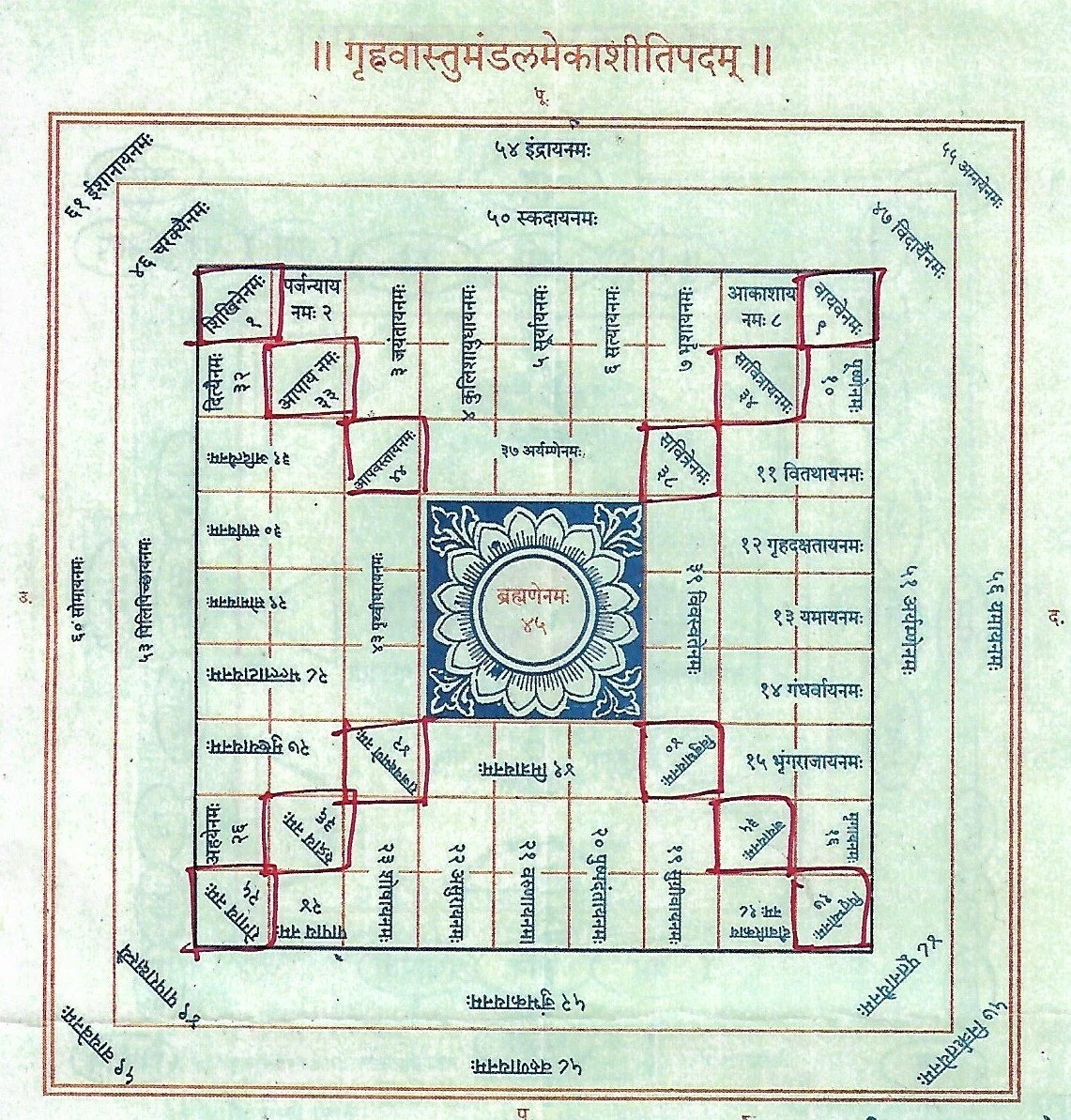
This alignment is most clearly expressed through the Vāstu Puruṣa Maṇḍala, a geometric blueprint that underlyes Hindu temple design. The mandala is both a cosmological diagram and a map of consciousness, taking the form of a geometric grid divided into sixty-four or eighty-one smaller squares, organised around a center. The central square, the Brahma Pada, represents the source of creation: pure, undifferentiated consciousness. The temple’s innermost sanctum, the garbhagṛha, is placed precisely here.
Surrounding this center, the remaining squares are assigned to various deities and cosmic forces, arranged so that energy symbolically flows inward. As we move through the structure, this can be felt tangibly and observed. Complexity of design and adornment gradually gives way to simplicity and a sense of unity. The devotee is a necessary participant in the architecture, moving towards the divine and returning to the source of all.
The geometric language of the temple is built upon two fundamental forms: the square and the circle. The square represents stability, order, and the material world, its corners corresponding to the cardinal directions and the grounded nature of human experience. As such, the square dominates the temple’s plan.
The circle, by contrast, symbolizes infinity, wholeness, and the cosmic order. It represents time, cycles, and the divine. Although temples are rarely circular in structure, their conceptual design often begins with a circle that is “squared.” The boundless reality of Brahman can take form within the finite world without being diminished.
“Unity within diversity, order within complexity, and the presence of the infinite within the finite.”
The system of measurement contributes further to this symbolic system. Hindu temple architecture employs precise units such as the aṅgula and the tāla, as dimensions follow harmonious ratios rather than arbitrary scale. These proportions resonate with cosmic order, much like musical intervals produce harmony through mathematical relationships. Space, like sound, becomes a medium through which balance and coherence are experienced.
We see this attention to proportion most clearly in the temple’s vertical dimension. The rising tower above the sanctum is designed to appear as an organic ascent and evoke the soul’s movement from the earthly realm toward higher planes of existence.
At the base of this ascent lies the garbhagṛha, the inner sanctum and “womb chamber” of the temple. Small, dark, and deliberately austere, it is a perfect square or cube, symbolizing completeness and stability. The absence of natural light and lack of ornamentation draws attention inward, towards our consciousness. As we approach the sanctum, we leave behind the sensory richness of the outer halls and enter a space of stillness and potential, with the architecture mirroring the meditative journey.
Vertical symbolism of the temple extends beyond the tower. Hindu temples are often conceived as representations of Mount Meru, the mythological axis of the universe. The temple’s central vertical line, sometimes called the brahma sūtra, aligns earth and sky, creating a conduit for cosmic energy. At the summit, the kalaśa finial signifies abundance, immortality, and the union of the earthly and the divine.
Most Hindu temples face east, greeting the rising sun as a symbol of knowledge, life, and awakening. In many temples, architectural alignment allows sunlight to illuminate the deity at specific times of the year, linking ritual practice to astronomical cycles. The temple, then, functions not only as a sacred enclosure, but as a calendar and observatory that synchronizes human worship with celestial movement.
Ultimately, the purpose of Hindu temple geometry, as with sacred geometry across cultures, is not about mathematical precision for its own sake. Instead, it functions as a symbolic language, communicating philosophical truths that words alone cannot convey: unity within diversity, order within complexity, and the presence of the infinite within the finite. The temple becomes a mirror and a participant of the universe
Hindu temple’s architecture reveal a worldview in which art, science, and spirituality are inseparable. These structures are designed not only to house deities or inspire awe, but to guide consciousness toward harmony with cosmic order. To walk through a Hindu temple is to traverse a cosmic diagram, moving from the outer world of form and multiplicity toward the silent center of being. The building becomes our teacher.
Trisha Singh is an architect and writer.
Film
<div style="padding:75% 0 0 0;position:relative;"><iframe src="https://player.vimeo.com/video/1149086277?badge=0&autopause=0&player_id=0&app_id=58479" frameborder="0" allow="autoplay; fullscreen; picture-in-picture; clipboard-write; encrypted-media; web-share" referrerpolicy="strict-origin-when-cross-origin" style="position:absolute;top:0;left:0;width:100%;height:100%;" title="Personal Legacies- Materiality and Abstraction clip 16"></iframe></div><script src="https://player.vimeo.com/api/player.js"></script>

Iggy Pop Playlist
Iggy Confidential
Archival - March 23, 2025
Iggy Pop is an American singer, songwriter, musician, record producer, and actor. Since forming The Stooges in 1967, Iggy’s career has spanned decades and genres. Having paved the way for ‘70’s punk and ‘90’s grunge, he is often considered “The Godfather of Punk.”
Film
<div style="padding:56.25% 0 0 0;position:relative;"><iframe src="https://player.vimeo.com/video/1149085400?badge=0&autopause=0&player_id=0&app_id=58479" frameborder="0" allow="autoplay; fullscreen; picture-in-picture; clipboard-write; encrypted-media; web-share" referrerpolicy="strict-origin-when-cross-origin" style="position:absolute;top:0;left:0;width:100%;height:100%;" title="Acting Shakespeare - Using the Verse clip 4"></iframe></div><script src="https://player.vimeo.com/api/player.js"></script>
7 Army - The I Ching
Chris Gabriel December 20, 2025
The Army is pure if it is led by a wise man…
Chris Gabriel December 20, 2025
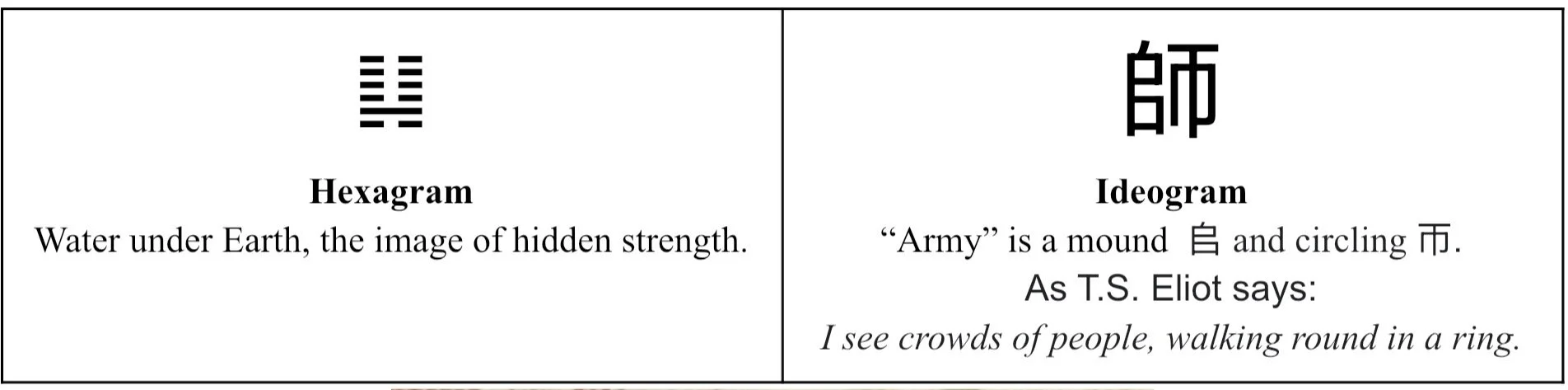
Judgment
The Army is pure if it’s led by a wise man.
Lines
1
The Army goes with discipline.
2
In the middle is the commander with three orders from the King.
3
Sometimes the Army leaves wagons full of corpses.
4
Then the Army rests.
5
Fields full of birds. Catch them. An older boy leads the army. A younger boy is dead.
6
A great one gives orders, opening the country and accepting families. Small ones can’t do this.
Qabalah
Malkuth to Yesod: The Path of Tau. The Universe. Malkuth envelopes the energy of Yesod. The Earth to the Moon.
In this hexagram, we see the image of earth over water. It is something simple atop something dangerous, so in this way we are given the image of the Army. Consider revolutions in which simple folk become warriors. Naturally, this hexagram depicts an aquifer, or an underwater reservoir - a great resource hidden underground.
A clear natural example that intertwines the Army with the underground is an Ant colony and an anthill is not so different from a military bunker.
The lines give us a very stark look at war.
1
An army is worse than useless if it is undisciplined. Yet again, the Ant provides the ideal of the military, absolute devotion and a singular purpose.
2
An army won’t get much done without orders from above.
3
Even when the military functions properly, many people die for the sake of some greater goal.
4
After atrocities and horror, soldiers must rest and recuperate.
5
This is the most significant line in the hexagram. We should not mistake the realistic view of the military here with a denouncement of war - this line clearly advocates for the military acquisition of resources. War comes with the ultimate cost - teenagers leading men in battle against fellow teenagers, and few coming out alive.
6
After war, the land a state has taken is put to use and inhabited.
Another military development through which this hexagram can be understood is camouflage. Camouflage allows something that looks simple to hide something dangerous. Consider the deceptive fulfillment of prophecy by Malcom in Macbeth:
Let every soldier hew him down a bough
And bear ’t before him. Thereby shall we shadow
The numbers of our host and make discovery
Err in report of us.
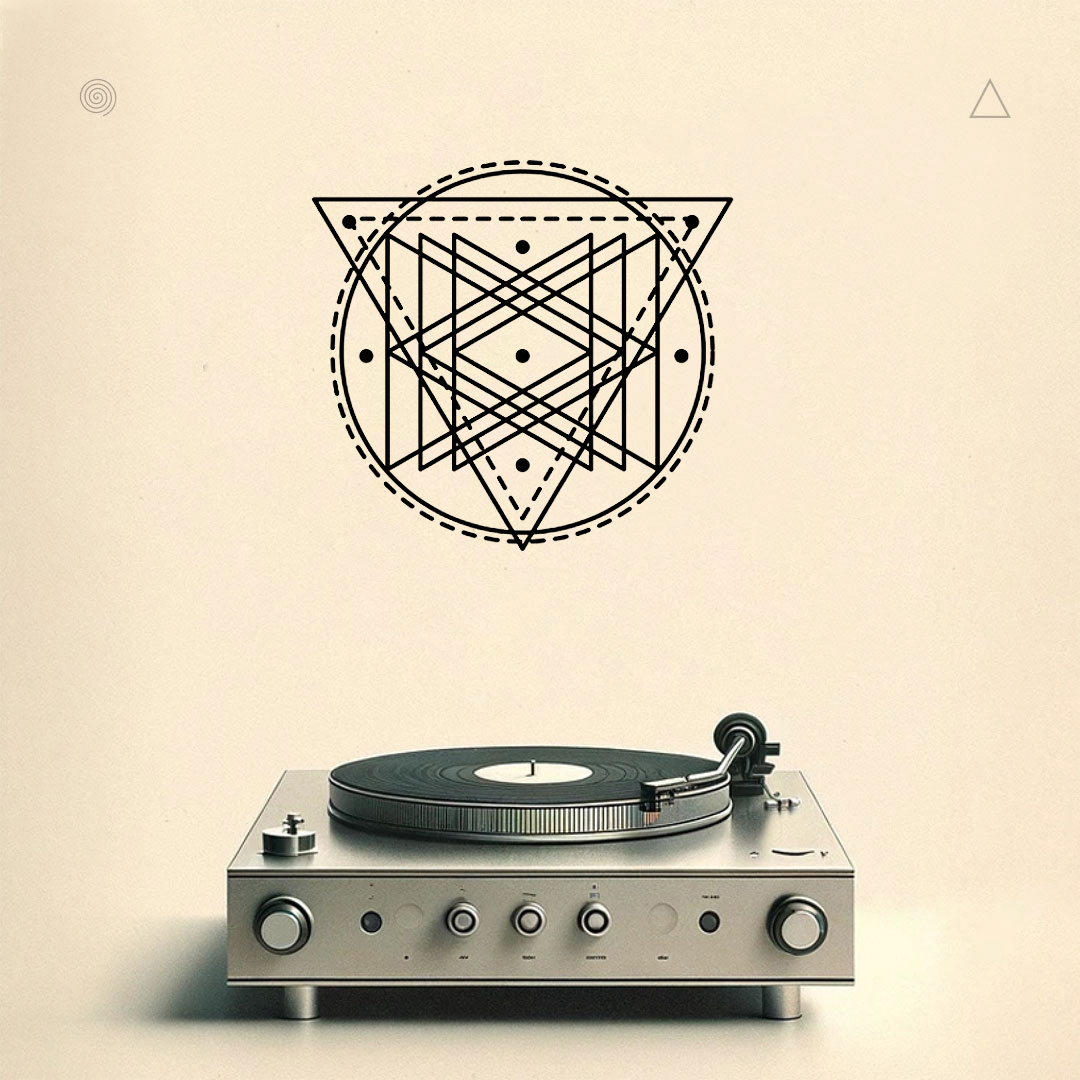
Hannah Peel Playlist
Archival - December 14, 2025
Mercury Prize, Ivor Novello and Emmy-nominated, RTS and Music Producers Guild winning composer, with a flow of solo albums and collaborative releases, Hannah Peel joins the dots between science, nature and the creative arts, through her explorative approach to electronic, classical and traditional music.
Drunvalo Melchizedek's Unity Breath Meditation
Molly Hankins December 18, 2025
The Unity Breath Meditation moves our consciousness in preparation to receive the new information in his book and the higher dimensional frequencies pouring into Earth at this time…
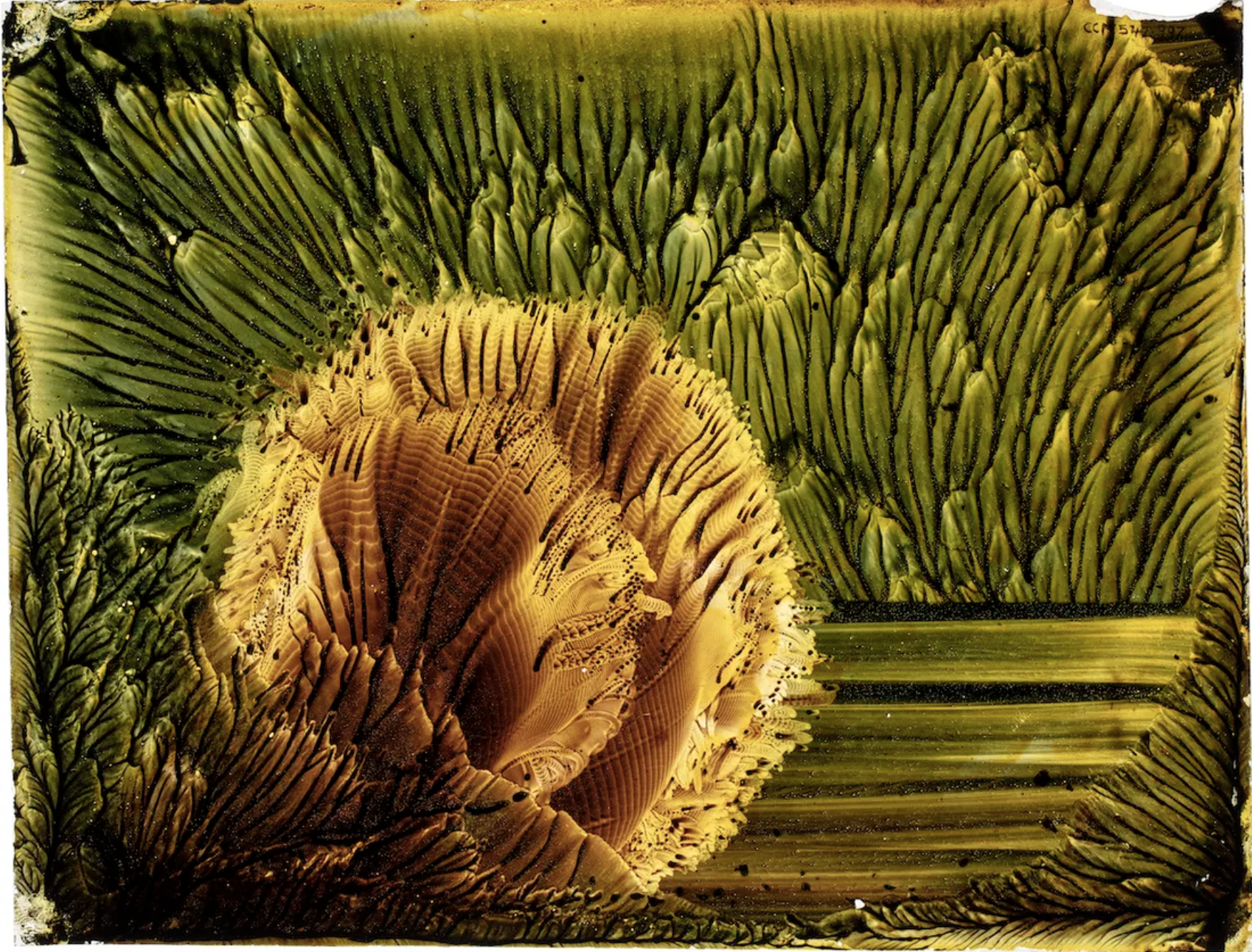
‘Impression Figure’ of recorded sound by Margaret Watts Hughes, Late 1800s.
Molly Hankins December 18, 2025
Ancient Secrets of the Flower of Life author and spiritual teacher Drunvalo Melchizedek began speaking publicly again this year after suffering a stroke, and has announced the completion of his next book due out in 2026. Parts 1 and 2 of Ancient Secrets of the Flower of Life were first published in 1999, and as we wait for the third installation to be released, Drunvalo has been discussing how to prepare for the quantum leap in consciousness we are going through right now as a planet. Many of his teachings discuss moving the seat of our conscious minds from our brain into our hearts. Best articulated in his 2003 book Living In The Heart, he recommends using what he calls the Unity Breath Meditation to move our consciousness in preparation to receive the new information in his book and the higher dimensional frequencies pouring into Earth at this time.
The Unity Breath Meditation was channeled by Drunvalo from the deceased Indian monk and yogi Sri Yuketeswar. “He told me that in India no one would even consider approaching the divine without a certain state of mind and heart,” Drunvalo explained. “And he gave me very specific instructions on exactly how to consciously connect with God.” By connecting emotionally with these ideas, we expand our connection with nature and Source Energy. This expanded channel allows us to cross the threshold into more subtle realms of consciousness, download new states of awareness and embody the integration of those new states.
To begin the meditation, close your eyes and imagine a beautiful, natural setting - including little details like feeling the breeze on your face. “Mother Earth cares about every person on this Earth, she actually knows your name,” Drunvalo says. Connect emotionally to her divine feminine love for you in the meditation, then send that gratitude as a beam of energy down the base of your spine and into the earth’s core. Wait for her to return the energy before moving to the next step. “Trust her, because she can feel when you’re ready,” he says in reference to what kind of energy Mother Earth sends back. Drunvalo believes that it’s dangerous to expand our consciousness too quickly, and that Earth can help us modulate and ground that expansion. It is the emotional connection to the soul of our planet that allows us access to these energies.
Next connect to Father Sky, allowing gratitude to swell for divine masculine energy, and send a beam of energy up into the cosmos or straight to our Sun. Sri Yukteswar specifically recommends placing your energy into a small sphere of light that moves intentionally along the beam, telling us this will activate the unity consciousness grid around the Earth. When Rupert Sheldrake explains the Morphogenetic field of interconnected, living information systems organizing consciousness, he may very well be describing the exact same concept.
Keep breathing as you wait for Father Sky to return the energy, and once received, begin breathing it into your heart along with the energy from Mother Earth. Allow both beams of energy to meet in your heart. Then move your consciousness down into your heart. As you breathe into this space, be aware that the divine is alive there. Source consciousness is expressed through your being, and it loves being you. Now we are in conscious co-creation with that energy, breathe into gratitude for the opportunity to co-create reality. You may find engaging in this meditation increases the intuitive messages from both the natural world and higher consciousness. There is a tiny, sacred place inside your heart - use your imagination to find it.
“Whichever way feels right, is the right way for you. Once you’re in your heart, find the sacred space.”
According to Drunvalo, performing the Unity Breath Meditation and visualization allows us to access the subtle realms of expanded awareness, aligning our frequencies. “I believe that the Unity Breath creates the vibration within you that allows you to find the holy grail, the sacred space of the heart, the place where God originally created all there is. It is so simple. What you have always been looking for is right inside your own heart,” Drunvalo writes in Living In The Heart.
As a precursor to getting into our hearts, Druvalo tells us we must get into our bodies, imagining a pranic tube that runs from just above our heads and through our root chakras into the Earth. Prana is like chi - an energetic life force that can be built, harnessed and channeled into anything. That energy moves along the pranic tube that runs through our spinal column and connects our physical bodies to our souls while we’re alive in human form.
There are distinct masculine and feminine ways of getting into the heart. The masculine way requires you to imagine a toroidal field around your body, moving your consciousness through the field in either direction and into the heart. The feminine way is not prescriptive, we just imagine ourselves to be in the heart and we are there. Whichever way feels right, is the right way for you. Once you’re in your heart, find the sacred space. Drunvalo explained, “The sacred space of the heart is older than creation itself. Before there were galaxies to live within, there was space. All the spaces you have traveled within this creation you have recorded within this space. So at first you might begin to remember what this is all about, what life is all about.” Bring anything you wish to manifest into this sacred place and give it love to accelerate fruition.
What expanded awareness looks like is unique to each of us, but the conscious exchange of higher dimensional energy between Earthly and galactic intelligence that happens during the Unity Breath tends to feel quite enjoyable. Once the channel is opened, stay open to intuitive messages from nature and beyond. Drunvalo also recommends inviting someone you deeply love, living or dead, to be with you in that sacred place within the heart, and to amplify that love into your energy field and the collective. “Now you know your way home,” he writes. “Within the sacred space of the heart, all worlds, all dimensions, all universes, and all of creation found their birth. Interconnecting through your one heart are all the hearts of all life everywhere!” We strengthen this network of hearts making up the unity consciousness grid by meditating on the people we love, then pouring that love into daily living.
Molly Hankins is an Initiate + Reality Hacker serving the Ministry of Quantum Existentialism and Builders of the Adytum.
Mike Cessario
1h 16m
12.17.25
In this clip, Rick speaks with Mike Cessario about food marketing and his new approach to it.
<iframe width="100%" height="265" src="https://clyp.it/qbn40tn0/widget?token=59acc50c9fe7db367efa4c0bab5eace6" frameborder="0"></iframe>
Film
<div style="padding:56.25% 0 0 0;position:relative;"><iframe src="https://player.vimeo.com/video/1147126764?badge=0&autopause=0&player_id=0&app_id=58479" frameborder="0" allow="autoplay; fullscreen; picture-in-picture; clipboard-write; encrypted-media; web-share" referrerpolicy="strict-origin-when-cross-origin" style="position:absolute;top:0;left:0;width:100%;height:100%;" title="Carlo Rovelli on The Order of Time clip 9"></iframe></div><script src="https://player.vimeo.com/api/player.js"></script>
Wounds
Sofia Luna December 16, 2025
For most of human existence, our wounds signified that we were part of the natural world…

Robert White, Compleat Discourse of Wounds (1678).
Sofia Luna December 16, 2025
For most of human existence, our wounds signified that we were part of the natural world. They wrote the story of life without separation as we not only blended into, but were an active part of the ecosystem. Last week, noticing a boy having breakfast with his mother rocking a severely bruised eye, it felt like a novelty. In a modern, western world, physical wounds and battle scars have all but disappeared from everyday reality. What, I wondered, are the global repercussions of the sterilisation of our physical plane?
We no longer walk through irregular terrains filled with natural pigments, or scramble over cliffs with battered bodies. We construct buildings to keep nature out and monuments to hold our ambitions together. We walk with slicked back hair, and polished suits through angular concrete landscapes. We refine and decorate our avatars, surgically 'enhance' our geometries, and homogenise the surface of our lives and our bodies the same way we do to our walls. We call this progress. Beneath our skin, though, lies irregularity—festering deep, invisible wounds, not of flesh but of spirit.
In the gradual fabrication of the modern metropolis, we transferred our bodily wounds to earth. To her soil, her small ferns, to past predators, waters, rivers, and birds—not realising that they too, give us life. We looked away from the damage caused as we dreamt of a human centric world, building structures to keep dangers out. And they did but the fact that wounds incrementally disappeared from the visual field made it really difficult for us to track what was hazardous to our new existence.
As our infrastructures mutated, so did our wounds, but our definitions of danger stayed the same. Only in cases of mass destruction or abuse in focused areas are we able to look from afar and say “yes, there is a problem we need to work on!”.That which invisibly infects the collective beyond time and space is really hard to put a finger on, and so is difficult to heal. Consequently, moving from tiger scratches 20,000 years ago to inexplicable spirit aches have left us living "in a space without a map," as Joanna Macy remarked.
Few of us could survive in a forest right now, but we need not be that adventurous—a lot of humans can't even deal with free time at home. We require constant stimulation, and have become completely averse to the uncharted. We follow paths that have been clearly traced before in fear of getting lost. Is this a place worth existing in? A lot of people have started to realise it is not and I have witnessed the ample collective inkling that we should recalculate our relationship with the world and ourselves.
“Wounds are holes, holes are doors, doors into something, openings, where, if we choose to enter them, the person that walks out is not the same who walked in.”
We have been so isolated from nature that we don't even consider its absence as one of the causes for global unsettlement or the sharp rises in anxiety, loneliness, depression and spiritual voids that so many of us experience. Isn't she Mother Earth? We are the child that has cut their parent off and have been left traumatised.
We talk about rewilding gardens but it is time to talk about rewilding society. We are hungry for something that was taken from us. When certain religions first appeared, they replaced our connection to the wild with a relationship to something more abstract. Slowly we have been extracted out of the symbiotic relationship we had with our planet, as institutions of belief arranged themselves on top of everything and everyone as the source. Religion replaced nature. It reasoned with the invisible and colonised our imagination for the past millennia. Thank God, time, and the increasing access to information, that what was hiding underneath—the incoherence, the imposed patriarchy, intolerance, and the general abuse of power that was then mimicked by corporations— was exposed. Today, younger generations are unsubscribing from this expired belief system and in that process have started seeking something else. Many of us are returning back to nature, to our nature.

Caravaggio, The Incredulity of Saint Thomas (1602)
Hosting Shinrin-Yoku experiences (the science backed Japanese practice of Forest Bathing, known to balance the body and mind) one quickly sees how fulfilling, cleansing, healing, energising, and surprisingly simple the practice feels when all you do is walk through a forest, fully present, without the intrusion of technology. This evidence shows how much nature feels like home—how nurturing she is, how much our bodies need her, and yet, how absent she is in modern cities.
I have found that the more I heal my insides, the closer I feel to the natural world, the more natural it feels to live in this world, and the more I unearth my own self and the old memories of the soul. Wounds are holes, holes are doors, doors into something, openings, where, if we choose to enter them, the person that walks out is not the same who walked in. Unhealed wounds propagate, the same way good energy creates more good energy and healed wounds attract healed people. There is no need to try and save the entire world, because the entire world is simply the one You inhabit—you choose what to do with it.
I write this to speak into reality a transformation, I believe, is happening to many. We are interconnected, and in this floating rock, no one experiences anything alone, the Human Experience is shared. Regardless of the 'never-ending horrors', we are on our way back to nature. And Nature is not just a tree, a fish and a squirrel. Nature is you, in essence. Nature is beauty, it is The Grand, it is Vast. It is Vital, it is Infinite, it is Eternally Alive. It is Robust, Real, Complex. It is Us. It is also everything we are not right now, and everything we are becoming.
Sofia Luna explores and builds tools that facilitate this time's modern cognitive shift. She is a Colombian artist, creative consultant, entrepreneur and imaginator living In The Middle of The Future.
Film
<div style="padding:72.58% 0 0 0;position:relative;"><iframe src="https://player.vimeo.com/video/1147131629?badge=0&autopause=0&player_id=0&app_id=58479" frameborder="0" allow="autoplay; fullscreen; picture-in-picture; clipboard-write; encrypted-media; web-share" referrerpolicy="strict-origin-when-cross-origin" style="position:absolute;top:0;left:0;width:100%;height:100%;" title="Othello clip 2"></iframe></div><script src="https://player.vimeo.com/api/player.js"></script>
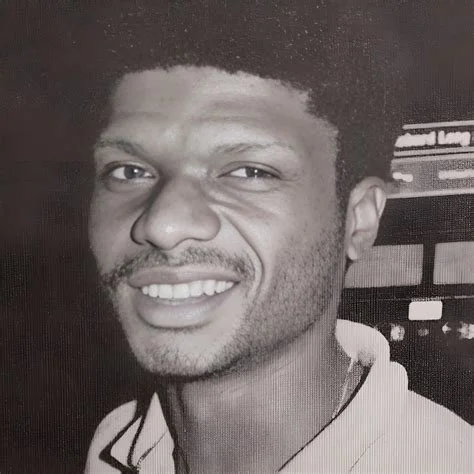
Larry Levan Playlist
Archival 1967-1987
Larry Levan was an influential American DJ who defined what modern dance clubs are today. He is most widely renowned for his long-time residency at Paradise Garage, also known as “Gay-Rage”, a former nightclub at 84 King Street in Manhattan, NY.
Film
<div style="padding:55.83% 0 0 0;position:relative;"><iframe src="https://player.vimeo.com/video/1146275986?badge=0&autopause=0&player_id=0&app_id=58479" frameborder="0" allow="autoplay; fullscreen; picture-in-picture; clipboard-write; encrypted-media; web-share" referrerpolicy="strict-origin-when-cross-origin" style="position:absolute;top:0;left:0;width:100%;height:100%;" title="The Valley of Gwangi clip 2"></iframe></div><script src="https://player.vimeo.com/api/player.js"></script>
6 Divorce - The I Ching
Chris Gabriel December 13, 2025
Fight, but not to the bitter end…
Chris Gabriel December 13, 2025
Judgment
Fight, but not to the bitter end.
Lines
1
Don’t draw it out, there will be rumours.
2
Unable to fight, he goes back to his small town.
3
Live off your old deeds. Working for the king brings nothing.
4
Unable to fight, go back to yourself. Be calm.
5
Fight, and fortune follows.
6
Sometimes you are given a ribbon, and by morning you’ve been stripped of it three times.
Qabalah
Imperfectly, Kether to Yesod, or Gimel ג directly. The High Priestess.
Kether only makes contact with Tiphereth below, not Yesod. The path between them is the lunar Gimel.
Heaven to the Moon.
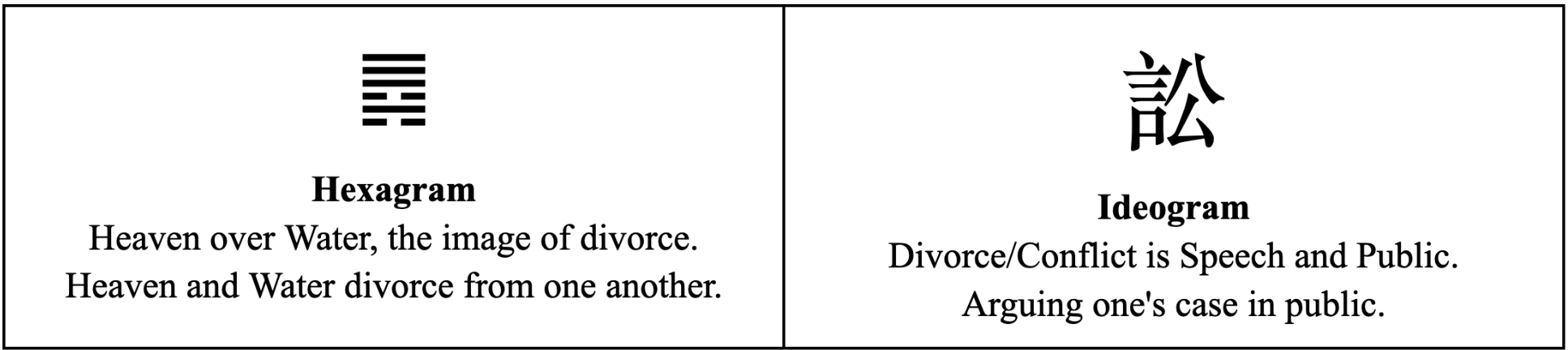
The rain we had been waiting for comes down, and when it rains, it pours. This storm can lead to relief, but in the moment it can be exceedingly troublesome and unpleasant. The ideogram shows public dispute: the airing out of dirty laundry. Often called conflict, strife, or contention, the clearest title is divorce. We are dealing with separation, the splitting of water from the sky as they go their separate ways. Divorce is very difficult but the hope is that it will eventually calm and peace. This is not necessarily about splitting a marriage, but all splits: arguments, breakups, and lawsuits.
1
Just as the judgment says, it is best to get things done quickly or to give it up when the time is right. Consider very public, very ugly divorce procedures and court cases, they invite gossip and bad attention.
2
This is like a classic “divorced dad” joke, where after divorcing he moves back to his home town and lives in a little apartment. In this case, this is the right action to take!
3
When new work doesn’t come, we have to live off our old work.Consider this as dipping into personal savings when you’re in trouble.
4
We often see people who are divorced “become themselves” again; they pick up old hobbies, or spend time with old friends.
5
Fight when the time is right and you’ll have victory.
6
Even when there are apparent victories, especially with divorces involving children, they are often appealed, reversed, and continually fought over.
In the previous hexagram, we eagerly awaited what comes down here. It was the calm before the storm. As a religious person may yearn for the horrors of an Apocalypse, with hope that something greater is on the other side of trials, we must have faith that we will get through the troubles that come our way.
George Harrison puts it perfectly:
A cloudburst doesn't last all day
Seems my love is up and has left you with no warning
It's not always gonna be this gray
All things must pass
His wisdom echoes chapter 23 of the Tao Te Ching:
A Terrible wind won’t last all morning
A Terrible storm won’t last all day
Who causes these?
Heaven and Earth.
Heaven and Earth can’t make something last
Why could Man?
As humans, we cannot keep our relationships and friendships forever - all things must pass. When it’s time to part ways with someone, don’t make it ugly.
Film
<div style="padding:73.33% 0 0 0;position:relative;"><iframe src="https://player.vimeo.com/video/1146275114?badge=0&autopause=0&player_id=0&app_id=58479" frameborder="0" allow="autoplay; fullscreen; picture-in-picture; clipboard-write; encrypted-media; web-share" referrerpolicy="strict-origin-when-cross-origin" style="position:absolute;top:0;left:0;width:100%;height:100%;" title="Citizen Kane clip 2"></iframe></div><script src="https://player.vimeo.com/api/player.js"></script>
Mediating Planetary Co-Existence
Tuukka Toivonen December 11, 2025
Heather Barnett, an artist who works with slime mold, recently told me she viewed herself not simply as a practitioner of art but as a mediator. Through years of collaborative experimentation she had found herself, without intending to, acting as an intermediary between two mutually foreign forms of intelligence — slime molds and human beings…

Yggdrasill, The Mundane Tree. From a plate of the Prose Edda, Oluf Olufsen Bagge. 1847.
Tuukka Toivonen December 11, 2025
Heather Barnett, an artist who works with slime mold, recently told me she viewed herself not simply as a practitioner of art but as a mediator. Through years of collaborative experimentation she had found herself, without intending to, acting as an intermediary between two mutually foreign forms of intelligence — slime molds and human beings. Curating the often astonishingly clever behaviors of these oatmeal-loving, network-making slime molds for human audiences, she uncovered new synergies and creative connections. In live performances, she invited audiences to mimic the physical movements of such ‘lesser beings’, resulting in surprising patterns of group behavior. This workconjured up a kind of interspecies awareness and relationship in Heather, and those who saw it, where none had previously existed. Another experienced artist I spoke to, Julia Lochmann, expressed a similar ethos of intermediation — in this case, one focused on seaweed-human relations. Both practitioners had set up collectives for like-minded slime mould and seaweed enthusiasts that brought artists together with scientists, students, designers and even entrepreneurs. These conversations prompted me to reflect further on the significance of those who mediate immersively between different organisms or environments. Could their experimental, connective engagements open up new possibilities for a deeper planetary co-existence? And what could those of us with less experience in this area learn from seasoned intermediators?
At a basic level, to mediate is to form a link between two previously disconnected or estranged entities. By occupying an intermediary position, one takes on the task of facilitating an agreement or reconciliation of some kind, and fostering mutually beneficial forms of co-existence. Mediators of various kinds abound in our daily lives; people who introduce us to opportunities and ideas we did not know about or familiarize us with technologies we knew not how to operate. Those who teach us novel languages mediate a new relationship between us and other cultures. With a little help from such fluent speakers and cultural mediators, it becomes far easier to pick up the meanings, structures and nuances — even the perceptual and aesthetic inclinations — of new languages and cultures. What once seemed indecipherable becomes more and more intelligible, accessible and rich in meaning. We gradually enter a shared world. and then, for a moment, we feel awed by the uplifting resonance — a sense of synchrony, agreement or correspondence — that we discover between ourselves and an aspect of the world that used to be alien to us.
“We have long positioned humans as the only ‘intelligent’ species while denying the cognitive abilities, agency and aliveness of every other life-form. We now possess the opportunity to change course…”
In their revelatory book on the search for planetary intelligence, one that involves animals, plants, and machines, the author James Bridle dedicates a chapter to exploring how plants perceive the world and what scope might exist for us to relate to them at a sensorial and existential level. Bridle recounts an experiment by two biologists from the University of Missouri during which a recording was made of the sound of cabbage white caterpillars feeding on a cress plant (Arabidopsis thaliana). The scientists subsequently removed the caterpillars, playing back only their sounds to the cress plant, which caused the plant to switch on its chemical defenses for deterring predators, despite their absence. Having ensured this reaction arose exclusively in response to the specific sound of caterpillars, there was only one conclusion to be drawn: the cress plant could hear. Bridle reads this and other eye-opening experiments on ‘plant sensing’ as suggestive of
multiple distinctive worlds and as expressions of common ways of being and perceiving that cross species lines:
‘We share a world. We hear, plants hear; we all hear together. We all feel the same sun, breathe the same air, drink the same water. Whether we hear the same sounds in the same way, whether they are meaningful to us in the same way, is beside the point. We exist, together, in the shared experience and creation of the more-than human world’ (Bridle 2023: 69-70).¹

Atlas des Champignons, M. E. Descourtilz. 1827.
Bridle’s work engages in acts of mediation that takes notable interspecies experiments and discoveries, and translates them into relational transformations. It reveals how profoundly illusionary our prior assumptions of a disconnected existence have been, and how false the idea that plants, animals, fungi and ourselves inhabit essentially separate worlds is. By submitting to a vacuous kind of objectivity, Bridle shows we have tried to make the world conform to our man made, fixed conceptualizations, and in doing so have limited the full use of our own perceptual capabilities. We have long positioned humans as the only ‘intelligent’ species while denying the cognitive abilities, agency and aliveness of every other life-form. We now possess the opportunity to change course, and to whole-heartedly cohabit the shared world Bridle so animatedly writes about. We can do this through updating our mental constructs and discovering new resonances between ourselves and the living world. Much like the feelings of connection we gain when learning a new language, might we feel a similar (or perhaps an even greater) sense of enchantment and resonance as we regain the ability to participate fully in the more-than human world — a world where intelligence is present everywhere?
I suspect that mediators — whether nominally classified as artists, writers, scientists, naturalists or entrepreneurs — matter precisely because they have the power to help us see such novel possibilities for planetary co-existence. They awaken us to ways of being, to a new type of sensing and relating that we have struggled to notice or thought could not be accessed within the confines of contemporary society. And not only that: they often perform intermediation work not only in theory but in practice, experimentally and at scale. Such practical work can range from the curation of intimate group experiences within local forest ecologies to masterfully finding correspondences and agreements between the seemingly incompatible tendencies of financial interests and living systems.
It strikes me that today’s mediators may have something fundamental in common with the healers and shamans whom the ecological philosopher David Abram encountered in Nepal and Indonesia at the end of the last millennium. Focused on maintaining harmonious and mutually nourishing relations between human settlements and the wider ecologies they were part of, these traditional practitioners of magic and medicine could ‘slip out of the perceptual boundaries that demarcate his or her particular culture’ while exhibiting a ‘heightened receptivity to the meaningful solicitations—songs, cries, gestures —of the larger, more-than-human field’ (Abram 1996:9).² There is a certain perceptual kinship between these traditional practitioners and the contemporary mediators I have discussed, one found in a shared style of viscerally inhabiting and bridging multiple worlds. It is remarkable that for the traditional shamans and magicians Abram observed, their role as human-nonhuman intermediaries appeared to be their primary function, while healing activities were of only secondary importance.
Surely the kinds of mediators — whatever their formal identities — who can radically shrink the distance between us and myriad other life forms that constitute this planet have a far more important role to play than we have hitherto realized. And surely it will be through myriad acts of intermediation, whether initiated by seasoned practitioners or ourselves, that we will find it easier to once again experience the more-than-human world as intelligible, rich in meaning, even wondrous — and, perhaps most importantly, as truly shared.
Tuukka Toivonen, Ph.D. (Oxon.) is a sociologist interested in ways of being, relating and creating that can help us to reconnect with – and regenerate – the living world. Alongside his academic research, Tuukka works directly with emerging regenerative designers and startups in the creative, material innovation and technology sectors.
¹ Bridle, James. 2023. Ways of being: Animals, plants, machines: the search for a planetary 1 intelligence. London: Penguin Books.
² Abram, D. 1996. The spell of the sensuous: Perception and language in a more-than-human 2 world. New York: Pantheon books.
Film
<div style="padding:56.25% 0 0 0;position:relative;"><iframe src="https://player.vimeo.com/video/1146273077?badge=0&autopause=0&player_id=0&app_id=58479" frameborder="0" allow="autoplay; fullscreen; picture-in-picture; clipboard-write; encrypted-media; web-share" referrerpolicy="strict-origin-when-cross-origin" style="position:absolute;top:0;left:0;width:100%;height:100%;" title="Yosemite Valley 1924 clip 2"></iframe></div><script src="https://player.vimeo.com/api/player.js"></script>