
AI, Bauhaus and the Case for Philosophical R&D
Molly Hankins January 13, 2026
As we begin our co-evolution with AI, questions are being raised from all sectors about the existential implications of this technological quantum leap.
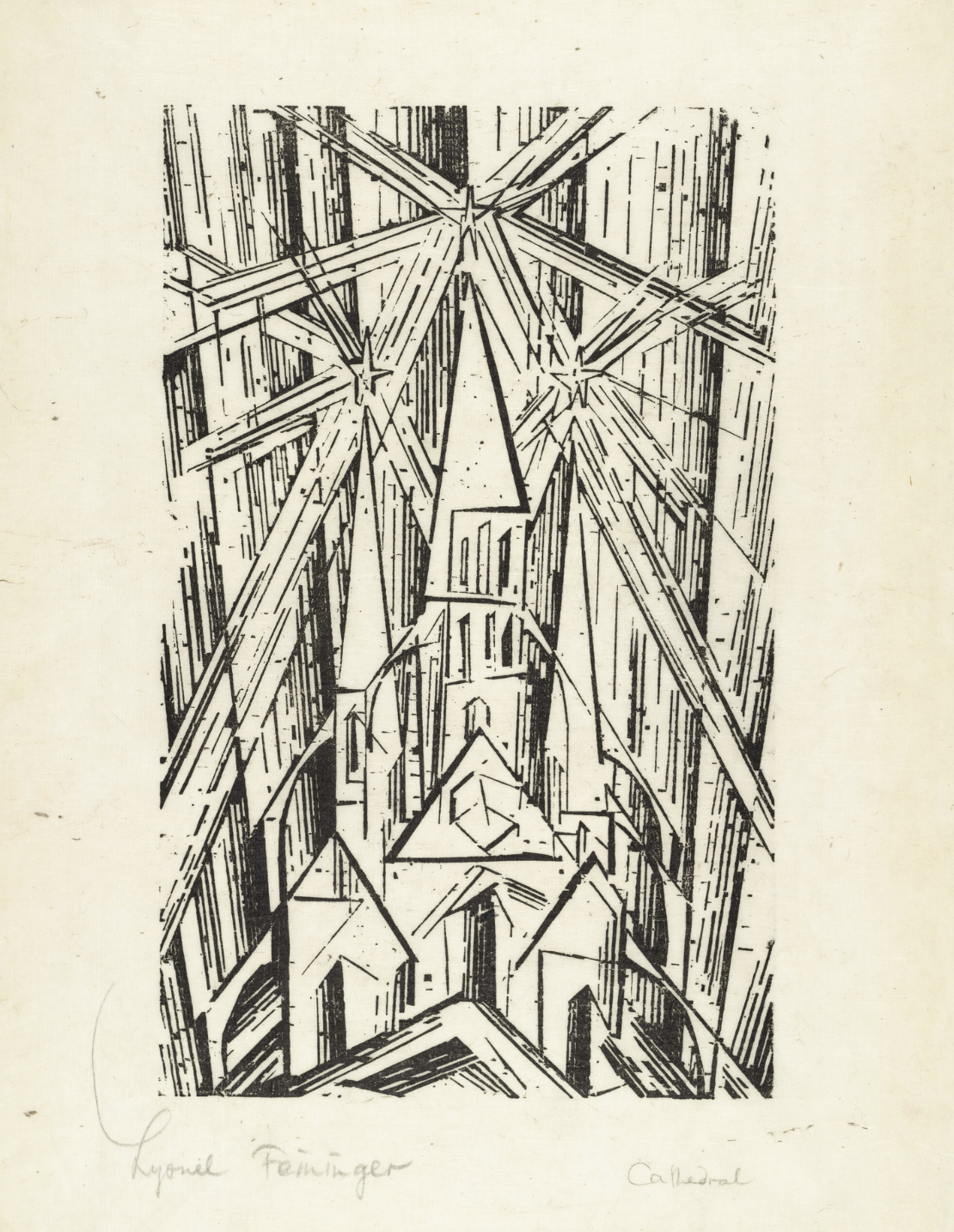
Cathedral (Kathedrale), Lyonel Feininger. 1919. Used as the cover for the Bauhaus Manifesto.
Molly Hankins January 13, 2026
As we begin our co-evolution with AI, questions are being raised from all sectors about the existential implications of this technological quantum leap. According to philosopher Tobias Rees, investment in philosophical AI R&D, and using the ideas generated to further long-term thinking when it comes to responsibleAI engagement practices, is absolutely essential. He believes the true danger of AI is the conceptual lag of humans more than the rapid progression of the tech. “I am adamant that those who build AI understand the philosophical stakes of AI,” Tobias said in an interview with Noema Magazine. “AI defies many of the most fundamental, most taken-for-granted concepts — or philosophies — that have defined the modern period and that most humans still mostly live by.” This millennium, technology has been evolving faster than our ability to learn how to responsibly use it, but the stakes have become much higher with the emergence of general intelligence.
Rees is not worried about AI being smarter than humans but he does believe it’s critical to study how to use it in complement with our human intelligence. “For example, AI has much more information available than we do and it can access and work through this information faster than we can. It also can discover logical structures in data —patterns — where we see nothing. Perhaps one must pause for a moment to recognize how extraordinary this is. AI can literally give us access to spaces that we, on our own, qua human, cannot discover and cannot access. How amazing is this?” Rees asks. The dimensions of life that open up by learning how to work with increasingly sophisticated AI are barely conceivable at this stage in our co-evolution, but awfully exciting to consider.
For instance, what would happen if we used AI to generate data about ourselves, in order to understand our patterns and how we can work on our personal development goals? Rees asks us to, "Imagine an on-device AI system — an AI model that exists only on your devices and is not connected to the internet — that has access to all your data. Your emails, your messages, your documents, your voice memos, your photos, your songs, etc. I stress on-device because it matters that no third parties have access to your data. Such an AI system can make me visible to myself in ways neither I nor any other human can. It literally can lift me above me. It can show me myself from outside of myself, show me the patterns of thoughts and behaviors that have come to define me.” These insights, if taken to heart and acted upon, could offer specific means for disrupting patterns that are often operating at an unconscious level.
“Bauhaus brought artists, engineers and designers together with the mission of elevating architecture to the 20th century and beyond. Now, 25 years into the 21st century, we are well into the most prolific technological advancement in human history, and most of us don’t even know what questions to ask about it.”
To understand why this kind of self-reflective partnership is even possible, we have to pause on what makes contemporary AI fundamentally different from earlier technology. For most of technological history, machines mirrored human logic in advance; we told them what to do and how to do it. Intelligence lived upstream in the designer’s assumptions, rules, and categories. The machine merely executed. What we are encountering now is something more strange and less predictable. “We do not give them their knowledge. We do not program them. Rather, they learn on their own, for themselves, and, based on what they have learned, they can navigate situations or answer questions they have never seen before. That is, they are no longer closed, deterministic systems. Instead they have a sort of openness and a sort of agentive behavior, a deliberation or decision-making space that no technical system before them ever had,” he explained.
Rees points to the Bauhaus School, founded in 1919 in Germany by architect Walter Gropius. He believed that the introduction of new building materials such as steel, concrete, and large-scale glass represented such a fundamental rupture to the field of architecture - which had been working with essentially the same building materials for centuries - that a multi-disciplinary educational think-tank was needed to understand how to best utilize them. Rees says, “We need philosophical R&D labs that would allow us to explore and practice AI as the experimental philosophy it is. Billions are being poured into many different aspects of AI but very little into the kind of philosophical work that can help us discover and invent new concepts — new vocabularies for being human — in the world today.” Bauhaus brought artists, engineers and designers together with the mission of elevating architecture to the 20th century and beyond. Now, 25 years into the 21st century, we are well into the most prolific technological advancement in human history, and most of us don’t even know what questions to ask about it.
AI ethics think tanks done Rees’s way, with a philosophical R&D approach and participating voices from many different disciplines, are how we prevent the future of AI from being determined solely by corporate incentives, security panic, or political agendas. If we don’t make the investment in understanding the nature of our relationship with AI, Rees predicts that people will keep trying to understand the new in terms of old paradigms, which won’t work, and we’ll get decades of turbulence as a result. Answering the question ‘how do we evolve the human concepts that will determine what AI becomes in the world?’ may spare us some of the growing pains of co-evolving with AI, particularly general artificial intelligence. Rees founded limn, a philosophical R&D lab, which has a YouTube full of elegantly simple explanations of this complex subject, and serves as an invitation to get us thinking about what’s to come with AI, and what kind of relationship we want to have with it.
Molly Hankins is an Initiate + Reality Hacker serving the Ministry of Quantum Existentialism and Builders of the Adytum.
Film
<div style="padding:75% 0 0 0;position:relative;"><iframe src="https://player.vimeo.com/video/1154446592?badge=0&autopause=0&player_id=0&app_id=58479" frameborder="0" allow="autoplay; fullscreen; picture-in-picture; clipboard-write; encrypted-media; web-share" referrerpolicy="strict-origin-when-cross-origin" style="position:absolute;top:0;left:0;width:100%;height:100%;" title="Portrait of Jennie clip 3"></iframe></div><script src="https://player.vimeo.com/api/player.js"></script>

Iggy Pop Playlist
Iggy Confidential
Archival - April 4, 2025
Iggy Pop is an American singer, songwriter, musician, record producer, and actor. Since forming The Stooges in 1967, Iggy’s career has spanned decades and genres. Having paved the way for ‘70’s punk and ‘90’s grunge, he is often considered “The Godfather of Punk.”
10 Walking - The I Ching
Chris Gabriel January 10, 2026
Walking on a tiger's tail; it doesn’t bite…
Chris Gabriel January 10, 2026
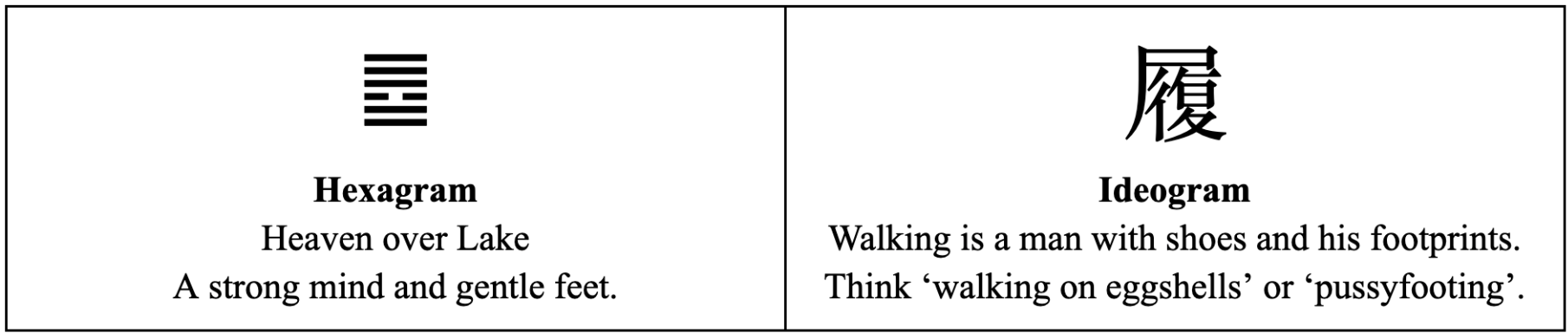
Judgment
Walking on a tiger's tail; it doesn’t bite.
Lines
1
Walking on.
2
Walking the easy way on your own.
3
A blind man can see like a lame man can walk. Walking on a tiger’s tail and being bitten.
4
Walking on a tiger’s tail with a heart full of fear.
5
Walking the line.
6
Walking and watching your step. The time comes.
Qabalah
Kether to Binah: The Path of Beth. The Magician.
The Magician walks carefully along the path.
In this hexagram we see the image of caution, and of walking carefully. At times, we are confronted with dangers too great to oppose and must tread lightly. The image is pleasant, that of a calm lake under the heavens, but here we apply it to the body: the head is strong and driven, while the feet are soft and gentle.
The ideogram deepens the image, walking and watching your steps so as not to make a sound. The lines of writing show us the dynamics that form from this situation.
The Judgment gives us the danger - a tiger - we are behind it and walk over its tail, yet it doesn’t bite. When you walk gently enough, you can avoid the claws and fangs of the beast.
1
Sometimes the best thing to do is just keep walking.
2
If your path is certain and your eyes are open, trouble rarely comes. It is in erring from the path that we tend to walk into dangerous situations. Think of how walking along a main road differs from walking in a dark alley.
3
When we are distracted or uncertain, we invite trouble. One can picture a tourist in a crowded city, their uncertainty and awkwardness is immediately apparent to thieves. Or when we are walking while texting and nearly head into traffic.
4At times, fear is the proper reaction to danger. Without fear mankind would have died out long ago. This is the gift of our fight or flight response. There is no use fighting a tiger.
5
Walking the line is walking the “straight and narrow”. Take these verses from Matthew 7:13-14:
13 Enter ye in at the strait gate: for wide is the gate, and broad is the way, that leadeth to destruction, and many there be which go in thereat:
14 Because strait is the gate, and narrow is the way, which leadeth unto life, and few there be that find it.
6
When we walk carefully through danger, we can often escape it entirely.
As this hexagram corresponds to the Magician, I think of the relation with Mercury, the God of Thieves, who shows how a thief who walks very carefully and quietly can achieve his ends. Or of the Magician himself, who carefully “walks the circle” and stays within it, lest he be torn asunder.
A more positive view of the dynamic here is that of gymnasts, skaters and mountain climbers, who do something very dangerous with astonishing grace and skill. With regard to “the straight and narrow” an acrobat can dance on a tightrope! It calls to mind a line from magician and mountaineer Aleister Crowley’s Book of Lies:
He leapt from rock to rock of the moraine without ever casting his eyes upon the ground.
Expertise is one form of magick, faith is another. The expert is beyond faith, their body and mind are attuned to the otherwise dangerous and difficult situations they find themselves in. Faith lets anyone walk without fear. Psalm 23 says it best:
Yea, though I walk through the valley of the shadow of death, I will fear no evil: for thou art with me; thy rod and thy staff they comfort me.
Therefore, let us learn what the Magician knows well: the art of walking and of faith, so no danger can assail us as we go through the world.
Numerology, Fibonacci, and Magic
Flora Knight January 8, 2026
Fibonacci sequences may not hold a prominent place in traditional magic or witchcraft, but to study them reveals the underlying principles that are deeply intertwined not just with sacred geometry and the natural spirals of the universe, but with the mystical world in it’s totality…
Albrecht Durer, Melencolia I featuring a magic numerology square. (1514)
Flora Knight January 8, 2026
Fibonacci sequences may not hold a prominent place in traditional magic or witchcraft, but their underlying principles are deeply intertwined with sacred geometry and the natural spirals of the universe. Two spiritual interpretations derived from the Fibonacci sequence are particularly noteworthy in our modern magical understandings, and particularly in the practice of Wicca: the concepts of twin flames and the number 33 sequence.

The spiral and golden rectangle of the Fibonacci sequence.
The idea of twin flames has long been embedded in magical traditions. Love, often symbolized by two flames, is a recurring theme in love spells and incantations, where lighting two candles side by side is believed to elevate love to a higher spiritual plane. This concept is represented by the number 11, a significant number in witchcraft. The Fibonacci sequence begins with 1 + 1, a numerical foundation that has been embraced by some modern Wicca sects as resonating with the essence of twin flames.
Another intriguing use of the Fibonacci sequence involves starting the sequence with the number 33. The number 3 represents the mind, body, and spirit, so 33 symbolizes the spiritual realization of these elements. When the Fibonacci sequence begins with 33, it leads to important numbers such as 3, 6, and 9, which are said to represent the ascension of the universe. Mapping these numbers on a grid also forms a pentagram, a powerful symbol in Wicca.
The 12th number in this modified Fibonacci sequence is 432, a number of profound significance in modern Wicca. The frequency of 432 Hz resonates with the universe’s golden mean, Phi, and harmonizes various aspects of existence including light, time, space, matter, gravity, magnetism, biology, DNA, and consciousness. When our atoms and DNA resonate with this natural spiral pattern, our connection to nature is enhanced.
The number 432 also appears in the ratios of the sun, Earth, and moon, as well as in the precession of the equinoxes, the Great Pyramid of Egypt, Stonehenge, and the Sri Yantra, among other sacred sites. While Fibonacci sequences were not commonly used in traditional magic before the 20th century, we see their presence everywhere, and they are meaningful in explanations of sacred geometry.
“This sequence, when viewed through a spiritual lens, reveals the underlying order and symmetry in nature, guiding us toward a deeper appreciation of the divine patterns that govern our existence.”
But beyond just Fibonacci, the study of numbers reveals secrets of the world, and to understand the magical perspective of the world, we must understand how different numbers carry various symbolic meanings:

William F. Warren, Illustration from Paradise Found. (1885).
1: The universe; the source of all.
2: The Goddess and God; perfect duality; balance.
3: The Triple Goddess; lunar phases; the physical, mental, and spiritual aspects of humanity.
4: The elements; spirits of the stones; winds; seasons.
5: The senses; the pentagram; the elements plus Akasha; a Goddess number.
7: The planets known to the ancients; the lunar phase; power; protection and magic.
8: The number of Sabbats; a number of the God.
9: A number of the Goddess.
11: The twin flames; the number of ethereal love.
13: The number of Esbats; a fortunate number.
15: A number of good fortune.
21: The number of Sabbats and Esbats in the Pagan year; a number of the Goddess.
28: A number of the Moon; a number 101 representing fertility.
The planets are numbered as follows in Wiccan numerology:
3: Saturn
7: Venus
4: Jupiter
8: Mercury
5: Mars
9: Moon
6: Sun
Numerology has been a significant aspect of witchcraft for nearly 3,000 years, with most numbers being assigned specific meanings by various magical traditions. The most consistent sacred numbers, linked to sacred geometry, are 4, 7, and 3. These numbers represent the universe, the earthly body, and the seven steps of ascension, respectively.
The story of the Tower of Babel illustrates the ancient understanding of the universe through numbers. The tower's seven stages were each dedicated to a planet, with colors symbolizing their attributes. This concept was further refined by Pythagoras, who is said to have learned the mystical significance of numbers during his travels to Babylon.
The seven steps of the tower symbolize the stages of knowledge, from stones to fire, plants, animals, humans, the starry heavens, and finally, the angels. Ascending these steps represents the journey towards divine knowledge, culminating in the eighth degree, the threshold of God's heavenly dwelling.

The Tower of Babel.
The square, though divided into seven, was respected as a mystical symbol. This reconciled the ancient fourfold view of the world with the seven heavens of later times, illustrating the harmony between earthly and cosmic orders.
In contemporary Wicca and broader spiritual practices, the exploration of numerology and Fibonacci sequences opens new pathways to understanding the universe and our place within it. These numerical patterns and sequences are not just abstract concepts; they reflect the intricate designs of nature and the cosmos. By integrating Fibonacci sequences into spiritual practices, modern Wiccans and seekers of wisdom can tap into a profound sense of unity and harmony with the natural world.
The Fibonacci sequence, with its origins in simple arithmetic, evolves into a complex and beautiful representation of life's interconnectedness. This sequence, when viewed through a spiritual lens, reveals the underlying order and symmetry in nature, guiding us toward a deeper appreciation of the divine patterns that govern our existence.
As we continue to explore and embrace these ancient and modern numerological insights, we can uncover new layers of meaning and connection. The study of numbers in any form invites us to see the world not just as a series of random events, but as a harmonious and purposeful tapestry. This perspective encourages a more profound spiritual journey, where every number, pattern, and sequence becomes a gateway to greater wisdom and enlightenment.
Flora Knight is an occultist and historian.
Film
<div style="padding:75% 0 0 0;position:relative;"><iframe src="https://player.vimeo.com/video/1152668848?badge=0&autopause=0&player_id=0&app_id=58479" frameborder="0" allow="autoplay; fullscreen; picture-in-picture; clipboard-write; encrypted-media; web-share" referrerpolicy="strict-origin-when-cross-origin" style="position:absolute;top:0;left:0;width:100%;height:100%;" title="Achooo Mr. Kerrooschev!"></iframe></div><script src="https://player.vimeo.com/api/player.js"></script>
Mike White
1h 22m
1.7.26
In this clip, Rick speaks with Mike White about defied expectations during the casting process.
<iframe width="100%" height="265" src="https://clyp.it/0etulxid/widget?token=4cd785943f5f08d1236513b475eb40e2" frameborder="0"></iframe>
Film
<div style="padding:72.58% 0 0 0;position:relative;"><iframe src="https://player.vimeo.com/video/1152023699?badge=0&autopause=0&player_id=0&app_id=58479" frameborder="0" allow="autoplay; fullscreen; picture-in-picture; clipboard-write; encrypted-media; web-share" referrerpolicy="strict-origin-when-cross-origin" style="position:absolute;top:0;left:0;width:100%;height:100%;" title="Othello clip 3"></iframe></div><script src="https://player.vimeo.com/api/player.js"></script>
The Three Ways of Art (1810)
Friedrich Overbeck January 6, 2026
Three roads traverse the Land of Art, and, though they differ from one another, each has its peculiar charm, and all eventually lead the tireless traveller to his destination, the Temple of Immortality…

Italia und Germania, Friedrich Overbeck. 1828.
At the turn of the 19th century, Neo-Classicism was at its zenith. Paintings and sculptures paid homage the newly re-discovered ancient worlds of Rome and Greece with a simple, symmetrical, and overtly moral style. At the Vienna Academy in 1809, a group of 6 artists rejected this new movement and, out of protest and belief, took up a monastic life in Rome to search for an art born out of ‘a pure heart’. This group became derisively known as the Nazarenes, and Friedrich Overbeck was one of their leaders. They found the Neoclassicist fascination with both the ancient and the modern to be paganistic and lacking in soul, so looked instead to the artists of the Middle ages and early Renaissance. They mimicked the lifestyles of these painters, valuing hard, honest work and austere, holy living in a rundown monastery. Overbeck acknowledges in his remarkable essay that he is striving for the very same goal as his contemporaries, and is generous in his acceptance that the way of the Nazarenes is not the only way to reach it. Yet his bias is clear, a middle way between the ancient and the new, the truthful and the beautiful, is the best journey.
Friedrich Overbeck January 6, 2026
Three roads traverse the Land of Art, and, though they differ from one another, each has its peculiar charm, and all eventually lead the tireless traveller to his destination, the Temple of Immortality. Which of these three a young artist should choose ought therefore to be determined by his personal inclination, guided and fortified by reflection.
The first is the straight and simple Road of Nature and Truth. An uncorrupted human being will find much to please his heart and satisfy his curiosity along this road. It will lead him, for better or for worse, through fair, productive country, with many a beautiful view to delight him, through he may occasionally have to put up with monotonous stretches of wasteland as well. But, above these, the horizon will usually be bright, and the sun of Truth will never set. Of the three roads, this is the most heavily travelled. Many Netherlanders have left their footprints on it, and we may follow the older ones among them with pleasure, observing the steadiness of their direction which proves that these travellers advanced imperturbably on their road: not one of these tracks stops short of the goal. - But the most recent footprints are another matter; most of them run in zig-zags to the right and the left, indicating that those who made them looked this way and that, undecided, wondering whether or not to turn back and take another road. Many of these tracks, in fact, disappear into the surrounding wastes and deserts, into impenetrable country. What the traveller on this road must chiefly guard against are the bogs along one side where he may easily sink into mud over his ears, and the sandy wastes on the other side which may lead him away from the road and from his destination. But if he manages to continue along the straight, marked path, he cannot fail to reach his destination. The level country makes this road agreeable to travel, there are no mountains to climb, and the walking is easy, so long as he does not stray to one side or the other, into bog or desert. Besides, there is plenty of company to be found on this road, friendly people, representing all nationalities. And the sky above this country is usually serene. The careful observer will find here everything the earth offers, he need never be bored on this road. And yet, I must warn the young artist not to raise his expectation too high, for, frankly, he will see neither more, nor less than what other people also see, every day, in every lane.
The second road is the Road of Fantasy which leads through a country of fable and dream. It is the exact opposite of the first. On it, one cannot walk more than a hundred steps on level ground. It goes up and down, across terrifying cliffs and along steep chasms. The wanderer must often dare to take frightening leaps across the bottomless abyss. If he does not have the nerve for it, he will become dizzy at the first step. Only men of very strong constitution can take this road and follow it to the end. - Strange are its environs, usually steeped in night; only sudden lightning flashes intermittently illuminate the terrible, looming cliffs. The road often leads straight to a rock face and enters into a dark crevice, alive with strange creatures. Suddenly, a ray of light pierces the darkness from afar, the light increases as one follows it through the narrow crevice, until abruptly the rocks rccede and the brightness of a thousand suns envelops the traveller. Then he is seized, as if by heavenly powers, he eagerly plunges into the bright sea of joy, drinking its luminous waters with wild desire, then, intoxicated and full of fresh ardor, he tears himself from the depths and soars upward like an eagle, his eyes on the sun, until he vanishes from sight. Thus joy and terror succeed each other in sharpest contrast. Not the faintest glimmer of the light of Truth penetrates into these chasms, insurmountable mountains enclose the land, and only rarely do fleeting shadows or dream visions which can bear the light of Truth venture to drift across the barriers, where they then seem to stride like giants from peak to peak.
“Thus sunrise and sunset, Truth and Beauty alternate here, and combine, and from their union rises the ideal.”
Just as this land is the opposite of the land of Nature in every feature, it is its opposite also with respect to population. In the other land, the road is constantly thronged with travellers; here it is usually empty. Few dare to enter this region, and even these few have little in common with one another, they go their separate ways, each sufficient to himself, none paying attention to the others. Michelangelo's luminous trace shines above all in this darkness. What distinguishes this road from the other is the colossal and sublime. Never is anything common or ordinary seen here, everything is rare, new, unique. Never is the wanderer's mind at peace: wild joy and terror, fear and expectation beset him in turn.
Let those who love strong emotion and lawless freedom travel this road, and let them walk boldly, it is sure to take them most directly to their destination. But those who love gentler impressions, who can neither grasp the colossal, nor bear the humdrum, and who like neither the bright midday light of the land of Nature, nor the stormy night of the land of Fantasy, but would prefer to walk in the gentle twilight, my advice to them is to take the third road which lies midways between the other two: the Road of the Ideal or of Beauty. Here he will find a paradise spread before him where the flower-fragrance of spring combines with autumn's fruitfulness. - To his right rise the mountains of Fantasy, to his left the view sweeps across fertile vineyards to the beautiful plain of the Land of Nature. From this side, the setting sun of Truth sheds its light; from the other, the morning light of Beauty rises from behind the golden mountains of Fantasy and bathes the entire countryside in its rosy haze. Thus sunrise and sunset, Truth and Beauty alternate here, and combine, and from their union rises the ideal. Here even Fantasy appears in the light of Truth, and naked Truth is clothed in the rose-fragrance of Beauty.
This road, besides, is neither so populous as the first, nor so deserted as the second, and the travellers on it differ from those of the second road by their sociability. One sees them walking in pairs, and friendship and love, their constant companions and guides, strew flowers on their way. Then, too, this road is neither so definitely marked as the first, nor so unkempt as the second. It runs, in beautiful variety of setting, from hill to meadow, from lake shore to orange grove. Every imaginable loveliness contributes to this variety. But in the very charm of this road there lies a danger to the traveller, for it may cause him to forget his destination, and cause him to lose all desire for the Temple of Immortality. Thus it happens that some of the travellers are overtaken by death before they reach the Temple. A loving companion may then carry their body to the Temple's threshold, where it will at once return to life and everlasting youth.
These then, dear brothers in art, are the three roads; choose between them according to your inclination, but test your powers first, by using reason. Whichever road you choose, I should advise you to go forward on it without looking too much to the left or right. The proof that each of the three roads leads to the goal is given three men who went separate ways and whose names are equally respected by posterity: Michelangelo took the road of Fantasy, Raphael the road of Beauty, and Dürer that of Nature, though he not infrequently crossed over into the land by Beauty.
Johann Friedrich Overbeck (1789 – 1869) was a German painter and a founder of the Nazarene art movement.
Film
<div style="padding:75% 0 0 0;position:relative;"><iframe src="https://player.vimeo.com/video/1152020135?badge=0&autopause=0&player_id=0&app_id=58479" frameborder="0" allow="autoplay; fullscreen; picture-in-picture; clipboard-write; encrypted-media; web-share" referrerpolicy="strict-origin-when-cross-origin" style="position:absolute;top:0;left:0;width:100%;height:100%;" title="Alabama Highlands (1937)"></iframe></div><script src="https://player.vimeo.com/api/player.js"></script>
Hannah Peel Playlist
Archival - December 15, 2025
Mercury Prize, Ivor Novello and Emmy-nominated, RTS and Music Producers Guild winning composer, with a flow of solo albums and collaborative releases, Hannah Peel joins the dots between science, nature and the creative arts, through her explorative approach to electronic, classical and traditional music.
9 The Small (Nurturing) - The I Ching
Chris Gabriel January 3, 2026
Dark clouds, but no rain in the Western Lands…
Chris Gabriel January 3, 2026
Judgment
Dark clouds, but no rain in the Western Lands.
Lines
1
Go your own way, what could go wrong?
2
Lead the way back.
3
A noisy ride where husband and wife can’t see eye to eye.
4
Have faith and the fear of blood goes.
5
With entwined faith we are rich in neighbors
6
The rain came down. Still virtue grew. A woman in danger, the Moon is almost full. The Sage’s journey will be unfortunate.
Qabalah
Chokmah, the Paternal. The 4 Twos. The 2 of Swords and the 2 of Disks.
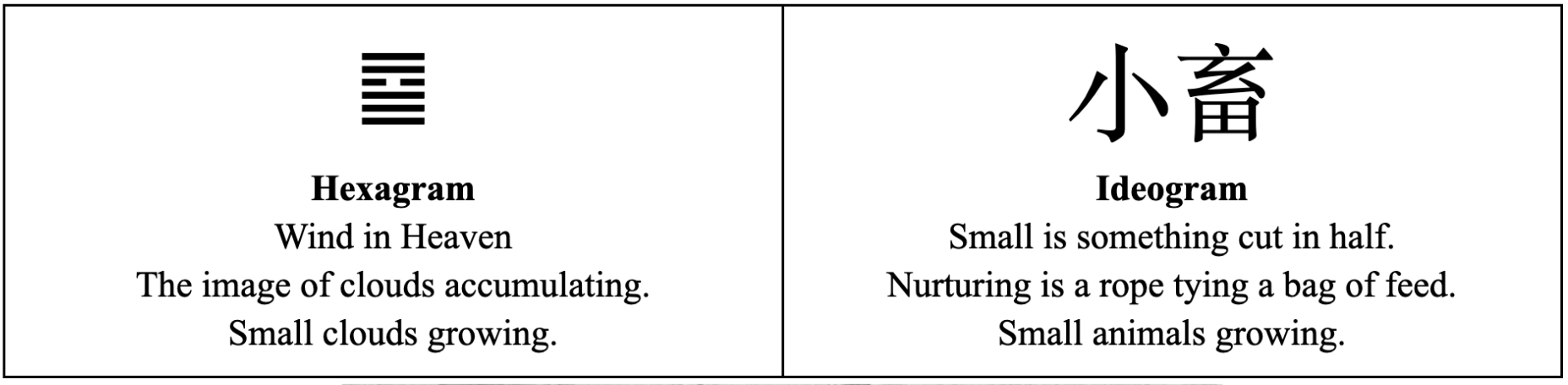
In hexagram 9, we are given the image of accumulation: the process of making a mountain out of a molehill, of turning something little into something big. This can be the growth of a great storm cloud from a small bit of moisture, or the growth of a baby into an adult. This can be applied to social dynamics too, as written in the lines. It is also the phenomena of perspective and proportion, how something large and distant looks small. Thus the hexagram is a cloud far up in the heavens, looking very small from the ground.
We are shown dark clouds that bring no rain, for they are still growing.
1
One must follow their own path to grow. Each vine, flower, and tree fights for its own sunlight, and contorts itself to do so. They follow their own way to survive.
2
At times, growth requires retreat, though it may appear as regression. No matter how far one goes, we still need to sleep.
3
This is the social form of making a mountain out of a molehill. If a couple is driving and they get a flat tire, it can elicit an argument fantastically out of proportion to the minor inconvenience they’ve experienced. The little problem grows into a drama representing the problems of the whole relationship.
4
When we have faith in the ultimate goal of growth, our anxieties fade and the hard work necessary to achieve such a thing becomes light.
5
When we show a little kindness and goodwill to those around us, we will often find they are willing to support us in times of need. Bringing flowers or gifts to a new neighbor can invite a friendship and reciprocal kindness.
6
When things have grown, we see their fruits. When things reach their fullness, so too does the danger of spilling. A cloud which accumulates enough water soon bursts forth and pours out the rain it has accumulated.
Nietzsche expresses this dynamic well in Zarathustra:
“Indeed, who was not defeated in his victory!
Indeed, whose eye did not darken in this drunken twilight!
Indeed, whose foot did not stagger and forget how to stand in victory!
– That I may one day be ready and ripe in the great noon; ready and ripe
like glowing bronze, clouds pregnant with lightning and swelling udders of milk –”
As we grow, things become more treacherous and the stakes become higher. At the final moment, we can slip, and spill all that we’ve made. Consider children playing with blocks or sandcastles, or building a house of cards; we can keep these things steady as we build them up, but as we prepare to finish them, it can all come tumbling down. Nietzsche’s Zarathustra prays to his Will that he will be able to maintain this state of growth and height, that his accumulated energy can be directed properly at the right time, not lost in pride.
Pride comes before a Fall.
Daron Malakian - ON METAL (Part 2)
2h 4m
1.2.26
In this clip, Rick speaks with Daron Malakian about Nu Metal’s quick rise in popularity.
<iframe width="100%" height="265" src="https://clyp.it/1srewuxv/widget?token=6ff7c4737ebbdf56032a8c1db82b5ca2" frameborder="0"></iframe>
Welcome, 2026: Year 1 of the Fire Horse
Molly Hankins January 1, 2026
As we cross the threshold from a numerological year 9 of the wood snake in 2025 into a year 1 of the fire horse, beginning February 17th in the Chinese zodiac, we are shedding the last of our old identity-skins…
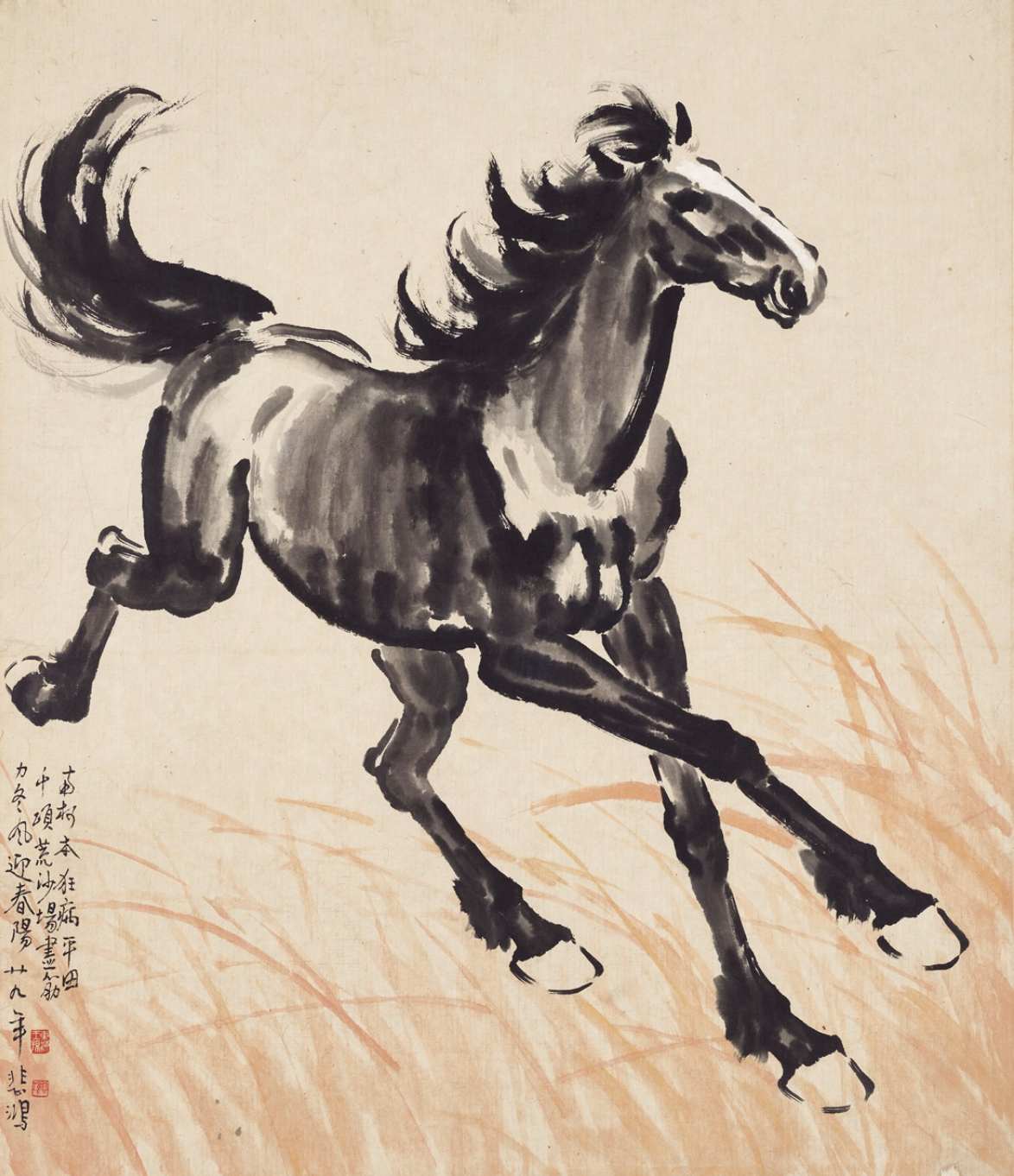
Galloping Horse, Xu Beihong. 1941.
Molly Hankins January 1, 2026
As we cross the threshold from a numerological year 9 of the wood snake in 2025 into a year 1 of the fire horse, beginning February 17th in the Chinese zodiac, we are shedding the last of our old identity-skins. What wasn’t working in our lives on the material plane is being closed out over the next six weeks, as the year 1 energy of 2026 refreshes our consciousness and charts our new course in life. The fire horse energy gives us the supercharged creativity to begin and sustain the momentum of following our highest excitement. A year 1 also promises surprises, unexpected opportunities, new relationships, and a significant expansion of our perspectives. Think back to the last year 1 which was in 2017- that was fire rooster year and there will likely be parallels across the macro themes in our lives.
In numerology, annual cycles are calculated by adding the numerals of a given year together, so 2026 is a year 1 because 2+2+0+6 = 10, and 1+0 = 1. The 1 represents a fresh start, so this is a year that asks us to embrace change and become more ourselves. The fire horse energy will fuel the urge to express our authenticity and share it with the people we love. Having shed so much over this previous year, we are ready to make new connections that form a circuit of conscious beings stable enough to run the powerful fire horse energy. In 2026, our life force is activated at a new level, and this will magnetize resonant souls who will be great company on our life’s journey. They also reflect back to us what we need to recognize within ourselves.
Numerologist and best-selling author Kaitlyn Kaerhart, who was interviewed for Tetragrammaton in 2025, believes that “when we know the nature of the cycle we’re in, we have a greater awareness of the energy that’s most supported at any given time, and how to make that energy work for us.” The year of the fire horse brings action and change, but beware that the energy can also be so quick-moving that it can lead to distraction or hot-headedness. “This year will feel dramatically different from 2025,” Kaerhart says. “Year 9 is the most intense and demanding year in numerology because it’s focused on endings, closure, grief and release. Collectively, 2025 was a dismantling, like a caterpillar dissolving inside the cocoon. In 2026, we emerge. This is the year we grow wings and begin again from a new level of awareness.”
“This isn’t a year to rush blindly. It’s a year to choose wisely.”
As for how to work with the new year energy, Kaerhart points out that not only are we in year 1, replete with fresh-start energy, but there’s a ton of horsepower behind that creative urge. We must be conscious of what we’re creating, why we’re doing it and who we’re working with. “Because year 1 is foundational, the most important way to work with this energy is through conscious initiation. Be intentional about what you start,” she reminds us. “Relationships, businesses, creative projects, relocations and commitments made this year have staying power. They carry momentum that can last the full nine-year cycle.”
Horses have co-evolved with mankind to help us get where we’re going and build lasting structures, so think of this energy as the fuel powering the next phase of our individual and collective evolution. In order to tame a horse, trust must be built and limits must be put in place otherwise the horse will run wild and we lose its power. The horse must also be tended to and taken care of, the same is true for this year. We can use this cycle to our advantage by slowing down our thinking and acting, making sure that what we’re doing aligns with who we are and how we want our lives to be. Conversely, we can create chaos with this energy if we’re impatient or misaligned in our relationships and activities.
“This isn’t a year to rush blindly,” Kaerhart says. “It’s a year to choose wisely. The consequences of our choices matter more now than they have in years.” As we work with this new energy, it can also be helpful to compare the year 1 we’re collectively experiencing to the one we are personalling travelling, which requires another simple calculation. To figure out what personal year you’re in, add up the digits of your birthday to the current year. For example, a July 10th birthday would add up to a personal year 9, because 7+1+0+2+0+2+6 = 9. This means endings and new beginnings will be happening right next to each other. The image of the ouroboros comes to mind, where the snake eats its own tail in a representation of eternal self-creation. For more specifics on how our personal year cycles interact with that of the collective, Kaerhart publishes annual planners detailing how to use this information to work with the astrological energy of the year.
Since what we create this year sets the tone for the next 9 years, the hope is that we can tame the fiery horse energy and harness it for our highest good. “Year 1 is the year where new timelines are initiated, identities are reshaped and long-term paths are chosen,” she explains. “It’s the spark year — the moment where ideas move from possibility into form.”
Molly Hankins is an Initiate + Reality Hacker serving the Ministry of Quantum Existentialism and Builders of the Adytum.
Film
<div style="padding:42.22% 0 0 0;position:relative;"><iframe src="https://player.vimeo.com/video/1120730199?title=0&byline=0&portrait=0&badge=0&autopause=0&player_id=0&app_id=58479" frameborder="0" allow="autoplay; fullscreen; picture-in-picture; clipboard-write; encrypted-media; web-share" referrerpolicy="strict-origin-when-cross-origin" style="position:absolute;top:0;left:0;width:100%;height:100%;" title="The Poseidon Adventure clip 1"></iframe></div><script src="https://player.vimeo.com/api/player.js"></script>
Daron Malakian - ON METAL (Part 1)
1h 41m
12.31.25
In this clip, Rick speaks with Daron Malakian about the theatrics involved with metal music.
<iframe width="100%" height="265" src="https://clyp.it/qhq0tvwb/widget?token=6e608bd528fc4cd94a2a470c5ed9ed2d" frameborder="0"></iframe>
Film
<div style="padding:56.25% 0 0 0;position:relative;"><iframe src="https://player.vimeo.com/video/1151235387?badge=0&autopause=0&player_id=0&app_id=58479" frameborder="0" allow="autoplay; fullscreen; picture-in-picture; clipboard-write; encrypted-media; web-share" referrerpolicy="strict-origin-when-cross-origin" style="position:absolute;top:0;left:0;width:100%;height:100%;" title="Moonwalk One - Moonwalk"></iframe></div><script src="https://player.vimeo.com/api/player.js"></script>
The Curriculum of the Bauhaus (1919)
Walter Gropius December 30, 2025
Intellectual education runs parallel to manual training…

The Bauhaus School Building in Weimar, Germany.
Four years after the formation of the Bauhaus, its founder Walter Gropius wrote a text entitled ‘The Theory and Organization of the Bauhaus’ as a manifesto, declaration and explanation of the radical new world they were trying to form. The Bauhaus was a new type of art school, founded in 1919 in Weimar, Germany that attempted to unify individual expression and the process of mass manufacturing and modernity. It was inherently inter-disciplinary, and its output ranges from furniture and buildings, to paintings and craft work, each of which was valued individually and as a cohesive part of the greater whole. Perhaps no single movement has had quite as much impact in the 20th century, and the very visual language of the modern world owes its debt to this small school in Germany. Here, Gropius explains the curriculum of the school, and in doing so espouses some of the core philosophical ideas of the movement - that of intersectionality between mediums, rigorous focus on craft and technicality and an emphasis on the freedom that can be found within constraints of production.
Walter Gropius December 30, 2025
The course of instruction at the Bauhaus is divided into:
The Preliminary Course (Vorlehre)
Practical and theoretical studies are carried on simultaneously in order to release the creative powers of the student, to help him grasp the physical nature of materials and the basic laws of design. Concentration on any particular stylistic movement is studiously avoided. Observation and representation - with the intention of showing the desired identity of Form and Content - define the limits of the preliminary course. Its chief function is to liberate the individual by breaking down conventional patterns of thought in order to make way for personal experiences and discoveries which will enable him to see his own potentialities and limitations. For this reason collective work is not essential in the preliminary course. Both subjective and objective observation will be cultivated: both the system of abstract laws and the interpretation of objective matter.
Above all else, the discovery and proper valuation of the individual's means of expression shall be sought out. The creative possibilities of individuals vary. One finds his elementary expressions in rhythm, another in light and shade, a third in color, a fourth in materials, a fifth in sound, a sixth in proportion, a seventh in volumes or abstract space, an eighth in the relations between one and another, or between the two to a third or fourth.
All the work produced in the preliminary course is done under the influence of instructors. It possesses artistic quality only in so far as any direct and logically developed expression of an individual which serves to lay the foundations of creative discipline can be called art.
*
Instruction in form problems
Intellectual education runs parallel to manual training. The apprentice is acquainted with his future stock-in-trade - the elements of form and color and the laws to which they are subject. Instead of studying the arbitrary individualistic and stylized formulae current at the academies, he is given the mental equipment with which to shape his own ideas of form. This training opens the way for the creative powers of the individual, establishing a basis on which different individuals can cooperate without losing their artistic independence. Collective architectural work becomes possible only when every individual, prepared by proper schooling, is capable of understanding the idea of the whole, and thus has the means harmoniously to coordinate his independent, even if limited, activity with the collective work. Instruction in the theory of form is carried on in close contact with manual training. Drawing and planning, thus losing their purely academic character, gain new significance as auxiliary means of expression. We must know both vocabulary and grammar in order to speak a language; only then can we communicate our thoughts. Man, who creates and constructs, must learn the specific language of construction in order to make others understand his idea. Its vocabulary consists of the elements of form and color and their structural laws. The mind must know them and control the hand if a creative idea is to be made visible. The musician who wants to make audible a musical idea needs for its rendering not only a musical instrument but also a knowledge of theory. Without this knowledge, his idea will never emerge from chaos.
A corresponding knowledge of theory - which existed in a more vigorous era - must again be established as a basis for practice in the visual arts. The academies, whose task it might have been to cultivate and develop such a theory, completely failed to do so, having lost contact with reality. Theory is not a recipe for the manufacturing of works of art, but the most essential element of collective construction; it provides the common basis on which many individuals are able to create together a superior unit of work; theory is not the achievement of individuals but of generations. The Bauhaus is consciously formulating a new coordination of the means of construction and expression. Without this, its ultimate aim would be impossible. For collaboration in a group is not to be obtained solely by correlating the abilities and talents of various individuals. Only an apparent unity can be achieved if many helpers carry out the designs of a single person. In fact, the individual's labor within the group should exist as his own independent accomplishment. Real unity can be achieved only by coherent restatement of the formal theme, by repetition of its integral proportions in all parts of the work. Thus everyone engaged in the work must understand the meaning and origin of the principal theme.
Forms and colors gain meaning only as they are related to our inner selves. Used separately or in relation to one another they are the means of expressing different emotions and movements: they have no importance of their own. Red, for instance, evokes in us other emotions than does blue or yellow; round forms speak differently to us than do pointed or jagged forms. The elements which constitute the 'grammar' of creation are its rules of rhythm, of proportion, of light values and full or empty space. Vocabulary and grammar can be learned, but the most important factor of all, the organic life of the created work, originates in the creative powers of the individual. The practical training which accompanies the studies in form is founded as much on observation, on the exact representation or reproduction of nature, as it is on the creation of individual compositions. These two activities are profoundly different. The academies ceased to discriminate between them, confusing nature and art - though by their very origin they are antithetical. Art wants to triumph over Nature and to resolve the opposition in a new unity, and this process is consummated in the fight of the spirit against the material world. The spirit creates for itself a new life other than the life of nature.
Each of these departments in the course on the theory of form functions in close association with the workshops, an association which prevents their wandering off into academicism.
*
The goal of the Bauhaus curriculum
The culminating point of the Bauhaus teaching is a demand for a new and powerful working correlation of all the processes of creation. The gifted student must regain a feeling for the interwoven strands of practical and formal work. The joy of building, in the broadest meaning of that word, must replace the paper work of design. Architecture unites in a collective task all creative workers, from the simple artisan to the supreme artist.
For this reason, the basis of collective education must be sufficiently broad to permit the development of every kind of talent. Since a universally applicable method for the discovery of talent does not exist, the individual in the course of his development must find for himself the field of activity best suited to him within the circle of the community. The majority become interested in production; the few extraordinarily gifted ones will suffer no limits to their activity. After they have completed the course of practical and formal instruction, they undertake independent research and experiment.
Modern painting, breaking through old conventions, has released countless suggestions which are still waiting to be used by the practical world. But when, in the future, artists who sense new creative values have had practical training in the industrial world, they will themselves possess the means for realizing those values immediately. They will compel industry to serve their idea and industry will seek out and utilize their comprehensive training.
Walter Adolph Georg Gropius (1883 – 1969) was a German architect and founder of the Bauhaus School. He is widely regarded as one of the pioneering masters of modernist architecture, and one of the most influential art theorists of the modern age.
8 Union - The I Ching
Chris Gabriel December 27, 2025
Unity. There is luck when the source of divination is pure. Restless ones come too late, they are ill fated…
Chris Gabriel December 27, 2025
Judgment
Unity. There is luck when the source of divination is pure. Restless ones come too late, they are ill fated.
Lines
1
Unity with faith. Faith fills pots.
2
Unity within.
3
Unity with the wrong people.
4
Unity without.
5
Unity with appearance. The King has three ways, losing the bird in front of him. His people don’t warn him.
6
Unity without a leader.
Qabalah
Yesod to Malkuth: The Path of Tau. The Universe.
Yesod’s energy flows over Malkuth.
The Moon to the Earth.
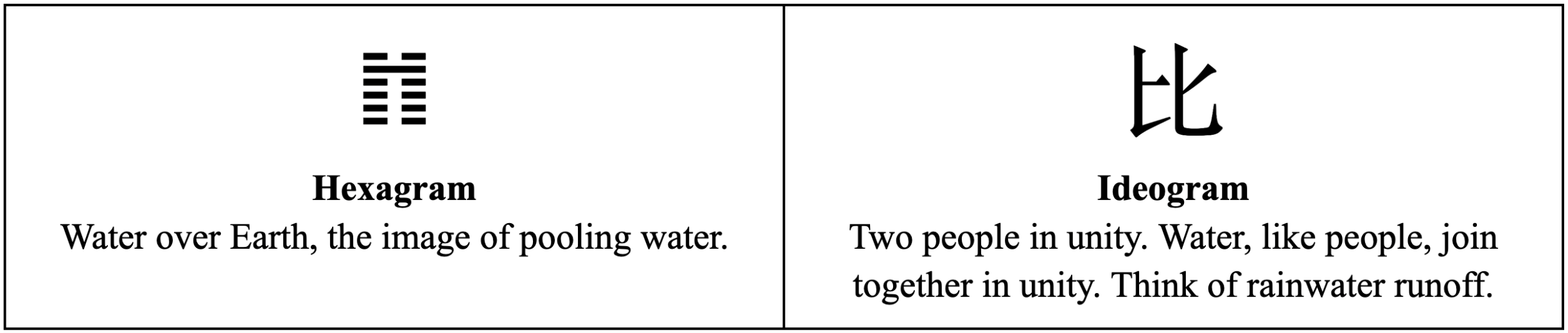
In this hexagram we have the image of water pooling on the face of the Earth, as a puddle is formed. People are drawn together in the same way the water gathers together. This is Unity, or likeness: people who are alike will unify. When I was a child I loved watching raindrops race down a window pane, gathering others as it went and this is the essence of the hexagram. Unlike water, who we unify with determines a great deal.
1
A Union requires faith, an ideal, a goal which is greater than the sum of its parts. Mere selfishness or utility is not enough to keep people unified. A great group of friends will feed one another, and help each other when they’re down. As Ringo sings: “I get by with a little help from my friends”.
2
The unity we seek without must come from within, an internal resonation with others. Through internal resonance we can attract friends.
3
When you don’t look carefully, it’s easy to fall in with a bad crowd, to make bad friends. This is one of the worst mistakes a person can make. “You are the company you keep”, and if you keep bad company, you can spoil your life. They will drag you down, and leave you if you fall below them.
4
We can unify with what is beyond our limited network. The outside holds great potential; it is how a union grows, through alliances with those outside.
5
When we act in unison with our appearance we do well. Honesty allows more complexity, even at the cost of immediate power through deception. The King wants a more difficult game, so he allows some of the animals to get away.
6
A great union is made of equals, without a clear leader. E pluribus unum, not primus inter pares.
In the last hexagram, we looked at hidden powers and disciplined movements of trained armies. Here we see visible unions, friendships, and alliances. This is diplomacy rather than violence, peace rather than war. Having the right friends will keep us from needing to fight, or at least make our fights much easier. The wrong friends will draw us into many more fights than we would have had on our own.
We can think of Aesop’s Fable of the Bundle of Sticks, the Fasci. The father of three sons shows them a bundle of sticks and has each attempt to break it, none of them can. When they undo the bundle, they easily break the sticks one by one, the moral being “United we stand, divided we fall.” or “Unity gives strength.” .
Film
<div style="padding:72.87% 0 0 0;position:relative;"><iframe src="https://player.vimeo.com/video/1149700684?badge=0&autopause=0&player_id=0&app_id=58479" frameborder="0" allow="autoplay; fullscreen; picture-in-picture; clipboard-write; encrypted-media; web-share" referrerpolicy="strict-origin-when-cross-origin" style="position:absolute;top:0;left:0;width:100%;height:100%;" title="All My Good Countrymen clip 5"></iframe></div><script src="https://player.vimeo.com/api/player.js"></script>