

Venus Verticordia
NIKOLAUS PFAFF
In early 1600s Europe, while Rudolph II ruled Austria, Bohemia and the Holy Roman Emperor, the height of sophistication was the Kunstkammer, or Cabinet of Curiosities. These were decadent cabinets intended to be filled with objects, art works, artefacts and tokens that showed the wealth, culture and worldliness, and it was these cabinets that defined the aesthetic philosophies of the day. Nikolaus Pfaff was a court artist of Rudolph, and one of the most renowned sculptors of his day, working primarily in organic material and finding his speciality in the carving of ivory. This type of work was seen as a collaboration with the divine, where the artist elevated the beauty of life’s building blocks into artistic perfection that highlighted the genius of both creators. Pfaff’s work was mystic and spiritual, combining ideas of antiquities with mythical and folkloric detailing to create pieces of profound wonder.
Nikolaus Pfaff
NIKOLAUS PFAFF, c.1609. CARVED IVORY ON EBONY PEDESTAL
In the face of meaningless war, wanton destruction and the spectacle of collective genocide that seems sanctioned by society, a group of artists across Europe felt that they were left with no option but to reject the very foundation their modern world was built on. It was logic and reason, capitalism and society that had got the world to where it was in 1916, and so these same tools were useless to get it out. Enter Dada, a loose movement built on the embrace of nothingness and the absence of meaning, its very name a manifesto for the chaotic, irrational and absurd. Dada was designed to offend, not in content but in sensibility, flying boldly in the face of conceptions of aesthetics and art, ideas that the artists saw little use for. Arp was one of the founders of this movement, though sects sprang up across the continent, and he worked across mediums, applying the dada anti-philosophy to poetry, sculpture, art and collage. His work still puzzles and entices, for we still need an embrace of chaos when logic seems to fail us.

Glass and Checkerboard
JUAN GRIS
At the age of 19, Juan Gris gave up everything. He sold his possessions and moved to Paris, ingratiating himself with Apollinaire, Matisse, Braque and, a little later, Picasso. He worked as a satirical cartoonist, painting rarely but learning throughout from those who surrounded him, falling deep into the cubist world they were creating. It was not until 1911, however, after seeing Metzinger’s work ‘Tea Time’, that he found a painting practice that spoke to him. Metzinger, for Gris, had unified mathematics and art on canvas, his cubist portrait less free flowing than Braque or Picasso but rigid in its grid structure. Gris seized upon this and developed his own style that he named Analytical Cubism. The subject’s deconstruction is more rigorous and scientific, as if each element has been carefully taken apart and rearranged. His paintings alight something primal, our desire for order and straight lines, yet also express a freeness and spiritual understanding of the world. Gris was amongst the most distinctive of the cubists for this marriage between the rational and the impossible.
Juan Gris
JUAN GRIS, c.1917. OIL ON WOOD.
At the age of 19, Juan Gris gave up everything. He sold his possessions and moved to Paris, ingratiating himself with Apollinaire, Matisse, Braque and, a little later, Picasso. He worked as a satirical cartoonist, painting rarely but learning throughout from those who surrounded him, falling deep into the cubist world they were creating. It was not until 1911, however, after seeing Metzinger’s work ‘Tea Time’, that he found a painting practice that spoke to him. Metzinger, for Gris, had unified mathematics and art on canvas, his cubist portrait less free flowing than Braque or Picasso but rigid in its grid structure. Gris seized upon this and developed his own style that he named Analytical Cubism. The subject’s deconstruction is more rigorous and scientific, as if each element has been carefully taken apart and rearranged. His paintings alight something primal, our desire for order and straight lines, yet also express a freeness and spiritual understanding of the world. Gris was amongst the most distinctive of the cubists for this marriage between the rational and the impossible.

Christ at the Sea of Galilee
TINTORETTO
Mannerism emerged in direct opposition to the natural perfection of the High Renaissance. Where da Vinci, Rafael and Michelangelo were depicting the harmonious beauty of the world with astute realism, the Mannerists were exaggerating the features they deemed most beautiful to create artificial scenes. Their figures are elongated and irregularly proportioned to produce unnatural elegance. The balance and symmetry of the renaissance gave way to compositional tension and asymmetry, creating dynamic and vivid scenes. Alongside El Greco, Tintoretto stands tall amongst the Mannerists; known as ‘il Furioso’ in his native Italy, he drew with abandon and speed, his brushwork bolder than any that had come before. While he mostly depicted scenes of Venice, his religious works are some of the masterpieces of the movement. Here, Jesus is rendered in few strokes, his body long and weightless as he looks out to the sea at his disciples in a boat below an ominous sky. The colours guide us from the dark sky to the luminescent Christ and the loose, unnatural landscape creates a powerful sense of drama.
Jacopo Tintoretto
JACOPO TINTORETTO, c.1570s. OIL ON CANVAS.
Mannerism emerged in direct opposition to the natural perfection of the High Renaissance. Where da Vinci, Rafael and Michelangelo were depicting the harmonious beauty of the world with astute realism, the Mannerists were exaggerating the features they deemed most beautiful to create artificial scenes. Their figures are elongated and irregularly proportioned to produce unnatural elegance. The balance and symmetry of the renaissance gave way to compositional tension and asymmetry, creating dynamic and vivid scenes. Alongside El Greco, Tintoretto stands tall amongst the Mannerists; known as ‘il Furioso’ in his native Italy, he drew with abandon and speed, his brushwork bolder than any that had come before. While he mostly depicted scenes of Venice, his religious works are some of the masterpieces of the movement. Here, Jesus is rendered in few strokes, his body long and weightless as he looks out to the sea at his disciples in a boat below an ominous sky. The colours guide us from the dark sky to the luminescent Christ and the loose, unnatural landscape creates a powerful sense of drama.

Survival
JENNY HOLZER
“We don’t need work on joy”, said Jenny Holzer. Instead, her work digs deep into the flaws of society, into the darkness of humanity and her own psyche and screams it from the rooftops, quite literally. She has used almost every medium available except, for most of her career, a paintbrush and canvas. Instead, she utilises a text based art and presents it on everything from billboards, stone plaques, posters and benches to t-shirts, race cars and postcards. Since 1980 she has been disseminating her text-based work into public spaces and public consciousness. In short phrases, she considers domestic violence, government censorship, the war on terror, gender theory, and personal intimacy. Her work is urgent, immediate, and straightforward yet, presented within public settings, it takes on an abstraction. Holzer disseminates words of confident poetry that interrupt your day and require contemplation.
Jenny Holzer
JENNY HOLZER, 1985. ELECTRONIC BILLBOARD.
“We don’t need work on joy”, said Jenny Holzer. Instead, her work digs deep into the flaws of society, into the darkness of humanity and her own psyche and screams it from the rooftops, quite literally. She has used almost every medium available except, for most of her career, a paintbrush and canvas. Instead, she utilises a text based art and presents it on everything from billboards, stone plaques, posters and benches to t-shirts, race cars and postcards. Since 1980 she has been disseminating her text-based work into public spaces and public consciousness. In short phrases, she considers domestic violence, government censorship, the war on terror, gender theory, and personal intimacy. Her work is urgent, immediate, and straightforward yet, presented within public settings, it takes on an abstraction. Holzer disseminates words of confident poetry that interrupt your day and require contemplation.

Nature Abhors a Vacuum
HELEN FRANKENTHALER
Having allowed chance and chaos to be collaborators for most of her career, pioneering color-field painting through the soak-stain technique, Frankenthaler began to wrest back some control. Shortly before painting this work, she had spent time in England working on a series of welded sculptures and contemplating large public commissions of her work. These two ideas were front of her mind when painting ‘Nature Abhors a Vacuum’ as the large swathes of colour so synonymous with her paintings find themselves, for almost the first time, with hard edges. She used wood and tape to block the flow of paint from differing areas of the canvas, restricting the freedom that the paint had once enjoyed, and relegating its status from collator to assistant. Having long embraced a lack of control, here Frankenthaler guides the outcome more, suggesting a maturity in her relationship to her process. ‘You have to know how to use the accident, how to recognise it, how to control it”, she said, ‘So that the whole surface looks felt and born at once”.
Helen Frankenthaler
HELEN FRANKENTHALER, 1973. ACRYLIC ON CANVAS.
Having allowed chance and chaos to be collaborators for most of her career, pioneering color-field painting through the soak-stain technique, Frankenthaler began to wrest back some control. Shortly before painting this work, she had spent time in England working on a series of welded sculptures and contemplating large public commissions of her work. These two ideas were front of her mind when painting ‘Nature Abhors a Vacuum’ as the large swathes of colour so synonymous with her paintings find themselves, for almost the first time, with hard edges. She used wood and tape to block the flow of paint from differing areas of the canvas, restricting the freedom that the paint had once enjoyed, and relegating its status from collator to assistant. Having long embraced a lack of control, here Frankenthaler guides the outcome more, suggesting a maturity in her relationship to her process. ‘You have to know how to use the accident, how to recognise it, how to control it”, she said, ‘So that the whole surface looks felt and born at once”.

Solitude
THOMAS HARRISON ALEXANDER
Trained as an engineer, Harrison approached nature as a scientist, searching endlessly for something new, something unseen, that revealed truth and beauty. Spending summers at a ramshackle cottage on the Brittany coast, he would race to the dunes each evening and watch the sun set over the water, observing the colours change successively with new variations and gradients appearing each night. It was not that Harrison was a lover of nature, rather he was a lover of art and admired nature only in service of art itself. He saw the scale of the earth, and the beauty in that scale, and spent his life trying to capture it in all of its poetic light and colour. Solitude is somewhat unusual in Harrison’s oeuvre, though large in scale like the others, it appears not to be of the sea in its dramatic splendour but of a lake in its quiet tranquillity. A figure stands, nude, at the end of a still rowboat while the oar balances delicately on the surface, not breaking the water tension, and catches the brightness of the moonlight. The work is both peaceful and ominous, one sentence in a lifelong love letter to the water.
Thomas Alexander Harrison
THOMAS ALEXANDER HARRISON, 1893. OIL ON CANVAS.
Trained as an engineer, Harrison approached nature as a scientist, searching endlessly for something new, something unseen, that revealed truth and beauty. Spending summers at a ramshackle cottage on the Brittany coast, he would race to the dunes each evening and watch the sun set over the water, observing the colours change successively with new variations and gradients appearing each night. It was not that Harrison was a lover of nature, rather he was a lover of art and admired nature only in service of art itself. He saw the scale of the earth, and the beauty in that scale, and spent his life trying to capture it in all of its poetic light and colour. Solitude is somewhat unusual in Harrison’s oeuvre, though large in scale like the others, it appears not to be of the sea in its dramatic splendour but of a lake in its quiet tranquillity. A figure stands, nude, at the end of a still rowboat while the oar balances delicately on the surface, not breaking the water tension, and catches the brightness of the moonlight. The work is both peaceful and ominous, one sentence in a lifelong love letter to the water.

The Resurrection
BOTTICINI
Botticini, for all of his genius, is historically illusive. We have very few works confirmed to be by his hand, but many more which have since been attributed to him with some certainty, though without the necessary records to be definitive. His handiwork exists as invisible threads pulled by art historians, finding fingerprints of a master, and contemporary of Da Vinci, in works long mis-authored. Born in Florence as the impact of the Renaissance was growing, his father made and painted playing cards and trained the young Francisco in his early life, before he joined Leonardo Da Vince as an apprentice in the workshop of Del Verrocchio. Botticini’s work was unusual, graphic and compositional strange, perhaps inspired by the playing cards he grew up painting. The work, despite obvious technical signs of age, feels extraordinarily contemporary, the manipulation of planes and positioning of Jesus is almost surrealist. It is a celebratory, affecting and uncanny work of reverence and experimentation.
Francesco Botticini
FRANCESCO BOTTICINI, c.1467. TEMPERA ON POPLAR.
Botticini, for all of his genius, is historically illusive. We have very few works confirmed to be by his hand, but many more which have since been attributed to him with some certainty, though without the necessary records to be definitive. His handiwork exists as invisible threads pulled by art historians, finding fingerprints of a master, and contemporary of Da Vinci, in works long mis-authored. Born in Florence as the impact of the Renaissance was growing, his father made and painted playing cards and trained the young Francisco in his early life, before he joined Leonardo Da Vince as an apprentice in the workshop of Del Verrocchio. Botticini’s work was unusual, graphic and compositional strange, perhaps inspired by the playing cards he grew up painting. The work, despite obvious technical signs of age, feels extraordinarily contemporary, the manipulation of planes and positioning of Jesus is almost surrealist. It is a celebratory, affecting and uncanny work of reverence and experimentation.

Study for “Swing Landscape”
STUART DAVIS
In Jazz music, a basic chord structure is improvised on by musicians, creating new and unlikely combinations and songs from a base starting point. Stuart Davis’ paintings can be understood in the same way; he worked within a theme, painting series of similar images where he would alter the color, the geometric composition and scale but retain the base formal components. Employed by the Works Progress Administration, that gave artists jobs painting murals during the Great Depression, he was fiercely patriotic, depicting America in joyous reverie. His works are jazz ballads, loose and unstructured by rich in emotion in movement. This is a fragment of a preparatory work of his masterpiece, “Swing Landscape”. It depicts workers at a dock, abstracted and frenetic. There is an inherent optimism to Davis’ paintings of contemporary life, he renders labour and leisure in the same vivid style, uplifting the everyday occasion into musicality.
Stuart Davis
STUART DAVIS, 1938. OIL ON CANVAS.
In Jazz music, a basic chord structure is improvised on by musicians, creating new and unlikely combinations and songs from a base starting point. Stuart Davis’ paintings can be understood in the same way; he worked within a theme, painting series of similar images where he would alter the color, the geometric composition and scale but retain the base formal components. Employed by the Works Progress Administration, that gave artists jobs painting murals during the Great Depression, he was fiercely patriotic, depicting America in joyous reverie. His works are jazz ballads, loose and unstructured by rich in emotion in movement. This is a fragment of a preparatory work of his masterpiece, “Swing Landscape”. It depicts workers at a dock, abstracted and frenetic. There is an inherent optimism to Davis’ paintings of contemporary life, he renders labour and leisure in the same vivid style, uplifting the everyday occasion into musicality.

The Picture From Thibet
EMIL CARLSEN
Regarded as one of the greatest painters of his day, Carlsen struggled financially throughout his career. He worked mainly in still lives, beautifully and delicately rendered in a palette of soft hues and fine brushwork, and he held many prestigious teaching posts across America. Yet, still lives were hard to sell, having fallen out of vogue in favour of portraits, nudes and landscapes. It would take the Cubists to resurrect the medium some decades after he Carlsen reached prominence, and Carlsen found himself a master of an art-form considered dead. Despite that, he persisted, sure in the importance of the medium and his creations. “The simplest and most thorough way of acquiring all the knowledge of the craft of painting and drawing”, he said, “[is] the study of inanimate objects, still life painting, the very surest road to absolute mastery over all technical difficulties.”
Emil Carlsen
EMIL CARLSEN, c.1920. OIL ON CANVAS.
Regarded as one of the greatest painters of his day, Carlsen struggled financially throughout his career. He worked mainly in still lives, beautifully and delicately rendered in a palette of soft hues and fine brushwork, and he held many prestigious teaching posts across America. Yet, still lives were hard to sell, having fallen out of vogue in favour of portraits, nudes and landscapes. It would take the Cubists to resurrect the medium some decades after he Carlsen reached prominence, and Carlsen found himself a master of an art-form considered dead. Despite that, he persisted, sure in the importance of the medium and his creations. “The simplest and most thorough way of acquiring all the knowledge of the craft of painting and drawing”, he said, “[is] the study of inanimate objects, still life painting, the very surest road to absolute mastery over all technical difficulties.”

The Corpses of the De Witt Brothers
JAN DE BAEN
Artworks can write history in their image, defining a cultural event beyond its factual happening and representing the age through a quiet artistic bias. In the modern world, we are familiar with this idea after more than a century of photography, taken as truth, defining our understanding of the past and the present, yet we often think of paintings differently. When two brothers who had influence in Dutch parliament for many years were lynched by an angry mob in the late 1600s, it was a national story, and sketches composed by onlookers were reproduced in newspapers across the country. Jan de Baen used these sketches and accounts from attendees to construct his own version of events – trying, as was the philosophy of the Dutch Golden Age, to be as accurate as possible. Yet he still painted with his own astute eye, and the work is aesthetically beautiful not simply by accident. Decisions were made in every brushstrokes and the work was of such quality that it became enormously famous still to this day. The murder of the DeWitt Brothers is now remembered almost entirely through de Baen’s painting, and the truth of what happened on that day no longer matters – art has trumped truth to define the past.
Jan de Baen
JAN DE BAEN, c.1674. OIL ON CANVAS.
Artworks can write history in their image, defining a cultural event beyond its factual happening and representing the age through a quiet artistic bias. In the modern world, we are familiar with this idea after more than a century of photography, taken as truth, defining our understanding of the past and the present, yet we often think of paintings differently. When two brothers who had influence in Dutch parliament for many years were lynched by an angry mob in the late 1600s, it was a national story, and sketches composed by onlookers were reproduced in newspapers across the country. Jan de Baen used these sketches and accounts from attendees to construct his own version of events – trying, as was the philosophy of the Dutch Golden Age, to be as accurate as possible. Yet he still painted with his own astute eye, and the work is aesthetically beautiful not simply by accident. Decisions were made in every brushstrokes and the work was of such quality that it became enormously famous still to this day. The murder of the DeWitt Brothers is now remembered almost entirely through de Baen’s painting, and the truth of what happened on that day no longer matters – art has trumped truth to define the past.

Piano Mover’s Holiday
CHARLES DEMUTH
A new world was being built, one defined by sleek lines, mass-production, factories that churned out repetitive perfection and removed the individual from the act of the creation. The shadows of skyscrapers hung heavy over the east coast, joined by the chimney stacks of manufacturing that blew white smoke into the air as if heralding the change to a modern age. While in Europe, artists were responding to this with obstruction that took the form of Cubism’s abstraction and Futurism’s dynamism, a group of American painters led by Charles Demuth developed a style known as Precisionism. Like the European movements that influenced it, it reduced the work to its simple geometric shapes but, unlike them, it did not attempt to obscure them but to celebrate the immaculate perfection of a machine-tooled world. Demuth’s intentionally obfuscating titles nod to the absurdist that seemed present but his sharp, cohesive and proud lines spoke to a pride with his American identity and laid the groundworks for Pop Art, that took celebration of American commerce to its logical extreme.
Charles Demuth
CHARLES DEMUTH, 1919. DISTEMPER ON COMPOSITION BOARD.
A new world was being built, one defined by sleek lines, mass-production, factories that churned out repetitive perfection and removed the individual from the act of the creation. The shadows of skyscrapers hung heavy over the east coast, joined by the chimney stacks of manufacturing that blew white smoke into the air as if heralding the change to a modern age. While in Europe, artists were responding to this with obstruction that took the form of Cubism’s abstraction and Futurism’s dynamism, a group of American painters led by Charles Demuth developed a style known as Precisionism. Like the European movements that influenced it, it reduced the work to its simple geometric shapes but, unlike them, it did not attempt to obscure them but to celebrate the immaculate perfection of a machine-tooled world. Demuth’s intentionally obfuscating titles nod to the absurdist that seemed present but his sharp, cohesive and proud lines spoke to a pride with his American identity and laid the groundworks for Pop Art, that took celebration of American commerce to its logical extreme.

Woodland Pond at Sunset
GERARD BILDERS
‘It is not my aim and object’, said Bilders, ‘to paint a cow for the cow’s sake or a tree for the tree’s, but by means of the whole – to create a beautiful and huge impression which nature sometimes creates, also with the most simple means’. As a boy, Bilders visited museums in The Hague and there got lost in the 17th century Dutch Landscape paintings, falling headfirst into the framed scenes and finding refuge in the nature that he depicted. It was the all-encompassing pastoral beauty of these works that drove him to capture the landscape in its totality, and in doing so create works of abundant calm and beauty. It was not the individual elements of the natural world that enthralled him, but the unity and wholeness of the whole scene that was essential for his work. Bilders lived in the nature he created, finding his home in represented lands until he died from tuberculosis at the age of 26.
Gerard Bilders
GERARD BILDERS, c.1862. OIL ON CANVAS.
‘It is not my aim and object’, said Bilders, ‘to paint a cow for the cow’s sake or a tree for the tree’s, but by means of the whole – to create a beautiful and huge impression which nature sometimes creates, also with the most simple means’. As a boy, Bilders visited museums in The Hague and there got lost in the 17th century Dutch Landscape paintings, falling headfirst into the framed scenes and finding refuge in the nature that he depicted. It was the all-encompassing pastoral beauty of these works that drove him to capture the landscape in its totality, and in doing so create works of abundant calm and beauty. It was not the individual elements of the natural world that enthralled him, but the unity and wholeness of the whole scene that was essential for his work. Bilders lived in the nature he created, finding his home in represented lands until he died from tuberculosis at the age of 26.

St. Jerome
EL GRECO
El Greco returned five times to the image of Saint Jerome, depicting him in various states and guises. Jerome was a priest, theologian, historian and translator who produced the most important Latin translation of the bible. This representation is amongst El Greco’s later of Jerome, and shows him primarily as a scholar, in sumptuous velvet garb with vividly emphasised folds, pointing at the bible with authority. Though Greco depicted him earlier as a penitent, he retains some of the same features in this painting of him as a scholar. The long white beard and gaunt features allude to his time spent in the Syrian desert, contrasted with his clothes and elevated status here. The work is about Jerome’s duality, showing his life story in but a single frame, one that captures his importance, achievements and status while making clear the hardships he has been through.
El Greco
EL GRECO, c.1610. OIL ON CANVAS.
El Greco returned five times to the image of Saint Jerome, depicting him in various states and guises. Jerome was a priest, theologian, historian and translator who produced the most important Latin translation of the bible. This representation is amongst El Greco’s later of Jerome, and shows him primarily as a scholar, in sumptuous velvet garb with vividly emphasised folds, pointing at the bible with authority. Though Greco depicted him earlier as a penitent, he retains some of the same features in this painting of him as a scholar. The long white beard and gaunt features allude to his time spent in the Syrian desert, contrasted with his clothes and elevated status here. The work is about Jerome’s duality, showing his life story in but a single frame, one that captures his importance, achievements and status while making clear the hardships he has been through.

La Barrière
PAUL GAUGUIN
At the end of the century, a small group of artists attempted aesthetic alchemy. Known as the Synthetists, being part of the Synthetism movement, they wanted to combine the external appearance of nature, the internal feelings of the artist, and the purity of aesthetic colour and form into single works that spoke to the totality of human experience across cerebral and physical plains. Gauguin was the leader of this movement, distinctly different from the Impressionists whom he has been latterly associated with, and he understood the nature of painting in more rational, empirical way. For Gaugin, and all the Synthetists, it was essential to remember that paintings are simply flat surfaces covered in arranged color, and the goal of a painting was the remind the viewer of this, alongside more emotional responses. So Gaugin’s work is read first in response, the initial feeling that the painting provokes leads you into truthfulness, and a deep appreciation for the simple act of arranging colors.
Paul Gauguin
PAUL GAUGUIN, 1889. OIL ON CANVAS.
At the end of the century, a small group of artists attempted aesthetic alchemy. Known as the Synthetists, being part of the Synthetism movement, they wanted to combine the external appearance of nature, the internal feelings of the artist, and the purity of aesthetic colour and form into single works that spoke to the totality of human experience across cerebral and physical plains. Gauguin was the leader of this movement, distinctly different from the Impressionists whom he has been latterly associated with, and he understood the nature of painting in more rational, empirical way. For Gaugin, and all the Synthetists, it was essential to remember that paintings are simply flat surfaces covered in arranged color, and the goal of a painting was the remind the viewer of this, alongside more emotional responses. So Gaugin’s work is read first in response, the initial feeling that the painting provokes leads you into truthfulness, and a deep appreciation for the simple act of arranging colors.

Reserve Head
UNKNOWN SCULPTURE OF THE 4TH DYNASTY, REIGN OF KHUFU
The true function of these life-size sculptures is unknown. Found in the sub-tombs of non-royalty along the Nile and dating from 2551-2496B.C, nearly all known examples have the same seemingly intentional damage, consisting of damaged or removed ears and a deep carved line from the back of the cranium to the nape of the neck. Carved of smoothed but unpolished limestone, they are no idealised portraits the like would be made for private busts or death masks, but instead seem to be honest portraits of the deceased. Many theories persist but none are conclusive, and perhaps never will be. They take their name of ‘Reserve Heads’ from the early theory that these were spare vessels for the soul of the dead if something were to happen to their entombed body. Yet mystery surrounds these delicate portraits, and their otherwise simple forms are all the more enticing for the inherent unknowability of their function.
Unknown Sculptor of the 4th Dynasty, Reign of Khufu
UNKNOWN SCULPTOR OF THE 4TH DYNASTY, REIGN OF KHUFU, c.2609-2584 BC. LIMESTONE.
The true function of these life-size sculptures is unknown. Found in the sub-tombs of non-royalty along the Nile and dating from 2551-2496B.C, nearly all known examples have the same seemingly intentional damage, consisting of damaged or removed ears and a deep carved line from the back of the cranium to the nape of the neck. Carved of smoothed but unpolished limestone, they are no idealised portraits the like would be made for private busts or death masks, but instead seem to be honest portraits of the deceased. Many theories persist but none are conclusive, and perhaps never will be. They take their name of ‘Reserve Heads’ from the early theory that these were spare vessels for the soul of the dead if something were to happen to their entombed body. Yet mystery surrounds these delicate portraits, and their otherwise simple forms are all the more enticing for the inherent unknowability of their function.

Woman in Blue
CHAÏM SOUTINE
Pain, anguish, and poverty seem to materialise in tortured hands. The flesh and bones distort, fracture, expand, and contract in painful brushstrokes and Soutine, in his depiction of 10 digits, fills them with enough emotion to last a lifetime. Painted in the inter-war years, it depicts an unknown subject - normal for Soutine who rarely depicted anyone he had a personal connection with – whose anonymity does not dampen the psychological intensity of the work. Abstract in its colours and style yet traditional in subject, it never shies away from a seeming revulsion to flesh, creating a caricature of humanity that feels at once absurd and sharply observed. Soutine lived in abject poverty nearly all of his life, often forgoing food in favour of art supplies and channelling his literal hunger into inspiration and drive. The titular women in blue is a stand-in for Soutine himself, her pain is his, their shared lives built upon both universal hardship and the beautiful longing for more that accompanies it.
Chaïm Soutine
CHAÏM SOUTINE, c.1919. OIL ON CANVAS.
Pain, anguish, and poverty seem to materialise in tortured hands. The flesh and bones distort, fracture, expand, and contract in painful brushstrokes and Soutine, in his depiction of 10 digits, fills them with enough emotion to last a lifetime. Painted in the inter-war years, it depicts an unknown subject - normal for Soutine who rarely depicted anyone he had a personal connection with – whose anonymity does not dampen the psychological intensity of the work. Abstract in its colours and style yet traditional in subject, it never shies away from a seeming revulsion to flesh, creating a caricature of humanity that feels at once absurd and sharply observed. Soutine lived in abject poverty nearly all of his life, often forgoing food in favour of art supplies and channelling his literal hunger into inspiration and drive. The titular women in blue is a stand-in for Soutine himself, her pain is his, their shared lives built upon both universal hardship and the beautiful longing for more that accompanies it.

Prometheus Being Chained By Vulcan
DIRCK VAN BABUREN
Prometheus stole fire from the Gods and gave it to the mortals. In some versions of the story, it was he who crafted humans from clay and used the fire to imbue them with life, in others the fire was merely a tool to allow them to create civilisation. Yet in all tellings, the ending if the same; the great Titan Prometheus is bound to rock by the blacksmith God Vulcan, god of fire, volcanoes and deserts, and for eternity has his liver consumed by an eagle. It is one of many stories from the ancient world that artists of the Baroque drew their stories from yet is devoid of so much of the romance more commonly seen in the movement. Van Baburen’s depiction borrows heavily from the work of Renaissance artists before him, adapting Caravaggio’s depiction of St. Paul to become his Prometheus most notably. Yet for all the obvious influences, van Barburen brings new light to an ancient story and find the humanity, the religion and the beauty in myth.
Dirck van Baburen
DIRCK VAN BABUREN, 1623. OIL ON CANVAS.
Prometheus stole fire from the Gods and gave it to the mortals. In some versions of the story, it was he who crafted humans from clay and used the fire to imbue them with life, in others the fire was merely a tool to allow them to create civilisation. Yet in all tellings, the ending if the same; the great Titan Prometheus is bound to rock by the blacksmith God Vulcan, god of fire, volcanoes and deserts, and for eternity has his liver consumed by an eagle. It is one of many stories from the ancient world that artists of the Baroque drew their stories from yet is devoid of so much of the romance more commonly seen in the movement. Van Baburen’s depiction borrows heavily from the work of Renaissance artists before him, adapting Caravaggio’s depiction of St. Paul to become his Prometheus most notably. Yet for all the obvious influences, van Barburen brings new light to an ancient story and find the humanity, the religion and the beauty in myth.

Purification of the Temple
EL GRECO
An angry Christ drove the moneychangers out of the Temple, flipping their tables in disgust at the heresy they showed. Though one of the most common contemporary stories from the New Testament, it was not a popular theme of painting for most of the Renaissance, presenting a side of Christ that seemed counter to the beauty and divinity so much of the work strove for. Yet El Greco returned to this subject multiple times throughout his career, and at the turn of the 1600s, it began to take on radically new meaning. As Protestantism began to rise across Europe, the Catholic Church saw this story as an analogy for their attempt to purify themselves from the scourge of this new religion. Protestantism was, for them, the heresy to true Christianity, and Christ driving the moneychangers out was inspiration for them to keep the Catholic faith pure and alive.
El Greco
EL GRECO, c.1600. OIL ON CANVAS.
An angry Christ drove the moneychangers out of the Temple, flipping their tables in disgust at the heresy they showed. Though one of the most common contemporary stories from the New Testament, it was not a popular theme of painting for most of the Renaissance, presenting a side of Christ that seemed counter to the beauty and divinity so much of the work strove for. Yet El Greco returned to this subject multiple times throughout his career, and at the turn of the 1600s, it began to take on radically new meaning. As Protestantism began to rise across Europe, the Catholic Church saw this story as an analogy for their attempt to purify themselves from the scourge of this new religion. Protestantism was, for them, the heresy to true Christianity, and Christ driving the moneychangers out was inspiration for them to keep the Catholic faith pure and alive.

Dada Head
HANS RICHTER
Living in Zurich during the war, Richter became the chronicler of the Dadaists with his naïve and intoxicating portraits. Before Tristan Tzara introduced him to a young filmmaker and Richter found his calling in moving pictures, it was painted, mixed media works like these that occupied his attention. Trying to paint using the principles of avant-garde music, using the negative space to offer moments of calm before slowly rising to a crescendo, Richter applied the philosophy of an aphysical medium to the page. As he moved through the 1910s, these portraits got increasingly abstract, and the multiple portraits he painted across his career tell the story of a movement away from the external world and into an inner life. Richter’s experimental films, some of the very first to ever be made, owe a debt to his painterly work. In pushing the boundaries of one medium, he was able to open up unknown potential in another.
Hans Richter
HANS RICHTER, 1918. INK AND CHARCOAL ON PAPER.
Living in Zurich during the war, Richter became the chronicler of the Dadaists with his naïve and intoxicating portraits. Before Tristan Tzara introduced him to a young filmmaker and Richter found his calling in moving pictures, it was painted, mixed media works like these that occupied his attention. Trying to paint using the principles of avant-garde music, using the negative space to offer moments of calm before slowly rising to a crescendo, Richter applied the philosophy of an aphysical medium to the page. As he moved through the 1910s, these portraits got increasingly abstract, and the multiple portraits he painted across his career tell the story of a movement away from the external world and into an inner life. Richter’s experimental films, some of the very first to ever be made, owe a debt to his painterly work. In pushing the boundaries of one medium, he was able to open up unknown potential in another.
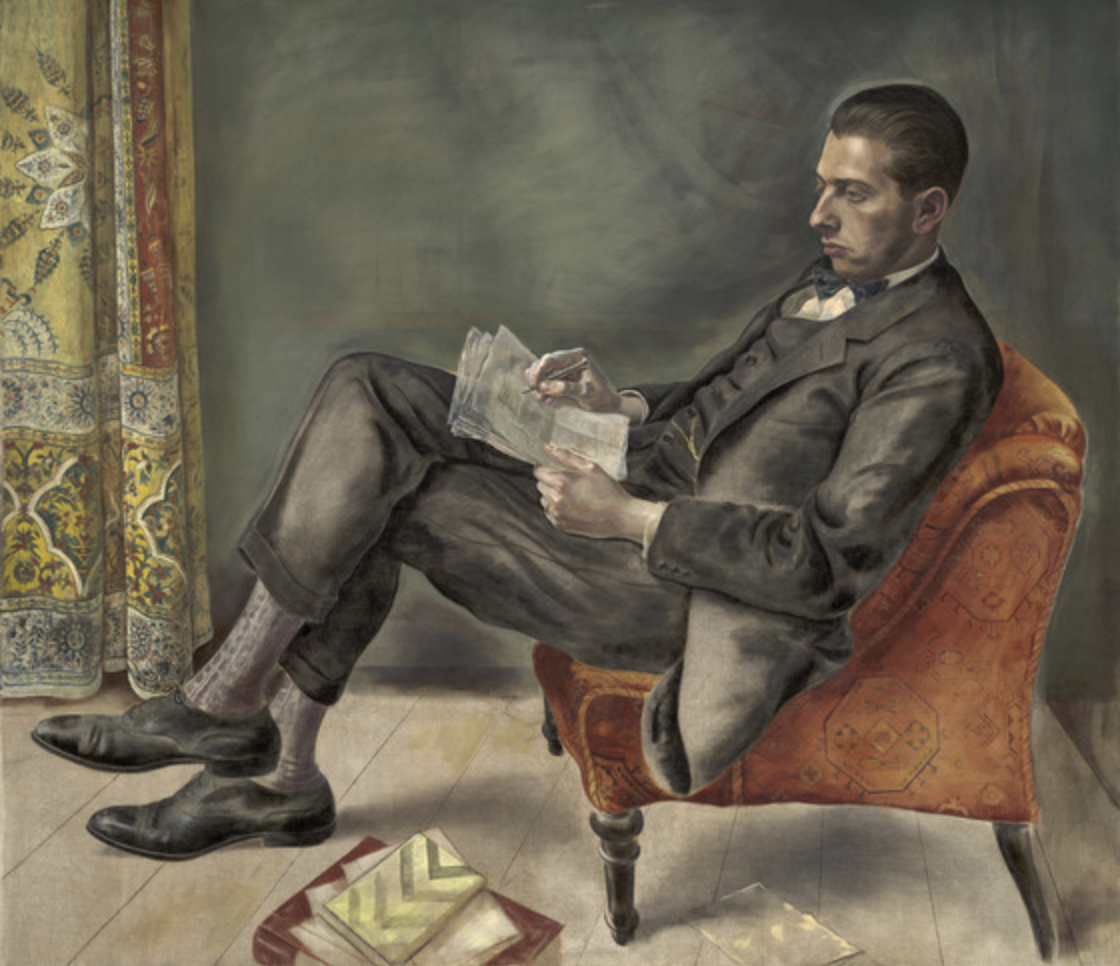
Portrait of Dr. Felix J. Weil
GEORGE GROSZ
Grosz rejected the expressionist spirit that was overtaking European art in the early decades of the 20th Century. He saw their style as self-involved, uncommitted to reality in its yearning for romantic ideals which could never be and resented the personality cults that the artists of the movements cultivated, willingly or not, around them. ‘The cult of individuality and personality, which promotes painters and poets only to promote itself, is really a business.”, he said, “The greater the 'genius' of the personage, the greater the profit.” Instead, Grosz was at the forefront of a style known as New Objectivism, which was about practical and honest engagement with the world, rid of pretentions or fancy instead the artists would try and represent the world as it appeared and find the art in the truthful imperfections around them. His portraiture came to define this style, austere and honest, he depicts people as they were, creating historical records that aspire to little more than the beauty of the everyday.
George Grosz
GEORGE GROSZ, 1926. OIL ON CANVAS.
Grosz rejected the expressionist spirit that was overtaking European art in the early decades of the 20th Century. He saw their style as self-involved, uncommitted to reality in its yearning for romantic ideals which could never be and resented the personality cults that the artists of the movements cultivated, willingly or not, around them. ‘The cult of individuality and personality, which promotes painters and poets only to promote itself, is really a business.”, he said, “The greater the 'genius' of the personage, the greater the profit.” Instead, Grosz was at the forefront of a style known as New Objectivism, which was about practical and honest engagement with the world, rid of pretentions or fancy instead the artists would try and represent the world as it appeared and find the art in the truthful imperfections around them. His portraiture came to define this style, austere and honest, he depicts people as they were, creating historical records that aspire to little more than the beauty of the everyday.