

Leda and the Swan
PAUL CÉZANNE
In Metamorphoses by Ovid, amongst the greatest of the Roman poets, the story of Leda and the swan is one of consensual eroticism. This is at odds with other accounts of the myth, where the level of consent in the relationship differs wildly, though all see Zeus take the shape of a swan and have sexual relations with Leda that result in children. Yet it was Ovid’s telling that took up favour in the Renaissance. This was not least because the depiction of erotic acts between humans was firmly forbidden and so the Roman story was a suitable vehicle for artists to express a human sexuality otherwise forbidden by the church. Cézanne, some centuries removed from this vogue, choses the same subject matter and for much the same reason. The most explicitly erotic paintings of his oeuvre, his rendering of Leda and the Swan is overtly sensual, with Leda’s hips turned towards the viewer and the swan wrapping around her wrist as his wings rise. Yet the painting speaks to classicism, and its eroticism is well dressed in a literary academia and rich in aesthetic value, Cézanne’s loose brushstrokes and subtle colours bringing a melancholy, erotic beauty to the scene that, nonetheless, feels a weight of historical context.
Paul Cézanne
PAUL CÉZANNE, c.1880. OIL ON CANVAS.
In Metamorphoses by Ovid, amongst the greatest of the Roman poets, the story of Leda and the swan is one of consensual eroticism. This is at odds with other accounts of the myth, where the level of consent in the relationship differs wildly, though all see Zeus take the shape of a swan and have sexual relations with Leda that result in children. Yet it was Ovid’s telling that took up favour in the Renaissance. This was not least because the depiction of erotic acts between humans was firmly forbidden and so the Roman story was a suitable vehicle for artists to express a human sexuality otherwise forbidden by the church. Cézanne, some centuries removed from this vogue, choses the same subject matter and for much the same reason. The most explicitly erotic paintings of his oeuvre, his rendering of Leda and the Swan is overtly sensual, with Leda’s hips turned towards the viewer and the swan wrapping around her wrist as his wings rise. Yet the painting speaks to classicism, and its eroticism is well dressed in a literary academia and rich in aesthetic value, Cézanne’s loose brushstrokes and subtle colours bringing a melancholy, erotic beauty to the scene that, nonetheless, feels a weight of historical context.

Head of a Woman
PABLO PICASSO
‘The masks weren’t like other kinds of sculptures’, said Picasso when talking about the African art that influenced and inspired him, ‘they were magical things’. It was this implacable power that most informed him, above any sense of visual order or identity, it was the way in which the masks pointed to a higher level of existence and seemed to understand the totality of humanity in all of its contradictions. So much of the earth-shaking revolution that Picasso would bring to the art world started out of this aspirational influence. As he further developed Cubism alongside Braque, for this is a particularly early work of the movement, the multiplicity of perspectives would get larger, more overt and more severe, but they all strove for the same goal that the African masks did almost effortlessly – capture the truth that life can never be truly seen from one perspective.
Pablo Picasso
PABLO PICASSO, 1907. OIL ON CANVAS.
‘The masks weren’t like other kinds of sculptures’, said Picasso when talking about the African art that influenced and inspired him, ‘they were magical things’. It was this implacable power that most informed him, above any sense of visual order or identity, it was the way in which the masks pointed to a higher level of existence and seemed to understand the totality of humanity in all of its contradictions. So much of the earth-shaking revolution that Picasso would bring to the art world started out of this aspirational influence. As he further developed Cubism alongside Braque, for this is a particularly early work of the movement, the multiplicity of perspectives would get larger, more overt and more severe, but they all strove for the same goal that the African masks did almost effortlessly – capture the truth that life can never be truly seen from one perspective.

Group of Trees
CHAIM SOUTINE
As German bombs fell on Paris, artists scattered to safety. Soutine, Amadeo Modigliani, and their dealer Leopold Zborowski fled to the south of France where they stayed for three years in the small town of Céret, a sharp contrast to the metropolitan life they had been used to in the capital. But the town proved invigorating for the group, and Soutine executed a series of turbulent landscapes that are at once beautiful and fearful, reflecting his exiled state and the prevalent sadness of the ensuing war. Violence seeps into every brushstroke and landscapes of the pastoral, rolling hills and thick woodlands come alive with a feeling of war. Here, a group of trees obscuring a town in the distance curl up like flames, moving with erratic freedom that engulfs the surrounding landscape. Background and foreground collapse into one as the view seems to morph into torment. In retreat, Soutine found peace in the land but none in his mind and his art reflected this duality, creating some of the most disquieting works of his career and showing how the pains of war seep into everything.
Chaim Soutine
CHAIM SOUTINE, c.1922. OIL ON CANVAS.
As German bombs fell on Paris, artists scattered to safety. Soutine, Amadeo Modigliani, and their dealer Leopold Zborowski fled to the south of France where they stayed for three years in the small town of Céret, a sharp contrast to the metropolitan life they had been used to in the capital. But the town proved invigorating for the group, and Soutine executed a series of turbulent landscapes that are at once beautiful and fearful, reflecting his exiled state and the prevalent sadness of the ensuing war. Violence seeps into every brushstroke and landscapes of the pastoral, rolling hills and thick woodlands come alive with a feeling of war. Here, a group of trees obscuring a town in the distance curl up like flames, moving with erratic freedom that engulfs the surrounding landscape. Background and foreground collapse into one as the view seems to morph into torment. In retreat, Soutine found peace in the land but none in his mind and his art reflected this duality, creating some of the most disquieting works of his career and showing how the pains of war seep into everything.

The Apparition
GUSTAVE MOREAU
Salome danced for King Herod, and was rewarded with any gift that her heart desired. Spurred by her mother, who harboured open resentment towards John the Baptist for his public reprove of her marriage to the king, Salome requested the head of the imprisoned prophet. Herod, regretful but true to his word, obliged. The story appears twice in the bible, though Salome remains unnamed in both, and it became a subject of desire, obsession and inspiration for hundreds of artists through the renaissance to modernity who depicted Salome and the scene in paint, stone and pencil. None, however, were quite like Moreau’s. In a setting of pure, indulgent opulence, where both the background and the figures are adorned in ornamentation and luxury, John’s head appears not on a platter but as an apparition, floating in a halo of light and gold as thick, rich blood drips from his neck. It is a deeply surreal scene, both erotic and disturbing in which we cannot know whether the apparition is a shared hallucination, a real appearance or purely the vision of Salome herself.
Gustave Moreau
GUSTAVE MOREAU, 1876. WATERCOLOR.
Salome danced for King Herod, and was rewarded with any gift that her heart desired. Spurred by her mother, who harboured open resentment towards John the Baptist for his public reprove of her marriage to the king, Salome requested the head of the imprisoned prophet. Herod, regretful but true to his word, obliged. The story appears twice in the bible, though Salome remains unnamed in both, and it became a subject of desire, obsession and inspiration for hundreds of artists through the renaissance to modernity who depicted Salome and the scene in paint, stone and pencil. None, however, were quite like Moreau’s. In a setting of pure, indulgent opulence, where both the background and the figures are adorned in ornamentation and luxury, John’s head appears not on a platter but as an apparition, floating in a halo of light and gold as thick, rich blood drips from his neck. It is a deeply surreal scene, both erotic and disturbing in which we cannot know whether the apparition is a shared hallucination, a real appearance or purely the vision of Salome herself.
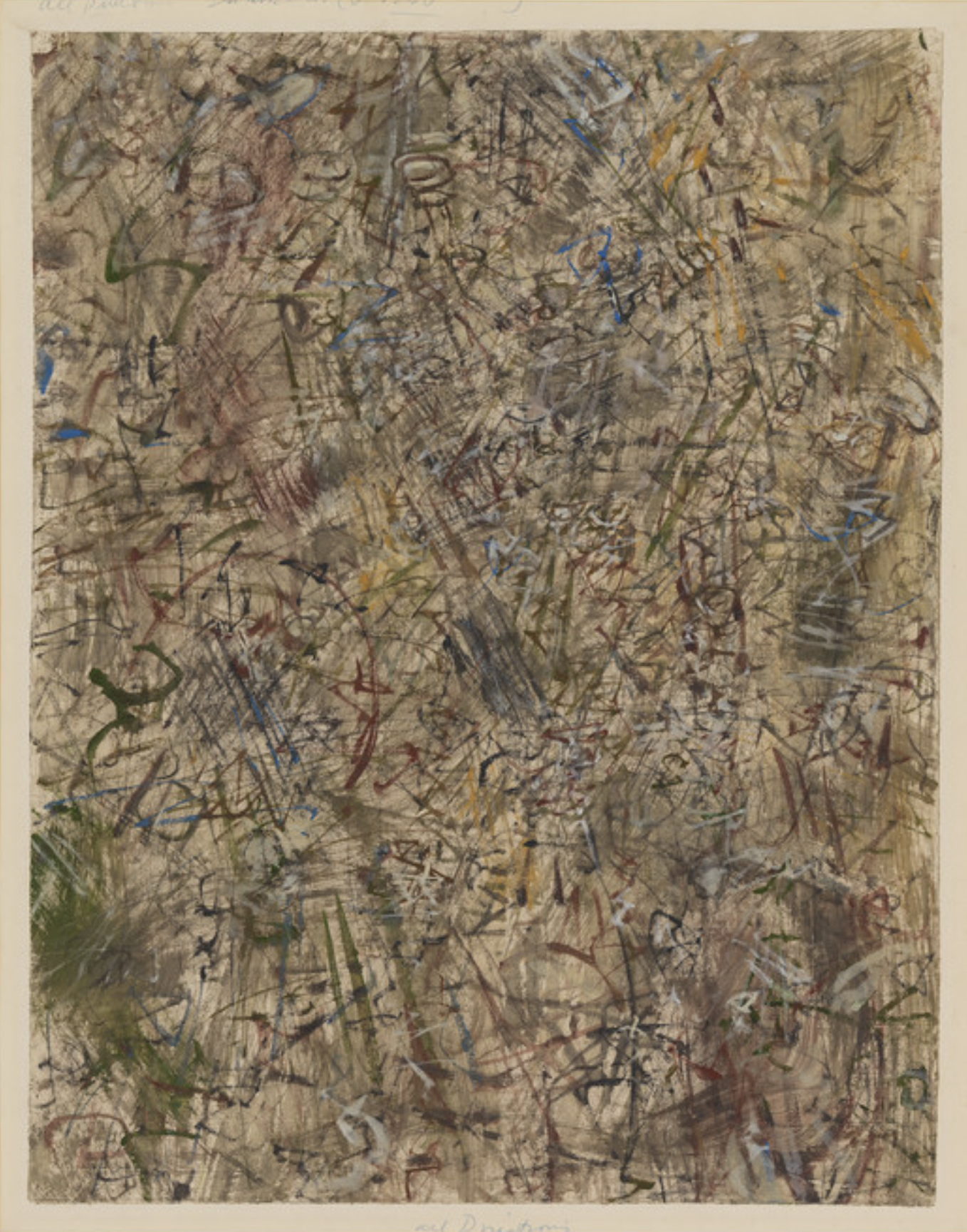
All Directions
MARK TOBEY
A mystic of the west coast and sage of Seattle, the paintings speak of a metaphysical oneness that can be achieved through art, faith and creation. Mark Tobey’s work cannot be understood outside of his prescription to the Baháʼí Faith, a spiritual religion that believes in the unity of all people outside of faith, nationality, race, or sex. All major religions are unified in their core beliefs, according to Bahá’i, but divergent in their social practices and interpretations and the world can only be prosperous when these groups come together. Tobey took up this faith in the early 1900s while travelling across Japan and China, where he also learnt traditional calligraphy and brushstroke styles. He pioneered ‘all-over’ painting, where the artwork is removed from the confines or composition and each inch is as valuable as the next, with no centre of information anywhere. Predating Pollock and the Abstract Expressionists who were deeply inspired by Tobey, his works reward deep looking that enters you into a world of remarkable peacefulness.
Mark Tobey
MARK TOBEY, 1957. TEMPERA ON PAPER.
A mystic of the west coast and sage of Seattle, the paintings speak of a metaphysical oneness that can be achieved through art, faith and creation. Mark Tobey’s work cannot be understood outside of his prescription to the Baháʼí Faith, a spiritual religion that believes in the unity of all people outside of faith, nationality, race, or sex. All major religions are unified in their core beliefs, according to Bahá’i, but divergent in their social practices and interpretations and the world can only be prosperous when these groups come together. Tobey took up this faith in the early 1900s while travelling across Japan and China, where he also learnt traditional calligraphy and brushstroke styles. He pioneered ‘all-over’ painting, where the artwork is removed from the confines or composition and each inch is as valuable as the next, with no centre of information anywhere. Predating Pollock and the Abstract Expressionists who were deeply inspired by Tobey, his works reward deep looking that enters you into a world of remarkable peacefulness.

The Water Urn
JEAN-SIMÉON CHARDIN
In an era of grandeur, Chardin turned his talents to the mundane. Large, dramatic historical scenes were prized by the academic painters of his contemporary France, and shown across the country by institutions who saw the past as an essential subject matter of value. The works were large, depicting battles, mythologies, and morals meant to stir patriotism and contemplation. Chardin rejected this idea not just in the size of his works, far smaller in scale and presentation, but in his compositional choices and the very scenes he chose to depict. Considered one of the greatest still-life painters of his generation, he was equally regarded in his genre scenes that showed maids, chefs, and the ‘back-of-house’ kept private from the eyes of the aristocracy and artistic elite. His paintings show daily life, paying respect to duty and to labour by depicting it with care and diligence. The scenes are not dramatic, though they are compositionally immaculate, but the figures are beautiful and the reverence to his subjects is clear in each brushstroke.
Jean-Siméon Chardin
JEAN-SIMÉON CHARDIN, c.1736. OIL ON WOOD PANEL.
In an era of grandeur, Chardin turned his talents to the mundane. Large, dramatic historical scenes were prized by the academic painters of his contemporary France, and shown across the country by institutions who saw the past as an essential subject matter of value. The works were large, depicting battles, mythologies, and morals meant to stir patriotism and contemplation. Chardin rejected this idea not just in the size of his works, far smaller in scale and presentation, but in his compositional choices and the very scenes he chose to depict. Considered one of the greatest still-life painters of his generation, he was equally regarded in his genre scenes that showed maids, chefs, and the ‘back-of-house’ kept private from the eyes of the aristocracy and artistic elite. His paintings show daily life, paying respect to duty and to labour by depicting it with care and diligence. The scenes are not dramatic, though they are compositionally immaculate, but the figures are beautiful and the reverence to his subjects is clear in each brushstroke.

The Disks
FERNAND LÉGER
Léger’s paintings are not abstract. Though they do not seek to imitate life, they create an equivalence to it, a modern view of a modern matter that reveals truth and accuracy in it’s portrayal with each deepening look. Years working in the French Engineer Corps during the war introduced the artist to the cutting edge of technology and mechanisation, and he understood that modernity was most readily expressed through these mediums. Léger saw an inevitability to the confluence of man and technology, as modern advancements changed the look of the world, so too would they change the make up of humans and his paintings are more accurate to the experience of burgeoning modernity than any photorealistic work. The men if the left of this painting disappear into the cogs and machines, inseparable and indistinguishable from the metal that moves around them, save for their pronounced greyness in the face of bright colours. The war had only just ended and Léger did not see the world he depicted as a utopia, he saw it simply as a state of the present, and of things to come.
Fernand Léger
FERNAND LÉGER, 1918. OIL ON CANVAS.
Léger’s paintings are not abstract. Though they do not seek to imitate life, they create an equivalence to it, a modern view of a modern matter that reveals truth and accuracy in it’s portrayal with each deepening look. Years working in the French Engineer Corps during the war introduced the artist to the cutting edge of technology and mechanisation, and he understood that modernity was most readily expressed through these mediums. Léger saw an inevitability to the confluence of man and technology, as modern advancements changed the look of the world, so too would they change the make up of humans and his paintings are more accurate to the experience of burgeoning modernity than any photorealistic work. The men if the left of this painting disappear into the cogs and machines, inseparable and indistinguishable from the metal that moves around them, save for their pronounced greyness in the face of bright colours. The war had only just ended and Léger did not see the world he depicted as a utopia, he saw it simply as a state of the present, and of things to come.

The Joy of Life
HENRI MATISSE
One of the foundational pillars of early modernism, Matisse’s monumental canvas ‘The Joy of Life’ contains within it the past, the present, and the future. The past, in its lush pastoral setting and compositional similarities to an Italian Renaissance print by the great Agostino Carracci and an earlier Flemish painting by Paolo Fiammingo. The present, in its spatial distortions, flattening of dimensions and cadmium colours that rejected the conservative malaise of the day, causing outrage and offence when it was shown at the Salon des Indépendants in 1906. Together with Picasso’s ‘Les Demoiselles D’Avignon’, it created a new language of European painting that came to define the art history of the 20th Century. And the future, for within the painting is the origins of another of Matisse’s masterpieces. In the centre, furthest from the viewer, is a group of dancers who, three years later, would take centre stage in Matisse’s most well-known work ‘The Dance’. Matisse hid one seminal work inside another, anticipating the direction that he and the European artistic canon would move.
Henri Matisse
HENRI MATISSE, c.1905. OIL ON CANVAS.
One of the foundational pillars of early modernism, Matisse’s monumental canvas ‘The Joy of Life’ contains within it the past, the present, and the future. The past, in its lush pastoral setting and compositional similarities to an Italian Renaissance print by the great Agostino Carracci and an earlier Flemish painting by Paolo Fiammingo. The present, in its spatial distortions, flattening of dimensions and cadmium colours that rejected the conservative malaise of the day, causing outrage and offence when it was shown at the Salon des Indépendants in 1906. Together with Picasso’s ‘Les Demoiselles D’Avignon’, it created a new language of European painting that came to define the art history of the 20th Century. And the future, for within the painting is the origins of another of Matisse’s masterpieces. In the centre, furthest from the viewer, is a group of dancers who, three years later, would take centre stage in Matisse’s most well-known work ‘The Dance’. Matisse hid one seminal work inside another, anticipating the direction that he and the European artistic canon would move.

Self Portrait
WILLIAM GLACKENS
Painting at a time when the conventions of aesthetic beauty were tightly controlled by institutional forces, Glackens, along with a group of 7 artist who together were known as ‘The Eight’, defied convention to highlight their own understanding of beauty. Informed by European impressionism, they focused on realist and gritty scenes of urban life, especially in New York where most were based, to rail against the conservatism that dominated the American painterly movement at the time. Painted when the artist was 38, this self-portrait presents the artist with a knowing gaze, each brushstroke seemingly moving in a different direction to the last so that the painter’s hand is evident in every square inch of the canvas. It is, in some ways, a rallying cry against the vogue of the day, more energetic portrayals of life and a celebration of the inelegance and imperfection of existence than with the modernist techniques of the day.
William Glackens
WILLIAM GLACKENS, 1908. OIL ON CANVAS.
Painting at a time when the conventions of aesthetic beauty were tightly controlled by institutional forces, Glackens, along with a group of 7 artist who together were known as ‘The Eight’, defied convention to highlight their own understanding of beauty. Informed by European impressionism, they focused on realist and gritty scenes of urban life, especially in New York where most were based, to rail against the conservatism that dominated the American painterly movement at the time. Painted when the artist was 38, this self-portrait presents the artist with a knowing gaze, each brushstroke seemingly moving in a different direction to the last so that the painter’s hand is evident in every square inch of the canvas. It is, in some ways, a rallying cry against the vogue of the day, more energetic portrayals of life and a celebration of the inelegance and imperfection of existence than with the modernist techniques of the day.

The Storm on the Sea of Galilee
REMBRANDT VAN RIJN
In tumultuous waters, Christ’s disciples wrestle with their fishing boat to gain central back from the heavy storm that confronts them. They pull at the sails, adjust the rigging in anxious actions while others cower and hold on for dear life. One figure vomits overboard while another, a hidden self-portrait of the artist, looks directly at the viewer with a fearful gaze. Only Christ, bathed in unnatural light despite an otherwise accurately observed scene, remains calm, and his disciples gather around and look to him for salvation and hope. The scene is true to the Bible in most ways, depicting the titular story when the scared disciples woke Jesus in a panic as their fishing boat faced imminent danger, only for him to calm the storm with his commands and reprimand the disciples for their lack of faith. It is the earliest painting by Rembrandt, and his only seascape, despite a vogue for the motif in his contemporary Netherlands. That Rembrandt chose this story for such a significant painting is telling – he is a disciple regaining faith, aware of the battle ahead but sure that his artwork can calm any storm he faces.
Rembrandt van Rijn
REMBRANDT VAN RIJN, 1633. OIL ON CANVAS.
In tumultuous waters, Christ’s disciples wrestle with their fishing boat to gain central back from the heavy storm that confronts them. They pull at the sails, adjust the rigging in anxious actions while others cower and hold on for dear life. One figure vomits overboard while another, a hidden self-portrait of the artist, looks directly at the viewer with a fearful gaze. Only Christ, bathed in unnatural light despite an otherwise accurately observed scene, remains calm, and his disciples gather around and look to him for salvation and hope. The scene is true to the Bible in most ways, depicting the titular story when the scared disciples woke Jesus in a panic as their fishing boat faced imminent danger, only for him to calm the storm with his commands and reprimand the disciples for their lack of faith. It is the earliest painting by Rembrandt, and his only seascape, despite a vogue for the motif in his contemporary Netherlands. That Rembrandt chose this story for such a significant painting is telling – he is a disciple regaining faith, aware of the battle ahead but sure that his artwork can calm any storm he faces.

The Unique Eunuch Ivy
FRANCIS PICABIA
Starting in 1915, Francis Picabia began to paint portraits of his circle of friends as various machines and mechanical devises. Figures of the avant-garde circle became lamps, engine parts, pulleys and cameras, rendered in clinical diagrammatic lines and playful forms. By 1920, having completed hundreds of these unorthodox portraits known as Mechanomorphs, Picabia abandoned the straight edge precision and rigorous rationality of the series. Instead, the machine parts have melted down and morphed into free-form amorphous objects that resemble single cell organisms as much as they do production line objects. Rendered in metallic silver paint and slick enamel, the means of production still speak to the factory, even if the objects they depict do not. The title too moves the portraits away from the knoweable and into the fantastic imaginary, the unique eunuch an almost impossible figure of Picabia’s creation. Replete with wit as his works were, this painting also features the hallmark of Machine Co., an invented corporation that pokes fun at the natural form of the shapes on display and the overtly human hand present in their creation.
Francis Picabia
FRANCIS PICABIA, 1920.
Starting in 1915, Francis Picabia began to paint portraits of his circle of friends as various machines and mechanical devises. Figures of the avant-garde circle became lamps, engine parts, pulleys and cameras, rendered in clinical diagrammatic lines and playful forms. By 1920, having completed hundreds of these unorthodox portraits known as Mechanomorphs, Picabia abandoned the straight edge precision and rigorous rationality of the series. Instead, the machine parts have melted down and morphed into free-form amorphous objects that resemble single cell organisms as much as they do production line objects. Rendered in metallic silver paint and slick enamel, the means of production still speak to the factory, even if the objects they depict do not. The title too moves the portraits away from the knoweable and into the fantastic imaginary, the unique eunuch an almost impossible figure of Picabia’s creation. Replete with wit as his works were, this painting also features the hallmark of Machine Co., an invented corporation that pokes fun at the natural form of the shapes on display and the overtly human hand present in their creation.

The Ribalds
HONORÉ DAUMIER
A prolific artist and a professional caricaturist, these two pursuits, which to Daumier seemed hardly worth distinguishing, were at odds with each other in the public eye. Born into a working-class family, Daumier worked tirelessly from the age of 12 training as an artist and developing a keen eye for the details of society and a revolutionary witticism. By 20 he was producing caricatures for satirical political papers and was arrested for his unflattering depictions of the King Louis Philippe I. This brought with it renown and favour, his works were seen by many and well admired across society yet when he tried to show his paintings and his work as a fine artist, he was rejected almost outright for stepping out of his lane. Few recognised his artistic brilliance and saw his value only as a caricaturist. In the final year of his life, a solo show of his work was shown and, in the months before he died, he received the recognition that had been kept from him.
Honoré Daumier
HONORÉ DAUMIER, 1848. OIL ON CANVAS.
A prolific artist and a professional caricaturist, these two pursuits, which to Daumier seemed hardly worth distinguishing, were at odds with each other in the public eye. Born into a working-class family, Daumier worked tirelessly from the age of 12 training as an artist and developing a keen eye for the details of society and a revolutionary witticism. By 20 he was producing caricatures for satirical political papers and was arrested for his unflattering depictions of the King Louis Philippe I. This brought with it renown and favour, his works were seen by many and well admired across society yet when he tried to show his paintings and his work as a fine artist, he was rejected almost outright for stepping out of his lane. Few recognised his artistic brilliance and saw his value only as a caricaturist. In the final year of his life, a solo show of his work was shown and, in the months before he died, he received the recognition that had been kept from him.

Bowl, Figs, and Apples
PIERRE-AUGUSTE RENOIR
More than eight hundred canvases were left in the artist’s studio after his death, in various stages of completion, and this was one of them. Cut from a larger study that contained multiple variations of a similar composition, this small rectangular still life was mounted alone as a work worthy of its own frame. The fruit seems almost alive, so ripe and ready to eat that each individual fig and apple casts a halo of freshness around itself as if inviting the viewer to reach through the oil and grab it. All of which is in sharp contrast to the dainty porcelain of the bowl in the middle, the handles protruding with delicacy outwards to the scene of objects it cannot hold. When Renoir painted this work, his arthritis had become debilitating and his technique was a world away from the one he had used as a young man. The vivid and broad brushstrokes came not, initially, from aesthetic choice but from necessity as it changed his visual language to one he was physically able to achieve. Yet the strange paradox at the heart of it seems to be that as Renoir aged, his works took on a vitality and virility that imbues them with youth and energy far above any of his earlier paintings.
Pierre-Auguste Renoir
AUGUSTE RENOIR, 1916. OIL ON CANVAS.
More than eight hundred canvases were left in the artist’s studio after his death, in various stages of completion, and this was one of them. Cut from a larger study that contained multiple variations of a similar composition, this small rectangular still life was mounted alone as a work worthy of its own frame. The fruit seems almost alive, so ripe and ready to eat that each individual fig and apple casts a halo of freshness around itself as if inviting the viewer to reach through the oil and grab it. All of which is in sharp contrast to the dainty porcelain of the bowl in the middle, the handles protruding with delicacy outwards to the scene of objects it cannot hold. When Renoir painted this work, his arthritis had become debilitating and his technique was a world away from the one he had used as a young man. The vivid and broad brushstrokes came not, initially, from aesthetic choice but from necessity as it changed his visual language to one he was physically able to achieve. Yet the strange paradox at the heart of it seems to be that as Renoir aged, his works took on a vitality and virility that imbues them with youth and energy far above any of his earlier paintings.

A Montrouge
HENRI DE TOULOUSE-LAUTREC
Born into aristocracy but shunned for his disabilities, Toulouse-Lautrec retreated into the underbelly of society, and shone a light on the darkness of glamour at the heart of Paris. In the Cabaret shows that he frequented, alongside a group of outcasts, hustlers, performers and runaways, one of the performers sung stories of the character Rosa La Rouge. A murderous prostitute who tormented Paris, this fictional figure became embedded in Toulouse-Lautrec’s mind and he painted her here, using his favourite model Carmen Gaudin. He works like a filmmaker, capturing her in movement and motion, her hair obscuring her eyes and a sharp chin that points outward menacingly. There is little judgement in the oil, but nor is there celebration; his imagined image of this maligned figure is treated with dignity and respect. The painting hung in the same nightclub that the Cabarets featuring La Rouge were performed in, the large scale of the work haunting the venue like a spectre.
Henri de Toulouse-Lautrec
HENRI DE TOULOUSE-LAUTREC, 1886. OIL ON CANVAS.
Born into aristocracy but shunned for his disabilities, Toulouse-Lautrec retreated into the underbelly of society, and shone a light on the darkness of glamour at the heart of Paris. In the Cabaret shows that he frequented, alongside a group of outcasts, hustlers, performers and runaways, one of the performers sung stories of the character Rosa La Rouge. A murderous prostitute who tormented Paris, this fictional figure became embedded in Toulouse-Lautrec’s mind and he painted her here, using his favourite model Carmen Gaudin. He works like a filmmaker, capturing her in movement and motion, her hair obscuring her eyes and a sharp chin that points outward menacingly. There is little judgement in the oil, but nor is there celebration; his imagined image of this maligned figure is treated with dignity and respect. The painting hung in the same nightclub that the Cabarets featuring La Rouge were performed in, the large scale of the work haunting the venue like a spectre.

Prìere Eclair de Soir
MARCEL JANCO
As one of the founders of Dada, alongside a group of 5 other artists living in Zurich during the first world war, Janco had abilities of creation that had not yet been invented. Joined by his brothers from their native Romania, he upturned the European consciousness with works of absurdism and chaos, fighting against a logic of rationality that seemed to imprison the youth in a life that hardly felt living. Yet, not 4 years after the founding of the group, Janco and his co-founder Hans Arp abandoned the movement to spread the word of Constructivism across Eastern Europe. In doing so he traded a rejection of the institutional ways of thinking that were still impacting contemporary life to a total embrace of hyper-modernity, and a way of creating that was not meant to be in rebellion to but in reflection of the modern age. This plaster relief was made only a few months before this dissent, and the constructivist influence is already clear, with sharp angular lines that pierce and aspire to perfection, but the Dada is in him too with a composition that warps perspective and ignores the laws of nature.
Marcel Janco
MARCEL JANCO, 1918. PLASTER RELIEF.
As one of the founders of Dada, alongside a group of 5 other artists living in Zurich during the first world war, Janco had abilities of creation that had not yet been invented. Joined by his brothers from their native Romania, he upturned the European consciousness with works of absurdism and chaos, fighting against a logic of rationality that seemed to imprison the youth in a life that hardly felt living. Yet, not 4 years after the founding of the group, Janco and his co-founder Hans Arp abandoned the movement to spread the word of Constructivism across Eastern Europe. In doing so he traded a rejection of the institutional ways of thinking that were still impacting contemporary life to a total embrace of hyper-modernity, and a way of creating that was not meant to be in rebellion to but in reflection of the modern age. This plaster relief was made only a few months before this dissent, and the constructivist influence is already clear, with sharp angular lines that pierce and aspire to perfection, but the Dada is in him too with a composition that warps perspective and ignores the laws of nature.

Jeremiah Lamenting the Destruction of Jerusalem
REMBRANDT VAN RIJN
Misery came not from surprise but from knowledge. The prophet Jeremiah had foreseen the destruction of Jerusalem and had urged penitence on behalf of those whose sinfulness was the root cause of the inevitable siege. Yet his calls had not been heeded, and that what he had foreseen came to light brought no satisfaction, only the sadness that he could not have changed the fate he saw in his visions. Rembrandt depicts him here as old and world-weary, having received the prophesies as a young man it is as if the weight of his knowing has taken its toll. He sits alone, the drama heightened by stark contrasts between the light and dark, and he appears as a solitary figure, made so by the unique knowledge of the future he was given by god. The riches in front of him offer no solace, and Rembrandt’s ode to this reluctant prophet is one of deep empathy, his personal suffering becomes analogous to that of Jerusalem.
Rembrandt van Rijn
REMBRANDT VAN RIJN, 1630. OIL ON PANEL.
Misery came not from surprise but from knowledge. The prophet Jeremiah had foreseen the destruction of Jerusalem and had urged penitence on behalf of those whose sinfulness was the root cause of the inevitable siege. Yet his calls had not been heeded, and that what he had foreseen came to light brought no satisfaction, only the sadness that he could not have changed the fate he saw in his visions. Rembrandt depicts him here as old and world-weary, having received the prophesies as a young man it is as if the weight of his knowing has taken its toll. He sits alone, the drama heightened by stark contrasts between the light and dark, and he appears as a solitary figure, made so by the unique knowledge of the future he was given by god. The riches in front of him offer no solace, and Rembrandt’s ode to this reluctant prophet is one of deep empathy, his personal suffering becomes analogous to that of Jerusalem.

The Studio Boat
CLAUDE MONET
Monet put himself in the picture and broke a cardinal rule of the movement he had created. Though Impressionism did not attempt to replicate life, it valued the subjective truth of observation above all else, with an intense focus on light and colour to portray the titular ‘impression’ of the scene being painted. Here, Monet works en plein air, the act of painting outdoors, to capture the soft hues of the Siene in situ, playing with the light so exactly that we can sense the hour of the day in which he was painting. These works were not unusual in his oeuvre, his Siene paintings are numerous and the studio boat depicted was purchased by him in order to allow him to get greater views from which to execute a greater number of these works. Yet, in this painting, Money depicts himself in the studio boat he paints, betraying his observation with a depiction he could only imagine. He places himself in the centre of the scene, emphasising the creative role of the artist and the autonomy of painting as an act made by the individual.
Claude Monet
CLAUDE MONET, 1876. OIL ON CANVAS.
Monet put himself in the picture and broke a cardinal rule of the movement he had created. Though Impressionism did not attempt to replicate life, it valued the subjective truth of observation above all else, with an intense focus on light and colour to portray the titular ‘impression’ of the scene being painted. Here, Monet works en plein air, the act of painting outdoors, to capture the soft hues of the Siene in situ, playing with the light so exactly that we can sense the hour of the day in which he was painting. These works were not unusual in his oeuvre, his Siene paintings are numerous and the studio boat depicted was purchased by him in order to allow him to get greater views from which to execute a greater number of these works. Yet, in this painting, Money depicts himself in the studio boat he paints, betraying his observation with a depiction he could only imagine. He places himself in the centre of the scene, emphasising the creative role of the artist and the autonomy of painting as an act made by the individual.

Group of Women
JOAN MIRO
Abstract screams ring across a smoky landscape. Bright colors try to break through, being choked by darkness that swirl around them leaving only the ghost of their presence behind. The figures reveal little of their origin, anthropomorphic shapes that exist in a nether-world of nature, changing species with each observation – save for the unmistakable mouth of a human that forms the central focus of this work. She is a woman, and she screams towards the sky in desperation in agony as the bombs of the Spanish civil war fall around her. Picasso had revealed Guernica, his masterpiece in protest of the same war, the previous year, and the pose of Miró’s screaming women matches almost perfectly that of a horse in the right of Picasso’s work. An almost unclassifiable artist, Miró’s work veered between surrealism, fauvism, and expressionism but remained always uniquely his own. Often childlike and plumbing the depths of his subconscious, this work oozes with a tragedy and darkness quite unusual for the artist known for his playful, witty works.
Joan Miró
JOAN MIRÓ, 1938. OIL ON CANVAS.
Abstract screams ring across a smoky landscape. Bright colors try to break through, being choked by darkness that swirl around them leaving only the ghost of their presence behind. The figures reveal little of their origin, anthropomorphic shapes that exist in a nether-world of nature, changing species with each observation – save for the unmistakable mouth of a human that forms the central focus of this work. She is a woman, and she screams towards the sky in desperation in agony as the bombs of the Spanish civil war fall around her. Picasso had revealed Guernica, his masterpiece in protest of the same war, the previous year, and the pose of Miró’s screaming women matches almost perfectly that of a horse in the right of Picasso’s work. An almost unclassifiable artist, Miró’s work veered between surrealism, fauvism, and expressionism but remained always uniquely his own. Often childlike and plumbing the depths of his subconscious, this work oozes with a tragedy and darkness quite unusual for the artist known for his playful, witty works.
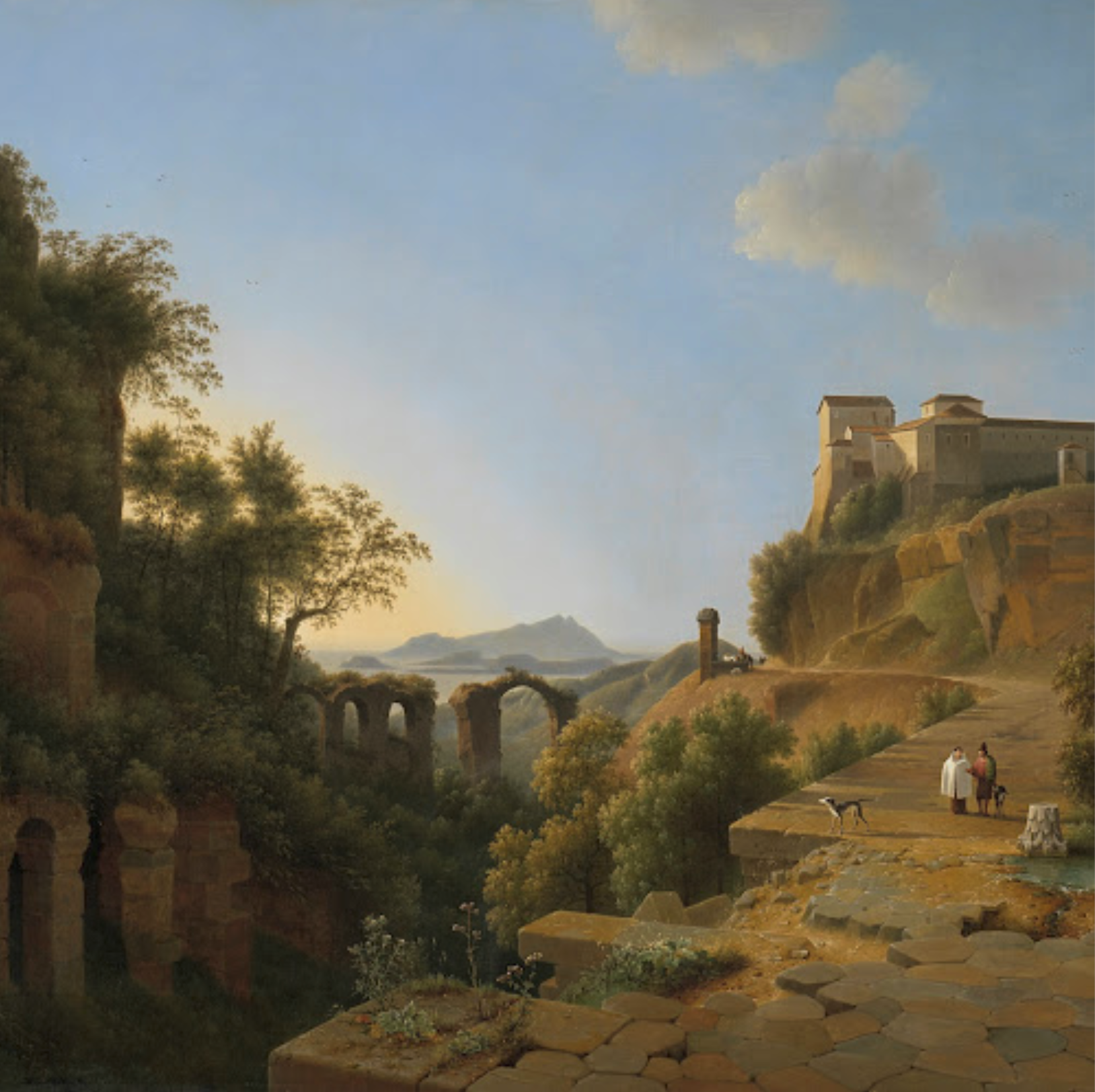
The Gulf of Naples with the Island of Ischia in the Distance
JOSEPHINUS AUGUSTUS KNIP
For three years, the Dutch painter Josephus Augustus Knip lived in Rome, and would frequently travel around Italy to visit sites of historical importance and natural beauty. He painted watercolours during this time, and made constant sketches of his surroundings, depicting the soaring Italian landscape and the crumbling beauty of its ancient structures. Having worked as the court artist for Napoleon III, these Italian works were modest in comparison to his previous oeuvre, being prepared and finished on card, paper and panels, and being executed exclusively in pencil and watercolour. Yet, when he returned to the Netherlands, he used these sketches to paint more soaring, significant works such as this. The landscape depicted here is imaginary, yet grounded in pure observation. Knip collapses hundreds of miles and thousands of years into a single painting, depicting the coastline of Naples, with the island of Ischia and the volcano Epomeo in the background, but incorporates the ruins of buildings in Rome and rural Italy, with the remnants of the coliseum on the left and Nero’s aqueducts in the middle. It is an ode to the country in a simple square, a flattening of time and place into pure, joyous aesthetics.
Josephinus Augustus Knip
JOSEPHINUS AUGUSTUS KNIP, 1818. OIL ON CANVAS.
For three years, the Dutch painter Josephus Augustus Knip lived in Rome, and would frequently travel around Italy to visit sites of historical importance and natural beauty. He painted watercolours during this time, and made constant sketches of his surroundings, depicting the soaring Italian landscape and the crumbling beauty of its ancient structures. Having worked as the court artist for Napoleon III, these Italian works were modest in comparison to his previous oeuvre, being prepared and finished on card, paper and panels, and being executed exclusively in pencil and watercolour. Yet, when he returned to the Netherlands, he used these sketches to paint more soaring, significant works such as this. The landscape depicted here is imaginary, yet grounded in pure observation. Knip collapses hundreds of miles and thousands of years into a single painting, depicting the coastline of Naples, with the island of Ischia and the volcano Epomeo in the background, but incorporates the ruins of buildings in Rome and rural Italy, with the remnants of the coliseum on the left and Nero’s aqueducts in the middle. It is an ode to the country in a simple square, a flattening of time and place into pure, joyous aesthetics.

Pleasing Numbers
GIACOMO BALLA
While his contemporaries depicted their ideas of movement through violence, machines, and the violence of machines, Balla explored it with a lightness of touch, a sense of beauty and whimsy in the word and a pervading witticism. A leading Italian Futurist, a movement which as the name suggests was concerned with the dynamism of the hyper-modern, it’s speed, youth, automation and movement, Balla embraced the central philosophies of the movement while implicitly rejecting the sanctioned approach. He instead saw modernity as not something to be feared, not something lacking humanity in the face of machines but instead found the idiosyncrasies of the everyday experience and depicted them through the cerebral ideas of the contemporary age. In his depiction of numbers, Balla brought the warmth of the human and the beauty of imperfection to the great signifiers of rationality and objectivity. His title is revealing, by bringing mathematics into art, it not only helps the latter but makes the former pleasing, freeing them from the confines of their need for perfection.
Giacomo Balla
GIACOMO BALLA, 1919. OIL ON CANVAS.
While his contemporaries depicted their ideas of movement through violence, machines, and the violence of machines, Balla explored it with a lightness of touch, a sense of beauty and whimsy in the word and a pervading witticism. A leading Italian Futurist, a movement which as the name suggests was concerned with the dynamism of the hyper-modern, it’s speed, youth, automation and movement, Balla embraced the central philosophies of the movement while implicitly rejecting the sanctioned approach. He instead saw modernity as not something to be feared, not something lacking humanity in the face of machines but instead found the idiosyncrasies of the everyday experience and depicted them through the cerebral ideas of the contemporary age. In his depiction of numbers, Balla brought the warmth of the human and the beauty of imperfection to the great signifiers of rationality and objectivity. His title is revealing, by bringing mathematics into art, it not only helps the latter but makes the former pleasing, freeing them from the confines of their need for perfection.