

Young Mother Sewing
CASSATT
Cassatt was in the first generation of ‘New Women’, riding the waves of early 19th century feminism to universities and freedom. The only American impressionist, she had a close, likely platonic, relationship with Degas, each fuelling, critiquing and improving the other. Yet, after 10 years with the group, she abandoned him and the movement. Cassatt was fiercely independent, across every element of her life, and she resisted the constraints of working within a group of artists. Instead, she turned her eye to the domestic, feminine scenes she saw around her. The latter years of her life were dedicated to painting scenes of mothers and daughters – dignified and quiet, without drama or politics, they are contemporary versions of renaissance compositions, Madonna and Child updated to the tribulations of contemporary motherhood.
Mary Cassatt
MARY CASSATT, 1900. OIL ON CANVAS.
Cassatt was in the first generation of ‘New Women’, riding the waves of early 19th century feminism to universities and freedom. The only American impressionist, she had a close, likely platonic, relationship with Degas, each fuelling, critiquing and improving the other. Yet, after 10 years with the group, she abandoned him and the movement. Cassatt was fiercely independent, across every element of her life, and she resisted the constraints of working within a group of artists. Instead, she turned her eye to the domestic, feminine scenes she saw around her. The latter years of her life were dedicated to painting scenes of mothers and daughters – dignified and quiet, without drama or politics, they are contemporary versions of renaissance compositions, Madonna and Child updated to the tribulations of contemporary motherhood.

Easter Monday
DE KOONING
So named for the day it was completed, Easter Monday is an abstract representation of urbanity and a masterpiece of De Kooning’s gestural style. An underlayer of newsprint is all but obscured by sparring colours and forms, seemingly fighting for space on the canvas with each brushstroke evidence of an emotional reaction. It makes up a series of 10 large scale works De Kooning exhibited the spring of its creation, and of all of its counterparts it feels the most like its season. A work exploring decay and regeneration, over a literal backdrop of media and information, it captures something of spring in the city, the heat starting to rise, life re-entering in anger and dialogue that brings destruction with it.
Willem De Kooning
WILLEM DE KOONING, 1956. OIL AND NEWSPAPER TRANSFER ON CANVAS.
So named for the day it was completed, Easter Monday is an abstract representation of urbanity and a masterpiece of De Kooning’s gestural style. An underlayer of newsprint is all but obscured by sparring colours and forms, seemingly fighting for space on the canvas with each brushstroke evidence of an emotional reaction. It makes up a series of 10 large scale works De Kooning exhibited the spring of its creation, and of all of its counterparts it feels the most like its season. A work exploring decay and regeneration, over a literal backdrop of media and information, it captures something of spring in the city, the heat starting to rise, life re-entering in anger and dialogue that brings destruction with it.

The Beeches
DURAND
What should art aspire to? This was the question Durand was dealing with when he painted The Beeches. His work before had an emphasis on drama, on creating narrative scenes that were visually striking but told a compelling story within the aesthetics. A part of the Hudson River School of artists, Durand adapted as they did and the Beeches marked a departure to a new style of painting that his contemporaries would follow. He began to be more truthful to nature, to see the role of art as creating a mood, and a mood of tranquillity at that. Sublime drama and expression fell away to naturalistic representation, and the ability to get lost not in a story but in a place, a scene, and to leave it with different eyes than you arrived with.
Asher Brown Durand
ASHER BROWN DURAND, 1845. OIL ON CANVAS.
What should art aspire to? This was the question Durand was dealing with when he painted The Beeches. His work before had an emphasis on drama, on creating narrative scenes that were visually striking but told a compelling story within the aesthetics. A part of the Hudson River School of artists, Durand adapted as they did and the Beeches marked a departure to a new style of painting that his contemporaries would follow. He began to be more truthful to nature, to see the role of art as creating a mood, and a mood of tranquillity at that. Sublime drama and expression fell away to naturalistic representation, and the ability to get lost not in a story but in a place, a scene, and to leave it with different eyes than you arrived with.

Elegy to the Spanish Republic No. 70
MOTHERWELL
More than 100 paintings, each one a lament for what was lost after the Spanish Civil War. Rough, visceral black ovoid forms cover each canvas, while stark white rectangles rhythmically divide the space. They are an extended meditation on life and death, inspired in equal parts by contemporary poetry, surrealism and history. Motherwell employed the use of automatism, allowing his subconscious self to control the paint. He transmitted his emotions unfiltered onto canvas, the fury and frustration with the war and the hope he felt for life ahead dance in jagged dialogue. For Motherwell, the "Elegies" serve as a personal testament to the tragedy of war, a reminder that such profound loss should never be forgotten. Yet, beyond their specific historical context, they also function as universal symbols, exploring the eternal contrast between life and death and their intricate interplay.
Robert Motherwell
ROBERT MOTHERWELL, 1961. OIL ON CANVAS.
More than 100 paintings, each one a lament for what was lost after the Spanish Civil War. Rough, visceral black ovoid forms cover each canvas, while stark white rectangles rhythmically divide the space. They are an extended meditation on life and death, inspired in equal parts by contemporary poetry, surrealism and history. Motherwell employed the use of automatism, allowing his subconscious self to control the paint. He transmitted his emotions unfiltered onto canvas, the fury and frustration with the war and the hope he felt for life ahead dance in jagged dialogue. For Motherwell, the "Elegies" serve as a personal testament to the tragedy of war, a reminder that such profound loss should never be forgotten. Yet, beyond their specific historical context, they also function as universal symbols, exploring the eternal contrast between life and death and their intricate interplay.
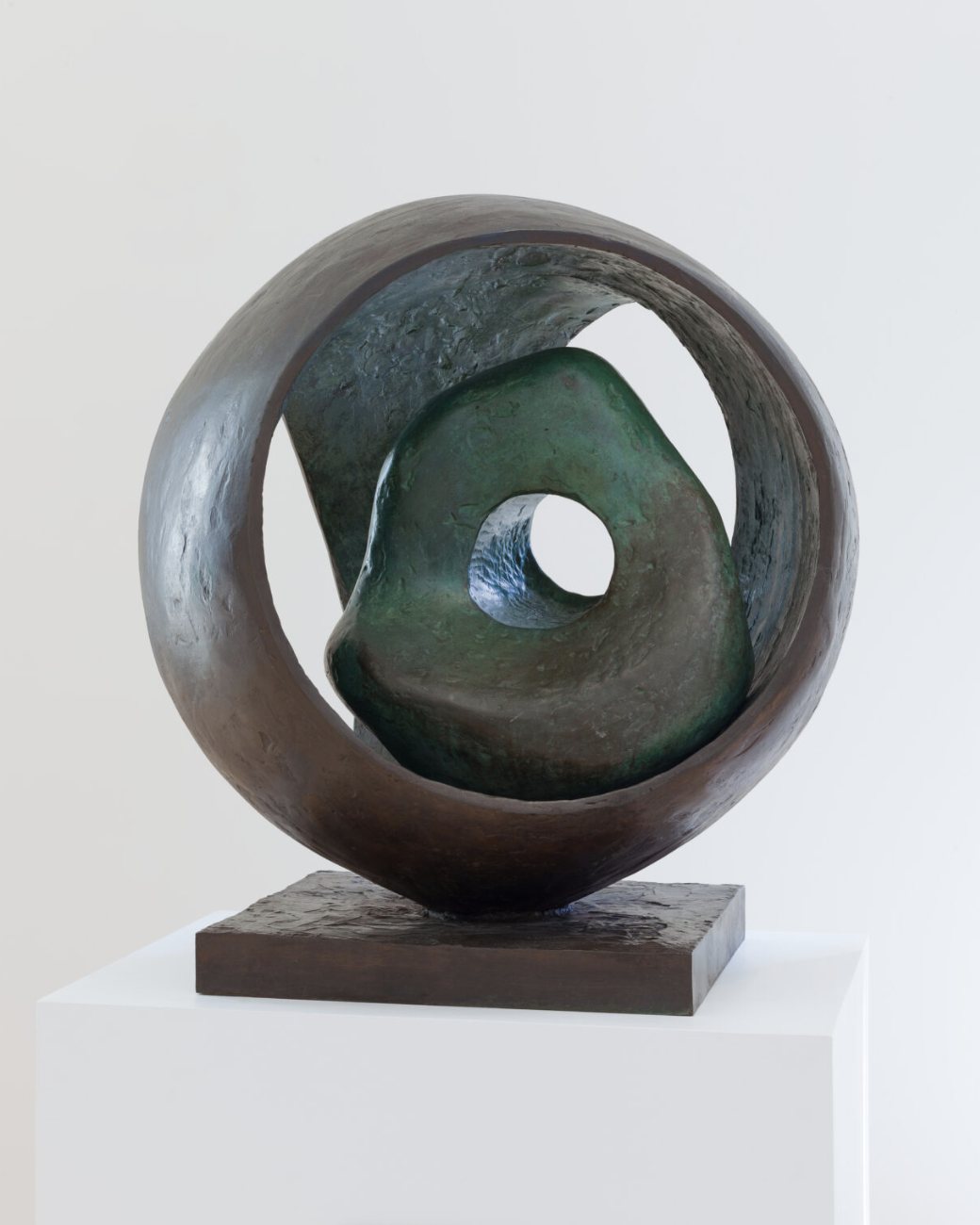
Sphere with Inner Form
HEPWORTH
‘There is an inside and outside to every form’, said Barbara Hepworth, ‘… a nut in its shell or a child in the womb’. Hepworth’s sculptures did not deal in such concrete forms - her work is organic, natural, abstract and unrecognisable - but they touch on something universal and infinite. Here, the misshaped form is cradled by the sphere, as if a child in their mother’s stomach, or the first revelation of a Russian doll. The inside of one bronze, patinaed form reveals the outside of another, creating a philosophical mobius strip of sculpture; one work must birth another, it cannot sit empty. Sphere with Inner Form blurs the lines Hepworth herself delineated between inside and outside - it becomes a dialogue between form and void, emptiness and our need to fill it.
Barbara Hepworth
BARBARA HEPWORTH, 1963. BRONZE.
‘There is an inside and outside to every form’, said Barbara Hepworth, ‘… a nut in its shell or a child in the womb’. Hepworth’s sculptures did not deal in such concrete forms - her work is organic, natural, abstract and unrecognisable - but they touch on something universal and infinite. Here, the misshaped form is cradled by the sphere, as if a child in their mother’s stomach, or the first revelation of a Russian doll. The inside of one bronze, patinaed form reveals the outside of another, creating a philosophical mobius strip of sculpture; one work must birth another, it cannot sit empty. Sphere with Inner Form blurs the lines Hepworth herself delineated between inside and outside - it becomes a dialogue between form and void, emptiness and our need to fill it.

Nude in Front of a Mantel
BALTHUS
Paintings should be seen and not read about, so believed Balthus. He rejected many conventions of the art world throughout his career and only towards the very end of his long life did he begin to talk about his work in any traditional way. Yet Balthus’ work was talked about by others, both in adoration and controversy. Depicting the physical and psychological struggles of adolescence, Balthus paintings of young people are erotically charged, yet never explicit. The narrative scenes are disquieting and uncomfortable as he casts the viewer as a voyeur, yet in a classical, figurative style they are dreamlike and technically beautiful works. A loner and outsider, Balthus’ own reluctance to discuss his work increased their mythology and infamy. When the artist stays quiet, it is us who must consider the work most deeply.
Balthus
BALTHUS, 1955. OIL ON CANVAS.
Paintings should be seen and not read about, so believed Balthus. He rejected many conventions of the art world throughout his career and only towards the very end of his long life did he begin to talk about his work in any traditional way. Yet Balthus’ work was talked about by others, both in adoration and controversy. Depicting the physical and psychological struggles of adolescence, Balthus paintings of young people are erotically charged, yet never explicit. The narrative scenes are disquieting and uncomfortable as he casts the viewer as a voyeur, yet in a classical, figurative style they are dreamlike and technically beautiful works. A loner and outsider, Balthus’ own reluctance to discuss his work increased their mythology and infamy. When the artist stays quiet, it is us who must consider the work most deeply.

Irises
VAN GOGH
The irises want to escape. Escape the porcelain jug that has become their vase and escape the confines of the small canvas they live on. Painted in the final days of Van Gogh’s stay at the Saint-Rèmy asylum, it was the last of four paintings of irises Van Gogh created in his life. Two were painted during his time in the asylum and two in the year immediately before. The differences between these works are staggering. The former pair depict irises in the wild, the natural background energetic and free as the flowers rise from the earth in freedom. The latter pair are confined, placed on tables against flat backgrounds, longing to be wild but starting to wilt. Van Gogh was an iris, a wild-flower, who found rare beauty in nature, and saw the beauty of wilderness in his confinement.
Vincent Van Gogh
VINCENT VAN GOGH, 1890. OIL ON CANVAS.
The irises want to escape. Escape the porcelain jug that has become their vase and escape the confines of the small canvas they live on. Painted in the final days of Van Gogh’s stay at the Saint-Rèmy asylum, it was the last of four paintings of irises Van Gogh created in his life. Two were painted during his time in the asylum and two in the year immediately before. The differences between these works are staggering. The earlier pair depict irises in the wild, the natural background energetic and free as the flowers rise from the earth in freedom. The latter pair are confined, placed on tables against flat backgrounds, longing to be wild but starting to wilt. Van Gogh was an iris, a wild-flower, who found rare beauty in nature, and saw the beauty of wilderness in his confinement.

Summer Mountains
DING
In traditional Chinese culture, the proper appreciation of an artwork is expressed with the phrase du hua, or "to read a painting." There is a literal interpretation of this; from right to left, these artworks become visual, narrative poems, with unfolding detail telling aesthetic and plotted stories. In Qu Ding’s Summer Mountains, we can see figures, dwarfed by the scale and majesty of their landscape, moving across the work on a pilgrimage to a mountainous retreat. These figures are not obvious at a first look, they only appear when we practice the art of reading the works, exercising a skill of deep looking. And in this, the more metaphorical interpretation of du hug becomes clear; to truly read a painting is not just to see the details deeply but to see past them, through the outer appearance of the subject and into its inner essence.
Qu Ding
QU DING, c.1050. INK AND COLOR ON SILK.
In traditional Chinese culture, the proper appreciation of an artwork is expressed with the phrase du hua, or "to read a painting." There is a literal interpretation of this; from right to left, these artworks become visual, narrative poems, with unfolding detail telling aesthetic and plotted stories. In Qu Ding’s Summer Mountains, we can see figures, dwarfed by the scale and majesty of their landscape, moving across the work on a pilgrimage to a mountainous retreat. These figures are not obvious at a first look, they only appear when we practice the art of reading the works, exercising a skill of deep looking. And in this, the more metaphorical interpretation of du hug becomes clear; to truly read a painting is not just to see the details deeply but to see past them, through the outer appearance of the subject and into its inner essence.

The Death of Socrates
DAVID
Socrates chose death over renouncing his beliefs. More than that, he used his imminent demise to teach his followers — he did not shy away or cower, he faced death calmly and it became his final lesson. In 18th Century France, at the height of the Enlightenment, he was a heroic figure for this steadfast commitment to truth and learning. A commitment never more clear then as he faces his death sentence by poison hemlock with dignity, rationality and self-control. Commissioned by a wealthy French scholar, David worked for more than 5 years on the piece, consulting hellenistic and classical historians, studying ancient Roman funerary scenes and reading obsessively to create a work that served as both an allegory for the present and an accurate depiction of the past. While Socrates embodied Enlightenment thought, only 2 years later the French Revolution began and the painting took on another meaning. To proudly die for your beliefs, to strive for truth, righteousness and the betterment of man and accept whatever fate may come from doing so — The Death of Socrates was shown publicly 4 years after its debut and became a symbol of the revolution just as it had become one of the Enlightenment before. David shows that resisting authority is a beautiful, noble thing.
Jacques Louis David
JACQUES LOUIS DAVID, 1787. OIL ON CANVAS.
Socrates chose death over renouncing his beliefs. He did not shy away or cower, he faced death calmly and it became his final lesson. In 18th Century France, at the height of the Enlightenment, he was a heroic figure for this steadfast commitment to truth and learning. A commitment never more clear then as he accepts his death sentence by poison hemlock with dignity, rationality and self-control. Commissioned by a wealthy French scholar, David worked for more than 5 years on the piece, consulting hellenistic and classical historians, studying ancient Roman funerary scenes and reading obsessively to create a work that served as both an allegory for the present and an accurate depiction of the past. While Socrates embodied Enlightenment thought, only 2 years later the French Revolution began and the painting took on another meaning. To proudly die for your beliefs, to strive for truth, righteousness and the betterment of man and accept whatever fate may come from doing so — The Death of Socrates was shown publicly 4 years after its debut and became a symbol of the revolution just as it had become one of the Enlightenment before. David shows that resisting authority is a beautiful, noble thing.

Self-portrait
RENOIR
Renoir could hardly hold a paintbrush in 1910. Rheumatoid arthritis had rendered his body feeble and the exacting brushstrokes of his youth impossible. Retreating to the French countryside he refused to give up. Instead, in his final years, he developed an entirely new artistic style fitting to the requirements of his ailing body. In his last self portraits, the canvas became a mirror to the soul of the artist, a celebration of the past and a defiant statement of life in the face of increasingly clear mortality. Renoir represented the end of an artistic journey of portraiture that started with Reubens nearly 400 years earlier. He was the last of his kind, a painter steeped in tradition, embrassing tentatively the Impressionist present he found himself in. In this self-portrait, Renoir immortalizes not just himself, but the essence of artistic endeavor—a testament to the enduring dialogue between creator and creation, between past and future, and between the mortal and the immortal.
Pierre-Auguste Renoir
PIERRE-AUGUSTE RENOIR, 1910. OIL ON CANVAS.
Renoir could hardly hold a paintbrush in 1910. Rheumatoid arthritis had rendered his body feeble and the exacting brushstrokes of his youth impossible. Retreating to the French countryside he refused to give up. Instead, in his final years, he developed an entirely new artistic style fitting to the requirements of his ailing body. In his last self portraits, the canvas became a mirror to the soul of the artist, a celebration of the past and a defiant statement of life in the face of increasingly clear mortality. Renoir represented the end of an artistic journey of portraiture that started with Reubens nearly 400 years earlier. He was the last of his kind, a painter steeped in tradition, embrassing tentatively the Impressionist present he found himself in. In this self-portrait, Renoir immortalizes not just himself, but the essence of artistic endeavor—a testament to the enduring dialogue between creator and creation, between past and future, and between the mortal and the immortal.

Sunflowers
MITCHELL
Balanced on fragile stalks, the sunflower is a pure concentration of mass and color that forces its way upwards to bloom in splendour, only to droop and wilt so visibly as to almost express the sadness of its mortality. This oddly human quality was exactly what Mitchell saw in the flowers, treating them ‘like people’ and returning to them over 40 years. The title of her works were decided after they were painted, drawing on the feelings and states she was in during their production. So, the Sunflower series are made in momnts of pride and fradility, their frenetic confident brushstrokes a mask for the delicateness of spirit. “If I see a sunflower drooping, I can droop with it”, she explained, “and I draw it, and feel it until its death”.
Joan Mitchell
JOAN MITCHELL, 1991. OIL ON CANVAS
Balanced on fragile stalks, the sunflower is a pure concentration of mass and colour that forces its way upwards to bloom in splendour, only to droop and wilt so visibly as to almost express the sadness of its mortality. This oddly human quality was exactly what Mitchell saw in the flowers, treating them ‘like people’ and returning to them over 40 years. The title of her works were decided after they were painted, drawing on the feelings and state she was in during their production. So, the Sunflower series are made in moments of pride and fragility, their frenetic, confident brushstrokes a mask for the delicateness of spirit. ‘'If I see a sunflower drooping, I can droop with it,' she explained, 'and I draw it, and feel it until its death.'

Lamentation (The Mourning of Christ)
GIOTTO
Across the gulf of two eras, Giotto built a bridge. Out of the Byzantine tradition of flat, sharp and highly decorated art, he launched a revolution from a single building, armed with wet plaster, paint and a brush. That building was the Scrovegni Chapel in Padua, and over two years Giotto painted a biblical narrative in immense frescoes that would inform the future of painting. Widely considered the father of the Renaissance, it is his work in Padua that warrants the claim. Here, death, mourning and resurrection as played out in a single scene. A Byzantine influence is clear: the gold halos that adorn the figures, moments of angularity in the faces and the decorative borders that surrounds it. Yet compositionally, Giotto was doing something radically new. The overlapping figures creating a sense of depth, the rising path that balances the work in two, the open display of emotion – all of these were to become trademarks of Renaissance painting but in 1305 it was miraculous. Giotto literally added a new dimension to painting, transforming flat planes into something that could represent the three-dimensional world. But he also added the dimension of emotion, and paintings became vehicles for expression and catharsis under his legacy.
Giotto
GIOTTO, c1305. FRESCO.
Across the gulf of two eras, Giotto built a bridge. Out of the Byzantine tradition of flat, sharp and highly decorated art, he launched a revolution from a single building, armed with wet plaster, paint and a brush. That building was the Scrovegni Chapel in Padua, and over two years Giotto painted a biblical narrative in immense frescoes that would inform the future of painting. Widely considered the father of the Renaissance, it is his work in Padua that warrants the claim. Here, death, mourning and resurrection as played out in a single scene. A Byzantine influence is clear: the gold halos that adorn the figures, moments of angularity in the faces and the decorative borders that surrounds it. Yet compositionally, Giotto was doing something radically new. The overlapping figures creating a sense of depth, the rising path that balances the work in two, the open display of emotion – all of these were to become trademarks of Renaissance painting but in 1305 it was miraculous. Giotto literally added a new dimension to painting, transforming flat planes into something that could represent the three-dimensional world. But he also added the dimension of emotion, and paintings became vehicles for expression and catharsis under his legacy.

Blue White
KELLY
“To hell with pictures”, said Ellsworth Kelly, for he does not paint pictures in any traditional sense of the word. Instead, Kelly’s works are imposing studies of tension, geometry and colour, so striking in their scale and vibrancy that the flat plane seems to metamorphosize into three dimensions. Kelly came back to the composition of ‘Blue White’ many times after its creation, the moment of contact between two enormous, abstracted forms became a recurring motif. Yet, on repeated viewing, the planes shift and the blue forms become the background to hard edged white shapes trying to cut their way through. Kelly did not want meaning ascribed to his work, he simply wanted them to be absorbed and, through this absorption, have the viewer question their perception.
Ellsworth Kelly
ELLSWORTH KELLY, 1962. OIL ON CANVAS.
“To hell with pictures”, said Ellsworth Kelly, for he does not paint pictures in any traditional sense of the word. Instead, Kelly’s works are imposing studies of tension, geometry and colour, so striking in their scale and vibrancy that the flat plane seems to metamorphosize into three dimensions. Kelly came back to the composition of ‘Blue White’ many times after its creation, the moment of contact between two enormous, abstracted forms became a recurring motif. Yet, on repeated viewing, the planes shift and the blue forms become the background to hard edged white shapes trying to cut their way through. Kelly did not want meaning ascribed to his work, he simply wanted them to be absorbed and, through this absorption, have the viewer question their perception.

Still Life with Apples
CÉZANNE
Cézanne wanted to conquer Paris with an apple. Using the simplest of objects, he created a new vernacular of painting. If the work looks beautiful but not revolutionary today, that is because Cézanne succeeded in his mission. In fact, in this simple depiction of seven apples, so many of Cézanne’s groundbreaking ideas and techniques are on show. Multiple perspectives, geometric reduction, visible, almost emphasised, brushstrokes and a modulation of colour. Using an apple, Cézanne broke every rule available. Using an apple, Cézanne did in fact conquer Paris. “He is the father of us all”, said Picasso and Matisse, and in that sense he became the father of modernity.
Paul Cézanne
PAUL CEZANNE, c.1878. OIL ON CANVAS.
Cézanne wanted to conquer Paris with an apple. Using the simplest of objects, he created a new vernacular of painting. If the work looks beautiful but not revolutionary today, that is because Cézanne succeeded in his mission. In fact, in this simple depiction of seven apples, so many of Cézanne’s groundbreaking ideas and techniques are on show. Multiple perspectives, geometric reduction, visible, almost emphasised, brushstrokes and a modulation of colour. Using an apple, Cézanne broke every rule available. Using an apple, Cézanne did in fact conquer Paris. “He is the father of us all”, said Picasso and Matisse, and in that sense he became the father of modernity.

Impression, Sunrise
MONET
While not the originator of the movement, Matisse’s poetic work of light and atmosphere gave the Impressionist’s their name. Painted in the wake of France’s emergent industrialization, Monet’s painting was a statement of individuality. When reproduction has become easy, and exact copies are the domain of machines, expression must come in the form of spontaneity and feeling. The work is not unfinished, but instead full of potential for what could be as modernity starts to infringe on the present. Thus, the hazy, rich colours, relaxed, free flowing brush strokes, and luminous palette that depict the port of Monet’s native town make no attempt at representing the real, but instead serve as a vision of utopia.
CLAUDE MONET
CLAUDE MONET, 1872. OIL ON CANVAS.
While not the originator of the movement, Matisse’s poetic work of light and atmosphere gave the Impressionist’s their name. Painted in the wake of France’s emergent industrialization, Monet’s painting was a statement of individuality. When reproduction has become easy, and exact copies are the domain of machines, expression must come in the form of spontaneity and feeling. The work is not unfinished, despite suggestion from contemporary critics, but instead full of potential for what could be as modernity starts to infringe on the present. Thus, the hazy, rich colours, relaxed, free flowing brush strokes, and luminous palette that depict the port of Monet’s native town make no attempt at representing the real, but instead serve as a vision of utopia.

The Daughters of Edward Darley Boit
SARGENT
Not as much a portrait of girls as a portrait of childhood, Sargent’s most psychologically compelling work moves between beautiful and unnerving with each view. The four sisters are placed in their Parisian front room, ordered by age, with the youngest at the front and the oldest retreating into the shadows, a dark passageway behind her. The girls are wooden in their poses, so much so that the work has been called a still life, while the scenery, particularly the large Japanese vases, seem alive and dynamic. The work is temporal, time unfolds away from us as the children grow up and are moved away from the clarity of innocence into the dark unknowing of adolescence.
JOHN SINGER SARGENT
JOHN SINGER SARGENT, 1882. OIL ON CANVAS.
Not as much a portrait of girls as a portrait of childhood, Sargent’s most psychologically compelling work moves between beautiful and unnerving with each view. The four sisters are placed in their Parisian front room, ordered by age, with the youngest at the front and the oldest retreating into the shadows, a dark passageway behind her. The girls are wooden in their poses, so much so that the work has been called a still life, while the scenery, particularly the large Japanese vases, seem alive and dynamic. The work is temporal, time unfolds away from us as the children grow up and are moved away from the clarity of innocence into the dark unknowing of adolescence.
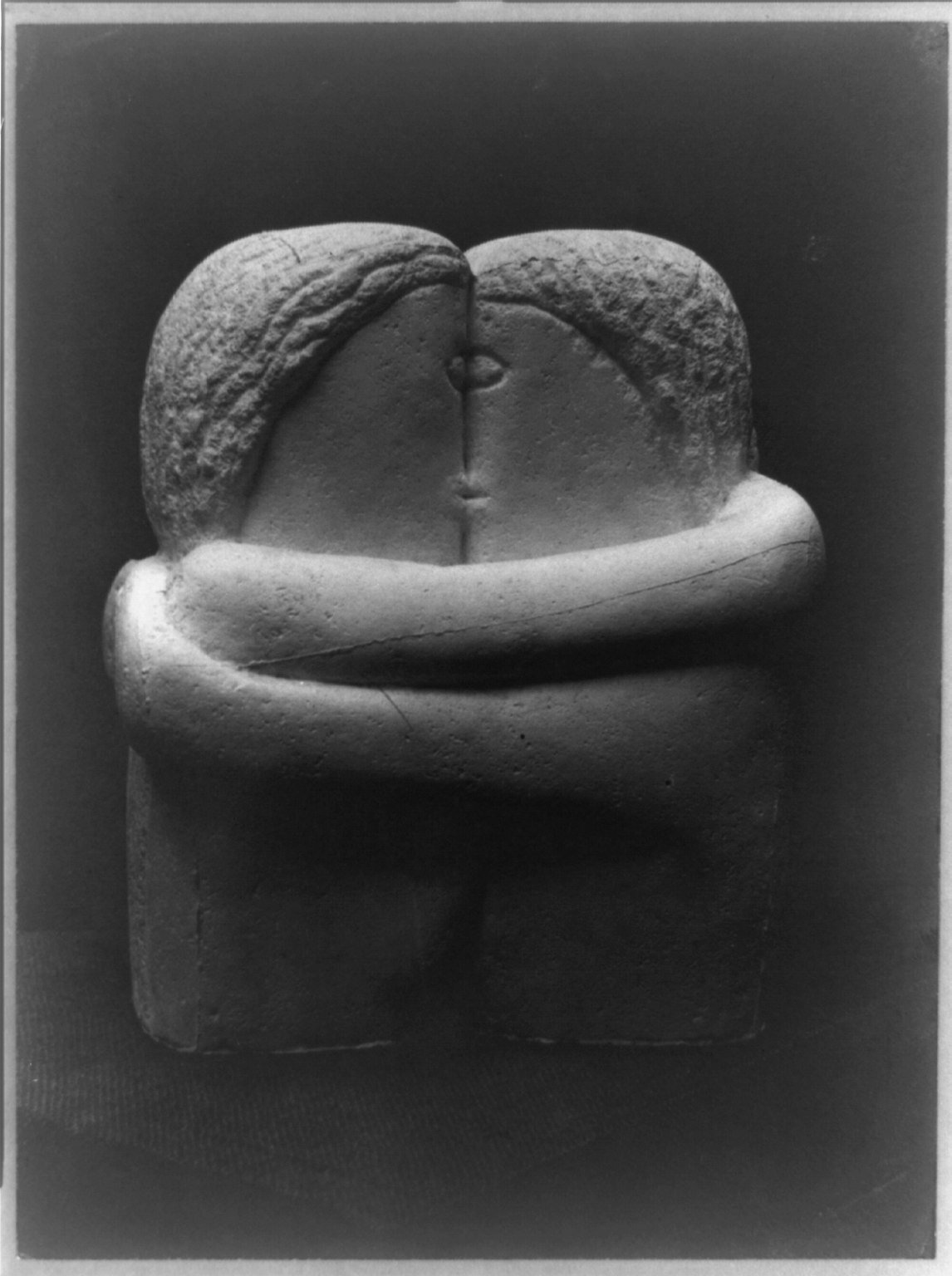
The Kiss
BRANCUSI
Two lovers are dissolved into a pure, single, abstract form in the first sculpture of modernism. Brancusi’s choice of a kiss to make this radical, revolutionary action was no mistake. In a fell swoop he was situating himself in pantheon of art history and making all the painted and sculpture depictions of romance that came before him seem old fashioned. Throughout the rest of his life he would come back again and again to this sculpture, creating new versions that were simpler, more formalistic than the ones before. Yet here is the first, a proto-cubist rendering that reduces the most natural of acts into art that approaches geometry. Inspired by African, Assyrian and Egyptian art, ‘The Kiss’ created a new language of Western Sculpture by subverting one of its most sustained motifs.
CONSTANTIN BRANCUSI
CONSTANTIN BRANCUSI, 1908. PLASTER.
Two lovers are dissolved into a pure, single, abstract form in the first sculpture of modernism. Brancusi’s choice of a kiss to make this radical, revolutionary action was no mistake. In a fell swoop he was situating himself in pantheon of art history and making all the painted and sculpture depictions of romance that came before him seem old fashioned. Throughout the rest of his life he would come back again and again to this sculpture, creating new versions that were simpler, more formalistic than the ones before. Yet here is the first, a proto-cubist rendering that reduces the most natural of acts into art that approaches geometry. Inspired by African, Assyrian and Egyptian art, ‘The Kiss’ created a new language of Western Sculpture by subverting one of its most sustained motifs.

The Canale Della Guidecca, Venice, towards Sunset, with Boats Moored off the Dogana and Santa Maria della Salute
TURNER
For the specificity of its title, Turner’s work of ‘Canale Della Guidecca’ is full of inaccuracies, half-truths and imagination. Most of the buildings pictured are non-existent, and those that are have been moved from their locations for the sake of balance and beauty. Yet John Ruskin, the greatest art critic of his time, said ‘without one single accurate detail, the picture is the likest thing to what it is meant for – the looking out of the Guidecca landwards, at sunset – of all that I have ever seen’. Turner’s genius was that he was able to capture the essence of a place or an event, and he understood that essence was more about the feeling it provoked than anything else. You can stand at the Guidecca today, look out towards sunset, feel the calm, gentle, soft majesty wash over you and know that Turner’s painting might not have been accurate, but it was truthful.
J.M.W. TURNER
J.M.W. TURNER, 1840. GRAPHITE AND WATERCOLOR ON PAPER.
For the specificity of its title, Turner’s work of ‘Canale Della Guidecca’ is full of inaccuracies, half-truths and imagination. Most of the buildings pictured are non-existent, and those that are have been moved from their locations for the sake of balance and beauty. Yet John Ruskin, the greatest art critic of his time, said ‘without one single accurate detail, the picture is the likest thing to what it is meant for – the looking out of the Guidecca landwards, at sunset – of all that I have ever seen’. Turner’s genius was that he was able to capture the essence of a place or an event, and he understood that essence was more about the feeling it provoked than anything else. You can stand at the Guidecca today, look out towards sunset, feel the calm, gentle, soft majesty wash over you and know that Turner’s painting might not have been accurate, but it was truthful.

Annunciation
CARAVAGGIO
It is fitting, perhaps, that all that remains of Caravaggio’s hand in this painting is the Angel Gabriel. Subject to centuries of restoration, the painting has become almost a Frankenstein’s monster of retouching, preservation and repair. Yet Gabriel, floating above the Virgin Mary in a billow of clouds, has needed little of this work. Instead, the hand of the master is evident and all the more potent for it; Gabriel seems to emerge from the paintings plane in luminosity, escaping the confines of the canvas and floating between our world and the one Caravaggio depicts. Known for using everyday people as life models for religious figures and bringing his contemporary experience into his religious paintings, Caravaggio does not deify the Virgin Mary. Instead he presents her as an almost tragic figure, prepared for the burden required but crushed by the expectation. Caravaggio brought images of the Bible down to his modern world and with his brushstrokes elevated them to something divine.
CARAVAGGIO
CARAVAGGIO, c.1608. OIL PAINT FROM WOOD TRANSFERRED TO CANVAS
It is fitting, perhaps, that all that remains of Caravaggio’s hand in this painting is the Angel Gabriel. Subject to centuries of restoration, the painting has become almost a Frankenstein’s monster of retouching, preservation and repair. Yet Gabriel, floating above the Virgin Mary in a billow of clouds, has needed little of this work. Instead, the hand of the master is evident and all the more potent for it; Gabriel seems to emerge from the paintings plane in luminosity, escaping the confines of the canvas and floating between our world and the one Caravaggio depicts. Known for using everyday people as life models for religious figures and bringing his contemporary experience into his religious paintings, Caravaggio does not deify the Virgin Mary. Instead he presents her as an almost tragic figure, prepared for the burden required but crushed by the expectation. Caravaggio brought images of the Bible down to his modern world and with his brushstrokes elevated them to something divine.

Oberon, Titiana and Puck with Fairies Dancing
BLAKE
‘A Midsummer Night’s Dream’ and William Blake are natural bedfellows. Shakespeare’s most wild, inventive and dreamlike play suited a man who saw imagination as “human existence itself”, and Blakes drawing of the final scene embodies nature and emotion over logic and reasoning. The four fairies dance in a circle, jubilant and joyful with their linked lands creating infinity. Oberon and Titiana stand aside, almost fearful of the scene ahead of them for these fairies are nature themselves, feminine, untameable and sexually free. Blake interpreted Shakespeare’s work to align with his worldview, and free love was an essential part of that. A unique mind, he saw visions of a potential world where humans would return to natural, primal states that would create an honest society.
WILLIAM BLAKE
WILLIAM BLAKE, c.1786. WATERCOLOR AND GRAPHITE ON PAPER
‘A Midsummer Night’s Dream’ and William Blake are natural bedfellows. Shakespeare’s most wild, inventive and dreamlike play suited a man who saw imagination as “human existence itself”, and Blakes drawing of the final scene embodies nature and emotion over logic and reasoning. The four fairies dance in a circle, jubilant and joyful with their linked lands creating infinity. Oberon and Titiana stand aside, almost fearful of the scene ahead of them for these fairies are nature themselves, feminine, untameable and sexually free. Blake interpreted Shakespeare’s work to align with his worldview, and free love was an essential part of that. A unique mind, he saw visions of a potential world where humans would return to natural, primal states that would create an honest society.